Tag: fia

  • Niki Lauda says F1 does not need Flavio Briatore

    Niki Lauda says F1 does not need Flavio Briatore

    Formula One champion and F1 legend, Niki Lauda, sees no reason why Flavio Briatore should be brought in to increase the popularity of the sport and believes it is already making leaps forward with recent changes.

    Following lower numbers of spectators at some circuits and criticism of the sport across this season, Formula One has set up a new working group to work on the popularity of the sport. Flavio Briatore, who was banned from Formula One following the 2008 Crashgate saga, has been named as a possible candidate to head the group. Bernie Ecclestone has however since played down the chances of Briatore getting involved.

    Asked whether he thought Flavio Briatore was the man for the job, Lauda said, “No. Why do we need Flavio? I have heard this for the first time, but Bernie is in charge, and he should stay in charge.”

    Lauda says he trusts in Ecclestone to improve F1 and commented that a recent push to allow drivers to race without excessive penalties is already making the sport better.

    “We should think, together with Bernie because he is the master, what we can improve,” he said. “I have to say the change that we had with Charlie [Whiting, race director] and the stewards to not get involved as much as before was a great move. [At Hockenheim] even the Sauber in the middle of the road, it was exciting. If there was a safety car then everybody would get bored.

    “So Hockenheim was an improvement with ‘under investigation’, and in Hungary we have seen no problems at all with ‘under investigation’ because today there were a lot of things that could have been under investigation. It is going in the right direction now.”


  • F1 2014: German GP Preview – German or Englishman?

    F1 2014: German GP Preview – German or Englishman?

    The battle for supremacy between Lewis Hamilton and Nico Rosberg has been so enthralling that somehow the Formula 1 season is already on the cusp of its tenth round.

    Hockenheim returns for the first time since 2012 to not only the new hybrid Formula but also to a new pecking order. In 2012, the Hockenheimring had its first introduction to both DRS and Pirelli tyres. Red Bull Racing and Lotus arrived at that grand prix as the likely podium contenders. Ferrari’s Fernando Alonso won the race from Jenson Button and Kimi Raikkonen.

    The circuit’s 4.574 km layout is a blend of long straights and final sector medium-speed corners. The hairpin in the first sector of the lap is a key area for overtaking which places commands good braking performance. Despite a relatively short lap driver and engineers need to strike a balance between top-speed and downforce. “You’d like to have the downforce for the stadium and to keep it steady on the brakes but equally you don’t want too much drag on the straights,” says Red Bull driver Daniel Ricciardo.

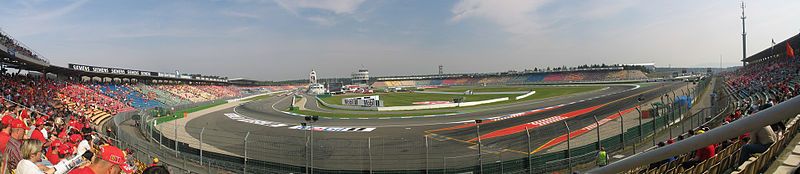
    107_0_1342623070The final sector is not favourable for overtaking but the stadium section is a vital element to what makes the German GP unique. The decidedly muted sound of Formula 1 cars should make it possible to hear the cheering of the crowds, should a German driver be leading the race.

    The driver’s will need to vigilant at the start of the race as the first corner tightens dramatically before opening up onto the straight. Although there is an expanse of run-off area a touching of wheels or front-wing is a high probability. Teams such as Ferrari will need to devote more time towards their qualifying pace in order to avoid starting mid-grid and the possibility of a first-lap incident.

    Before then, the first one and a half hours of free practice will be the centre of attention as Williams’ development driver Susie Wolff gets another opportunity to participate in an official session.  However, don’t expect any flashy laptimes from the Scot. The main aim is to run through Williams’ program which is geared towards set-up of the car rather than outright pace.

    Sebastian Vettel’s Red Bull didn’t have the pace to challenge for victory around the Hockenheimring two years ago and it’s not much isaustria-vettel-redbull different in 2014. The reigning champion is unlikely to match the Mercedes but the Red Bull may have a better outing this weekend thanks to the aerodynamic demands of the final sector.

    Out of the car the verbal digs continue between the two Mercedes drivers. Ahead of the German GP Lewis Hamilton noted that seeing as Nico Rosberg was raised in Monaco he could not consider himself German.  Rosberg responded to his teammate by describing himself as “100% German.” It is clear that Hamilton is continuing his methodical psychological battle against Nico Rosberg as much out of the car as on the track. Some may think it’s nonsense and that the Brit should get on with driving. However, the make-up of Lewis Hamilton the racing driver dictates he exploits every possible advantage, in whichever form it is presented.

    It was crucial for Hamilton to strike back at Silverstone and it will be an important long-term victory if he does the same this weekend. The biggest incentive for Lewis Hamilton to bring that same intensity to the track is the chance to take over the lead of the driver’s championship.

  • FRIC Suspension Deemed Illegal by FIA

    FRIC Suspension Deemed Illegal by FIA

    The FRIC (Front and Rear Interconnected) suspension systems used by some F1 teams was deemed illegal by the FIA and could be banned as soon as the German Grand Prix in less than two weeks time.

    The FRIC suspension systems work with a series of valves, pipes and cylinders that controls the pitch of the car during acceleration and braking and also through cornering. Mercedes are believed to be running a very complicated version of the FRIC suspension at the moment and could be impacted the most if the ban were to be enforced before the German Grand Prix.

    According to the FIA the suspension systems are in breach of article 3.15 of the technical regulations which outlaws any moveable aerodynamic device.

    Article 3.15 is quoted below for reference:

    Any specific part of the car influencing its aerodynamic performance :
    a) Must comply with the rules relating to bodywork.
    b) Must be rigidly secured to the entirely sprung part of the car (rigidly secured means not having any degree of freedom).
    c) Must remain immobile in relation to the sprung part of the car.

    The FIA, is however, considering to impose the ban from the start of the 2015 season due to the fact that the 2014 cars were all built around these suspension systems and there is not enough time for testing between now and the German Grand Prix. This can only happen if the teams unanimously agree to it. It is a tough ask for teams to all agree on the 2015 ban, especially if some teams are not using the same suspension system or feel that their system is not working as well as the next teams.

    If the majority of the teams do not agree to postponing the ban, the FIA’s Charlie Whiting has made it clear that teams will be reported to the stewards for not complying with the regulations.


    An explanation about FRIC suspension is available here

  • FIA World Motorsport Council Agree on 2015 Changes

    FIA World Motorsport Council Agree on 2015 Changes

    The FIA World Motorsport Council (WMSC) concluded their their second FIA Sports Conference in Munich, Germany on Thursday 26 June 2014 and agreed on the changes for the 2015 Formula 1 season.

    One of the big changes for 2015 will be standing starts after a safety car period.

    The full detail of changes for the 2015 Formula 1 Season are listed below.

    Power units

    • The number of engines permitted by each driver in a season will be four. However, if there are more than 20 races in a season, the number will increase to five.
    • The penalty for a complete change of Power Unit will be starting from the back of the grid, not the pit lane.

    Aerodynamic testing

    •  The number of wind tunnel runs will be reduced from 80 hours per week to 65 hours per week.
    • Wind-on hours are to be reduced from 30 hours per week to 25 hours.
    • Computational Fluid Dynamics (CFD) usage is to be reduced from 30 Teraflops to 25 Teraflops.
    • Two periods of tunnel occupancy will be allowed in one day (rather than only one).
    • Teams will only be able to nominate one wind tunnel in one year.

    Testing

    • There will be three pre-season tests of four days each in Europe in 2015 (currently teams are able to test outside Europe). This will be reduced to two tests of four days in 2016.
    • There will be two in-season tests of two days each in Europe (instead of the current four). Two of these four days must be reserved for young drivers.

    Car specification at an Event

    • The current restrictions to the parc fermé will now apply from the start of P3 instead of the start of qualifying.

    Wheels and tyres

    • The ban on tyre blankets will be rescinded for 2015. This will be re-discussed if and when the wheel and tyre diameter increases in the future.

    Personnel Curfew

    • The Friday night curfew will be extended from six to seven hours in 2015 and will increase to eight hours in 2016.

    Safety Car restarts

    • Safety Car restarts will now be a standing start from the grid. Standing starts will not be carried out if the Safety Car is used within two laps of the start (or restart) of a race or if there are less than five laps of the race remaining.


    Changes to 2015 Technical Regulations

    • A number of changes have been made, including:
    • A number of new regulations for the noses to ensure improved safety and to provide more aesthetically pleasing structures.
    • A number of new regulations concerning skid blocks to ensure that they are made from a lighter material (titanium) and are better contained.
    • New regulations to ensure that the brake discs rotate at the same speed as the wheels.
    • A two-stage wheel fastener retaining system is now compulsory.
  • Friday Practice To Be Revamped

    Friday Practice To Be Revamped

    The current format of the Formula 1 weekend is set to be overhauled for the 2015 season.

    The proposed changes will mainly affect Friday running. An agreement has been reached amongst the team to scrap the two 90 minute practice sessions in favour of a single 90 minute session to be run later on a Friday afternoon. The biggest motivating factor behind the proposed change in believed to be a cost-cutting measure.

    Several other changes have also been approved by the team among which is call to ban in-season testing, and stricter rules for fitting last minute upgrades to cars.

    Despite the fact that the teams have signed off on the Friday practice session revamp the proposal still has to be given the green light by the Formula 1 Commission and the FIA World Motorsport Council. The proposal will be considered later this month.


  • 2014 Formula 1 UBS Chinese Grand Prix: Friday Press Conference

    TEAM REPRESENTATIVES

    Pat FRY (Ferrari)

    Charlie WHITING (FIA)

    Yasuhisa ARAI (Honda)

    Andy COWELL (Mercedes AMG HPP)

    Rob WHITE (Renault Sport F1)


    PRESS CONFERENCE

    If we can start with you Charlie? The new power units have excited a lot of debate since the beginning of the year. Will you once again briefly take us through the philosophy behind this technology and why F1 believes it was the right time to introduce it?

    Charlie WHITING: I think it was fairly clear, we’re going back a little while now, that Formula One, being the foremost single seat category, should be at the forefront of technology. I think bit was also clear at the time that the motor manufacturers were also looking towards conservation. So we felt we had to go that way. I think to ignore that would have been rather silly. I think we would have possibly lost some manufacturers and certainly deterred others from coming in.

    I guess efficiency plays a part in that as well?

    CW: Of course that was the major goal. We started four years ago with the engine manufacturers. We had quite big meeting with lots of them assembled in Paris. It was the 27th of April, in fact, in 2010. We assembled them all together and the initial goal was to have a 50 per cent increase in efficiency but over a period of time that became diluted somewhat because it appeared that was rather ambitious for the start of this new engine era. So we ended up with what we have now and that is an engine that everyone can see is about 35 per cent more efficient than the previous engines.

    So, Andy Cowell, does that represent a small step in the right direction or a giant leap?

    Andy COWELL: It represents a giant leap – going from internal combustion engines, naturally aspirated at about 30 per cent thermal efficiency up to engines where we’re all targeting 40 per cent thermal efficiency is a huge step, a huge introduction of new technology both on the internal combustion engine for efficiency and also on the two energy recovery systems that we’ve got on the power unit.

    What do Mercedes expect to get from this project in terms of technology that can be eventually transferred to the road? Is that a long way in the future or is it already happening?

    AC: It’s already happening. The regulations were specifically written to take some of the ideas are already in the road car world, so downsizing, downspeeding and turbocharging but adding some new, interesting technologies in there such as the electric turbocharger as a specific example and those sort of projects are already being worked on.

    Can I ask the same question of Rob White. What does Renault expect to get from this project in terms of road cars.

    Rob WHITE: It’s a big leap, as Andy says. I share the remarks that transfers are already happening. The transfers are not only specific technologies, the e-turbo being one of them, but also the fundamental alignment of the mission we have. Our challenge now is to race, to go as fast as we can with the given fuel allocation, which is a very, very similar mission to our road car colleagues who have to use the smallest amount of fuel to get a given mission done and that’s extremely close.

    There’s been quite a lot of talk about how the power units are contributing to racing and we’ve heard some unusual suggestions for things might be changed. Firstly, do you think there are problems with the racing this year? Secondly, what do you think of ideas such as shortening races, raising fuel limits etc. Do those suggestions miss the point?

    RW: The main problem I see so far is that Andy has won rather more than I’d like and we have win less than I’d like. The specific suggestions are just shifting the goalposts rather than doing anything fundamental and I think as Charlie indicated the basic parameters that we’re now racing with were decided well upstream in sufficient time that we knew what to do with them. I honestly feel that the numbers were well judged and I think the 100kg/h fuel limit and the 100kg for the race, as well as having the benefit of being nice round numbers, also play out more or less as predicted in terms of the level of performance and the level of fuel saving needed to get to the end of the race. I think we’ve seen in the early races that there hasn’t been an excessive amount of fuel saving that would perhaps have damaged the show. I think we’ve seen more recently, particularly in Bahrain… We all enjoyed the race there, it was the first one I saw from the comfort of my living room and it was certainly an exciting one to watch.

    Now we’ve heard from two of the manufacturers currently involved in F1 but let’s get the thoughts of a manufacturer that will next year return to the sport after six seasons away? Thank you very much Mr Arai for coming to our press conference. What is it in the new regulations that has encouraged Honda to come back into Formula One at this time?

    Yasuhisa ARAI: Thank you very much. I am delighted to be here and to be given this opportunity by the FIA to speak at this conference. As you mentioned we will return in the year 2015 for the Formula One. One of the major reasons for our decision was the new regulation introduced this year and that the various environment… I mean green technologies in the new Formula One power unit, as well as the total energy management are both very challenging and significant. The new regulation encourages each power unit supplier to pursue the ultimate combustions efficiency and high pressure direct injections, such as many, many new technology. Thus the challenge is to convert each unit of gasoline into energy and this is expected to be reflected on the huge production mode. That’s the reason why.

    Q: You’re setting up a new base at Milton Keynes in the United Kingdom. What will that facility be responsible for in the coming years?

    YA: That, we will open June this year. Now still under construction but that factory is to do the engine maintenance for the races and rebuilding the Formula One engine and also to go to the race-track for the trackside service. That’s Milton Keynes.

    Pat Fry_Press ConferenceQ: Pat, as someone more responsible for the chassis side of things at Ferrari, let’s talk about how you integrate these new power units with the cars. Have you found that the chassis and engine departments have needed to work closer together this year or is the relationship pretty much the same as always?

    Pat FRY: I think with the changes to the power unit this year, there’s obviously a huge amount more technology to understand and that has definitely pulled the chassis department and the engine department closer together. That starts everywhere from the simple, basic simulations that you do before an event to tuning the car. Everything is now inter-related. So where you used to play with a diff and brake balance and whatever, you’ve now got all the various ERS levels of charging and deciding what to do with waste gates and turbos. So there’s a huge amount more interaction between the two groups.

    Q: Has the engine department given you a power unit on the minimum weight or are you having to shed weight from the car?

    PF: We’re fairly close to the weight limit. I’m sure everyone is struggling. The combination of an engine on the weight limit and just all the bits and pieces we want on a standard car, it’s quite a challenge to get down to the weight limit anyway. But yeah, we’re just on that limit.

    QUESTIONS FROM THE FLOOR

    Q: (Dieter Rencken – Racing Lines) Question to Andy and Rob and Mr Arai if you would like to contribute as well please: Andy, you were talking about 40 per cent efficiency. Now, we’ve got relatively immature technology at the moment. What sort of progress in terms of efficiency do you engine manufacturers foresee over the seven-year lifecycle of these engines?

    AC: It’s a difficult one to predict. We’re working hard to improve the efficiency of the internal combustion engine, make sure that every single drop of fuel that goes in… and that’s where working with Petronas helps tremendously to get us to the point we’re at today and to move forwards race by race with fuel developments. And then it’s just mastering the conversion efficiencies – so every single step where we’re converting the energy, just improving little by little and then with a new power unit homologated next year. I guess I’m not coming up with a prediction for exactly how much we’re going to improve year by year – but I imagine it’s going to be very similar to when we were in the naturally-aspirated era, where there were times when we thought 13,000rpm was impressive and we all ended up well over 20,000rpm. So it’ll be a similar level of development.

    Rob?

    RW: I think Andy was cautious when saying 40 per cent. I think to be competitive you need to be a bit better than 40 per cent already. I think we shouldn’t underestimate just how important that is in terms of automotive technology. I think these power units are fantastic pieces of kit in terms of the raw, thermal efficiency that is achieved. Better than any road car engine by a margin. And I think it’s also important to draw attention to the fact that the energy management challenge is also part of the real efficiency of the race car which is in addition to the thermal efficiency of the power unit. There will be rapid progress even during the course of this year. We’ve seen progress in the early races without any change to the underlying hardware. That’s something that will continue during the season. That’s something that will take another step forward over the winter – as Andy as suggested – when we homologate a new version of the power unit for 2015. This is another mirror-image of what happens in the big, wide world outside, where every iteration of our road car product brings with it a significant step forward in fuel consumption, which of course is the same thing for us: a step forward in performance for the same fuel flow or fuel limit.

    Mr Arai, would you like to comment or is it a bit too early for you to make any predictions.

    YA: There is a strange feeling because our door for 2015 is still not open yet. So I can make just a small comment. How to make the good efficiency is just a three major fields. Technology fields. One is combustion itself – combustion chamber design, another one is how to recover the energy, that’s very important for these new regulations and finally the torque management. Positive and negative torque management is very important to make a good, fast car. That’s my comment.

    Q: (Gary Anderson – Autosport) As you were saying Andy, revs, that’s always been the push, everybody wanted to get more revs, more revs, more revs. This year the regulation maximum is 15,000 but on a good day you might see twelve. Do you see that changing, and if it did change do you see that helping the noise?

    AC: You’re correct with regard to the revs that we’re running on the track. I don’t see that changing, I don’t see the need for the revs to change to change the noise of the power unit. The principal reason why the engine is quieter is the turbine wheel and the muffling effect that you get from that. That’s one of the key technologies for recycling the waste energy that would normally go down the tailpipe so it’s a key aspect of the technology that we’ve got. There are other things we can do though with the tailpipe, perhaps, to change the noise.

    Q: (Gary Anderson – Autosport) Could I just add a second part: why is it 12,000 rpm instead of 15,000rpm?

    AC: The fundamental reason is the fuel flow rate formula so you get the 100 kilograms per hour once you’re at 10,500 rpm. If you rev an engine faster, you generate more friction and friction is the enemy of an engine and the enemy of a race car because you have to reject it to the radiators and there’s then an aerodynamic deficit from doing that. None of us want to be below 10,500 rpm but none of us want to be at high revs because all you do is create heat.

    RW: There’s not much to add. The fuel flow curve, the fuel law is the thing that fixes the engine speed as Andy indicated. We hear a little bit less about the slope below 10,500 than the maximum which is 100 kilos but it is that knee point that fixes the rpm at which the engines make the best power and best efficiency and the engine speed above that is to do with the spread needed to pass the gear ratios.

    Q: (Marc Surer – Sky Germany) It’s in a similar direction, my question for the motor engineers: what can you do to increase the noise? There’s a lot of talk about it but I haven’t heard a solution yet.

    RW: First thing to say is that the noise of the current engine is a consequence of the overall layout, the architecture and so forth. I think in terms of the possible adjustments to change the noise it makes, I think we’re at the beginning of a consultative process that will kick off in about an hour’s time. Andy’s alluded to tail pipe changes – that’s something that could be a way to go. I think the scope to fundamentally and profoundly alter the noise of the engines is extremely limited by the type of technology that we have deployed and therefore I think we need to be realistic about the scope of any action that we might take but of course we’re sensitive to the subject and we’ll certainly participate in any of the studies that might lead to actions being taken.

    PF: I think the engine people in the room know the problem a lot more than I do. I think what Andy said about… you’ve got the turbo there to try and take all the energy that we can out, so it’s always going to be quieter. There’s a round of meetings starting today, in fact, that will discuss and try and work out how to improve the situation.

    Q: (Dieter Rencken – Racing Lines) Mr Arai, if we have a look at Mercedes, they’re supplying their own team and three customers. Renault are doing four customers; Ferrari are doing one plus two. Next year, you’ve got McLaren. Could you give us some insight into your plans for both 2015 and thereafter in terms of customer teams, whether your relationship with McLaren actually permits that, please?

    YA: So, for year 2015, McLaren is our only customer. I don’t think about the future, because we want to concentrate on next season.

    Q: (Dieter Rencken – Racing Lines) I understand your philosophy there but surely you must have done costing and recovery against the units and that must surely include some sort of sale or customer-type project or do you not have any plans for customers at all?

    YA: Of course we want to have good results next season and see the results from other manufacturers. Please chose our power unit for next season. If teams want to use our engine or power unit, we can deliver after year 2016 but right now there are no plans.

    Charlie WhitingQ: (Gary Anderson – FOM) Rob, it’s been fairly well documented that you obviously haven’t started the season the way you intended to. Do Renault need any concessions from other manufacturers or the FIA, to do the improvements that you need or are you happy to work within the regulations and do what you’re allowed at the moment to catch up?

    RW: I think the first thing to say is that the technical and sporting regulations are the same for all the engine suppliers. We knew what we were getting into and we’re in it now. We’re not lobbying for any regulatory change. I think that for the time being our priority is to continue the recovery actions that we’ve put in place and I expect to pursue that over the course of this season.

    Q: (Michael Schmidt – Auto, Motor und Sport) Question to Charlie: the rules allow changes to the engines if it is for reliability, cost-saving and safety. But let’s say if you do a change for reliability reasons and you make a certain component stronger, isn’t that – let’s say – automatically gaining horsepower through the back door?

    CW: I think that the system that we have now is the same as it’s been since 2006. If an engine manufacturer asks for changes for reliability, we always assess that, we always try to see if there is a possible – as you put it – back door route to get more performance but we are absolutely confident that the changes that we’ve allowed so far this season are purely for reliability and we also have the fall-back of consulting all the other engine manufacturers so if we agree to some changes for reliability and we then circulate it among the other engine manufacturers, they have the opportunity to highlight any potential back door treatment, as you put it.

  • Court upholds Ricciardo’s Australian GP disqualification

    Court upholds Ricciardo’s Australian GP disqualification

    The FIA’s International Court of Appeal has upheld the stewards’ decision to exclude Daniel Ricciardo from the Australian Grand Prix following a hearing in Paris on Monday.

    Ricciardo finished the season opening Australian GP in 2nd place but was disqualified after the stewards discovered that his RB10 had exceeded the fuel flow rate limit of 100kg/hr and despite warnings, his team chose to ignore the directives from the stewards to turn down the fuel flow rate.

    Red Bull appealed the decision claiming that they used their own fuel flow sensor after experiencing unreliability when using the FIA’s sensors. The team were confident that their appeal would be successful.

    The appeal was heard in Paris on Monday and the International Court of Appeal announced on Tuesday morning that they have upheld the decision of the stewards.

    The FIA issued a statement saying: “The Court, after having heard the parties and examined their submissions, decided to uphold the Decision N°56 of the Stewards by which they decided to exclude Infiniti Red Bull Racing’s car N°3 from the results of the 2014 Australian Grand Prix.”

    A full explanation behind the reasoning of the verdict is expected later this week.

    Red Bull have issued a statement accepting the FIA’s decision on the matter:

    “Infiniti Red Bull Racing accepts the ruling of the International Court of Appeal today.

    We are of course disappointed by the outcome and would not have appealed if we didn’t think we had a very strong case. We always believed we adhered to the technical regulations throughout the 2014 Australian Grand Prix.

    We are sorry for Daniel (Ricciardo) that he will not be awarded the 18 points from the event, which we think he deserved. We will continue to work very hard to amass as many points as possible for the team, Daniel and Sebastian throughout the season.

    “We will now move on from this and concentrate on this weekend’s Chinese Grand Prix.”


    Photo Credit: Infiniti Red Bull Racing Formula 1 Team


  • Red Bull appeal verdict to be announced on Tuesday

    Red Bull appeal verdict to be announced on Tuesday

    The General Secretary of the FIA’s International Court of Appeal has said that a verdict on Red Bull’s appeal against the disqualification of Daniel Riccardo at the Australian Grand Prix, will only be given on Tuesday.

    “We will announce the decision tomorrow morning at the latest,” said Jean-Christophe Breillat following a six-hour long hearing at the FIA’s headquarters in Paris today.

    He has also confirmed that only the verdict will be given and then a full explanation around the reasoning behind the decision will be made available “by the end of the week”.

    Red Bull argued that the technical directive (16:14) relating to fuel flow sensors is not regulatory. As such, they believe that the team cannot be punished for ignoring the FIA’s request to reduce its fuel flow, since the directives are generally regarded as advice. The team also tried to prove that the team had not exceeded the maximum fuel flow at any point during the Australian Grand Prix.

    Both Chief Engineer of Car Engineering, Paul Monaghan and Chief Technical Officer Adrian Newey were called as Red Bull witnesses and subjected to questioning. For the FIA, Head of Powertrain Fabrice Lom was called.

    Observers from McLaren, Lotus, Williams and Force India were also present at the hearing.

    Daniel RicciardoMercedes team representative Paul Harris – who previously represented the team at the Pirelli Tyregate hearing – was most vocal at today’s hearing, accusing the Red Bull team of “knowingly and repeatedly” ignoring the FIA’s instructions to turn down the fuel flow on Ricciardo’s engine.

    He desribed Red Bull’s approach as a “flagrant breach” of the FIA’s direction and called for the court to impose a suspended further sanction on top of the original exclusion due to fears that the Austrian team will repeat the alleged offence in future.

    “We are, frankly, and with great respect, concerned that Red Bull have shown such a flagrant and deliberate disregard for these rules that there is a real risk that they will do it again,” he said. “We are here to seek to ensure that does not happen. We must have a level playing field going forward for the remainder of the season.”

    “We respectively submit that the most effective way of ensuring that Red Bull do not flout further written and oral instructions from the FIA – at least for the remainder of this season – is for this court to recognise the severity of their infringement and to impose a further sanction upon them, which is to be suspended for the remainder of the season so that they are acutely alert for the remainder of the season that there is no possibility of them transgressing the boundaries again.”

    He dismissed Red Bull’s claims that the FIA’s approved sensors were unreliable and argued that their alternative system used to measured the flow was also not “100 per cent” accurate. He also backed the FIA’s official sensors saying that they are “rigorously tested and rigorously calibrated.”

  • FIA to hear Red Bull Ricciardo appeal today

    FIA to hear Red Bull Ricciardo appeal today

    Red Bull have appealed Daniel Ricciardo’s second place Australian Grand Prix disqualification and the appeal will be heard by the FIA at a hearing in Paris today.

    According to team boss, Christian Horner, Red Bull are confident that they have a “very strong case.”

    Ricciardo, who raced his way to second place at the seasoning opening home grand prix for the Aussie but was stripped of the position, and the 18 accompanying points, after his RB10 was found to have “consistently exceed” the maximum allowed fuel flow rate of 100 kgs per hour.

    Red Bull have argued that there was a problem with the sensors provided by the FIA which is why they chose to rely on their own. In essence, the team chose to ignore a technical directive from the FIA which explains what to do in the event of a fuel flow sensor ‘drifting’ or failing completely.

    According to the team, Ricciardo’s sensor did drift, and they therefore chose to use a back-up system which had not been pre-approved by the FIA. The disqualification was as a direct result of Red Bull ignoring the FIA’s advice before and during the race. The governing body insists that Red Bull were warned several times during the race.

    Horner claims that the team had every right to ignore the FIA’s advice – because it was exactly that, advice, and not legally binding rules as per the technical regulations.

    Daniel RicciardoShould the team win their appeal, they will move up to second place in the Constructors’ Championship, and Ricciardo would move up to third place in the Drivers’ Championship.

    “Those points are vital, every point is vital,” Horner said. “We believe we’ve a very strong case. As more races have progressed issues have become more evident, new evidence has come to light, new understandings have come to light. Hopefully we can present our case fairly and get the second place Daniel deserves from Melbourne.”

    Ricciardo has confirmed that he will not attend the hearing in Paris today.

  • Red Bull adamant Ricciardo fuel flow rate was within regulations, will appeal

    Red Bull adamant Ricciardo fuel flow rate was within regulations, will appeal

    Red Bull Team Principal, Christan Horner, remains adamant that the team complied fully with regulations governing the flue flow rate following Daniel Ricciardo’s exclusion from the Australian Grand Prix.

    Ricciardo, who finished the race in second place, becoming the first Australian to win a podium at the Australian Grand Prix, was excluded from the race results following a decision by the stewards after the FIA deemed his car had exceeded the 100kg/h flow limit. They have released a detailed explanation on their ruling, which you can read in full here.

    Christian-HornerTeam boss Christian Horner is confident however that Red Bull will win the appeal against the ruling saying that there was “zero variance” from the 100kg/h limit on Red Bull’s own calibrated equipment which the team relies on since they do not trust the FIA’s own sensor following previous faults with it.

    “These fuel-flow sensors that are provided by the FIA to measure fuel have proved problematic down the pitlane since their introduction in testing,” Horner said shortly after news broke of Ricciardo’s disqualification from second place.

    “There have been discrepancies and they have been unreliable – indeed some cars may well have run without them in the race itself or failed in the race itself. We had a fuel-flow sensor that was fitted to the car that we believed had an error. Based on our calculation on the fuel that the injectors are providing to the engine, which is a calibrated piece of equipment and is consistently standard across the pitlane, there is zero variance.”

    Red Bull are appealing the decision and expect that it will be overturned. “We wouldn’t be appealing if we didn’t think that we had a defendable case,” he said.