Tag: fia

  • Ferrari Fined 15 000 Euros for DRS Misuse

    Ferrari Fined 15 000 Euros for DRS Misuse

    Ferrari have been fined 15 000 Euros for the illegal use of DRS during the Hungarian Grand Prix.

    Fernando Alonso was able to use DRS on three occasions even though he was not within one second of the car in front of him at the detection point. According to AutoSport officials said in a statement that a setting error from the team was to blame, but the advantage gained was negligible.

    It was found that the team did not change the DRS setting from the pre-race setting to the race setting.

    There was a small advantage of less than a second gained by Alonso and the team argued that Alonso was unable to use DRS at other times during the race when he was permitted to do so.

    The team is responsible for the setting on the ECU so the stewards decided to hand down the 15 000 Euro fine rather than penalizing the driver. This means that Alonso gets to keep his P5 finish.

  • FIA and Formula One Group agree on F1 Concorde deal

    FIA and Formula One Group agree on F1 Concorde deal

    The FIA and Formula One Group have released the following statement regarding their agreement on the terms for a F1 Concorde deal.

    “The Formula 1 Group and the FIA have signed an agreement setting out the framework for implementation of the 2013 Concorde Agreement.

    This agreement will come into force upon approval by the respective governing bodies of the signatory parties in the coming weeks.

    Further information on this agreement will be available after receipt of such approval.”


  • Austrian Grand Prix to return to F1 in 2014

    Austrian Grand Prix to return to F1 in 2014

    It has been announced that the Austrian Grand Prix will return to the Formula One calendar in 2014 after an 11 year absence.

    According to a very brief statement by Red Bull, the event will be held at the Red Bull Ring on July 6th.

    The statement explained, “Dietrich Mateschitz (Red Bull owner) and Bernie Ecclestone have reached agreement to the effect that Formula 1 will come back to Styria next year”.

    Red Bull Ring - Austrian Grand Prix to return to F1 calendar in 2014The last Austrian Grand Prix was held in 2003 after which it fell off the calendar when redevelopment plans stalled. New owner, Red Bull, spent time considering what to do with the venue but eventually pushed in a massive investment which eventually saw the circuit reopen in 2011 under a new name – the Red Bull Ring. It has since hosted rounds of the DTM championship, as well as the Formula Renault 3.5 Series.

    We came very close to seeing and Austrian Grand Prix on this year’s calendar as a replacement for the New Jersey race but a deal could not be agreed on.

    The FIA will still need to formally approve the return of the Austrian Grand Prix when it finalises the 2014 calendar at a meeting with its World Motor Sport Council.

    Photos: Redbull.com


  • World Motor Sport Council confirms FIA’s F1 pit lane safety clampdown

    World Motor Sport Council confirms FIA’s F1 pit lane safety clampdown

    The FIA’s World Motor Sport Council have confirmed regulation changes for Formula One pit lanes, after the council voted in favour of the changes in order to increase safety in F1 pit lanes.

    In response to an incident where FOM cameraman, Paul Allen, was hit by Mark Webber’s loose wheel, the FIA announced that it wanted to make immediate changes to the regulations and pit lane rules. These changes were set to only be made in 2014 but the WMSC has voted that the changes will be made with immediate effect.

    Starting from the Hungarian Grand Prix, the pit lane speed limit will be reduced from 100 kph to 80 kph.

    Furthermore, a rule has been introduced that stipulates that all F1 team members who work on a car during pit stops must now wear helmets.

    This is stated in Article 23.11 of the revised F1 Sporting Regulations: “All team personnel carrying out any work on a car during a race pit stop must be wearing head protection.”


  • Broadcast crews banned from pitlanes during all F1 sessions

    Broadcast crews banned from pitlanes during all F1 sessions

    Formula One broadcast personnel and camera crews have been banned from the pit lanes at all circuits, during all sessions – including practice sessions, qualifying and the race.

    This follows an FIA announcement yesterday in which the FIA stipulated that they would be clamping down on safety in the pit lanes following the incident at the German Grand Prix where Mark Webber’s loose tyre hit FOM cameraman Paul Allen, breaking his ribs and collar bone.

    The FIA have since their statement, sent an email to all TV crews and media that they will now be banned from the pit lane going forward.

    The FIA statement, released last night read as follows:

    Following a pit lane incident at last weekend’s German Grand Prix, the FIA has decided to take steps to increase F1 safety and is to institute an immediate ban on anyone other than event marshals and team personnel being present in pit lane during races and grand prix qualifying sessions. Access for approved media will be confined to the pit wall.

    Pit lane drama at German GRand PrixLast weekend’s incident at the Nürburgring occurred when, following a pit stop, a wheel became detached from the Red Bull Racing car of Mark Webber as he made his way towards the pit lane exit. The loose wheel struck a television cameraman who was hospitalised as a result. He is expected to make a full recovery.

    In order to reduce the risk of similar accidents in the future, the FIA, on the initiative of its President, Jean Todt, will be seeking to make changes to the Formula One Sporting Regulations. In order to effect this, the FIA today informed teams that the approval of the World Motor Sport Council (WMSC) will immediately be sought for two changes to the Sporting Regulations. Both of these changes have already been approved for 2014. However, for safety reasons, the WMSC will be asked to approve their immediate implementation. The changes are:

    1)    Article 23.11*, which will now require all team personnel working on a car during a pit stop to wear head protection.

    2)    Article 30.12**, which will provide for a reduction of the pit lane speed limit during races from 100km/h to 80km/h (with the exception of Melbourne, Monaco and Singapore, where due to track configuration the limit remains at 60km/h). 

    Finally, in relation to the incident at the German Grand Prix, the FIA is expecting a written report from Red Bull Racing tomorrow. This will also be shared with the other teams in order to help improve pit lane safety.

    *        23.11        Team personnel are only allowed in the pit lane immediately before they are required to work on a car and must withdraw as soon as the work is complete. All team personnel carrying out any work on a car during a race pit stop must be wearing head protection.

    **        30.12        A speed limit of 80km/h will be imposed in the pit lane during the whole Event. However, this limit may be amended by the stewards following a recommendation from the FIA F1 safety delegate. Any team whose driver exceeds the limit during any practice session will be fined €100 for each km/h above the limit, up to a maximum of €1000. However, in accordance with Article 18.1 the stewards may inflict an additional penalty if they suspect a driver was speeding in order to gain any sort of advantage. During the race the stewards may impose either of the penalties under Article 16.3a) or b) on any driver who exceeds the limit.


  • FIA bans tyre swapping at German Grand Prix

    FIA bans tyre swapping at German Grand Prix

    The FIA today imposed a ban on all tyre swapping for this weekend’s German Grand Prix. They have also issued strict limits on tyre pressures and cambers for the race.

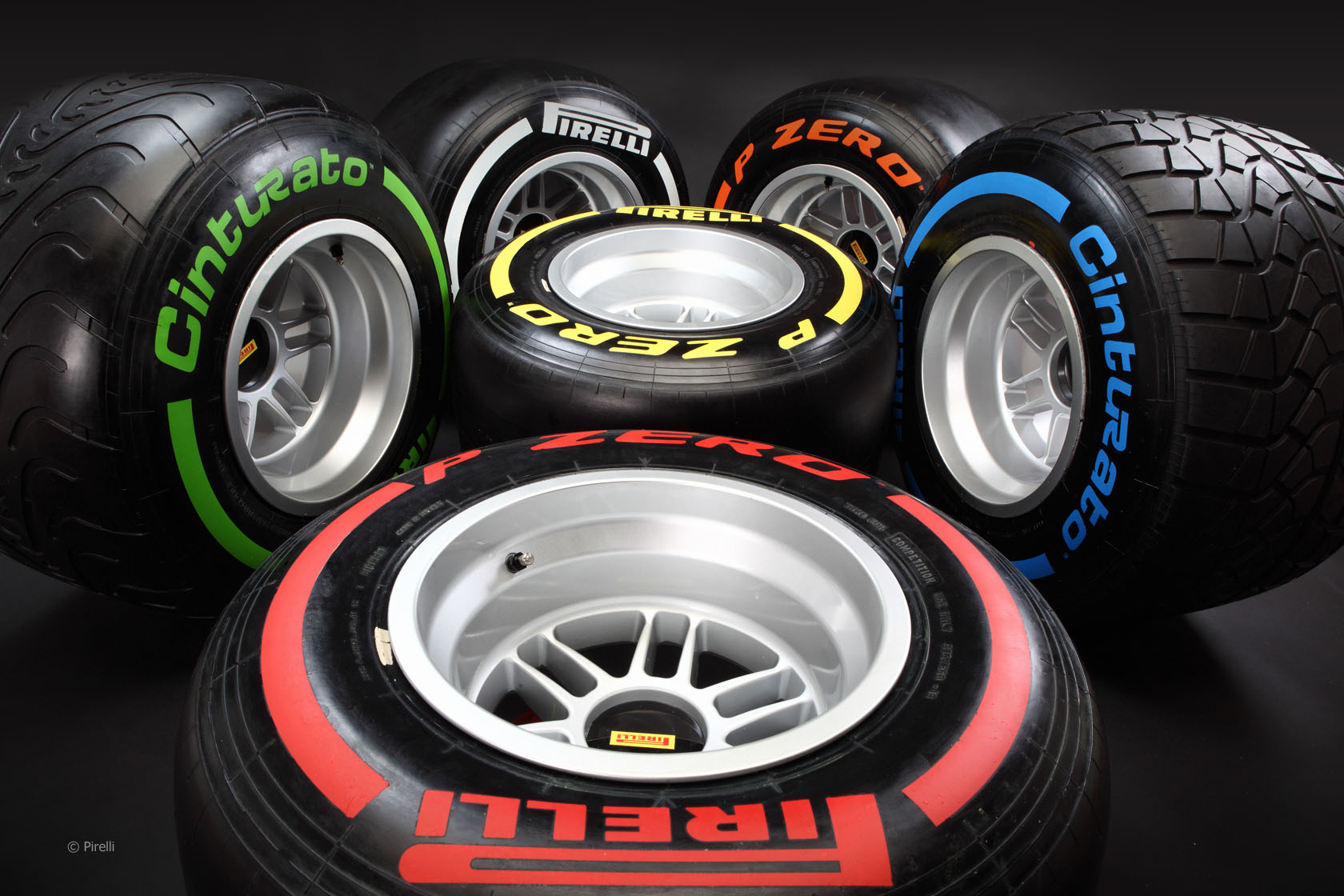
    This follows a request by Pirelli to the FIA, to limit how F1 teams exploit the rubber because according to Pirelli this was a major contributing factor to the blow-outs suffered at the British Grand Prix. Earlier this week, Pirelli openly blamed teams in a statement for the failures at Silverstone.

    The FIA has agreed to enforce strict limits on tyre operations this weekend.

    Race director Charlie Whiting, who nearly red-flagged the British Grand Prix, issued a note to teams on Friday stating that: “For safety reasons, we have been asked by Pirelli to ensure that the tyres on all cars are run under the conditions listed below.

    Pirelli tyre swappingIt will be the responsibility of each team to satisfy the FIA technical delegate that the cars comply with the following requirements at all times.”

    The note specified that minimum starting pressures front and rear will be 16psi, the minimum stabilised running front pressure will be 20psi, and at the rear it will be 19psi. The maximum negative camber allowed at the front will be four degrees, and it will be 2.5 degrees at the rear.

    Regarding tyre swapping Charlie also added, “Front and rear tyres must be used on the side of the car for which they were originally designated (no swapping from side-to-side.)”. This was another factor which Pirelli stated contributed to the Silverstone failures.

    With drivers threatening to boycott the German Grand Prix should further failures be experienced this weekend, we can only hope that the changes Pirelli has made to the tyres for this weekend will ensure that a recurrence of the drama last weekend is not seen at the Nurburgring.

  • 2013 Young Driver’s Test – FIA set out the rules

    Pirelli f1 tyre testingFormula 1’s govering body, the FIA, has announced that it will send its own observers to this month’s young driver’s test.

    The recent Mercedes-tyregate debacle has prompted the FIA to appoint a ‘security guard’ to ensure that no current race drivers do any work on car development. On the back of multiple tyre failures at the British grand prix the governing body changed testing regulations to allow for the regular race drivers to help out with the tyre work at the test. The Silverstone grand prix circuit will be used from July 17 – 19 for the test.

    However, the FIA has stipulated that no current race driver will be only be allowed to work on an emergency testing programme for tyre manufacturer Pirelli. The observers will scrutinise the running programs of every team to ensure that all development work is done by the ‘young’ driver who still be present at the test.

    Pirelli also has two further private tests planned in the coming weeks for which the FIA have told Pirelli motorsport director, Paul Hembery, that it would be willing to allow the tyre company to use a 2013 car if required.

  • F1 2013: British GP Review – Rosberg tops at dramatic Silverstone

    F1 2013: British GP Review – Rosberg tops at dramatic Silverstone

    Formula 1 in 2013 hasn’t been short of drama but it well and truly ramped up for the eighth round of the season at Britain’s Silverstone grand prix.

    It was home-grown hero Lewis Hamilton who thrashed the field to take only his second pole position at the famous circuit. The margin between the 2008 champion and teammate Rosberg was the biggest it had been all season as Mercedes locked out the front row of the grid. Sebastian Vettel was ever present in third ahead of retiring teammate, Mark Webber.

    Force India’s Paul Di Resta delivered an excellent lap for fifth but would later be excluded from qualifying for an underweight car. The Lotus of Kimi Raikkonen and Ferrari of Fernando Alonso seemed to struggle in qualifying trim as the duo only managed to start eighth and ninth.

    Pirelli tyre failures during the British Grand prixLewis Hamilton led cleanly away from pole position as Vettel slotted into third ahead of Rosberg. Mark Webber’s race was made a lot tougher after a clash with Romain Grosjean left the Australian with damage to the front-wing. A bit of damage to a front-wing would be the least dramatic issue of the day.

    Lewis Hamilton easily in the lead of the race and steadily building a gap over Vettel would become the first driver to suffer a left rear tyre blowout. The Pirelli tyre seemed to completely disintegrate without any indication whatsoever. Somehow Hamilton was able to return his Mercedes to the pits but his chances of victory had been thrown out the window.

    It looked like horrible luck for Hamilton until two laps later Felipe Massa’s Ferrari suffered the exact same failure. Jean-Eric Vergne became the third driver to suffer a tyre blow-out on lap 15 as his left rear spectacularly exploded on the Hangar straight.

    The Toro Rosso driver’s tyre failure brought out the safety car as debris from the blowout littered the circuit.  McLaren’s Sergio Perez would be the final driver to suffer an identical tyre blow-out on lap 46. At this point drivers were being told to avoid the kerbs in case they were the cause for the tyre problems.  But Fernando Alonso didn’t share the same opinion after the race. “I have been racing here 12 years & never had this problem (tyre). I think the kerbs were perfectly ok,” said the Ferrari driver.

    Racing resumed on lap 22 with no certainty of whose Pirelli could fail next but there was still a race to be had as Vettel led Rosberg over the start/finish line. The Red Bull driver extended his advantage over Rosberg to two seconds but the Mercedes driver was gradually starting chip away at his lead. Rosberg wasn’t required to do much more work in catching Vettel as the reigning world champion’s car grinded to a halt at the pit entry with a gearbox failure.

    The stricken Red Bull prompted another safety car and Rosberg, Webber and Alonso dived into the pitlane for a fresh set of medium tyres. The only front-running driver not to take a fresh set of tyres was Kimi Raikkonen.vettel-onboard Raikkonen was running second when he asked his team why they had not called him into the pits for fresh tyres. The Lotus pitwall had roughly half a lap behind the safety car to decide on a pitstop but responded to Raikkonen’s question with “I don’t know” and “It’s too late now.” On a day when championship leader Vettel failed to score any points the Lotus pitwall destroyed what could have been a significant gain in the championship stakes. Raikkonen eventually finished fifth, defenceless on hard tyres he had put on twenty laps earlier. It is on moments like this that championships are lost and won.

    Mark Webber’s announcement of his retirement at the end of the season sent the rumours of Raikkonen joining the Red Bull team into overdrive. Lotus team principal Eric Boullier has said that they are doing everything they can to keep the Finn in the team. He believes that the ‘atmosphere’ within the team is enough to make Raikkonen stay put – it isn’t. During his two year hiatus from Formula 1 the Iceman let it be known that he is only interested in winning races – not fighting for second. The doubt is whether Lotus can consistently deliver up to that standard. Mistakes such as this will surely make Raikkonen’s decision to stay or leave a lot less difficult. Lotus are a good team but many suggest that the only thing making them great is Kimi Raikkonen. Since his return to Formula 1 he hasn’t put a wheel wrong and he has rekindled a kind of speed and driving class second to none. Give this guy what he needs and he will win you a world championship. Lotus’ mistakes could be more costly than they expect.    

    Mark Webber, recovered from front-wing damage, charged through the field in the closing laps to within seven tenths of race leader Rosberg. Similarly, Fernando Alonso’s fresh tyres allowed him pass several cars and finish third overall. Fernando Alonso was happy to salvage third place on a weekend where Ferrari look decidedly off the pace but called on his team to ‘raise their game’ in the coming races.

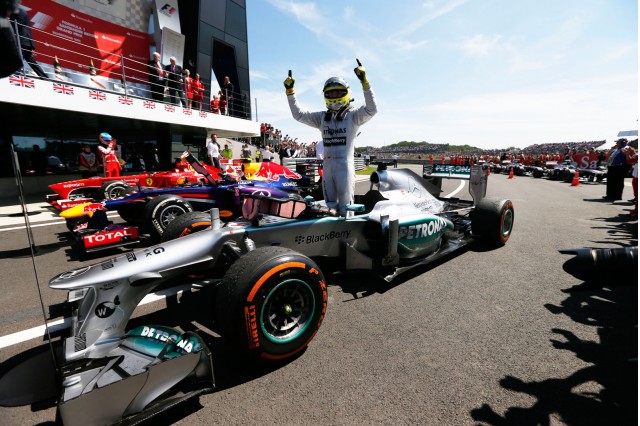
    merc-team-photoNico Rosberg inherited the lead of the race but he won the British GP on pure merit. Never putting a wheel wrong he soaked up the late-race pressure from Webber like a pro. Career victory number three was well deserved for the most improved driver of 2013. 

    The Pirelli tyregate saga took a very dramatic turn during the British GP prompting the teams to angrily demand answers from the Italian tyre supplier. So serious was the tyre situation that race director Charlie Whiting admitted post-race that he was close to putting out the red flag.

    Paul Hembery has failed to appear at press conferences at the last two races but at some point Pirelli and their motorsport director will have to face the music. Pirelli have been invited, by FIA President Jean Todt, to attend the Sporting Working Committee meeting at the Nurburgring next week in order to find a solution to the tyre problems.

    The teams are now pushing for next month’s young driver’s test to be scrapped in favour of a fully fledged tyre test.

  • FIA confirms changes to 2014 regulations

    FIA confirms changes to 2014 regulations

    The FIA today confirmed a number of changes to the 2014 regulations including the introduction of a penalty points system and in-season testing.

    Here are the changes to the 2014 regulations as published by the FIA.

    The following summarises the changes made to the 2014 Sporting Regulations:

    Further to a request from Mercedes, it will be permitted to supply engines to a maximum of four Formula One teams in 2014.

    A penalty point system for drivers will be introduced. If a driver accumulates more than 12 points he will be banned from the next race. Points will stay on the driver’s licence for 12 months. The amount of points a driver may be given for infringements will vary from one to three depending upon the severity of the offence.

    The procedure for a driver to be given the chance to give back any advantage he may have gained by leaving the track has been adopted.

    A significant reduction in the amount of wind tunnel testing and CFD work has been imposed to help reduce costs and potentially allow two teams to share one wind tunnel.

    Four two-day track tests will be allowed in season in place of the current eight one-day promotional days and the three-day young driver test. These will take place at tracks in Europe on the Tuesday and Wednesday after a race in order to ensure minimal additional resources are necessary.

    Track testing will now also be permitted in January 2014 in order to allow earlier testing of the new power units.

    For safety reasons all team personnel working on a car in a race pit stop will be required to wear head protection.

    Each driver will be provided with one extra set of tyres for use only during the first 30 minutes of the first practice session on Friday, to encourage teams to take to the track at that time without having to worry about using valuable tyre wear.

    A number of new regulations have been confirmed to govern the new, far more complex power units. It is agreed that only five power units may be used by each driver for the whole season. Any use of an additional complete power unit will result in that driver having to start the race from the pit lane. Any changes of individual elements above the permitted five, such as turbocharger, MGU or Energy Store, will result in a 10 grid place penalty.

    No manufacturer will be allowed to homologate more than one power unit during the homologation period from 2014-2020. Changes to the homologated unit will continue to be permitted for installation, reliability or cost saving reasons.

    Drivers must now use a gearbox for six consecutive events, an increase from the current five.

    No car may use more than 100kg of fuel for the race, from the time the lights go out at the start of the race to the chequered flag. This will be monitored by the use of an FIA approved fuel flow meter.

    The pit lane speed limit, which is currently set at 60km/h for the free practice sessions and 100km/h for the qualifying practice and race (60km/h for the whole event in Melbourne, Monaco and Singapore), has been amended so it is set at 80km/h for the whole event (except the three races mentioned which would stay at 60km/h for the whole event). This is for safety reasons, as most accidents happen during the race when the speed limit is higher; drivers also have very little chance to practice stopping from 100km/h until the race.


    FIAThe following summarises the changes made to the 2014 Technical Regulations:

    Measures have been put in place to ensure that the cars do not incorporate a step in the chassis behind the nose. These changes will also ensure that a genuine low nose, introduced for safety reasons, is always used.

    The minimum weight limit has been raised by 5kg, as the power unit is now likely to weigh more than originally expected. The weight distribution has also been changed accordingly.

    Electronic control of the rear brake circuit is permitted in order to ensure consistent braking whilst energy is being recovered.

    In order to ensure that side impact structures are more useful in an oblique impact and more consistent, they will become standard items made to a strictly laid out manufacturing process and fitted to the cars identically. The impact tests currently carried out will be replaced by static load push-off tests and squeeze tests. This will also help reduce costs as no team will need to develop their own structures.

    In order to ensure that the cockpit rims either side of the driver’s head are stronger, the amount of deflection during the static load tests has been reduced from 20mm to 5mm.

  • F1 Video: Ross Brawn’s Stance on the Outcome of Testgate

    F1 Video: Ross Brawn’s Stance on the Outcome of Testgate

    Ross Brawn talks to Sky Sports about his stance on the outcome of the F1 Testgate FIA International Tribunal Hearing.