Tag: fia

  • F1 2014: Details of Bianchi Crash Revealed

    F1 2014: Details of Bianchi Crash Revealed

    The FIA has revealed more details about Jules Bianchi’s crash during the Japanese grand prix.

    Formula 1 race director Charlie Whiting went through CCTV footage taken a handful of minutes before the Marussia driver’s crash.

    “There is a dryish line. As the rain has intensified, a little bit of water creeps on to the drier line, and as cars go a little bit wide there, you see that Adrian got onto that and lost control,” Whiting explained.

    “He touches that slightly wetter bit of track, and he is behind Jules at this point. When he hits that slightly wetter bit of track, he loses control and spins. A lap later, with double waved yellow flags being displayed, Bianchi hits the same bit of water.”

    Whiting noted that Bianchi had tried to correct the slide and in so doing over-corrected his car and hurtled off the circuit.

    “You can see Jules doing something similar [to Sutil]. He hits the same bit of water, but there is a slight difference – he does not spin like Adrian did. He corrects and goes off at a slightly different trajectory.”

    Whiting further confirmed that mechanical failure was ruled out a possible cause for the crash and stipulated that it was not yet possible to determine the speed on impact.

  • F1 2014: FIA To Propose Yellow Flag Speed Limit

    F1 2014: FIA To Propose Yellow Flag Speed Limit

    Formula 1 teams will come together this weekend to discuss the possible implementation of a specified yellow flag speed limit.

    The FIA and race director Charlie Whiting has called for a meeting to discuss the possibility of limiting the speed of cars in the yellow flag zones. The meeting comes as a result of Jules Bianchi’s crash during the Japanese Gp in which he sustained a severe head injury.

    “There are some things to learn and we want to engage with all teams and drivers to make sure we come up with good, sound and well thought through ideas,” said Whiting.

    “One of the most important things for us to learn here is that it is probably better to take the decision to slow down away from drivers. It is better to try to put in place a system where it is much clearer to everybody how much we think cars should slow down in similar circumstances.”

    “That is what we are working on, starting tomorrow morning, with a meeting with all the teams to discuss exactly that.

    “We want a way of trying to impose a speed limit – it probably won’t be a speed limit as such, but there will be a way of controlling speed with complete certainty and complete clarity.”

    Whiting also confirmed that extreme caution would be exercised in the use of recovery vehicles.

  • Schumacher “can live a relatively normal life” soon

    Schumacher “can live a relatively normal life” soon

    FIA president and former Ferrari boss, Jean Todt, has delivered some very promising news about Michael Schumacher’s condition since his skiing accident last December.

    Todt and Schumacher are close friends and the FIA president has apparently been visiting the Schumacher family regularly since the F1 legend returned home to continue his recovery.

    Very little has been made public about Schumacher’s condition and how is recovery is progressing but Todt has reportedly offered the Belgian broadcaster RTL some very positive news.

    “We may assume that Schumacher can live a relatively normal life within a short period of time,” Todt said.

    “What we can say is that he will probably never again drive a Formula One car.”

    According to RTL, Todt visited Schumacher in the week before the Japanese Grand Prix.

    “He fights. His condition improves, which is very important,” said Todt, “as is the fact that he is now home with his family.”

    There have been no official updates from Schumacher’s spokesperson or his family as yet and we continue to wish him and his family well. #ForzaMichael

    Photo Credit: WRi2


  • FIA confirm severe head injury for Bianchi

    FIA confirm severe head injury for Bianchi

    The FIA has confirmed in an official statement that Marussia Formula One driver Jules Bianchi has suffered a severe head injury and is undergoing surgery following his crash at the Japanese Grand Prix.

    Bianchi crashed at Turn 7 on Lap 43 of the race at Suzuka a couple of minutes after Adrian Sutil had spun into the barriers at the same corner. Bianchi’s Marussia crashed into a recovery vehicle that had been deployed to recover Sutil’s Sauber.

    Bianchi was taken to the circuit’s medical centre and then transported to the Mie General hospital by an ambulance, remaining unconscious throughout.

    In a statement issued by the FIA the Formula One governing body said that, “The CT scan shows that he has suffered a severe head injury and is currently undergoing surgery.

    “Following this, he will be moved to intensive care where he will be monitored.

    “Mie General Hospital will issue an update as soon as further information becomes available.”

    Adrian Sutil says that he believes the safety car should have been deployed but the FIA has stated that double yellows were waved at the corner to warn drivers of the danger following his accident.


  • Video: FIA’s Matteo Bonciani about Jules Bianchi’s condition

    Video: FIA’s Matteo Bonciani about Jules Bianchi’s condition

    Head of F1 Communications for the FIA Matteo Bonciani makes a statement to the press saying that Jules Bianchi was taken to the hospital, unconcious.

  • Typhoon Phanfone Update – Storm still threatening Japanese GP

    Typhoon Phanfone Update – Storm still threatening Japanese GP

    The FIA confirmed this morning that Sunday’s Japanese Grand Prix will go ahead as planned at 15:00 local time. Typhoon Phanfone however remains a real threat to the race at Suzuka.

    Earlier this morning, the Typhoon Phanfone had been upgraded to a super typhoon but has since been downgraded again to a typhoon. The exact path that the storm is set to take remains uncertain but forecasts are suggesting that it could pass south of the Suzuka circuit at around 18:00 with wind speeds of up to 170 km/h.

    Even if Typhoon Phanfone does not hit the circuit directly, the outlying rain bands that will come with it are quite likely to disrupt the Japanese Grand Prix, and could even make it impossible to race. According to UBIMET, the official weather partner of the FIA have also indicated that the Japanese Grand Prix will almost certainly be run in wet weather.

    Typhoon Phanfone heading for SuzukaThe FIA have said that it will continue to monitor Typhoon Phanfone and has reiterated that safety remains the primary concern. There are talks of an option to run the race behind the safety car for at least two laps to ensure that half points can be awarded. However, even this might not be possible. If the rain is too severe, there is no way they would risk the lives of the drivers. Furthermore, sunset is expected at around 17:30, so the race will only have two and a half hours in which to run instead of the four hour time limit which the regulations allow for.

    “Although we expect rain during the normal race period, the heaviest rain and possibly storm force winds will affect the circuit later on” said expert on-site meteorologists for UBIMET, Steffen Dietz and Andy Swan. “More problematic will be the demobilisation and onward transport of the equipment to Sochi, where the next Grand Prix will be run on Sunday October 12th.”

    F1 teams usually pack well into the night following a grand prix and continue the following day in order to ensure that their freight makes it to its next destination on time. There is very little doubt that Typhoon Phanfone has a serious chance of disrupting that.

    Typhoon Phanfone heading for Suzuka “The main body of the typhoon will impact most of Honshu on Sunday night with gusts of up to 120 kph (75 mph) and torrential rain over a few hours. Disruption to transport out of Nagoya airport is almost certain,” Dietz and Swan added.

    “Probably Phanfone will pass to the southeast of Suzuka. There are also model solutions that can draw the eye directly on the race circuit. In both cases severe structural damage is expected on Monday, with possible widespread severe damage from the second case.”

    Nevertheless, Mercedes boss Toto Wolff is optimistic the race will still go ahead.

    “Actually I have heard the opposite,” he said. “I don’t know if the storm is going to be further south, but I have heard that there are going to be banks of rain with dry places in between. At the moment I think we have to just get on with it.”

    When asked about the impact that Typhoon Phanfone will have on getting to Sochi on time, Wolff said, “If you know that this is going to hit you on Sunday night or Monday, the only thing you can do is work flat-out and try to get the freight onto the airplane. But at the end of the day this is force majeure, if the storm’s going to hit transport generally and the planes leaving then we have a problem. Formula One has overcome larger obstacles than 24 hours of delay. But, honestly, I don’t know.”

  • FIA Issues Final Directive to Teams Regarding Radio Ban

    FIA Issues Final Directive to Teams Regarding Radio Ban

    The FIA has issued a final directive to teams regarding the ban on pit-to-car radio transmissions.

    After some backlash from the teams a meeting with team principals was held on Thursday. The FIA then decided to relax some of the bans regarding car performance, but driver coaching is still banned. The decision was taken to relax the ban on car performance till 2015, as the teams argued that it would be nearly impossible to implement the ban in such a short period of time.

    The updated list regard what is not allowed over team radio and on the pit board will now include the following

    • Driving lines on the circuit.
    • Contact with kerbs.
    • Car set up parameters for specific corners.
    • Comparative or absolute sector time detail of another driver.
    • Speeds in corners compared to another driver.
    • Gear selection compared with another driver.
    • Gear selection in general.
    • Braking points.
    • Rate of braking compared to another driver.
    • Rate of braking or application of brakes in general.
    • Car stability under braking.
    • Throttle application compared to another driver.
    • Throttle application in general.
    • Use of DRS compared with another driver.
    • Use of any overtake button.
    • Driving technique in general.


  • F1 2014: Singapore GP Preview – Stage set for Singapore Showdown

    F1 2014: Singapore GP Preview – Stage set for Singapore Showdown

    It wasn’t that long ago that the thought of Formula 1 cars under lights was just something the ringmasters were talking about for the future. Now, in 2014, Singapore marks its seventh year on the calendar. It’s no exaggeration to say that after nearly a decade of glittering floodlit F1 cars it still tickles the fancy.

    Sebastian Vettel has won the last three Singapore Gp and it isn’t outside the realm of possibility that he could notch up number four. A complete domination, not a Mercedes victory is a given this weekend. Singapore’s Marina Bay circuit has the most corners of all the tracks on the 2014 calendar and its dependence on mechanical grip rather than pure engine power creates the potential for some rivalry.  “The demands on the car are very high in terms of braking, steering and also the engine. It’s also a long race – often running to the full two hour limit and frequently characterised by safety cars,” says Paddy Lowe, Mercedes technical director.

    The battle between Lewis Hamilton and Nico Rosberg will too recommence. In Italy, Hamilton got the better of Rosberg but the latter still holds a 22 point lead. As proven in Monaco, minus the dubious qualifying incident, Rosberg is no slouch around the street circuits. But the small mistake, that cost him victory at Monza, is the tiniest indication of a crack in the ever polished veneer. As a result Hamilton is in the ascendency where the psychological fight is concerned but it means little if you’re still trailing in the points. However, the Brit and not Rosberg, is the one under more pressure this weekend. Because, unlike Hamilton, never before has Rosberg been lauded as the fastest man in F1, never has he been called a championship contender before this year, and never has he been expected to win simply because of who he is. This all translates to the fact that Rosberg has very little to prove and has far less pressure than megastar Lewis Hamilton.
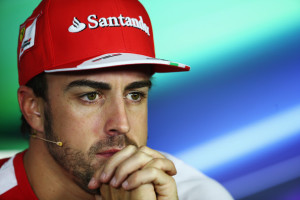
    Alonso Press ConferenceChange is abounding in the Ferrari camp as the ubiquitous Luca di Montezemolo has stepped down as President. Montzemolo must be praised for the terrific and tireless job he has done to maintain the team’s legacy. This is another in a long line of significant changes within the Italian team and while all the re-shuffling and re-working and hiring and ‘gardening leave’ is  fine and dandy there is still a worry that all the moving and shaking may not pan out where it matters most – on the track.

    Nevertheless, one of its two drivers, Kimi Raikkonen, is optimistic about a better performance around the Singapore streets. A disastrous home grand prix last time out again drew attention to its dismal power unit and Raikkonen has pointed out the ERS (energy recovery system) as the team’s biggest Achilles heel. However, the less power hungry and more twisty the circuit the better it will play to the Ferrari.  “I think the next few circuits will suit us as they’re not so fast. We have to go there and see how the car is, but I expect to be in a stronger position,” says Raikkonen.

    One of the things that have always been liked about Formula 1 is its excessive attention to detail. No element or point is too small to escape the hawk-like, near obsessive, meticulousness with which these teams go to work. Recently, this continuous aim towards perfectionism has spilled over to ‘driver coaching.’ We say recently because audiences have only been exposed to radio communications between car and pitwall over the last few seasons.

    ‘Driver coaching’ has been noted most frequently between the Mercedes drivers and their respective engineers this season. On numerousThe Mercedes F1 team are not having the best season so far occasions Hamilton and/or Rosberg would be instructed as to where they could potentially gain time or where they were losing time in comparison to the teammate. No more says the FIA who have clamped down and outlawed all messages that aid driver or car performance. This includes informing a driver about how to manage his fuel consumption.
    Long since some have been moaning that the drivers are simply puppets merely following instruction from the pitwall. Now driving will be instinctual rather than a reaction to reams of telemetry data. By golly, they’ll have to think for themselves and it could just improve F1’s image.

    Invariably, because F1 employs some of the most brilliant minds in the world there is likely to be coded message passed to the drivers even if the FIA has said these are not allowed. Good news is that we will still here Bonno telling Hamilton that it’s “hammer time” and Kimi Raikkonen will be left alone as he so memorably requested at the 2012 Abu Dhabi grand prix.

  • FIA bans F1 radio instructions to drivers with immediate effect

    FIA bans F1 radio instructions to drivers with immediate effect

    Formula One’s governing body, the FIA, has banned F1 radio communication between drivers and their race engineers that relates to the performance of the car.

    As part of their effort to improve F1, the FIA has decided to ban any F1 radio communications that may appear to make driving in Formula One seem too easy as a result of drivers getting instructions on how to drive their cars.

    The fight for the 2014 Formula One Drivers’s World Championiship title between Mercedes team mates Nico Rosberg and Lewis Hamilton, in particular, has seen a number of examples of both drivers being coached with information from the pit wall about how they are performing against their team mate and where and how they can improve.

    F1 radio messages are also often seen to advise drivers on where they can make changes in order to aid the performace of their cars but F1 race director Charlie Whiting has issued a statement to all teams informing them that these messages are banned with immediate effect.

    Article 20.1 of the FIA’s F1 Sporting Regulations is being cited. The article states, “The driver must drive the car alone and unaided”.

    Whiting’s message to teams regarding the ban on F1 radio communications read, “”In order to ensure that the requirements of Article 20.1 of the F1 sporting regulations are respected at all times FIA intends to rigorously enforce this regulation with immediate effect. Therefore, no radio conversation from pit to driver may include any information that is related to the performance of the car or driver.”

    The ban on F1 radio communications has been prompted by fears that the amount of communication between drivers and their race engineers during races has increased to the point where drivers now seem like “puppets” steering the wheel.

    The radio ban will include information about tyres, the condition of the brakes, fuel consumption, engine maps, ERS modes, fuel mix and differential settings. Formation lap instructions such as burnouts, gearbox sync, clutch bit point and brake and tyre temps are also banned. It seems like the only thing the race engineers will be able to relay to the drivers over the radio are messages about traffic, pit stop timing and, if the need arises, team orders. It seems that drivers will be looking at their pit boards more often now.

    A recent example of such F1 radio communication which gained a lot of media and social media attention was when Nico Rosberg asked his race engineer for “driving advice” during the German Grand Prix.

    Following the ban on F1 radio communications, teams still have the freedom to advise drivers on pit stop strategies and also on safety issues.

    The ban will be discussed further in Singapore, ahead of the Singapore Grand Prix, in order to clarify exactly what is and is not permitted.

  • No FIA investigation into Rosberg-Hamilton Spa incident

    No FIA investigation into Rosberg-Hamilton Spa incident

    The FIA has confirmed that there will be no investigation into the Nico Rosberg-Lewis Hamilton collision at the Belgian Grand Prix.

    The accident occured on Lap 2 of the Belgian Grand Prix as Rosberg clipped the rear of Hamilton’s Mercedes when the two rounded Les Combes. Hamilton sustained a puncture and ultimately retired from the race after struggling to make any progress through the field.

    The Spa-Francorchamps race stewards decided not to investigate the collision at the time, classifying it as a racing incident. However, talk emerged that the FIA may well take action against Rosberg after Hamilton claimed that during a post-race team meeting, Rosberg admitted to deliberately crashing into him.

    “He said he did it on purpose, he said he could have avoided it. He said ‘I did it to prove a point,” Hamilton said.

    The FIA has however confirmed that they will not intervene in the issue and that there will be no further investigation into the incident unless any “new element” was officially submitted that could justify opening an investigation.

    FIA communications boss Pierre Regent confirmed, “The FIA will not intervene in this issue. Only a ‘new element’ that would have appeared after the results became final could justify us opening an investigation. A comment alleged to have been made in an internal briefing and later denied by the team itself does not constitute such a ‘new element’.”

    Naturally, Mercedes are not going to submit any application to launch an investigation into an incident involving the two team mates, so the matter is considered a closed case.

    Video: Nico Rosberg’s Post-race reaction
    Video: Lewis Hamilton’s Post-race reaction

    Photo: Screengrab of SkySports F1 footage