Latest

  • Chinese Grand Prix Preview – Controlling China

    Chinese Grand Prix Preview – Controlling China

    Most all of the headlines since the Malaysian grand prix have included team orders, Sebastian Vettel or both. On whichever side you sit of this controversial piece of Formula 1 theatre it has kept tongues wagging for a good while.

    But finally the attention is set to be focused on the most important thing – racing. Whatever has been said, however the statements have played out, on the track is where the real talking needs to be done. As the third round of the season the Chinese GP seems as good a place as any to do just that.

    Three thousand workers took just eighteen months to convert a section of swampland into an international spec racetrack. Designed by F1 architect Herman Tilke the Shanghai circuit, situated in the Jiading district, combines a highly technical complex of corners with a kilometre long back-straight. Inspired by the Chinese character Shang sectors one and two contain ten of the track’s fifteen corners; emphasizing the technical make-up and demand for good braking stability and traction.

    Since its debut in 2004 the Chinese GP has dished up some pretty decent racing. This 5.451 km Shanghai circuit is where Renault clinched a constructor’s title in 2005; the pitlane entrance is where Lewis Hamilton beached his McLaren in 2007 an event that would have a monumental impact on the driver’s world title that year. Despite being seen as one of the ‘new’ F1 circuits 2013 will be the tenth running of the Chinese GP. McLaren and Ferrari share the majority of the spoils with three victories each but no driver, with the exception of Lewis Hamilton, has been able to win this race on more than one occasion.

    Current championship leaders Red Bull Racing don’t have a stellar record either. Since rising to prominence the Milton Keynes team has only taken one victory in the last five Chinese grand prix. If they are to better this record they will have to do it against their run of form at this venue and with clever tactics.

    The Shanghai International circuit is one very demanding on tyres and strategy. In 2012 it was Lotus who rolled the dice on Raikkonen’s strategy; although the Finn was running second towards the closing stages of the race his tyres soon ran out of life and he was summarily relegated to fourteenth place in matter of laps. Bear in mind that the 2012 Pirelli tyres were a lot more conservative than what the Italian company has supplied in 2013 which will make the tyre wear a more precarious balancing act than ever.

    Only two races of the races on the 2013 calendar have been run and in those two races the slightest appearance of a pecking order has started to emerge. Red Bull seem to have carried their qualifying pace from last season but the chasing pack in the form of Lotus and Ferrari are able to match if not beat the reigning champions on race pace. The Mercedes of Lewis Hamilton and Nico Rosberg does appear to be a bit greedy on rear tyre wear but in the cooler conditions of Shanghai this won’t be a particular difficulty.

    The weather forecast, tentative at best, predicts much cooler temperature than have been experienced in the first two races. The threat of rain, sure to materialize at some stage, will almost certainly linger throughout the week.

    Fifty-six will be the amount of laps for Sebastian Vettel and Mark Webber to settle their differences on the track. But Mercedes, looking to replicate its 2012 glory, could be the menace or a fast starting Fernando, Ferrari-clad, may well unleash the pace that has been simmering just beneath the surface.

  • Vortex Generators in Formula One

    A vortex generator is a small aerodynamic surface which consists of a small vane that creates a vortex. They’re mostly used on aircraft to delay or disturb the separation of the flow of air from the boundary layer of a surface.

    In Formula One they’re used just above the sidepods of the f1 car to “re-attach” the airflow above the sidepods so that the air flows along the coke-bottle shape of the car. This better aids the use of the coanda exhaust system that Formula One teams are using to create more downforce at the rear of the car by utilising the exhaust gasses. This extra airflow, together with the coada exhaust, are what teams have used to create extra downforce at the rear of their cars since the exhaust blown diffusers were banned.

    F1 Teams have used different methods to re-attach this airflow over the sidepods. Ferrari are using a series of horizontal vanes that are alongside the driver on either side of the car just behind the wing mirrors.

    Mercedes F1 are running a combination of the horizontal vanes along the cockpit and a series of vortex generators above the sidepod.

    Horizontal vanes and vortex generators on the Mercedes F1 car. Photo: F1.com
    Horizontal vanes and vortex generators on the Mercedes F1 car. Photo: F1.com

    Mclaren and Lotus seem to be running a slightly different configuration. They have a horizontal flap that extends across the top of the sidepod.

    McLaren F1 horizontal flap across the top of the sidepod. Photo: F1.com
    McLaren F1 horizontal flap across the top of the sidepod. Photo: F1.com

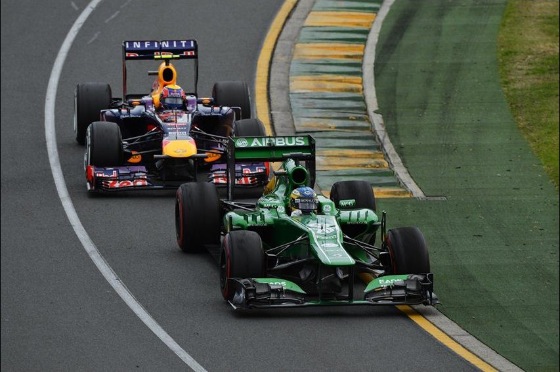
    The rest of the teams, Red Bull, Torro Roso, Caterham and Force India are running vertical  vane vortex generators above the sidepods. The number of vanes varies between the teams, but we’re mostly seeing two to three vanes.

    Vertical vanes seen on the Caterham and Red Bull. Photo: F1.com
    Vertical vanes seen on the Caterham and Red Bull. Photo: F1.com

    Williams, Sauber and Marussia are yet to employ the use of vortex generators on their F1 cars. We’re only at the beginning of the season so it’s safe to say that somewhere along the line we will see them with it on their cars.

    The height of a vortex generator usually indicates the height of the boundary layer they want to disturb. Which is why some teams have tall vortex generators and others have short ones.


  • Formula One Pull Rod vs Push Rod Suspension

    Most formula one fans have heard these two terms thrown about but are not really clear on what the difference is between pull rod suspension and push rod suspension on a Formula One car. F1 Madness’ technical writer takes a closer look.

    At the beginning of the 2012 season we saw Ferrari run a front and back pull rod suspension. This was was in response to Red Bull Racing running a rear pull rod suspension and a front push rod suspension configuration for the 2012 season.

    For the 2013 season, Ferrari have opted to keep with the front push rod suspension and McLaren have also moved to a front pull rod setup.

    Pull rod suspension runs the pull rod from the outer end of the top wishbone down the bottom corner of the chassis.  For the rear suspension, the inner end of the pull rod set up is on the gearbox casing.  This mounts the inboard elements of the system low down on the gearbox, either inside entirely contained within the casing (which is more aerodynamic), or splits the elements inside and outside of the gearcase.

    newpullvspush
    Push-rod setup on the left and pull-rod setup on the right. Image: f1fanatic.co.uk

    The main benefit of the pull rod suspension is to place the almost horizontal pull rod in an ideal aerodynamic path to direct the airflow over the formula one car. This will offer a very small coefficient of drag benefit. With a pull rod setup, the top wishbone is under more stress, which will require a much stronger construction.

    Ferrari have stuck with the front pull rod design and carried it over to its 2013 car. They obviously see some benefit to it. Reverting to the conventional push rod setup would’ve been a major admission of failure from them. It looks as though it’s worked for them since they’ve stuck with it and were looking good in testing.

  • Formula One Team Orders

    Formula One and @F1_Madness fan, Reynard Gelderblom (@Reynardg) sent us his thoughts on team orders in the wake of the 2013 Malaysian Grand Prix where both Red Bull and Mercedes F1 issued their F1 drivers with team orders.

    Let us know what you think about team orders in the comments section below. Here’s what Reynard had to say:


    The order of things

    Sebastian Vettel and Mark Webber Photo: Red Bull Racing
    Sebastian Vettel and Mark Webber Photo: Red Bull Racing

    Every now and again controversy creeps into F1. Unlike other sports, this isn’t related to drug allegations or match fixings, although there are those who do compare this to the latter.

    Think back to Austria 2002 and USA 2012, Ferrari’s team strategies have been the cause for a fair amount of these talking points. Two weeks ago this again overshadowed the media reports after the Malaysian Grand Prix.

    Formula One Team orders: hate them, support them – they’re part of the sport. If you’re a team manager you would certainly do everything in your power to ensure the best possible result in a race. The third and fourth place finish for Mercedes F1 went a long way to consolidate their position as a front running team. This wouldn’t have been the case had Lewis Hamilton or Nico Rosberg retired near the end. Yes, sure we would’ve talked about it, but nothing shows your worth quite like the results sheet.

    Red Bull Racing of course has been dominating the sport for the last three years, but the one-two finish will certainly have a lot of teams thinking during the three-week break.

    This didn’t come without a price though. For those who missed it: Prior to the final pit stop, Red Bull decided that in order to save the tyres and engines, Sebastian Vettel and Mark Webber would keep their positions after the last tyre change. Webber had track position, but Vettel didn’t back down. First, he blatantly asked the team to let him through. When that request was denied, he took matters into his own hands and while Webber had his engine turned down, the reigning champion took the first position. Afterwards the tension between the two drivers could be cut with a knife, and let it be said you would’ve needed a very sharp knife for that.

    Understandably, Webber felt robbed. He did what the team asked and in his mind he did enough to take the victory.

    Now before calling Vettel greedy or a cheat, let me put you into the three times Formula One World Champion’s shoes for a second. Imagine you’ve been the leading salesman at your office for the last couple of months. Around the middle of the month, your boss calls you in and says “Joe, it’ll be better for this company if we let John tie up those last four deals this month.” How will you feel? Given that you are paid to be the best in your field, to maximise your own and company profits – will you really be able to just buy into that strategy? Or will you also, like Vettel, look for ways to maintain your number one status? Do exactly what you love to and what you’re good at doing?

    Personally, I do think there is a time and place for it. Coming down to the last few races of the season there’s a need for this, especially when you’re in the hunt for either one of the two championships. As early as round two of the season – well that one is debatable.

    As team manager you’ve got to keep in mind that inside the car, there are two drivers, both with their own ambitions as well. Perhaps there is a better way of doing this. Given the fact that issuing instructions over the team radio is allowed, I don’t see why Red Bull couldn’t step in and instruct Vettel to fall back the lap after.

    One thing is for certain, the current way of enforcing team orders is a lot better than what we saw in the past with suspicious pit stops. Vettel did exactly the same thing we saw from the three former triple F1 world champs – Alain Prost, Ayrton Senna and Michael Schumacher. He’s a racer, not just a driver. I would like to see a fair race as well though.

    Personally, I think Red Bull’s decision was unfair to Vettel and by
    consequence, to Webber as well. The team got their finishes on the first two steps of the podium; I just wonder what the price for this will turn out to be.

    By Reynard Gelderblom

    Reynard Gelderblom is the motorsport editor for Street Motion.

    Keep up with the latest local motorsport news by following for Street Motion on Twitter.

    streetmotion

  • Australian F1 GP Review: Raikkonen Devastating Down Under

    Australian F1 GP Review: Raikkonen Devastating Down Under

    For ten days before the Formula 1 paddock arrived Melbourne had been experiencing a heat wave of record breaking proportions. But the heavens well and truly opened just before Saturday’s qualifying session.

    Thanks to Mother Nature only the first part of qualifying was completed and the rest postponed to Sunday morning. The pace of Red Bull sent an ominous message as the team locked out the front row and Sebastian Vettel racked up pole position number thirty.

    Lewis Hamilton slotted his Mercedes into third place as McLaren barely made the final part of qualifying with Jenson Button. A noteworthy session from Felipe Massa saw the Brazillian out-qualify his teammate Fernando Alonso.

    The major talking point however, as expected, was the tyres. Jenson Button worryingly said that his set of supersoft tyres was completely shredded after only three laps of qualifying. It wasn’t just talk from JB either as five laps into the grand prix the McLaren pulled into the pits for a new set of medium tyres. It compounded a miserable start to the season for Button and Perez who eventually finished ninth and eleventh with what looks like a fundamentally slow car.

    Mark Webber followed suit a lap later but the frontrunners seemed able to push the performance of the supersofts slightly further. Under pressure from the two Ferrari’s, Vettel pitted on lap 8 followed by Massa (lap 9), Alonso and Raikkonen (lap 10).

    Lotus ended pre-season testing with several reliability issues and little to show for four days running. Seventh and eighth on the grid suggested that the same problems over one lap were still there. But Raikkonen had said that he was happy with the car and that reliability wasn’t a concern. He was right.

    A seventh place starting position only slightly delayed the prodigious progress Kimi Raikkonen would make throughout the race. He first dispatched Lewis Hamilton around the outside of turn 13 and set off after the two Ferrari’s and leader Vettel. Nevertheless, the first round of pitstops cropped up before the Finn could advance any further. However, it was the 23 lap stint on the medium tyres where the Finn came alive.

    Raikkonen delivered a sublime stint of driving and was able to stretch the performance of the tyres while simultaneously keeping up the pace. By the time he made his second and final stop of the race, Raikkonen had built up a fifteen second gap over now second placed Fernando Alonso. The first few laps after Alonso’s pitstops were substantially quicker than Raikkonen’s but the Lotus driver, seemingly always in control, had the capacity to up his pace whenever he pleased. And just to ensure a straightforward run to the flag the Iceman put in the fastest lap of the race and extended his gap to twelve seconds.

    Sebastian Vettel, unable to replicate his qualifying pace, managed the third step of the podium. The triple world champion was still happy to finish in the top three and believes that there is no need to worry about the pace of their rivals.

    Felipe Massa secured fourth place ahead of a struggling Lewis Hamilton. The Brit initially planned on a two-stopper but the tyre hungry Mercedes forced the team to opt for plan B and a three-stop strategy. Another difficult day on his home track relegated Webber to sixth as the Aussie struggled with a KERS issue throughout the race. Adrian Sutil’s return could scarcely have gone better with a solid seventh ahead of teammate di Resta and Jenson Button. Romain Grosjean rounded out the top ten some one minute and twenty-two seconds adrift of his race winning teammate.

    If Raikkonen’s performance appeared effortless from the outside it’s because it was; Raikkonen called it one of the easiest victories of his career. Coincidentally, six of the last ten Australian GP race winners have gone on to win the world championship.

    After four tedious months of waiting the Malaysian GP follows immediately on the back of Oz. The Sepang circuit will be a bigger test of car design and will provide more opportunity for DRS passes with its two long straights. The weather in these parts tend to vary quite a bit too; from monsoon levels of rain to boiling hot temperatures in the region of 40 degrees.

  • 2013 Australian F1 Grand Prix Preview: So it Begins

    2013 Australian F1 Grand Prix Preview: So it Begins

    The Albert Park circuit is not the most prodigious or even the most memorable race track you’re ever likely to come across. But there are few more welcome sites than twenty-two race cars lining up on the grid for the much anticipated start of the 2013 Formula 1 season.

    Formula 1 is arguably the most unpredictable sport on the planet and thousands of testing miles have done nothing to change that. The truth is any one of ten drivers could walk away with the spoils on Sunday afternoon. But who of the possible pretenders will be the likeliest amongst the mob?

    Sure to be the most nervous of the lot will be the five rookies making their Formula 1 debuts this weekend.  Marussia have gone with an all new line-up and both Max Chilton and Jules Bianchi will get their first grand prix start this weekend. Giedo van der Garde will step in at Caterham while Esteban Gutierrez will start his first race for Sauber. Williams’ will be hoping that Finn Valtteri Bottas can transfer his potential and talent to the track.

    The Albert Park circuit continues to be a stronghold on the Formula 1 calendar and in addition to coaxing their new cars around the 5.303 km long circuit drivers will want to get an understanding of the 2013 Pirelli tyres. Whatever information teams gathered from pre-season testing won’t be of much use as the high ambient temperatures Down Under will present a completely different read.  The FIA has also tweaked the rules regarding the use of DRS. Drivers will only be permitted to use DRS, for all session, in the demarcated zones; most circuits are expected to have two DRS zones.

    Hardly any alterations have been made to the technical rules for 2013; leading most teams to follow an evolutionary path in the design and development process of their cars. It also means that, in a season of few changes, the field will be closer than ever.

    There is little doubt that Infiniti Red Bull Racing will be up the sharp end of the grid. However, the Red Bull is severely lacking in straight line speed; in fact, it’s the slowest of the lot. But this is a team that have played their cards extremely close to their chest throughout pre-season testing and there is no apparent concern within the team.

    An impressive conclusion of the final pre-season test in Barcelona for Mercedes has elevated the team to a serious threat. Hamilton will unquestionably take the team to a new level and good or bad his performance in Australia is destined to draw attention. This team has the potential to cause the biggest upset this weekend.

    McLaren will be effectively led by the debonair Jenson Button but its Sergio Perez and the MP4-28 that the uncertainty lingers over. As the car has both dazzled and perplexed the team through testing.  A man with no qualms is Fernando Alonso. The Ferrari driver was able to find something special to drag a sub-par Ferrari to second place at the end of 2012. This year his Ferrari already appears to be in better shape which will make the Spaniard a definite and extremely dangerous factor.

    Kimi Raikkonen and Romain Grosjean are equally satisfied with what the Lotus E21 has delivered so far. Whereas the team didn’t exploit their chances early on in 2012 they should be ready to just that this season; with an in-form Raikkonen Lotus will be F1 2013’s darkhorse.

    How is it possible that all of these teams could win this weekend? The fact remains that throughout the thousands of laps completed in winter testing every single one of these were fastest at some stage. Provided that everything goes to plan, and the weather plays along, Australia should be a cracker.