Tag: Claire Williams

  • 2016 Formula 1 Bahrain Grand Prix: Friday Press Conference

    2016 Formula 1 Bahrain Grand Prix: Friday Press Conference

    TEAM REPRESENTATIVES:

    Franz TOST (Toro Rosso)

    Dave RYAN (Manor Racing)

    Robert FERNLEY (Force India)

    Claire WILLIAMS (Williams)

    Not in attendance: Monisha KALTENBORN (Sauber)

    Paul HEMBERY (Pirelli)
    PRESS CONFERENCE
    Bob, the car showed some flashes of real speed in pre-season in testing and in Melbourne you had a good result with seventh. How confident are you that you’ll be able to take a step on from the fifth place overall the team achieved last year? ?
    Robert FERNLEY: I wouldn’t say that I was overly confident but optimistic. I think that Toro Rosso have done a good job. Williams are always strong. Red Bull are coming back and the engine’s proving well there. So I think the competition for that third to sixth place in the Constructors’ Championship is going to be very, very challenging this year and very tough and we’ve just got to prove that we’re up for it.

    Talking about Toro Rosso and other teams, in the second half of the race in Melbourne, Romain Grosjean in particular was able to stay ahead of the Force India. Were you surprised at the pace of the Haas and do you think that everybody has closed up behind you, quite tightly?
    RF: I don’t think that necessarily the Melbourne pace was something worrying. Melbourne’s just a very difficult circuit to overtake on and I think the red flag played in the favour very much of Haas. In our case I think it went against us slightly. So I don’t think it was a pace issue particularly, just a circuit-related issue.

    Thanks for that. Franz, coming to you, you got off to a good start in Australia, with a double points finish, and the car clearly has some pace. That obviously puts the team in the spotlight, in many different ways. Does the improvement in the team’s pace make you attractive again for outside investors?
    Franz TOST: I hope so. At Toro Rosso the doors are always open for people who bring money, because we have many ideas how to invest it in a proper way. Of course it’s easier to negotiate with partners if you are successful at the race track. This year, so far, we have a very competitive package. The STR11 shows a good performance; also both drivers are very skilled and very fast. The engine is also good and the team has improved as well and therefore I expect to have a successful season and I hope that we can find additional money.

    That improvement in pace was evident in Melbourne but you might not have got the race result you wanted. Obviously, we all saw what happened with Carlos and with Max in the pit stops. Have you spoken to the drivers in between and how has that been resolved?
    FT: Yeah, we had a very good first part of the race until the red flag. After the red flag we lost the pace. The reason why we called in Carlos was that he had a lot of vibration on the front axle and for safety reasons we wanted to change the tyres. Max then came into the pits and the team didn’t know this and we were too late with the tyre change. Therefore, he came out behind the group of Grosjean, Hulkenberg, Palmer and behind Carlos and then of course there was a little bit of a fight between them. But that’s normal. That’s competition. We discussed everything after the race, we analysed everything and we explained to the drivers what happened. Everything is sorted out and I expect from them a good and competitive race here as well.

    The battle between the drivers looks like it might shape up to be one of the season’s most intense. How do you, in the team’s best interest, manage them, given that they a relatively young partnership?
    FT: You must not forget that both of them are very young. Both of them want to make a career in Formula One and therefore they are fighting for every millimetre. This is what we want to see and therefore why we also have them in the team. At Toro Rosso the philosophy is not to come out with a team order, to say ‘you have to let the other past’. Only if we change the strategy, of the drivers are on a different strategy and if we think it will be an advantage for the team, then of course, but otherwise there are no team orders. We expect discipline from the drivers. What do I mean by discipline? That they respect each other, that they let the other driver the space to survive, that they don’t crash on each other and that they compete on the race track like people want to see it and then we will see who will be the better.

    Dave, welcome back, a couple of questions for you. Your car seemed fairly comfortable running in the lower midfield in Melbourne. What kind of result of results do you expect from the rest of the season, what’s achievable? 
    Dave RYAN: I’d like to think we can run with the pack. We haven’t been able to do that in previous years. If we can do that then we can be in a good position to seize opportunities that come our way. I believe we can score points and we need to score points, and that’s the goal.

    You’re almost six months into your tenure at Manor. When you arrived what did you feel were the things that most urgently needed addressing and now where do you feel the team is at now in terms of personnel, resource and operational stability?
    DR: The team was clearly, or had been, in a very difficult place. They did a fantastic job last year. They were in a bit of a holding pattern really. Most of last year was spent looking forward to getting a package together for this year. Stephen Fitzpatrick, our team owner, did a great job on that front: he secured a terrific engine deal, a great transmission arrangement. After that, it was just a question of putting a good car together, which our guys have done. So, last was a bit of a holding pattern and it was all about getting ready for this year. We’ve got a pretty good package. There are no excuses on the engine front, the driveline, and it’s down to us to show we belong here – and we do. And we’ve managed to change the team considerably. We’ve got a lot of new people. There were a lot of good people anyway. Even from Melbourne to this race it’s developed, it’s changed a lot and we’re going forward and that’s what we need to see.

    And what about your drivers? They are both quite inexperienced. What do you see is the potential from both of them?
    DR: I see huge potential. First of all they’re both young guy, a bit like Franz was saying. I enjoy their enthusiasm. Having youngsters around is very invigorating. They’re both very, very switched on young guys. Quite different personalities but fierce determination in both of them to succeed and I’m sure we’ll see two very good drivers develop during the year.

    OK, thanks. Claire, coming to you, lonely at the front there…
    Claire WILLIAMS: I have no friends!

    Williams have finished third in the past two seasons. This year, do you see it as the same battle again, against Red Bull for that third position, or has there been that step over the winter that will allow you to take the fight to Ferrari and Mercedes?
    CW: I’d like to think so. As you say, we’ve come third in two consecutive seasons now, which is a fantastic achievement for Williams. But we did come into this year knowing and understanding that it was going to be much harder to try to maintain that position, let alone push forward and try to catch the Ferraris and Mercedes, but of course that was the target for the guys back at Grove over the winter period. I think in Melbourne it was far too early to tell really where anybody is on the grid this year, so we’re going to have to give it a few races to see where we are, but of course the target for us as a team is always to make improvements. We’d love to be able to close the gap to Ferrari and Mercedes, but I think we’ve seen in Melbourne that the competition has closed around us. The Force Indias, the Reds Bulls, the Toro Rossos, they are all there. We had a great fight in Melbourne and I expect the rest of the season will be like that, so we have our work cut out if we are to maintain third, let alone push forward.

    One of things you have been working on is the new short nose that is supposed to be arriving. Are we going to see that tested tomorrow? Has it arrived? Is it arriving?
    CW: It is winging its way here as we speak, so I very much hope it will be on the car, it’s going on Felipe’s car tomorrow in P3, and we’ll just have to understand where it is, what performance it’s giving us and then decide whether we run it in qualifying or not.

    QUESTIONS FROM THE FLOOR

    Q: (Kate Walker – motorsport.com) A question for everybody please. We’ve had an awful lot of doom and gloom – and I’ve very over that. Could everybody please tell me one thing that you’re looking forward to about the 2016 season. Something that excites you, that makes you passionate.

    RF: If you look at it from the point of view that probably the first… the manufacturing teams in terms of Mercedes and Ferrari are clearly ahead of the game, I think what’s exciting for me is what Claire’s just hit upon: I think we’ve got four or five teams that are really fighting hard for those third to sixth places. I think that’s going to be an incredible battle through the year. If that was the front of the Formula One field, think how wonderful it would be for the fans.

    Franz?
    FT: We have a very competitive midfield where all the competitors are very close together, we go to Azerbaijan and see a new race, and we have 21 races.

    Claire?
    CW: The same as what everyone else has said: I think the competition this year is going to be phenomenal. I think we’ve had a couple of good years of racing. As I said, Melbourne really demonstrated that it’s going to be a really close fight for everybody this year, up and down the order, which is really exciting. I’m really pleased with what you said about the doom and gloom, because I’m totally over it as well and I think it would be really nice if we recognised the positives of our sport, of which there are so many. I think actually now Formula One, from a strategic perspective, and looking at where we’re moving forwards to into the future to into the future, now coming close to signing off the new power unit regulations – hopefully – in addition to the new 2017 regulations, I think there’s a lot to hopefully look forwards to. I think the driver aids situation, as much as there’s been a lot of talk around that, positive and negative, I think that’s really exciting: the drivers have what they wanted, and that’s to be drivers in the car again and to take control of their cars. For me, to see drivers going out there, having a fight, I think it will be a really exciting season. That’s what I’m looking forward to.

    David, it’s a new role for you…
    DR: Yes, I endorse that. Melbourne showed, or gave every indication of the season to come. For me personally it’s going to be… I’m really looking forward to the season and I’m going to enjoy seeing Manor Racing progress. That’s what I’m looking forward to most.

    Q: (Dieter Rencken – Racing Lines) A question to Robert Fernley. Bob, there’s been a fair amount of negative coverage about your team owner, team principal Vijay Mallya recently. He’s not here so I need to ask you. Is the team endangered in any way? We hear some stories of $400million dollars being offered in repayment. How does that affect the team?
    RF: You know Dieter, I didn’t see you behind the camera – I thought I’d got away with it for this meeting! Vijay’s issues are well publicised but, like all things, I think there’s been a bit of media over-reaction, especially from India on all of that. It’s something, just to give you an idea of India itself, I’ve been in and out of India for well over 30 years and the only thing I’ve learnt in 30 years is how little I know about India, so I think you’ve just got to let that flow and for Vijay to deal with it. Force India is blessed with a very good technical team and that technical team has progressively moved Force India up the Constructors’ table and I think today we are realising some of the best returns the team has ever had from the payments side of things, even though we complain about the disparity – which is a separate issue. And we also have a very good commercial team. And I think the commercial team is allowing Force India pretty well now to stand on its own feet and, whilst the shareholders are always there to help us – and Vijay’s been the main person in doing that over the last nine years. It’s not a short term, nine years, to be keeping a Formula One team going. I don’t think there’s any concerns for Force India.

    Q: (Dieter Rencken – Racing Lines) Claire, very brief one to you. You’ve just said you’re signing off the 2017 powertrain regulations and ‘hopefully’ the 2017 aero regulations. Can you elaborate on why you use the word ‘hopefully’? I doubt you normally use words willy-nilly.
    CW: I think I should have applied ‘hopefully’ to both. We have a Strategy Group meeting that’s just been scheduled coming up, and as we all know in Formula One, things are fluid. I said ‘hopefully’ just to temper it. I don’t think you should put too much emphasis on that word.

    …so there is a chance that they may not go through, based on that?
    CW: I doubt it. I think it’s becoming far too late in the day. I think we pushed the date anyway and we need to get these signed off if we’re all to be ready for 2017.

    Q: (Dieter Rencken – Racing Lines) My second question to all of you. There’s been a lot of noise coming from the GPDA recently and one of their points of concern is that they’re not being heard, particularly when it comes to the governance structure, regulations changing etc. given that two of you people are on the Strategy Group and the other two on the Formula One Commission, have the drivers aired their concerns to you at all as team principals on the various commissions and groups?

    BF: No, I’ve not spoken to any of the drivers on that Dieter. I think the drivers have got a role to play. They do have a meeting every race weekend with Charlie so they do represent their views at that meeting and those are transmitted to us through Charlie, which is the correct way of doing it. I think it’s very difficult to have a member of the GPDA on the F1 Commission. It’s very difficult to represent 22 people with one opinion. We have enough difficulty doing it with six on the Strategy Group, so I’m not sure where that would go. Clearly the voice of the drivers is very, very important and we should be listening to them.

    Claire?
    CW: Yeah, I echo what Bob has said. The drivers are one of the key stakeholders of our sport, as are the teams, the media and our fans and we have to listen to all those stakeholders if we’re to create a sport that’s going to sustain in the long term. I’m pleased that they’ve come out and talked about their concerns. I think now we have to go away and think about them and address them and to see how we can engage them. Personally, in the team we have a constant and open dialogue with both our drivers and they always feedback information. On the converse, I think drivers have been listened to, probably more than they have in recent times, talking about the driver aids and the cars we are producing for them for next year – but as Bob said, it’s difficult to represent such a wide group. And then, how does that potentially fit in to the current governance structure that we have at the moment.

    Dave, your thoughts on this.
    DR: I think the drivers are the great personalities of this sport. I think they should be listened to. I think their opinion is really valued and we should heed what they say. We should certainly take notice, that’s for sure.

    Finally, Franz.
    FT: Our drivers are fortunately young, they are not so involved in all of this political issues. Generally the drivers are here for driving and, regarding the Formula One rules, there are so many parties being involved, it’s unnecessary to bring in another party. Nevertheless, the drivers can come up with ideas – but not after regulations are being defined. Like now, the 2017 regulations. To come now and say ‘this is not good’, it’s too late: because this has been defined. They should do it before. Generally, they should be concentrated to drive. That’s their job.

    Q: (Sanjeev Palar – Fox Sports Asia) The fans are holding their breath to try and understand and then figure out what’s happening with qualifying, so perhaps someone can tell us how is it going to be resolved, are there going to be any more changes that we see this season, and what is the process and opportunity to implement such changes?
    DR: We’re holding our breath as well.
    FT: We’ve discussed this qualifying procedure many times and the reason why this new qualifying came into play is because the organisers wanted to increase the show. Now, we saw in Melbourne that qualifying three ended up in a mess, because during the last four or five minutes  no car was out there, but this was already mentioned before, because the calculation of all the teams showed that at the end, maybe one or two cars would have tyres to go out twice in qualifying three. The new qualifying model itself is not so bad but in qualifying three, the eight cars need to have two sets of tyres so that all the cars are out there. Why? Because qualifying three is the most important part of the qualifying, it’s when pole position is being decided and therefore the cars need to be out on the track and neither the old qualifying… all this would be good, in combination with the new one because then the drivers would be out only at the last one or two minutes and with the new qualifying we know that the last four or five minutes no one is out any more. Therefore, in my opinion, we should go back to the old qualifying when we know that the cars will be on the track and will race for pole position.
    CW: In qualifying, the revised form in Australia came out and we said we would give it a go and if it didn’t work we would revert and come back to the drawing board, and obviously that meeting happened on Sunday and everybody agreed that we would revert back to the 2015 format until we could all come together and decide and actually try and come up with a well considered revised process for qualifying. Unfortunately that obviously has happened in the interim, we’ve had a new vote among strategy group members which then went to the commission. Now we have this hybrid system which we’re running tomorrow. Personally, from a Williams perspective, we would have rather to have gone back to the 2015 format as a holding pattern, to give us time to meet again as a group and to actually have time to go through what a new system could look like rather than kind of go to a hybrid system which might not work again. I think we have to wait anyway and see whether that will work or not tomorrow and then take the time to actually think about it. I think otherwise our fans are just going to look at our sport and go ‘what are they doing?’ You can’t do this in the second race of a championship so it’s really important to us that we get this resolved as quickly as possible but to do it in a well-thought through manner.
    Q: Dave, your drivers were probably disadvantaged in Q1 last time out, it didn’t probably go according to plan. What’s your feeling about it?
    DR: No, it didn’t go according to plan for us in Melbourne. I think the important thing is that the regulations were changed for Melbourne, we did give it a try and it clearly didn’t work for many reasons. But the fans have overwhelming said ‘we didn’t like it’. We did have the meeting on the Sunday morning and we did agree to change it. However, since then circumstances have intervened and we’re now back to what we had in Melbourne, so I guess we’re going to go through it again and just see how it pans out. Maybe we’ll all be a bit better prepared for it this time round and maybe it will be a bit different. So let’s see what happens in qualifying tomorrow and we’ll review it again on Sunday morning.
    Q: Bob, do you think teams will be a bit more comfortable with the process tomorrow and it might go a bit more smoothly than it did in Australia?
    BF: For sure I think teams will be better prepared. There still could be issues with it. From a personal point of view, I would like to have seen the compromise programme come in because I think that actually Q1 and Q2 were quite exciting. Clearly we got it wrong for Q3. I would have liked to have seen a little bit of an adjustment before we stopped everything but we have to go, at the end of the day, with the way the governance system works and we are where we are and let’s see how it goes tomorrow.

    Q: (Sanjeev Palar – Fox Sports Asia) Everyone has expressed their opinion on what they prefer but I think what we’re trying to understand and what we’re trying to convey to the fans is what process happens to decide what the final qualifying system will be for 2016, because it doesn’t seem like we have one. We had one in Australia, then we thought it’s gone all over the place, so what is the actual process to finalise the qualifying system that we’re going to have for this season?
    BF: It has to go through the strategy group and then from the strategy group it has to go through the F1 commission. You need 100 percent of the votes from the teams, the F1 commission, and then if it gets the majority that’s necessary, it will go back to the world council to be put into sanction, so that’s the process. There is no other process.
    DR: I think it’s true to say that once it passes through the strategy group for the Formula One commission, it can’t be changed so it can only be approved or disapproved from that point on, both at the Formula One commission and beyond. We only get what comes through from the strategy group, so that’s the process and then we vote on it and it’s a yes or a no, not a maybe we can do this instead, so that’s the process, it is very clear cut in fact.

  • Meet Williams’ 2016 Challenger – the FW38

    Meet Williams’ 2016 Challenger – the FW38

    The Williams F1 team have unveiled their 2016 Formula One season challenger, releasing images of their Mercedes-powered FW38, ahead of the first pre-season test in Spain next week.

    The team had promised that the 2016 car would be “significantly different”. The FW38 still sports a very familiar nose and the livery is also mostly unchanged but the sidepods and rear do appear to have had some facelifting. More updates are scheduled to come ahead of the first race in Melbourne with Deputy team principal Claire Williams insisting that the FW38 launched today is “by no means the final product”.

    Valtteri Bottas will debut the car in the pit lane at the Circuit de Barcelona-Catalunya at the pre-season test, before handing over to team-mate Felipe Massa in the second half of the week.

    The FW38 will once again be powered by a Mercedes engine – a significant factor in the team’s two third-place finishes in the Formula One Constructors’ Championship over the last two years. The FW38 will retain its Martini sponsorship. The team are confident that the FW38 can deliver what it takes to challenge the front running teams.

    Williams FW38“Williams has started to cement our position back amongst the front running teams after finishing third in the Championship in the past two seasons,” said Williams Team Principal Sir Frank Williams.

    “This has been a great achievement given the resources of those around us. Staying where we are will be a challenge in itself, but we are determined to keep improving because only winning will ever be good enough.

    “We have a very stable team going into 2016, with Felipe [Massa] and Valtteri [Bottas] teaming up for a third successive season. They work well together and both have the ideal blend of speed and consistency. Our technical team has also remained very consistent which will be to our advantage and we have some of the best engineering minds on the grid at our disposal.

    “We have a busy couple of weeks of testing coming up to learn more about our package and to refine the car ahead of the first race. We will have to wait until Melbourne to find out exactly where we stand in the pecking order but I’m confident that our hard work over the winter will stand us in good stead.”

    Deputy team principal Claire Williams added: “2016 promises to be a very competitive year in Formula One and there will be a number of strong teams who have us in their sights. We are confident that we have made a step forward over the winter and that the FW38 will build on the strengths of the FW37 and address some of its weaknesses. We started design work on the car earlier than normal and hopefully this extra development time will stand us in good stead.

    “The car we are launching today is by no means the final product. We are already planning updates for Melbourne and will be pushing for constant improvements over the course of the season. Williams enters 2016 in a strong place. We have a great team of people and over the past two years we have started to regain our competitive edge. Now we need to build on that and take this team back to where we all want it to be.”

    Photo Credits: FW38 images courtesy of Williams Martini Racing


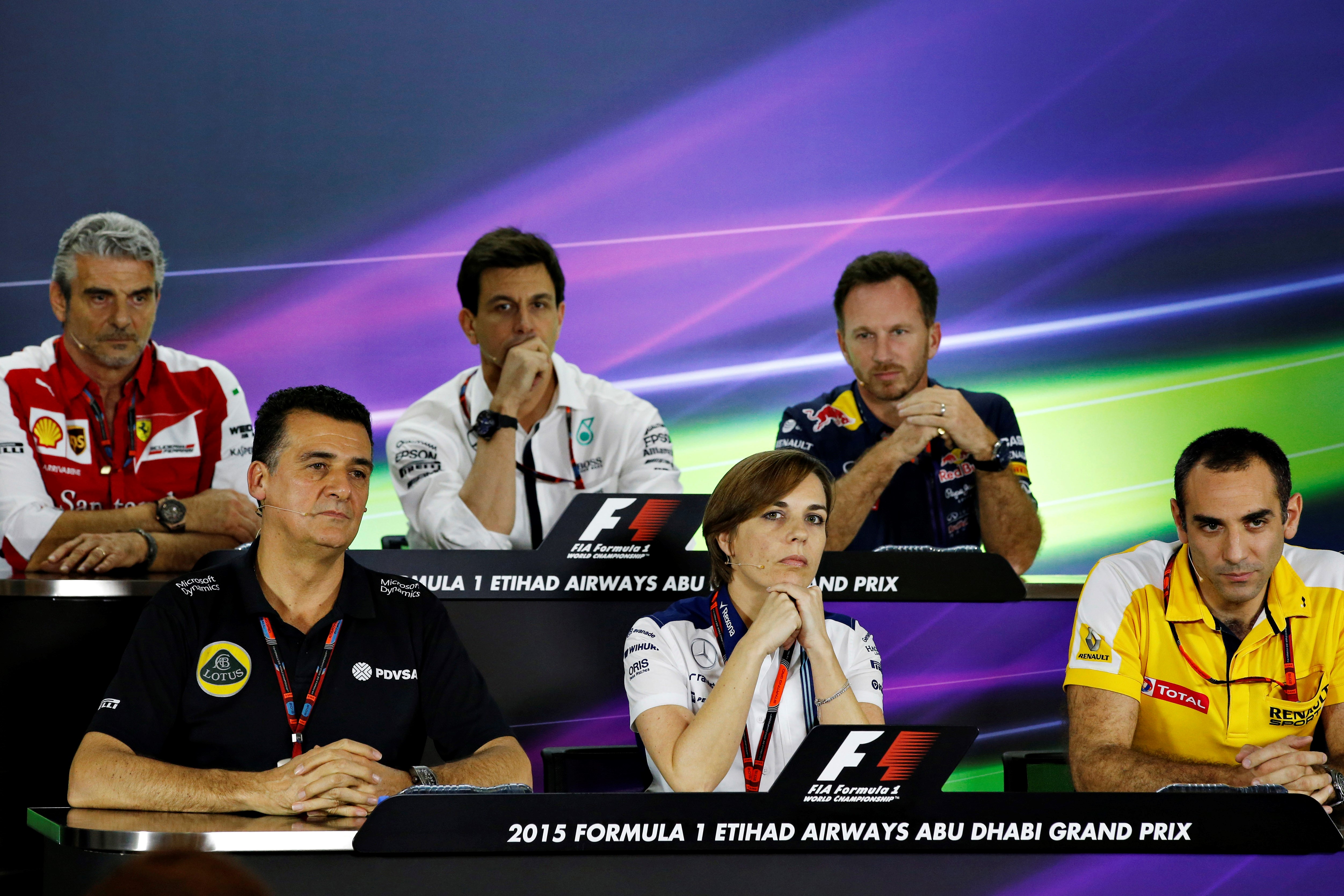
  • 2015 Formula 1 Abu Dhabi Grand Prix: Friday Press Conference

    2015 Formula 1 Abu Dhabi Grand Prix: Friday Press Conference

    TEAM REPRESENTATIVES:

    Cyril ABITEBOUL (Renault)

    Maurizio ARRIVABENE (Ferrari)

    Federico GASTALDI (Lotus)

    Christian HORNER (Red Bull Racing)

    Claire WILLIAMS (Williams)

    Toto WOLFF (Mercedes)


    PRESS CONFERENCE

    Cyril, it’s been a little while since you’ve been here joining us in the press conference. You’ve been talking a little bit recently about next year – larger budgets etc – but can you tell us what exactly Renault will be doing next year in Formula One?

    Cyril ABITEBOUL: Well I’m afraid I can’t answer to that question. I would like to be in a position to be able to answer to that questions, but I am not today. What I can say is that there will be no announcement regarding Renault’s future – short-term or middle-term future – over the weekend, but there will be an announcement, very likely, in the course of next week. We have always said that we would like to do that after the season. Thee season is ending on Sunday, around the start of December and that is what we will do stick to that plan, which is to make an announcement then.

    OK, Federico, if I could come to you, where does that leave you and your thoughts on this?

    Federico GASTALDI: Well, we are on the same page. As I keep saying we have been working, all the time, actually since the Singapore race. We have Renault people already at the factory and it doesn’t change anything. They are the ones who have to announce. We cannot push Renault to make the decision because it’s their call.

    Christian, coming to you, you were quoted this morning as saying that you know now for sure what engine you are going to use next year, but clearly no announcement yet, so what’s holding that up?

    Christian HORNER: Well, we have and agreement in place for next year, so it’s great news that we will be on the grid next year, but unfortunately due to circumstance beyond our control we can’t announce exactly what that is. Perhaps Toto can tell you?

    Toto?

    Toto WOLFF: Can I?

    Coming back to you then Cyril, can you give us a sense of what it’s been like in the past weeks and months, the work that’s gone on behind the scenes and also your own personal ambitions for the brand?

    CA: It’s typical Formula One. I think it has been a proper rollercoaster for us, for me, but also for the whole team, for a lot of people involved, I should say technical people involved in the engine programme. Clearly, Federico made reference to the work being done between Lotus and Renault and it’s fair to say that there is a process going on since the signing of the letter of interest on the 28th of September, there is a process involving a lot of people. I think 50 people have been working night and day on the realisation of a possible acquisition of a majority stake in Lotus. It’s just a project, It’s been a proper rollercoaster, very exciting. I have to say there has been a little bit of frustration on the track. We would have liked to do a better job for Red Bull and Toro Rosso engine-wise, but we always knew it was a long-term game to fix the issues we had. We have not managed to deliver a product that was in accordance to what we would have liked to do with those new regulations, so hopefully we will have the strategy, the time and the resouces to do that in the next few years.

    Thank you for that. Coming back to you Federico, clearly this weekend again a race against time for the mechanics to get the garage and the cars prepared for today’s sessions. Not the first time this has happened. Can you explain the background?

    FG: We have been open in explaining what happened with the team. As everyone knows we have some financial issues. We have been trying to work out a new procedure where the team spends less money. So fortunately between Renault and the shareholders and Mr Ecclestone we kept going but again it’s just the situation we are in in Formula One at the moment. Genii have done a fantastic since they got involved in the team in 2010. We have had podiums, won races, so for a small private team it’s not a bad job.

    Tank you. Coming back to you Christian, can you give us your reaction to the outcome of this week’s F1 Commission meeting and the direction taken, the direction from here in terms of the minimum number of teams that a manufacturer should supply and things like the simplification and cost of the engines. Maybe you could give us your thoughts on those items?

    CH: Earlier in the week there was a positive discussion in the Strategy Group where the independent engine was discussed as an alternative product to being into Formula One and I think the reasons that the FIA and the promoter are keen on that is because costs are obviously critically high and as we have seen availability is also a key issue. So that was discussed in the Strategy meeting and it passed through the Strategy meeting. It then went to he Formula One Commission where despite a lot of the teams voicing concerns about costs the vote for the independent engine at that point wasn’t carried through. However, as a compromise position the manufacturers agreed and were requested to report back to the Commission by the 15th of January a solution to the current issues – a cheaper product, a more affordable product, a more available product and something that could potentially entice other manufacturers to come into Formula One. I think that the situation as we see it is that subject to what the manufacturers come back with by the 15th will depend whether or not the FIA feel the need to proceed with an independent engine to meet that criteria. So, it’s going on at the moment obviously, the time between now and the 15th of January is going to be a critical and busy period to define what this new power unit should be and what the cost and availability criteria are going to be.

    Can I throw that across to you then Toto, your thoughts on what Christian’s just said and the likelihood of a resolution?

    TW: The outcome is public and the independent engine concept with a balance of performance has not been approved. Nevertheless we are all pretty aware that you need to work on your product and develop your product and there are certainly aspects of that engine which can be looked at – costs of supplies is a very legitimate cause. The situation where a team might end up having no engine needs to be addressed and this is the task we have taken away. Is there an alternative concept from 2018 onwards which can address some of these topics, including the noise factor, question mark. We are looking at this and mid-January we are going to come back with hopefully a concept that is workable, financeable and that ticks all those boxes.

    Maurizio, can you give us Ferrari’s position on this?

    Maurizio ARRIVABENE: Already at the Strategy Group level the power units manufacturers they were more than keen to discuss about the 2018 engine with all the characteristics described before by Toto. So it was not a new news. Afterwards, at the F1 Commission the alternative engine was stopped and tomorrow the power manufacture companies are going to meet and we are going to seriously work on the new solution.

    Claire, coming to you, in a season where many independent teams have had a rocky road, you have managed to sail on fairly serenely. What’s been the secret?

    Claire WILLIAMS: I don’t know what the secret is. I think we just tend to keep our heads down and get on doing what we love doing and that’s going racing. We’ve worked hard over the past two years in order to turn this team around. We’ve made a lot of changes within the team and fortunately a lot of those changes are paying off. We’ve managed to secure third in the Constructors’, which is fantastic and testament to all the hard work that has gone in behind the scenes to try to turn this team around over the past 18 months. I’m really proud of the team and the job they have done this year. I think everyone knows though that there is almost a sense of disappointment that we’re third at Williams. We want to be winning races and fighting for that world championship. We’ve made some mistakes this year that have been fairly visible for people to see and we need to improve upon our operations to make sure we don’t make those mistakes next year and we can continue to improve in 2016.

    Tell us about the signing of Lance Stroll, former Ferrari Young Driver Academy prospect. You’ve signed him up, what’s the plan for him?

    CW: Lance is joining our young driver programme, starting next year. We will doing some simulator work with him to try to improve him as a driver. As everyone knows Williams enjoys nurturing young talent and we’ve identified Lance to take on that role next year. He’ll be doing simulator work with our guys at the factory and he will be undertaking a team immersion programme, so similar to the programme we did with Valtteri many years ago now. So he’ll be doing that and we’ll be supporting his season in Formula 3 next year and hopefully he will have a great season and we’;ll see where he ends up at the end of ’16.

    Thank you for that. Coming back to you Toto, a record-breaking season comes to an end this weekend. You’ve been beaten only by Ferrari and Maurizio this season. How do you assess that challenge and do you expect a title challenge from them next year? 

    TW: From the numbers it was indeed a very successful season and I am very happy and satisfied with how it went and there is a great buzz in the team and spirits are high but in Formula One as in many other sports and business only tomorrow’s result counts and this is why we are looking very much forward to next season. Ferrari is about best ‘frenemy’ and they have stepped up a lot over the winter. Clearly in Malaysia it came with a bit of a shock win and it was good for us to see that and I think generally they have done a good job and for F1 it is important that you have more teams competitive in the front fighting with each other, as much as you would like tot see it as a comfortable situation it is not sustainable and the better the platform is the better it is for us all.

    Maurizio, your points of view? Is there belief in Maranello that you can come back here 12 months from now and be fighting for the championship?

    MA: I hope so, because last time I said we would like to stay in front of them, this is an objective. Then last weekend somebody said in Italy, they make a statement in the newspaper ‘yeah, but where they want to go, they are going to be second, Mercedes is going to win’, and I was asking ‘So, what you want me to do in terms of objective? To tell to everybody that I would like to be second next year?’ Of course [to beat them] is our objective but it doesn’t mean we are going to achieve it. But we will try very hard.

    QUESTIONS FROM THE FLOOR

    Q: (Joe Saward – Grand Prix Special) Can I ask the three manufacturer teams: if there was an equivalency formula, would you still be here?

    TW: Formula One is not a place, in my point of view, that should have an equivalency formula. It is very much the World Championship and the pinnacle of the best drivers, the best cars, the best engineering and I think it is important to understand what our DNA is and it has functioned very well over a long period of time. Doesn’t mean there shouldn’t be things we’re looking at and changing for the future but an equivalency formula, balance of performance wouldn’t be Formula One any more.

    Cyril?

    CA: It depends on the formula, y’know? Seriously, I think in addition to what Toto has mentioned about the DNA of the sport, the biggest hurdle I can see is that when there is distribution of something like a couple of hundreds of millions that are distributed on a yearly basis, I would not want to be the guy who has to sign off the formula that will decide the distribution. I think that will be opening the doors to an awful lot of discussions. There is already a lot of politics and talks in our sport, which I think is part of the game frankly, and of the show, but I think it will be simply way too much. So, clearly I believe, as a Renault representative, I recommend to Renault to stay away from that.

    Maurizio?

    MA: I think we already have an equivalent formula that is so-called Formula Indy. I mean, Formula One, it’s the pinnacle of motorsport so I agree that we need to think about the future in future to reduce the cost but to reduce the cost you need new regulation first. Due to new regulation you can reduce the cost but the competition is distinguished in Formula One and the research from any other motorsport.

    Q: (Ian Parkes – Autosport) Question for Toto. Toto, Esteban Ocon has just announced on Twitter that he’s now a Mercedes AMG F1 driver. Does that mean that he’s taken up the reserve role from Pascal? And can we assume that Pascal is therefore moving on to Manor?

    TW: So, yes, we’ve taken up the option on him because he has been with us now, or has been following the DTM team for a while, has been the test driver in DTM and integrated well and he’s doing a very good job in GP3 as well and he’s somebody we’d very much like to have in the family. This is why we’ve exercised the option. It doesn’t mean that we’ve found a solution for Pascal. The current driver market is a bit difficult because most of the teams have already announced their drivers and it need to be the right deal – but having taken up Esteban we are conscious that we need to find a suitable programme for both of them. It could well mean that it could eventually end up for both of them in a testing role, in a reserve driver role and in a DTM role – so it’s not done yet.

    Q: (Dieter Rencken – Racing Lines) A question to all of you please. We’re currently talking about 2017 regulations, completely different underbodies etcetera, different aero packages, tyres. At the same time we’re talking about the possibility of a completely different engine concept. Isn’t this indicative of the sort of disjointed approach to Formula One that, on the one side we’re talking about a completely different chassis concept in, sort of, 15 months time, and on the other side, in 18 months or two years, we’re looking at a completely different engine. Should we not co-ordinate these packages together?

    CH: I absolutely agree with you Dieter. We should bring it all in, in 2017.

    Claire?

    CW: I think the conversations are still on-going, I don’t think anything’s been decided yet and I think they’re very early days in those conversations and we’re trying to map out what the best course of action is – but I think you have to remember the reasons behind the fact we’re having these conversations is in order to try and improve our sport and make it the best that it possibly can be – and we’ve still got a bit of a way to go before we do that but I think if you look at the regs that the working groups are working on at the moment around the new car and the chassis etcetera what that’s going to look like and then you look at what we’re trying to do with the engines and bring down the costs of those. If we can get both areas right, then I think in ’17 – and if not, if we have to wait to ’18 so be it – but I think it could make Formula One a much more stable platform that we can all enjoy in the future.

    Federico?

    FG: Well we certainly need the stability but I think there’s still a lot of things to be discussed in order to find a solution that will suit everyone.

    Cyril?

    CA: I believe the processes are exactly the same. On chassis side I think we are trying to improve the product which is already a good product, while on the engine side we are trying to recover from a number of issues that are associated to the current regulations. I think we recognise that, that’s why I guess the process is different and the timing of those two exercises is slightly different.

    Maurizio?

    MA: I think this discussion, it looks less confused than what it is in reality. The chassis is still under discussion and it will be an evolution and not a revolution concerning the engine. The good news is for 2016 and 2017 everything, it’s very clear now, opening also the door to us, because we are still second, to Renault and also to Honda. We will continue to do our job especially. Tomorrow with the first meeting about the new power unit that is supposed to be in 2017. We try to do all of our best but I think even the Wizard of Oz couldn’t be able to do it for 2017. For sure for 2018. So, it’s much more positive than what it looks like.

    Do you agree with that Toto?

    TW: Yeah. There’s some good stuff coming. I think in terms of chassis regulation there’s interesting bits and synchronisation probably makes sense but you need, of course, to look at the costs.

    Q: (Christian Menath – Motorsport-Magazin.com) Question for all of you. In the past it has always been almost impossible to find one way for all the teams, for all the parties in F1 Commission and Strategy Group and so on. Some people say that now things changed a bit in the last meetings. Why now? Is it the alternative engine that was there or…? Why is it possible now and not in the past?

    CH: I suppose when you look at it, the teams have collectively been spectacularly incapable of coming up with solutions and sensible remedies to the problems – and I think the problem we face in Formula One is you’ve got vested interest. Within your own team you try to protect the elements that are your strengths, that offer you that competitiveness over your opponents. And I think this is where Formula One has tripped over itself over previous years and indeed, the engine formula that we’ve ended up with today arguably is a mistake. It’s expensive. The technology is fantastic but we’re not doing a great job of communicating that and I think it’s put a situation where probably half the grid is currently insolvent. I think there’s a fundamental question that needs to be answered and that is: what should Formula One be? I certainly believe that Formula One should be entertainment. It should have a technological interest to it but that needs the promoters and the owners of the sport, together with the regulators to decide what that product is, come up with a set of rules, not let engineers write those rules, they come up with those rules and put them in front of the teams and say “that’s what Formula One is going to be and that’s what it should be for the future,” and they need to bring in some people with the right skillset to be able to define what those regulations are. And there’s good people that aren’t currently in employment within teams at the moment that are impartial, that come up with a set of regulations that are in the best interests of Formula One, that’s going to provide the best show for the fans, for the public, for the paying spectators who are the backbone of what we do because without them there is no show, there is no Formula One and we need to get Formula One back to being a sport that is enthralling to the public.

    Maurizio, do you share that view?

    MA: I think if you are winning races, of course the show is perfect for you. If you are not winning races the show needs improvement. It’s normal. But I think at this stage, I’ve said so many, many times, we need to work all together, really to improve the show, to attract more spectator, especially on the segment, on the younger segment – and I think this is something, it’s an objective because the population of the world TV viewer, reader and so on is getting older and older and older and this is what we have to do. Of course, during the way you find it’s not an easy way to go because of course the people who have an advantage, they want to keep it. The people that doesn’t have any advantage, they are using sometimes this problem to criticize the overall system. I think with great cooperation between all of us, we can solve it.

    Toto, back to the question about the level of consensus, what are your thoughts on that?

    TW: I would just follow Maurizio on that one. Summed it up pretty well.

    Q (Joe Saward – Grand Prix Special) This is for the three manufacturers again. You guys represent very, very large companies that have lots and lots and lots of money. Why in the world are you fighting over a few millions when you’re getting the technology that Formula One gives and you’re getting the exposure as well? Why don’t you just settle down, give people a decent price and let’s get on with it?

    Cyril?

    CA: Thank you! Frankly, it’s a good question. At the end of the day, at the end of the road that might be what’s at stake but I think maybe there is some road to cover before we get there. You’re talking about the amount of money that we all have, yes, absolutely, but you know times are difficult. Automotive car makers have their own challenge, they need to invest for their core business which is road car technology that you find on the road, not on the track. We’ve got a number of risks associated to what we do. I’m not talking about motorsport. You are aware of the ‘Dieselgate’ and a lot of us are exposed  – maybe not Ferrari – but a lot of us are exposed to this difficulty, this challenge that the world of carmakers are facing but that’s not the only issue, we’ve got a number of issues, like the currency, like the markets, the lack of confidence of certain customers, so we need to be extremely careful. At the end of the sale, it’s a sales and marketing decision. Basically, we need to demonstrate that investing in Formula One, or spending – because it’s not an investment – spending in Formula One is more cost-efficient than spending, for instance, in the regular advertising or spending in badminton in China. So there is a number of KPIs that we need to follow, that we need to monitor and demonstrate that this is competitive as a marketing spend perspective. At least for a manufacturer, which is a mainstream manufacturer, like Renault, and for which Formula One has always been in the DNA but for which is not a must – there are many carmakers that are very successful and are not in Formula One. So, we need to be extremely careful about whatever can, I would say, threaten or destabilize our business case in Formula One and obviously subsidizing the cost of engines to independent teams – even though we appreciate it might be a necessity to be in the sport and to have a healthy sport but it is something that is endangering the business case. That is the situation.

    TW: It is a situation where all those big OEMs – like everyone else out there – is trimmed on efficiency and particularly the car industry with the problems Cyril has described, are in a constant loop of margins, recalibrating margins, of trimming down costs and Formula One, although it is part of the DNA what we do at Mercedes, because it’s around the car, it needs to have the right price for what you do and this is why you can’t just apply easy-going mentality and say it doesn’t matter if you spend a little bit more or a little bit less. It does because somebody will look at the numbers and somebody will make a decision whether it makes sense or not. And this is why we are aware (that) although we have this big mothership behind us, that it needs to be the right price, it needs to have the right value and we are monitoring that and if we are a having a bad race with a bad audience or not the right viewing numbers in terms of what you deliver to your partners, that’s being considered and that is how we operate.

    MA: You don’t have to mix up the big name of Ferrari. Ferrari has a name that is in a worldwide business, it’s at the top. That doesn’t mean that the budget is in a wordwide business at the top. We need to be careful. Mr Marchionne is not joking about that, to respect the budget that is assigned to us. We are not the kind of company that is throwing money out of the window. That’s the point. So don’t mix up the big name with budget. That’s another story.

    Q: (Chris Lines – AP) Christian, does this new engine supply deal suggest that Red Bull has a fresh commitment to staying in the sport as a constructor, as an owner? And you describe the deal as a transition. I was wondering, a transition towards what?

    CH: Well, to answer the first part of your question, I think it’s no secret that during the summer that Dietrich Mateschitz became fairly disillusioned with Formula One, with the direction that things were heading. He said in conversations that he’d personally had the undertakings that he had that didn’t come to fruition. He is probably the most committed supporter of Formula One over the last ten years, if you look at two Grand Prix teams, a Grand Prix on the calendar, the amount of promotion that Red Bull worldwide puts into Formula One, the young driver programmes, investing in youth and young talent, more than probably 1500 employees across the different teams and markets, regarding the two Formula One projects. So for Red Bull it’s a major major part of their promotional budget spend, that is committed to Formula One, and I think that during the summer months or the latter part of the summer, he was seriously concerned with the direction the sport was heading and what the return of Formula One could ultimately provide. I think that having sat and thought about it, he’s decided that there’s too much at stake, that Red Bull have invested so much into the sport that he wants to see the team get back to its former glory. We’ve got some challenges ahead to achieve that. I think the current constitution of performance obviously in a power unit dominated formula it’s a difficult situation if you’re not aligned to a competitive power unit at this point in time, so 2016 will be a transitional year for us and I think as hopefully regulations come to fruit or come to bear with the changes that Jean Todt is pushing for, that the promoter is pushing for, to achieve a more affordable, more available power unit, can only be a positive thing for any independent team, not just Red Bull but all the other independent teams that are currently on the grid.

    Q: (Ian Parkes – Autosport) Christian, with regard to your remarks about a sole regulatory body, that would suggest that perhaps you’re calling for the abolition of the strategy group and the F1 commission. Is that the case, is that feasible and to the other five, do any of you agree with Christian’s remarks that you would again like to see a sole regulatory body, that the teams would no longer have an input?

    CH: I believe that an input is fine and the teams obviously have an investment in the business, so there’s no reason why things shouldn’t be discussed among the key stakeholders and certain teams obviously are stakeholders. And the strategy group is supposed to be looking at the longevity of Formula One but what the strategy group continually gets embroiled in is fire-fighting issues of the current day. Instead of looking at what should a Formula One car be like in 2020 and beyond, we’re constantly dealing with issues of today and tomorrow, rather than further down the road. So I think that of course there has to be consultation with the teams but at the end of the day, somebody has to run the business, and somebody has to say this is the route that we’re going and a democratic approach to that will not work in our opinion.

    CW: I think it’s a bit of a case of be careful of what you wish for. I think that we’re very lucky that we have – as Williams, as a team – that we have a seat at that table and can be part of the democratic process that we do have in F1 at the moment. I like that, I like being able to be involved but I do think that at the moment, as Christian said, we have a number of agendas on the table and it’s very difficult to get everybody to agree around that table when we’re having discussions and we all run our businesses in very different ways and we all have very different capability within our teams. But I’m not sure if I would subscribe to our sport having a single regulatory body. I think it would be very difficult for everybody around the table.

    FG: Well, I agree with them and I’m sorry to keep repeating the same things but the problem for me is that we are not in the same boat, we are not on the same page and we are not on the same agenda. As Cyril has pointed out before, we are all looking for our own stability as a team individually. It’s hard to have a common approach that will benefit the sport at the end of the day.

    CA: As a Frenchman I am for the dictature (dictatorship) as long as you can chose the dictator. I think it’s fair to say that if we want to be progressive, what Formula One is, maybe there needs to be some form of re-grouping of different groups and functions and something a bit more effective and again progressive. Having said that, there is always some dangers, that again the power can be in the hands of someone who has a particular agenda which can be the individual or collective, I’m not thinking of anyone in particular. But I think on balance, if you look at Formula One I would prefer it to be more progressive than it is, so if that involves a little bit of dictatorship maybe that would be better.

    TW: Can I follow Claire on her opinion? That’s what I would say.

    MA: I think a couple of years ago we had an aero dominating formula, today we have a power unit dominating formula. I think that the right balance should be defining to be sure to make everybody happy. Then the question if we go for a democratic decision or a kind of dictatorial decision is not for me to decide. I mean we have a commercial rights holder, we have a federation but of course we also have the interests of the teams so my aim is to find the right balance for the future and to make everybody happy and working to enhance the show and to go back to a spectacular Formula One.

    Q: (Nahed Sayooh – Autosport Middle East) Maurizio, you have set a target of three wins this season and the team achieved it. What is the target for 2016?

    MA: The target for 2016 is to cancel the smile from the face of my friend Toto.

    Q: (Christopher Joseph – Chicane) Christian, you spoke earlier about the need to communicate the technology aspect of Formula One. Do you think that with the endless discussions about strategy direction, power units etc etc, are we losing the plot in terms of communicating this technology message?

    CH: I think to a degree we are. What these cars achieve with 100 kilos of fuel and the fuel economy they are achieving is impressive but I’m not sure how many fans actually give a damn about that. I think that what they want to see is the drivers who need to be the heroes, racing wheel to wheel and competitive racing. Machines that are Formula One cars are truly spectacular to drive and I think Formula One is the pinnacle of motor sport and it’s competing against an awful lot of other sports that are now demanding television air time. And it’s got to be entertaining from start to finish. I think that that’s what we need to be striving for, that’s what we need to be looking to achieve. Now of course technology plays a role but I don’t believe it needs to be the primary role, that should be about the drivers and out-and-out racing.

    Q: (Dieter Rencken – Racing Lines) Toto, from the pit lane in Brazil, you seemed to indicate that the difference in price to the teams of the new engine to the old engine is about plus twenty percent which works out at ten percent per annum, or if that price gets held for next year, about six percent per anum, which is roundabout six percent of a smaller team’s budget. What’s the big outcry about, why do you want to throw this engine out with the bathwater when in fact there’s only about a six percent difference from one to the other?

    TW: I couldn’t follow you on that calculation. But the main point is that there are lots of numbers out there and lots of wrong numbers out there and as a matter of fact I can only speak for Mercedes because these are the calculations I know, it’s from a previous engine spec: the old eight cylinder engine plus KERS. About the difference to what we have today, it is what you have mentioned, 20 or 25 percent. Is that too much? Maybe. I remember times when I joined Formula One a couple of years ago, the price was around £30m, three-zero plus a driver. Nevertheless, I think it’s legitimate to question the price and obviously the lower the price, the better it is for Formula One, the more sustainable it becomes, the better it is for most of the teams and that is OK and we need to look at it. But the difference is not what’s been said.

  • 2015 Formula 1 Mexican Grand Prix: Friday Press Conference

    2015 Formula 1 Mexican Grand Prix: Friday Press Conference

    TEAM REPRESENTATIVES:

    Vijay MALLYA (Force India)

    Claire WILLIAMS (Williams)

    Maurizio ARRIVABENE (Ferrari)

    Toto WOLFF (Mercedes)

    Yasuhisa ARAI (Honda)

    PRESS CONFERENCE
    Q: Claire, if I can start with you. Williams won this race the last time it was here back in 1992. Did you watch that race and what are your thoughts on coming back to this circuit today?
    Claire WILLIAMS: I was 14 when that race was one and I don’t remember watching it. I probably did; I’m sure I did. But it’s great to come back here. We won the race prior to that with Riccardo Patrese as well, so Williams has a good history here. I’d love if we were able to repeat that this weekend. Obviously we haven’t had some great races in the past few, so the team really needs a strong result here. But it’s a great venue. I think everyone in Formula One for our return to Mexico has really enjoyed the experience so far. The promoters have done a great job with the facilities we have, so it will be a good weekend.

    Q: This time last year you were battling for position in the Constructors’ Championship but you’re looking pretty solid now in third for this season. It’s obviously progress but are you satisfied with the season you’ve had?
    CW: This year for us was all about consolidation. If we are able to secure third this year again, that’s fantastic for a team operating on the budgets we are operating on. We are operating on a budget that is half or a third of some of the bigger teams out there and I’m really proud of the job that everybody in our team has done. It’s been hard work this year. We haven’t had some of the podiums we would have liked to have had but we’ve done a job. But it’s not over yet, we still go work to do but getting thirds again would be fantastic.

    Q: Thank you. Vijay, if I can move on to you. It’s a huge weekend for your team, in particular Sergio of course. Are you enjoying it, are the team feeling added pressure this weekend at all?
    Vijay MALLYA: No, we are absolutely enjoying being here in Mexico. As you may know we launched the car in Mexico in January this year. Checo has a huge following, we have many large Mexican sponsors and I personally love Mexico because there are many similarities with India, so this is like a home race for us as well.

    Q: We are hearing talk of a name change for the team for next season. What can you tell us about it? What does it mean for the team and how is it going to be structured?
    VM: We are in discussion, nothing has been finalised, we have many options and I’ll be able to confirm or otherwise once I have something to say. As I’ve said, and as was faithfully reported by Autosport, I don’t like to count my chickens before they hatch.

    Q: Thank you very much. Arai-san, can I ask you first what happened this morning in terms of Jenson’s engine and what effect did that have on running this afternoon?
    Yasuhisa ARAI: Jenson’s engine we had planned to change between FP1 and FP2 but we detected, by sensor, a high-voltage failure. Actually we don’t know but we need time to learn. We have to change many items to go out the garage.

    Q: There is talk of Honda supplying a second team, or maybe not. What is the current situation and if you were given the choice would Honda rather supply more than one team?
    YA: Obviously we cannot discuss details at this moment. We have been approached by the team but discussions are ongoing and nothing has been decided. I always say this season: we are always open, so we are on discussions that are ongoing – that’s it.

    Q: Toto, you were invited onto the panel in Austin to celebrate as Constructors’ Champions and we’re delighted to see you now as double champions this season. Tell us your thoughts on Lewis as a three-time world champion and also how he’s changed over his three years with the team?
    Toto WOLFF: It’s clear that when you win a third drivers’ title you move into the ‘Olymp’ of drivers. There are not many who have scored three title or more and he’s part of that. He’s had an extraordinary season, almost without any mistakes. The car didn’t let him down and this is then where he ended up. The journey he had in the team… he started the same time I joined the team. I think it’s normal that as a person you develop, you grow into the team, you get to know the people, the car suits you more and this is the result of three years with Mercedes.

    Q: On the flip side, it’s obviously difficult for Nico. Where does he go from here? How does he rebuild for 2016?
    TW: For the team it’s always biitersweet and just to keep the right balance I think he had a season with so many ups but also many downs. Some very good performances, he was always there. He outqualified Lewis on some of the occasions but then he was also let down with the car in Monza, with the engine failure and this is simply where we need to improve – to provide a car that makes them capable of fighting each other, because it lifts the team. Today you could see he has a very strong pace and the combination of the two of them makes where we are. We won the Constructors’ title also because Nico is such a strong contender to Lewis and this is a very beneficial situation to the team.

    Q: Thank you. Maurizio, can I ask you how important is it that Sebastian now finishes second in the Drivers’ title race for Ferrari?
    Maurizio ARRIVABENE: The championship is not finished. At the moment he is second but I think Nico is hunting him but we will do our best to keep [Sebastian] in that position, even if Toto do not like.

    Q: Sebastian drove a great race in Austin. Can you tell us what he’s brought to the team and how motivating performances like that are to the team?
    MA: I don’t want to talk about Sebastian, because every time they are asking me questions – he’s a four-time world champion. He’s demonstrate that he is a great driver but he also have a good team around him. He has integrated himself very well into the team and also with Kimi, I have to say, and everybody is going in the right direction. He gave us an additional push and I recognise he is a great driver. By the way, congratulations to Mercedes and to Lewis for the title, the really deserve [it].

    QUESTIONS FROM THE FLOOR

    Q: (Ian Parkes – Autosport) Toto, you recently signed an agreement with Manor to supply power units for next season. They describe themselves as a team of real racers but two of those real racers, John Booth and Graeme Lowdon, have seemingly resigned form their positions. I just wondered what you make of that and if that poses any threat to the deal going forward into next year?
    TW: Obviously when I spoke about racers, John and Graeme was very much meant by that plus of course the rest of the team, it’s a bunch of real fighters that have shown stamina in keeping the team in the sport. I’ve known John forever, since the Formula Renault days of Lewis and Formula 3 days. Manor means John Booth and John Booth means Manor and Graeme has made sure… was very instrumental in keeping the team alive last year, so seeing them go, from a personal standpoint and from the racing spirit, is obviously a blow. So going forward, we have signed the deal with Manor and I would say we need to give credit to everybody in the team who stays in the team but we are curious spectators from now on.

    Q: (Dieter Rencken – Racing Lines) Question to Maurizio. Last week in Austin I asked you what your thoughts and comments were about the possibility of another kind of engine, that was being discussed. You said that you’d rather wait until it’s gone through Strategy Group etcetera before commenting – yet on Monday we heard that Ferrari had invoked a veto against such a plan. Could you please explain the difference and also whether in fact there was a veto that was invoked – and why? Thank you.
    MA: Concerning the veto it is quite easy. We exercised our veto in compliance with our legitimate commercial right to do business as a powertrain manufacturer. There’s nothing to add.

    Q: (Kate Walker – motorsport.com) I’ve got a follow-up for Maurizio. Given the rude financial health of the Ferrari F1 team’s finances, how do you morally justify exercising your veto?
    MA: I repeat it. I have to repeat again. The rules are done by the Federation and it’s fine but we just exercise our commercial right as a powertrain manufacturer. This is the reason why.

    It was a question about the moral justification, given your strong financial position.
    MA: Why do we have to justify it more? Here we are talking about commercial right. We are not talking about budget, we are not talking about anything else. If somebody, they are asking you, they give you a specification to produce apple, OK you produce apple in line with the specification. That somebody,  they’re asking you, OK, we want to impose you the price of the apple’, what are you going to do? This is the principle. It has nothing to do with the rest.

    Q: (Christopher Joseph ¬– Chicane) Question for the front row [MA, TW, YA] in terms of powertrain. How important is it for you, as powertrain manufacturers, that you have gained some traction in the Mexican market – and what is the relationship between excellence in powertrain on the track and how that relates to road car technology?
    TW: To answer the first question, Mexico is a huge market and very important market for us. We’re not only producing cars in Mexico but also it’s the sheer size is very important for us. From the relevance to road car technology, there is a huge relevance – and it goes in both directions. What you are seeing on the roads is hybrid technology and fuel efficiency and this is the fastest lab in the world. We have been part of a sport that set very stringent new rules two years ago in terms of efficiency of those power units – yet those power units deploy more power than the engines before and we are almost there in terms of laptimes with 100kg instead of 150-160kg – so it’s very, very road relevant.

    Arai-san – how important is it to be visible to the Mexican market?
    YA: Here is a very, very important market for us, of course. We made a new plant in Celaya and opened that plant. Our services are very strong in Mexico. This is the 50 years anniversary for the first win for Honda in Formula One this year. It is a very special place in Mexico.

    Maurizio – how important to be visible to the Mexican market and the relevance to road cars?
    MA: For us of course it’s important because Mexico somehow is the door of South America. It’s a growing market so for a car manufacturer company it’s a very, very important and this is the reason why we were very happy to have the grand prix here because it’s another opportunity to enlarge the Formula One sport and the Formula One race in South America. The show I think is more completed now with Austin, USA, Mexico now and Brazil.

    Q: (Ralf Bach – Auto Bild Motosport) A question to Toto. Toto, can you understand Ferrari’s opinion in this engine case? The veto right and the answer.
    TW: This is obviously a very controversial topic and, as with many things, black and white is not the answer. There is… we were… there is a set of rules which were implemented in Formula One two years ago and we started developing those engines three, four, five years ago, based on that set of rules. As large corporations we work on long-term planning. It is part of the budget process. It is part of the R&D process. From that standpoint, part of it is a business case and you need to calculate how much you can charge for those engines, how much you can recover for those engines. Ferrari is a public company now, so it is difficult as a commercial entity to just be confronted with the situation where price is being imposed. It somehow takes away the commercial ability of refinancing. Now, you can say, for a large organisation it doesn’t matter: a couple of millions don’t matter – but they do. It’s how we are being set up, the constant always trying to improve your result and optimise your organisation – which is why it’s a discussion I think we should have behind closed doors. I think it is very important to understand the financial constraints of some of the smaller teams and we remain committed to cost reductions. It’s not like the big teams are stubborn and say “well, we don’t want to hear anything of that.” This is a platform that functions with all of us. We are not just running fronting it and saying we don’t care what happens behind us or aside of us. You need to balance that. I think Ferrari’s first reaction – and excuse me [MA] that I’m talking for you in that case – is the imposing ways are very difficult to cope for a commercially-oriented entity. I can understand Ferrari’s standpoint and I can also understand it’s a very controversial and difficult situation for some of the smaller teams, and of course how it’s being brought forward, it doesn’t look very neat – but there is a much more to it than just a sheer veto and saying “no, we don’t want to have the discussion,” because that’s not how it was.

    MA: In fact, what I said, my answer was only concerned to the reason we applied the veto. For the rest I totally agree with veto. It is not a position against the other team. It is a decision that is defending a commercial principle. For the rest we are open to finding any other solution. At Toto explained, you have in a public company, as we are now, but also in a company as Mercedes is, you have research and development costs that somehow you have to recover. I don’t find any commercial entity all around the world that is giving their product out to the market for free – or at cost. So this is the principle.

    Q: (Ian Parkes- Autosport) The FIA recently announced plans to potentially introduce a budget engine from 2017. To Vijay and Claire, could you give us your thoughts on that, whether it’s a unit which would likely appeal to you? And to the front three engine manufacturers, again your thoughts on that, bearing in mind the multi-millions of pounds that you’ve spent in developing the current system?
    CW: Everybody is aware that Williams is always in support of any cost control measures in Formula One, and we respect the work that the FIA are doing in that regard. But we also have always come out in support of the current power unit that we have, it’s hugely relevant to the auto industry of today and in Formula One, this needs to be a technically innovative championship. So I think there are arguments on both sides and as Toto said, it’s quite an evocative subject and one that we want to have conversations around with the FIA and directly rather than talking about it in the press at this stage.
    VM: I received a communication from the FIA proposing the new engine concept with outline specifications. I appreciate the cost cutting initiative. I think Force India has constantly been asking for cost control measures in Formula One for good reason, I might add. But it’s very early stages for us to comment on whether we would be supportive of this particularly new engine or not. Having said that, we have an excellent relationship with Mercedes. We have a fantastic power train. Sure, if the FIA feels that an engine should cost six or seven million euros, this gives me a little foot in the door to request my friend Toto for a discount. But having said, we are contractually obliged to Mercedes ‘til 2020 and we respect our contract, but having said, any cost saving initiative is welcome from our point of view and should be discussed by all teams in the strategy group and those who are not in the strategy group, because they are equally relevant and hopefully we can all come to a conclusion.
    I just take another minute: I heard what Maurizio said about the recent veto by Ferrari. He further states that he would be very prepared to sit down and discuss cost reduction measures which is something that we appreciate. Unfortunately, in the past, the strategy group has been discussing cost control for the last two years and there has been no significant result. Hopefully now, going forward, we will all sit down with the seriousness that it deserves and find a solution that is satisfactory to all teams that are competing in this world championship.
    TW: Vijay’s a very shrewd businessman so nothing else was expected, same as Claire. As I said before, we cannot close our eyes to what’s happening in Formula One and we need to show respect for every team – the ones that are part of the strategy group and the ones not part of the strategy group, and you need to consider that. And you have to balance that against your own commercial pressures. I think Formula One was successful with the current engines in attracting engine manufacturers. It is a period where we are having four suppliers in the sport, which I would consider as a success and I think that from our standpoint, what we need is a long term visibility of regulations and what’s happening so we need to try to make our customers and partners in the smaller teams save costs as good as we can and have a serious discussion about it and maybe Jean Todt and Bernie’s initiative now is going to trigger more emphasis on those discussions so I take it as a positive. We remain open to the regulations, we are not the ones who make the regulations but we have a voice and we sit there and we hope I can make that argument heard, that we need long term stability in coming up with solutions. If, going forward, we need different regulations in terms of power units we would very much discuss that, if it makes sense or not, but we shouldn’t shake the system too much because that doesn’t fit to the long term perspectives of large organisations like the three of us represent.
    YA: I think that for Formula One there are three major important things. One is sustainability, as you discussed, the cost to a price. And how more attractive and keep the good fun. And also the challenge of new technology; the current regulation is a very good direction, and also the competition. Those are the three major areas which are always important and we always discuss about that.
    MA: I think I tend to full agree with Todt because here you have two companies, they do chassis, they do engine, gearbox, everything on the car so we need to find a bit of a balance versus others because everybody looks smaller but if you compare us and what we are doing to maybe our teams, we have all the respect for them. They maybe do only the chassis. We need to find the balance in between all of us. As Vijay said, we are ready to sit down to discuss, to find a good solution which is making everybody happy and most importantly, it’s helping Formula One to grow in terms of spectacularisation and so on. So, this is our point of view. We want to continue our discussion but as Toto said, you can’t shake the box too much because otherwise you create further confusion. I mean if you apply the rules, the rules need to be discussed, agreed by everybody and equal for everybody, because I don’t think a solution to have three, four, five different power units that they are running in Formula One is going to satisfy us and to simplify also, because most of the time, now that what we discuss in the strategy group is becoming public. I can say something in the strategy group where also we are discussing how to simplify the rules so we also need to do that and to do it we need to unify the rules, to simplify and to look further to enhance the show.

    Q: (Will Buxton – NBC SN) Toto said a few moments ago that we can’t be blind to the situation in this sport any longer and yet the use of the veto by Ferrari shows that if not blind, it could possibly be argued that there’s a slight blurring of vision. I would like to ask the members of the panel that don’t have the right of veto for a simple yes or no answer; should anybody in this sport, should any team in this sport have the right of veto over regulation?
    CW: I think it is what it is. I think it’s like a lot of things in Formula One, that it is in the regulations that if Ferrari have that veto, it’s a historical veto they’ve had for many years. I don’t believe that they’ve exercised it on a regular basis but they obviously exercise it when they feel opposed to something and opposed to something that they believe that they should be opposed to because it’s important to them and Maurizio has laid out the reasons why he used… Ferrari used their veto. Where I sit, Williams, we’ve always just abided by the rules, they are what they are, like a lot of things in Formula One and we just go along with them.
    VM: I sit on the world motorsport council of the FIA so I’m not going to express my personal opinion. The FIA president Jean Todt has already issued a press statement surrounding this entire issue of the recommendations that were made for cost control measures, that Ferrari vetoed it, and he very clearly stated that he does not intend to contest the exercising of that veto so that’s it as far as I’m concerned.
    TW: Well, there is not a yes and no answer to this, it’s much more complex than this and I think it is an historic right which is a right that was earned in participating in the sport for fifty or sixty years, God knows how many years, and having amassed this tremendous amount, the question is is the veto the right way in terms of honouring that. It’s up to others to make that judgement so considering that, I think that somebody like Ferrari needs to have different right of opinion and expressing themselves than somebody who has been here ten minutes.

    Q: (Dieter Rencken – Racing Lines) Arai-san, major corporations move employees, they give them projects, they give them assignments etc. I’m hearing from Japan that your assignment is a three year assignment, that there were two years to set up the Honda F1 programme and one year to introduce it in the field, i.e. this year. Can you assure us categorically that you’ll still head the programme next year or will somebody else take over?
    YA: I don’t know. I can’t say here.

    Q: (Christopher Joseph – Chicane) Just further to your response, Toto, you talked about the veto and in general you’ve all spoken about the veto being part of the historic nature, the DNA, if you will, of Formula One. Is it perhaps time that, seeing as teams like the Williams team, all the independent garagistas as they were called, should they not have a veto, are they just not equally part of this great circus?
    TW: If we all had a veto, it doesn’t make any sense any more. No, I think this is really such a complex discussion which we shouldn’t have in public. My personal opinion is that you need to respect Ferrari’s position. It is the strongest brand in Formula One and it has done a lot around Formula One and has been honoured in various contracts be it the veto or be it with commercial rights. And whatever the ways of that being honoured is another question. Is veto the right thing to exercise your position or not, I don’t know, but it’s not a discussion we should be having here.
    MA: I would like to add also that we are not applying the veto to every single meeting. If we do it, we think a lot about it and we do it if, in our opinion, it’s necessary to do it and the last one, I remember, was applied by Jean Todt actually a couple of years ago, many years ago.

  • Official Unveiling of the Williams FW37

    Official Unveiling of the Williams FW37

    After being “soft launched” together with F1 Racing Magazine, the Williams F1 team finally took the covers off its new creation, the FW37.

    “After such a strong season in 2014 we are looking to continue the move back towards the front of the grid,” commented Team Principal and Founder Sir Frank Williams.

    “The move from ninth to third was a tough challenge, but ultimately every step up from now on will be even harder.”

    “I am looking forward to seeing the car in testing and assessing how other teams have fared over the winter in comparison to us. We should, once again, have a very exciting season ahead of us which will hopefully bring more success to Williams.”

    Claire Williams, Deputy Team Principal: “The team learnt and developed a lot in 2014 and this has made us a better team and well prepared for the challenges that face us as we head into a new season.

    “I am incredibly confident in the team around me and the line-up we have that 2015 can make it another successful and exciting year for Williams Martini Racing, and now can’t wait to get back on track.”

    Photos courtesy Williams Martini Racing Formula 1 Team

  • Australian Grand Prix: Team Principal Press Conference

    Australian Grand Prix: Team Principal Press Conference

    Team Representatives

    Toto Wolff (Mercedes)

    Eric Boullier (McLaren)

    Rob White (Renault Sport F1)

    Stefano Domenicali (Ferrari)

    Claire Williams (Williams)

    Christian Horner (Red Bull Racing)


    Q: A very interesting first day’s running. I’ll start with you Christian, as the defending world champion team. I guess given where you were two weeks ago in the winter testing, you must be fairly pleased with the way this first day of running has turned out. Tell us what has been going on behind the scenes in this intervening period?
    Christian Horner:
     Well today has been a very string first day for us. It’s been our first proper test day of the season. We’ve had a very difficult pre-season with numerous issues, which have been pretty well documented prior to us arriving in Melbourne. It was refreshing for the drivers to get plenty of laps in and really get a first proper feel for the car. It’s been an encouraging start but we still have an awful lot of work to do we can still see that there is quite a gap to the Mercedes and to Ferrari but we’re starting to realise what that gap is and by the end of this weekend that should hopefully have a bit more clarity. But certainly behind the scenes there’s an enormous amount of effort of going on both back in the Red Bull factory back in Milton Keynes and of course in Viry-Chatillon with the Renault guys as well. With such a big regulation change and such is the complexity of what is nowadays referred to as the power unit rather than the engine it’s not unsurprising that there have been quite a lot of issues to deal with.

    Q: Tell us about managing the situation from your point of view. Does being a four-time world champion team recently – focusing on things like teamwork and morale – does it make it easier to rescue yourself from the kind of situation you were in because you’ve had some success or does it make it more difficult?
    CH:
     Neither of those issues has been an issue. Morale is extremely high and we work very effectively as a team. It’s been a challenging winter to design, build and then obviously modify RB10, but the way the team has responded to the challenge has been fantastic. There is a real desire and inner strength within the team. We’ve achieved quite a bit over the past few years and that’s not by accident. As I’ve said there are always engineering solutions to engineering problems.

    Q: Thank you for that. Moving to you Stefano. Obviously Christian thinks you’re ahead of his team. Fernando was fastest this morning and third this afternoon. How do you assess the first day of term for Ferrari, and what was the difference in programme between Alonso and Raikkonen.
    Stefano Domenicali: 
    Today was an interesting day just to see if some of the issues we had during the Bahrain test were solved. We are still not on top of all the things we have to solve and this is something that shows, as Christian says, the complexity of this project. But you know, what we have to do is keep working on the things we know. We need to improve and that’s the way it is. For sure there were different things to test and to try between the drivers but that’s part of the normal programme we do. In my view today maybe you will see that some teams were a little bit hiding or having some issues for the day. Tomorrow the situation will be different again, we don’t know, we will see. If there will also be different weather conditions this will be another thing we never tested with this car so far, so the managing of the car in possibly wet conditions could be another exciting or challenging thing for all of us. But so far, it’s important that we were able to run with the programme we wanted even if we had some little issue to solve. But that’s part of the game, it’s just the first free practice of a long season.

    StefanoDomenicali_PressConferenceQ: And are you happy with the structure you’ve got in place now? I know there has been a lot work behind the scenes – technical facilities, changes in the management, new people coming in, appointments and what have you. Is this the team you want now?
    SD:
     I think the basic for sure. We’ve done a great job in the last couple of years to restructure the team, restructure the facility, that was absolutely and imperative thing to do and I think that now we are in the way that we should be to do the best we can in these conditions. So, so far I’m pleased about it.

    Q: Talking about restructuring, Claire, we’ll come across to you. Obviously very much a new look Williams team in more ways than one. What steps that have gone on behind the scenes with your team are you most proud of at the moment?
    Claire Williams: 
    I think like you said we’ve had a lot of effort that’s gone on behind the scenes to make sure that we entered this season in a completely different place as to how we ended it last year. So I think a lot of work has gone one behind the scenes but I don’t think you can single out one of those efforts. Bringing in the Mercedes engine has had a huge influence on our position this year and our performance. Bringing in Pat Symonds and him heading up a whole new technical team as well has been significant and played its part as has obviously bringing in Felipe Massa to partner Valtteri this season. So there has been a lot of work and we’ve had a good winter but this is only the first race of the year and we haven’t qualified yet, so we’ll have to wait and see how we do tomorrow.

    Q: You had the fastest time in the Bahrain test, you did the second-highest kilometres in testing, where are you today? What has today’s running revealed to you?
    CW:
     Today’s been positive. I think the engineers are all relatively happy with what they’ve managed to achieve. It’s been the usual programme of everything you’d expect us to be running on Friday practice. I think Felipe had a bit of an issue this morning which prevented him from going out – but that was to do with his radio software rather than an issue with the car. Valtteri seems comfortable with the car, little bit of understeer that we’ve got to correct overnight but both drivers are saying that they’re happy.

    Q: Eric, fifth and ninth this afternoon, plenty of laps on the board. Is it about what you expected from your first day of competitive running?
    Eric Boullier: 
    I don’t know if we had any expectations today, just obviously we had a lot of plans and a lot of tests to do, to go though. Obviously first to put again some laps and miles and setup for the drivers. I think we can be happy, we went through most of the plan today so I think the team did a good job.

    Q: You’ve been at McLaren a few weeks now. What changes do you want to make in the team and how much autonomy are you going to be given to do that by the management group?
    EB:
     The first part of your question, it is still in my head, on my mind, my plan. But it doesn’t have to be public. This is obviously a great team, a lot of history, the best facilities, I think, in the paddock. And obviously a lot of great individuals eager to do well and go back where the team should be. So, that’s going to be… let’s say, most of the work is going to be to get everybody on track on this. For the second part of the question, it’s a team effort as always. The idea behind the split in the team principal role is something which we have… I actually had personal experience in Lotus. I think it’s good today when you have so much travel during the season and so many people to care about at the factory, it’s obvious that you need to focus or get some different roles split over the company. I think it worked well in the past and it should work well in McLaren.

    Q: Toto, you came here as favourites, certainly among a lot of pundits, fastest and second fastest on the soft tyre runs, long run looked to be a step ahead of the others. Did it turn out how you expected today?
    Toto Wolff: 
    Yes. If you look after Free Practice Two and analyse that, that was quite satisfying. As you said, on one lap the pace was good and the long run was good as well. But you can see how quickly it goes. In Free Practice One, Lewis went out and after half a lap the car stopped, so you need to be very careful. It’s just enough to have a little problem and the race or the qualifying could be finished.

    Q: Obviously you’ve got two top drivers and clearly a competitive package. Have you had conversations behind the scenes in terms of priority, team orders, obviously thinking about what happened last year?
    TW:
     Yes, we had those conversations, and I think it’s important to have those conversations. Both of the drivers know each other for quite a long time, they have been team-mates before – back in karting – and we got caught out by surprise last year in Malaysia and we don’t want this to happen again. It’s just very good discussions we had. They’re not only very talented and fast but also very intelligent. They treat each other in a very fair way. We went through some of scenarios and I think we’re in a good place.

    Q: So it depends on circumstances as to what you decide?
    TW:
     It depends on circumstances, yes.

    Q: Rob, two teams getting plenty of laps on the board today, two teams in a bit of difficulty. Obviously your problems going into this season have been well catalogued. How do you feel about what we’ve seen today?
    Rob White: 
    First race weekend is always a testing time and of course this year feeling particularly anxious because we’re not as well prepared as we would have liked to have been. So, one of the things that Christian rightly alluded to is the fact that in some ways some of the race weekend scenario still needed to be practiced for the first time in P1 and also P2. So, pleased to be able to run through a normal-looking race weekend programme. That’s the big achievement of today.

    Q: Obviously you hadn’t done too many practice starts coming into this Melbourne weekend. I noticed there were quite a few taking place with Renault-powered cars today. Are you happy where you are on practice starts?
    RW:
     Yeah. There was nothing magical. They were kind of towards the end of the run plan for the testing and we didn’t quite get there in the pre-season testing in several cases. We haven’t got any particular concern about them. Of course we’re now into learning about the setup parameters in order to try to get some performance into the practice starts. It is a very important phase of the race. We’re very conscious and all of our teams are very conscious of that. So, once again, we’re behind where we would have liked to be and the task now is to try and gain ground.

    Q: A quick line from you on that Christian, are you comfortable on the starts.Christian-Horner
    CH:
     It’s been the least of our problems. We haven’t been out on the track doing laps, let alone starts. We’re hoping to start the race on Sunday so we’ll need a start.

    QUESTIONS FROM THE FLOOR

    Q: (Mark Fogarty – The Age) Claire and gentlemen, the reaction to the sound of the engines has been underwhelming, to say the least. You people have heard these engines during testing, has it occurred to anyone that we’ve got a real problem on our hands, just how horrible they sound, and how the fans are going to react?
    CW:
     Personally I like the sound of the engines, but then I love Formula One and I love watching cars go round a racetrack. I think people will pretty quickly get used to what Formula One engines sound like. We’ve had so many changes over so many decades of motor racing and you very quickly forget what a previous engine sounds like and I think people just want to see a good race on Sunday and I think that as long as we can deliver that then I think that any issues that perhaps… or contentious conversations around that may fade away.

    TW: Well, if you like sound of engines, let’s go back to V10 and V12, let’s not do any hybrid. This is modern technology, this is where road cars are going. Downsizing is the motto and I think we just need to accept that the formula has changed. These cars are going to go quicker than the old ones in a couple of races, we’re going to get used to the sounds and I promise next year you will not notice and you will not notice any difference any more.

    SD: I think that Claire and Toto summarised the situation very well.

    Q: (Flavio Vanetti – Corriere della Serra) Stefano, are you worried about the problems that Kimi seems to have had today or are you more satisfied by the performance of Fernando?
    SD:
     I always have to see the negative side of the… or the empty side of the glass, so of course we need to make sure that all the things that are still not solved – not only on Kimi’s side – have to be solved or addressed very quickly because the competition is very strong and the time that we have available is not a lot. So I think that for me the most important thing is to address and to solve the issue very quickly and whatever it is, the driver is not really the problem because I’m sure that both drivers will be able to manage the situation in the best way that they can, but there is still a lot of work to do.

    Q: (Stuart Codling – F1 Racing) Eric, you’ve added a new sponsor to your rear wing without much in the way of fanfare. Could you explain the significance of that and maybe shed some light on your quest for a title sponsor. Are you closer to announcing something? I think Ron said the other week that it would be in the next few events. Are we closer to firming something up there?
    EB:
     We lately signed a new sponsor which is good news and we are happy to welcome Asos which is an on-line fashion retailer. I think it’s in nine languages delivering to 234 countries – I know my figures. It’s obviously very exciting for us. It’s a huge company selling clothes and selling all stuff like fashion stuff.

    Regarding the other part of the question, we will soon announce… we will hope to sign soon a title partner. We are not in a rush to announce it until everything is closed and done but it’s going to be done in due time.

    Q: (Dan Knutson – Auto Action) Stefano, three questions about your power plant: what are the specific issues that need to be fixed? Within the rules of homologation, what can you now do to develop the engine and the third question is how do you rate your engine compared to your rivals?
    SD:
     First of all, we need to wait and see because points are the things that count so the first thing we need to do is to work on the reliability of it, because that is still not clear if it’s enough, it’s never enough compared to the others. In terms of analysis, I think we need to be careful because when you address only the issue on the engine, I think that’s wrong. We need to address if there is the need, of course, to address the things on the entire car, on the efficiency of the car in a global way, not only the engine, on the mechanical side there’s also the balancing of electrical power versus the engine power itself versus the efficiency of the car as the car itself. I think the right answer is that we need to work all around the car, full stop, and we will see where we’re going to be because I already see a lot of classifications done already but I think it is better for everyone not to anticipate too much. I know that words are easy to fly away but I think we need to be very cautious and careful. That’s why I keep this position. I think that we have a good base and we need to develop on that and see when it counts to bring home the points that are the things that are more important for this championship.

    Q: (Ted Kravitz – Sky Sports) Christian, your cars with Daniel did more than a race distance today and Sebastian almost did a race distance across the two sessions. Is that the first time you’ve done a whole race distance in a day’s running in the whole of pre-season testing and does that mean that you can do the whole of the race distance on Sunday with a vague confidence that the car will actually do all the laps, especially as we saw a heat bulge on Sebastian’s car in the lower left hand part of the side pod during FP1?
    CH:
     Well, I think Sebastian today has covered a third of the mileage of his total winter and obviously Daniel has done pretty much a race distance today, so that’s extremely encouraging for our guys and the guys back in Paris at Renault. So hopefully it bodes well for the weekend because the most important thing is to see the chequered flag on Sunday and that in itself is an enormous challenge. We’ve learned some valuable lessons today, an awful lot of information to look at and to be honest with you, it’s the first real opportunity that the drivers have had to drive the car properly without it being interrupted at any different part of the lap or the circuit. Really, for both drivers it’s been their first chance to really start to explore the car and for the engineers to start to look at set-up and so in many respects, this is where we would ideally like to have been at the first test but that wasn’t the case. We’ve got some ground to make up.

    Q: (Dieter Rencken – Racing Lines) To all of you including Rob because it could affect your side of the championship, since we last met in Brazil, we’ve introduced double points at the last race which is arguably the least scintillating race of the season. Given that the structure, the entrants and drivers licence fees are basically a tax on performance, how do you feel about these double points races, possibly for the last three races? Now there’s talk about points for qualifying positions, what are your sentiments?
    RW:
     I guess my opinion is more as a relatively independent observer and as a fan of the sport, I think that as long as the points structure is understood in advance, it’s an optimisation target like all of the rest and Formula One is a fantastic machine for getting the best out of a given set of constraints. I personally am not in favour of things that are hard to understand and therefore if it gets too complicated, I won’t like it.

    TW: Yuh. Is it good? I think when it was decided we didn’t put too much emphasis on it, we didn’t think it was a big drama. It’s clear that you have to support the commercial rights holder and if the TV audience is dropping, I think we have an obligation to listen. We got the reaction afterwards, it was not what we expected. You have to honour that. Nothing has changed since then, the last race remains double points and let’s see what we’re going to do next year.

    CW: Exactly the same as what Toto was saying.

    Q: (Andrea Cremonesi – La Gazzetta dello Sport) Stefano, yesterday your president sent a letter to the fans; could you explain to us the meaning of the letter, particularly the part he wrote about the systems and all the problems that can be grey areas in the rules. Could you explain the spirit of the letter, please?
    SD:
     I’m not the president, first of all. You know that very well. No, I think that our chairman wanted to send a letter to our supporters before the first weekend of another season, as he always does every year, and I think that he was highlighting the challenge that we have this year in terms of new regulations for us and it’s a challenge also for the federation to align with these regulations because also on their side, it’s a big task to make all the controls that are needed to make sure that everything is running properly, so I would say it’s just for him a way to stay close to our tifosi, to our supporters because you know how much he cares about Formula One and that’s the way you always are at the beginning of the season.

    Q: (Heikki Kulta -Turun Sanomat) Stefano, if it rains tomorrow, does it help your drivers to challenge the Mercedes boys for the top positions?
    SD:
     Good question – the answer is I don’t know. We will see.

    Q: (Will Buxton – NBCSN) For everybody, there’s rumours doing the rounds that there’s a move on to try and get a test in Malaysia next week, before the race. Is that something… by the looks of things, it’s a surprise. I was wondering if that is something you had heard and if so it’s something you would be in favour of?
    CH:
     Well, it’s certainly a surprise. It’s the first I’ve heard of it and if it is happening, we won’t be there. I think it’s fairly unlikely.

    EB: I’ve never heard of it too.

    Q: (Sylvia Arias – Parabrisas) Monsieur Boullier, I would like to know your opinion about Federico Gastaldi. As team principal, I saw you today saying to him ‘good luck’.
    EB:
     Yes, I wished him good luck, obviously, but I have no opinion at all because it’s not my matter anymore.

    Q: (Dieter Rencken – Racing Lines) What sort of progress would all of you like to see made on the cost cap or budget caps or whatever?
    CH:
     What was the question again? You wanted the cost cap or what progress? Forget the word cost cap for the moment. Let’s just focus on saving money. I think everybody around this group here wants to see all of the teams save money. The necessity to spend money in order to be competitive is what we want to reduce and I think however we achieve that as a group, it’s something we all want to see happen. How to make it happen is obviously something much more complex. Then there’s obviously discussions about caps and this and that. You’ve got to look at the root causes for why are costs the way they are and then in my opinion, address it that way.

    EB: I think Ron has maybe said he’s not favour of caps – again, it’s words. Definitely he’s obviously in favour of reducing costs. Obviously competition or trying to be competitive is obviously the nature of any sport, especially Formula One, so we just need to draw the line and make sure that technically we can’t spend too much to be competitive and try to have some targets which could be reasonable and suiting everybody.

    TW: Maybe Stefano wants to say something.

    SD: I think that Christian and Eric have summarised the situation very clearly, so nothing to add. We are always saying the same thing.

    Q: (Dieter Rencken – Racing Lines) But there’s no progress and that as the question: what progress would you like to see made?
    SD:
     I think that progress is on the way because we are discussing what to do at the level of the strategy group. I’m sure that you’re aware of the work that is around that. I think that at this moment it’s better to stay quiet and tell you when the thing is done and say we are doing something without going into the details of it.

    Q: But it is the case that it’s got to be in place by 2015, isn’t it?
    SD:
     Yeah.

    CH: We’ve done an incredible job of reducing the costs for this year with the introduction of a new power train that’s probably 25 percent more so we’re doing a great job so far!

    Q: (Chris Lines – AP) Rob, can you tell us a bit about the problems afflicting each of the teams; are they individual to the teams or is it a common problem and do you have a time line when you think this engine will be functioning at its principal level? Will it be KL, Bahrain, China, Europe?
    RW:
     If we take a step back and look at the kind of troubles that have befallen us and our teams, then the first thing to say I think is that we’re behind where we should be in terms of time, in terms of our internal objectives, then independent of one’s level of competitiveness, then it’s completely unacceptable to be coming to a first race as relatively unprepared as we are and without having run through all of the scenarios that we needed to. In terms of where the trouble lies, then we remain confident that the building blocks that we’ve got in place are the right ones, that we know the level of thermal efficiency that we need for the turbocharged engine to be competitive in terms of power. We know that the regulatory constraints on the electrical machines from the battery and that mustn’t be exceeded but in order to be competitive, you’ve got to be able to be up with those limits and we are up with those limits and where it’s tough is delivering turbo to the backside of the drivers to the contact patch between the tyre and the tarmac, the sum of those parts and at the moment we’re not yet able to deliver that in a decent fashion. And this comes right back to the heart of these regulations. In order to get the performance out of the cars, the cars are going to be quicker than the old cars in a minute with substantially less fuel, there’s a lot more stuff and getting all that stuff to peacefully cohabit in the race car and to make it appear to the driver like it’s a different thing to the thing it is is where the troubles are. I guess that’s the stuff that is common to all users of our power unit and I don’t really have anything much to say about the specific differences between one car and another. We’re certainly working hand-in-hand with the teams that we work with in order to fix our problems and if we can participate in solving other ones then that’s good too.

    Q: (Will Buxton – NBCSN) FOTA, perhaps in the run-up to this season the perhaps inevitable dissolution of the Formula One Teams Association. How disappointed were those of you that were members of it with the dissolution of FOTA; those of you that weren’t, why didn’t it work for you? And as we move forwards with this sport and the usual talk of the need to reduce costs, how important is the unity of the teams in progressing this sport?
    CW:
     Yes, obviously we were a member of FOTA and it was disappointing that it did dissolve but I think that from when it was originally established – it set out with a very clear mandate – and over the years that mandate has changed for a variety of reasons. I think the most important thing in this sport is that teams come together to work together to address the issues that we face and whatever those may be. We do need some form of structure around the teams so that we have a platform to have conversations so whether that’s FOTA or whether that’s something else, that’s something that Williams would be keen to be a part of in the future but obviously we, as a team, are now part of the F1 strategy group which obviously we’re pleased about.

    EB: Obviously as McLaren and ex-deputy chairman, we were quite involved in FOTA. I think it’s a bit disappointing to see FOTA disappearing but it was expected in the end. First FOTA was created in a different context with a lot of car manufacturers in the paddock and it has survived over the years. There were some defections and it just ended up where unfortunately it should have been. The most important thing is to keep some discussions and some firm places between the teams, as Claire said, to address our issues if we have to.

    TW: I think the mandate of FOTA was to represent all teams and that mandate got diluted over the years. Teams stepped back and at the end it was a bit of a struggle for FOTA to keep alive and I think we were either all in or no FOTA.

    SD: I think that clearly at the specific moment when FOTA was created it was really a situation that there was really the need to make sure that the teams were all together and if you recall, during that time, there were situations where the championship could have gone through a different part, we were very close to being in that situation but year by year the situation changed and therefore that was the reason why we quit FOTA two years ago, because we felt that that kind of situation was not really needed any more to be effective as an organisation. I think that for sure it is important for teams to agree and speak on a lot of subjects because we are all the actors in this show but we also need to recognise that there are different actors with different weights that also have be considered. All of us do care about this business, do care about this sport and I believe that this is fundament to also look ahead in the new way that we are organised, for example with the strategy group, to make sure that we take the right decisions for the future of Formula One.

    CH: I think that Stefano has summed it up perfectly. FOTA, when it was created, had some specific agendas. It was at a time of uncertainty over many issues regarding Formula One and then of course, the crisis came in 2008 and FOTA at that time achieved some good things in reducing costs and teams working harmoniously together within critical circumstances. Then the mandate as FOTA changed, and when it suddenly became involved in how you run your team and run your business and trying to police how a team is run, that’s not the role of the teams and you’re only ever going to end up in conflict when teams are trying to write regulations of how they should spend budgets etc etc. For that reason, we left at an identical time to Ferrari, because we just didn’t believe in the direction that FOTA was going. Then it was no surprise to see – ultimately – that it petered out over the last few years

  • Maldonado to leave Williams?

    Maldonado to leave Williams?

    It has emerged that Pastor Maldonado, who is frustrated with the performance of his Williams team, might leave the team at the end of the 2013 season.

    If Maldonado leaves he would take with him a massive chunk of sponsorship money from Venezuelan oil giant, PDVSA, which is reportedly valued at 35 million Euros a year. According to sources, PDVSA, who are under contract for two more years at Williams, are in talks with Williams deputy team boss, Claire Williams to discuss and exit deal to buy its way out of the contract.

    According to Germany’s Auto Motor und Sport, Maldonado is keen to make a move to Lotus next year. If PDVSA get out of their Williams contract, he could bring with him a very large cash injection that is so desperately needed at the Enstone based team.

    Of course, all of this is just rumour and speculation at this point. Although the F1 silly season does tend to spring a few surprises at times.

  • Williams F1 celebrating 600 races at the British Grand Prix

    Williams F1 celebrating 600 races at the British Grand Prix

    The Williams F1 Team is celebrating a landmark achievement this weekend at the British Grand Prix – reaching 600 races in Formula One.

    Founded in 1977 by Frank Williams and Patrick Head, Williams has secured 297 podiums, 114 race wins and 16 World Championship titles over the past 36 years.

    Nine of these titles have been won in the Constructors’ Championship, with the remaining seven titles being Drivers’ Championships won with Alan Jones, Keke Rosberg, Nelson Piquet, Nigel Mansell, Alain Prost, Damon Hill and Jacques Villeneuve. Williams has grown into a significant international business since its inception and its achievements have earned Founder and Team Principal Frank Williams a knighthood in the 1999 New Year’s Honours List to augment France’s highest decoration, the legion d’Honneur.

    The team will publicly celebrate reaching 600 races at its home Grand Prix this weekend – a fitting place to celebrate as Silverstone witnessed the team’s first ever race win in 1979 and its 100th race win in 1997. The team will officially reach 600 starts in Formula One at the German Grand Prix, and will mark this milestone by displaying the number 600 on the sidepod of both FW35s. The livery will also be emblazoned with the names of all 691 Williams employees who work across all divisions of the Williams Group as a tribute to their continued hard work and dedication.

    Sir Frank WilliamsSpeaking about reaching 600 starts in Formula One, Founder and Team Principal Sir Frank Williams said; “For an independent team like Williams to reach 600 races at the pinnacle of motorsport is a remarkable achievement. 78 teams have come and gone or changed ownership since our foundation and our longevity is a testament to the thousands of people who have sacrificed so much to keep us here. It seems only right to mark this milestone at the home of British motorsport alongside our loyal British fans.”

    Claire Williams, Deputy Team Principal and Commercial Director, added; “Williams has never been an organisation to dwell on what has gone before, but this weekend we will be rightly celebrating our heritage  and reflecting on some of our defining moments over the past 36 years. This is also an opportunity for us to take stock and look ahead to the future, making sure that we have the necessary pieces in place to make our next 600 races just as memorable.”

    Source: Williams F1


  • Williams F1 Team and Mercedes Announce Long Term Engine Deal

    Williams F1 Team and Mercedes Announce Long Term Engine Deal

    The Williams F1 Team and Mercedes Benz have announced an engine agreement for 2014.

    The agreement covers the engines and the Energy Recovery System (ERS), which will be able to deploy ten times more energy than the current KERS. The new ERS will harvest energy from the exhaust turbine and rear axle. The transmission and the chassis will be supplied by Williams.

    Williams founder and team principal, Frank Williams said, “I’m delighted to announce our new association with Mercedes-Benz for the 2014 Formula One season and beyond.”

    “We are also pleased to conclude this agreement early in the season and we very much look forward to working with Mercedes AMG HPP (High Performance Powertrains) in developing our 2014 race car,” said Deputy Team Principal, Claire Williams

    Toto Wolff, Executive Director of Mercedes AMG Petronas and shareholder at Williams, concluded by saying, “It is a win-win situation for both HPP and Williams, which will ensure HPP is able to supply at least three teams on a long-term basis under the new regulations and could open interesting new perspectives for technology transfer.”