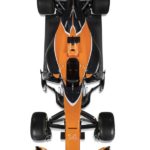
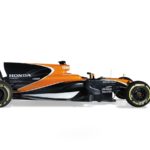
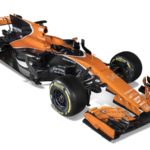
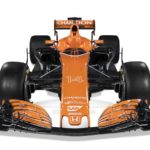
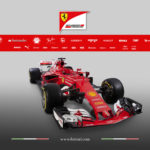
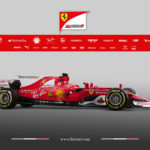
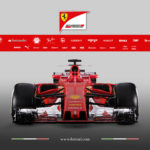
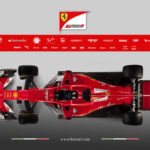
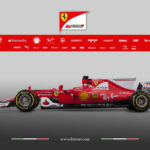
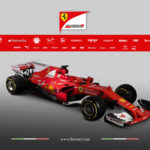
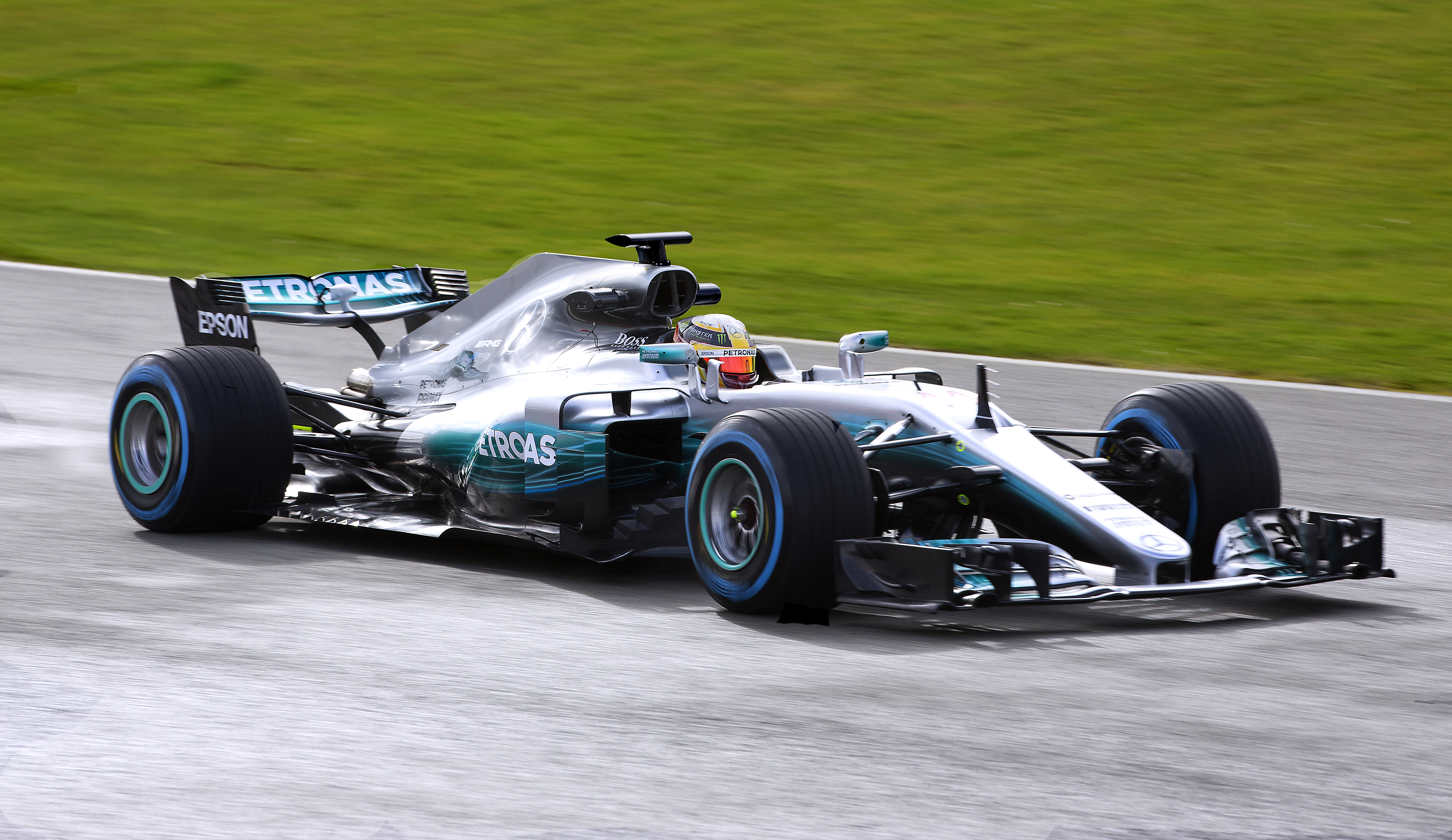
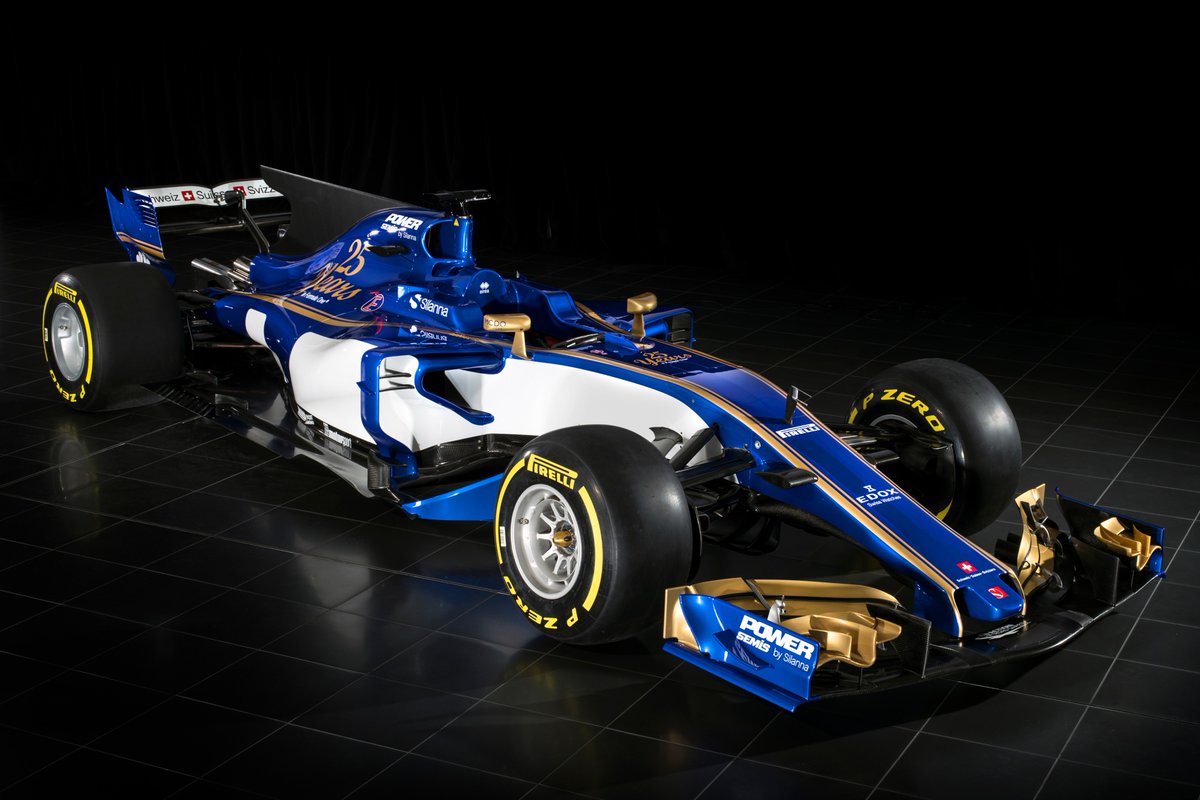
The new Sauber C36-Ferrari has completed the very first laps of the Circuit de Catalunya in Spain for a filming day ahead of pre-season testing for the 2017 Formula 1 season.
Latest
-

Force India’s VJM10 Breaks Cover
The Sahara Force India Formula One team launched their 2017 contender, the VJM10, today at the Silverstone Circuit.
With all the sponsors and media around the two driver for Force India, Sergio Perez and Esteban Ocon, pulled off the covers off the VJM10. The car cuts an imposing figure with it’s low and wide stance.
“I can’t remember being more excited ahead of a new season,” said Force India Team Principal Vijay Mallya.
“The VJM10 looks aggressive and purposeful, and is the result of a huge effort behind the scenes over the last twelve months,” he added.
Mallya hit back at Renault Team Principal Cyril Abiteboul saying: “It’s not the amount of weapons but the quality in your armory!”
Force India have targeted a top 3 finish in the constructors championship this season after a very strong 4th place finish in 2016.
“This year the cars are completely new and nothing can be carried over from previous years,” explained Chief Operating Officer, Otmar Szafnauer.
“Although we have completely new aerodynamics on the VJM10, it’s fair to say that our aero philosophy is very similar to 2015 and 2016.”
Talking about the technical challenge of designing the 2017 car, Technical Director Andrew Green said that his team was under no illusions in designing the 2017 car and that it was a steep learning curve for them.
“It’s definitely a big overhaul; one that requires a change in mentality,” said Green.
“It took a bit of time to adjust at first, but we are there now and I am confident we know where to look and where the performance is coming from with this car.
“The development slope is incredibly steep and we are going to see significant updates to the cars at regular intervals, right from the start; it’s going to be big updates and I don’t think development will start to taper off any time soon.”
Photo credit: Sahara Force India Formula One Team
-

Renault Sport F1 Unveils 2017 Formula 1 Car
The Renault F1 team became the third team to reveal its 2017 car, the Renault R.S.17, today in London.
Following images released by Williams and Sauber of their 2017 cars, Renault revealed their car today in front of reporters and sponsors. The event was broadcast live on YouTube and Facebook.
Renault have kept with the yellow and black livery this year but have incorporated more black into the design. The low and wide rear wing and the wide tyres make the car seem lower and faster already. As we’ve seen on the Williams and Sauber, Renault have also incorporated a shark fin behind the engine cover and a stub nose.
Jérôme Stoll said that the aim for Renault this season is to finish fifth in the championship. It was also announced the Renault Ambassador Alain Prost has now been appointed as a Special Advisor to Renault Sport F1.
Piloting the R.S.17 for Renault will be Nico Hulkenberg and Kevin Magnussen with Sergei Sirotkin appointed as test driver.
Ladies & gentlemen… Meet our 2017 challenger, the @RenaultSportF1 R.S.17! #RS17Launch pic.twitter.com/o3veTcFJeQ
— Renault Sport F1 (@RenaultSportF1) February 21, 2017
-

Bigger, Faster, Wider in 2017
With the 2017 field about to head into pre-season testing and with all the cars about to be unveiled the anticipation is building. The narrative for the new 2017 rules is that cars will be wider, bigger and faster with some saying that the cars will be 4-5 seconds a lap faster. Hence, several circuits on the F1 calendar have been advised to beef up their safety measures and increase the layers of armco at some high-speed corners.
The cars will look very different this year too. The most noticeable changes are the wider and lower rear wings and the wider tyres. The general idea behind these changes is to make racing more exciting for the fans by making the cars faster and tougher to drive which will make it more physically demanding on the drivers.
The Front Wing
The front wing is undoubtedly one of the most important aerodynamic pieces on an F1 car. It is the first component to receive airflow and it affects other aerodynamic elements behind it. The front wing channels the air under, over and around the sides of the car to be used by the other components such as the barge boards, side pod wings, diffuser and rear wing.
For 2017 the width of the front wing has been increased to 1800mm , up from the 1650mm from 2016. The overall shape of the wing will take on a deltoid (swept back) shape with the middle of the wing further forward than the outer most edge.
The overall width of the car has been increased from 1800mm to 2000mm and further back, the maximum width of the floor and sidepods has been increased to 1600mm, up from 1400mm. The increase in width means an increase in the size of the barge boards to better deal with the tyre wake from the front wheels.
Tyres
The 2017 tyres have been drastically changed by the F1 tyre supplier, Pirelli. In order to aid the faster cornering speeds and faster cars, the tyres have been made wider and bigger.
The front tyre width increases from 245mm to 305mm while the rear tyres increase in width from 325mm to 405mm. The diameter of the front and rear tyres has increased by 10mm. However, the rim size of 13-inches remains unchanged.
Rear Wing & Diffuser
The rear wing will look very different this year as well. The rear wing structure for 2017 has been moved 150mm rearwards and 150mm lower, down from 900mm which will give it a swept back look. In addition to the lower rear wing the overall width has also been increased from 750mm to 900mm. The new rules make further provision for the rear wing to start narrow and curve outward to the wider width.
With the swept back rear wing, the height of the diffuser will be increased from 125mm off the ground to 175mm off the ground. Teams will now be able to start the incline of the diffuser 175mm ahead of the rear wheels compared to right at the rear wheels in 2016.
The plank length under the car will be reduced by 100mm as well.
With all the modifications and the wider tyres, the minimum weight of the cars is set at 728kg. This is a considerable increase when considering that in 2016 the minimum weight of the cars was set at 702kg. The increase in weight should mean slower lap times, but the increased mechanical and aerodynamic grip on the cars has effectively cancelled out the loss in time and has actually translated into a gain in lap time.
Demand on Drivers
The faster cornering speeds expected this year places a bigger physical demand on the drivers. The cars are expected to be harder to drive and with the added weight of the bigger tyres, harder to steer.
Mi tipo de “siesta” este invierno… 🤔 // my kind of “siesta” this winter… 😅🤔 pic.twitter.com/OEeq7xQvKS
— Carlos Sainz (@carlosainz) February 9, 2017
Ahead of the 2017 drivers have been giving us a sneak peak of their training regimes. The faster cornering speeds expected this year require the neck muscles of the drivers to be much stronger. There have been some interesting exercise techniques being used by drivers to strengthen their neck muscles ahead of the start of the season.
One thing’s for certain. The drivers this year will be the fittest and the strongest they’ve ever been.
-

F1 2017: Williams Steal The March
The Williams revival has begun. Late last week the privately owned team revealed the first render of what their 2017 challenger, the FW40, will look like.
As is always the case the first time a new F1 car is unveiled the team does not want to give away any of the major details until they have to. More of the aerodynamic changes will likely been seen on 27 February, the first day of testing.
Nevertheless, some of the highly anticipated 2017 changes are clear to see in the computer rendered image of the Williams. The most striking difference in the wider and lower rear wing. From the angle of this image it isn’t easy to distinguish the increase in the width of the car but the smaller, and slightly lower, sidepod air intake are noticeable.
The wider front and rear tyres are also clear to see. The bigger tyres also mean thicker and stronger suspension arms in order to deal with the increased load. Another notable difference is the engine air intake, above the cockpit, which appears significantly bigger than in 2016 and follows a trend set by engine-supplier Mercedes. In this image it appears as if Williams have opted to maintain a similar nose-design to its 2016 car. The chances are that the nose section in this image is a bluff by the team.
The overall impression of the FW40, so named for Williams’ 40th anniversary, is a sleek, contained design which doesn’t reveal too much of what’s likely truly up the team’s sleeve.
The Grove based team dominated the news cycle late last week with several announcements. The first was signing of Dirk De Beer as head aerodynamicist. De Beer’s most recent post was alongside James Alison, now at Mercedes, at both Ferrari and Lotus. De Beer will commence his new position on March 1st.
“I am extremely pleased to be joining Williams,” said De Beer. “The team has an incredible heritage in Formula One, and I’m proud to now be a part of that. I’m looking forward to working with Dave Wheater and the Williams aero team to help continue driving forward the development of the car throughout the season and beyond.
Deputy Team Principal, Claire Williams added: “We’re delighted to have someone with Dirk’s vast experience joining us. Having spent several years as a Head of Aerodynamics in Formula One, his knowledge and technical expertise will undoubtedly be a great asset to the team in our continued push to restore Williams to the front of the grid.”
While it is early days yet for the 2017 season Williams says they’ve put a lot of work into re-structuring the team but stops short of putting any concrete expectations on the 2017 season. “But we have to move up from fifth,” she said.
-

F1 2017: F1 2017: Team-by-team Guide, Part 2
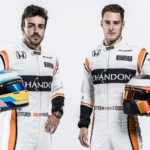
McLaren – Fernando Alonso & Stoffel Vandoorne
Given the results it’s produced over the last two seasons it’s safe to say that McLaren’s renewed partnership with Honda has been miserable. As proud and prominent a company Honda may be there is no doubt that they underestimated the task of re-entering the sport.
Fernando Alonso and 24-year-old Stoffel Vandoorne will drive for the team in 2017. In the 2016 Bahrain grand prix Vandoorne made his debut as Alonso sat out with fractured ribs from a crash in Australia. The Belgian driver not only out-qualified teammate Jenson Button but when on to finish in tenth, scoring one point for the team. What was most impressive about Vandoorne’s grand prix debut was the ease with which he slipped into the role of race driver. There were no wild off-track moments and hardly any mistakes. Regardless of the car’s performance in 2017 he’s unlikely to rattle Alonso’s cage but he has already revealed himself as a driver to watch.
For a driver of Fernando Alonso’s caliber 2017 will be catalyst for his future in the sport. It’s unlikely, if McLaren were to underperform again, that he would stick around for much longer. It’s unlikely that he’ll slip into retirement either given his hunger for success. Come 2018 there is likely to be a plethora of options and all of them would welcome Alonso with open arms.
Toro Rosso – Carlos Sainz JR & Daniil KvyatThe sister Red Bull team should have had a much better 2016 season. But running a year-old Ferrari engine encumbered it. This season they revert back to Renault power and with a good chassis they could, potentially, threaten a team like Force India.
For one of its drivers, Russian Daniil Kvyat, it’s likely the last chance to make a real impression. His very public demotion from the Red Bull team last year was a spirit breaker and he took months to show some sort of recovery from it. But he did so as he fiercely held off her replacement Max Verstappen at the 2016 Singapore grand prix. On the other side of the garage Carlos Sainz Jr. must underline the enormous talent shown in the previous season. If he does, a better drive at a bigger team is definitely in his future.
Sauber – Marcus Ericsson & Pascal WehrleinIn the nick of time the Swiss-based team was given a new lease on life from Swedish investment firm, Longbow Finance. Though an independent team Sauber has rich history in the sport. Much credit must go to Monisha Kaltenborn and her team for continuing to fight for a team in a near financial death spiral. Sauber has already stressed the importance of chassis design and development in the new season. Thanks to relatively comfortable financial position the team will be able to maintain a program of development in 2017 unlike in 2016.
Marcus Ericsson remains as driver and while his performances have been solid an uncompetitive car has dwarfed them. Pascal Wehrlein slots in alongside and has a lot to prove to the paddock and himself. He will feel hard done by for not getting the Force India or Merc drive. But there’s a reason he didn’t get – the powers that be didn’t think him ready to step up. 2017 is his chance of changing that opinion not just on the track but in the garage too.
Renault – Nico Hulkenberg & Jolyon PalmerThe French team is very much in a re-building phase and wouldn’t expect to make a massive splash in the new season. But their expectation will be to see a steady improvement throughout the season.
With several crashes and lackluster showings Jolyon Palmer has not impressed in the Renault. And now he’ll be matched up against one of the most highly rated drivers on the grid in Nico Hulkenberg. German-driver Hulkenberg is the sort that fits well into any team but is running short on time to make it into one of the top teams in the sport.
Haas F1 – Romain Grosjean & Keven Magnussen
The American-owned team started the 2016 season like a house on fire. That fire has dampened slightly but it is still a team of immense potential that is run, by Gene Haas, in the best way possible.
There is a sense of unfulfilled potential when you think about Romain Grosjean. His stint in the Lotus a few seasons ago looked like it would be the springboard to greater things but it hasn’t worked out for the Frenchman. But he’s a quality driver who should easily have the measure of teammate Kevin Magnussen if he can learn how to drive around the issues that may be present in the 2017 Haas car.
-

Dirk De Beer Joins Williams as Head of Aerodynamics
The Williams Formula 1 Team has announced that Dirk De Beer will join the team as Head of Aerodynamics.
De Beer will commence his role at the Grove based team from 1 March 2017.
His recent stint in F1 was at Ferrari alongside James Allison, who was announced as Mercedes Technical Director from 1 March 2017. Before working at Ferrari, De Beer worked as an aerodynamicist at the Lotus F1 Team(Renault) and before his stint at Lotus he was at Sauber.
“I am extremely pleased to be joining Williams,” said De Beer.
“The team has an incredible heritage in Formula One, and I’m proud to now be a part of that. I’m looking forward to working with Dave Wheater and the Williams aero team to help continue driving forward the development of the car throughout the season and beyond.
“I would like to thank Williams for giving me this opportunity.”
Deputy Team Principal, Claire Williams added: “We’re delighted to have someone with Dirk’s vast experience joining us.
“Having spent several years as a Head of Aerodynamics in Formula One, his knowledge and technical expertise will undoubtedly be a great asset to the team in our continued push to restore Williams to the front of the grid.”
-

FIA Clarifies Sale of 1% Share in F1 Holding Company
The FIA have moved to clarify comments about their sale of the 1% holding in Delta Topco(The holding company of the commercial rights of Formula 1).
A report on Forbes accused the FIA of a conflict of interest when selling the 1% share of Delta Topco, which at the time of sale to Liberty Media was worth $80 Million.
The issue was that the FIA, as the regulatory body of F1, needed to give approval of the sale of F1 to Liberty Media. The FIA, which owned 1% of Delta Topco, could only cash in on the 1% if F1’s commercial rights, which were owned by Delta Topco, was sold.
The FIA gave approval and was handed a cheque by Liberty Media.
In a statement released by the FIA on Thursday 16 February 2017, they clarify all the allegations made in various reports. They’ve also said that they are willing to prove that there was no conflict of interest during the sale of F1.
Full statement below:
“In light of this, the FIA wishes to make clear the following once again:
- Firstly, the prize money allocated in the Formula One World Championship is done so in accordance with the bilateral agreements that exist between each team and the Commercial Rights Holder (CRH). The FIA has no knowledge of these agreements
- Secondly, there is no conflict of interest on the part of the FIA with regard to its approval of the change of control of the CRH which has been approved by the World Motor Sport Council taking into consideration exclusively the terms of the existing agreements between the CRH and the FIA and the best interests of the Championship
- As per the Agreements made in 2001 for 100 Years, the FIA could only have withheld its consent in the event that the change of control would materially alter the ability of the CRH to fulfill its obligations; it is obvious that the taking of control of the Formula One Group by Liberty does not create such a risk, and nobody has ever suggested a different view in this respect
The FIA would naturally be happy to demonstrate the absence of any conflict of interest to any competent authority that may so request.
Once again, the FIA looks forward to its collaboration with both Liberty and the Formula One Group to create a constructive relationship that will ensure the continued success and the development of the FIA Formula One World Championship in the long term.”
-

James Allison Joins Mercedes as Technical Director
Former Ferrari Technical Director James Allison will take up the Technical Director Role at Mercedes.
Allison, who left Ferrari in the middle of the 2016 season after a shakeup at Ferrari will join the Brackley based outfit from 1 March 2017 taking up the role previously held by Paddy Lowe. He will report directly to Mercedes Motorsport Boss Toto Wolff. Allison will oversee will have numerous managers reporting to him covering all aspects technical aspects of the team.
“I am very excited to be getting back to work after this time away from the sport,” said Allison about his appointment at Mercedes.
“It’s a massive privilege to be given the trust of a position in the team that has done so spectacularly well in the past three seasons.
“I am really looking forward to playing my part in the helping Mercedes go from strength to strength in the coming years.”
Toto Wolff added:” I am delighted to welcome James to Mercedes and very much looking forward to working with him.
“Our technical team is extremely skilled at every level and at the top of its game after delivering three world championships in a row.
“It wasn’t an easy task to find the right personality who can strengthen our experience group of engineers, give our talented young team members the space to develop and also bring his own vision to this role.
“James is a sharp engineer; I think we have found the perfect guy and the right fit with out senior leaders.”
-

F1 2017: Team-by-team Guide, Part 1
Mercedes – Lewis Hamilton & Valtteri Bottas
Given their ominous and unbeatable run since the start of the hybrid era Merc automatically start the new year as favourites. However, this ‘theory’ is based solely on what’s gone before. In reality, there is nothing to suggest that the Silver Arrows’ dominance will continue into the vastly different 2017 season. Nevertheless, even if they don’t brandish the same sort of advantage over the rest of the field there is a reasonable expectation that they’ll be mixing it at the front.
The Silver Arrows enter an interesting period where its driver line-up is concerned too. In Lewis Hamilton they have a three-time world champion who is prodigiously fast and who still seems to have an incredible hunger for winning. However, Hamilton showed his fallibility through several costly errors on track and a few peppery statements off it.
Red Bull – Daniel Ricciardo & Max VerstappenWith the virtuoso Adrian Newey in the stable the new aero rules could play right into Red Bull’s hands. In 2016 the Austrian team proved that their power unit was the only hindrance to their competitiveness. If the Tag Heuer-branded Renault power unit can match its Merc counterpart the Red Bull will be exceptionally difficult to beat.
Although Max Verstappen exploded onto the scene and electrified more than a few supporters Daniel Ricciardo still had the measure of the teenaged Dutchman. Verstappen’s biggest test this season will be to, firstly, consistently out-perform his Aussie teammate. What’s more, Verstappen’s biggest challenge will be to deal with the weight of expectation. In 2016 he had near free reign; if he performed well it was a bonus for the team, if he didn’t they would understand that he was dropped into the deep-end. Now he is expected to deliver every time he’s strapped into cockpit.
Ferrari – Kimi Raikkonen & Sebastian VettelThere is such a thing as famous last words but Ferrari’s season could hardly be worse than in 2016. The team failed to win a single race and made several, embarrassing mistakes. Nevertheless, the Maranello-based team is keen to turn things around. They’re reportedly doing so with an innovative new multi-jet system for its internal combustion engine that will limit reliance on the turbocharger.
It’s unlikely that there is a more harmonious driver pairing in the paddock than Kimi Raikkonen and Sebastian Vettel. The two teammates work in perfect symmetry with the team with little to no ego getting in the way of the task at hand. Rumours of Raikkonen’s future will undoubtedly begin to swirl as soon as he hits the track that but as history has shown it couldn’t bother him any less. There is little question about the Ferrari drivers’ ability to deliver. Rather the question is about what they’ll be given to drive.
Force India – Sergio Perez & Esteban OconFor a privately-owned team Force India’s likely expectation will be to finish fourth in the constructor’s championship as they did in 2016, perhaps to score a first win if the cards fall their way. They’re a team that regularly punches above its weight but is unlikely to do better than last season.
It’s a big year for Sergio Perez and his future in F1. Several outstanding performances have proven his ability but he’s yet to translate it into a drive for a top team. With Bottas on a one-year deal at Mercedes a standout season from Perez could catapult him into the seat in 2018. Despite being favoured over Pascal Wehrlein Merc prodigy Esteban Ocon, who is still finding his feet in the sport, is highly unlikely to show Perez the way in 2017.
Williams – Felipe Massa & Lance StrollThe Claire Williams-run operation’s ambition is unlikely to be a title in 2017. However, the aim will be to restore the legendary team’s name to at least fourth in the standings. They’ve already completed a massive coup by snatching Paddy Lowe from Mercedes. While it’s unclear if Lowe will take up his new position immediately the Englishman is one of the most highly regarded leaders in F1.
Valtteri Bottas’ departure to Merc has cut short Felipe Massa’s retirement and while the Brazilian’s stock in F1 isn’t nearly as high as it was in the mid-2000s his level of experience was attractive enough to Williams. Alongside the one-time runner-up will be Canadian teenager Lance Stroll. It will be a learning curve for Stroll but expect him to take the fight to his veteran teammate in terms of outright speed.
Part 2 coming soon.