Tag: testing

  • F1 2020: Testing Diary – Week Two

    F1 2020: Testing Diary – Week Two

    The two pre-season tests at Spain’s circuit de Barcelona Catalunya has concluded and true to Formula 1 form has produced more questions than answers.

    Mercedes reliability

    The first pre-season test was highlighted by an incredible run of reliability as drivers pounded around the Catalunya circuit for hundreds of laps without breaking down. But the second week of testing brought with it a number of mechanical breakdowns.

    An on-track stoppage for Vettel in the second week slightly curtailed his running. However, it was later found to be a minor problem that was easily mended. Ferrari was able to re-install the repaired engine that ran issue-free.  It wasn’t quite the same for Mercedes. While the works Mercedes team have emerged with what many believe to be the quickest car on the grid there are some questions over the reliability of the engine.

    In the six days of testing Mercedes were forced to run three engines after suffering failures. Williams, powered by Merc, also ran three engines with deputy team principal Claire Williams confirming that the breakdowns were all different in nature.

    Mercedes don’t think it’s a major concern but it is a potential chink in the armour ahead of the 2020 season. “It’s just not quite where we want it to be reliability wise,” said Lewis Hamilton. “But I am sure they are back at the factory now working hard to rectify whatever the issue is.”
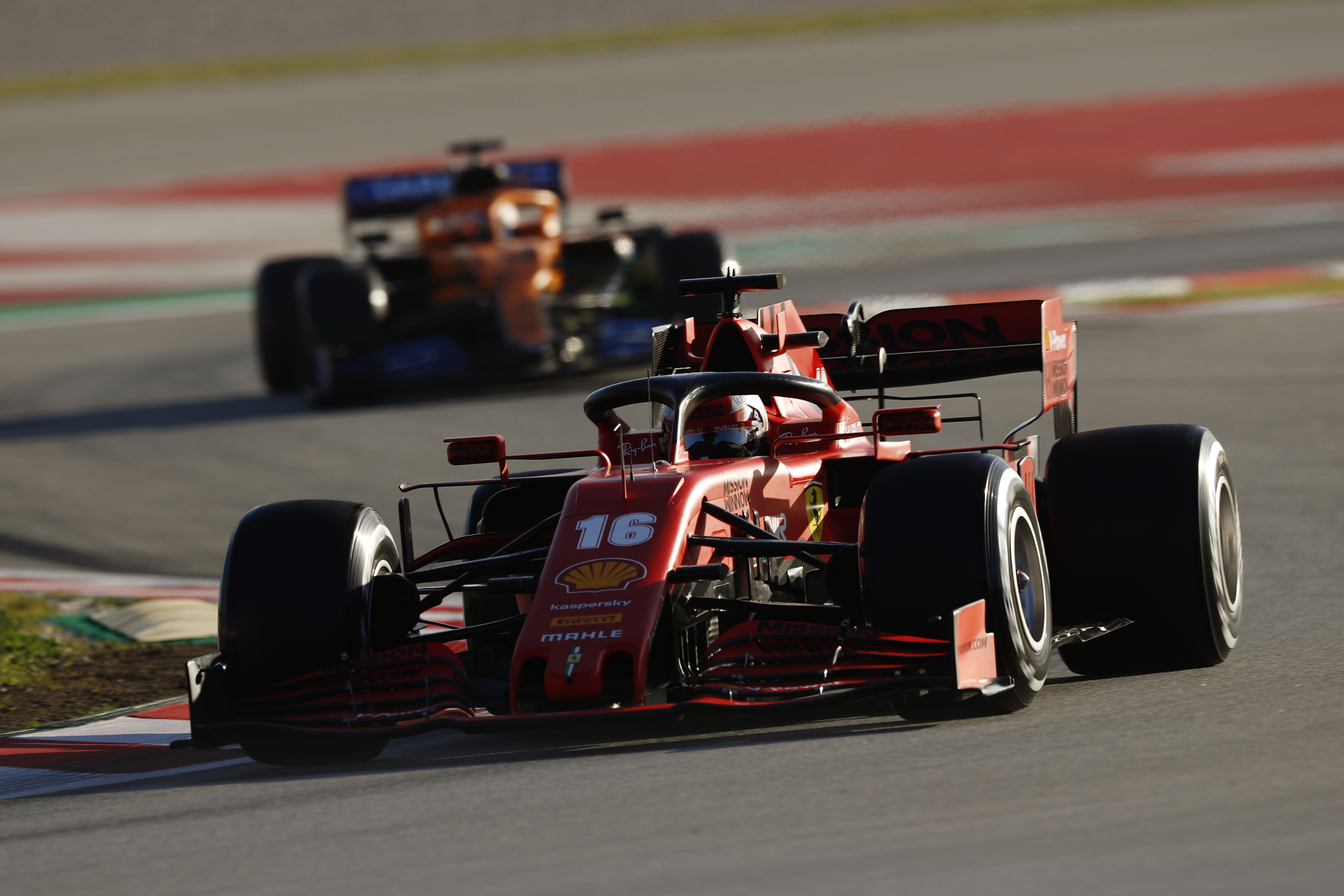
    2020 Barcelona February testing IIMidfield

    After a strong start to testing Racing Point is not ruling out the possibility of challenging Ferrari and the new car even has Sergio Perez proclaiming it the best car he’s ever driven in his career. For the rest of the of the midfield teams, outside the Big Three, it’s a question of wait and see.

    For now long run pace and relative performance in Spain suggest a close contest in the midfield. Haas F1 team principal Guenther Steiner saying that there is no one of knowing the true pecking order. “We may be at the front [of the midfield] or at the back. We don’t know,” said Steiner.

    While McLaren appears to be in a fight with Renault they are wary of Alpha Tauri (formerly Toro Rosso) who in turn are keeping a close eye on Haas and Alfa Romeo. It’s clear too that Williams have made significant strides forward in comparison to 2019 but just how much progress is still unknown. “Certainly the one of the biggest differences is the build quality as has changed dramatically from this time last year,” said deputy team principal Claire Williams. “That’s been really great to see, bringing a car that’s in really good shape, that comes out the box to a very high standard of which we should be proud at Williams.”

    Pecking order

    Pre-season testing is hardly definitive but it’s safe to say that barring unreliability Mercedes appears to have delivered a quick car. Ferrari’s openness on being behind both Merc and Red Bull and looking over their shoulder to Racing Point is a bit suspicious. It may just be their way of not heading to Australia as the center of attention and with the expectation of winning, as they did in 2019. Or it may well be true. Ferrari may be truly wary of Racing Point. In that is the beauty of a new Formula 1 season. As important as pre-season testing is there is no way of truly knowing what the pecking order will be. But all will be revealed when they roll out for qualifying in Australia.

    All images courtesy of Pirelli Motorsport
  • F1 2020: Testing Diary – Week 1

    F1 2020: Testing Diary – Week 1

    The first four-day test has concluded at Spain’s Circuit de Barcelona Catalunya and has raised numerous talking points and more than a few eyebrows.

     The Big Three

     Ferrari team principal Mattia Binotto said in a press conference that the Maranello-based team might well be behind both Mercedes and Red Bull in the early part of the season. But the initial reports from both Seb Vettel and Charles Leclerc is that the 2020 car, dubbed the SF1000, is a definite improvement from last season’s car.

    This is a different approach from Ferrari. In 2019 the team were upbeat and seemingly sure that they were heading to Australia well ahead of Mercedes. It wasn’t the case and the team spent the better part of the season playing catch up. This year they’ve taken what appears to be a more measured approach. There were no performance runs in the first week of testing and the engines were run at a very conservative mode for most of it too. It could be that they’ve decided to take the same, more cautious, approach with what they are saying too. It might well be smoke and mirrors and Ferrari’s attempt to not get ahead of themselves after being burnt in 2019.

    Here is what we do know for sure. The long runs during the first test showed a car quite heavy on the tyres with the laptimes deteriorating quite a bit quicker than nearest rivals Merc and Red Bull. The team is also expected to introduce a bevy of new parts for the second test that could, if Binotto’s admissions are true, push them closer to their competitors.

    2020 Barcelona February testing IThere is a good feeling around the Red Bull garage that they have unquestionably taken a step forward. Max Verstappen racked up more than 100 laps in his first day in the car and declared it “fast everywhere”. How much of a step forward they have made and whether it is enough to beat Mercedes remains a mystery. But there is real optimism that Red Bull has produced a car that could well fight for the championship from the beginning of the season. It remains to be seen however if this optimism is a genuine reflection of pace or merely hype.

    One of the biggest talking point to come out of the first test is Mercedes’s introduction of a moveable steering wheel which tech director James Allison has named DAS – Dual Axis Steering. From on-board footage of Lewis Hamilton’s car it became clear that he was pulling the steering wheel towards himself and then pushing it back before braking for either turn one or turn nine on the Catalunya circuit. It is believed, but unconfirmed by Mercedes; that the DAS system alters the toe, the lean angle of the front wheels, on the straits.

    By adjusting the toe out it straightens the wheels thereby creating less aero drag and less scrub on the front tyres as they are now pointing straight ahead instead of at an angle. It is speculated that because the tyres point straight ahead it creates less resistance and therefore aids with tyre temperature and wear. The question remains as to how much of an advantage this system gives Merc. Some in the paddock believe that DAS is not a game-changer and that the rest of the Mercedes package for 2020 is far more important in providing performance.

    Nevertheless, the DAS system is an incredibly feat of engineering that strikes right at the heart of what makes F1 technology the dazzling marvel that it is. While some might wish for the DAS to be illegal Merc has confirmed that the FIA has known about the system for some time and that they are confident of its legality.

    Racing Point

    When the Racing Point pulled out of the garage and rolled down the pitlane on the first day of testing it raised more than a few eyebrows and it wasn’t because of the slightly brighter pink livery either. You don’t need any technical nous to understand that Racing Point had produced, virtually, a carbon copy of Mercedes’s 2019 car. From the slightly bulbous nose through to the rear suspension it’s so similar that it has been nicknamed the ‘Pink Mercedes’ in the paddock.

    2020 Barcelona February testing IRacing Point isn’t trying to hide the effective ‘photocopying’ of the 2019 Merc either. Along with tech director Andy Green they have patently admitted to taking thousands of photos of the 2019 Merc and simply copying the design. And it’s worked too, at least to some degree as a smiling Sergio Perez proclaimed that he finally has a racecar to fight with.  

     Williams

    The Grove-based team could hardly have done worse than they did in 2019. The good news is that from all indication they are doing significantly better than twelve months ago. Not only was the team ready and raring to go on the first day of testing but also they were first onto track with a clear statement of intent.

    George Russell, now in his second year with the team, is confident that the team wont simply be making up the numbers this year and that they will be racing in 2020. De facto team principal Claire Williams too was positively buoyant and with a smile on her face said that the target is getting into Q2, the second part of quali, points finishes, and a comprehensive upgrade schedule for 2020. There is unlikely to be a single person in the paddock who wouldn’t be happy that Williams has started to climb out of the doldrums of the last few years.

    The second test, scheduled to run at Catalunya this week, is expected to see the focus shift somewhat towards more work on performance, meaning more focus on shorter runs and ultimate pace.

    All images courtesy of Pirelli Motorsport
  • F1 2018: Testing Diary, Week One

    F1 2018: Testing Diary, Week One

    The first pre-season ahead of the 2018 has been one of the most difficult to read anything into. The main reason being the cold, even snowy, weather for much of the first week of testing at the Circuit de Catalunya.

    Nevertheless, even though the fuel loads, engine mappings, and run plans are unknown to outside observers there is always something to learn from cars on track.

    Mercedes

    It is easy enough to assume that Mercedes has built a good car for the 2018 season. With the exception of a suspected oil or fuel pressure issue early in the week, there didn’t appear to be significant issues with the reliability of the W09. Though they hit the track relatively slowly as the week progressed so the car too began to come into its own. What was evident was that both drivers, Lewis Hamilton and Valtteri Bottas, seemed to struggle with oversteer while in the process of heating the tyres. Naturally, it’s still a work in progress but Mercedes would be pleased with their work thus far.

    Ferrari

    In contrast, Ferrari seemed to start the week on the front-foot with a car that appeared to be an impressive step forward. The SF71H looked stable and showed no reliability issues whatsoever. As the test progressed however Ferrari seemed to stagnate slightly in its performance. There was no real improvement from the car that rolled out of the pitlane on day one. This could very well have been Ferrari’s run plan, which will make their performance in the second test all the most interesting. It is quite clear however that Ferrari and Mercedes maintain an advantage in engine performance.

    Red Bull

    It was a rather muddled few days for Red Bull. While the first day likely went according to plan much of the rest of the test session was spent fidgeting with aero parts. Similarly, Max Verstappen’s time in the cockpit was affected by fuel leaks and ending up in the kitty litter. The good news is that when it’s on track and running smoothly the Red Bull looks a good car. It may be early days yet but it is quite evident that the Renault engine is still somewhat adrift of the performance of the Mercedes and Ferrari engine.

    Renault and McLaren

    The Renault works team look to be the leaders of the mid-field after the first few days of testing. The car looks settled in the hands of both Nico Hulkenberg and Carlos Sainz Jr and appears to be a good platform to build from for 2018. While Renault may be topping the mid-field it’s likely only by a slight margin over McLaren. Fernando Alonso and Stoffel Vandoorne’s new orange-and-blue liveried car looks quite solid and, most importantly, reliable with the Renault power unit now in the back of the car.

    Toro Rosso

    The announcement that Toro Rosso was partnering with Honda was a surprise given the Japanese manufacturer’s dire runs with McLaren. However, in stark contrast to 2017 the Honda engine ran with notable reliably. While the Toro Rosso didn’t set any headline grabbing laptimes it seems that the team and Honda are willing to work together which will be vital for their season prospects.

    The second pre-season test commences on the 6th of March ahead of the opening round of the season in Australia on March 25th.

  • Bahrain In-Season Test Round Up

    Bahrain In-Season Test Round Up

    The first Formula 1 in-season test took place at the Bahrain International Circuit on 19 and 19 April. Pirelli also used the opportunity to test the 2018 tyres with Ferrari on the Tuesday.

    The test saw a mix of current drivers and young drivers with a couple of new faces with the likes of Sean Gelael in the Toro Rosso, Oliver Turvey in the McLaren, and Gary Paffet in the in Williams.

    Pirelli, together with Ferrari ran the 2018 tyres on Tuesday. Head of Car Racing at Pirelli, Mario Isola said that Pirelli was able to complete their programme with Ferrari for the day. Despite the delay with the car due to mechanical problems, officials allowed Pirelli a further 3-hours of running.

    The both test days time sheets were topped by Mercedes with Lewis Hamilton finishing fastest on the first day and Bottas on the second day. While Hamilton had issues on the first day of the test at the beginning he was able to complete 97 laps. That tally was however, exceeded by Bottas on day two of the test. The Finn racked up 143 laps which is the equivalent to just under 1.5 grand prix race distance at 774.916km. At the end of the test Mercedes say that they may have found a solution for their tyre problem’s they’ve been having in the race.

    After a disaster weekend at the Bahrain Grand Prix, McLaren were hoping to try some new ideas around their power unit in the hope that it will bring them some much needed reliability. After the first day of the test with Turvey at the wheel it looked as though McLaren would spend most of their time in the garage tinkering with the power unit. Turvey was the slowest at the end of the first day posting just 17 laps.

    Things looked up for the Woking team on the second day with Stoffel Vandoorne at the wheel. The Belgian clocked up 81 laps for the day and was 4th fastest.

    “Today has probably been our best day this season so far,” said Vandoorne at the end of the 2nd day.

    “It’s the first time that we’ve had a day without any big problems, where we could actually get on with our programme. I think we completed everything we wanted to do today, and we went through a lot of set-up stuff that we didn’t manage to do in Barcelona.”

    “It’s been a very productive day and I’m very happy that we’ve been able to do so many laps. Especially after a difficult day yesterday and a difficult weekend, it wasn’t looking great, but I’m very pleased.

    “For the team, it’s not been an easy week, after a double-header and then coming to the test with so many issues. They’ve been working flat-out, and they’ve done a very good job to get the car back out on track every time.”

    Team Principal Eric Boullier praised the team for the hard work and effort that has gone into these past few weeks. According to Boullier the team were able to get through their entire programme for the day and were able to complete back-to-back test runs.

    “It’s certainly been a trying couple of weeks for everyone at McLaren-Honda, and I can’t thank the team enough for the long hours, hard work and incredible effort they’ve put in after a long period away from home,” said Boullier

    “Oliver and Stoffel, too, have both done a sterling job, and, for Stoffel in particular, the mileage we’ve been able to cover today after difficult back-to-back race weekends for him has been priceless.”

    Haas’ Romain Grosjean who was very critical of the braking issues caused by the Brembo brakes on the Haas was in the car on the first day testing out brakes from Carbone Industrie. The Frenchman felt that the brakes from Carbone Industrie were better, but the situation was made slightly more complicated after Brembo brought updated products to the Chinese Grand Prix which the team had used during the Bahrain Grand Prix.

    The rest of the teams went about their business testing various new parts and configurations on their cars and collecting data with a few issues popping up during the course of the the test.

    The pack up will be quick and the teams ship off to their bases to evaluate all the data collected during the test and prepare for the Russian Grand Prix.

    Bahrain 2017 Test_Overall

  • F1 2017: Official Testing Day 2 Wrap-Up

    F1 2017: Official Testing Day 2 Wrap-Up

    Official testing entered its second day ahead of the start of the 2017 Formula 1 season.

    Three time champion Lewis Hamilton set the early morning pace with a quickest time of 1:20:983 on the red-walled Supersoft Pirelli compound tyres. It was a another difficult day for McLaren as this time Stoffel Vandoorne saw his running curtailed by engine/power unit issues. The McLaren team was forced to change the engine which cost several hours. Vandoorne managed to get back out and completed 40 laps before calling it a day.

    Meanwhile, Canadian rookie Lance Stroll stepped into the cockpit of the Williams for his first official day of testing but binned the FW40 shortly afterwards. While the driver walked away unscathed from the relatively minor crash the team announced an early end to their day’s running as they had no spare parts for the car. Stroll completed a total of twelve laps.


    “It is still early days and I have only done a handful of laps,” said Stroll.

    “I am just getting to grips with the FW40, and there is still a lot of time ahead of us. It was good to finally get behind the wheel to just get a feel for it.

    “Like I said, it is still early days, so I need to do a lot more running before I know exactly where I am and where the car is at. I will have a much better picture once we have more laps under our belts, but it was good to break the ice and I am looking forward to some more running.”

    Elsewhere, Haas F1’s Kevin Magnussen racked up a century of laps and a solid day of run for the American team. The dane ended the days running in fourth with a total of 118 laps under the belt. Red Bull’s Max Verstappen completed his running in third with 89 laps on the board.

    It was a slow start for Ferrari reserve driver Antonio Giovinazzi on his first outing for Sauber. He sat out most of the morning session with a power unit issue. The Sauber team were able to replace the engine and get him out for an installation lap just before the lunch break. He was back out after lunch and completed 67 laps in the Sauber C36.


    “It was a positive day for me, despite the issues we had in the morning,” said Giovinazzi.

    “In the afternoon I was able to get up to speed running a good amount of laps. I want to thank the Sauber F1 Team again for this opportunity. Now I am looking forward to being back in the car tomorrow.”

    Later in the afternoon Ferrari’s Kimi Raikkonen set the quickest lap of the day. His lap of 1:20:960 was set on the yellow-walled soft tyre. Reports were that Raikkonen was not feeling entirely healthy but the Finn nevertheless completed 108 laps for the day.

    Valtteri Bottas took over from teammate Lewis Hamilton in the afternoon and ran several race simulation stints in the W08. The Finnish driver clocked 102 laps by the end of the afternoon.


  • F1 2017: Official Testing  Day 1 Wrap-Up

    F1 2017: Official Testing Day 1 Wrap-Up

    The first official day of testing commenced at Spain’s Circuit de Catalunya on Monday.

    The eagerly awaited first day of testing got off to an expected slow start as the new cars trickled out of their respective garages to set the first installations laps. First out on circuit was Renault’s RS17 but the rest quickly followed suit.

    The first red flag of the testing session was brought out by Red Bull’s Daniel Ricciardo who parked his brand-new RB13 at turn 3. Nevertheless, before the stoppage Mercedes’ Valtteri Bottas had set a quickest time in the 1:24s with a set of Pirelli’s new medium compound tyre.

    This time was soon eclipsed by Sebastian Vettel who put the Ferrari on top of the timing sheets with a 1:23:560. The Ferrari and Mercedes teams easily set the most number of laps in the opening morning of testing. Meanwhile, gremlins struck in the McLaren garage as Fernando Alonso’s car developed an oil system problem. The team estimated a four to five hour period to get to the bottom of the issue.

    McLaren’s problems with their engine seem like a repeat of last years testing and was summed up by AutoSport’s Gary Anderson rather eloquently.

    “It’s not good news for McLaren-Honda to be sat in the garage chasing some kind of oil system problem. The engines coming to this test should all be test-bench run and where the engine connects up to the system of the car should be bulletproof. Using the excuse that this is testing and things will go wrong is rubbish because you only have eight days and you need to hit the ground running. Losing a big part of a day is time you will never recover, and by the time the McLaren runs again, most of its rivals will have built up a lot of mileage. We’ve seen a lot of finger problems for McLaren and Honda during the past few years, and maybe this is the same again. Not a good start to testing.”


    The second half of the day was more productive for the teams that were off to a slow start in the mornings.

    McLaren changed the engine in the MCL32 and sent Alonso out on track for a few laps and to catch on on some running he missed during the morning. Alonso ended his day with 14 laps on the board with a fastest time of 1:24.852.


    Ricciardo was the first one to emerge from the pits after the lunch break and Red Bull were able to get going with their testing program and managed to complete 50-laps before the end of the day. Ricciardo’s fastest lap put him 5th fastest on the day with a time of 1:22.926.

    Mercedes topped the time sheets at the end of the day and had the highest tally of completed laps on the day. Lewis Hamilton jumped into the car after lunch and set the fastest time of the day of 1:21.765. Ferrari’s Sebastian Vettel was the second fastest with a 1:21.878. Vettel completed 128 laps and will welcome a day’s rest when Kimi Raikkonen takes over testing duties on Tuesday.


    After a brief retirement, Felipe Massa completed 103 laps on his return. He set the 3rd fastest time of the day with a time of 1:22.706.

    With limited running, Sergio Perez completed 39 laps for Force India and finished the day 7th fastest ahead of Carlos Sainz who was 8th fastest on the day. ON his first outing for Renault, Nico Hulkenberg set the 9th fastest time of the day completing 57 laps around the Circuit de Catalunya.

    Compared to last year the times are already much quicker and are set to become faster as testing goes on. The times have almost no meaning at this point. The objective for the teams is to get as much mileage on the cars during these few days as possible and learn as much about the car as they can. Engineers will be pouring over the data and will be ready with new setup parameters tomorrow


  • Red Bull, Haas, and Toro Rosso Launch 2017 Challengers

    Red Bull, Haas, and Toro Rosso Launch 2017 Challengers

    No less than three Formula 1 teams launched their 2017 challengers on the 26th of February.

    On the eve of the commencement of official testing in Barcelona, Spain Red Bull Racing, Haas F1, and Scuderia Toro Rosso took the opportunity to launch their new-for-2017 F1 cars.

    Red Bull Racing’s RB13

    Red Bull was first out of the gate with a short and sweet pre-recorded clip released on several social media sites. The premise of Red Bull’s launch video centered on superstition as 2017 car is the 13th built by the Austrian team. The RB13 retains, mostly, the same livery as in 2016 with subtle changes including a bit more red than is normally present. Nevertheless, the matte finish, introduced, in 2016 has been maintained for the new season. Along with the launch of the RB13 the team touted a new hashtag playing up the connotations of the number 13.

    “We are like a swan on the surface and paddling furiously underneath but that is the same as every preseason so generally we are on target,” said Team Principal Christian Horner.

    Chief Engineering Officer Rob Marshall said: “The car is expected to be between three and five seconds a lap faster and most of that gain will come through cornering speeds where the increased downforce on the car will mean the car will go around the corners quicker.”


    Haas F1 Launches the VF-17

    VF17_RIGHT_FRONT_TQA day after filming day pictures were leaked on Twitter, the Haas Formula One team launched their 2017 contender the VF-17.

    In their second year in Formula 1 and their first rule change, the Haas F1 team had a monumental task ahead of them in developing their 2017 car.

    After starting very well in 2016 their season tapered off and although picking up some points they did not finish the 2016 season as strongly as they started.

    The 2017 car with some major changes seems promising for the Kanapolis based team in their mid field fight.

    “I think the pedal box is the same, but all the rest is very different from last year’s car,” said Guenther Steiner, Team Principal of Haas F1.

    “You always try to make a faster car, which is normally a lighter car. Now we can put on more ballast and get better weight distribution.

    “The aero is completely new, as are the tires, so we needed to have some built-in adjustability.

    “Aesthetically, the car has a more aggressive look. It’s lighter and more aerodynamically efficient. Everything we learned from our first car has been applied to our new car.”


    Scuderia Toro Rosso’s STR12

    Toro Rosso was the last team to launch their car for the 2017 season. The launch took place at the Circuit de Catalunya a day before the first day of the pre-season test.

    Toro Rosso unveiled their new car the STR12 with a striking new blue and chrome livery. We at F1Madness think that this is the best livery from all the teams.

    Speaking about the new car, Technical Director James Key says that the 2017 rule changes are the biggest changes he’s seen on a car that he can remember.

    “In my 20 years in F1 it’s the biggest chassis change I can remember,” said James Key.

    “In ’98 the narrow track had just arrived and there were various tweaks up to 2009, when a larger change occurred, but other than the front wing it was still based around principles that we knew. These rules however, include a track change, significantly different tyres and a new aero regulation as well.

    “From a chassis point of view it’s all encompassing with a lot of new things to learn.”

    Key believes that teams now have more aerodynamic freedom with car development this season.

    “It’s nice to have a bit more freedom. We probably haven’t had as many aerodynamic tools to play with since 2008, But then the rules tightened up in 2009 and even further in 2014. Now, some freedom has returned and that’s a great challenge for the aero department.”

    Toro Rosso are expecting more this year after switching to Renault Power Units and feel that after last years turn around they can finish higher in the points this season.


  • F1 2016: Pre-season Test 1 Day 3 – Hulkenberg On Top

    F1 2016: Pre-season Test 1 Day 3 – Hulkenberg On Top

    The third day of testing at Spain’s circuit de Catalunya was headed by Force India driver Nico Hulkenberg.

    The morning running was marked with the introduction to Formula 1 of Indonesia’s first ever grand prix driver Rio Haryanto. The rookie Manor driver seemed comfortable in the early running and put together a solid first few stints. A slight error later on in the morning saw the Manor end up in the gravel trap of turn 5 which prompted the second red flag of the morning.

    The first red flag of the day was prompted by the Toro Rosso of Carlos Sainz as the Spaniard was forced to stop at the exit of the pitlane with a loose rear wheel. The morning was a complete write-off for Ferrari driver Kimi Raikkonen as the team struggled to get on top of a fuel pick-up issue. The Finnish driver was only able to complete three installation laps before lunch.

    Meanwhile, Nico Rosberg continued with Mercedes’ run programme by putting together several race simulation runs in the morning. As lunch rolled around it was Nico Hulkenberg in the Force India heading the timing sheet with a 1:25.286. The German would later improve his time to a 1:23.110.

    The session after lunch saw the two Mercedes drivers swop around with Lewis Hamilton taking over testing duties for the remainder of the day. Kimi Raikkonen was able to put Ferrari on the board after lunch and the Finn completed xx laps for the day. Felipe Massa was the first driver to reach 100 laps on day three of the first pre-season test in the Williams whilst Carlos Sainz also put more than 100 laps on the board in his Toro Rosso.

    Late on in the day’s running Renault driver Kevin Magnussen brought out the red flag as his car stopped on the start/finish strait. It proved a minor blip on the radar as proceedings got underway within minutes. Haryanto was first out on track in the Manor Mercedes on the medium compound tyres. By this stage no driver had opted to strap on the ultrasoft compound.

    McLaren called an end to their day’s running thirty minutes before the close of the session. Jenson Button’s car, which completed only 51 laps, suffered an hydraulic leak.Williams too brought an early end to proceedings after discovering an oil leak of Felipe Massa’s car.

    Toro Rosso driver Carlos Sainz ended the day with 161 laps on the board while Hulkenberg in the Force India heads Romain Grosjean, in the Haas, at the top of the leaderboard.

    POS Driver Team/Car Best lap Gap Laps
    1 Nico Hulkenberg Force India-Mercedes VJM09 1:23.110 – 99
    2 Romain Grosjean Haas-Ferrari VF-16 1:25.874 +2.764 82
    3 Kimi Raikkonen Ferrari SF16-H 1:25.977 +2.867 78
    4 Kevin Magnussen Renault R.S.16 1:26.014 +2.904 111
    5 Nico Rosberg Mercedes F1 W07 Hybrid 1:26.084 +2.974 74
    6 Carlos Sainz Toro Rosso-Ferrari STR11 1:26.239 +3.129 161
    7 Felipe Nasr Sauber-Ferrari C34 1:26.392 +3.282 115
    8 Lewis Hamilton Mercedes F1 W07 Hybrid 1:26.421 +3.311 88
    9 Daniil Kvyat Red Bull Racing-TAG Heuer RB12 1:26.497 +3.387 74
    10 Felipe Massa Williams-Mercedes FW38 1:26.712 +3.602 109
    11 Jenson Button McLaren-Honda MP4-31 1:26.919 +3.809 51
    12 Rio Haryanto Manor Racing-Mercedes MRT05 1:28.249 +5.139 78


  • F1 2016: Pre-season Test 1 Day 2 – Vettel Quickest Again

    F1 2016: Pre-season Test 1 Day 2 – Vettel Quickest Again

    The second day of testing got underway with the circuit de Catalunya bathed in bright sunshine.

    Mercedes driver Nico Rosberg was the first driver on track and the first to set a flying lap as the second day of testing got underway.The majority of the first two hours of the morning were spent on gathering important data that the teams will carry through to the first few races of the 2016 season. Ferrari’s Sebastian Vettel emerged from the garage around mid-day to set the fastest lap of the morning – a 1:24:940.

    By this stage Vettel was the only driver to break the 1:24 barrier. Soon after Red Bull’s Daniel Ricciardo dipped in the 1:24 to go second fastest overall. Fernando Alonso and Lotus’ Jolyon Palmer gave the yellow-walled soft tyre a trundle but did not set a representative time on the softer tyre. The first red flag of the session was brought out by Max Verstappen as his Toro Rosso grinded to a halt in the final sector of the circuit. As the Toro Rosso was recovered to the pits testing was underway again. Nico Rosberg immediately shot to the top of the timing sheets with a 1:24:867.

    A switch onto the quicker, red-walled, supersoft tyre took Ricciardo quickest before the Ferrari of Sebastian Vettel emerged to set a 1:23.658 on the same tyre. Just before the lunch break Daniel Ricciardo fitted the new-for-2016 ultra-soft tyre. He quickly took over at the top of the timing sheet only to be outdone by Vettel’s own run on the purple-walled tyres. The Ferrari driver set a time of 1:22.810.

    haasThe session after lunch was interrupted by the stoppage of Jolyon Palmer’s Renault which had to be recovered to the pits on the back on a flatbed truck. Reports later surfaced that the Renault’s issue may have been turbo related. It brought an early end to Renault’s running with Palmer only able to complete 42 laps for the day.

    By mid afternoon Nico Rosberg had again underlined the reliability of the new Mercedes by reaching the 100 lap mark without any issues. Most of the teams settled into longer stints in the afternoon. Williams driver Valtteri Bottas bucked the trend and opted to run a stint of laps on the orange-walled hard tyres. Similarly, Vettel opted instead for the ultrasoft tyres for run. The Ferrari driver completed only a handful of laps before the drop off in performance forced him back into the pits.

    McLaren can breath a sign of relieve as Fernando Alonso racked 100 laps two hours before the of the day’s running. In stark contrast to McLaren’s fortunes twelve months ago both Alonso and Jenson Button have already reported a much more positive feeling with the 2016 car. Several other drivers including Max Verstappen, Valtteri Bottas, Daniel Ricciardo, Marcus Ericsson, Sergio Perez and Sebastian Vettel all completed more than 100 laps. But it was Nico Rosberg and his Mercedes that set the most laps of the day with a mammoth 172 laps.

    By the end of the day’s running Sebastian Vettel’s 1:22:810 remained quickest overall.

    POS Driver Team/Car Best lap Gap Laps
    1 Sebastian Vettel Ferrari SF16-H 1:22.810 – 126
    2 Daniel Ricciardo Red Bull Racing-TAG Heuer RB12 1:23.525 +0.715 112
    3 Sergio Perez Force India-Mercedes VJM09 1:23.650 +0.840 101
    4 Nico Rosberg Mercedes F1 W07 Hybrid 1:24.867 +2.882 172
    5 Marcus Ericcson Sauber-Ferrari C34 1:25.237 +2.427 108
    6 Esteban Gutierrez Haas-Ferrari VF-16 1:25.524 +2.714 79
    7 Valtteri Bottas Williams-Mercedes FW38 1:25.648 +2.838 134
    8 Pascal Wehrlein Manor Racing-Mercedes MRT05 1:25.925 +3.115 71
    9 Fernando Alonso McLaren-Honda MP4-31 1:26.082 +3.272 119
    10 Jolyon Palmer Renault R.S.16 1:26.189 +3.379 42
    11 Max Verstappen Toro Rosso-Ferrari STR11 1:26.539 +3.729 121

  • F1 2016: Ferrari Passes Crash Test

    F1 2016: Ferrari Passes Crash Test

    The 2016 Ferrari car is well on course to make its debut in February after passing a mandatory FIA crash test.

    The safety regulations of the FIA dictate that all critical areas of a Formula 1 car pass a standardised crash test before it is allowed to be officially entered into any official FIA race.

    The latest team to pass the crash test is Ferrari who received the official stamp of approval after undergoing several tests. Reports are that the Italian team needed several attempts at passing the test because sampled more than one nose for their 2016 challenger. The Ferrari team’s 2016 car is already reported to be quite different from it’s 2015 predecessor and is rumoured to be introducing a short nose concept for the new season. The new nose isn’t so much a reproduction from what we’ve seen on other cars in 2015 but more a mixture between the nosecone sported by Mercedes and Toro Rosso.

    The 2016 Ferrari, still unnamed, is expected to be launched towards the end of February as testing for the 2016 season gets underway in Spain.