Tag: maurizio arrivabene

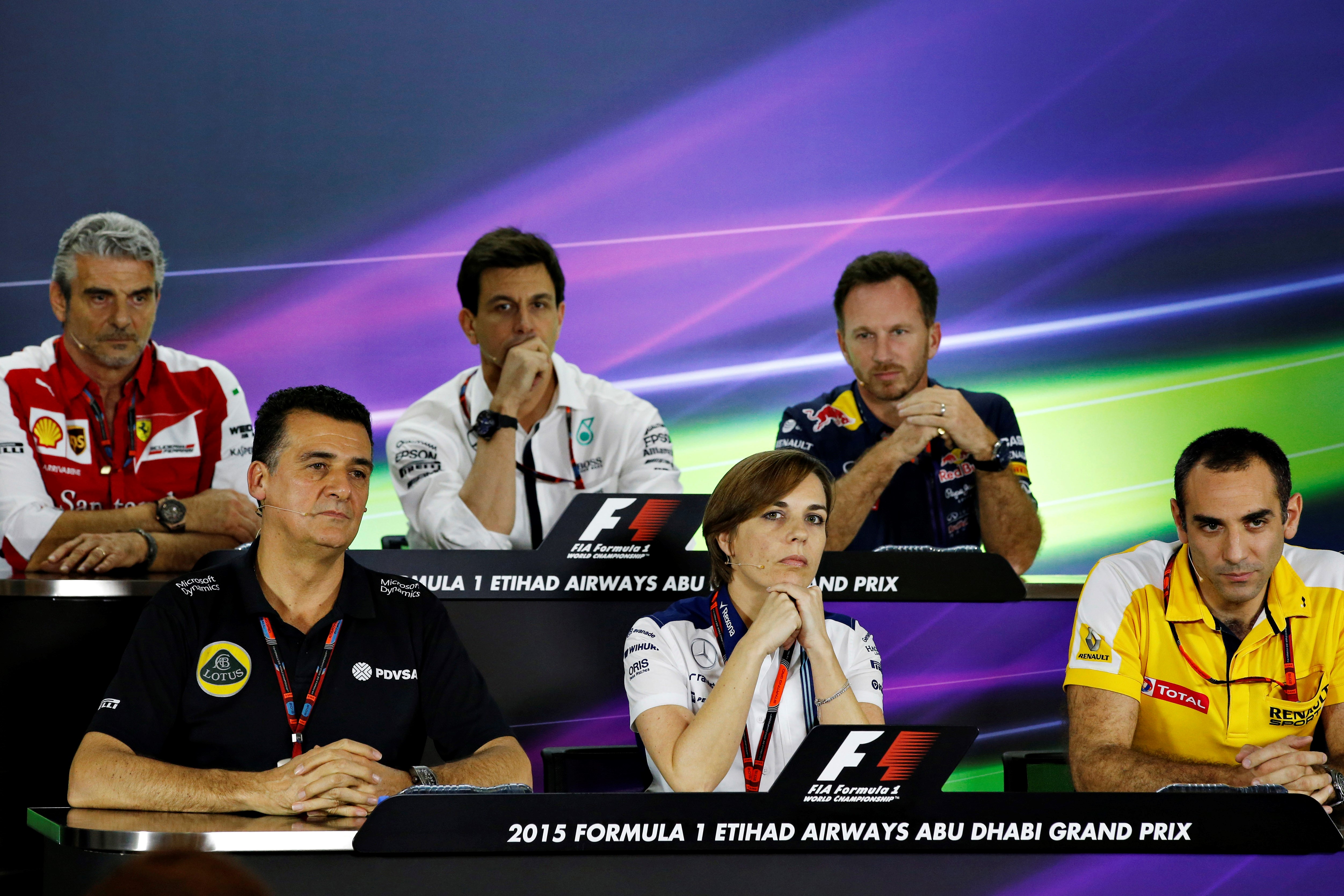
  • 2015 Formula 1 Abu Dhabi Grand Prix: Friday Press Conference

    2015 Formula 1 Abu Dhabi Grand Prix: Friday Press Conference

    TEAM REPRESENTATIVES:

    Cyril ABITEBOUL (Renault)

    Maurizio ARRIVABENE (Ferrari)

    Federico GASTALDI (Lotus)

    Christian HORNER (Red Bull Racing)

    Claire WILLIAMS (Williams)

    Toto WOLFF (Mercedes)


    PRESS CONFERENCE

    Cyril, it’s been a little while since you’ve been here joining us in the press conference. You’ve been talking a little bit recently about next year – larger budgets etc – but can you tell us what exactly Renault will be doing next year in Formula One?

    Cyril ABITEBOUL: Well I’m afraid I can’t answer to that question. I would like to be in a position to be able to answer to that questions, but I am not today. What I can say is that there will be no announcement regarding Renault’s future – short-term or middle-term future – over the weekend, but there will be an announcement, very likely, in the course of next week. We have always said that we would like to do that after the season. Thee season is ending on Sunday, around the start of December and that is what we will do stick to that plan, which is to make an announcement then.

    OK, Federico, if I could come to you, where does that leave you and your thoughts on this?

    Federico GASTALDI: Well, we are on the same page. As I keep saying we have been working, all the time, actually since the Singapore race. We have Renault people already at the factory and it doesn’t change anything. They are the ones who have to announce. We cannot push Renault to make the decision because it’s their call.

    Christian, coming to you, you were quoted this morning as saying that you know now for sure what engine you are going to use next year, but clearly no announcement yet, so what’s holding that up?

    Christian HORNER: Well, we have and agreement in place for next year, so it’s great news that we will be on the grid next year, but unfortunately due to circumstance beyond our control we can’t announce exactly what that is. Perhaps Toto can tell you?

    Toto?

    Toto WOLFF: Can I?

    Coming back to you then Cyril, can you give us a sense of what it’s been like in the past weeks and months, the work that’s gone on behind the scenes and also your own personal ambitions for the brand?

    CA: It’s typical Formula One. I think it has been a proper rollercoaster for us, for me, but also for the whole team, for a lot of people involved, I should say technical people involved in the engine programme. Clearly, Federico made reference to the work being done between Lotus and Renault and it’s fair to say that there is a process going on since the signing of the letter of interest on the 28th of September, there is a process involving a lot of people. I think 50 people have been working night and day on the realisation of a possible acquisition of a majority stake in Lotus. It’s just a project, It’s been a proper rollercoaster, very exciting. I have to say there has been a little bit of frustration on the track. We would have liked to do a better job for Red Bull and Toro Rosso engine-wise, but we always knew it was a long-term game to fix the issues we had. We have not managed to deliver a product that was in accordance to what we would have liked to do with those new regulations, so hopefully we will have the strategy, the time and the resouces to do that in the next few years.

    Thank you for that. Coming back to you Federico, clearly this weekend again a race against time for the mechanics to get the garage and the cars prepared for today’s sessions. Not the first time this has happened. Can you explain the background?

    FG: We have been open in explaining what happened with the team. As everyone knows we have some financial issues. We have been trying to work out a new procedure where the team spends less money. So fortunately between Renault and the shareholders and Mr Ecclestone we kept going but again it’s just the situation we are in in Formula One at the moment. Genii have done a fantastic since they got involved in the team in 2010. We have had podiums, won races, so for a small private team it’s not a bad job.

    Tank you. Coming back to you Christian, can you give us your reaction to the outcome of this week’s F1 Commission meeting and the direction taken, the direction from here in terms of the minimum number of teams that a manufacturer should supply and things like the simplification and cost of the engines. Maybe you could give us your thoughts on those items?

    CH: Earlier in the week there was a positive discussion in the Strategy Group where the independent engine was discussed as an alternative product to being into Formula One and I think the reasons that the FIA and the promoter are keen on that is because costs are obviously critically high and as we have seen availability is also a key issue. So that was discussed in the Strategy meeting and it passed through the Strategy meeting. It then went to he Formula One Commission where despite a lot of the teams voicing concerns about costs the vote for the independent engine at that point wasn’t carried through. However, as a compromise position the manufacturers agreed and were requested to report back to the Commission by the 15th of January a solution to the current issues – a cheaper product, a more affordable product, a more available product and something that could potentially entice other manufacturers to come into Formula One. I think that the situation as we see it is that subject to what the manufacturers come back with by the 15th will depend whether or not the FIA feel the need to proceed with an independent engine to meet that criteria. So, it’s going on at the moment obviously, the time between now and the 15th of January is going to be a critical and busy period to define what this new power unit should be and what the cost and availability criteria are going to be.

    Can I throw that across to you then Toto, your thoughts on what Christian’s just said and the likelihood of a resolution?

    TW: The outcome is public and the independent engine concept with a balance of performance has not been approved. Nevertheless we are all pretty aware that you need to work on your product and develop your product and there are certainly aspects of that engine which can be looked at – costs of supplies is a very legitimate cause. The situation where a team might end up having no engine needs to be addressed and this is the task we have taken away. Is there an alternative concept from 2018 onwards which can address some of these topics, including the noise factor, question mark. We are looking at this and mid-January we are going to come back with hopefully a concept that is workable, financeable and that ticks all those boxes.

    Maurizio, can you give us Ferrari’s position on this?

    Maurizio ARRIVABENE: Already at the Strategy Group level the power units manufacturers they were more than keen to discuss about the 2018 engine with all the characteristics described before by Toto. So it was not a new news. Afterwards, at the F1 Commission the alternative engine was stopped and tomorrow the power manufacture companies are going to meet and we are going to seriously work on the new solution.

    Claire, coming to you, in a season where many independent teams have had a rocky road, you have managed to sail on fairly serenely. What’s been the secret?

    Claire WILLIAMS: I don’t know what the secret is. I think we just tend to keep our heads down and get on doing what we love doing and that’s going racing. We’ve worked hard over the past two years in order to turn this team around. We’ve made a lot of changes within the team and fortunately a lot of those changes are paying off. We’ve managed to secure third in the Constructors’, which is fantastic and testament to all the hard work that has gone in behind the scenes to try to turn this team around over the past 18 months. I’m really proud of the team and the job they have done this year. I think everyone knows though that there is almost a sense of disappointment that we’re third at Williams. We want to be winning races and fighting for that world championship. We’ve made some mistakes this year that have been fairly visible for people to see and we need to improve upon our operations to make sure we don’t make those mistakes next year and we can continue to improve in 2016.

    Tell us about the signing of Lance Stroll, former Ferrari Young Driver Academy prospect. You’ve signed him up, what’s the plan for him?

    CW: Lance is joining our young driver programme, starting next year. We will doing some simulator work with him to try to improve him as a driver. As everyone knows Williams enjoys nurturing young talent and we’ve identified Lance to take on that role next year. He’ll be doing simulator work with our guys at the factory and he will be undertaking a team immersion programme, so similar to the programme we did with Valtteri many years ago now. So he’ll be doing that and we’ll be supporting his season in Formula 3 next year and hopefully he will have a great season and we’;ll see where he ends up at the end of ’16.

    Thank you for that. Coming back to you Toto, a record-breaking season comes to an end this weekend. You’ve been beaten only by Ferrari and Maurizio this season. How do you assess that challenge and do you expect a title challenge from them next year? 

    TW: From the numbers it was indeed a very successful season and I am very happy and satisfied with how it went and there is a great buzz in the team and spirits are high but in Formula One as in many other sports and business only tomorrow’s result counts and this is why we are looking very much forward to next season. Ferrari is about best ‘frenemy’ and they have stepped up a lot over the winter. Clearly in Malaysia it came with a bit of a shock win and it was good for us to see that and I think generally they have done a good job and for F1 it is important that you have more teams competitive in the front fighting with each other, as much as you would like tot see it as a comfortable situation it is not sustainable and the better the platform is the better it is for us all.

    Maurizio, your points of view? Is there belief in Maranello that you can come back here 12 months from now and be fighting for the championship?

    MA: I hope so, because last time I said we would like to stay in front of them, this is an objective. Then last weekend somebody said in Italy, they make a statement in the newspaper ‘yeah, but where they want to go, they are going to be second, Mercedes is going to win’, and I was asking ‘So, what you want me to do in terms of objective? To tell to everybody that I would like to be second next year?’ Of course [to beat them] is our objective but it doesn’t mean we are going to achieve it. But we will try very hard.

    QUESTIONS FROM THE FLOOR

    Q: (Joe Saward – Grand Prix Special) Can I ask the three manufacturer teams: if there was an equivalency formula, would you still be here?

    TW: Formula One is not a place, in my point of view, that should have an equivalency formula. It is very much the World Championship and the pinnacle of the best drivers, the best cars, the best engineering and I think it is important to understand what our DNA is and it has functioned very well over a long period of time. Doesn’t mean there shouldn’t be things we’re looking at and changing for the future but an equivalency formula, balance of performance wouldn’t be Formula One any more.

    Cyril?

    CA: It depends on the formula, y’know? Seriously, I think in addition to what Toto has mentioned about the DNA of the sport, the biggest hurdle I can see is that when there is distribution of something like a couple of hundreds of millions that are distributed on a yearly basis, I would not want to be the guy who has to sign off the formula that will decide the distribution. I think that will be opening the doors to an awful lot of discussions. There is already a lot of politics and talks in our sport, which I think is part of the game frankly, and of the show, but I think it will be simply way too much. So, clearly I believe, as a Renault representative, I recommend to Renault to stay away from that.

    Maurizio?

    MA: I think we already have an equivalent formula that is so-called Formula Indy. I mean, Formula One, it’s the pinnacle of motorsport so I agree that we need to think about the future in future to reduce the cost but to reduce the cost you need new regulation first. Due to new regulation you can reduce the cost but the competition is distinguished in Formula One and the research from any other motorsport.

    Q: (Ian Parkes – Autosport) Question for Toto. Toto, Esteban Ocon has just announced on Twitter that he’s now a Mercedes AMG F1 driver. Does that mean that he’s taken up the reserve role from Pascal? And can we assume that Pascal is therefore moving on to Manor?

    TW: So, yes, we’ve taken up the option on him because he has been with us now, or has been following the DTM team for a while, has been the test driver in DTM and integrated well and he’s doing a very good job in GP3 as well and he’s somebody we’d very much like to have in the family. This is why we’ve exercised the option. It doesn’t mean that we’ve found a solution for Pascal. The current driver market is a bit difficult because most of the teams have already announced their drivers and it need to be the right deal – but having taken up Esteban we are conscious that we need to find a suitable programme for both of them. It could well mean that it could eventually end up for both of them in a testing role, in a reserve driver role and in a DTM role – so it’s not done yet.

    Q: (Dieter Rencken – Racing Lines) A question to all of you please. We’re currently talking about 2017 regulations, completely different underbodies etcetera, different aero packages, tyres. At the same time we’re talking about the possibility of a completely different engine concept. Isn’t this indicative of the sort of disjointed approach to Formula One that, on the one side we’re talking about a completely different chassis concept in, sort of, 15 months time, and on the other side, in 18 months or two years, we’re looking at a completely different engine. Should we not co-ordinate these packages together?

    CH: I absolutely agree with you Dieter. We should bring it all in, in 2017.

    Claire?

    CW: I think the conversations are still on-going, I don’t think anything’s been decided yet and I think they’re very early days in those conversations and we’re trying to map out what the best course of action is – but I think you have to remember the reasons behind the fact we’re having these conversations is in order to try and improve our sport and make it the best that it possibly can be – and we’ve still got a bit of a way to go before we do that but I think if you look at the regs that the working groups are working on at the moment around the new car and the chassis etcetera what that’s going to look like and then you look at what we’re trying to do with the engines and bring down the costs of those. If we can get both areas right, then I think in ’17 – and if not, if we have to wait to ’18 so be it – but I think it could make Formula One a much more stable platform that we can all enjoy in the future.

    Federico?

    FG: Well we certainly need the stability but I think there’s still a lot of things to be discussed in order to find a solution that will suit everyone.

    Cyril?

    CA: I believe the processes are exactly the same. On chassis side I think we are trying to improve the product which is already a good product, while on the engine side we are trying to recover from a number of issues that are associated to the current regulations. I think we recognise that, that’s why I guess the process is different and the timing of those two exercises is slightly different.

    Maurizio?

    MA: I think this discussion, it looks less confused than what it is in reality. The chassis is still under discussion and it will be an evolution and not a revolution concerning the engine. The good news is for 2016 and 2017 everything, it’s very clear now, opening also the door to us, because we are still second, to Renault and also to Honda. We will continue to do our job especially. Tomorrow with the first meeting about the new power unit that is supposed to be in 2017. We try to do all of our best but I think even the Wizard of Oz couldn’t be able to do it for 2017. For sure for 2018. So, it’s much more positive than what it looks like.

    Do you agree with that Toto?

    TW: Yeah. There’s some good stuff coming. I think in terms of chassis regulation there’s interesting bits and synchronisation probably makes sense but you need, of course, to look at the costs.

    Q: (Christian Menath – Motorsport-Magazin.com) Question for all of you. In the past it has always been almost impossible to find one way for all the teams, for all the parties in F1 Commission and Strategy Group and so on. Some people say that now things changed a bit in the last meetings. Why now? Is it the alternative engine that was there or…? Why is it possible now and not in the past?

    CH: I suppose when you look at it, the teams have collectively been spectacularly incapable of coming up with solutions and sensible remedies to the problems – and I think the problem we face in Formula One is you’ve got vested interest. Within your own team you try to protect the elements that are your strengths, that offer you that competitiveness over your opponents. And I think this is where Formula One has tripped over itself over previous years and indeed, the engine formula that we’ve ended up with today arguably is a mistake. It’s expensive. The technology is fantastic but we’re not doing a great job of communicating that and I think it’s put a situation where probably half the grid is currently insolvent. I think there’s a fundamental question that needs to be answered and that is: what should Formula One be? I certainly believe that Formula One should be entertainment. It should have a technological interest to it but that needs the promoters and the owners of the sport, together with the regulators to decide what that product is, come up with a set of rules, not let engineers write those rules, they come up with those rules and put them in front of the teams and say “that’s what Formula One is going to be and that’s what it should be for the future,” and they need to bring in some people with the right skillset to be able to define what those regulations are. And there’s good people that aren’t currently in employment within teams at the moment that are impartial, that come up with a set of regulations that are in the best interests of Formula One, that’s going to provide the best show for the fans, for the public, for the paying spectators who are the backbone of what we do because without them there is no show, there is no Formula One and we need to get Formula One back to being a sport that is enthralling to the public.

    Maurizio, do you share that view?

    MA: I think if you are winning races, of course the show is perfect for you. If you are not winning races the show needs improvement. It’s normal. But I think at this stage, I’ve said so many, many times, we need to work all together, really to improve the show, to attract more spectator, especially on the segment, on the younger segment – and I think this is something, it’s an objective because the population of the world TV viewer, reader and so on is getting older and older and older and this is what we have to do. Of course, during the way you find it’s not an easy way to go because of course the people who have an advantage, they want to keep it. The people that doesn’t have any advantage, they are using sometimes this problem to criticize the overall system. I think with great cooperation between all of us, we can solve it.

    Toto, back to the question about the level of consensus, what are your thoughts on that?

    TW: I would just follow Maurizio on that one. Summed it up pretty well.

    Q (Joe Saward – Grand Prix Special) This is for the three manufacturers again. You guys represent very, very large companies that have lots and lots and lots of money. Why in the world are you fighting over a few millions when you’re getting the technology that Formula One gives and you’re getting the exposure as well? Why don’t you just settle down, give people a decent price and let’s get on with it?

    Cyril?

    CA: Thank you! Frankly, it’s a good question. At the end of the day, at the end of the road that might be what’s at stake but I think maybe there is some road to cover before we get there. You’re talking about the amount of money that we all have, yes, absolutely, but you know times are difficult. Automotive car makers have their own challenge, they need to invest for their core business which is road car technology that you find on the road, not on the track. We’ve got a number of risks associated to what we do. I’m not talking about motorsport. You are aware of the ‘Dieselgate’ and a lot of us are exposed  – maybe not Ferrari – but a lot of us are exposed to this difficulty, this challenge that the world of carmakers are facing but that’s not the only issue, we’ve got a number of issues, like the currency, like the markets, the lack of confidence of certain customers, so we need to be extremely careful. At the end of the sale, it’s a sales and marketing decision. Basically, we need to demonstrate that investing in Formula One, or spending – because it’s not an investment – spending in Formula One is more cost-efficient than spending, for instance, in the regular advertising or spending in badminton in China. So there is a number of KPIs that we need to follow, that we need to monitor and demonstrate that this is competitive as a marketing spend perspective. At least for a manufacturer, which is a mainstream manufacturer, like Renault, and for which Formula One has always been in the DNA but for which is not a must – there are many carmakers that are very successful and are not in Formula One. So, we need to be extremely careful about whatever can, I would say, threaten or destabilize our business case in Formula One and obviously subsidizing the cost of engines to independent teams – even though we appreciate it might be a necessity to be in the sport and to have a healthy sport but it is something that is endangering the business case. That is the situation.

    TW: It is a situation where all those big OEMs – like everyone else out there – is trimmed on efficiency and particularly the car industry with the problems Cyril has described, are in a constant loop of margins, recalibrating margins, of trimming down costs and Formula One, although it is part of the DNA what we do at Mercedes, because it’s around the car, it needs to have the right price for what you do and this is why you can’t just apply easy-going mentality and say it doesn’t matter if you spend a little bit more or a little bit less. It does because somebody will look at the numbers and somebody will make a decision whether it makes sense or not. And this is why we are aware (that) although we have this big mothership behind us, that it needs to be the right price, it needs to have the right value and we are monitoring that and if we are a having a bad race with a bad audience or not the right viewing numbers in terms of what you deliver to your partners, that’s being considered and that is how we operate.

    MA: You don’t have to mix up the big name of Ferrari. Ferrari has a name that is in a worldwide business, it’s at the top. That doesn’t mean that the budget is in a wordwide business at the top. We need to be careful. Mr Marchionne is not joking about that, to respect the budget that is assigned to us. We are not the kind of company that is throwing money out of the window. That’s the point. So don’t mix up the big name with budget. That’s another story.

    Q: (Chris Lines – AP) Christian, does this new engine supply deal suggest that Red Bull has a fresh commitment to staying in the sport as a constructor, as an owner? And you describe the deal as a transition. I was wondering, a transition towards what?

    CH: Well, to answer the first part of your question, I think it’s no secret that during the summer that Dietrich Mateschitz became fairly disillusioned with Formula One, with the direction that things were heading. He said in conversations that he’d personally had the undertakings that he had that didn’t come to fruition. He is probably the most committed supporter of Formula One over the last ten years, if you look at two Grand Prix teams, a Grand Prix on the calendar, the amount of promotion that Red Bull worldwide puts into Formula One, the young driver programmes, investing in youth and young talent, more than probably 1500 employees across the different teams and markets, regarding the two Formula One projects. So for Red Bull it’s a major major part of their promotional budget spend, that is committed to Formula One, and I think that during the summer months or the latter part of the summer, he was seriously concerned with the direction the sport was heading and what the return of Formula One could ultimately provide. I think that having sat and thought about it, he’s decided that there’s too much at stake, that Red Bull have invested so much into the sport that he wants to see the team get back to its former glory. We’ve got some challenges ahead to achieve that. I think the current constitution of performance obviously in a power unit dominated formula it’s a difficult situation if you’re not aligned to a competitive power unit at this point in time, so 2016 will be a transitional year for us and I think as hopefully regulations come to fruit or come to bear with the changes that Jean Todt is pushing for, that the promoter is pushing for, to achieve a more affordable, more available power unit, can only be a positive thing for any independent team, not just Red Bull but all the other independent teams that are currently on the grid.

    Q: (Ian Parkes – Autosport) Christian, with regard to your remarks about a sole regulatory body, that would suggest that perhaps you’re calling for the abolition of the strategy group and the F1 commission. Is that the case, is that feasible and to the other five, do any of you agree with Christian’s remarks that you would again like to see a sole regulatory body, that the teams would no longer have an input?

    CH: I believe that an input is fine and the teams obviously have an investment in the business, so there’s no reason why things shouldn’t be discussed among the key stakeholders and certain teams obviously are stakeholders. And the strategy group is supposed to be looking at the longevity of Formula One but what the strategy group continually gets embroiled in is fire-fighting issues of the current day. Instead of looking at what should a Formula One car be like in 2020 and beyond, we’re constantly dealing with issues of today and tomorrow, rather than further down the road. So I think that of course there has to be consultation with the teams but at the end of the day, somebody has to run the business, and somebody has to say this is the route that we’re going and a democratic approach to that will not work in our opinion.

    CW: I think it’s a bit of a case of be careful of what you wish for. I think that we’re very lucky that we have – as Williams, as a team – that we have a seat at that table and can be part of the democratic process that we do have in F1 at the moment. I like that, I like being able to be involved but I do think that at the moment, as Christian said, we have a number of agendas on the table and it’s very difficult to get everybody to agree around that table when we’re having discussions and we all run our businesses in very different ways and we all have very different capability within our teams. But I’m not sure if I would subscribe to our sport having a single regulatory body. I think it would be very difficult for everybody around the table.

    FG: Well, I agree with them and I’m sorry to keep repeating the same things but the problem for me is that we are not in the same boat, we are not on the same page and we are not on the same agenda. As Cyril has pointed out before, we are all looking for our own stability as a team individually. It’s hard to have a common approach that will benefit the sport at the end of the day.

    CA: As a Frenchman I am for the dictature (dictatorship) as long as you can chose the dictator. I think it’s fair to say that if we want to be progressive, what Formula One is, maybe there needs to be some form of re-grouping of different groups and functions and something a bit more effective and again progressive. Having said that, there is always some dangers, that again the power can be in the hands of someone who has a particular agenda which can be the individual or collective, I’m not thinking of anyone in particular. But I think on balance, if you look at Formula One I would prefer it to be more progressive than it is, so if that involves a little bit of dictatorship maybe that would be better.

    TW: Can I follow Claire on her opinion? That’s what I would say.

    MA: I think a couple of years ago we had an aero dominating formula, today we have a power unit dominating formula. I think that the right balance should be defining to be sure to make everybody happy. Then the question if we go for a democratic decision or a kind of dictatorial decision is not for me to decide. I mean we have a commercial rights holder, we have a federation but of course we also have the interests of the teams so my aim is to find the right balance for the future and to make everybody happy and working to enhance the show and to go back to a spectacular Formula One.

    Q: (Nahed Sayooh – Autosport Middle East) Maurizio, you have set a target of three wins this season and the team achieved it. What is the target for 2016?

    MA: The target for 2016 is to cancel the smile from the face of my friend Toto.

    Q: (Christopher Joseph – Chicane) Christian, you spoke earlier about the need to communicate the technology aspect of Formula One. Do you think that with the endless discussions about strategy direction, power units etc etc, are we losing the plot in terms of communicating this technology message?

    CH: I think to a degree we are. What these cars achieve with 100 kilos of fuel and the fuel economy they are achieving is impressive but I’m not sure how many fans actually give a damn about that. I think that what they want to see is the drivers who need to be the heroes, racing wheel to wheel and competitive racing. Machines that are Formula One cars are truly spectacular to drive and I think Formula One is the pinnacle of motor sport and it’s competing against an awful lot of other sports that are now demanding television air time. And it’s got to be entertaining from start to finish. I think that that’s what we need to be striving for, that’s what we need to be looking to achieve. Now of course technology plays a role but I don’t believe it needs to be the primary role, that should be about the drivers and out-and-out racing.

    Q: (Dieter Rencken – Racing Lines) Toto, from the pit lane in Brazil, you seemed to indicate that the difference in price to the teams of the new engine to the old engine is about plus twenty percent which works out at ten percent per annum, or if that price gets held for next year, about six percent per anum, which is roundabout six percent of a smaller team’s budget. What’s the big outcry about, why do you want to throw this engine out with the bathwater when in fact there’s only about a six percent difference from one to the other?

    TW: I couldn’t follow you on that calculation. But the main point is that there are lots of numbers out there and lots of wrong numbers out there and as a matter of fact I can only speak for Mercedes because these are the calculations I know, it’s from a previous engine spec: the old eight cylinder engine plus KERS. About the difference to what we have today, it is what you have mentioned, 20 or 25 percent. Is that too much? Maybe. I remember times when I joined Formula One a couple of years ago, the price was around £30m, three-zero plus a driver. Nevertheless, I think it’s legitimate to question the price and obviously the lower the price, the better it is for Formula One, the more sustainable it becomes, the better it is for most of the teams and that is OK and we need to look at it. But the difference is not what’s been said.

  • 2015 Formula 1 Mexican Grand Prix: Friday Press Conference

    2015 Formula 1 Mexican Grand Prix: Friday Press Conference

    TEAM REPRESENTATIVES:

    Vijay MALLYA (Force India)

    Claire WILLIAMS (Williams)

    Maurizio ARRIVABENE (Ferrari)

    Toto WOLFF (Mercedes)

    Yasuhisa ARAI (Honda)

    PRESS CONFERENCE
    Q: Claire, if I can start with you. Williams won this race the last time it was here back in 1992. Did you watch that race and what are your thoughts on coming back to this circuit today?
    Claire WILLIAMS: I was 14 when that race was one and I don’t remember watching it. I probably did; I’m sure I did. But it’s great to come back here. We won the race prior to that with Riccardo Patrese as well, so Williams has a good history here. I’d love if we were able to repeat that this weekend. Obviously we haven’t had some great races in the past few, so the team really needs a strong result here. But it’s a great venue. I think everyone in Formula One for our return to Mexico has really enjoyed the experience so far. The promoters have done a great job with the facilities we have, so it will be a good weekend.

    Q: This time last year you were battling for position in the Constructors’ Championship but you’re looking pretty solid now in third for this season. It’s obviously progress but are you satisfied with the season you’ve had?
    CW: This year for us was all about consolidation. If we are able to secure third this year again, that’s fantastic for a team operating on the budgets we are operating on. We are operating on a budget that is half or a third of some of the bigger teams out there and I’m really proud of the job that everybody in our team has done. It’s been hard work this year. We haven’t had some of the podiums we would have liked to have had but we’ve done a job. But it’s not over yet, we still go work to do but getting thirds again would be fantastic.

    Q: Thank you. Vijay, if I can move on to you. It’s a huge weekend for your team, in particular Sergio of course. Are you enjoying it, are the team feeling added pressure this weekend at all?
    Vijay MALLYA: No, we are absolutely enjoying being here in Mexico. As you may know we launched the car in Mexico in January this year. Checo has a huge following, we have many large Mexican sponsors and I personally love Mexico because there are many similarities with India, so this is like a home race for us as well.

    Q: We are hearing talk of a name change for the team for next season. What can you tell us about it? What does it mean for the team and how is it going to be structured?
    VM: We are in discussion, nothing has been finalised, we have many options and I’ll be able to confirm or otherwise once I have something to say. As I’ve said, and as was faithfully reported by Autosport, I don’t like to count my chickens before they hatch.

    Q: Thank you very much. Arai-san, can I ask you first what happened this morning in terms of Jenson’s engine and what effect did that have on running this afternoon?
    Yasuhisa ARAI: Jenson’s engine we had planned to change between FP1 and FP2 but we detected, by sensor, a high-voltage failure. Actually we don’t know but we need time to learn. We have to change many items to go out the garage.

    Q: There is talk of Honda supplying a second team, or maybe not. What is the current situation and if you were given the choice would Honda rather supply more than one team?
    YA: Obviously we cannot discuss details at this moment. We have been approached by the team but discussions are ongoing and nothing has been decided. I always say this season: we are always open, so we are on discussions that are ongoing – that’s it.

    Q: Toto, you were invited onto the panel in Austin to celebrate as Constructors’ Champions and we’re delighted to see you now as double champions this season. Tell us your thoughts on Lewis as a three-time world champion and also how he’s changed over his three years with the team?
    Toto WOLFF: It’s clear that when you win a third drivers’ title you move into the ‘Olymp’ of drivers. There are not many who have scored three title or more and he’s part of that. He’s had an extraordinary season, almost without any mistakes. The car didn’t let him down and this is then where he ended up. The journey he had in the team… he started the same time I joined the team. I think it’s normal that as a person you develop, you grow into the team, you get to know the people, the car suits you more and this is the result of three years with Mercedes.

    Q: On the flip side, it’s obviously difficult for Nico. Where does he go from here? How does he rebuild for 2016?
    TW: For the team it’s always biitersweet and just to keep the right balance I think he had a season with so many ups but also many downs. Some very good performances, he was always there. He outqualified Lewis on some of the occasions but then he was also let down with the car in Monza, with the engine failure and this is simply where we need to improve – to provide a car that makes them capable of fighting each other, because it lifts the team. Today you could see he has a very strong pace and the combination of the two of them makes where we are. We won the Constructors’ title also because Nico is such a strong contender to Lewis and this is a very beneficial situation to the team.

    Q: Thank you. Maurizio, can I ask you how important is it that Sebastian now finishes second in the Drivers’ title race for Ferrari?
    Maurizio ARRIVABENE: The championship is not finished. At the moment he is second but I think Nico is hunting him but we will do our best to keep [Sebastian] in that position, even if Toto do not like.

    Q: Sebastian drove a great race in Austin. Can you tell us what he’s brought to the team and how motivating performances like that are to the team?
    MA: I don’t want to talk about Sebastian, because every time they are asking me questions – he’s a four-time world champion. He’s demonstrate that he is a great driver but he also have a good team around him. He has integrated himself very well into the team and also with Kimi, I have to say, and everybody is going in the right direction. He gave us an additional push and I recognise he is a great driver. By the way, congratulations to Mercedes and to Lewis for the title, the really deserve [it].

    QUESTIONS FROM THE FLOOR

    Q: (Ian Parkes – Autosport) Toto, you recently signed an agreement with Manor to supply power units for next season. They describe themselves as a team of real racers but two of those real racers, John Booth and Graeme Lowdon, have seemingly resigned form their positions. I just wondered what you make of that and if that poses any threat to the deal going forward into next year?
    TW: Obviously when I spoke about racers, John and Graeme was very much meant by that plus of course the rest of the team, it’s a bunch of real fighters that have shown stamina in keeping the team in the sport. I’ve known John forever, since the Formula Renault days of Lewis and Formula 3 days. Manor means John Booth and John Booth means Manor and Graeme has made sure… was very instrumental in keeping the team alive last year, so seeing them go, from a personal standpoint and from the racing spirit, is obviously a blow. So going forward, we have signed the deal with Manor and I would say we need to give credit to everybody in the team who stays in the team but we are curious spectators from now on.

    Q: (Dieter Rencken – Racing Lines) Question to Maurizio. Last week in Austin I asked you what your thoughts and comments were about the possibility of another kind of engine, that was being discussed. You said that you’d rather wait until it’s gone through Strategy Group etcetera before commenting – yet on Monday we heard that Ferrari had invoked a veto against such a plan. Could you please explain the difference and also whether in fact there was a veto that was invoked – and why? Thank you.
    MA: Concerning the veto it is quite easy. We exercised our veto in compliance with our legitimate commercial right to do business as a powertrain manufacturer. There’s nothing to add.

    Q: (Kate Walker – motorsport.com) I’ve got a follow-up for Maurizio. Given the rude financial health of the Ferrari F1 team’s finances, how do you morally justify exercising your veto?
    MA: I repeat it. I have to repeat again. The rules are done by the Federation and it’s fine but we just exercise our commercial right as a powertrain manufacturer. This is the reason why.

    It was a question about the moral justification, given your strong financial position.
    MA: Why do we have to justify it more? Here we are talking about commercial right. We are not talking about budget, we are not talking about anything else. If somebody, they are asking you, they give you a specification to produce apple, OK you produce apple in line with the specification. That somebody,  they’re asking you, OK, we want to impose you the price of the apple’, what are you going to do? This is the principle. It has nothing to do with the rest.

    Q: (Christopher Joseph ¬– Chicane) Question for the front row [MA, TW, YA] in terms of powertrain. How important is it for you, as powertrain manufacturers, that you have gained some traction in the Mexican market – and what is the relationship between excellence in powertrain on the track and how that relates to road car technology?
    TW: To answer the first question, Mexico is a huge market and very important market for us. We’re not only producing cars in Mexico but also it’s the sheer size is very important for us. From the relevance to road car technology, there is a huge relevance – and it goes in both directions. What you are seeing on the roads is hybrid technology and fuel efficiency and this is the fastest lab in the world. We have been part of a sport that set very stringent new rules two years ago in terms of efficiency of those power units – yet those power units deploy more power than the engines before and we are almost there in terms of laptimes with 100kg instead of 150-160kg – so it’s very, very road relevant.

    Arai-san – how important is it to be visible to the Mexican market?
    YA: Here is a very, very important market for us, of course. We made a new plant in Celaya and opened that plant. Our services are very strong in Mexico. This is the 50 years anniversary for the first win for Honda in Formula One this year. It is a very special place in Mexico.

    Maurizio – how important to be visible to the Mexican market and the relevance to road cars?
    MA: For us of course it’s important because Mexico somehow is the door of South America. It’s a growing market so for a car manufacturer company it’s a very, very important and this is the reason why we were very happy to have the grand prix here because it’s another opportunity to enlarge the Formula One sport and the Formula One race in South America. The show I think is more completed now with Austin, USA, Mexico now and Brazil.

    Q: (Ralf Bach – Auto Bild Motosport) A question to Toto. Toto, can you understand Ferrari’s opinion in this engine case? The veto right and the answer.
    TW: This is obviously a very controversial topic and, as with many things, black and white is not the answer. There is… we were… there is a set of rules which were implemented in Formula One two years ago and we started developing those engines three, four, five years ago, based on that set of rules. As large corporations we work on long-term planning. It is part of the budget process. It is part of the R&D process. From that standpoint, part of it is a business case and you need to calculate how much you can charge for those engines, how much you can recover for those engines. Ferrari is a public company now, so it is difficult as a commercial entity to just be confronted with the situation where price is being imposed. It somehow takes away the commercial ability of refinancing. Now, you can say, for a large organisation it doesn’t matter: a couple of millions don’t matter – but they do. It’s how we are being set up, the constant always trying to improve your result and optimise your organisation – which is why it’s a discussion I think we should have behind closed doors. I think it is very important to understand the financial constraints of some of the smaller teams and we remain committed to cost reductions. It’s not like the big teams are stubborn and say “well, we don’t want to hear anything of that.” This is a platform that functions with all of us. We are not just running fronting it and saying we don’t care what happens behind us or aside of us. You need to balance that. I think Ferrari’s first reaction – and excuse me [MA] that I’m talking for you in that case – is the imposing ways are very difficult to cope for a commercially-oriented entity. I can understand Ferrari’s standpoint and I can also understand it’s a very controversial and difficult situation for some of the smaller teams, and of course how it’s being brought forward, it doesn’t look very neat – but there is a much more to it than just a sheer veto and saying “no, we don’t want to have the discussion,” because that’s not how it was.

    MA: In fact, what I said, my answer was only concerned to the reason we applied the veto. For the rest I totally agree with veto. It is not a position against the other team. It is a decision that is defending a commercial principle. For the rest we are open to finding any other solution. At Toto explained, you have in a public company, as we are now, but also in a company as Mercedes is, you have research and development costs that somehow you have to recover. I don’t find any commercial entity all around the world that is giving their product out to the market for free – or at cost. So this is the principle.

    Q: (Ian Parkes- Autosport) The FIA recently announced plans to potentially introduce a budget engine from 2017. To Vijay and Claire, could you give us your thoughts on that, whether it’s a unit which would likely appeal to you? And to the front three engine manufacturers, again your thoughts on that, bearing in mind the multi-millions of pounds that you’ve spent in developing the current system?
    CW: Everybody is aware that Williams is always in support of any cost control measures in Formula One, and we respect the work that the FIA are doing in that regard. But we also have always come out in support of the current power unit that we have, it’s hugely relevant to the auto industry of today and in Formula One, this needs to be a technically innovative championship. So I think there are arguments on both sides and as Toto said, it’s quite an evocative subject and one that we want to have conversations around with the FIA and directly rather than talking about it in the press at this stage.
    VM: I received a communication from the FIA proposing the new engine concept with outline specifications. I appreciate the cost cutting initiative. I think Force India has constantly been asking for cost control measures in Formula One for good reason, I might add. But it’s very early stages for us to comment on whether we would be supportive of this particularly new engine or not. Having said that, we have an excellent relationship with Mercedes. We have a fantastic power train. Sure, if the FIA feels that an engine should cost six or seven million euros, this gives me a little foot in the door to request my friend Toto for a discount. But having said, we are contractually obliged to Mercedes ‘til 2020 and we respect our contract, but having said, any cost saving initiative is welcome from our point of view and should be discussed by all teams in the strategy group and those who are not in the strategy group, because they are equally relevant and hopefully we can all come to a conclusion.
    I just take another minute: I heard what Maurizio said about the recent veto by Ferrari. He further states that he would be very prepared to sit down and discuss cost reduction measures which is something that we appreciate. Unfortunately, in the past, the strategy group has been discussing cost control for the last two years and there has been no significant result. Hopefully now, going forward, we will all sit down with the seriousness that it deserves and find a solution that is satisfactory to all teams that are competing in this world championship.
    TW: Vijay’s a very shrewd businessman so nothing else was expected, same as Claire. As I said before, we cannot close our eyes to what’s happening in Formula One and we need to show respect for every team – the ones that are part of the strategy group and the ones not part of the strategy group, and you need to consider that. And you have to balance that against your own commercial pressures. I think Formula One was successful with the current engines in attracting engine manufacturers. It is a period where we are having four suppliers in the sport, which I would consider as a success and I think that from our standpoint, what we need is a long term visibility of regulations and what’s happening so we need to try to make our customers and partners in the smaller teams save costs as good as we can and have a serious discussion about it and maybe Jean Todt and Bernie’s initiative now is going to trigger more emphasis on those discussions so I take it as a positive. We remain open to the regulations, we are not the ones who make the regulations but we have a voice and we sit there and we hope I can make that argument heard, that we need long term stability in coming up with solutions. If, going forward, we need different regulations in terms of power units we would very much discuss that, if it makes sense or not, but we shouldn’t shake the system too much because that doesn’t fit to the long term perspectives of large organisations like the three of us represent.
    YA: I think that for Formula One there are three major important things. One is sustainability, as you discussed, the cost to a price. And how more attractive and keep the good fun. And also the challenge of new technology; the current regulation is a very good direction, and also the competition. Those are the three major areas which are always important and we always discuss about that.
    MA: I think I tend to full agree with Todt because here you have two companies, they do chassis, they do engine, gearbox, everything on the car so we need to find a bit of a balance versus others because everybody looks smaller but if you compare us and what we are doing to maybe our teams, we have all the respect for them. They maybe do only the chassis. We need to find the balance in between all of us. As Vijay said, we are ready to sit down to discuss, to find a good solution which is making everybody happy and most importantly, it’s helping Formula One to grow in terms of spectacularisation and so on. So, this is our point of view. We want to continue our discussion but as Toto said, you can’t shake the box too much because otherwise you create further confusion. I mean if you apply the rules, the rules need to be discussed, agreed by everybody and equal for everybody, because I don’t think a solution to have three, four, five different power units that they are running in Formula One is going to satisfy us and to simplify also, because most of the time, now that what we discuss in the strategy group is becoming public. I can say something in the strategy group where also we are discussing how to simplify the rules so we also need to do that and to do it we need to unify the rules, to simplify and to look further to enhance the show.

    Q: (Will Buxton – NBC SN) Toto said a few moments ago that we can’t be blind to the situation in this sport any longer and yet the use of the veto by Ferrari shows that if not blind, it could possibly be argued that there’s a slight blurring of vision. I would like to ask the members of the panel that don’t have the right of veto for a simple yes or no answer; should anybody in this sport, should any team in this sport have the right of veto over regulation?
    CW: I think it is what it is. I think it’s like a lot of things in Formula One, that it is in the regulations that if Ferrari have that veto, it’s a historical veto they’ve had for many years. I don’t believe that they’ve exercised it on a regular basis but they obviously exercise it when they feel opposed to something and opposed to something that they believe that they should be opposed to because it’s important to them and Maurizio has laid out the reasons why he used… Ferrari used their veto. Where I sit, Williams, we’ve always just abided by the rules, they are what they are, like a lot of things in Formula One and we just go along with them.
    VM: I sit on the world motorsport council of the FIA so I’m not going to express my personal opinion. The FIA president Jean Todt has already issued a press statement surrounding this entire issue of the recommendations that were made for cost control measures, that Ferrari vetoed it, and he very clearly stated that he does not intend to contest the exercising of that veto so that’s it as far as I’m concerned.
    TW: Well, there is not a yes and no answer to this, it’s much more complex than this and I think it is an historic right which is a right that was earned in participating in the sport for fifty or sixty years, God knows how many years, and having amassed this tremendous amount, the question is is the veto the right way in terms of honouring that. It’s up to others to make that judgement so considering that, I think that somebody like Ferrari needs to have different right of opinion and expressing themselves than somebody who has been here ten minutes.

    Q: (Dieter Rencken – Racing Lines) Arai-san, major corporations move employees, they give them projects, they give them assignments etc. I’m hearing from Japan that your assignment is a three year assignment, that there were two years to set up the Honda F1 programme and one year to introduce it in the field, i.e. this year. Can you assure us categorically that you’ll still head the programme next year or will somebody else take over?
    YA: I don’t know. I can’t say here.

    Q: (Christopher Joseph – Chicane) Just further to your response, Toto, you talked about the veto and in general you’ve all spoken about the veto being part of the historic nature, the DNA, if you will, of Formula One. Is it perhaps time that, seeing as teams like the Williams team, all the independent garagistas as they were called, should they not have a veto, are they just not equally part of this great circus?
    TW: If we all had a veto, it doesn’t make any sense any more. No, I think this is really such a complex discussion which we shouldn’t have in public. My personal opinion is that you need to respect Ferrari’s position. It is the strongest brand in Formula One and it has done a lot around Formula One and has been honoured in various contracts be it the veto or be it with commercial rights. And whatever the ways of that being honoured is another question. Is veto the right thing to exercise your position or not, I don’t know, but it’s not a discussion we should be having here.
    MA: I would like to add also that we are not applying the veto to every single meeting. If we do it, we think a lot about it and we do it if, in our opinion, it’s necessary to do it and the last one, I remember, was applied by Jean Todt actually a couple of years ago, many years ago.

  • F1 2015: Singapore GP Preview – Scores To Settle In Singapore

    F1 2015: Singapore GP Preview – Scores To Settle In Singapore

    Formula 1 has swopped the sprawling European country side for the city lights of Singapore as the paddock readies for the thirteenth round of the championship.

    As far as street race go the Singapore grand prix doesn’t have that much in common with its so-called Monegasque counterpart. While the Monte Carlo grand prix is steeped in regal history Singapore brings a more modern feel to the paddock.

    Singapore made its debut on the calendar back in 2008 as F1’s first ever night race. It would become known for the controversial, pre-planned, crash of then Renault driver Nelson Piquet Jr. It was later uncovered that team principal Flavio Briatore has ordered the young Brazilian driver to deliberately crash and induce the deployment of the safety-car to aid teammate Fernando Alonso. The Spaniard would take a second victory around the streets as a Ferrari driver in 2010. It’s a happy hunting ground for Sebastian Vettel too who has seen the chequered flag first on three occasions.

    The Marina Bay circuit is a five kilometre test of extreme concentration under intense conditions. Was the race only a handful of laps we’d scoff at the idea that this floodlit circuit could be seriously hard work for drivers. But with sixty-one laps, each with twenty-three corners and oppressive humidity the Singapore grand prix demands both physical and mental concentration of the highest order.

    MOTOR-RACING-PRIXThere could be more than two Mercedes in the mix as well. The importance of horsepower can be played down somewhat around a street circuit which could open the door for a few contenders. In Hungary and Monaco Red Bull Racing were well in the mix with both Daniil Kvyat and Daniel Ricciardo.

    If there increased competitiveness is a given this weekend then this is the only clarity that the once near unbeatable team appear to have at this moment.  The uncertainty of the team’s future is being fuelled by the fact that its deal with engine supplier Renault runs out at the end of the season. As it stands, it looks as if the only two choices on the table for the Austrian team are either a year-old Ferrari engine or an abrupt adios to the sport. Renault itself is believed to be close in taking a 65% controlling interest in the Lotus team.

    Amid the imminent French takeover the struggling Japanese sits Ferrari who will fancy their chances this weekend.  Whilst team boss Maurizio Arrivabene has been singing the praises of his drivers the engine department delivered an upgrade for Monza with which Raikkonen was pleasantly surprised. While Singapore doesn’t demand the same straight line speed as Monza the upgrade would have brought a slight improvement to the driveability and power delivery to the engine which is important around the twisting streets.

    Mercedes driver Nico Rosberg at the F1 Malaysian Grand Prix - Image credit: Mercedes AMG F1Two weeks ago Sebastian Vettel delivered a morale boosting second place at the team’s home race. But a boost in confidence won’t be enough to halt the Lewis Hamilton behemoth. It has to start in qualifying where it’s going to require another exceptional run in qualifying if they are to have any say in Sunday’s proceedings.

    A 53 point chasm sits between Hamilton and Nico Rosberg and while the numbers are against the German it is in the mental game where he has taken the biggest beating, even without the Monza failure. If Nico Rosberg has the psychological ability to fight back he must now lay it all on the line.

  • 2015 Formula 1 Italian Grand Prix: Friday Press Conference

    2015 Formula 1 Italian Grand Prix: Friday Press Conference

    TEAM REPRESENTATIVES:

    Robert FERNLEY (Force India)

    Matthew CARTER (Lotus)

    Paul HEMBERY (Pirelli)

    Christian HORNER (Red Bull Racing)

    Maurizio ARRIVABENE (Ferrari)

    Eric BOULLIER (McLaren)

    PRESS CONFERENCE

    Maurizio, if we could start with you. Obviously you’ve been here many times before as a partner of Ferrari. You’ve lived the moments of victory in front of the tifosi with Schumacher, Barrichello, Alonso etc. Tell me about the sense of responsibility you feel today as the boss of the Ferrari Formula One team at the Italian Grand Prix ?

    Maurizio ARRIVABENE: You’re right, it’s a big story, because you feel Monza, Milan, all the region here on your shoulder. Yesterday, we were out of the track to meet the tifosi and you know looking at the enthusiasm of them, looking at the high of them, the way they were screaming, were thinking myself, Sebastian and also Kimi, we were thinking ‘OK, we have to do something for them’ and your pressure and your emotion is going up to the sky. You want to give them something and you want to see in their eye a big smile. But you are also conscious about what you can do here. So if I… I feel my responsibility here in Monza is huge, especially yesterday when we were nearby the tifosi and we were looking at them and their enthusiasm, I hope that the heart, the big heart that normally they took here after the race can be the equivalent of a token and it goes straight in our engine. What can I say more than that!

    The Italian Grand Prix is the only race along with the British Grand Prix that has been on the F1 calendar every year since the start of F1. We hear all the time that the race is potentially under threat. Can Ferrari allow the possibility of there being no Italian Grand Prix? Are you playing any role in this process?

    MA: Playing a role is a big word. I mean we are not negotiating with Bernie. It’s not our job, it’s not our responsibility. Having said so, I think the grand prix of Italy is Monza and I want to be very clear on that. The only picture that I saw in Maranello of Enzo Ferrari at a track actually was here at Monza and I said many, many times something very clear: there is a core of Formula One that in my opinion is represented by Monza, Spa Francorchamps, Hockenheim, Silverstone and Monaco. This is the core of Formula One and I think we have to preserve it. Because every person that is losing his own culture, he’s losing the roots, he’s not anymore a person – I mean if we are talking about human beings. But also for these kind of things. If we are losing the core in my opinion then we are losing the show, so I think we can do everything that is in our possibility to defend a grand prix and the clear statement is the following: the grand prix of Italy is Monza. The second sentence is that we need to preserve the core of Formula One. I have nothing against all the other grands prix, because it is an international show but even a show has a core and the core for Formula One is the number of grands prix that I mentioned before. This is my personal opinion and it’s also I think our opinion as Ferrari.

    OK, thank you very much. Eric, coming to you: the performance curve is clearly upwards from a fairly low baseline at the start of the season but is the curve moving upwards fast enough for you?

    Eric BOULLIER: No. Obviously we would like to be a little higher up in the hierarchy and maybe fighting for more points regularly. There is obviously the last… Spa and here would be difficult for us but we knew this coming here. We see some positives as well, because reliability is a bit better and we keep developing the car as fast as we can.

    It’s no secret that you have quandary again over drivers for next season. What plans do you have for Jenson Button, Kevin Magnussen and Stoffel Vandoorne. How many of those three do you expect to be racing in Formula One next year and which one of those three will be in a McLaren?

    EB: Obviously we expect the four of them to race. As far as we are concerned, at McLaren we have only two cars, so there will be only two race seats. We have two world champions today and we do intend to keep them, so far. Nevertheless it’s a luxury problem to have four good drivers and we will do obviously… Kevin and Stoffel are very good drivers, both of them we expect to race Formula One but if we can’t fit or accommodate them at home we will do our best to make sure they can race next year.

    Matthew, what did the podium at Spa mean to the team last time out and how much were you able to celebrate given all the stuff that was going on after the race?

    Matthew CARTER: The podium meant an awful lot to the team and it really is testament to the guys back at Enstone and the guys that work week in, week out and the quality that know we’ve got down at Lotus. It was obviously was bittersweet because of everything else that was going on and I don’t particularly want to talk about that at this stage but certainly for the team it was a real shot in the arm and it’s really helped us and hopefully it’s a stepping stone to go forward.

    It’s no secret that the ownership situation at your team has moved on a little in recent weeks. What can you tell us today about the future ownership and direction of this team?

    MC: It’s difficult for me to say too much. Obviously my job is to run the team and to look after the team as it stands. The ownership and the shareholding of that team are down to our current shareholders and our potential future shareholders. All I can tell you is that negotiations with a certain car manufacturer have been ongoing for a number of months and as far as I’m aware we’re just trying to run the team as best we can with the tools we’ve got.

    Thank you. Coming to you Robert, obviously there’s a draft calendar at the moment for next year with 21 races on it and discussions are ongoing about various areas of that, but the summer shutdown appears to be a talking point amongst your peer group. Can you tell us your thoughts on how important that is and how it would be not to have it?

    Robert FERNLEY: I think it’s also very important to support the commercial rights holder. We understand the challenges it faces to put a global sport on and we have to make efforts to accommodate races where we can. But I think also that has to be done around the teams. We run a very tight ship. Most of the teams run a tight ship. The travelling staff need to have that summer break and if we don’t do that we’re going to burn them out or we’re going to have to bring in a second crew. Either way it’s not good for Formula One or the costs of the independent teams. The other thing I think as well is that from a media point of view there is a certain amount of anticipation that comes after the summer break for the second half of the season and I think we shouldn’t forget the importance of that from the expectation of fans and the eagerness of fans to get into the second half. So I think the summer break ad a whole, from my point of view and from Force India’s point of view, should be retained at all cost.

    It’s been a strong middle part of the season for Force India – strong points, good qualifying performances – and you’ve just re-signed Nico Hulkenberg. How important is that piece of the jigsaw for the future?

    RF: I think it’s very important for us to try to keep stability and I expect we’ll do that. Vijay is working very hard now to finish off the second contract with Checo and hopefully we’ll get some news on that for Singapore. With the continuity and the stability of rules into 2016 hopefully we can carry the performance through.

    Paul, we saw a lot of long run practice today, some pretty big mileages notched up in free practice two. Can you tell us about what was learned in terms of where race strategy is?

    Paul HEMBERY: Well, it’s pretty much going to be a one-stop race; we’ve known that coming into the weekend. That I guess is what the teams have been focusing on and 1.2 difference between the two compounds and as I say one-stop race unless of course we get some rain.

    Spa was the first time for a while that you’ve had some tyre failures. We saw yesterday’s report but what more can you tell us about recommendations to the teams and what went into that report?

    PH: The first thing I’d like to underline is the outstanding collaboration we’ve had from particularly Ferrari, Maurizio’s team, Toto and the Mercedes team. We’ve had a good sharing of information. And that’s been very positive as well, the involvement of the FIA. I think that’s something that sometimes gets lost in the media that behind the scenes there is a lot of collaboration that goes on and we thank everybody for that. Going forward I think it’s important to underline that we feel we need to have a little bit more collaboration directly with the drivers and we’ve already discussed that with a number of the teams and we have an agreement that there should be a clearer exchange between us all so that we’re all aiming for the same things going forward and that opens up what we feel needs to be a very serious testing programme in the future. If we are going to carry on in 2017 there are very dramatic changes to the tyre sizes involved and that needs a proper testing programme. In years gone by tyre suppliers in Formula One have been able to test for 100,000km every season and we’re currently unable to use any Formula One car whatsoever to do testing. We are working with the teams behind the scenes and I believe that going forward we will find a solution that will allow us all to be a lot more comfortable going forward.

    Q: Coming to you Christian, obviously not a straightforward afternoon for Red Bull Racing. Can you tell us what was going on, some of the problems you had?

    Christian HORNER: Yeah, we’ve had a couple of issues. We had a hydraulic issue on Daniel Ricciardo’s car, which was caused by the DRS system, so that just was a wing change that sorted that out, and we had a gearbox issue on Dany Kvyat’s car that needed some attention after the first session – so it’s certainly been a busy time for the guys downstairs so far.

    Q: Red Bull’s owner Dietrich Mateschitz has said he’ll quit Formula One if Red Bull doesn’t have a competitive engine. It’s no secret you’re pushing behind the scenes to get either a Ferrari or a Mercedes engine – what kind of relationship can you promise them if you succeed?

    CH: Well. Sitting here today we still have a contract with Renault. To my knowledge I’ve not had any discussion with Ferrari – unless Maurizio can tell me differently. But we’ve got an agreement with Renault as I say, we’ve got conditions within that agreement that aren’t privy to this group here and time will tell in terms of what their future holds for them. So hopefully something will be forthcoming in the near future.

    QUESTIONS FROM THE FLOOR

    Q: (Dieter Rencken – Racing Lines) Question to Matthew. Matthew, it’s no secret there have been certain financial issues surrounding your team. A couple of days after Silverstone for example, winding up applications whatever, but from here on in you face enormous expenses in terms of running costs, freight to flyaway races etcetera. Can you guarantee us that you will in fact be at Singapore. Has, for example, your sea-freight container left for Singapore and when did it leave?

    MC: I can guarantee you that we’ll be at Singapore. The sea-freight container… one of our sea-freight containers has left, our airfreight will leave next week. We will be in Singapore. As far as the first part of your question is concerned, yes, we’ve had… the financial issues are all over the press, everyone is aware of them. We’re working as hard as we can behind the scenes to get them sorted out. None of them have become terminal, obviously. We’re still here, we’re still racing and we will continue to do that. The negotiations that were referred to earlier on are going on behind the scenes. I’m hopeful that’s going to secure our future one way or the other going forward – and when I say one way or the other it just means we have more than one option going forward to secure the future of the team. As far as the race of the races this season, we have a budget in place and we will operate to that budget and will be at all the races.

    Q: (Barna Zsoldos – Nemzeti Sport) Question for Maurizio, Christian and Eric. Sitting on the pitwall during the race, what was your best and worst decision, best and worst moments and most memorable and maybe most embarrassing moments so far?

    CH: Christ! I’ve been sitting on there for ten years now so there’s been a few. Most memorable moments, probably 2010 when we managed to go into the last race in Abu Dhabi and there were obviously four drivers in contention for the Championship and we managed to call it right on that day – so that was certainly a memorable moment. There’s been quite a few over the years but difficult to hightlight too many today.

    Maurizio?

    MA: In eight months I don’t have a lot of stories to tell you…

    What was your best decision?

    MA: My best decision, or my best thought, it was in Malaysia when we won the race. The first thought was ‘oh my God, it’s too early.’ In terms of embarrassment, I have two choices: one was Austria, the other was Canada when we don’t have a very good race in front of Mr Marchionne. I mean, pick one of the two, it’s the same.

    Eric?

    EB: Best race would be Abu Dhabi with the Kimi win, obviously. The worst one would be Germany 2013 where Grosjean was on his way to win and couldn’t because of a safety car. Embarrassing moment… I have plenty now.

    Q: (Miguel Sanz – Marca) Question for Eric. Which one of the seven remaining circuits, apart from Singapore suits well your car?

    EB: Maybe Sochi. There is… it’s not as bad as Spa or here. It should be a bit better in every track. Singapore should suit us much better than the other ones, but more or less the other ones are fine.

    Q: (Peter Farkas – Auto Motor) A question about the tyre situation today. Paul, could you confirm if the values that have been circulating in the press regarding pressures like 21 front and 19.5 rear have been correct. And have there been any other recommendations regarding cambers? And the same question to a couple of team bosses, especially Christian and Maurizio: are you satisfied with these values and how did it effect your performance today?

    PH: Yeah, the values are based on information given to us by the various teams. Of course, not every team is the same so you have to take analysis based over the whole field. Based on what we’ve seen today, we haven’t seen any issues of blistering which might be one of the concerns if you raise the pressures. So, from what we’ve seen, it appears to be working for the vast majority of people.

    Christian?

    CH: I’m not actually sure what the pressures are: they seem to go up and down like a fiddler’s elbow. I think Pirelli have reacted well to the situation last weekend, Maurizio’s obviously far more informed than I am in that respect. Hopefully there won’t be any issues here this weekend. Certainly in the long runs we’ve had in practice, that we’ve mainly focussed on today, everything’s been 100 per cent normal.

    Maurizio?

    MA: For us, I said yesterday, we said everything. We have clear and constructive conversation and explanation from Pirelli. Today have another constructive meeting and we are going to meet each other even more often to better communicate between ourselves. I’m perfectly satisfied regarding the pressure. We’ve got that information very clearly from Pirelli and we are perfectly fine with that.

    Q: (Alan Baldwin – Reuters) Paul, just to follow up that earlier question, could you actually give us the tyre pressures that have been recommended by you. As Christian says, they seem to have been going up and down like a fiddler’s elbow. And, are they just a recommendation is there any action to enforce a particular pressure?

    PH: Well, from P1 they’ve been 21, 19.5 on the rear. So, that’s what they are, that’s what they’ll be for the weekend.

    Q: (Dan Knutson – Auto Action / Speedsport magazines) Christian, I realise your big engine upgrade is coming for Russia – but for the new units coming in this weekend, what has Renault told you? Do you have some tweaks in them?

    CH: No, they’re pretty much the same specification we’ve had so far. At the moment no tokens have been used. When the upgraded engine will appear is TBC. There’s nothing actually confirmed yet. We’ll wait to here in due course, no doubt.

    Q: (Heikki Kulta – Turun Sanomat) Maurizio, I heard that last night Kimi set a record for signing autographs with the tifosi for half an hour. Did you push him or where did that eagerness come from?

    MA: No. I was simply talking with him in my way – no, I’m joking now. We had several conversations and I said I know that you are a very cool guy and most probably because you are cool, they like you but at least if we meet the guys – the tifosi – you have to sign and at least move your hand and say hallo and possibly to smile. And he stuck to these instructions and I was thinking, is there something wrong here? I was happy, of course, but then I was thinking that maybe he’s becoming superstitious and he’s doing this and tomorrow it’s raining and also on Sunday. And I was hoping about that. He’s becoming a good guy and I was pleased about that, even if I’m still thinking and when I’m thinking, I said it can’t be Kimi, it was a sosia (doppelganger) or somebody else.

    Q: (Fernando Ramos – Racing Magazines) Paul, you talk about the need of proper track testing in the future. Is this a condition for Pirelli to stay in F1 or if teams and the Federation and everybody don’t see common sense, can Pirelli afford to stay in F1 for five years without proper testing in the future?

    PH: With the proposed changes that have been more or less confirmed with all the teams now with the dimensions of the tyres – going to wider tyres – then yes, it has to be a condition for staying in. You can’t make such a dramatic change without testing.

    Q: (Fabrizio Corgnati – Diario del Web) Maurizio, based on the data that you learned today in free practice, what are your realistic goals for the race?

    MA: There needs to be an awful lot to look at Mercedes. I think – being serious – we saw, as expected, Mercedes are very very strong in shape but our pace was not bad. It’s too early to promise something but we try to do our best, especially because it’s our home Grand Prix, but again, we have a lot of competitors but Mercedes is still far away from us at the moment.

    Q: (Graham Kill – Grand Prix Times) For everyone, apart from Paul: we heard the latest team, Williams, confirming an unchanged driver line-up for next season. There’s a bit of a perception out there that the drivers’ market has become a bit more conservative and teams are more reluctant these days to change drivers. Do you agree that that’s the case and if so, do you have reasons for it, perhaps the testing ban or something else?

    RF: Yeah, I don’t think there’s any reason to assume that you’re not going to move drivers and change drivers. I think you’re always looking for stability and if you have drivers that are performing well, you want to retain them. And equally, if they move on and the opportunity comes to bring somebody new through, certainly in the independent teams, you’re going to take that opportunity.

    MC: I think we’re probably in a slightly different position in that we have two drivers under contract. The only reason that we haven’t announced our driver line-up for next year is that we’re waiting to see what pans out in the next few weeks/month or so. So absolutely no reason to change, both drivers under contract but I think there’s probably wider issues to play at Lotus at the moment.

    Q: Eric, you’ve kind of half answered it already.

    EB: Yes, I did it.

    MA: We confirmed Kimi after Hungary. Again, he’s a World Champion, he’s the last World Champion with Ferrari. We don’t have to forget that. And the second reason was for stability with the team, it’s quite a new team and we would like to keep the stability in the team and to have a clear goal for everybody. I have nothing to add. And you see also, yes, he is very very good in PR so he’s becoming another Kimi. Vettel, I don’t need to say a word about Seb.

    CH: Well, changing drivers in any team is quite a big thing. The drivers are pretty fundamental components and I think that if ever you’re going to change, you want to change for the better. So in answer to your other question, our driver line-up… Ricciardo was on a long term contract as is Dany Kvyat who obviously, from our perspective, has options that we have to exercise at certain points in time. Now Red Bull has always invested in youth and brought in some really young talent and it’s great to see Max Verstappen and Carlos Sainz Junior doing such a wonderful job this year and again, through GP2 and other categories, Red Bull continues to be investing in young talent so we’ve got quite a large talent pool but of course you always want to put your best foot forward.

    Q: (Louis Dekker – NOS.NL) Maurizio, I saw a lot of yellow T-shirts at Ascari with the text Lello and that’s an Italian driver in GP2, Marciello, so the question is who will be the next Formula One driver from Italy and when?

    MA: There is no time. The yellow rumour at the moment in Italy is Valentino Rossi. The yellow. Lello is a driver and all the drivers in the Ferrari Academy have to prove their talent before (they get) a contract in Formula One. I’m pleased that Lello has a lot of fans or supporters. Supporters count a lot but at the end he needs to prove his talent. This is for everybody in life. You want to go there, deserve it. We are pleased with him but the season isn’t finished yet. Sorry people, I was hearing yellow and I was thinking Valentino.

    Q: (Dieter Rencken – Racing Lines) Paul, obviously there’s an awful lot of PR fall-out after the incidents at Spa-Francorchamps and then this week we had some rather warm words coming out of the commercial rights holder. We can think of millions of reasons why but the fact of the matter is that it’s virtually unprecedented. We know that you’re locked in a battle with an opposition tyre company for the contract going forward. Were there any thoughts on the part of Pirelli’s management and board to withdraw from Formula One after the fall-out?

    PH: No, I think the fall-out was rather exaggerated. As I said earlier, we’ve been working extremely well behind the scenes with Maurizio and his team and also with Toto and a number of the other Formula One teams and the FIA so I think a lot of it’s more in the media rather than a practical situation. We’re obviously discussing at the moment going forward and there are a number of areas that we need changing to enable that to happen. I’ve already mentioned testing, we also want to make sure that we’re all singing off the same hymn sheet so the teams, ourselves and the drivers all know what we’re aiming for and we’ll all agree with what we’re doing, that there’s a common sense of purpose, so that’s really where we’re at.

    Q: (Alan Baldwin – Reuters) Maurizio, is there news on James Allison’s contract? Has he signed a new long term contract with Ferrari?

    MA: I already said so, I already confirmed that in Belgium. Yeah. He’s got a long term contract with us.

    Q: (Peter Farkas – Auto Motor) Maurizio, could you please confirm that Ferrari has upgraded its engine for Monza and by how much?

    MA: The super engine, the famous super engine. We’ve spent a couple of tokens here but we have a little improvement but we are far from this super engine that has been mentioned, a lot of time. I can confirm that we have spent a couple of tokens but I don’t confirm that we have a super engine here. We have a Ferrari engine, this is enough.

  • Arrivabene: “Williams Was Stronger Than Us Today”

    Arrivabene: “Williams Was Stronger Than Us Today”

    Ferrari Team Principal Maurizio Arrivabene has acknowledged that Williams were stronger than the Maranello outfit at the British Grand Prix.

    Speaking after the race he said that Ferrari can not be happy with their performance of the weekend and that the team needs to stay humble about Sebastian Vettel’s 3rd place finish.

    “Overall I can’t be happy with this weekend: on an all-dry race, the result would have been much different,” commented Arrivabene after the race.

    “I feel happy because once again Seb made the perfect call to come into the pits, and then drove superbly to open the gap to the Williams cars,” he continued.

    “Also, I am pleased with a very good race strategy. We need to stay humble and not brag ourselves, because today third place came courtesy of a great drive by Seb and a great strategy-but we also need a great car.

    “In the case of Kimi, whose strategy was identical to Seb’s, he thought it better to come in. If it had rained harder, maybe he could have won the race. But we must be honest and acknowledge that Williams was stronger than us today”.

    Kimi Raikkonen was poised to finish higher up the points but he chose to pit for intermediate tyres too early, which meant he lapped much slower than the other cars for a few laps before the rain started falling. In the dry he was happy with the balance of the car but bemoaned the lack of straight line speed when he was stuck behind Nico Hulkenberg’s Force India.

    “In the early part of the race we were stuck behind Hulkenberg’s Force India, they were too fast on the straight and in the places you could pass, while we lacked some speed,” said Raikkonen after the race.

    He went on to say:”It’s a pity because the handling of the car was good through the whole race and the behavior was definitely better than yesterday.

    “When it started raining heavily, the track became very slippery, especially in Turns 7 and 8; so I took the decision to come in the pits for Intermediate, but then the rain stopped. Probably I made the call three or four laps too early. But in general, this kind of track is not ideal for us, and this is something we have to work on.”

    Vettel, although happy with the podium finish, admitted that the rain helped him on the way to his podium finish which he felt the team deserved.

    “It was not easy to take the right decision with the weather,” said Vettel

    “But we did a great call to pit just in the perfect lap, made up a lot of ground and finished on the podium.

    “I’m sorry for the people that got wet, but the rain helped us today! It was in the end a podium finish that we deserved, as we made the right call at the right time.”

    He is concerned with Williams step in performance over the weekend and says that the team has lots to learn and understand.


    Photo credit: Scuderia Ferrari Formula 1

  • Ferrari still targeting two 2015 race wins

    Ferrari still targeting two 2015 race wins

    Ferrari team boss Maurizio Arrivabene has said that Ferrari will not change its target of two race wins for the 2015 Formula One season following on a below average Canadian Grand Prix. The Ferrari boss likened the idea of changing their target to surrending which he is most definitely not ready to do.

    After not recording a single win during the 2014 F1 season, Ferrari returned to the top step of the podium after only two races, with Sebastian Vettel taking the victory in Malaysia.

    Despite using engine tokens to close the gap to pace setting rivals Mercedes, Kimi Raikkonen and Sebastian Vettel managed only fourth and fifth places at the end of the Canadian Grand Prix.

    Arrivabene however sees no reason to change their expectations despite the dissapointing result. “No, absolutely no change,” Arrivabene said. “If I change the objectives it’s like if I say, ‘I surrender’, and we don’t surrender.”

    “Going to the podium every race is boring, but when you go down from the podium it’s the worst,” he continued. “I think we need to look up and not down, but don’t change the objectives, no way.”

    He added that engine upgrades brought to the Canadian Grand Prix were in line with their expectactions and that Ferrari need to accept that Mercedes is just a lot stronger at the moment.
    “The engine upgrade was giving us the positive answer that we were asking for,” he said.

    “Unfortunately it was not a good weekend, but the response we had from the engine was good.

    “We need a bit of humility to recognise at the moment they [Mercedes] are stronger than us, without thinking, ‘OK, now we have closed the gap so we can beat them every race’.

    “This is not realistic, but the answer that we get during the weekend is quite good.”

    Photo Credit: Scuderia Ferrari


  • Arrivabene Plays Down Ferrari Pace

    Arrivabene Plays Down Ferrari Pace

    Speaking to the media at the second pre-season test in Montmelo, Ferrari Team Principal Maurizio Arrivabene has played down the strong pace they have showed at testing so far.

    “I have never believed in such a thing as a winter championship,” he said.

    “We have our feet on the ground and as I said already in December, winning two races could be considered a success, three would be perfect and if we win four, I will run barefoot on the hills of Maranello.”

    At the first test in Jerez Ferrari showed some pace and finished on top of the time sheets on three of the four days. So far Raikkonen has finished fastest on the first day of the second test in Barcelona and was just 0.010s off the pace for the second day. It’s clear that Ferrari have made significant gains in aerodynamics and engine performance. It also seems as though the team is functioning smoother.

    Whether all these changes yields race winning results is still to be determined.


    Photo Credit: Scuderia Ferrari F1