Tag: honda

  • F1 2017: Australian Gp Qualifying Report – Hamilton Leads

    F1 2017: Australian Gp Qualifying Report – Hamilton Leads

    Lewis Hamilton has secured pole position for Australian grand prix but it was far from the comfortable domination the Mercedes driver has been used to.

    Nipping at the gearbox of the Mercedes was Sebastian Vettel in the Ferrari only two tenths off the pole position time. This time is in stark contrast to Ferrari’s last six outing in quali around the Albert Park during which they had failed to come within in, roughly, seventh tenths of the quickest time.

    New Merc driver Valtteri Bottas, in third, will share the second row with Ferrari’s other driver Kimi Raikkonen, in fourth. Red Bull were a distant best of the rest in the shape of Max Verstappen while Daniel RIcciardo in the second part of quali. Constrastingly, Romain Grosjean shone for Haas in sixth.

    Williams’ fresh out of retirement Felipe Massa secured seventh ahead of Toro Rosso’s Carlos Sainz and Daniil Kvyat in eighth and ninth respectively. While Daniel Ricciardo is nailed down in tenth the Red Bull driver is likely to require a gearbox change which will trigger a five place grid drop for tomorrow’s race.

    Sergio Perez will line up the pink-liveried Force India in eleventh while Fernando Alonso managed the twelfth quickest time in the McLaren.

    Standings After Q3:

    Screen Shot 2017-03-25 at 10.11.14 AM

  • Australian Gp Preview: F1 2017 Finally Comes To Life

    Australian Gp Preview: F1 2017 Finally Comes To Life

    The wait for the 2017 Formula 1 season is nearly over as it heads into the first round at Australia’s Albert Park circuit.

    This weekend one of the most dramatic overhauls of F1 regulations will finally come to life as the battle commences for the 2017 championship. From a purely visual perspective the wider tyres and different aerodynamic layout of the cars present a rather different, but appealing, new look to Formula 1. They will be much faster too and may be up to five seconds a lap quicker than their predecessors.

    With the new era comes a change in several sporting regulations too. For the tyres Pirelli have attempted to provide more durability so as to allow drivers to push harder for longer before it begins to degrade. Whether this will have a detrimental effect on strategy, cutting down on the number of stops, remains to be seen.

    Should it rain Down Under the race will longer start behind a safety-car. Instead, the safety-car will take the field around the track until it is deemed safe to re-start in which case the cars will line up on the grid for a standing start. Further, the launch off the grid has been tightened up where it concerns the clutch. It’s now up to the driver to find the correct bite point, without any pre-programmed settings, and to ensure the best start without getting wheelspin or bogging down the engine.

    TEST F1/2017 - T2 SPAGNAThe eight days of running, across two sessions of testing, suggested that the top three teams might be the closest they’ve been since the start of the hybrid era. Lewis Hamilton has been on record calling Ferrari the favourite. Race drivers Sebastian Vettel and Kimi Raikkonen shied away from such declarations but there is no denying that the Scuderia have made an impressive step forward. So impressive in fact that it is likely the team to beat in Australia. But they aren’t buying into the hype though as Ferrari president, Sergio Marcionne, has insisted that Mercedes are still ahead.

    For their part Mercedes have announced that it will be running a second, upgraded, specification of engine in Australia. While reports are that it would’ve been introduced later on because of reliability concerns to the timetable has been moved up. There could be several reasons for this but the likelihood is that Mercedes is feeling slightly nervous about the Ferrari hence the early introduction.

    What is a fact is that both Ferrari and Mercedes were sandbagging at different times during testing in Spain and the true pace of both cars will only be revealed in Saturday’s qualifying session.

    2017 Barcelona Pre-Season Test 2, Day 2 - Steve EtheringtonAlong with Ferrari and Mercedes, Red Bull are tipped to be part of the front-running group the true pace of the RB13 is the biggest mystery of the top three teams. While Renault has made impressive progressive with its 2017 power unit it is still behind the Mercedes and Ferrari. Despite this, given the street-like layout of Albert Park, Red Bull is very much the dark horse. While they are well capable of springing a surprise with all things being equal it’s unlikely to be for the top step of the podium.

    As part street-track with a layout comprised, mostly, of medium speed corners, the Albert Park circuit is an outlier on the calendar that is unlikely to present the truest representation of the pecking order in 2017. Nevertheless, at the end of it there will be twenty-five important points and it is the first step of a 2017 season in which it seems that there might finally be a three-horse race.

  • Vettel Ends His Pre-Season Testing Top of the Time Sheets

    Vettel Ends His Pre-Season Testing Top of the Time Sheets

    Sebastian Vettel topped the timing sheets for Ferrari on the penultimate day of testing before the start of the 2017 season.

    The session before lunch was topped by Ferrari driver Sebastian Vettel who set a time of 1:19:024 on a set of the purple marked ultra softy tyres. However, what was eye-catching about the German’s time was the manner in which he set it. Twice on his approach to the start/finish line he deliberately lifted off the throttle making his time significantly slower than it would’ve been. There could be several reasons for this approach but most point to Ferrari wanting to disguise their true pace ahead of the season-opener in Australia.

    Mercedes had another good day with 147 laps between Lewis Hamilton and Valtteri Bottas. Hamilton was 2nd fastest just a little over three tenths down on Vettel’s time. Hamilton also setting his time on the ultra soft tyres. Taking over in the afternoon was Bottas who completed 95 laps before calling it a day.

    It was not a smooth start to the day for Toro Rosso who suffered with technical issues in the morning session. But things looked much more encouraging in the afternoon session and Daniil Kvyat was able to put in some good times and his fastest time of 1:20.416 earned him 4th fastest.

    Quietly going about their business was the Haas team with Kevin Magnussen at the wheel of the VF-17. Magnussen set the 5th fastest time of the day and completed a very respectable 119 laps. Finishing behind Haas on the day was Daniel Ricciardo for Red Bull who seemed somewhat off the pace today. Red Bull have put the pace down to setup. Despite the slow pace Ricciardo completed 128 laps in the RB13.

    There were yet more woes for McLaren as Stoffel Vandoorne ground to halt and brought out the red flag. The Belgian’s stoppage wasn’t crash related but it was an electrical issue. This comes merely a day after Alonso fingered Honda as the villain in McLaren’s 2017 story. Vandoorne manage to complete 48 laps before the chequered flag and finished 7th fastest.

    Both Sauber drivers were out in the car once again today with Pascal Wehrlein 9th fastest and Marcus Ericsson 11th fastest. Between the the Sauber drivers was Renault’s Jolyon Palmer in 10th.

    The two Williams drivers finished 11th and 12th with Felipe Massa ahead of rookie Lance Stroll. Williams concentrated on race simulations and long run tyre evaluation. They had a very good day of running and between the two drivers completed 165 laps.


  • F1 2017: Official Testing  Day 1 Wrap-Up

    F1 2017: Official Testing Day 1 Wrap-Up

    The first official day of testing commenced at Spain’s Circuit de Catalunya on Monday.

    The eagerly awaited first day of testing got off to an expected slow start as the new cars trickled out of their respective garages to set the first installations laps. First out on circuit was Renault’s RS17 but the rest quickly followed suit.

    The first red flag of the testing session was brought out by Red Bull’s Daniel Ricciardo who parked his brand-new RB13 at turn 3. Nevertheless, before the stoppage Mercedes’ Valtteri Bottas had set a quickest time in the 1:24s with a set of Pirelli’s new medium compound tyre.

    This time was soon eclipsed by Sebastian Vettel who put the Ferrari on top of the timing sheets with a 1:23:560. The Ferrari and Mercedes teams easily set the most number of laps in the opening morning of testing. Meanwhile, gremlins struck in the McLaren garage as Fernando Alonso’s car developed an oil system problem. The team estimated a four to five hour period to get to the bottom of the issue.

    McLaren’s problems with their engine seem like a repeat of last years testing and was summed up by AutoSport’s Gary Anderson rather eloquently.

    “It’s not good news for McLaren-Honda to be sat in the garage chasing some kind of oil system problem. The engines coming to this test should all be test-bench run and where the engine connects up to the system of the car should be bulletproof. Using the excuse that this is testing and things will go wrong is rubbish because you only have eight days and you need to hit the ground running. Losing a big part of a day is time you will never recover, and by the time the McLaren runs again, most of its rivals will have built up a lot of mileage. We’ve seen a lot of finger problems for McLaren and Honda during the past few years, and maybe this is the same again. Not a good start to testing.”


    The second half of the day was more productive for the teams that were off to a slow start in the mornings.

    McLaren changed the engine in the MCL32 and sent Alonso out on track for a few laps and to catch on on some running he missed during the morning. Alonso ended his day with 14 laps on the board with a fastest time of 1:24.852.


    Ricciardo was the first one to emerge from the pits after the lunch break and Red Bull were able to get going with their testing program and managed to complete 50-laps before the end of the day. Ricciardo’s fastest lap put him 5th fastest on the day with a time of 1:22.926.

    Mercedes topped the time sheets at the end of the day and had the highest tally of completed laps on the day. Lewis Hamilton jumped into the car after lunch and set the fastest time of the day of 1:21.765. Ferrari’s Sebastian Vettel was the second fastest with a 1:21.878. Vettel completed 128 laps and will welcome a day’s rest when Kimi Raikkonen takes over testing duties on Tuesday.


    After a brief retirement, Felipe Massa completed 103 laps on his return. He set the 3rd fastest time of the day with a time of 1:22.706.

    With limited running, Sergio Perez completed 39 laps for Force India and finished the day 7th fastest ahead of Carlos Sainz who was 8th fastest on the day. ON his first outing for Renault, Nico Hulkenberg set the 9th fastest time of the day completing 57 laps around the Circuit de Catalunya.

    Compared to last year the times are already much quicker and are set to become faster as testing goes on. The times have almost no meaning at this point. The objective for the teams is to get as much mileage on the cars during these few days as possible and learn as much about the car as they can. Engineers will be pouring over the data and will be ready with new setup parameters tomorrow


  • 2016 Formula 1 Japanese Grand Prix: Friday Press Conference

    2016 Formula 1 Japanese Grand Prix: Friday Press Conference

    TEAM REPRESENTATIVES – Ayao KOMATSU (Haas), Bob BELL (Renault), Luigi FRABONI (Ferrari), Paddy LOWE (Mercedes), Yusuke HASEGAWA (Honda), Pat SYMONDS (Williams)

    PRESS CONFERENCE

    Bob, let’s start with you: How have you been getting on rebuilding the staff at Enstone, where do you still lack and what will the effect of all this be on the 2017 car?

    Bob BELL: Well, I’m only a small piece of the team that is doing the rebuilding, as you call it, but it’s certainly a big challenger. I don’t think perhaps from the outside people realise how run down the Enstone squad had become in the last couple of years, so there’s a lot to do. As well as the process of rebuilding the team of course we had to build a car for this year and start work on an even better one for next year, which wouldn’t be terribly hard. It’s been a challenge, it continues to be so, but there’s a very strong spirit in Enstone as anybody who knows the place will testify to and we’re certainly up to the challenge.

    The updates in Malaysia made the car a lot better, with Kevin 14th on the grid and Jolyon taking his first championship point, yet some are saying that Renault has not really been making progress this year. What’s happening from your perspective and what’s the short-term plan if you like, between here and Abu Dhabi, based on what you’ve learned in the past week or two?

    BB: I think it’s probably fair to say that in the last few races our progress forward other than what the Viry guys have been able to do with the power unit, on the chassis side it’s been less to do with new bits and more to do with understanding how to get more out of what we’ve already got and we’ll continue that process until the end of the season. I’m sure like most teams we’re pretty much totally dedicated now in terms of development capacity to looking ahead to 2017.

    OK, thanks very much for that. Coming to Luigi Fraboni, head of power unit operations at Ferrari. Next season will be a token free season, what will that mean in practical terms as far as the preparation pre-season and the competition we’re going to see during the year?

    Luigi FRABONI: You know, as Ferrari, we are in favour of not having the tokens, this for us is a good thing. Of course next year you will have still the four power units so we need to follow the rule, but not have the tokens will give you more flexibility on making you plan and also on changes during the season. On our side, as you know, we already used the tokens this year so this means that we had quite a strong evolution during the season and so not having this this limit for next season is good and at the moment the development of the power unit for 2017 is proceeding quite well.

    Now, earlier in the season we had a discussion in one of these sessions about starting negotiations about the post 2020 engine formula. What’s your opinion? Do you see them being hybrid turbos, similar capacity, but what other directions would you like to see?

    LF: Honestly, at the moment I’m more focused on 2017, so I honestly don’t have any strong opinion on 2020. I would say that the rules for me are very challenging and I really like it.

    Would you like to start the discussions soon though about it?

    LG: My chairman for sure will start?

    OK, perfect. Hasegawa-san, Honda has made several updates to its power units in 2016, was the result as expected and will you be introducing any further updates before the end of the year?

    Yusuke HASEGAWA: Of course we have to shift our development for next year already, so I don’t think we can have some update for the rest of the event. But, last update, which we introduced in Malaysia, and Spa was a big update… I think we made a decent level of step up with this. We are not satisfied but we can feel a little bit happier.

    Part of the new FIA agreement regards manufacturers supplying more than one team – Eric Boullier was telling us in this conference in Malaysia it would be a good thing – but the Mercedes teams seem to be locked in to 2020, Renault has commitments with its teams, so are you feeling the need to press teams who are not yet committed?

    YH: Not yet committed, but we understand the situation, so we are preparing the organisation and we are preparing resource for that.

    To supply a second team?

    YH: Yes, that’s right.

    Komatsu-san, we’ve heard Romain Grosjean on the radio quite a bit in recent races getting quite annoyed with various aspects of the car. What’s the problem been and how are you addressing it?

    Ayao KOMATSU: Yeah, I think one of the problems is with consistency. We have very small amount of resource and a limited number of people. It’s not just getting one specification of the car – each component has to be put together really well and we have to monitor the quality and that area I think we really need to improve. Sometimes you’re putting on the same parts but the performance is not exactly the same. Sometimes our diagnostics are not good enough to understand what Romain is feeling straight away, so we really need to improve in every single area but we’re really working on that. With Romain, on the radio he’s quite an emotional guy but once he comes up in a debrief he’s very, very good. He’s got a really sense, he really helps us in understanding the car and where we need to go.

    It may just be an impression from the outside but your fortunes this season seem to have risen and fallen in parallel with Ferrari’s. Is that coincidence or is there more to it and what does that say about 2017?

    AK: For us really, trying to understand the fundamental things about the car, aerodynamics, tyres, that’s what we are focusing on, but again with our team being new, slightly inexperienced and still with all the analysis processes, data processes in their infancy we just need to start improving in those area. We really got to put our systems and process in place so we don’t have the same problems next year, so we can hit the ground running from February.

    Paddy, coming to you, can you give us a bit more detail on what failed on Hamilton’s engine in Malaysia? Was it related to having to push so hard in the middle of the race, as Red Bull would have us believe, and what have you done to mitigate against a repeat?

    Paddy LOWE: So, Lewis had a failure one of his big end bearings, at a very low mileage actually, a little over 600km, because he had three new engines from Belgium, when he took all the penalties. This was the second of those, first race Malaysia, to be used properly. It was a very young failure for that bearing and not at all typical of the model. And we were operating it within completely normal bounds. There were no parameters out of their normal range. No, he wasn’t pushing particularly hard, he was running in a normal race state at that part of the race, so totally unexpected for that reason. We are trying analyse why the bearing failed. We don’t understand it precisely. It’s very difficult on these occasions, you don’t often see it – the box of bits your get back from an engine blow-up. Very difficult to analyse that forensically and arrive at a root cause. But we’ve taken a number of precautionary changes across all eight power units that are on the grid to try to reduce the stress on that bearing.

    Now Nico Rosberg looks a different driver this year, I don’t know if you feel the same way. What changes do you see in his approach and his mentality and likewise how do you see the evolution of Hamilton?

    PL: I think Nico is an incredibly strong driver and I think we have seen over the last three years that he can qualify extremely well. I think, for me, the step that he has made this year is that he has improved his race craft considerably. He’s proving himself much better able to fight for the positions. He’s come across a few points along the way, with a few incidents that didn’t quite come off how he wanted, but overall that’s where he has made the step.

    And Lewis?

    PL: Lewis, I think he gets better every year. Very , very difficult guy to beat for Nico, so in one way that’s unfortunate for Nico to have such a strong team-mate but the two together are an incredible force for the team – they push each other. That’s what is fantastic. When you have two very strong team-mates is that they actually elevate the total performance of the team, and we see that. We have races such as Monza where Lewis was incredibly string and then Singapore where Nico was incredibly strong and that’s what you need, for each driver to push each other to new limits.

    Pat, Williams are locked in this battle with Force India, just three points in it, with five races to go. At the moment, though, they are consistently outscoring you – Monza was the only time since June that you’ve outpointed them in a grand prix. What can you point to that gives you confidence you can end this season ahead of them and launch yourselves into 2017 on the front foot?

    Pat SYMONDS: Well I think it’s going to be a close fight. They have done a great job with their upgrades this year and we appreciate that it’s not going to be an easy job. I think what we must do is ensure that we have perfect reliability and in the last race in Malaysia I thin Felipe could have been in there, in the mix – of course Valtteri beat both the Force Indias in Malaysia – but Felipe wasn’t able to join the party because of an electronics problem on the starting grid. So that sort of thing is really the sort of thing that can determine these championship fights. It’s unfortunate but I think our focus is on getting the reliability and our focus is on utilisation, because we’re not bringing big upgrades to the car – we have a small change on the front wing here. It’s really now about making sure that what we’ve got we use well, we use out tyres well, we get our strategy and our tactics right, and we take the fight right to the end.

    We’ve some quite a lot of evolution in the senior technical staff at Williams over the last couple of years, will we see more changes in technical management going forward?

    PS: We’re always looking. We are still relatively speaking a small team and we need to increase our knowledge and our capability in every way, so yes, we are looking a long way ahead now at where we might pick up people, We know we are weak in some areas, we know we have to improve in those areas, so yes, we are always on the lookout for good people.

    QUESTIONS FROM THE FLOOR

    Q: (Dieter Rencken – Racing Lines) Last Sunday a driver hinted that his car had been technically sabotaged. Is it possible in this day and age – with all the telemetry, all the data, with the long life engines and components – for a team to sabotage a driver? A question to all of you but Paddy if you don’t mind starting, I think you know why.

    PL: Yeah, I can’t agree with you that the driver hinted there was sabotage. Lewis has been very clear, certainly with us, that that’s completely out of the question. I think anybody with an ounce of intelligence analysing the situation would realize that the prospect of us designing a system that would cause a big end to fail at that precise point in the race… if we were that good we would win everything and control everything at every point. We’ve had other failures in the year that are very unfortunate and if we were good enough to arrange such sabotage we wouldn’t have any failures. It’s a very tough business Formula One. The engineering is operating right at the boundary of performance and things do go wrong. The complexity is incredible and trying to engineer something to happen on purpose on a car… it’s similar to when people say to us ‘you favour one driver over another’ and the idea that we might give better equipment to one driver or another. If we’ve invented something that makes our car quicker of course we want it on both cars, because we want to win the race. We never hold back or would ever even contemplate it, even if we could engineer it, which we couldn’t. Anyone intelligent could work that out.

    Anyone have anything to add? Hasegawa-san?

    YH: I didn’t get the question. I didn’t understand.

    I think the question was based on comments Hamilton made after he retired in the last, regarding whether or not someone or something wanted him not to win.

    PL: And interpretations of those comments.

    Q: (Abhishek Takle – Mid-Day) Question to Pat. Pat, there’s been some speculation about your future recently, including that you may be considering retiring. I wonder if you could shed some light on that for us please.

    PS: Yeah, I read that myself! I was quite surprised actually. It reminded me of Mark Twain. You will all know that Mark Twain was once taken ill while he was in London and a newspaper in New York picked up the story and actually published his obituary. He sent a very famous telegram to them, saying ‘rumours of my demise are greatly exaggerated’. I think I’d probably take the same view on my retirement.

    Q: (Daniel Johnson – The Telegraph) Question to Paddy, just returning to the previous subject. Regardless of the interpretation, Lewis did have some quite strong words on Sunday saying “I’ve got questions for Mercedes, this is unacceptable,” he said “something doesn’t feel right to me.” As the person responsible for the technical operation of the team, how hurtful is it to you and your guys even the insinuation that there may be some foul play involved?

    PL: I think the thing you have to bear in mind is that we’re all very rational people, certainly in the engineering area and we all know that you can throw three double-sixes in a row. That is possible, statistically – and yet when you see it done, emotionally you feel ‘how did that happen’. We have got a little bit of that scenario with Lewis. We have eight power units out there running around and, with the exception of one failure, they have all fallen to Lewis this year on his power unit and that is something that none of us can really understand, how things could turn out that way. But it is just the way the dice has been thrown. Things do go wrong. We understand that and it just so happens that, by pure coincidence, that has occurred repeatedly on Lewis’ car. We’re gutted about it. We just wish luck wouldn’t fall that way. Understandable that Lewis, as we all were feeling immediately after that blow-up, ‘how can that have happen again?’ Personally, I was only just getting over the idea of the consecutive failures he had in qualifying earlier in the year where already you felt the statistics had fallen very, very unfairly, and I was very happy for Lewis that he managed to recover his points back up to a place of level competition with Nico. So, y’know, it was a real blow. But we quickly try to become rational and just accept that these things happen and then you move on and look to the future.

    Q: (Sam Collins – Racecar Engineering) Question for the whole panel actually. There’s an engineering skill shortage currently in the UK which is well documented elsewhere. Is that causing problems for those of you who are actively recruiting at the moment and how do you see that developing over the next two to three years with the UK probably leaving the single market and freedom of movement and the EU, stuff like that?

    Bob, that’s a good one for you to start with, isn’t it?

    BB: What gives you the impression we’re recruiting heavily? Yeah, there is a shortage of skilled engineers, particularly if you want skilled engineers with Formula One experience and that is partially to do with the fact that most engineers in Formula One these days are locked down with long-term contracts which makes it difficult to get them at relatively short notice. I don’t think there’s necessarily a shortage of young, eager and very capable of graduates, for example, coming out of the education system. Most teams on the grid try and use that resource as much as they possibly can. And so, I think I would agree there is potentially a skill shortage but I think perhaps the difficulties that a team such as ours faces in recruiting is more to do with the difficulty of acquiring experienced F1 engineers already locked into existing teams. As for the influence of Brexit, it’s too early to tell what the consequence of that will be on the future of the supply of engineers in the UK. I think it would be great is the UK plc could develop a stronger industrial base. I think that would be good for the country and I think all of us in Formula One would be fully supportive of initiatives that helped develop that. Not only would it potentially provide more engineering candidates for us in recruitment – but I think it would be good for the country as a whole. But ultimately, what happens, post-Brexit, I don’t think any of us can really tell.

    Pat, your thoughts?

    PS: Yeah, I think I agree with what Bob said. In spite of what I said earlier about always looking for talent, we’re not a team that’s expanding rapidly in the same way that Renault are. We do run a very strong undergraduate program and I am continually amazed at the quality of the undergraduates that go through our team. They really are very strong indeed. And, of course, the undergraduate schemes are very good because they give us a chance to have a sort-of extended interview with people. We also run graduate schemes. We sometimes take on those that have been on the undergraduate scheme, sometimes others. We don’t find a problem at that level. We get very good people coming in. I do agree that getting the senior people is quite difficult. People are on long-term contracts, and we put a lot of time at Williams into succession planning. So we do try to look quite a long way ahead at where things are going. In terms of Britain leaving the European Union, I think it is too early to tell how it will be. We do employ a lot of Europeans. We have particularly in aerodynamics, there seems to be a very strong contingent from France. I hope that we still maintain relative ease of employing Europeans. It’s already very difficult to employ non-Europeans in the UK. In my opinion far too difficult. So I hope things don’t get any worse.

    Hasegawa-san, do you have a view on this? You were nodding a couple of times through what Pat was saying.

    YH: Yeah, actually I don’t know the exact situation but we have already concern about the effect of the Brexit. Maybe we can answer from the different aspect. It is obvious that we have a lot of good engineers from the UK but also the reason Honda is doing the Formula One is that we have to educate Asian engineers as well, so that we have to take this opportunity to hire more good engineers. But of course we always appreciate that the UK is very open to the world about this even. We don’t want to, I don’t want to lose this situation, so please minimize this effect of the Brexit. This is not place that we have to ask about.

    Paddy, anything to add?

    PL: I think we’re very fortunate in Formula One that it’s seen as a very attractive destination for engineers. That wasn’t the case in the past. We have things like Formula Student that have created a greater awareness of the sport and the engineering within it particularly. And I think because of that we have become increasingly international in the staff that we recruit – from Europe and also further afield. So, I see that continuing to grow. It is a great engineering activity. Formula One achieves great things and it is all about engineering. So I would like to see that develop in the future – and perhaps with Brexit we can become even more international. Maybe there’s a positive side to it. I hope that the UK would see Formula One as a particularly successful industry within the UK itself and therefore would see a way to making that work.

    Ayao, anything to add?

    AK: No. We’re  growing at the moment but so far we’re happy with our recruiting a mixture of young and experienced. No complaints really. It’s good.

    Luigi, you’re not based in the UK but anything to add?

    LF: No, nothing to add.

    Q: (Dieter Rencken – Racing Lines) Question to Bob. Bob, obviously a global automotive brand like Renault cannot be seen to running around in tenth place and being ecstatic when they score a point – but given the difficulties you outlined earlier on, particularly the way that the infrastructure imploded, what sort of objectives has Mr Ghosn set the team regarding regular points-scoring, podiums, wins and then championships. And do you think they’re achievable?

    BB: Yeah. Of course corporately we’re not satisfied running around in tenth place and scoring single points. Actually that single point meant a lot to us. I’ve won a lot of points in Formula One over the years and that point meant more to me than perhaps any other. It’s a great motivator and it really lifted team moral so actually it was quite an important achievement. Moving beyond that, Mr Ghosn is very clear in his objectives for the team. He’s not here to make up the numbers, he’s here to see the team succeed. He also, of course, has been through this cycle before and he knows what it takes and how long it takes to achieve that and he’s set us realistic objectives that are in line with that. Next year the obvious step forward for us is to move into the midfield and be competitive there. 2018 to be looking at podiums and so on, and then out beyond that, four, five years hence, looking at a proper championship-winning campaign. No rocket science in that. If you look at history, if you look at what it took when Red Bull bought Jaguar, when Renault previously bought Benetton or when Mercedes bought Brawn it took five years in each instance for them to win a championship. That’s the sort of timescale, the sort of road map we’ve set ourselves. I think it’s realistic and it’s in line with corporate expectation.

    Q: (Gaeton Vigneron – RTBF) Question for Yusuke Hasugawa: Stoffel Vandoorne will be in your car next year; what do you expect from him and having raced this year in SuperFormula does that facilitate his adaptation to the Japanese way of working?

    YH: Simply speaking, he’s very good and he’s very clever and he’s always calm, especially in Bahrain. I was very surprised how quickly he suited to the new car. Although he was joining some tests in the winter, I think Bahrain was the first moment he drove this year’s car but he did a great job. Of course he’s a very good driver but other than that, he’s very calm and stable. It is a very great point, I think.

    Q: And on the point about him racing here in Japan this year, culturally, in terms of working?

    YH: Yes, I think so. He started to be around the Japanese culture and how do we feel and how difficult it is to communicate with Japanese people. I think it will be a great help for us as well.

    Q: (Dieter Rencken – Racing Lines) To all of you: there’s a debate at the moment about tyre testing in February, whether to go to Barcelona or Bahrain, go to both etc etc. There are also some suggestions that people are more worried about engine cooling than they are about the tyre testing because they say the tyres can’t really be changed much after the tyre test in any event. Where do your individual teams stand on this question?

    PL: Yes, so the situation is that we have the biggest change in tyre regulations probably for one or two decades and Pirelli have asked the FIA if they would support testing in Bahrain, which is outside Europe. So by regulation it requires a process to get there. So as I understand, a majority of teams support that request. For me, the important point that Pirelli were asking for is some hot condition testing of the compounds particularly. The structure of the tyre is created and tested in the lab but the compounds they can only evaluate in real circuit conditions and unfortunately the mule car programme which is running at the moment has delivered three cars which are very helpful to the process but they are not delivering the level of aerodynamic load that will be seen next year. So for me it’s a matter of supporting Pirelli’s request to contain the risk of arriving at the first race as being the first event with hot conditions and there’s real risk to the show. We’ve seen what can happen , for example, in Indianapolis 2005. We mustn’t forget that we need to put on a show, we need to run a 300 kilometers race with sensible numbers of tyres, so that’s not an inconsiderable risk and should be covered. So that’s why we particularly support that request.

    Q: Pat, where’s Williams on this?

    PS: Diametrically opposed. The cost of doing a test outside of Europe is vast. Depending on exactly how you do it and how much you have to ship back to the UK, how much you can ship on to the first race – we’re talking of a minimum of £300,000, probably a maximum of £500,000 so a likely figure sitting in the middle of that. Now to a team like Mercedes, I’m sure that they can put contingencies in their budgets to cover things like that. A team like Williams simply can’t, it’s a significant amount of our budget, it is unaccounted for and therefore I think it is the wrong thing to do. Now the rules do have an anomaly in them in that I’m sure everyone knows that at this stage of the year you normally need unanimous agreement to change the rules, but there is an anomaly in that there’s just this very one thing where at the moment the rules do not allow you to test outside Europe but there is this anomaly that by majority you can agree to test outside Europe. We are opposed to that. The thing that the rules do not allow you to do is to split the testing so you can’t have some people testing in Europe, some people testing outside. Now Paddy mentioned we need to have safety and the Indianapolis situation and things like that but I think it’s very very clear in the requirements that Pirelli have signed up to and indeed that Pirelli have asked for that we’re not running cars to test the safety of tyres. That has to be done off the car, that has to be done before they ever see a track, so I don’t think that that’s an acceptable reason to go testing in the Middle East or elsewhere. Yes, there will be difficulties but you know we’re in the same boat. We are having the tyres selected for us for the first few races which personally I think is a good thing. If it does come about, then obviously people are going to have to do it because, as I say, we can’t split the testing but it’s going to make a very very serious dent in our budget. If we do it, I think we need to consider where we do it because we do act like sheep quite often in Formula One and there’s this thing of ‘oh well, we’ve tested in Bahrain before, let’s go to Bahrain.’ Personally I don’t think Bahrain’s a very good circuit to go testing. We have tested there in the winter, some people remember some years ago that there was  a test there which was effectively sand-stormed off rather than rained off. And even when we tested there as recently as 2014, the first few hours of the day were spent just cleaning the circuit up. If you accept you’re going to stop on the way to Australia, it really doesn’t matter where you stop. I think Abu Dhabi would be a much better place, maybe even Malaysia. But as a team we’re opposed to the idea.

    BB: I tend to agree with Pat from a personal point of view. I think it’s an unnecessary waste. I don’t think it will make a massive difference to the show for next year. I think it’s just money. All teams at whatever end of the grid could well do without having to spend.

    AK: Yeah, I’m in the same camp as Bob and Pat really. If we can test in Europe it’s much better for a small team like us and in terms of a logistical challenge it’s much more manageable, so yeah, in favour of testing in Europe but at the same time I see the logic for testing in more representative conditions. Again for a smaller team like us, it’s difficult to get a comprehensive set of data and to extrapolate from what you’ve got, so it’s quite good to test in the most representative conditions but overall I think if you had to chose, you’d chose testing in Europe.

    Q: Of course it’s not just tyres that are being testing, it’s power units and engines as well. Luigi, where do you stand with Ferrari?

    LF: We will see what is the final decision of course. On our side, we have to co-ordinate with all the parts because if we go to Bahrain it’s different compared to Barcelona.

    YH: I have no opinion. I basically leave it up to McLaren. From a Honda point of view I don’t care. Either is OK.

    PS: Paddy, I don’t think you got your majority, did you?

    PL: I need to correct Pat because I think you misstated what I said. I wasn’t talking about the safety of the tyre from a construction point of view, I made that clear. It’s just safety from a show point of view with the compound. If you have the wrong compounds then we will be trying to do six or seven stop races and we don’t have the tyres to do it. That was my point.

    Q: (Ken Kawakita – Weekly Playboy) It was last year here that Fernando Alonso shouted ‘GP2 engine, GP2 engine’ and this year Honda made very big progress and is fighting midfield or fighting for points at every race. How do the other power unit suppliers see the progress Honda have made since last year? Can I have some words from Ferrari, Renault and Mercedes if possible, and having heard that, can I have one comment from Hasegawa-san?

    LF: Clearly, in the races compared to last year Honda has done a big improvement, it was a good job done for them which they will continue pushing. On my side, we are doing continuing improvement and I hope that next year we will do an extra step and we will come back to the picture from the last years.

    BB: I think it’s great for Formula One if all of the power units end up being reasonably close, the so-called convergence band. I think that’s good and healthy for the sport and well done to Honda for making such progress so quickly.

    PL: I think it’s great to see. Honda had a huge challenge to come into the sport having not been in it for a few years and to come fresh in with a totally new formula in 2015. It was always going to be a huge challenge so it’s great to see Honda back playing for points and I’m sure we will see more of them in the future.

    YH: Thank you very much for the very kind social comment here in Japan. I’m really really embarrassed. I’m happy to show some progress  but it’s very clear that we are still behind but I really want Fernando to correct his comment this weekend. Still we need to push more, much harder.

    Q: (Sam Collins – Racecar Engineering) Bringing you chaps back to the subject of tyres again; for 2017, how much evolution has there been in the wind tunnel tyres that Pirelli have supplied you with over the last 12/15 months, and also, how much information are you feeding back to Pirelli in terms of the loads you expect to see going through those tyres in terms of not just aero but the full vehicle dynamic model as well?

    AK: To be honest I haven’t been really involved in the ’17 wind tunnel development so I’m not really qualified to comment.

    PS: We got the wind tunnel tyres quite late actually. I think it was towards the end of February and believe it or not, we ran our first model with rear tyres on all four corners to get some idea of what was going on because we didn’t have the tyres available. We haven’t really evolved the tyres yet because it’s a parallel programme. To answer the second part of your question about anticipated loads, we regularly – in fact we have just in the last few days… all teams have updated the FIA and Pirelli with their latest simulations and it’s an ongoing process. So as we refine our estimates of loads, as we refine the vehicle dynamics and the aerodynamics, we regularly have to feed information in a given template – all teams do the same and all confidentially – to the FIA who check it for the coherence of the data and then pass it on to Pirelli.

    PL: I would say just the same as Pat. We are regularly providing data to the FIA and then onwards to Pirelli via a prescribed process so as we get closer to the final cars we will build, the data is becoming more and more accurate, so I think we’re keeping Pirelli well-informed through that process.

    BB: Not much to add, honestly. The processes described by Paddy and Pat are being followed by all teams.
  • F1 2016: Monaco GP – Masterful Hamilton Wins

    F1 2016: Monaco GP – Masterful Hamilton Wins

    If a race around the confined streets of Monte Carlo isn’t a big enough challenge the rain that came down made sure that it was emphatically more demanding.

    Daniel Ricciardo started the Monaco grand prix from his first career pole position and would’ve felt he had half the job done. As the race got underway behind the safety-car there was no perilous side-by-side running into turn one with Nico Rosberg’s Mercedes or the fear of pushing slightly over the limit any into a barrier.

    When racing did get underway Ricciardo quickly carved out a ten second to second placed Rosberg with Hamilton close behind in third. As the circuit started to dry Ricciardo dived into the pitlane for a set of intermediate tyres but the Mercedes of Lewis Hamilton stayed out. It was this stint, on the full wet tyre, that won Lewis Hamilton the Monaco grand prix.

    But for Hamilton to take his first victory of the season a lot of things had to go his way. First championship leader and teammate Nico Rosberg had to move over and let him by and this move revealed some Rosberg’s character.  Regardless of his pace, as the championship leader, there couldn’t have been an argument against Rosberg if he didn’t move out of the way for his biggest rival. By giving way to Hamilton he showed himself to be a team man.

    GP MONACO F1/2016Still victory seemed a long shot as Ricciardo closed right onto the back of Hamilton on his quicker intermediate tyres. Each driver would have to make one more stop for slick tyres. However, as the Australian dived into the pits for dry tyres a communication error meant the team was not ready. A thirteen second pitstop for Ricciardo meant Hamilton squeezed into the lead of race.

    Although demoralized Ricciardo refused to give up and hounded Hamilton for as long as possible. Nevertheless, the Australian was unable to take back the lead of the race and finished second. Not too far behind Force India’s Sergio Perez drove a stellar race to hold of the Ferrari of Sebastian Vettel for third. Ferrari’s Monaco experience was an unforgettable one as Kimi Raikkonen retired early on after touching the barrier in the hairpin and getting stuck on his own front-wing.

    Fernando Alonso showed his class with a fine fifth place finish for McLaren on their 50th anniversary. The opportunistic Nico Hulkenberg snatched sixth place from Nico Rosberg into the final corner on the last lap of the race. Meanwhile Rosberg, running with suspected glazed brakes, finished seventh ahead of Carlos Sainz in eighth, Jenson Button in ninth, and the Williams of Felipe Massa in tenth.

    GP MONACO F1/2016The race was interrupted by several virtual safety car periods as drivers fell victim to the difficult conditions and notoriously tight circuit. Renault’s Jolyon Palmer crashed in the start/finish straight while Toro Rosso’s Daniil Kvyat took out Kevin Magnussen. Max Verstappen was well on his way to recovering from a pitlane start but stuck his Red Bull into the barrier on lap 34.

    To add insult to a serious lack of pace Marcus Ericsson attempted a bizarre move on his Sauber teammate Felipe Nasr into the final corner that ended in a double retirement for the team.

    Some stars had to align for Hamilton’s first win of the 2016 season. But it was his masterfully controlled stint on a drying track with worn wet-weather tyres that sealed the deal. A car as dominate as the 2016 Mercedes often disguises a driver’s skill. But on this day not even this could overshadow Hamilton’s near impeccable feel and talent for driving a Formula 1 car.

    All images courtesy of Pirelli Motorsport.

  • F1 2016: Monaco GP Preview – Can Merc Be Toppled in Monaco?

    F1 2016: Monaco GP Preview – Can Merc Be Toppled in Monaco?

    In one way or another the famous streets of Monte Carlo have featured in every one of Formula 1’s 66-year history.  The scale and prestige of the Monaco grand prix is no less as it hosts the 6th round of the 2016 season.

    Several street tracks have come and gone in Formula 1 and some, like Singapore, has come to be well liked by drivers and fans. But there’s nothing quite as unique as the race on the sun-kissed streets of Monte Carlo.

    In truth racing cars having been threading themselves through the tight Monaco streets since 1929. In 1950 the Monaco grand prix became part of the newly formed F1 world championship. Argentine driver Juan Manuel Fangio won his first championship race in an Alfa Romeo and would later become a five-time world champion.

    It comes as no surprise that the most prolific winners around the famous streets are also the drivers who brilliantly conquered and defined their eras in the sport. Ayrton Senna leads the pack with seven wins while Michael Schumacher and Graham Hill have each taken five Monaco Gp victories.

    Monaco Grand PrixAcross its 78 laps the 3.337 kilometer Anthony Noghes circuit presents the most extreme challenge of concentration and skill seen at any time during a Formula 1 season. The blind rise up the hill after Ste Devote, Casino Square, Portier and the tunnel. The ultra quick left-right chicane just after Tabac at the entry to the swimming pool – all of it lined by barriers which leaves zero margin for error,” says Red Bull Racing’s Daniel Ricciardo. “I believe street circuits like Monaco bring out the best in a driver. It’s visible to the spectators who is running the fine line between risk and reward.”

    Pirelli’s purple side-walled ultrasoft tyre compound will make its debut this weekend. Mercedes and Red Bull have chosen an aggressive strategy by selecting ten sets of the ultrasoft compound for the weekend. Ferrari’s Kimi Raikkonen and Sebastian Vettel have chosen nine sets each of the purple side-walled tyre.

    But even the most shrewd tyre strategy could mean nothing as the tight, barrier-lined streets means that overtaking is at an absolute premium. Thus it makes qualifying more critical than at any other race. A mistake or problem in Saturday qualifying carries severe penalty and an unlikely chance of recovery on Sunday.

    Lewis Hamilton. Free practice, Monaco GPIt is here, in qualifying, that Mercedes still holds a sizeable advantage. However, following the two days of testing at Catalunya, after the Spanish Gp, Sebastian Vettel is convinced that he fight for victory in Monaco where Ferrari last claimed victory in 2001. “I think Monaco should be a strong track for us, last year we were very competitive there,” he said. “Now we have improved the car in the areas you need for that Grand Prix so I think it should help.

    But there is more than one team ready to challenge the Ferrari’s. McLaren’s racing director Eric Boullier believes his team has a chance at out-pacing Ferrari around the twisty circuit. While the Honda power unit still lacks power the characteristics of Monaco means it will not be as big a deficit.

    A more realistic threat is likely to come from Red Bull. The team ran an ungraded Renault power unit at the two-day Spanish test and the result was positive enough to fast track the introduction of it. Originally scheduled for the Canadian grand prix the power unit will be introduced in Monaco. However, Renault is able to provide only one engine for Red Bull and one for Renault.

    Will Ferrari, Red Bull or even McLaren be able to end Mercedes’ domination?

  • FIA Friday press conference – Chinese GP

    FIA Friday press conference – Chinese GP

    Here’s a look at who said what at the Friday Press Conference following practice ahead of the Chinese GP.

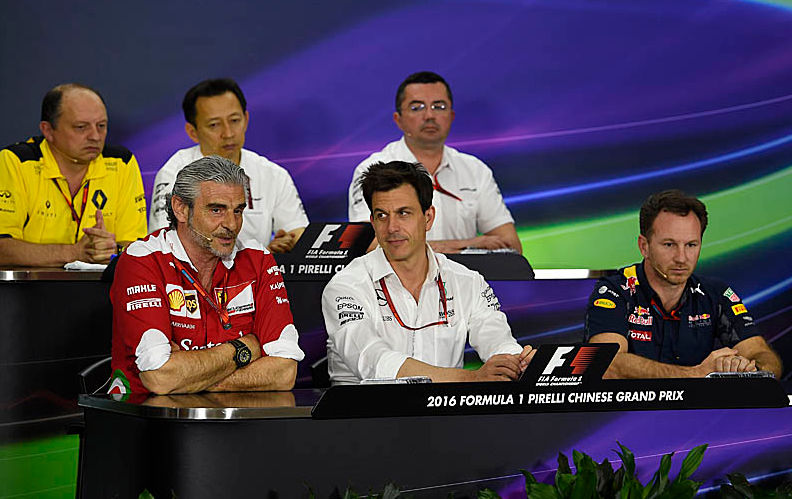
    TEAM REPRESENTATIVES – Frederic Vasseur (Renault), Yusuke Hasegawa (Honda), Eric Boullier (McLaren), Maurizio Arrivabene (Ferrari), Toto Wolff (Mercedes), Christian Horner (Red Bull Racing)

    PRESS CONFERENCE

    Maybe we could start with a general question for everyone. Obviously in the next couple of weeks there have got to be some decisions made on the future shape of Formula One, the regulations for 2017 and engines for 2018, so Christian, maybe we could start with you and how things are shaping up on the chassis side and where you think the discussion are, what shape we’re in and what we can look forward to?

    Christian Horner: Well, I believe that as far as the technical regulations are concerned, we’re pretty close to a conclusion on that. They were basically agreed at the last strategy meeting, so I think it’s just a formality to finalise those chassis regulations at the end of this month. I think most people are already tentatively looking towards next year based on those regulations anyway. As far as the engine regulations are concerned, again there have been some discussions recently, which again will go through the Strategy (Group) and subsequently onto the Formula One Commission but everything has to be fixed by the last day of this month for 2017, so I’m not expecting too many major surprises.

    And are you comfortable with where everything is at the moment, the shape of those regulations?

    CH: Well, they are the same for everybody at the end of the day. It represents a bigger change on the chassis side, so that inevitably is going to move things around a little. On the engine side there is obviously discussion still going on and that’s probably the bigger topic for the future, but as far as the chassis is concerned I think they are interesting rules, they add an element of variance compared to what we currently have, so you’ll see some different solutions no doubt from different teams, that you usually get from a regulations change such as that.

    Toto is that a situation that suits you, that there might be some variation in how the regulations suit the teams?

    Toto Wolff: Well, every variance challenges your organisation and I think we are well position to take up the challenge. Definitely making the cars look different, putting emphasis on new bits or innovation is interesting. Whether those rules can provide more interesting racing is another question. In hindsight, because we’ve voted on these regs already, we will see next if it works out. But yeah, I’m looking forward.

    Eric, what are your thoughts on this?

    Eric Boullier: Pretty similar to be honest to Toto and Christian. It’s exciting a little bit to have a new package. I guess the car will be faster and the drivers definitely will enjoy driving the car. So drivers happier, fans happier I guess. As far as we are concerned on the engine, we are seeking some stability, which would be the key to develop and have a better convergence in the future.

    Maurizio, Eric mentioned the fans there. These regulations are largely predicated on making Formula One more appealing, how important is it that Formula One gets these regulations right, now, for the next generation of Formula One fans?

    Maurizio Arrivabene: I think as my colleagues said, I think the regulations they are under discussion and nearly done, they are also especially to enhance the show in Formula One. Next year you are going to see a different car, tyres a bit larger and then if you want to make sure you do a good overtake you have to enlarge the track – no, I’m joking! I think it’s all following the direction to enhance the show and to make Formula One more interesting.

    Frederic, Renault has come back into the sport this year as a constructor, how difficult does it make it for you, or does it make it easier for you that everything changes next year?

    Frederic Vasseur: I don’t know if it will be easier or more difficult, but I think at least it’s new rules and it’s important for us also to start with this kind of game. But I think it’s not for sure much easier for us to start with a new regulation for next year, because we have to restructure the team and it’s not for us the best moment to change the regulations. But it doesn’t matter, it’s not the target, the FIA is not there to play the game for one team or another one but we have to try to push for Formula One and to find the most exciting way for the fan. And I think if the car is more impressive it will be much more fun for the fan and spectators.

    Hasegawa-san, welcome, your first time on this panel, and your second stint in Formula One. What’s Honda’s position on the engine regulations or the talks that are happening for 2018 in terms of power units for then? Are you satisfied with the progress that has been made there?

    Yusuke Hasegawa: As they mentioned still we need to have some further discussion but something like cost reduction and obligation. Yeah, from an engine manufacturer point of view, or as a member of Formula One society point of view, we have a kind of obligation to the fans and to this group, so Honda is happy to have that regulation, although we need to have some further discussion I understand.

    Just to the other people who engine manufacturers, what about the guaranteed supply that is being talked about for 2018. Is that something that you are comfortable with; is it deliverable? Toto?

    TW: It is a complex agreement. We have been given the task in coming up with solutions so that no team is left without an engine. I think all the engine manufacturers have acknowledged that, so we try to cover that. There is an aspect of price reduction, which is important to most of the teams, and we tried to cover that in the framework agreement. Obviously it’s very difficult to make everybody happy. Christian isn’t so happy. But I think we need to come up with a solution until the end of April. We need to ratify those regulations and at the moment everybody is working very hard to at least find the smallest common denominator.

    Christian, Toto mentioned that you may not be very happy. It’s obviously been an issue in the past. What’s your position on that supply going forward?

    CH: I think it’s a complex situation, but fundamentally there were four criteria that were requested by the governing body to be met to ensure stability moving forward. Those four criteria were: a significant reduction in cost to €12 million, the availability of supply or the guarantee of supply, power convergence to within a relatively small bandwidth and to address the noise. As we sit here now we are not anywhere near having met any of those criteria and I think unfortunately what will happen, as is often the case with these things, time will run out at the end of the month and nothing will be achieved and nothing will change. There is one more attempt in the Strategy meeting and the Commission meeting at the end of the month to discuss and table the concerns and where we’re at, but failing that regulations will inevitably stay as they are.

    Eric, Fernando back in the car today, maybe you could tell us what the process has been, how it worked with him today? And also maybe you could give us some insight into what Stoffel did at the last race and what he brought to the team.

    EB: Well, happily everything is back to normal. Fernando back in the car today was fine. The FIA wanted obviously to have another check and another go after practice one which was an easy one because he ran through practice one without any issues. He felt ready anyway before the Chinese GP weekend and I think this is a matter that is closed now. For Stoffel, obviously as far as we are concerned he did a very good job in Bahrain. Never easy to jump into an F1 car for a race weekend. I think he impressed everybody by how quiet he was and obviously by the good job he delivered. I think it’s a good driver for the future to have in our stable.

    Hasegawa-san, obviously the performance of McLaren has stepped up a little last year – what are your expectations for the rest of the season? Where do you see performance gains coming, when can you expect them to come?

    YH: It is too soon to say the exact number or position but obviously we’re not happy, we’re not satisfied with the current position. We can improve definitely with a decent level of step-ups so we are happy about that. Of course it is coming from the chassis as well but we can contribute with the power unit. It is important to show that we can improve in the step-ups. This is our target so far.

    Maurizio, one and two this afternoon, so a fairly good afternoon’s work. You’ve had two good results in Australia and Bahrain but a couple of technical issues as well. What’s been the response to those back at base and do you feel that that’s now been overcome?

    MA: What’s happened in Australia and Bahrain, we explained it very, very well and I think I don’t need to give further explanation because what we said, it was absolutely true, like it or not. Concerning here for the Chinese GP, it was a good Friday, not a bad one but unfortunately not gaining position on the grid or points in the championship. So, it’s a good short but the Chinese GP weekend is still long. Concerning the expectation of the season, I can say the Mercedes team of this year is the strongest one that I saw in the last ten years because it’s quite a lot of years that I’m around and, I mean, to be able to win against them, you have to work and be better than them. So, we are doing all our best to have good results.

    Toto, the best team in ten years! And Nico is performing very well at the moment. How have you seen him change over, not just the winter but if you look back to him in 2014-2015, do you think he came into the season with a different attitude? Is he a different driver?

    TW: Before answering the question I’d like to give the flowers back – they are pushing us very hard and you have seen today that it is raw performance and we have seen the performance in the last couple of races. Ferrari haven’t been able to pull it together because they made a big step from ’15 to ’16, similar to the step of ’14 to ’15 and in order to have the package rolled properly deliver and be reliable, that isn’t an easy task but in terms of sheer performance, they are really pushing us. And that is good; this is how the competition should be. In terms of Nico, he’s in a great place. I don’t see him oscillating a lot. People keep asking when Lewis had his winning streak last year, ‘is that going to knock Nico down?’ and then when he started winning after the championship was decided, ‘is it going to pull him up?’ Those guys perform on a very high level and it doesn’t particularly affect them whether they’ve had a good weekend or not. They’ve been in the job – or in motor racing – for 20 years or more, so the Nico I see today is developing as a personality, developing as a racing driver and learning – but also it’s not very much different to how I’ve known him the last couple of years.

    Frederic, you’re coming back to the grid as a constructor as we mentioned, you’ve had a couple of months now to assess where things are: what have you identified, or what did you identify as the things that needed immediate attention – and how is that progressing?

    FV: Nothing special and on every single matter because as we all know, we took over the company very late. The first challenge was to be on track for Barcelona and I think we did it but now, for sure, it’s a long term project and we have to improve on each area. There is no one, single matter to work on. We have to push on every single project and every single department of the company – but we know that it’s a long way and we are more than motivated and I hope that we will do it.

    Christian, these two gentlemen alongside you, they’re a little bit ahead but two fourth places in a row in Australia and Bahrain. Does that give you encouragement about the steps that have been made over the winter, not just on the chassis, on power unit as well. Where do you see it taking you this year?

    CH: Well we’re hoping to join their love-in. Sometimes two’s company, three’s a crowd… we’ve made good progress over the winter and I think at the last couple of races we’ve had arguably the third-fastest car. It’s a very tight pack fighting over that third place and the jump then to where these two teams are is quite a significant one. We’re hoping with further development on the power unit, that we expect around Montreal, to make good progress, certainly in the second half of the year and at certain circuits hopefully, try and get onto their shirt tails – but it’s quite a big gap that is inevitably going to take more than a season to close down.

    QUESTIONS FROM THE FLOOR

    Q: (Ben Edwards – Channel 4 TV) Frederic, about today, and about the tyre problem we saw on Kevin’s car and the decision not to run the car this afternoon; can you just explain that a little bit?

    FV: We investigated the problem at the end of FP1, that the problem came from the suspension and we had a lot of damage on the car and it was much better for us to stay in the garage for FP2 but we will be ready for tomorrow morning.

    Q: (Haoran Zhou – Top Driver) Question to everyone: during the last round of big regulation changes we heard that people like Ross Brawn were quoting downforce figures in the meeting to guide everyone how we should set these chassis rules. Presumably that sort of the discussion is present again in the strategy group; can you give us a rough range how much more downforce would next year’s car have on the chassis side? Is it one third or 20 points or something?

    TW: Interesting one! Around 80 percent! No, the numbers vary of course and they vary because of different interests so it goes from teams saying that it’s not a lot more than it is today until 30-35 percent.. So it could have quite a big effect on downforce which is in one sense good, because the cars will be more difficult to drive, will deploy much more G on the driver like in the past. But equally G isn’t visible for the spectator and the risk might be that overtaking could be more difficult and it will put an additional stress on the tyres. And all this is still in debate, but we have chosen the way forward and to come back to your question, that is the bit of the bandwidth I would say between zero and 30 percent.

    EB: It’s a little bit… yes, the debate was based as well on the tyres because we wanted to have more mechanical grip, let’s say, so there is a different tyre size, different compound and philosophy and all the discussion has been steered more about an improvement in lap time and on that point, I did agree with Toto. I think having a car with more downforce makes the drivers a little bit more confident to let’s say out-brake each other and obviously if you change the philosophy of the aero, less driven by the front wing, you improve the overtaking so I think it should be good.

    Q: (Joe van Burik – De Telegraaf) Mr Boullier, Stoffel Vandoorne received much praise for his performance in Bahrain; what more does he have to do to prove himself worthy of a fulltime racing seat or is that merely a matter of time?

    EB: Well, at this stage I don’t think he has to prove anything anymore, it’s just a question of having an opportunity.

    Q: (Haoran Zhou – Top Driver) Again, to presumably everyone: with the bigger tyre size for next year, presumably adding some weight, starting weight of the cars in race trim would be something like 820 kilograms and with Pirelli’s tyres being designed to degrade faster, that would significantly put a burden on how much the driver can push at the start of a race, which at the moment, at the start of the race, a Formula One car is not going that much faster than a GP2 car. Is there any way you can address that problem? And how much the drivers can push cannot really be solved by adding more aero to the cars in race trim.

    CH: First of all, I hope the cars aren’t 820 kilos. They’ve got a lot heavier with the new technology that’s been introduced over the last couple of years and compared to ten years ago, they’re more than a hundred kilos heavier than they were, almost approaching sports car weight, and that of course adds to the characteristic of making the car a little lazier than a lighter car but I disagree with you that by adding downforce and load back onto the car you’re going to give the driver a harder time. You’re going to give him much more of a workout. The drivers have been crying out for cars that are more challenging to drive. The cars that we have at the moment… it’s been discussed whether they are too easy to drive and I think that by making the cars edgier, by making them quicker you will get a bigger variance of drivers, the teams will get better value for money out of their drivers and they’ll have to start going to the gym again. So I think it’s a positive thing that we’ve got a regulation change but yes, the cars are a little bit on the heavy side. It would be nice to somehow get a hundred kilos out of them.

    FV: I think that Pirelli will adapt the tyres to the new regulations. It’s not a matter of downforce or degradation; it’s just the combination between the tyre regulations and degradation.

  • F1 2016: Bahrain GP Race Report – Desert Success for Rosberg

    F1 2016: Bahrain GP Race Report – Desert Success for Rosberg

    For nine years the Bahrain grand prix was run under the hot desert sun. For nearly a decade it wasn’t a race marked as one to look forward to and it almost always produced the most lacklustre racing of a season. But it would only take pushing back the starting time a few hours and a few thousand floodlight to ignite the Bahrain Gp into a spectacle of note. And in 2016 it delivered once more.

    As if to emphasise its transformation the drama started before a lap could be turned in anger. Ferrari’s Sebastian Vettel was forced into retirement on the formation lap. While Ferrari has stopped short of calling it an engine failure the plumes of smoke pouring from the rear of the car say otherwise. In Australia it was Raikkonen who retired with a turbo failure and there too Ferrari went out of its way to assure that there is no reliability concern. But even though its only two races into the season they’re developing a bit of an uncomfortable and undesirable habit of only getting one car to the chequered flag.

    Lewis Hamilton was sitting pretty in pole position with teammate Nico Rosberg alongside on the front row of the grid but it wasn’t to last very long for the Brit. Hamilton struggled to get off the line and ended up tangling with the Williams of Valtteri Bottas and dropped down to seventh.

    GP BAHRAIN F1/2016From fourth place Raikkonen made a poor start and dropped behind a pair of fast starting Williams’ and the Red Bull of Daniel Ricciardo. However, the Finn followed with some tenacious overtaking got himself into second place. By this stage the leading Mercedes of Rosberg was already eleven seconds up the road. The 2007 champion maintained a comparable pace with the Mercedes and even managed to reduce the gap to three seconds through strategy and occasional superior pace. But the number 7 Ferrari was never close enough to challenge for the lead of the race.

    As Hamilton recovered to third with some damage to the right-side barge board Rosberg wrapped up his fifth win in a row. For years we’ve been calling for Rosberg to step up his game and make it a championship battle worth watching and he’s done it now. There is still an incredibly long season ahead but Rosberg has started 2016 in the way that he’s needed to, in a way that will give Hamilton a lot to think about.

    With the top three positions established the rest of the points paying positions was an intense fight right to the chequered flag. The availability of three tyre compounds once again added a dynamism to the racing as drivers opted for strategies than ran the gamut of possibilities. Red Bull’s Daniel Ricciardo finished fourth thanks an early stop and rolling the dice by running the final stint on the medium tyres.

    GP BAHRAIN F1/2016As the race strategy engineer for the Haas F1 team Ruth Buscombe once again worked a brilliant strategy for Romain Grosjean. The Frenchman ran most of the race on the supersoft compound which allowed him to scythe through the field. He ran as high as fourth at one stage and ultimately finished fifth in what is turning out to be a fairytale debut for the American team.

    Toro Rosso’s Max Verstappen finished sixth ahead of Daniil Kvyat in seventh who recovered from starting fifteenth on the grid. After a difficult tyre strategy Felipe Massa and Valtteri Bottas finished eighth and ninth for Williams. Driver of the day belong the final points scorer Stoffel Vandoorne. The 24-year-old Belgian driver stood in for Fernando Alonso who is recovering from fractured ribs sustained in the Australian Gp crash. The difficulty of having to deal with the complexity of a 2016 F1 car, to understand the Pirelli tyres, and to fight with seasoned F1 drivers, must not be underestimated. Vandoorne put all of his talents on display and blitzed his F1 debut.

    The 2016 hasn’t begun to hit its stride and already an immense battle is brewing up and down the field. Roll on China.

    (All images courtesy of Pirelli Motorsport)

  • F1 2016: Bahrain Free Practice 1 Report – Rosberg On Top

    F1 2016: Bahrain Free Practice 1 Report – Rosberg On Top

    Mercedes driver Nico Rosberg topped the timing sheets in the first free practice session of the Bahrain grand prix.

    The first ninety minutes of practice for the 2016 Bahrain grand prix took place under natural light as opposed to the rest of the weekend which will be run on the floodlights which line the circuit.

    The first of the three free practice session ran without any major incident save for a few drivers locking up their front tyres as they attempt to find the limit of adhesion. With the news that Fernando Alonso is not medically fit to race this weekend came the debut of Belgian driver Stoffel Vandoorne. The highly rated rookie driver finished the first session in 18th place overall.

    Sergio Perez also stood aside for fellow countryman Alfonso Celis who piloted the Force India for the practice session. The 19 year old Mexican driver was twenty-first on the timing sheets. Nico Rosberg completed twenty-four laps and set the a quickest time overall of 1:32:294 on the yellow-walled soft tyre. Teammate Lewis Hamilton was second quickest with a 1:32:799.

    Ferrari split tyre strategy at the end of the session as Kimi Raikkonen set the third fastest time, a 1:34:128, on the soft tyre while Sebastian Vettel persisted with the medium compound tyre. The German ended the session in eleventh place with a quickest time of 1:35:037.

    Red Bull Racing driver Daniel Ricciardo completed twenty-seven laps and set a quickest time of 1:34:461 which was the fourth fastest time overall. Team principal Christian Horner noted that the team might struggle in qualifying trim this weekend but that they have high hopes for Sunday’s race.