Tag: christian horner

  • Breaking News: Red Bull Announces Engine Supplier

    Breaking News: Red Bull Announces Engine Supplier

    Red Bull Racing has revealed that it will continue its partnership with Renault Sport Racing as power unit suppliers.

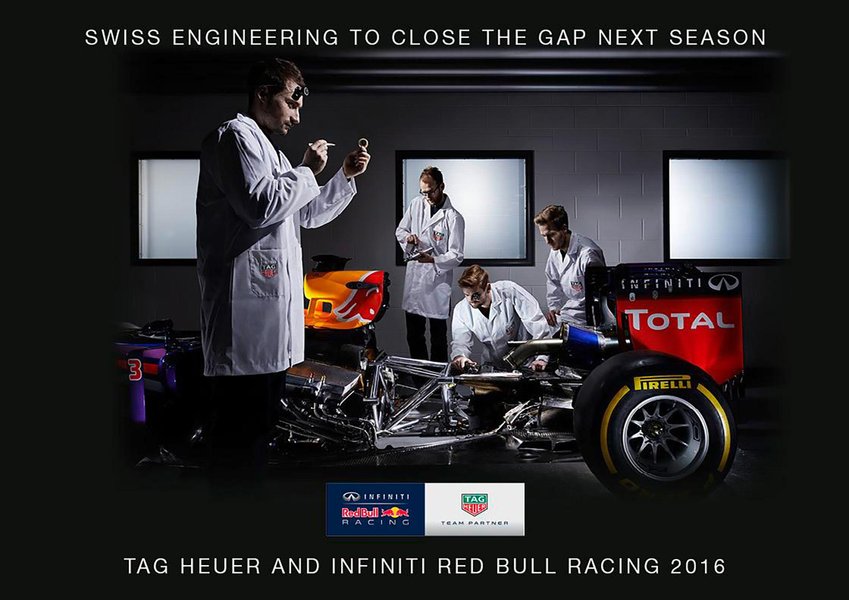
    The renewed partnership will run to the end of the 2018 season and will be badged as Tag Heuer. In addition the Toro Rosso team will move away from Ferrari power units and into the Renault stable for the 2017 and 2018 seasons.

    Christian Horner, Red Bull Racing Team Principal, said: “We are delighted to extend our partnership which has proved very successful over time. After the reconstruction that Renault has undertaken, clear progress has been made which has made it logical to continue with the TAG Heuer badged engine.”

  • F1 2016: Monaco GP Preview – Can Merc Be Toppled in Monaco?

    F1 2016: Monaco GP Preview – Can Merc Be Toppled in Monaco?

    In one way or another the famous streets of Monte Carlo have featured in every one of Formula 1’s 66-year history.  The scale and prestige of the Monaco grand prix is no less as it hosts the 6th round of the 2016 season.

    Several street tracks have come and gone in Formula 1 and some, like Singapore, has come to be well liked by drivers and fans. But there’s nothing quite as unique as the race on the sun-kissed streets of Monte Carlo.

    In truth racing cars having been threading themselves through the tight Monaco streets since 1929. In 1950 the Monaco grand prix became part of the newly formed F1 world championship. Argentine driver Juan Manuel Fangio won his first championship race in an Alfa Romeo and would later become a five-time world champion.

    It comes as no surprise that the most prolific winners around the famous streets are also the drivers who brilliantly conquered and defined their eras in the sport. Ayrton Senna leads the pack with seven wins while Michael Schumacher and Graham Hill have each taken five Monaco Gp victories.

    Monaco Grand PrixAcross its 78 laps the 3.337 kilometer Anthony Noghes circuit presents the most extreme challenge of concentration and skill seen at any time during a Formula 1 season. The blind rise up the hill after Ste Devote, Casino Square, Portier and the tunnel. The ultra quick left-right chicane just after Tabac at the entry to the swimming pool – all of it lined by barriers which leaves zero margin for error,” says Red Bull Racing’s Daniel Ricciardo. “I believe street circuits like Monaco bring out the best in a driver. It’s visible to the spectators who is running the fine line between risk and reward.”

    Pirelli’s purple side-walled ultrasoft tyre compound will make its debut this weekend. Mercedes and Red Bull have chosen an aggressive strategy by selecting ten sets of the ultrasoft compound for the weekend. Ferrari’s Kimi Raikkonen and Sebastian Vettel have chosen nine sets each of the purple side-walled tyre.

    But even the most shrewd tyre strategy could mean nothing as the tight, barrier-lined streets means that overtaking is at an absolute premium. Thus it makes qualifying more critical than at any other race. A mistake or problem in Saturday qualifying carries severe penalty and an unlikely chance of recovery on Sunday.

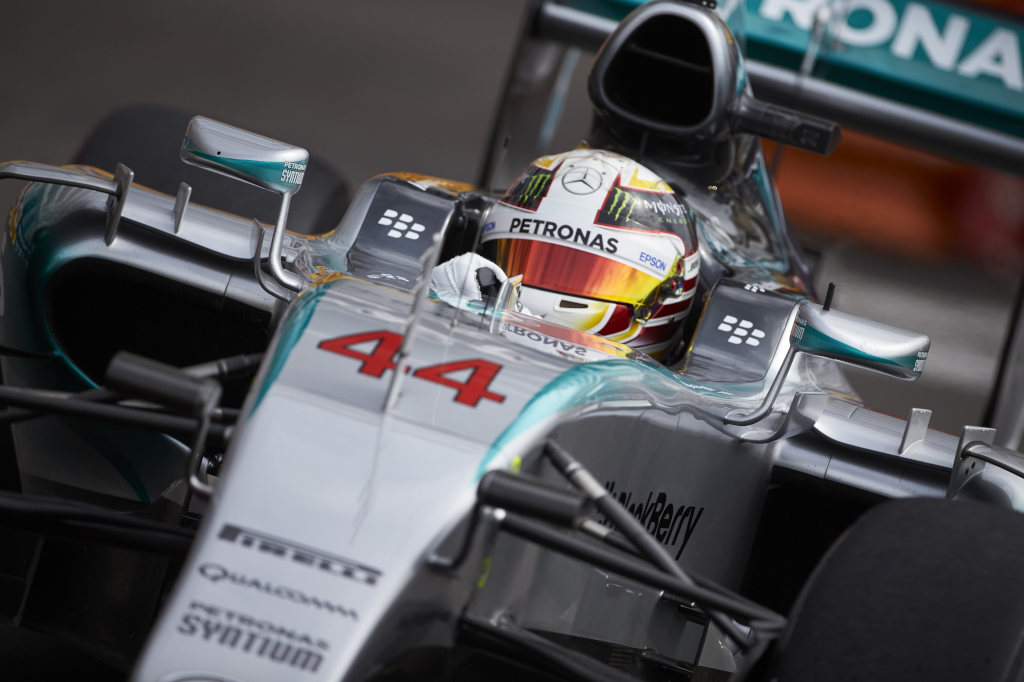
    Lewis Hamilton. Free practice, Monaco GPIt is here, in qualifying, that Mercedes still holds a sizeable advantage. However, following the two days of testing at Catalunya, after the Spanish Gp, Sebastian Vettel is convinced that he fight for victory in Monaco where Ferrari last claimed victory in 2001. “I think Monaco should be a strong track for us, last year we were very competitive there,” he said. “Now we have improved the car in the areas you need for that Grand Prix so I think it should help.

    But there is more than one team ready to challenge the Ferrari’s. McLaren’s racing director Eric Boullier believes his team has a chance at out-pacing Ferrari around the twisty circuit. While the Honda power unit still lacks power the characteristics of Monaco means it will not be as big a deficit.

    A more realistic threat is likely to come from Red Bull. The team ran an ungraded Renault power unit at the two-day Spanish test and the result was positive enough to fast track the introduction of it. Originally scheduled for the Canadian grand prix the power unit will be introduced in Monaco. However, Renault is able to provide only one engine for Red Bull and one for Renault.

    Will Ferrari, Red Bull or even McLaren be able to end Mercedes’ domination?

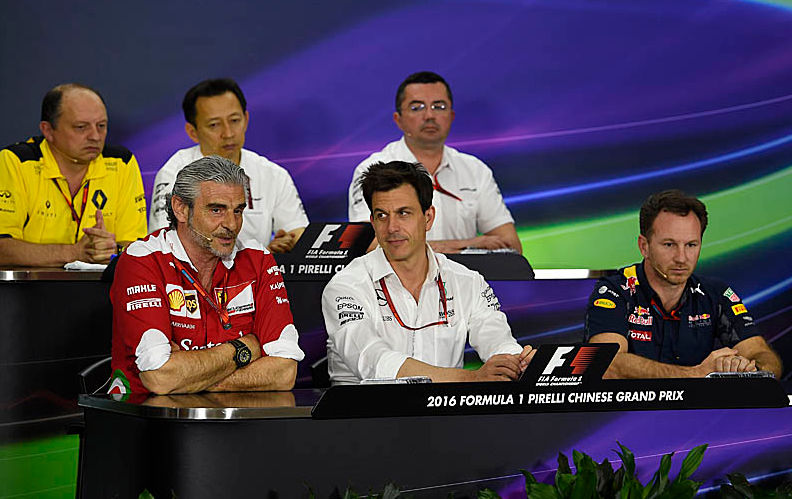
  • FIA Friday press conference – Chinese GP

    FIA Friday press conference – Chinese GP

    Here’s a look at who said what at the Friday Press Conference following practice ahead of the Chinese GP.

    TEAM REPRESENTATIVES – Frederic Vasseur (Renault), Yusuke Hasegawa (Honda), Eric Boullier (McLaren), Maurizio Arrivabene (Ferrari), Toto Wolff (Mercedes), Christian Horner (Red Bull Racing)

    PRESS CONFERENCE

    Maybe we could start with a general question for everyone. Obviously in the next couple of weeks there have got to be some decisions made on the future shape of Formula One, the regulations for 2017 and engines for 2018, so Christian, maybe we could start with you and how things are shaping up on the chassis side and where you think the discussion are, what shape we’re in and what we can look forward to?

    Christian Horner: Well, I believe that as far as the technical regulations are concerned, we’re pretty close to a conclusion on that. They were basically agreed at the last strategy meeting, so I think it’s just a formality to finalise those chassis regulations at the end of this month. I think most people are already tentatively looking towards next year based on those regulations anyway. As far as the engine regulations are concerned, again there have been some discussions recently, which again will go through the Strategy (Group) and subsequently onto the Formula One Commission but everything has to be fixed by the last day of this month for 2017, so I’m not expecting too many major surprises.

    And are you comfortable with where everything is at the moment, the shape of those regulations?

    CH: Well, they are the same for everybody at the end of the day. It represents a bigger change on the chassis side, so that inevitably is going to move things around a little. On the engine side there is obviously discussion still going on and that’s probably the bigger topic for the future, but as far as the chassis is concerned I think they are interesting rules, they add an element of variance compared to what we currently have, so you’ll see some different solutions no doubt from different teams, that you usually get from a regulations change such as that.

    Toto is that a situation that suits you, that there might be some variation in how the regulations suit the teams?

    Toto Wolff: Well, every variance challenges your organisation and I think we are well position to take up the challenge. Definitely making the cars look different, putting emphasis on new bits or innovation is interesting. Whether those rules can provide more interesting racing is another question. In hindsight, because we’ve voted on these regs already, we will see next if it works out. But yeah, I’m looking forward.

    Eric, what are your thoughts on this?

    Eric Boullier: Pretty similar to be honest to Toto and Christian. It’s exciting a little bit to have a new package. I guess the car will be faster and the drivers definitely will enjoy driving the car. So drivers happier, fans happier I guess. As far as we are concerned on the engine, we are seeking some stability, which would be the key to develop and have a better convergence in the future.

    Maurizio, Eric mentioned the fans there. These regulations are largely predicated on making Formula One more appealing, how important is it that Formula One gets these regulations right, now, for the next generation of Formula One fans?

    Maurizio Arrivabene: I think as my colleagues said, I think the regulations they are under discussion and nearly done, they are also especially to enhance the show in Formula One. Next year you are going to see a different car, tyres a bit larger and then if you want to make sure you do a good overtake you have to enlarge the track – no, I’m joking! I think it’s all following the direction to enhance the show and to make Formula One more interesting.

    Frederic, Renault has come back into the sport this year as a constructor, how difficult does it make it for you, or does it make it easier for you that everything changes next year?

    Frederic Vasseur: I don’t know if it will be easier or more difficult, but I think at least it’s new rules and it’s important for us also to start with this kind of game. But I think it’s not for sure much easier for us to start with a new regulation for next year, because we have to restructure the team and it’s not for us the best moment to change the regulations. But it doesn’t matter, it’s not the target, the FIA is not there to play the game for one team or another one but we have to try to push for Formula One and to find the most exciting way for the fan. And I think if the car is more impressive it will be much more fun for the fan and spectators.

    Hasegawa-san, welcome, your first time on this panel, and your second stint in Formula One. What’s Honda’s position on the engine regulations or the talks that are happening for 2018 in terms of power units for then? Are you satisfied with the progress that has been made there?

    Yusuke Hasegawa: As they mentioned still we need to have some further discussion but something like cost reduction and obligation. Yeah, from an engine manufacturer point of view, or as a member of Formula One society point of view, we have a kind of obligation to the fans and to this group, so Honda is happy to have that regulation, although we need to have some further discussion I understand.

    Just to the other people who engine manufacturers, what about the guaranteed supply that is being talked about for 2018. Is that something that you are comfortable with; is it deliverable? Toto?

    TW: It is a complex agreement. We have been given the task in coming up with solutions so that no team is left without an engine. I think all the engine manufacturers have acknowledged that, so we try to cover that. There is an aspect of price reduction, which is important to most of the teams, and we tried to cover that in the framework agreement. Obviously it’s very difficult to make everybody happy. Christian isn’t so happy. But I think we need to come up with a solution until the end of April. We need to ratify those regulations and at the moment everybody is working very hard to at least find the smallest common denominator.

    Christian, Toto mentioned that you may not be very happy. It’s obviously been an issue in the past. What’s your position on that supply going forward?

    CH: I think it’s a complex situation, but fundamentally there were four criteria that were requested by the governing body to be met to ensure stability moving forward. Those four criteria were: a significant reduction in cost to €12 million, the availability of supply or the guarantee of supply, power convergence to within a relatively small bandwidth and to address the noise. As we sit here now we are not anywhere near having met any of those criteria and I think unfortunately what will happen, as is often the case with these things, time will run out at the end of the month and nothing will be achieved and nothing will change. There is one more attempt in the Strategy meeting and the Commission meeting at the end of the month to discuss and table the concerns and where we’re at, but failing that regulations will inevitably stay as they are.

    Eric, Fernando back in the car today, maybe you could tell us what the process has been, how it worked with him today? And also maybe you could give us some insight into what Stoffel did at the last race and what he brought to the team.

    EB: Well, happily everything is back to normal. Fernando back in the car today was fine. The FIA wanted obviously to have another check and another go after practice one which was an easy one because he ran through practice one without any issues. He felt ready anyway before the Chinese GP weekend and I think this is a matter that is closed now. For Stoffel, obviously as far as we are concerned he did a very good job in Bahrain. Never easy to jump into an F1 car for a race weekend. I think he impressed everybody by how quiet he was and obviously by the good job he delivered. I think it’s a good driver for the future to have in our stable.

    Hasegawa-san, obviously the performance of McLaren has stepped up a little last year – what are your expectations for the rest of the season? Where do you see performance gains coming, when can you expect them to come?

    YH: It is too soon to say the exact number or position but obviously we’re not happy, we’re not satisfied with the current position. We can improve definitely with a decent level of step-ups so we are happy about that. Of course it is coming from the chassis as well but we can contribute with the power unit. It is important to show that we can improve in the step-ups. This is our target so far.

    Maurizio, one and two this afternoon, so a fairly good afternoon’s work. You’ve had two good results in Australia and Bahrain but a couple of technical issues as well. What’s been the response to those back at base and do you feel that that’s now been overcome?

    MA: What’s happened in Australia and Bahrain, we explained it very, very well and I think I don’t need to give further explanation because what we said, it was absolutely true, like it or not. Concerning here for the Chinese GP, it was a good Friday, not a bad one but unfortunately not gaining position on the grid or points in the championship. So, it’s a good short but the Chinese GP weekend is still long. Concerning the expectation of the season, I can say the Mercedes team of this year is the strongest one that I saw in the last ten years because it’s quite a lot of years that I’m around and, I mean, to be able to win against them, you have to work and be better than them. So, we are doing all our best to have good results.

    Toto, the best team in ten years! And Nico is performing very well at the moment. How have you seen him change over, not just the winter but if you look back to him in 2014-2015, do you think he came into the season with a different attitude? Is he a different driver?

    TW: Before answering the question I’d like to give the flowers back – they are pushing us very hard and you have seen today that it is raw performance and we have seen the performance in the last couple of races. Ferrari haven’t been able to pull it together because they made a big step from ’15 to ’16, similar to the step of ’14 to ’15 and in order to have the package rolled properly deliver and be reliable, that isn’t an easy task but in terms of sheer performance, they are really pushing us. And that is good; this is how the competition should be. In terms of Nico, he’s in a great place. I don’t see him oscillating a lot. People keep asking when Lewis had his winning streak last year, ‘is that going to knock Nico down?’ and then when he started winning after the championship was decided, ‘is it going to pull him up?’ Those guys perform on a very high level and it doesn’t particularly affect them whether they’ve had a good weekend or not. They’ve been in the job – or in motor racing – for 20 years or more, so the Nico I see today is developing as a personality, developing as a racing driver and learning – but also it’s not very much different to how I’ve known him the last couple of years.

    Frederic, you’re coming back to the grid as a constructor as we mentioned, you’ve had a couple of months now to assess where things are: what have you identified, or what did you identify as the things that needed immediate attention – and how is that progressing?

    FV: Nothing special and on every single matter because as we all know, we took over the company very late. The first challenge was to be on track for Barcelona and I think we did it but now, for sure, it’s a long term project and we have to improve on each area. There is no one, single matter to work on. We have to push on every single project and every single department of the company – but we know that it’s a long way and we are more than motivated and I hope that we will do it.

    Christian, these two gentlemen alongside you, they’re a little bit ahead but two fourth places in a row in Australia and Bahrain. Does that give you encouragement about the steps that have been made over the winter, not just on the chassis, on power unit as well. Where do you see it taking you this year?

    CH: Well we’re hoping to join their love-in. Sometimes two’s company, three’s a crowd… we’ve made good progress over the winter and I think at the last couple of races we’ve had arguably the third-fastest car. It’s a very tight pack fighting over that third place and the jump then to where these two teams are is quite a significant one. We’re hoping with further development on the power unit, that we expect around Montreal, to make good progress, certainly in the second half of the year and at certain circuits hopefully, try and get onto their shirt tails – but it’s quite a big gap that is inevitably going to take more than a season to close down.

    QUESTIONS FROM THE FLOOR

    Q: (Ben Edwards – Channel 4 TV) Frederic, about today, and about the tyre problem we saw on Kevin’s car and the decision not to run the car this afternoon; can you just explain that a little bit?

    FV: We investigated the problem at the end of FP1, that the problem came from the suspension and we had a lot of damage on the car and it was much better for us to stay in the garage for FP2 but we will be ready for tomorrow morning.

    Q: (Haoran Zhou – Top Driver) Question to everyone: during the last round of big regulation changes we heard that people like Ross Brawn were quoting downforce figures in the meeting to guide everyone how we should set these chassis rules. Presumably that sort of the discussion is present again in the strategy group; can you give us a rough range how much more downforce would next year’s car have on the chassis side? Is it one third or 20 points or something?

    TW: Interesting one! Around 80 percent! No, the numbers vary of course and they vary because of different interests so it goes from teams saying that it’s not a lot more than it is today until 30-35 percent.. So it could have quite a big effect on downforce which is in one sense good, because the cars will be more difficult to drive, will deploy much more G on the driver like in the past. But equally G isn’t visible for the spectator and the risk might be that overtaking could be more difficult and it will put an additional stress on the tyres. And all this is still in debate, but we have chosen the way forward and to come back to your question, that is the bit of the bandwidth I would say between zero and 30 percent.

    EB: It’s a little bit… yes, the debate was based as well on the tyres because we wanted to have more mechanical grip, let’s say, so there is a different tyre size, different compound and philosophy and all the discussion has been steered more about an improvement in lap time and on that point, I did agree with Toto. I think having a car with more downforce makes the drivers a little bit more confident to let’s say out-brake each other and obviously if you change the philosophy of the aero, less driven by the front wing, you improve the overtaking so I think it should be good.

    Q: (Joe van Burik – De Telegraaf) Mr Boullier, Stoffel Vandoorne received much praise for his performance in Bahrain; what more does he have to do to prove himself worthy of a fulltime racing seat or is that merely a matter of time?

    EB: Well, at this stage I don’t think he has to prove anything anymore, it’s just a question of having an opportunity.

    Q: (Haoran Zhou – Top Driver) Again, to presumably everyone: with the bigger tyre size for next year, presumably adding some weight, starting weight of the cars in race trim would be something like 820 kilograms and with Pirelli’s tyres being designed to degrade faster, that would significantly put a burden on how much the driver can push at the start of a race, which at the moment, at the start of the race, a Formula One car is not going that much faster than a GP2 car. Is there any way you can address that problem? And how much the drivers can push cannot really be solved by adding more aero to the cars in race trim.

    CH: First of all, I hope the cars aren’t 820 kilos. They’ve got a lot heavier with the new technology that’s been introduced over the last couple of years and compared to ten years ago, they’re more than a hundred kilos heavier than they were, almost approaching sports car weight, and that of course adds to the characteristic of making the car a little lazier than a lighter car but I disagree with you that by adding downforce and load back onto the car you’re going to give the driver a harder time. You’re going to give him much more of a workout. The drivers have been crying out for cars that are more challenging to drive. The cars that we have at the moment… it’s been discussed whether they are too easy to drive and I think that by making the cars edgier, by making them quicker you will get a bigger variance of drivers, the teams will get better value for money out of their drivers and they’ll have to start going to the gym again. So I think it’s a positive thing that we’ve got a regulation change but yes, the cars are a little bit on the heavy side. It would be nice to somehow get a hundred kilos out of them.

    FV: I think that Pirelli will adapt the tyres to the new regulations. It’s not a matter of downforce or degradation; it’s just the combination between the tyre regulations and degradation.

  • Hamilton secures pole as F1’s new qualifying fails to deliver

    Hamilton secures pole as F1’s new qualifying fails to deliver

    Lewis Hamilton secured pole position for the Australian Grand Prix in the debut of Formula One’s new elimination style qualifying format which has been widely criticised and can be described as nothing short of farcical.

    Hamilton finished 0.360s clear of his Mercedes team mate Nico Rosberg, but the session was decided and all drivers out of their cars with over three minutes left on the clock. There was not a single car on the track for the final 5 minutes of the session and drivers were walking down the pit lane to get weighed in while there was still time left in the session.

    There was no frantic final shootout, no final flurry of lap times, nobody rushing for the line to secure their positions on the grid. Just driver after driver accepting their fate and leaving the final minutes of qualifying to the two Mercedes drivers to decide which of them would start ahead of the other.

    The live elimination format also failed to deliver on the mixed up grid that F1’s decision makers had hoped for and pretty much castrated Q3 of the first qualifying session of the 2016 Formula One season.

    Ferrari, who should’ve been shooting it out at the front with the Mercs opted to complete just one run in what seemed to be a bid to save tyres for the race. The gap between Hamilton on pole and Sebastian Vettel who finished third on the grid stood at 0.838s with Kimi Raikkonen finishing fourth place – 1.196s off Hamilton’s time.

    Australian GP Qualifying - Sebastian Vettel, Ferrari
    Photo: Scuderia Ferrari

    Vettel said he couldn’t see why everyone was surprised. “We all said what is going to happen. It happened,” he said.

    “We were told to wait and see. Now we saw and I don’t think it was very exciting.

    “It was a bit crazy in the beginning with all the cars pushing and trying to do a lap before they get kicked out so managing traffic is busy but for no reason because the time is there in the session to do it.

    “For the people in the grandstands, I don’t feel it is right way to go as there are no cars to watch. They want to see Lewis, Nico, Kimi whoever pushing to limit at the end of the session when the track is supposed to be at its best.

    “I don’t think we need the criticism now, we had the criticism already but surely it is wrong way to go. That is what we said.”

    Max Verstappen secured his best qualifying result finishing fifth on the grid for Toro Rosso after a single Q3 attempt, ahead of Felipe Massa, Carlos Sainz Jr. and Daniel Ricciardo.

    The new rules resulted in the bottom three in Q3 limited to just one lap before the clock caught up with them and they were knocked out. The top eight will all start the race on the super-soft tyres they used to set their fastest time in Q2.

    The majority of the action in qualifying came from the opening stages of each session with the flurry of confusion and excitement in Q1 setting everyone up extreme anticlimactic disappointment. What should have been a thrilling introduction to the 2016 Formula One season – especially after the exciting build-up in FP3 – ended up an absolute disaster, or as Mercedes team boss Toto Wolff called it, “rubbish”.

    Sergio Perez and Nico Hulkenberg were 9th and 10th respectively and opted to return to the pits rather than attempt another lap and get themselves through to Q3. Valterri Bottas’ minor error at the final corner without enough time to finish another lap (instead of only being required to make it over the line to start another one) saw him finish in 11th place.

    Australian GP Qualifying - McLaren
    Photo: McLaren-Honda

    McLaren had impressed in FP3 and there were great expectations that we would see at least one of the two Woking machines in Q3, but seemed to have been caught out by the new format with Fernando Alonso and Jenson Button also being caught out by the 90 second clock and finishing 12th and 13th on the grid.

    Renault made it through to Q2 albeit significantly off the pace. Joylon Palmer and Kevin Magnussen could only manage 14th and 15th respectively.

    The absolute confusion of the Q1 session saw Daniil Kvyat being knocked out while he was in the pits and missing the cut for Q2 along with the Sauber, Haas and Manor drivers.

    The FIA are clearly going to have to rethink the introduction of this format. The majority of the drivers have come out saying that the new qualifying format does not work and team principals are not impressed either.

    It’s important to reminder that these are the folks who voted this new qualifying format in but it would seem they’re ready to eat the humble pie and call for change.

    Australian GP Qualifying - Christian Horner, Red Bull Racing
    Photo: Red Bull / Getty

    Red Bull team boss Christian Horner believes the sport needs to apologise to Formula 1 fans and called for the new qualifing format to be scrapped immediately.

    “It didn’t really work for me,” Horner said. “We have not really put on a show.

    “To have Sebastian Vettel and Kimi Raikkonen in fast cars not taking part with five minutes to go is wrong.

    “We need to learn from it and address it quickly. I think it needs to be done for Bahrain, personally.”

    Niki Lauda also came out saying that the new qualifying format was “terrible” and added that Bernie Ecclestone and Jean Todt make decisions without discussions with anyone else and then only present them to the teams to vote.

    Australian GP Qualifying - Toto Wolff, Mercedes AMG Petronas
    Photo: Mercedes AMG Petronas

    Toto Wolff didn’t hold back either, “I’m the first person to say that we shouldn’t talk the sport down but when the evidence is there before your eyes, you cannot shut them and deny reality,” he said.

    “The new format is pretty rubbish – much too complicated to follow and a damp squib at the end with nobody running. These were the downsides that we expected to see – and they outweigh the upsides, that much is clear now.

    “We wanted to listen to the promoters who were calling for a change – but my personal opinion is that we have found the wrong solution and we need to think carefully about what we do next.”

    Opinions have been flying around Twitter since the disastrous end to the qualifying session as well.

    Twitter user @GrandPrixDiary drew a very good analogy which summed up the second half of qualifying quite well:

    Adam Cooper raised the issue around Q2 drivers in 9th and 10th not fighting to get through to Q3:


    Joe Saward also summed things up pretty well:


    At the time of writing, our @F1_Madness poll has a very telling story to tell. Over 75% of voters feel that the new qualifying format is “utter rubbish”.

    Even F1 supremo Bernie Ecclestone is unimpressed with qualifying, saying that, “It was pretty crap. But this is what we’ve got, until we can change it.” Let’s hope that happens soon.


  • 2016 Formula 1 Australian Grand Prix: Friday Press Conference

    2016 Formula 1 Australian Grand Prix: Friday Press Conference

    TEAM REPRESENTATIVES:

    Cyril ABITEBOUL (Renault Sport)

    Toto WOLFF (Mercedes)

    Eric BOULLIER (McLaren)

    Maurizio ARRIVABENE (Ferrari)

    Christian HORNER (Red Bull Racing)

    Gene HAAS (Haas F1)


    PRESS CONFERENCE

    Cyril, let’s begin with you – welcome back as a Renault works team. Great history, 35 wins, two world championships and 100 podiums. How tough will it be to repeat those records against today’s competition?
    Cyril ABITEBOUL: I think it will be very tough and I know that there were a lot of comments regarding the time that it took us to make our decision last year. It’s not so much the appetite to be in Formula One but to be in a capacity to be successful in Formula One, that was the question mark. So we come in that competition with lots of humility. As you mentioned we have been there fro quite a long period of time, almost 40 years but we equally we know that the level has raised considerably. So we know it’s going to take time; it’s a long journey, a long-term plan but we think we have all the ingredients – financial, technical, the support of a large group – to make that a successful one. We’re going to take it step by step but it’s absolutely possible.

    What’s the plan for the engine this year? You’ve not used so many tokens so far. Do you expect to be close to Ferrari and Mercedes by the end of the season?
    CA: Well, actually, I think that this is a demonstration that we have used little tokens but I hope in connection to the fact that we have made a substantial step in terms of performance will be actual evidence that there is no connection between token use and performance. You can use a lot of tokens and bring absolutely nothing in terms of lap time, which actually is maybe something we did last year. I think the whole debate of tokens should go away and we should focus on performance. There is a plan to use more tokens during the course of the season, that’s the plan and we have made lots of comments about that. Hopefully it will happen, both for the benefit of the Renault works team and also Red Bull.

    Maurizio, coming to you – Sebastian told us here yesterday in the press conference he feels Ferrari has enough to challenge Mercedes this year. Tell us about the effort that has gone on behind the scenes to raise the level?
    Maurizio ARRIVABENE: We are doing our job. We are working very hard during the winter and we know where we are, but where you really are depends on what the other competitors are going to be. During this weekend we will know.

    We’ve got some new rules this year, qualifying rules, team radio rules, tyre rules etc coming into force, what differences do expect these to make, especially in the qualifying we’ll see tomorrow.
    MA: I don’t want to be against any changes, Ferrari don’t want to be against the change, I simply think that maybe giving a bit more time to the team to work on ideas was better. But I can’t say so with a certainty. The only certainty is that more probably tomorrow at the beginning of the qualifying we are going to see a line like on Saturday at the cashier of the supermarket – everybody wants to go out. Then we will see. It’s not fair to criticize before that has happened.

    Eric, your thoughts on that, the new regulations?
    Eric BOULLIER: Well, we’ll see this weekend. There is some upside and downside. The qualifying format we had before, I think we all agree, was a successful format. We were used to it. I think it is true that there will be more traffic at the beginning of each qualifying segment and there should be more unpredictability for the final result, but we will see.

    It was a tough year for McLaren last year to say the least. What’s the winter been like at Woking and what do you expect for 2016?
    EB: Well, I think every year we keep working harder and harder. It was a very, very busy winter for us. We’ll see. Obviously there is a lot of progress. We have been able to work through this Friday this weekend, which is good for both Honda and McLaren. We will see where we are. Obviously we don’t want to overpromise everything. We will go step by step and there is still some more to come.

    Coming to you Gene, a very warm welcome to Formula One. Your start-up has been a few years in the development. How does the reality match up to the expectation?
    Gene HAAS: Well, I’m nervous. I think there are a lot of things going on here that I’m new to and the team is new too. So, putting all of the pieces of the puzzle together along with all the personnel and having it all come together for the first time has been a learning experience. That’s really what we’re here for is to learn how Formula One really operates from the ground floor. Your can watch this racing your whole life but there’s nothing like being a participant to really understand it and I have a lot of respect for the teams that are here and the level of technical competence you have to have to even start one of these races. I’m pretty much in awe. It’s a challenge and I hope it’s a lot of fun.

    You’ve done it before, of course. You built a NASCAR team from scratch, won races, won championships. Formula One is obviously a different ball game from NASCAR but what would success in Formula One on a global scale mean to you?
    GH: I think you have to look at it in terms of years. I have the feeling that if you over-anticipate what you can do in the sport it will humble you very quickly. I think the first year or two just to be able to come to the races, be competitive, not make any major mistakes would be a tremendous achievement. I know a few of our drivers are hoping to score some points and that would certainly be an accomplishment.

    Christian, coming to you – a new season, several new partnerships for the team. It feels, maybe from the outside, a little bit like a team in transition. What’s the plan for the next stage?
    Christian HORNER: I think that it’s exactly that. I think we are in transition and I think we are hopefully getting on an upward curve now. We’ve had a positive winter, a busy winter. All the teams work hard. You know if you come into Formula One everybody works hard and arguably the smaller teams work the hardest as they have the least resource. But it’s about working smartly and I think this winter the team has worked not only hard but creatively and cleverly. We have a good basis of a car to develop throughout the year and with the different partnerships we have introduced, some exciting partnerships, welcoming Tag Heuer to the team not only as a sponsor but as branding on our power unit and also the announcement yesterday with Aston Martin, it’s very exciting for Red Bull Advanced Technologies.

    Coming back to the discussion about the rules, specifically on the team radio I’m interested. What are your thoughts on those restrictions and the repositioning of the driver as very much the man in control, the decision-maker?
    CH: Well I guess like modern technology these days and how people communicate, we’re working by text – maybe to SMS the driver would be an easier way, because we’re not allowed to say much these days. I think it’s going to be a voyage of discovery and I hope we haven’t gone too far on the radio stuff, because that’s taking away an element of dialogue between the engineer and the driver and some of that from behind the scenes can be quite entertaining, some it X-rated, but quite enthralling for the fans. We’ve got quite a few changes to take on board this year, let’s see how it goes.

    Coming to you Toto, obviously the last couple of years some records that pushed the boundaries a bit beyond where they have been before. But nothing lasts forever, as I’m sure Christian will tell you. How nervous do you feel and do you think you have enough this year to hold everyone at bay?
    Toto WOLFF: Before I answer the question, first of all I’d like to welcome the group and if you listen to what he says, that is certainly the right approach to enter Formula One. He’s been successful in NASCAR and obviously with his own company and I have no doubt that you will be successful in what you do here. You have to stay on your toes, that’s clear. You can be caught out quickly, either by regulations or just by not taking the right decisions and we’ve seen that over the last couple of years. There is a constant skepticism whether we have done a good enough job over the winter and we’re going to know more tomorrow.

    Mercedes has some young drivers coming through the system – Pascal Wehrlein racing here with Manor, Esteban Ocon coming through and seconded to Renault as a reserve. Will we see more of this sort of development of drivers coming through from Mercedes in the next couple of years?
    TW: I think it’s a good development. In the past it was only Red Bull holding up young drivers and transitioning them into Formula One on merit and now with Renault coming in and having Esteban Ocon, Kevin Magnussen being back in a car, Pascal Wehrlein in a Manor and an additional team which has financial resource, I think it’s good news and hopefully we will see more good young people come into Formula One based on merit. For us certainly it’s about finding the right places. It doesn’t make a lot of sense to start an inflationary system and just enter many young kids if you don’t have a place in Formula One. With Esteban and Renault I think we found a good solution for our mutual benefit. Equally with Pascal, a completely different challenge for him this year than last and we’ll see how that pans out.

    QUESTIONS FROM THE FLOOR

    Q: (Martin Moravec – DPA) Maurizio, last year you said that if Ferrari would win four races then you would go into the hills of Maranello barefoot. What would you do this year if Ferrari becomes World Champion?
    MA: I’ll let you know when it’s happened.

    Q: (Dieter Rencken – Racing Lines) Last month the Commercial Rights Holder was quoted as saying “this sort of thing is what is commonly known as a cartel and cartels are illegal. We are running something that is illegal. On top of all that it is anti-competitive.” Given the EU laws etcetera and also the complaint that’s also recently been filed, is Formula One really being run as a cartel? How do you feel about this comment? Any comeback on that?

    TW: Hi Dieter! It’s nice to start all over again. First of all, when you’re looking at today’s press conference, there’s a lot of positivity around what’s happening. Red Bull has bought Aston Martin back into the sport, a mega-brand. Renault is back as an official works team, Haas has entered the sport, an American team. But having said that, I don’t think there is any cartel around here, nor is the sport run as a cartel. Bernie is always good for controversy and throwing one in. If that were to run like a cartel we wouldn’t be sitting here. Some of us are part of multi-national global companies and we’re taking compliance very seriously. So… it just causes headlines but nothing else.

    Maurizio?
    MA: I think this talk of a cartel is simply ridiculous. Simply ridiculous. Everybody, they are doing their job, they try to do their best. We are talking here about brands who have a long story. They are not going to throw out of the window their story, their reputation for this comment that they don’t deserve even one word. I have to say, it’s strange because in this world you have to be careful sometimes because, if you are talking a bit more with somebody, if I’m going to go to the dinner with Toto or Cyril, I do a cartel? It’s simply a dinner! We have to learn something from rugby, that when you are in the field, you play very hard, you punch, whatever you have to do. And then afterwards, they go to the dinner and no-one is talking about having a cartel or creating some mismatch during the match. It’s simply ridiculous.

    Cyril?
    CA: No, I would not agree with that definition of cartel for the simply reason that we are all in a competitive environment, so at the end of the day Ferrari wants to win against Mercedes and hopefully one day Renault will want to win, I don’t know, against Ferrari. So, for that simple reason, any sort of unity will not last. So I will not agree with you. I will not concur with that. Plus, you have to accept that only a limited number of manufacturers have the financial capacity to subsidise the cost of the technology in accordance with the current regulation that we have all accepted. So no, I would not concur with that view.

    Christian, you’re on the outside of the manufacturer equation, what’s your perspective?
    CH: Look, I think you can understand that Bernie’s frustrated and his comments are borne out of frustration of being unable to influence change. You’ve got a dynamic in Formula One at the moment where the manufacturers collectively have a lot of strength. That primarily is through the technical regulations and the current situation regarding the power unit. I think Bernie’s frustration as a promoter is that he can’t influence that at this point in time. His comments obviously I think have come off the back of that. Our situation is different to that of a manufacturer team. As an independent team we rely on the manufacturers for the supply of an engine and, of course, there’s been great debate as to what price that engine should be, what format it should be and, of course, you have a divergence of performance as well. So, there’s some key issues that do need to be addressed. Hopefully consensus and agreement can be found on that in the near future.

    Eric, do you have a view on that?
    EB: I think it’s been debated.

    Gene?
    GH: Well, I think the complexity of the engine- turbo-electrical package was maybe underestimated by everybody, including Bernie and the teams of how hard it would be to build. It would seem to me that maybe in hindsight that maybe if there had been a price that had been set initially that said ‘this is what is has to be built for and what you have to sell to the teams for’ maybe the manufacturers would have had to make a compromise, saying “well, we can’t build the current package for that money, we’ll have to compromise.” I think it’s something that just wasn’t anticipated and unfortunately… I can certainly tell you what I know about the Ferraris is that the money they put into their [power unit] is probably well worth what they charge us for those packages but unfortunately that kind of technology doesn’t really make it back to the fan base, which is the people that we rely on. So, going forwards, those sort of things, cost, has certainly to be part of the equation before they make any kind of rulings.

    Q: (Peter Habicht – The Auto Channel) I have to two-part question, Gene, the first is to you and the next is to the team principals. So Gene, all credit to you, Gunther and the team and bringing America back to the sport after nearly 30 years. While there’s been little time for nostalgia, now that you’re here has there been anything more you’d like to share about your experience so far this weekend with American fans back home. And, to the rest of the team principals, do you have any words of advice for Gene?
    GH: Well, I tell you all of a sudden I’m sitting here in awe that I’m sitting among all these team principals from Ferrari, Mercedes and Renault and Honda and Red Bull, that’s pretty awesome for someone who… you look at these things in magazines. To be sitting among this group of elite is humbling, I can say that. It’s been a long journey, I’m not sure how I really got here but here I am. I think, if you probably ask everybody here, how you wind up here is somewhat unique. Things in life, I guess  you have to grab them. This is just part of the process of being able to compete at this level. It’s just awe inspiring. I know there’s some hard times ahead but I’m looking forward to it. Looking forward to the challenge.

    As for words of advice from the other team principals, maybe start with Christian.
    CH: I think it’s fantastic to have Haas join Formula One as an independent team, as a really credible independent team. Formual One’s a big challenge, it’s great to have an American, and a true American presence in Formula One. Words of advice… get a good lawyer!

    Eric?
    EB: Very similar. I think it’s very exciting for Formula One to have, as Christian said, a true American team and an American character like Gene joining us who had a deep understanding of racing, who has also useful experience in America with NASCAR, which he could share and I would be very happy to hear sometime. I don’t have any advice to give. He knows about racing enough and he is serious about what he had built already and I think it is going to be a nice surprise and maybe a difficult but a nice journey in Formula One.

    Cyril, you’re in a Renault shirt now but you were a team principal of a start-up. Any advice for Gene?
    CA: I was expecting that one. No. I think it’s interesting. I understand that you’re following and it’s interesting to see a new model, in particularly a collaboration with Ferrari because I think that there is a whole field of collaboration between teams which is not explored at this point in time by most teams, so I think I’ll be really curious and, to be honest, a bit frightened to see what it gives on Saturday. In terms of pieces of advice, I’ve heard a lot of people come in with big plans, willing to do things completely differently. So, don’t try to do things too differently because the good old recipes, they also work.

    Toto?
    TW: I think Gene doesn’t need any advice. He has done it very successfully in NASCAR and much more successful than all of us with his own company. If there is advice in Formula One it’s to manage expectations – because pressure is going to increase the better the results are and, the way you’ve been doing it, keeping both feet on the ground and staying humble, I think is the right approach.

    And Maurizio, presumably you speak all the time?
    MA: I think that what I have to say, we are talking most of the time about teams that left or want to leave Formula One and not enough about people like Gene. He’s a serious person, financially reliable, committed and with a lot of experience. I don’t have to give him any advice – but I have to congratulate people like Gene Haas, that they want to invest in Formula One and they want to take this sport seriously and not as a kind of speculation. In terms of a lawyer, he got a good lawyer – but he’s using his lawyer properly.

    Q: (Flavio Vanetti – Corriere della Serra) Maurizio, yesterday we read some quotes from president Marchionne. Is he putting too much pressure on the team or is he right to say that Ferrari is ready to win all the time?
    MA: If your editor is asking you to sell more copies, it is putting pressure on you. It’s normal that the president, when you do something, is not asking you, the following year, to do less than what you have done. The role of the president is to push his people to do better, better and better. If he’s going to create pressure this is normal, this is part of our job, this is part of any kind of job. He’s doing his role. He was giving to us what we were asking for and he’s pushing us to strive for the best.

    Q: (Peter Windsor – F1 Racing) Christian, you expressed some misgivings about the radio communication rules, which I’m sure some of us agree with. I personally agree with you but is there not a disconnect here, because we tend to think that nothing happens unless you guys have agreed to make it happen? Or am I wrong there? Can we not blame you for having it in the first place?
    CH: Not me personally, hopefully not. Look, I think out of well intention, sometimes we don’t think through the consequences. The intention of restricting the radio is that the drivers need to drive the car and I don’t think anybody enjoys hearing a driver being told how to operate his car. I think the problem that we have is that the complexity of these cars is so great now and the assistance that is required from the pit wall and behind the scenes is very different to Formula One of even three, four years ago. And it’s finding that line: is it right to help a driver find a bit of clear space in traffic or to pit now and so on? I think it’s going to be a bit of a voyage of discovery with this rule and I think applying it to the operation of the car is one thing; applying it to other sporting measures… we need to find that right balance and I’m not sure we’re going to achieve that immediately in one weekend.
    Q: (Peter Windsor – F1 Racing) Just to come back on that point, if you’re going to take away the radio, surely the logical thing is to replace that with other radio, because the fans do love to hear the radio, it’s part of the show now? And hearing the technology on the radio was actually a good thing, I think.
    CH: Absolutely, I think there’s entertainment through the radio and I think that what’s fascinating is to hear these guys communicating at the speeds that they’re achieving and in the heat of the battle – that radio content can produce good entertainment behind the scenes for the fans and it’s finding that balance. The bit that you should really hear is the intercom because there’s a far more interesting discussion going on on the pit wall on the intercom than there is on the radio and we, for sure, would love to hear the Mercedes intercom.

    Q: (Leon Alepidis – F1Fan.gr) Question to Mr Boullier: we presume that this season McLaren will be fighting with the midfield teams instead of at the front for the title, no title sponsor yet and two expensive drivers. Would you say that for now or with hindsight for the past that there has been a mistake, plans for investment for the development of the car instead of putting all this money into the drivers without having an actual good car to drive from the start of the project?
    EB: Well, definitely we at McLaren had a difficult year last year and we are not where we want to be and definitely we have the ambition to be. If you want to be the winning team you need to have all the best elements and if you have the best drivers before the best chassis or the best engine it’s a risk but it’s also a challenge than for the chassis and the engine to be the best. I think that as far as we are concerned, in terms of money, we have signed three new sponsors this year: Chandon, Richard Mille, Volvo Trucks. We have renewed another three sponsors. We are part of the McLaren Group which is profitable this year so I don’t think we have any issues on this part of the business. After that, it is just to be the best combination to catch Mercedes, Ferrari and Red Bull and others.

    Q: (Dieter Rencken – Racing Lines) Cyril, amongst all the announcements and personnel movements and promotions, one name wasn’t mentioned at all and that’s Rob White. Is he still with the company, what is he doing, is he involved?
    CA: Yes, he’s involved, he’s part of the company. There will be more announcements regarding the exact management structure in Enstone and in Viry but in particular in Viry after the appointment of Remy Taffin as our new technical director, so there will be more coming, so I will invite you to the staff meeting that we will do in that respect.

    Q: (Dan Knutson – Auto Action and Speedsport Magazines) Christian, in this room yesterday, Dan Ricciardo was asked about these rumours of Ferrari and among the things he said was that he’s completely focused on Red Bull and this season and then “not exactly out of contract either.” I realise these things are confidential but can you enlighten us a bit?
    CH: Yeah, he’s under contract, so I think he was pretty accurate with his comment. Red Bull invests in these guys at a young age, they develop them, they give them the opportunity through the Junior team and Toro Rosso. Sebastian Vettel was a prime example of that, Daniel Ricciardo is doing an excellent job, Dany Kvyat and the two exciting talents we obviously have in Toro Rosso. The contractual situation we have with Daniel Ricciardo is extremely clear. How long? That’s confidential.

  • Red Bull Racing’s 2016 F1 Challenger – the RB12

    Red Bull Racing’s 2016 F1 Challenger – the RB12

    Red Bull released the first images of its 2016 Formula One title challenger, the RB12, ahead of debuting the car on track at the opening day of pre-season testing at the Circuit de Catalunya.

    The team released studio photos via its various media channels moments before the RB12 hit the track with Daniel Ricciardo at the wheel. Three-time race winner Ricciardo and Daniil Kvyat will race the RB12 this year.

    Following very troubled 2015 season, the team will be hoping that the TAG Heuer-badged Renault powered RB12 will have what it takes to return to its former glory once again. The team claimed four successive titles between 2010 and 2013 but quickly fell behind when the F1 introduced V6 power units in 2014. The 2015 F1 season held only two podiums for the team and saw them finishing fourth in the constructor standings.

    Red Bull Racing RB12 launchA late decision to stick with Renault power – albeit under the guise of new Red Bull partner Tag Heuer – after approaching the three other engine suppliers looking to switch for 2016, has the team on a back foot ahead of the start of the season.

    Team boss Christian Horner: “Obviously the late engine decision last year was a challenge but we found a solution in time and the whole team has worked incredibly hard to recover over the winter.

    “Therefore, we’re looking to build on the significant progress we made in the second half of 2015 and to carry that momentum into the early races of this season.

    Red Bull Racing RB12 launch“My hopes for this season are that we genuinely make progress from where we were last year; that we get our heads down and we really develop the car well and hopefully with some performance coming on the power unit side as well, that will allow us to get closer to some of our immediate rivals.”

    According to chief technical officer Adrian Newey development on the RB12 was focussed around developing a cohesive package for all the parts. “I’m often asked what area of the car I’m most pleased with, but with the stable regulations we have at the moment it’s difficult to find any major new areas to exploit,” Newey said of the RB12.

    “Therefore, what we’ve really tried to concentrate on with this car is getting a cohesive package for all the parts – the suspension, the chassis dynamics, aerodynamics – that they all work together in harmony.

    “I think we’ve managed to build on the lessons of last year and all the indications from our simulations suggest that this year’s chassis should be strong.”

    Red Bull Racing RB12 launchChief engineering officer Rob Marshall hopes that the RB12 can win some races this year: “With the RB12, we are optimistic that we have made some good gains, but the difficulty is the wind tunnel and CFD numbers we’re seeing are our numbers and unless you can see everyone else’s numbers you don’t know where you are. We are happy that we are going in the right direction from our own point of view, but we won’t know until Melbourne.

    “As far as this car is concerned, I hope we can win some races. That might sound farfetched after last year, where we struggled at the beginning of the year, but I hope this year we can make a bit of a step power-wise and that will level the playing field a bit.”

    RB12 Photo Credits: Red Bull Racing


  • Red Bull Confirm Tag Heuer-Renault Power Unit for 2016

    Red Bull Confirm Tag Heuer-Renault Power Unit for 2016

    The Red Bull Racing Team have confirmed that they will be powered by a TAG Heuer Renault power unit for 2016.

    The new partnership with the Swiss watch maker will see TAG Heuer branded engines supplied by Renault. The 2016 RB 12 will be christened the Red Bull Racing-TAG Heuer RB12.

    TAG Heuer will also become the Official Timekeeper, Official Watch Partner and Team Performance Partner of the Red Bull Racing team from 2016 in a multi-year partnership.

    “TAG Heuer and Red Bull are two transcendent brands which have both a passion for racing and a drive to do things differently, and this unique collaboration is further evidence of that,” said Red Bull Team Principal Christian Horner.

    “TAG Heuer has been an icon in the world of Formula One for many years and we’re delighted that they’ve chosen to continue their association with the sport by teaming up with us. Our shared values of innovation and a desire to stand out from the crowd make this one of the most exciting partnerships in F1.”

    Horner revealed that Ilmor will head up the engine development and alludes to the fact that Mario Illien will be driving the development going forward.

    “We are also pleased to see Renault confirm its long-term commitment to F1 and would like to thank them for their contribution to the team since 2007. Their technical partnership with Ilmor gives us confidence, and we look forward to the 2016 season,” he added.

    Jean-Claude Biver, CEO of TAG Heuer and President of the LVMH Watch Division, added: “Formula One is deeply-rooted in TAG Heuer’s DNA, and Red Bull Racing is a young, dynamic and driven team, which perfectly fits with our marketing strategy.

    “It will give TAG Heuer great visibility and allow us to make our partnership exciting, different and innovative.

    “Our motto #DontCrackUnderPressure will be the guiding principle behind all our actions with the support of the Red Bull Racing team and its highly contagious enthusiasm.”


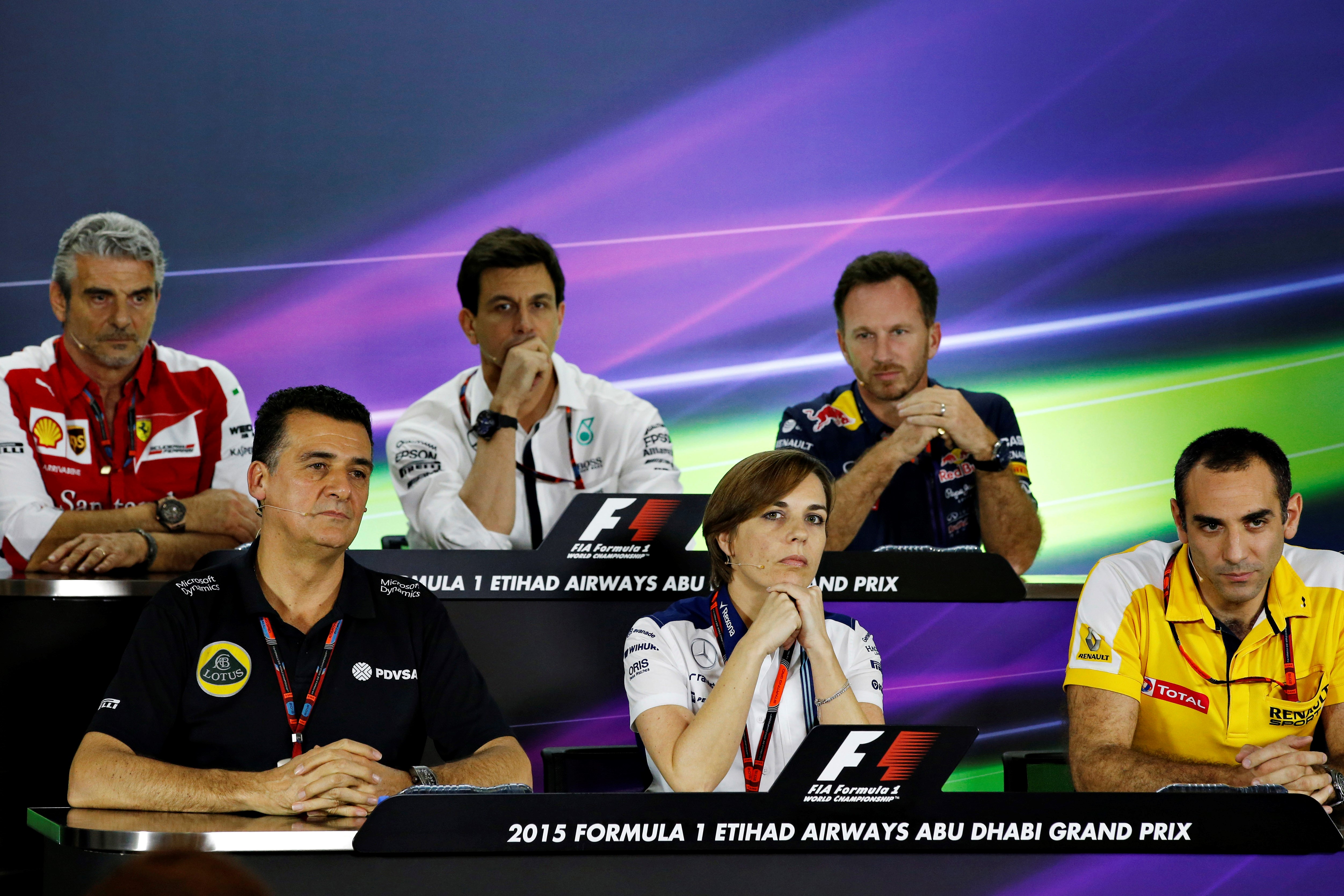
  • 2015 Formula 1 Abu Dhabi Grand Prix: Friday Press Conference

    2015 Formula 1 Abu Dhabi Grand Prix: Friday Press Conference

    TEAM REPRESENTATIVES:

    Cyril ABITEBOUL (Renault)

    Maurizio ARRIVABENE (Ferrari)

    Federico GASTALDI (Lotus)

    Christian HORNER (Red Bull Racing)

    Claire WILLIAMS (Williams)

    Toto WOLFF (Mercedes)


    PRESS CONFERENCE

    Cyril, it’s been a little while since you’ve been here joining us in the press conference. You’ve been talking a little bit recently about next year – larger budgets etc – but can you tell us what exactly Renault will be doing next year in Formula One?

    Cyril ABITEBOUL: Well I’m afraid I can’t answer to that question. I would like to be in a position to be able to answer to that questions, but I am not today. What I can say is that there will be no announcement regarding Renault’s future – short-term or middle-term future – over the weekend, but there will be an announcement, very likely, in the course of next week. We have always said that we would like to do that after the season. Thee season is ending on Sunday, around the start of December and that is what we will do stick to that plan, which is to make an announcement then.

    OK, Federico, if I could come to you, where does that leave you and your thoughts on this?

    Federico GASTALDI: Well, we are on the same page. As I keep saying we have been working, all the time, actually since the Singapore race. We have Renault people already at the factory and it doesn’t change anything. They are the ones who have to announce. We cannot push Renault to make the decision because it’s their call.

    Christian, coming to you, you were quoted this morning as saying that you know now for sure what engine you are going to use next year, but clearly no announcement yet, so what’s holding that up?

    Christian HORNER: Well, we have and agreement in place for next year, so it’s great news that we will be on the grid next year, but unfortunately due to circumstance beyond our control we can’t announce exactly what that is. Perhaps Toto can tell you?

    Toto?

    Toto WOLFF: Can I?

    Coming back to you then Cyril, can you give us a sense of what it’s been like in the past weeks and months, the work that’s gone on behind the scenes and also your own personal ambitions for the brand?

    CA: It’s typical Formula One. I think it has been a proper rollercoaster for us, for me, but also for the whole team, for a lot of people involved, I should say technical people involved in the engine programme. Clearly, Federico made reference to the work being done between Lotus and Renault and it’s fair to say that there is a process going on since the signing of the letter of interest on the 28th of September, there is a process involving a lot of people. I think 50 people have been working night and day on the realisation of a possible acquisition of a majority stake in Lotus. It’s just a project, It’s been a proper rollercoaster, very exciting. I have to say there has been a little bit of frustration on the track. We would have liked to do a better job for Red Bull and Toro Rosso engine-wise, but we always knew it was a long-term game to fix the issues we had. We have not managed to deliver a product that was in accordance to what we would have liked to do with those new regulations, so hopefully we will have the strategy, the time and the resouces to do that in the next few years.

    Thank you for that. Coming back to you Federico, clearly this weekend again a race against time for the mechanics to get the garage and the cars prepared for today’s sessions. Not the first time this has happened. Can you explain the background?

    FG: We have been open in explaining what happened with the team. As everyone knows we have some financial issues. We have been trying to work out a new procedure where the team spends less money. So fortunately between Renault and the shareholders and Mr Ecclestone we kept going but again it’s just the situation we are in in Formula One at the moment. Genii have done a fantastic since they got involved in the team in 2010. We have had podiums, won races, so for a small private team it’s not a bad job.

    Tank you. Coming back to you Christian, can you give us your reaction to the outcome of this week’s F1 Commission meeting and the direction taken, the direction from here in terms of the minimum number of teams that a manufacturer should supply and things like the simplification and cost of the engines. Maybe you could give us your thoughts on those items?

    CH: Earlier in the week there was a positive discussion in the Strategy Group where the independent engine was discussed as an alternative product to being into Formula One and I think the reasons that the FIA and the promoter are keen on that is because costs are obviously critically high and as we have seen availability is also a key issue. So that was discussed in the Strategy meeting and it passed through the Strategy meeting. It then went to he Formula One Commission where despite a lot of the teams voicing concerns about costs the vote for the independent engine at that point wasn’t carried through. However, as a compromise position the manufacturers agreed and were requested to report back to the Commission by the 15th of January a solution to the current issues – a cheaper product, a more affordable product, a more available product and something that could potentially entice other manufacturers to come into Formula One. I think that the situation as we see it is that subject to what the manufacturers come back with by the 15th will depend whether or not the FIA feel the need to proceed with an independent engine to meet that criteria. So, it’s going on at the moment obviously, the time between now and the 15th of January is going to be a critical and busy period to define what this new power unit should be and what the cost and availability criteria are going to be.

    Can I throw that across to you then Toto, your thoughts on what Christian’s just said and the likelihood of a resolution?

    TW: The outcome is public and the independent engine concept with a balance of performance has not been approved. Nevertheless we are all pretty aware that you need to work on your product and develop your product and there are certainly aspects of that engine which can be looked at – costs of supplies is a very legitimate cause. The situation where a team might end up having no engine needs to be addressed and this is the task we have taken away. Is there an alternative concept from 2018 onwards which can address some of these topics, including the noise factor, question mark. We are looking at this and mid-January we are going to come back with hopefully a concept that is workable, financeable and that ticks all those boxes.

    Maurizio, can you give us Ferrari’s position on this?

    Maurizio ARRIVABENE: Already at the Strategy Group level the power units manufacturers they were more than keen to discuss about the 2018 engine with all the characteristics described before by Toto. So it was not a new news. Afterwards, at the F1 Commission the alternative engine was stopped and tomorrow the power manufacture companies are going to meet and we are going to seriously work on the new solution.

    Claire, coming to you, in a season where many independent teams have had a rocky road, you have managed to sail on fairly serenely. What’s been the secret?

    Claire WILLIAMS: I don’t know what the secret is. I think we just tend to keep our heads down and get on doing what we love doing and that’s going racing. We’ve worked hard over the past two years in order to turn this team around. We’ve made a lot of changes within the team and fortunately a lot of those changes are paying off. We’ve managed to secure third in the Constructors’, which is fantastic and testament to all the hard work that has gone in behind the scenes to try to turn this team around over the past 18 months. I’m really proud of the team and the job they have done this year. I think everyone knows though that there is almost a sense of disappointment that we’re third at Williams. We want to be winning races and fighting for that world championship. We’ve made some mistakes this year that have been fairly visible for people to see and we need to improve upon our operations to make sure we don’t make those mistakes next year and we can continue to improve in 2016.

    Tell us about the signing of Lance Stroll, former Ferrari Young Driver Academy prospect. You’ve signed him up, what’s the plan for him?

    CW: Lance is joining our young driver programme, starting next year. We will doing some simulator work with him to try to improve him as a driver. As everyone knows Williams enjoys nurturing young talent and we’ve identified Lance to take on that role next year. He’ll be doing simulator work with our guys at the factory and he will be undertaking a team immersion programme, so similar to the programme we did with Valtteri many years ago now. So he’ll be doing that and we’ll be supporting his season in Formula 3 next year and hopefully he will have a great season and we’;ll see where he ends up at the end of ’16.

    Thank you for that. Coming back to you Toto, a record-breaking season comes to an end this weekend. You’ve been beaten only by Ferrari and Maurizio this season. How do you assess that challenge and do you expect a title challenge from them next year? 

    TW: From the numbers it was indeed a very successful season and I am very happy and satisfied with how it went and there is a great buzz in the team and spirits are high but in Formula One as in many other sports and business only tomorrow’s result counts and this is why we are looking very much forward to next season. Ferrari is about best ‘frenemy’ and they have stepped up a lot over the winter. Clearly in Malaysia it came with a bit of a shock win and it was good for us to see that and I think generally they have done a good job and for F1 it is important that you have more teams competitive in the front fighting with each other, as much as you would like tot see it as a comfortable situation it is not sustainable and the better the platform is the better it is for us all.

    Maurizio, your points of view? Is there belief in Maranello that you can come back here 12 months from now and be fighting for the championship?

    MA: I hope so, because last time I said we would like to stay in front of them, this is an objective. Then last weekend somebody said in Italy, they make a statement in the newspaper ‘yeah, but where they want to go, they are going to be second, Mercedes is going to win’, and I was asking ‘So, what you want me to do in terms of objective? To tell to everybody that I would like to be second next year?’ Of course [to beat them] is our objective but it doesn’t mean we are going to achieve it. But we will try very hard.

    QUESTIONS FROM THE FLOOR

    Q: (Joe Saward – Grand Prix Special) Can I ask the three manufacturer teams: if there was an equivalency formula, would you still be here?

    TW: Formula One is not a place, in my point of view, that should have an equivalency formula. It is very much the World Championship and the pinnacle of the best drivers, the best cars, the best engineering and I think it is important to understand what our DNA is and it has functioned very well over a long period of time. Doesn’t mean there shouldn’t be things we’re looking at and changing for the future but an equivalency formula, balance of performance wouldn’t be Formula One any more.

    Cyril?

    CA: It depends on the formula, y’know? Seriously, I think in addition to what Toto has mentioned about the DNA of the sport, the biggest hurdle I can see is that when there is distribution of something like a couple of hundreds of millions that are distributed on a yearly basis, I would not want to be the guy who has to sign off the formula that will decide the distribution. I think that will be opening the doors to an awful lot of discussions. There is already a lot of politics and talks in our sport, which I think is part of the game frankly, and of the show, but I think it will be simply way too much. So, clearly I believe, as a Renault representative, I recommend to Renault to stay away from that.

    Maurizio?

    MA: I think we already have an equivalent formula that is so-called Formula Indy. I mean, Formula One, it’s the pinnacle of motorsport so I agree that we need to think about the future in future to reduce the cost but to reduce the cost you need new regulation first. Due to new regulation you can reduce the cost but the competition is distinguished in Formula One and the research from any other motorsport.

    Q: (Ian Parkes – Autosport) Question for Toto. Toto, Esteban Ocon has just announced on Twitter that he’s now a Mercedes AMG F1 driver. Does that mean that he’s taken up the reserve role from Pascal? And can we assume that Pascal is therefore moving on to Manor?

    TW: So, yes, we’ve taken up the option on him because he has been with us now, or has been following the DTM team for a while, has been the test driver in DTM and integrated well and he’s doing a very good job in GP3 as well and he’s somebody we’d very much like to have in the family. This is why we’ve exercised the option. It doesn’t mean that we’ve found a solution for Pascal. The current driver market is a bit difficult because most of the teams have already announced their drivers and it need to be the right deal – but having taken up Esteban we are conscious that we need to find a suitable programme for both of them. It could well mean that it could eventually end up for both of them in a testing role, in a reserve driver role and in a DTM role – so it’s not done yet.

    Q: (Dieter Rencken – Racing Lines) A question to all of you please. We’re currently talking about 2017 regulations, completely different underbodies etcetera, different aero packages, tyres. At the same time we’re talking about the possibility of a completely different engine concept. Isn’t this indicative of the sort of disjointed approach to Formula One that, on the one side we’re talking about a completely different chassis concept in, sort of, 15 months time, and on the other side, in 18 months or two years, we’re looking at a completely different engine. Should we not co-ordinate these packages together?

    CH: I absolutely agree with you Dieter. We should bring it all in, in 2017.

    Claire?

    CW: I think the conversations are still on-going, I don’t think anything’s been decided yet and I think they’re very early days in those conversations and we’re trying to map out what the best course of action is – but I think you have to remember the reasons behind the fact we’re having these conversations is in order to try and improve our sport and make it the best that it possibly can be – and we’ve still got a bit of a way to go before we do that but I think if you look at the regs that the working groups are working on at the moment around the new car and the chassis etcetera what that’s going to look like and then you look at what we’re trying to do with the engines and bring down the costs of those. If we can get both areas right, then I think in ’17 – and if not, if we have to wait to ’18 so be it – but I think it could make Formula One a much more stable platform that we can all enjoy in the future.

    Federico?

    FG: Well we certainly need the stability but I think there’s still a lot of things to be discussed in order to find a solution that will suit everyone.

    Cyril?

    CA: I believe the processes are exactly the same. On chassis side I think we are trying to improve the product which is already a good product, while on the engine side we are trying to recover from a number of issues that are associated to the current regulations. I think we recognise that, that’s why I guess the process is different and the timing of those two exercises is slightly different.

    Maurizio?

    MA: I think this discussion, it looks less confused than what it is in reality. The chassis is still under discussion and it will be an evolution and not a revolution concerning the engine. The good news is for 2016 and 2017 everything, it’s very clear now, opening also the door to us, because we are still second, to Renault and also to Honda. We will continue to do our job especially. Tomorrow with the first meeting about the new power unit that is supposed to be in 2017. We try to do all of our best but I think even the Wizard of Oz couldn’t be able to do it for 2017. For sure for 2018. So, it’s much more positive than what it looks like.

    Do you agree with that Toto?

    TW: Yeah. There’s some good stuff coming. I think in terms of chassis regulation there’s interesting bits and synchronisation probably makes sense but you need, of course, to look at the costs.

    Q: (Christian Menath – Motorsport-Magazin.com) Question for all of you. In the past it has always been almost impossible to find one way for all the teams, for all the parties in F1 Commission and Strategy Group and so on. Some people say that now things changed a bit in the last meetings. Why now? Is it the alternative engine that was there or…? Why is it possible now and not in the past?

    CH: I suppose when you look at it, the teams have collectively been spectacularly incapable of coming up with solutions and sensible remedies to the problems – and I think the problem we face in Formula One is you’ve got vested interest. Within your own team you try to protect the elements that are your strengths, that offer you that competitiveness over your opponents. And I think this is where Formula One has tripped over itself over previous years and indeed, the engine formula that we’ve ended up with today arguably is a mistake. It’s expensive. The technology is fantastic but we’re not doing a great job of communicating that and I think it’s put a situation where probably half the grid is currently insolvent. I think there’s a fundamental question that needs to be answered and that is: what should Formula One be? I certainly believe that Formula One should be entertainment. It should have a technological interest to it but that needs the promoters and the owners of the sport, together with the regulators to decide what that product is, come up with a set of rules, not let engineers write those rules, they come up with those rules and put them in front of the teams and say “that’s what Formula One is going to be and that’s what it should be for the future,” and they need to bring in some people with the right skillset to be able to define what those regulations are. And there’s good people that aren’t currently in employment within teams at the moment that are impartial, that come up with a set of regulations that are in the best interests of Formula One, that’s going to provide the best show for the fans, for the public, for the paying spectators who are the backbone of what we do because without them there is no show, there is no Formula One and we need to get Formula One back to being a sport that is enthralling to the public.

    Maurizio, do you share that view?

    MA: I think if you are winning races, of course the show is perfect for you. If you are not winning races the show needs improvement. It’s normal. But I think at this stage, I’ve said so many, many times, we need to work all together, really to improve the show, to attract more spectator, especially on the segment, on the younger segment – and I think this is something, it’s an objective because the population of the world TV viewer, reader and so on is getting older and older and older and this is what we have to do. Of course, during the way you find it’s not an easy way to go because of course the people who have an advantage, they want to keep it. The people that doesn’t have any advantage, they are using sometimes this problem to criticize the overall system. I think with great cooperation between all of us, we can solve it.

    Toto, back to the question about the level of consensus, what are your thoughts on that?

    TW: I would just follow Maurizio on that one. Summed it up pretty well.

    Q (Joe Saward – Grand Prix Special) This is for the three manufacturers again. You guys represent very, very large companies that have lots and lots and lots of money. Why in the world are you fighting over a few millions when you’re getting the technology that Formula One gives and you’re getting the exposure as well? Why don’t you just settle down, give people a decent price and let’s get on with it?

    Cyril?

    CA: Thank you! Frankly, it’s a good question. At the end of the day, at the end of the road that might be what’s at stake but I think maybe there is some road to cover before we get there. You’re talking about the amount of money that we all have, yes, absolutely, but you know times are difficult. Automotive car makers have their own challenge, they need to invest for their core business which is road car technology that you find on the road, not on the track. We’ve got a number of risks associated to what we do. I’m not talking about motorsport. You are aware of the ‘Dieselgate’ and a lot of us are exposed  – maybe not Ferrari – but a lot of us are exposed to this difficulty, this challenge that the world of carmakers are facing but that’s not the only issue, we’ve got a number of issues, like the currency, like the markets, the lack of confidence of certain customers, so we need to be extremely careful. At the end of the sale, it’s a sales and marketing decision. Basically, we need to demonstrate that investing in Formula One, or spending – because it’s not an investment – spending in Formula One is more cost-efficient than spending, for instance, in the regular advertising or spending in badminton in China. So there is a number of KPIs that we need to follow, that we need to monitor and demonstrate that this is competitive as a marketing spend perspective. At least for a manufacturer, which is a mainstream manufacturer, like Renault, and for which Formula One has always been in the DNA but for which is not a must – there are many carmakers that are very successful and are not in Formula One. So, we need to be extremely careful about whatever can, I would say, threaten or destabilize our business case in Formula One and obviously subsidizing the cost of engines to independent teams – even though we appreciate it might be a necessity to be in the sport and to have a healthy sport but it is something that is endangering the business case. That is the situation.

    TW: It is a situation where all those big OEMs – like everyone else out there – is trimmed on efficiency and particularly the car industry with the problems Cyril has described, are in a constant loop of margins, recalibrating margins, of trimming down costs and Formula One, although it is part of the DNA what we do at Mercedes, because it’s around the car, it needs to have the right price for what you do and this is why you can’t just apply easy-going mentality and say it doesn’t matter if you spend a little bit more or a little bit less. It does because somebody will look at the numbers and somebody will make a decision whether it makes sense or not. And this is why we are aware (that) although we have this big mothership behind us, that it needs to be the right price, it needs to have the right value and we are monitoring that and if we are a having a bad race with a bad audience or not the right viewing numbers in terms of what you deliver to your partners, that’s being considered and that is how we operate.

    MA: You don’t have to mix up the big name of Ferrari. Ferrari has a name that is in a worldwide business, it’s at the top. That doesn’t mean that the budget is in a wordwide business at the top. We need to be careful. Mr Marchionne is not joking about that, to respect the budget that is assigned to us. We are not the kind of company that is throwing money out of the window. That’s the point. So don’t mix up the big name with budget. That’s another story.

    Q: (Chris Lines – AP) Christian, does this new engine supply deal suggest that Red Bull has a fresh commitment to staying in the sport as a constructor, as an owner? And you describe the deal as a transition. I was wondering, a transition towards what?

    CH: Well, to answer the first part of your question, I think it’s no secret that during the summer that Dietrich Mateschitz became fairly disillusioned with Formula One, with the direction that things were heading. He said in conversations that he’d personally had the undertakings that he had that didn’t come to fruition. He is probably the most committed supporter of Formula One over the last ten years, if you look at two Grand Prix teams, a Grand Prix on the calendar, the amount of promotion that Red Bull worldwide puts into Formula One, the young driver programmes, investing in youth and young talent, more than probably 1500 employees across the different teams and markets, regarding the two Formula One projects. So for Red Bull it’s a major major part of their promotional budget spend, that is committed to Formula One, and I think that during the summer months or the latter part of the summer, he was seriously concerned with the direction the sport was heading and what the return of Formula One could ultimately provide. I think that having sat and thought about it, he’s decided that there’s too much at stake, that Red Bull have invested so much into the sport that he wants to see the team get back to its former glory. We’ve got some challenges ahead to achieve that. I think the current constitution of performance obviously in a power unit dominated formula it’s a difficult situation if you’re not aligned to a competitive power unit at this point in time, so 2016 will be a transitional year for us and I think as hopefully regulations come to fruit or come to bear with the changes that Jean Todt is pushing for, that the promoter is pushing for, to achieve a more affordable, more available power unit, can only be a positive thing for any independent team, not just Red Bull but all the other independent teams that are currently on the grid.

    Q: (Ian Parkes – Autosport) Christian, with regard to your remarks about a sole regulatory body, that would suggest that perhaps you’re calling for the abolition of the strategy group and the F1 commission. Is that the case, is that feasible and to the other five, do any of you agree with Christian’s remarks that you would again like to see a sole regulatory body, that the teams would no longer have an input?

    CH: I believe that an input is fine and the teams obviously have an investment in the business, so there’s no reason why things shouldn’t be discussed among the key stakeholders and certain teams obviously are stakeholders. And the strategy group is supposed to be looking at the longevity of Formula One but what the strategy group continually gets embroiled in is fire-fighting issues of the current day. Instead of looking at what should a Formula One car be like in 2020 and beyond, we’re constantly dealing with issues of today and tomorrow, rather than further down the road. So I think that of course there has to be consultation with the teams but at the end of the day, somebody has to run the business, and somebody has to say this is the route that we’re going and a democratic approach to that will not work in our opinion.

    CW: I think it’s a bit of a case of be careful of what you wish for. I think that we’re very lucky that we have – as Williams, as a team – that we have a seat at that table and can be part of the democratic process that we do have in F1 at the moment. I like that, I like being able to be involved but I do think that at the moment, as Christian said, we have a number of agendas on the table and it’s very difficult to get everybody to agree around that table when we’re having discussions and we all run our businesses in very different ways and we all have very different capability within our teams. But I’m not sure if I would subscribe to our sport having a single regulatory body. I think it would be very difficult for everybody around the table.

    FG: Well, I agree with them and I’m sorry to keep repeating the same things but the problem for me is that we are not in the same boat, we are not on the same page and we are not on the same agenda. As Cyril has pointed out before, we are all looking for our own stability as a team individually. It’s hard to have a common approach that will benefit the sport at the end of the day.

    CA: As a Frenchman I am for the dictature (dictatorship) as long as you can chose the dictator. I think it’s fair to say that if we want to be progressive, what Formula One is, maybe there needs to be some form of re-grouping of different groups and functions and something a bit more effective and again progressive. Having said that, there is always some dangers, that again the power can be in the hands of someone who has a particular agenda which can be the individual or collective, I’m not thinking of anyone in particular. But I think on balance, if you look at Formula One I would prefer it to be more progressive than it is, so if that involves a little bit of dictatorship maybe that would be better.

    TW: Can I follow Claire on her opinion? That’s what I would say.

    MA: I think a couple of years ago we had an aero dominating formula, today we have a power unit dominating formula. I think that the right balance should be defining to be sure to make everybody happy. Then the question if we go for a democratic decision or a kind of dictatorial decision is not for me to decide. I mean we have a commercial rights holder, we have a federation but of course we also have the interests of the teams so my aim is to find the right balance for the future and to make everybody happy and working to enhance the show and to go back to a spectacular Formula One.

    Q: (Nahed Sayooh – Autosport Middle East) Maurizio, you have set a target of three wins this season and the team achieved it. What is the target for 2016?

    MA: The target for 2016 is to cancel the smile from the face of my friend Toto.

    Q: (Christopher Joseph – Chicane) Christian, you spoke earlier about the need to communicate the technology aspect of Formula One. Do you think that with the endless discussions about strategy direction, power units etc etc, are we losing the plot in terms of communicating this technology message?

    CH: I think to a degree we are. What these cars achieve with 100 kilos of fuel and the fuel economy they are achieving is impressive but I’m not sure how many fans actually give a damn about that. I think that what they want to see is the drivers who need to be the heroes, racing wheel to wheel and competitive racing. Machines that are Formula One cars are truly spectacular to drive and I think Formula One is the pinnacle of motor sport and it’s competing against an awful lot of other sports that are now demanding television air time. And it’s got to be entertaining from start to finish. I think that that’s what we need to be striving for, that’s what we need to be looking to achieve. Now of course technology plays a role but I don’t believe it needs to be the primary role, that should be about the drivers and out-and-out racing.

    Q: (Dieter Rencken – Racing Lines) Toto, from the pit lane in Brazil, you seemed to indicate that the difference in price to the teams of the new engine to the old engine is about plus twenty percent which works out at ten percent per annum, or if that price gets held for next year, about six percent per anum, which is roundabout six percent of a smaller team’s budget. What’s the big outcry about, why do you want to throw this engine out with the bathwater when in fact there’s only about a six percent difference from one to the other?

    TW: I couldn’t follow you on that calculation. But the main point is that there are lots of numbers out there and lots of wrong numbers out there and as a matter of fact I can only speak for Mercedes because these are the calculations I know, it’s from a previous engine spec: the old eight cylinder engine plus KERS. About the difference to what we have today, it is what you have mentioned, 20 or 25 percent. Is that too much? Maybe. I remember times when I joined Formula One a couple of years ago, the price was around £30m, three-zero plus a driver. Nevertheless, I think it’s legitimate to question the price and obviously the lower the price, the better it is for Formula One, the more sustainable it becomes, the better it is for most of the teams and that is OK and we need to look at it. But the difference is not what’s been said.

  • F1 2015: Red Bull Confirms Engine Deal

    F1 2015: Red Bull Confirms Engine Deal

    Red Bull Racing has finally confirmed that it has finalised a 2016 power unit supply deal.

    After months of negotiating the Red Bull Racing F1 team has finally put pen to paper on a power unit for the 2016 season. After spectacularly falling out with Renault mid way through the season the team went shopping at Ferrari and Mercedes only to come up empty handed. A rumoured attempt at securing Honda power even made the rounds but eventually a reconciliation with Renault was the team’s only option.

    Despite not confirming that the soon to be announced deal is with Renault the French manufacturer is the only plausible supplier at this late stage.

    “Next year will be a transitional year,” Red Bull principal Christian Horner told Autosport. “We have an agreement with an engine [supplier] for next year which hopefully will be confirmed in the coming days.”It will have a development path, which ironically, in a way, is what we were trying to achieve 12 months ago, and we’ll see how that goes.”


  • 2015 Formula 1 United States Grand Prix: Friday Press Conference

    2015 Formula 1 United States Grand Prix: Friday Press Conference

    TEAM REPRESENTATIVES: Matthew CARTER (Lotus), Vijay MALLYA (Force India), Franz TOST (Toro Rosso), Christian HORNER (Red Bull Racing), Eric BOULLIER (McLaren)
    PRESS CONFERENCE
    Q: Christian, we’ll begin with you. First of all, what’s the… you’re smiling?
    Christian HORNER: I’m just very upset to hear Toto is ill and couldn’t make it, that his helicopter couldn’t fly unfortunately. Anyway, I wish him well and hope he’s OK. I’m sure there will be no fine, obviously. It should be about 100 million, apparently.

    Q: Daniel Ricciardo was here with us yesterday, talking about the update Renault engine. What’s your final decision then on when and if you are going to use this updated version?
    CH: I think the situation for the Renault engine, for the updated version, which they are referring to as the D-spec version, Renault have confirmed earlier today that the conditions for it to run in aren’t quite right yet, so that has been postponed to Brazil, which for us makes more sense. We wouldn’t want to be taken engines out of the car here or next weekend in Mexico.

    Q: I’m sure it’s been a very intense period for you, trying to find a way forward for next year and beyond on the engine front. Would it be accurate to say that some kind of deal with Renault or Honda looks likely now or would you rule out those two options?
    CH: I think as we sit here there has been a great deal of speculation and interest in what the engine supply we are going to have next year is. As we sit here now, nothing is fixed. There is a lot of discussion going on in the background and hopefully there will be a resolution fairly soon.

    Q: OK, coming to you then Eric on that, can you clarify the position from McLaren’s point of view with respect to Honda and a secondary supply of engines. Is there an advantage to having another strong team helping to develop the power unit from your point of view?
    Eric BOULLIER: It’s difficult to comment, other than we are happy with our partnership with Honda and this is what we wanted to achieve, to be a works team with an OEM. I can’t comment obviously on what Christian just said or whatever happens.

    Q: From the little running you’ve been able to do today how much of a step forward is the updated engine that Fernando is running this weekend going to be?
    EB: Well, I think we were one of the most active teams on track this morning. We did enough laps to confirm what said after Russia, which is clearly an improvement of the engine. I think all his engineers were happy with the numbers and the mapping they were running through this morning.

    Q: Franz, coming to you, another team boss on the lookout for an engine. What are you going to be using next season?
    Franz TOST: We will see. We are still negotiating. It is not decided yet. Hopefully it will be soon the case because otherwise the timeframe will become quite small but nevertheless we are still optimistic that we will do it.

    Q: As you say, it’s getting quite late in the design process. With your resources that you have in Faenza, how much of a challenge is it to build a car now without knowing what engine you’re going to be using?
    FT: It’s a challenge because every day we lose will decrease our performance for next year, but we have an emergency plan for the design office and pay for the production and I’m still convinced we can do it in time.

    Q: OK. Matthew, coming to you. Obviously we are aware that the process of being acquired by Renault is ongoing, but how much planning have you been able to do? For example, with the letter of intent were you also given a set of blueprints for a 2016 Renault engine that you can start designing around?
    Matthew CARTER: Absolutely, yes. Again, it’s difficult for us to talk in any great detail but we certainly have an idea of the route we are going to go down next year. We can’t confirm anything at this stage but we certainly are heading down that route and things back at Enstone are taking shape.

    Q: Now, Romain Grosjean has confirmed he is moving on, does the Renault takeover have to be completed before you make your selection on his replacement?
    MC: No it doesn’t. I think there will probably be an announcement at some point this weekend with regard to our second driver.

    Q: Can you give us a little foretaste?
    MC: I can’t. The announcement will probably happen in the next hour or so but certainly after this press conference you will be aware of which direction we are heading in.

    Q: Very good, thank you for that. Vijay, podium last time out in Sochi. In the last five races Sergio has scored 39 points to Nico Hulkenberg’s 14, what’s been going on there?
    Vijay MALLYA: Well, I guess Nico hasn’t had the best of luck. He hasn’t finished as consistently as Sergio has but I think overall from a team perspective, since we launched the B-spec car in Silverstone we have shown we are a lot more competitive and I’m quite pleased about that. But Nico is a top-class driver and I’m sure he will score points going forward.

    Q: Now you and Sauber have made a formal complaint to the EU competition commission. Monisha Kaltenborn was in this press conference a couple of weeks ago in Sochi and spoke about this. Can you share your thought on it and what you believe the outcome will be?
    VM: I can’t predict the outcome. We have lodged a complaint basically saying that the distribution of Formula One income is disproportionate and disadvantageous to small teams and it’s a process and we’ll just see where it goes.

    QUESTIONS FROM THE FLOOR

    Q: (Seff Harding – Xiro Zone News) The question is for everyone. There is talk about returning to the V8 engine, which has been a fan favourite, and I wanted to get you guys’ thoughts on it and would you be prepared to return to that powerplant for next season?

    Christian?
    CH: We might have to because we don’t have an engine! If you look at the plus points of the V8s were, the sound was the obvious one for the fans. It was quite simple technology compared to what we have now, so the costs were significantly lower, but the machinery that we have now through the regulations we have, they are incredible bits of equipment and I think what we need to do is rather than look backwards, look forwards as to what should the engine develop to be for the future. And I think there are elements of what we have that are strong at the moment but I think it can be improved and I would certainly love to see the volume go back up and certainly the cost of development come down.

    Eric?
    EB: I think Christian said everything but as far as we are concerned, as McLaren-Honda, Honda joined the sport because of the challenge of the technology and obviously, yes, some may regret the engine noise of the V8 and some regret the cost as well but it’s true that we have to look forward and as a piece of technology it’s brilliant, once it works, in our case hopefully soon. It’s a nice challenge to run these engines.

    Anything to add from the back row, gentlemen? Matthew?
    MC: I think I tend to agree with what Eric said and the relevance of the new engines to the road car and the benefit that the road cars can get from the technology means we are going down the right path at the moment?

    Q: (Daniel Johnson – Daily Telegraph) A question for Eric. It emerged over the last week or so that Kevin Magnussen was fired by an email… OK, ended his contract with McLaren via an email from Ron’s PA on his 23rd birthday. I just wondered what you thought of that as a piece of man management by Ron, you know, is that really fair to Kevin? Is he owed a bit of an apology from the team?
    EB: So, first of all, he has not been fired, as you said. I want to tell you that his contract was ending this year, so there was an option to renew it or not and we decided to not renew it for several reasons. We as McLaren that Kevin obviously has a great talent and he has to be praised for that and he should get a drive in Formula One next year and his career should get there. Anyway he will have a successful career I’m sure. As far as I am concerned by the process, I will not comment.

    Q: (Daniel Johnson – Daily Telegraph) What does it say about the culture of McLaren?
    EB: Next question.

    Q: (Ian Parkes – Autosport) Question for Christian. Obviously  hindsight’s a wonderful thing but do you not now consider it a catastrophic business mistake to cancel your contract with Renault without having a replacement in place first of all.
    CH: That’s an interesting question. I think that, if you look at our relationship with Renault, it’s been unconventional from the start. I remember asking Flavio Briatore for the supply of the engine back in 2006 and somehow we ended up sponsoring Queens Park Rangers and sponsoring the Billionaire club for a year before receiving the engine – and since then we really we’ve enjoyed huge success with Renault during the V8 era and the collaboration between the companies was very strong during that period of time. And during that time they obviously had their own team and then they sold their team. I think obviously what’s happened with the regulations that came in for last year, the V6, the hybrid regulations, expectations were set and promises were made and inevitably in any relationship like the competitive environment that we have in Formula One, when promises aren’t fulfilled then frustration sets in. It’s not something that’s bubbled up just over the last few months. It’s been a progressive thing – probably on both sides in fairness. Despite the very best efforts of all the people involved, for whatever reason it hasn’t worked, and so the decisions that have been made have been made for a reason – and in the interests of the team moving forward. Red Bull’s goals and objectives in Formula One are to compete and to win. Unfortunately we haven’t felt that those objectives have been mirrored over the last couple of years. So, therefore, decisions have been taken based on the philosophy of where the team wants to be. So the situation that we’re in for next year is that we’re looking to find a competitive solution to enable the team, first of all, to continue racing but racing competitively – and competitively for the foreseeable future.

    Q: (Dan Knutson – Honorary) Eric, yesterday Fernando Alonso was telling us he’s very confident the team can make up a big chunk of time for next year. What do your computers and analysis show? How much can you improve, engine and chassis-wise, next year?
    EB: It’s an easy question because defining targets are always easy on paper. We know where we want to be as McLaren-Honda and if we get there we can obviously get what Fernando said. I’m not saying we’ll be there but we know we want to be there. We are definitely working on how to be there.

    Q: (Dieter Rencken ¬– Racing Lines) To the back [MC, VM, FT] basically there are five teams that are disadvantaged under the Strategy Group and revenue structures, the way they stand at the moment, yet only two of those five have actually lodged the complaint with the EU. So the question to Matthew and to Franz, do your teams not feel disadvantaged by the structures – or why did you not join in the action? And Vijay, are you disappointed that only two teams of five have actually taken that step?

    Matthew, let’s start with you.
    MC: I think we’re in a unique situation in terms of where we are as a team. From my own personal opinion, would we have taken a different route if we weren’t under the potential new owners, as we are, then possibly we would have done. However, as things stand at the moment, we are trying to plot a course through the turbulent times that we’re in at the moment, the best way that we can. We’ve been advised and we have discussed at a fairly high level, the route that we’re going to take and we’ve decided that we would not join the action.

    Franz?
    FT: We signed a contract a couple of years ago, we knew the contents and therefore there is no reason for us to claim against the commercial rights holder.

    And Vijay, your feelings?
    VM: First of all, even if one team complains, it is still a complaint. What we have sought is the intervention of the European Commission to determine whether the current distribution of income pattern is fair and equitable or not. I hear what Franz has said about contracts being signed. Yes, I can confirm that contracts have been signed but the disparity between the contracts was something that was unknown at the time those contracts was sign. And it’s never too late to complain, is it?

    Q: (Alan Baldwin – Reuters) Eric, Adrian Newey said the other day in an interview that he understood that McLaren had a veto on Honda supplying another team with an engine. Is that the case?
    EB: I think it’s better to not comment any more on this discussion because obviously as we said already there is a lot of discussion behind the scenes. McLaren and Honda are official partners and obviously there is a due respect of understanding from each party.

    Q: (Graham Harris – Motorsport Monday) A follow-up for Christian. You say you’re looking for a competitive engine for next year. Does that include Renault?
    CH: Does that include Renault… obviously discussions have been going on with Renault to understand what their plans are for next year but I think until they commit to whether they’re going to be in Formula One or not, it’s difficult at this stage to take that any further.

    Do you not have a contract with them officially for next year?
    CH: We have an agreement with Renault that runs to the end of next year which there’s obviously been a lot of speculation about and I’m sure there will be confirmation about that agreement in the coming days.

    Q: (Luigi Perna – La Gazzetta dello Sport) Question for Christian, considering the position which you are in now, maybe it would be better to consider the possibility to have a Ferrari spec, not the latest spec but a 2015 spec for next season, don’t you agree?
    CH: It may well be the case. I might agree with you. At the moment everything is open.

    Q: (Christopher Joseph – Chicane) Question for Vijay and Matt. Vijay, you spoke about ‘it’s never to late to complain’, a) why did it take you so long and, that’s the business rationale behind the decision: what do you think is the sporting rationale and how will that play out for you in the future?
    VM: I don’t see what bearing the European Union complaint has on the sporting side of things. I remember last year here in Austin there was much speculation on whether three teams would be boycotting the races. We raced here in Austin, we raced in Brazil and Abu Dhabi, we completed the season. Here we are again a year later – but fundamentals remain fundamentals. You exhaust various options and avenues of dialogue and, if you still remain unsatisfied, then there is a Commission to go to, which is what has been done.

    Matthew, anything to add?
    MC: No.

    Q: (Christian Menath- Motorsport Magazin) Christian, you said that the chance of running a Honda engine next year is 25 per cent as is the chance of running every other engine. That means that quitting F1 is no more an option for you.
    CH: For me it’s not an option, we have to find a solution and I’m working very hard to ensure that the team’s on the grid and competitive for next year and beyond.

    Q: (Alan Baldwin – Reuters) Christian, you said ‘for me it’s not an option’. Is it still an option for Mr Mateschitz?
    CH: Well of course it is, it’s his team at the end of the day. He recognises the commitment and the skill and determination that’s within the team. Again, he wants to find a solution going forward. He’s committed to helping that and behind the scenes is obviously involved in numerous discussions to try and facilitate that.

    Q: (Ian Parkes – Autosport) Just following up again Christian, so what’s changed behind the scenes then, that these discussions have now taken place, that you’re not now going to quit F1, because that has been something that Dietrich has suggested could happen for quite some time now?
    CH: That could still be his prerogative, that could still be his decision to do that. Indeed, if we don’t have an engine then we can’t race but my position, as team principal of the team feeling the responsibility for the in excess of 800 employees that we have, is to ensure that we’re on the grid and we’re racing and we’re racing competitively next year so therefore I’m working hard to try and ensure that we have a solution.

    Q: (Dieter Rencken – Racing Lines) It appears as though Pirelli will get the contract from 2017 going forwards and I believe that one of the points that they insist upon was that there is some form of testing, both for the 2017 cars and beyond. How do you feel about a possible return to testing?
    FT: We will increase the costs dramatically. Personally I am totally against this testing. We have some testing sessions at the beginning of the season and this should be enough. We have 20 races and if you look at the calendar, if you want to do some tests in between, you need to build up a test team which means we have to bring in another ten, fifteen mechanics, another five to seven engineers and at the end of the year, we have spent around ten million more and I’m just asking whether this is necessary. Absolutely not. I can give you the answer, because we have seen now the last years that without testing we can also achieve our goals. It’s just wasting money.
    EB: Well it’s true that it’s going to bring the costs up. This is not something that we’re obviously in favour of. We also need to understand that Pirelli maybe needs some track experience so all in one I guess if they can cover the cost or most of the cost of it so we can maybe find some agreement in the middle or in between, not having to necessarily bring back testing like in the old days but maybe a few days.
    VM: I agree with what Franz said. I think it will be unnecessary and a huge increase in cost and we’re only talking about cost control which also has not been implemented in spirit but now to go back to the old testing days will only once again drive costs out of control.
    MC: There’s probably a fine line between the old testing days and what Pirelli are suggesting. I think it needs to be looked at in more detail. I also think that if they’re suggesting that they need to do this testing to prove the safety or to prove the reliability and ultimately that’s going to increase the safety within the sport, then it’s possibly a good thing.
    CH: Well, I think if you take all the valid points that have been made, I think the other difficulty is that the tyres for 2017, the diameter and the width is significantly different so it’s not as easy as just bolting those tyres onto a current car. The downforce levels are going to be significantly different in 2017 to ’16 so therefore it’s going to be very difficult to build a car that is going to simulate what Pirelli need for 2017 so they’re going to have to rely a little bit like the rest of us on accurate simulation in order to make sure the product fits what it’s required for or find another way, outside of Formula One, of testing those tyres.

    Q: Dieter Rencken – Racing Lines) Eric, you seem to be against any form of increased testing yet Mr Dennis was recently quoted as saying that he favoured testing, he wanted a return to testing. Is that correct or not?
    EB: I didn’t say this. I didn’t say we were against testing… I am against testing. Definitely this is not what I said, I think. I think we are in favour and as long as some of the costs can be covered. Talking about the Pirelli testing.

    Q: (Will Buxton – NBC SN) Christian, when BMW pulled out of Formula One, Peter Sauber came to the rescue of his team. When Honda pulled out of Formula One, Ross Brawn took over his team. Sauber’s now celebrating 400 races and the team over at Brackley has just taken a second championship. You’ve said that Mr Mateschitz’s future might be whatever it is, maybe to pull out of Formula One. You’ve said that your intention is not to quit Formula One, not to have the team quit Formula One, to save the team. Is there a potential then, if Mr Mateschitz does want to pull his team out of Formula One, that you will take that responsibility on your own back, to save the team, potentially as Arden International as it’s been so successful in junior formulae?
    CH: Well, this weekend is actually our 200th Grand Prix and when you look at what Red Bull’s achieved in that period of time, 25 per cent of those races have been won, more than 100 podiums, four drivers’, four constructors’ world championships. It’s been a tremendously successful period for Red Bull. My objective is very clear: it’s to keep the current status quo running for the foreseeable future. Ultimately the final decision lies with Dietrich but he is an utmost fan of the sport, otherwise he would never have committed the kind of funds that are required to be competitive in Formula One. He’s been involved in Formula One, not just as a team owner for the last ten years but ten years prior to that as an investor in the Sauber team and prior to that as a sponsor. He’s invested in a lot of young drivers that owe their careers to Red Bull and his vision, and I believe that discussions of other shareholding or change of shareholding… they’re not applicable at the moment. The focus is purely on finding a solution to our engine predicament, that we can move forward for next year and the future.

    Q: (Michael Schmidt – Auto, Motor und Sport) Eric and Christian, if the European Commission finally shares the view of Force India and Sauber, what would that mean for your operation, how would it affect it and do you think then that the field would come closer together?
    EB: No idea, no idea because you started your question with ‘if’.
    CH: Money is an important factor in Formula One. The promoter theoretically could take the view of if he chose to give all the prize money to the winning team. It’s then down to the teams to decide whether they wish to enter or not. So it will be interesting to see how the EU rule on something like that, because does that mean that we could say that teams unwilling to supply engines, is that anti-competitive? So everything could therefore end up in the commission.

    Q: (Alan Baldwin – Reuters) Christian, if I can come back to Ian’s earlier question about how you got yourself into this pickle, I’m not sure you entirely answered it earlier on. There’s been speculation that what’s happened to Volkswagen with the emission scandal may have derailed your plans to some extent. Can you just comment on that? Is that the case?
    CH: Well of course there was – as publicly known – there has been discussion with the VW Group which obviously… with their current issues probably Formula One is the last thing on their mind. There were other discussions that will become apparent no doubt in the future as well, other promises that were made. There’s an awful lot of speculation and conjecture about our situation at the moment. Once everything is finalised I’m sure it will all become extremely clear.
    I would just like to add Happy Birthday to Dieter. I know this isn’t answering your question but I gather he’s 87 today and he’s looking great on it.