Latest

  • F1 2015: Mercedes To Sue Engineer

    F1 2015: Mercedes To Sue Engineer

    Mercedes is to institute legal action against an engineer who will be joining the Ferrari team in 2016.

    Benjamin Hoyle, the engineer in question, is accused of having stolen confidential data and information. He is scheduled to join the Ferrari team at the beginning of 2016. However, Mercedes AMG High Performance Powertrains (HPP), where Hoyle was employed in December 2012, is asking that the engineer only be allowed to join the team at the conclusion of the 2016 season.

    HPP claims that Hoyle removed hard copy documents containing confidential F1 information and also conducted a computer search for further information which he saved on a laptop. It is believed that amongst the data is files related to the compressor performance of HPP’s F1 engines and detailed reports on engine performance.

    It also being alleged that Hoyle also saved the information on his personal mobile phone, a micro SD card, a tablet, and an external hard drive. Further, Hoyle is accused of concealing his action by deleting files. HPP further claims that Hoyle’s action has given both him and Ferrari “an unlawful advantage”.

    Mercedes AMG High Performance Powertrains Ltd has confirmed that legal action is underway.

  • Toro Rosso Back To Ferrari Power for 2016

    Toro Rosso Back To Ferrari Power for 2016

    After the announcement that Renault will return to F1 and Red Bull have partnered with TAG Heuer with their power unit, Toro Rosso have confirmed that they will run with Ferrari Power Units in 2016.

    The move has been in the works for some months now and after the FIA approved a rule change to allow Ferrari to supply a previous year specification engine to a team, it was all but confirmed that the team would be Toro Rosso.

    Toro Rosso will use Ferrari’s 2015 power units which proved to be an enormous step forward from their 2014 unit. The 2015 Power Unit took Ferrari to 2nd in the Constructors Championship and 3rd and 4th in the drivers championship which Toro Rosso say is “a positive situation in which to start Scuderia Toro Rosso’s eleventh year in Formula 1.”

    “It’s great to be working with Ferrari again. We had a fruitful relationship in the past and I’m sure it won’t take long for us all to be working together very well again,” said the Team Boss of Toro Rosso, Franz Tost.

    “It’s true that time will be very tight for us to be ready for the first test, but we have the right team of people for this and I’m confident that together we will achieve a competitive package for next year – bring on 2016!”.

    Toro Rosso have also confirmed that they will retain their current driver line up of Carlos Sainz Jr. and Max Verstappen for 2016.

    “We can also count on Carlos and Max who, after being confirmed for the 2016 season, will be able to translate all this year’s learnings and experience into additional valuable feedback throughout the season.”


    Photo credit: Scuderia Toro Rosso Formula 1

  • Red Bull Confirm Tag Heuer-Renault Power Unit for 2016

    Red Bull Confirm Tag Heuer-Renault Power Unit for 2016

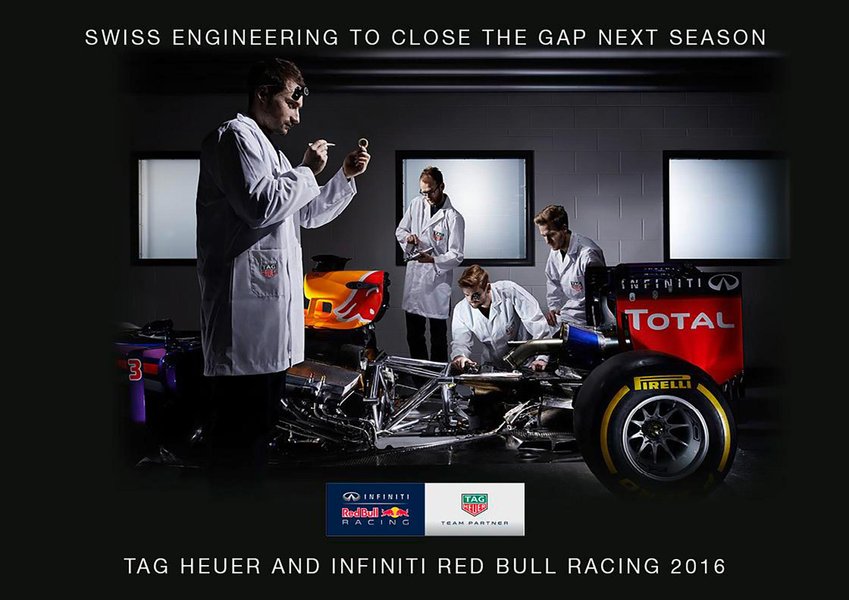
    The Red Bull Racing Team have confirmed that they will be powered by a TAG Heuer Renault power unit for 2016.

    The new partnership with the Swiss watch maker will see TAG Heuer branded engines supplied by Renault. The 2016 RB 12 will be christened the Red Bull Racing-TAG Heuer RB12.

    TAG Heuer will also become the Official Timekeeper, Official Watch Partner and Team Performance Partner of the Red Bull Racing team from 2016 in a multi-year partnership.

    “TAG Heuer and Red Bull are two transcendent brands which have both a passion for racing and a drive to do things differently, and this unique collaboration is further evidence of that,” said Red Bull Team Principal Christian Horner.

    “TAG Heuer has been an icon in the world of Formula One for many years and we’re delighted that they’ve chosen to continue their association with the sport by teaming up with us. Our shared values of innovation and a desire to stand out from the crowd make this one of the most exciting partnerships in F1.”

    Horner revealed that Ilmor will head up the engine development and alludes to the fact that Mario Illien will be driving the development going forward.

    “We are also pleased to see Renault confirm its long-term commitment to F1 and would like to thank them for their contribution to the team since 2007. Their technical partnership with Ilmor gives us confidence, and we look forward to the 2016 season,” he added.

    Jean-Claude Biver, CEO of TAG Heuer and President of the LVMH Watch Division, added: “Formula One is deeply-rooted in TAG Heuer’s DNA, and Red Bull Racing is a young, dynamic and driven team, which perfectly fits with our marketing strategy.

    “It will give TAG Heuer great visibility and allow us to make our partnership exciting, different and innovative.

    “Our motto #DontCrackUnderPressure will be the guiding principle behind all our actions with the support of the Red Bull Racing team and its highly contagious enthusiasm.”


  • Renault Confirms Return to F1 in 2016 as Works Team

    Renault Confirms Return to F1 in 2016 as Works Team

    Renault Chairman and CEO Carlos Ghosn has confirmed on Thursday night that Renault will return to Formula 1 as a works team.

    This announcement follows the letter of intent by Renault to buy the Lotus F1 team from Genii Capital in September. Since then, work was being done behind the scenes in order for the deal to be confirmed. Towards the end of the 2015 season, Renault engineers were on site working at the Lotus factory in Enstone. At the 2015 Season Finale there were concerns that the take over was not going to happen. It has since emerged that the deal has been concluded.

    “Renault had two options: to come back at 100 percent or leave,” said Carlos Ghosn

    “After a detailed study, I have decided that Renault will be in Formula 1, starting 2016.

    “The final details supplied by F1’s main stakeholders gave us the confidence to accept this new challenge. Our ambition is to win – even if it will take some time.”

    He went on to say that their return on investment as an engine supplier since the new engine regulations has been low.

    The terms of the acquisition of the Lotus F1 team are yet to be finalised and they are working to have it done in “the shortest time frame possible”.

    “Renault’s decision to continue its involvement in Formula 1 is confirmation that it sees motorsport as an essential part of the brand’s identity,” read a statement from Renault.

    “Formula 1 is the ultimate symbol of the passion for automobiles

    “Passion defines Renault as expressed by its brand signature, ‘Passion for Life’. In addition to attracting many customers, Formula 1 also fuels employee motivation.

    “As the pinnacle of motor sport, Formula 1 demands technological and operational excellence. The championship serves as a showcase for the technological expertise that Renault dials into its products for the benefit of its customers.

    The statement concluded saying that Renault will provide more information about their F1 program in January.


  • Pirelli Explains Tyre Choices and Regulations

    Pirelli Explains Tyre Choices and Regulations

    After the FIA announced changes to the Formula 1 Sporting and Technical regulations, Pirelli have released details on the tyre rule changes for the 2016 season.

    Pirelli will now supply three different compounds per race giving the teams more choice and flexibility in their race strategies.

    Pre-Race Tyre Nominations and Preparations

    • In consultation with the FIA, Pirelli will decide in advance which three compounds can be used at each race, and communicate this information to the teams.
    • The total number of sets that can be used during practice, qualifying and racing remains the same as it is currently: 13.
    • Pirelli will nominate two mandatory race sets for each car. Furthermore, one set of the softer compound will have to be kept for use in Q3 only.
    • The two mandatory sets chosen by Pirelli can be of two different compounds, from the three that have been nominated for the race weekend. These sets will obviously be identical for each team.
    • The remaining 10 sets can be chosen by each team, from the three compounds nominated for the race weekend.
    • The teams will make their choices within a deadline set by Pirelli. They will communicate their choices to the FIA, which will in turn tell Pirelli how many tyres to produce. The choices for each car will remain secret until 2 weeks before the race. If a team does not meet the deadline, the choice will be made by the FIA.
    • Once the choices for each car have been made, the FIA will continue to assign the tyres randomly via a barcode, as is the case currently.
    • The choices made by each team can vary for each of its cars: so each driverwithin a team can have a different allocation.
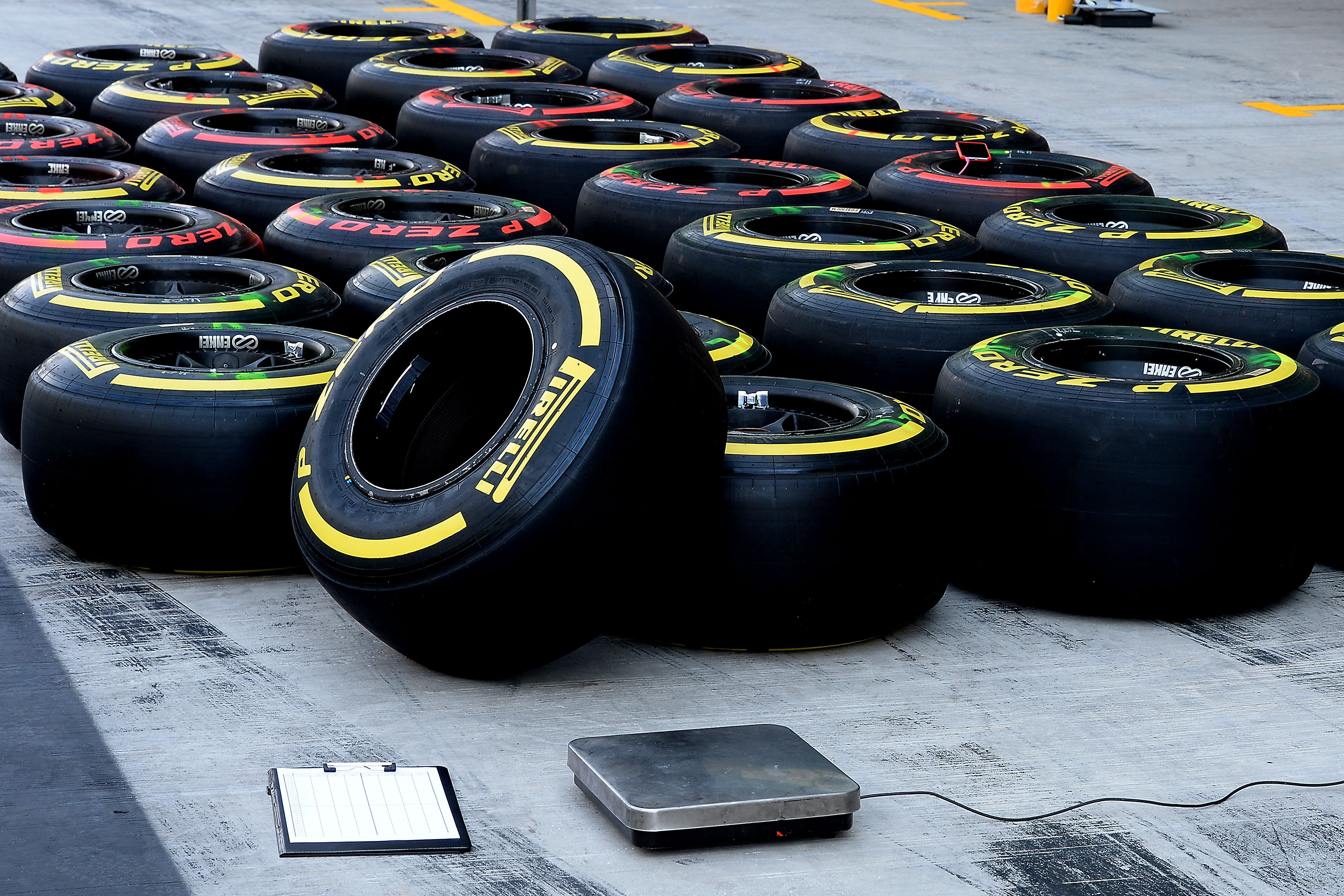
    • The tyres will be distinguished by different coloured markings on the sidewalls, as is currently the case.

    During the race

    • Teams will still have to give back tyres according to a certain schedule, but they can decide which tyres to give back at the following times
      • One set after the first 40 minutes of FP1
      • One at the end of FP1
      • Two sets at the end of FP2
      • Two sets at the end of FP3
    • The two mandatory sets nominated by Pirelli cannot be given back during practice and must be available for use in the race. At lease one of these two sets must be used during the race – but teams can decide which one.

    The top 10 at the end of qualifying will still have to give back the set of the softer compound nominated for Q3, and start the race on the tyres with which they set their fastest time in Q2 (the same rule as is the case currently).

    All other drivers will be able to use the set that is saved for Q3 during the race.


    Picture by Courtesy Pirelli

  • Mandate To Change F1 Given to Ecclestone and Todt

    Mandate To Change F1 Given to Ecclestone and Todt

    The World Motor Sport Council (WMSC) has approved a mandate to FIA President Jean Todt and Formula 1 Supremo Bernie Ecclestone to make changes to the sport.

    Ecclestone and Todt will put forward their proposal by 31 January 2016 with will tackle issues such as governance and Power Units and cost reductions.

    “The World Motor Sport Council approved, by a near unanimous number (just one vote against), a mandate for the FIA President, Jean Todt and the Representative of the Commercial Rights Holder, Bernie Ecclestone to make recommendations and decisions regarding a number of pressing issues in Formula One such as governance, Power Units and cost reduction,” read the statement by the FIA.

    Changes to the technical regulations were also approved. A new manufacturer entering the sport will be allocated 15 development tokens for their first year in the sport and 32 tokens for the second year.

    The power unit tokens for in season development for current teams will be allocated as follows:

    • 2016: 32 tokens
    • 2017: 25 tokens
    • 2018: 20 tokens
    • 2019: 15 tokens

    Sporting Regulation Changes

    • Formula 1 tyre supplier, Pirelli, will now provide three dry weather compounds per race instead of two.
    • Of the 13 sets of tyre available to the driver over the race weekend, Pirelli will choose two sets for the race(one of which must be used in the race) and one set of the softest compound available that can only be used in Q3. A driver will then be able to choose their remaining 10 sets from the available compounds.
    • If a race is declared a dry race, a drive must use at least two different dry-weather tyre compounds, of which one set must be the set chosen by Pirelli.
    • DRS will now be enabled immediately after the Virtual Safety Car (VSC) period. The VSC has also been extended to be used in Free Practice to minimise stoppages in the session.
    • Power units that were homologated in the previous season may be re-homologated for 2016.
    • The FIA have agreed to supply a fourth customer team with a 2015-specification power unit for 2016. Under the 2015 sporting regulations no manufacturer could supply more that one specification Power Unit. i.e. current year and previous year specification engines were not allowed.

    With the confirmation that Ferrari is supplying a fourth team next year, we can safely assume that the fourth team is Toro Rosso.


  • FIA Confirms Biggest Ever F1 Season Calendar for 2016

    FIA Confirms Biggest Ever F1 Season Calendar for 2016


    At the World Motor Sport Council (WMSC) meeting held on Tuesday the FIA confirmed the Formula 1 Calendar for 2016 making it the biggest F1 calendar in the history of the sport with 21 races.

    The Mexican Grand Prix was scheduled in the provisional calendar to go back-to-back with the Brazilian Grand Prix. It has now been moved to go back-to-back with the US Grand Prix in Austin. The US Grand Prix is subject to an agreement with the promoter and the sporting authority.

    The Azerbaijan Grand Prix is penciled in for 19 June 2016 which is the same day at the 24 Hours of Le Mans. The FIA have scheduled the race to avoid any conflict with Le Mans.

    The 2016 Calendar features 6 back to back races.

    Date City Country
    20 March 2016 Melbourne Australia
    3 April 2016 Bahrain Bahrain
    17 April 2016 Shanghai China
    1 May 2016 Sochi Russia
    15 May 2016 Barcelona Spain
    29 May 2016 Monte Carlo Monaco
    12 June 2016 Montreal Canada
    19 June 2016 Baku Azerbaijan*
    3 July 2016 Spielberg Austria
    10 July 2016 Silverstone United Kingdom
    24 July 2016 Budapest Hungary
    31 July 2016 Hockenheim Germany
    28 August 2016 Spa-Francorchamps Belgium
    4 September 2016 Monza Italy
    18 September 2016 Singapore Singapore
    2 October 2016 Sepang Malaysia
    9 October 2016 Suzuka Japan
    23 October 2016 Austin USA**
    30 October 2016 Mexico City Mexico
    13 November 2016 Sao Paolo Brazil
    27 November 2016 Abu Dhabi United Arab Emirates
  • F1 2015: Pirelli Abu Dhabi Tyre Test Report

    F1 2015: Pirelli Abu Dhabi Tyre Test Report

    Formula 1 tyre supplier, Pirelli held a 12 hour tyre test at the Yas Marina Circuit in Abu Dhabi to assess the new Ultra Soft Compound tyres and a new tyre construction for the 2016 Formula 1 season.

    A total of 1084 laps were completed and more than 6020 kms covered in the 12 hours seen McLaren’s Stoffel Vandoorne set the best time of the day. The Belgian set the best time of the day of 1:44.103 with a total of 99 laps for the day.

    A few conditions were imposed for the test however. Teams were not allowed to perform any aerodynamic tests, change any parts or try on any new parts. The test was run as a “blind” test which meant that neither the teams, nor the drivers knew the type of prototype tyre was being tested.

    “The Teams tested several different potential variations of the new ultrasoft compound, from which one will eventually be selected,” read a statement by Pirelli.

    “Prototype tyres were not marked with any colours or other visible markings, while base tyres[super soft and soft compound tyres] carried the usual colours on sidewalls.

    With the session running for almost 12hrs without any lunch break it was the longest single-day Formula 1 test in the history of the sport.

    “We had one shot when it came to testing tyres for next season, and we can be satisfied by what we’ve achieved in this test, even if we have to fully analyze the data,” said Pirelli Motorsport director Paul Hembery.

    “We’ve tested different versions of the new ultrasoft compound for 2016, which was one of the targets for this session.

    “The ultrasoft’s target for 2016 is to introduce a compound softer than the supersoft and mainly designed as agressive choice for street circuits: with better performance than the latest version of the supersoft tyre and faster degradation, in order to allow the Teams to take a more aggressive approach to race strategy.

    “Whether this will produce more pit stops, or any difference in strategies, it’s too early to say for now.

    “We will fully analyse our data and team telemetry once we get back to base.

    “But it seems we are heading in the right direction: the ultrasoft is expected to offer more possibilities for certain races.”

    Driver Team Time Laps
    Stoffel Vandoorne McLaren 1:44.103 99
    Kimi Raikkonen Ferrari 1:44.456 56
    Marcus Ericsson Sauber 1:44.480 50
    Jolyon Palmer Lotus 1:44.568 90
    Sebastian Vettel Ferrari 1:44.940 56
    Pascal Wehrlein Mercedes 1:45.605 107
    Daniel Ricciardo Red Bull 1:45.805 57
    Max Verstappen Toro Rosso 1:45.849 54
    Nico Hulkenberg Force India 1:45.852 71
    Valtteri Bottas Williams 1:45.940 103
    Daniil Kvyat Red Bull 1:46.309 48
    Carlos Sainz Jr. Toro Rosso 1:46.995 56
    Adderly Fong Sauber 1:48.439 57
    Alfonso Celis Jr. Force India 1:48.545 65
    Rio Haryanto Manor 1:49.593 56
    Jordan King Manor 1:49.661 59

  • F1 2015: Season Finale Review – Abu Dhabi, that’s a wrap

    F1 2015: Season Finale Review – Abu Dhabi, that’s a wrap

    As far as thrillers go the Abu Dhabi grand prix isn’t quite going to make the list of most memorable races. Though visually spectacular the Yas Marina circuit has brought the 2015 season to a close in fairly mundane manner but still provided several talking points.

    In only the second time in its seven year history the Abu Dhabi grand prix was won from pole position. First place on the starting grid belonged to Mercedes’ Nico Rosberg which he easily translated into the race lead as the sun began to set over the Yas Marina circuit. On the track it didn’t turn out to be a wheel-to-wheel battle between Rosberg and teammate Hamilton but rather a tactical fight through pit stop strategy.

    In the first round of pitstops Hamilton followed his race leading teammate into the pitlane only a lap later, effectively mirroring his strategy. However, with the constructor’s and driver’s title in the bag the Mercedes team allowed its drivers some leeway in strategy calls and racing up to the chequered flag. Lewis Hamilton took advantage of the rare freedom to extend his second stint on the yellow side-walled soft tyres. At one point Hamilton even considered running a one stop strategy and going to the end on his tyres. This strategy was quickly dismissed as impossible by his race engineer and Hamilton pitted to fit a set of the soft Pirelli tyres.

    Abu Dhabi 2015_StartThis strategy left Hamilton nearly twelve seconds behind race leader Rosberg. Although the three time champion was able to run with the fresher tyres in the closing stint of the race, he was only able to halve the pace to the leading car. The race concluded with Rosberg leading Hamilton home with a comfortable gap of just over eight seconds. This latest one-two finish Rosberg and Hamilton makes it the twelfth of the year for Mercedes.

    Not too far behind the Mercedes pair Ferrari’s Kimi Raikkonen delivered a strong drive to finish third. The Finn turned a good pace but never enough to challenge for victory.  While some will make a note that he finished the season in fourth place on the driver’s standings Raikkonen couldn’t care less of his ultimate position in the championship unless it’s position number one. Never one to sugar-coat reality Raikkonen, by his own admission, has labelled his season as distinctly “average.”

    After a strategic error in qualifying Sebastian Vettel was forced to start in fifteenth. The German was able to recover to take fourth place for Ferrari. Sergio Perez, who started on the second row of the grid in fourth, brought his Force India home in fifth ahead of Red Bull’s Daniel Ricciardo. Nico Hulkenberg was seventh in the other Force India while Felipe Massa struggled to an eighth place finish for the Williams team. In his final race with Lotus before heading off the American Haas team was Romain Grosjean who made the best of his supersoft tyres in the closing stages. Daniil Kvyat secured tenth and the final point on offer for the Red Bull Racing team.

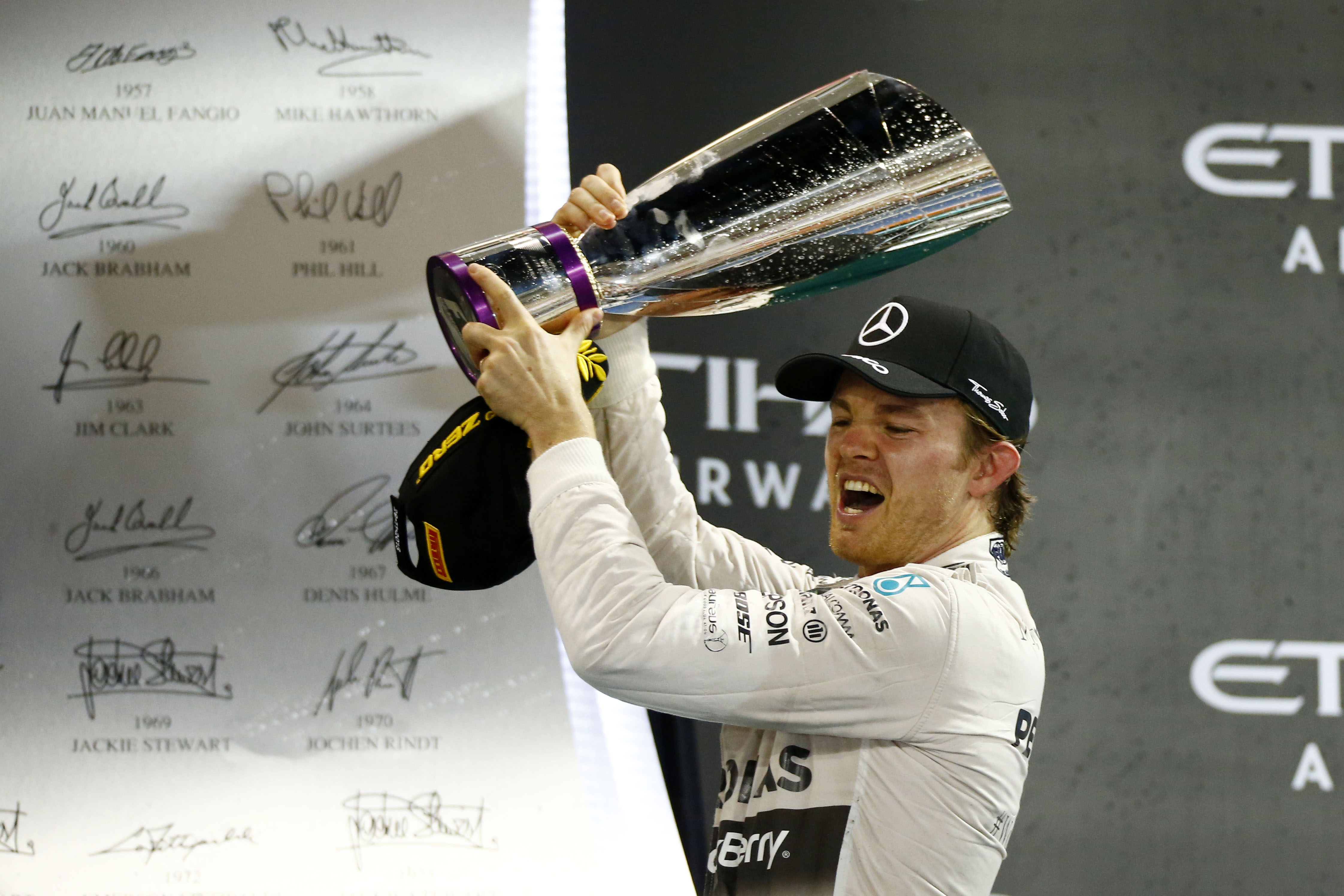
    Nico Rosberg_Abu Dhabi 2015_Podium2It wasn’t a race blighted by too many incidents however Fernando Alonso incurred a drive-through penalty for hitting the Lotus of Pastor Maldonado into turn one as the race got underway. In the pitlane Valtteri Bottas clipped the back of Jenson Button’s McLaren after an unsafe release by the Williams pitcrew. It resulted in a damaged front-wing for Bottas and five second penalty. The Finn eventually finished a lap down in thirteenth.

    Dutchman and rookie driver Max Verstappen showed up to the race as his ever-aggressive self and set about overtaking as many drivers as possible. However, his spirited overtaking proved a bit too much as race stewards penalised him with gaining an advantage after going off the circuit in a pass on Jenson Button. As the penalty was imposed after the race it dropped the teenage sensation to sixteenth place.

    In Brazil Hamilton was the quicker of the two Mercedes in the race but couldn’t find a way to overtake Rosberg. But here in Abu Dhabi Hamilton has been shaded, in terms of pace, for the entire weekend. For Nico Rosberg the season couldn’t have ended any better. Six pole positions and a hat trick of victories is an incredible run of form. It begs the question as to where this prodigious form has been the entire season. Is it as a result of a release of pressure or has Rosberg at long last found something that Hamilton has no answer for?

    (Images courtesy of Mercedes AMG F1 Team & Pirelli Motorsport).

  • FIA Makes Ruling on Wind Tunnel “Ambiguities”

    FIA Makes Ruling on Wind Tunnel “Ambiguities”

    On Saturday at the Abu Dhabi Grand Prix, the FIA received a request from Mercedes regarding clarification on wind tunnel regulations and the limits on wind tunnel work.

    The FIA have ruled on the matter and have told teams that teams are not allowed to collude on aerodynamic testing, more specifically, customer teams with technical partnerships with manufacturer teams.

    This comes after Mercedes pointed out a few ambiguities in the rules and after corresponding with the FIA on the matter, were referred to the race stewards. The stewards on Sunday made a recommendation to the FIA in an 8-page document.

    The controversy started when concerns were raised that Ferrari had benefited from additional wind tunnel testing which was performed with the Haas F1 team, who will be using various Ferrari components in their cars when they make their debut in F1 next year. Haas F1 were not bound by the current regulations which limits wind tunnel testing. Until Sunday’s ruling by the FIA.

    Ferrari and Haas were cleared by the FIA after examining the logs provided to them by Haas F1 and Ferrari. “Having examined the reports (including audit reports team facilities) provided to us, the Stewards confirm that there is no evidence that competitors have not complied with the requirements of Appendices 6 and 8 as they were interpreted prior to today’s date,” said the FIA in their settlement document.

    In the settlement document the FIA state:”The Stewards recommend to the FIA that in future once a potential competitor (as opposed to Official Entry) applies to be a competitor in the FIA Formula One World Championship and this application is accepted, that competitor should be bound by Appendices 6 and 8 (and for that matter any other appropriate sections of the Formula One Sporting and Technical Regulations).”

    It was also noted by the FIA that the ruling will apply going forward and not retrospectively.

    The FIA also issued a list of activities that will be deemed attempts to circumvent the regulations with regards to wind tunnel testing.

    • No employee or consultant of a competitor who is involved in aerodynamic development may pass any information obtained under their own ATR quota to an employee or consultant of another competitor.
    • No employee of a competitor who is involved in aerodynamic development, who leaves that company and takes up a similar position with another competitor, may do so without a suitable (or normal) period of “gardening leave” or “isolation”.
    • No employee of a competitor who is involved in aerodynamic development, and who leaves that company and takes up a similar position with another competitor, may then return to the original competitor without a suitable (or normal) period of “gardening leave” or “isolation”.
    • No employee of a competitor who is involved in aerodynamic development, and who then leaves that company, may pass information obtained under their former employer’s ATR quota to an employee or consultant of another competitor before a suitable (or normal) period of “gardening leave” or “isolation” has elapsed.
    • No employee of an external entity who is involved in F1 aerodynamic development may be employed by a competitor, on a permanent or temporary basis, without a suitable (or normal) period of “gardening leave” or “isolation”.
    • No employee of a competitor who is involved in aerodynamic development may be seconded to, or temporarily employed by, another competitor unless such secondment or employment is a genuine long term arrangement for the sole purpose of providing the other competitor with technical expertise. Any seconded employee must not then return to the original competitor without a suitable (or normal) period of “gardening leave” or “isolation”. Three months would be considered as a genuine long term arrangement.
    • No competitor may acquire aerodynamic surfaces from an external entity (even if such entity claims to have designed them for its own purposes), unless any aerodynamic testing resource used to develop the surfaces is counted within the relevant competitor’s ATR quota.
    • Teams sharing a wind tunnel (or any other aerodynamic testing resource as referred to in Appendix 8, including a CFD cluster) must put appropriate procedures in place to avoid any breach of confidentiality or of the general restrictions of Appendix 6 and Appendix 8. This would include (but not be limited to):

      (i) ensuring staff shared by both parties or employed by one party but involved in the operational part of the aerodynamic testing of the other party (such as operating or maintaining the wind tunnel and/or CFD hardware) give contractual covenants not to pass information or to allow information to pass between the parties.


      (ii) putting the physical infrastructure in place so the two parties operate their support activities (such as wind tunnel model preparation), other than the operational part of the testing mentioned above, in separate environments.


      (iii) putting the IT infrastructure in place so the two parties operate on separate networks and store their data on separate (at least virtually) storage hardware.