Tag: yusuke hasegawa

  • 2017 Japanese GP: Friday Press Conference – Part 2

    2017 Japanese GP: Friday Press Conference – Part 2

    PART TWO: TEAM REPRESENTATIVES – Yusuke HASEGAWA (Honda), Ayao KOMATSU (Haas), Paddy LOWE (Williams)


    Q: Hasegawa-san, if we could start with you please. It’s been a good couple of races for McLaren-Honda, particularly Stoffel Vandoorne, seventh in both of the last two races. Just wondering how much satisfaction have those results given you and how confident are you of another good result on home turf this weekend?

    Yusuke HASEGAWA: Obviously in Singapore and Malaysia we got points which were very good but of course we are not satisfied. We are aiming higher all the time but we feel kind-of relieved to get a decent step. So, of course we try to keep the same performance for here, in Suzuka.


    Q: What can you hope for this weekend?

    YH: So far, that we get some points.


    Q: And with regard to next year, let’s just talk a little bit about the relationship with Toro Rosso. How do you think that relationship might differ to the one that you’ve had with McLaren?

    YH: I don’t think it’s a huge difference. We have already started the preparation for next year. They are very kind and they are very excited to have a new partnership, which we, of course, are feeling the same thing. No, there’s not a big difference, just a new partner.


    Q: Is the commercial relationship going to be the same as it was with McLaren?

    YH: Of course, the McLaren-Honda, the name of the McLaren-Honda is very famous – in Japan at least, maybe in other countries. From that point of view it could be that the expectation from the audience is a bit less, so we need to show that we can make it better. From that point of view, maybe I will feel a bit less pressure from the outside but from the inside there is no difference. We need to prove that we can do a better job for next year.

    Q: Ayao, second season of the Haas Formula One team, what is your perspective on how it’s gone? How would you sum up the last 18 months with Haas? How’s it gone?

    Ayao KOMATSU: It’s going well. Of course it could be better but from last year to this year we made a very big improvement and even though it may not be obvious to everyone but consistency is better than last year and our understanding is better, but I think now that we made a step from last year we now know again how much we need to improve for next year so really concentrating on the next step.


    Q: Now you’ve worked with Romain for a long time, drivers like to progress every year, just how have you seen him grow in a small team like that, because we hear him a lot on the radio and it’s not always complimentary?

    AK: Sure, I know Romain since 2009. I’ve done every single race he’s done in Formula One together so we understand each other pretty well, but yeah, he’s quite an emotional guy but then what comes out as negative on the radio is what actually makes him quick as well so you can’t have it both ways. We both understand the downside of that so we’ve just got to manage it, try to channel it in the right way so that everybody works in a positive direction.


    Q: Now I guess this is the time of year when you work through the good points and the bad points of the current car. You obviously want to translate the good points into next year. Could you elaborate a little bit on the good and the bad of the VF17?

    AK: I think our baseline is pretty good but the operating window is not very wide, so when we can get the tyres to work OK, you can see the potential, we can be in Q3 but there are some events where we really cannot switch the tyres on then we are fighting to get out of Q1. In Malaysia, Saturday was our lowest point, both cars out in Q1 so that’s the bad point. Next year, we really need to keep this good base but then trying to have the wider window so that we can work with… obviously next year you can have more different compounds as well so that will be the key, trying to work with different compounds, trying to get consistency out of it.


    Q: Paddy, let’s start by talking about drivers: there’s a lot of speculation in the press about who is going to partner Lance Stroll in the team next year. Can you just tell us a little bit about what you want from that driver and indeed, who is in the running?

    Paddy LOWE: It seems like we’re one of the last chairs available for next year. Of course Felipe is very much in the frame, very very high on our list of possibilities but we owe it to ourselves to take a look around and see what could be the best option for the team going forwards. As you say, that will be a partner to Lance. Lance has made great progress through the year, we’re seeing him performing consistently, particularly in the races so we need a driver to complement Lance on that side of the garage. But all options are under consideration, to be honest. You’ve probably seen a number of names that are floating around that we’re looking at but honestly the range is almost unlimited. We will consider all ideas. We’re not in a super hurry to do so and we’ll just make sure we land the best line-up we can.


    Q: But is the idea to have an experienced driver alongside Lance?

    PL: I think there are many attributes you could attach to different drivers and experience could be one of them, but we may weigh that against other things. We’re not fixed on any particular aspect.


    Q: Because where is Williams’s natural habitat in this pit lane at the moment? You’re lying fifth in the Constructors’ championship; are you looking for a driver who can help leapfrog you up to third? Is that the ambition for next season?

    PL: Yeah, we’re always ambitious to move forwards as all teams are and I think we recognise that the driver or drivers are a very key element in the team. Clearly you need a quick car as well, but the driver is probably the single most important factor in the end to take the package forward and score the points and indeed win races. I’ve seen that in the past, what a difference drivers can make to the race proposition, so it’s a very important decision.


    Q: And just tell us a little bit about next year’s car, what’s going on back in Grove? Are you encouraged by the signs you’re seeing in the windtunnel, for example?

    PL: Lots of good work going on. Yeah, we’re making quite a few changes. We see lots of opportunities out there that we’re determined to exploit and the project’s going well, yeah. At the same time, you know, we recognise we’ve got some very tough competition out there, some teams that we respect greatly who are also fighting to move forward so it’s going to be a tough space next year. We all want to have cars that can get safely into Q3, that’s a kind of mark of respectability really in Formula One, but there are quite a few teams that will be trying to squeeze into that quite small box.


    QUESTIONS FROM THE FLOOR


    Q: (Dieter Rencken – Racing Lines) Hasegawa-san, you’ve just heard what Paddy said, that the driver is a crucial element in the overall package. With McLaren, you had various World Champions driving for you. With Toro Rosso, although they haven’t confirmed their line-up, the chances of them having a Grand Prix winner let alone a World Champion are fairly remote at this stage. Do you believe that a driver is not important to drive a project forward, at the state that Honda finds itself in at the moment?

    YH: For the next year, you mean?  Of course the driver project is very important and of course we’d like to encourage the Japanese motor racing character we well so that to do that a Japanese driver is also very important. But currently we have nothing we can tell you about the drivers for Toro Rosso and we don’t have any contract about that. Actually, we don’t have any position to tell. Of course, we may negotiate with them so maybe we would like to discuss about that but it is not a contract matter, so that maybe they are just as a partner, as a friendship matter.


    Q: (Dan Knutson – Auto Action and Speedsport) Paddy, there have been reports that you were going to test Robert Kubica and Paul di Resta in a 2014 car. Can you enlighten us as to what is going to happen?

    PL: Yeah, you’re correct, we will test those two drivers. We won’t give away any information around what we do within those tests, that’s a private matter for us and I would stress that that doesn’t mean that they’re the only drivers under consideration. As I said earlier, we’re considering quite a large range of which they are only two possibilities.


    Q: (Dan Knutson – Auto Action and Speedsport) Paddy, can you at least tell us when this test will happen?

    PL: In the next few weeks.


    Q: (Dieter Rencken – Racing Lines) Hasegawa-san, I’d like to just clarify my question earlier on about the fact that it wasn’t so much aimed at Japanese drivers, but just generally whether you believe or not that a proven or an established driver line-up is important to develop your Honda engine project going forward because you had had World Champions, whereas at Toro Rosso you are unlikely to even have a Grand Prix winner. Do you believe that an established driver line-up is important?

    YH: Yeah, sorry, I don’t answer the question. Yep, of course, the driver’s feedback is very important to evaluate the engine itself and to find any issue from the engine and also to stop the engine as soon as something happens. From that point of view, Fernando, Jenson and Stoffel were perfect for that development driver and evaluator so yeah, it is very important. So far, as I mentioned, we cannot tell (about next year). I am very happy to have Pierre Gasly, he is a very talented driver, but actually I didn’t work with him directly but I expect him very much. So I don’t know for next year but we expect to have good drivers, of course.


    Q: (Jens Nagler – Bild) Paddy Lowe, how intense has your contact to Nico Rosberg been in the last weeks? And did the subjects you talk about change since he is managing Robert?

    PL: I didn’t fully understand the question but was it you were saying what contact had I had with Nico? Actually, honestly I’ve just had a couple of phone conversations with him, but as you point out, yeah, he’s now doing some work with Robert Kubica, so he has an interest in promoting that idea to us so I’ve had some conversations with him on that subject. As you say, a bit different from the previous conversations that I had with him the last few years.


    Q: (Dieter Rencken – Racing Lines) Paddy, you may have missed it earlier on when Cyril was here because you were outside doing the TVs but he said that the chances were pretty good that Marcin Budkowski would be starting early April in the role of executive director. Does it concern you that the gardening leave, for want of a better description or expression is not sufficient, given the relationship that he’s had with teams? What do you believe is the ideal time and what do you think of the situation?

    PL: First point is to congratulate Marcin. It looks like he’s got an excellent job, very senior role at Renault. I worked with Marcin in the past at McLaren so you know he’s a strong engineer and that’s great that he has that opportunity. But I think you’re correct; the concern amongst all the teams has been the very short period of isolation between a role as an officer of the FIA, very senior officer, and working with a team. And it’s very critical that the teams have a strong degree of trust in their work with the FIA; that really underpins the ability of the FIA to police the sport from a technical point of view. It’s an important subject, the teams will be discussing that with the FIA to understand what should happen in this case or cases in the future. So I don’t have any pre-set ideas around what solution should exist or even could exist. Amongst the teams, with senior engineers, we have very long notice periods, as you know, for the same sort of reasons.


    Q: (Sam Collins – Racecar Engineering) Question for Paddy Lowe and Komatsu-san: we’ve had almost a season of running with these new generation cars now and almost every team I’ve spoken to has mentioned the narrow operational window of these cars and getting the tyres to work. What is it about the current rule-set that makes that operational window so hard to exploit?

    PL: I think it’s just mainly down to tyres. The tyre defines, to a great extent, the operating window of the car because it’s fundamentally the temperature window of the tyre, sometimes the pressure window, where the tyre delivers the best performance. So depending on how narrow or wide or peaky that window is determines then how difficult it is to make the car work at the fastest level. I think that’s the subject. I don’t think it’s necessarily that much more difficult than last year, the levels of grip are higher, the lap times are quicker but I think it feels just about as difficult as it was last year, to me.

    AK: It’s exactly as I… I don’t think it’s the cars, it’s more to do with the tyres, and some tyres can work in any conditions, some tyres need specific conditions so yeah, it’s mainly down to tyres.


    Q: (Ken Kawakita – Weekly Playboy) Hasegawa-san, Komatsu-san: this is very domestic question but having someone like you in the FIA press conference as a key member of a Formula One team, giving a lot of hope for young Japanese boys who are dreaming of being in Formula One to work as engineers, is it possible to have any advice to make the dream happen for those young Japanese boys or girls? Any word?

    AK: Yeah, I was interested in Formula One since I was a junior high school student and I wanted to do Formula One so then I thought, OK, it’s better to come to England so I decided to leave Japan after doing high school so I guess the advice is don’t limit yourself, if you like, don’t ever think you can’t do it, just assume that you can do it and then try your best and then when you’ve tried your best, even if you failed, then I think you learn a great deal from it, so there’s no downside so just try and believe you can do it. If I can give advice, that’s the advice.

    YH: Yeah, I think I’m completely different from him, so that he was aiming to be a Formula One engineer but I was joining Honda and I was just working as a mass production development and I never expected to be a Formula One engineer, but I always concentrated on doing my job, all the time and to improve myself, so the chance will come from outside, so I didn’t expect… so just do your job and just do it and improve by himself or herself is the important thing, I think.


    Q: Paddy, can you just tell us a little bit about how international the teams are, how many different nationalities might you have at Williams?

    PL: I haven’t got a number but it is a very international sport, not just in terms of drivers but also in terms of engineers and all the staff within the teams. I think that’s what makes it such an exciting and rich industry, and I’d echo the comments of my colleagues here, that if you have the determination, actually it’s not as difficult as you may imagine to make the progress and achieve the position that you may want, working in a team or some other part of the industry, so never think it’s out of your reach, go after it.

  • 2017 Belgian Grand Prix: Friday Press Conference – Part 2

    2017 Belgian Grand Prix: Friday Press Conference – Part 2

    PART TWO: TEAM PERSONNEL: Yusuke HASEGAWA (Honda), Franz TOST (Toro Rosso), Zak BROWN (McLaren)

    Q: Zak, let’s begin with you. Hungary, obviously a strong performance, the best performance of the season so far. How do you feel about the level of that performance that weekend and the steps on the journey back to competitiveness for your team?

    Zak BROWN: Hungary was definitely a step forward. Good to see both cars get home in the points. Sixth and tenth isn’t exactly what gets McLaren too excited but it was definitely forward progress.

    Q: Where are you now on the long-term plans in terms of power units. Obviously we’ve heard all these stories of various steps along the way from winter testing right through to the summer break. Has anything changed? What can you tell us?

    ZB: I think like all racing teams, we’re working on our 2018 drivers. We obviously announced Stoffel, which was never in doubt that he was going to continue with us, and we’re working on our second driver, some two-time World Champion, and making sure we have the most competitive race car for next year.

    Q: Hasegawa-san, coming to you, your side of that story. Obviously Hungary, a step forward, your updated engine here, and also where do you feel it’s going, the relationship with McLaren?

    Yusuke HASEGAWA: Of course, in Hungary we are very happy. Actually, we are very relieved we get the points. That is performance we are not satisfied with but it is a minimum level of performance we have to achieve, so we are relieved about that. So, still the matter, we need to update our engine performance definitely to convince McLaren as well and to satisfy us.

    Q: And the updated engine this weekend, what can you tell us about that? How much more performance is there in Stoffel’s car?

    YH: OK, it’s actually… we had planned to introduce a spec-4 engine here but we failed. Actually we didn’t match to the schedule. So that we have a halfway upgrade. We called it 3.5 and 3.6 but I think we can introduce some decent upgrade here but we don’t stop the improvement.

    Q: You have Franz next to you this afternoon. Is Toro Rosso still a possible contender for a second supply of engines in 2018? Are those talks still live?

    YH:  I don’t think so. We don’t have an official conversation about that. So although Mr Yamamoto visited Dr Marko, because we need to discuss about Super Formula, the Japanese formula series, and we have Pierre Gasly the Red Bull young driver, so that we have some communication with him – but other than that the Formula One engine supply, we didn’t have an actual conversation.

    Q: Franz, just picking up on that, as far as you’re concerned, that was never really something that was in the offing; you’re sticking with what you’ve got: Renault engines going forward.

    Franz TOST:  No, Hasegawa-san has just answered that there has never an official negotiation or talks between Honda and Toro Rosso.

    Q: We spoke to Christian in the first part of this press conference about your Red Bull Young Driver programme – obviously it’s been tremendously successful over the years but he was saying there’s no real hot prospects. You’ve got some young drivers in the pipeline but it’s just that sometimes there’s plenty of good drivers and sometimes there aren’t. I just wanted to know what your perspective was on what’s been achieved if you like and whether there’s still that same enthusiasm on the Red Bull side, when you consider that McLaren, Ferrari, Mercedes have all got some very hot prospects on the threshold of Formula One now?

    FT: I think Red Bull is in a fantastic situation because there are four drivers who are able to win races which they’ve showed in the past: Daniel Ricciardo, Max Verstappen, Carlos Sainz and Daniil Kvyat and there’s the reigning Formula Two champion, Pierre Gasly who is in the pipeline, who is also very successful in Japan. That means this infrastructure which Red Bull has built up is so successful and why should they change anything? You should also take into consideration that something can happen at Red Bull Racing – an accident and so on – and they can just take a driver from Toro Rosso and this is why Toro Rosso is educating drivers for Red Bull. Young drivers are coming but it takes another two or three years maybe until we can discuss to bring them into Formula One and I think that Red Bull is really in a fantastic position with the driver line-up.


    QUESTIONS FROM THE FLOOR


    Q: (Graham Harris – Motorsport Monday, Motorsport Week.com) Franz, Carlos Sainz is going to be spending his fourth year next year in Toro Rosso if we take Christian’s comments in Austria that they’ve activated his contract for next year. This will be the first time that a driver has actually spent a fourth season in the team. Who will be sitting next to him? Have you decided? Will it be Daniil next year as well or would you be evaluating that later in the season?

    FT: We will see. As I just mentioned before, Red Bull is in a fantastic situation. Why should they dismiss these highly skilled drivers? Red Bull has financed all the careers so far of Carlos Sainz and now he is ready to win races if he has a proper car so why give him to another team, to an opponent or whatever? And Daniil Kvyat was this year a little bit unlucky because many times we couldn’t provide him with a reliable and fast car and I’m convinced that once he gets this car that he will show his talent, because he did it already in the past. He won the GP3 championship before he came to us. He finished on the podium at Red Bull Racing in China and he can race and he has the ability to be successful and as I mentioned before, Pierre Gasly is in the pipelines, which means Red Bull is really in a very strong position and there’s no necessity to change something, but we will see. The driver line-up will be decided by Red Bull in the next months.

    Q: (Abhishek Takle – Midday) To Zak and Hasegawa-san: firstly, the upgrades that you introduced this weekend, have they delivered as promised, and secondly, it’s been reported that Honda has been working with Ilmor and has discovered some good gains on the power unit front. Hasegawa-san, firstly, can you confirm that you’re working with Ilmor and Zak, couldn’t Ilmor’s involvement convince McLaren to stick with Honda for the future?

    YH: First of all, about the performance upgrade, it is very difficult to compare the previous engine to this engine because this is a completely different circuit but from the data point of view, we see some good upgrade of the performance here.

    And regarding Ilmor consultancy, we do not disclose any partner of a consultancy or a supplier or any partnership. But we don’t deny about any kind of consultancy or partnership from outside. We have many partners in the development.

    ZB: A good question was what do we think about Ilmor. As Hasegawa-san said, it’s really up to Honda to discuss what their activities are. All I would say is that Ilmor as an organisation that has worked with McLaren in the past and is very successful and very good at what they do.

    I wouldn’t think we’ve been satisfied all year but I think Hasegawa-san’s not been satisfied with how things have gone so we have seen some improvements here at Spa, not to the level we’d hoped for but some improvement nonetheless.

    Q: (Dieter Rencken – Racing Lines) Zak, bearing in mind what the other two gentlemen said about there being no official discussions between Honda and Toro Rosso although there were talks at high echelons, I believe that the McLaren/Honda  contract has got some form of veto or approval clause where you’ve got to approve somebody else which I believe you did with Sauber. Have you been asked to bless some form of Toro Rosso/Honda deal at all? Has that come up?

    ZB: We did bless the Sauber arrangement which we were official asked to do and in fact started to get to work on a gearbox. I don’t think it’s appropriate for me to disclose any conversations we’ve had. What I would say is we would be very supportive of Honda having a relationship with Toro Rosso and have been asked by Christian if we would be in a position to help with a gearbox if asked, so I think that’s about as far as I will go on sharing any conversations.

    YH: We didn’t ask to start a conversation with Toro Rosso to McLaren actually because we didn’t have any official conversation so that it is…

    Q: (Livio Oricchio – GloboEsporte.com) Zak, it looks like Ferrari and Mercedes won’t supply the power units to McLaren, in the case that McLaren has decided not to continue working with Honda. And also, we believe, as Cyril said, that very possibly Renault won’t also supply, so it looks like you don’t have other options. Is that correct?

    ZB: No. We’re not going to give a running commentary on our power unit situation. I know it’s of keen interest to everyone but we’ll say something when we have something to say.

    Q: (Inaudible) Zak, do you feel within the team a difference for Stoffel now that his contract for ’18 has been announced and this weekend, racing at home, is there more pressure, is he different or is he relieved that he will continue for next year for you?

    ZB: Well, we always intended to put him in the car in ’18. Of course, any driver, when it becomes public at their home Grand Prix, I think that’s a nice feeling so Stoffel has been great all year for a rookie. He has been in a very difficult situation, we’ve not given him a faster, reliable race car which is that much more difficult when you don’t have the experience of someone like your teammate so he’s been a treat to work with and Hasegawa-san, I think you would agree, he’s been a real star this year.

    Q: (Graham Harris – Motorsport Monday, Motorsport Week.com) Zak, on the assumption – and it’s obviously an assumption – that you persuade Fernando to stay for next year, and he was wanting to do this, would we see another possible attempt at the Indy 500, given that this year he was very competitive and could have possibly won it on his first time out? Is that something you would perhaps dangle as a carrot to keep him there for next year?

    ZB: No. We would love to go back to Indianapolis, Fernando would love to go back to Indianapolis. He did an unbelievable job but it will conflict with Monaco again and we’re not going to be in the same situation that we were this year in Monaco, so unfortunately he can’t be in two places at once but we’d certainly love to do it with him again in the future.

    Q: (Abhishek Takle – Midday) A follow-up to what you said earlier, Zak, on not giving a running commentary on the power unit situation, how soon though do you need to have something to say? How soon do you need to be in a position to announce something because obviously whichever way you go will those influence your signing of Fernando for next year?

    ZB: Well, I think all racing teams right now – whether it’s McLaren or Toro Rosso or anyone else down the grid – we’re heading into 2018 so we need to be finalising all of our activities, whether that’s driver, car design so that will be soon.  As we all know, soon as the summer break is over it seems like it all starts to happen in Formula One so the timetable we’ve got to work to to get ready for next year.

    Q: (Ysef Harding – Xiro Xone News) This week, we talked about e-sports and how some e-sports events have been a platform for inspiring young drivers to have a way into motorsports. And now this week F1 has launched an e-sports championship. Do you feel these platforms are good for young people who are interested in motorsports and that could possibly find an inroad into motorsports through this?

    FT: I said already two years ago that you have to do something for e-sports because if you want to attract the young people, then e-sports is a very important game. What I said is that maybe ten or may nine o’ clock in the morning on Sunday there should be an e-game race here at the racetrack, just to attract the young people, to come to Formula One, to see Formula One and to involve them in this complete package. Therefore I’m really happy that Liberty media managed to come up with this game.

    YH: Sorry, actually I don’t have many opinions about the current operation or situation but I expect to make it a very attractive sport especially for the younger people.

    ZB: Yeah, I think e-sports is great. McLaren was the first team to announce our World’s Fastest Gamer and whoever ultimately wins that will be our simulator driver next year. I think it’s great what Liberty and Formula One have done and I think ultimately what you have with these sports is… Motor racing is a very expensive and difficult sport to get youngsters involved in, unlike football where you can go to school and you have a football and a pitch all ready to go so I think e-sports not only will generate a younger audience but it will also almost become the grass roots of motorsports and be able to expose a younger audience to what it’s like to drive a race car in a more inexpensive user-friendly way, so I think it’s great that we’re all embracing it.

    Q: (Dieter Rencken – Racing Lines) Zak, I’m not asking for a running commentary but I would just like to address the issue of engine supply to the teams, the FIA regulation being that you can only supply three teams with an engine. Now at the end of the day, unless you can persuade somebody to take the Honda engine it looks like you’re going to have to approach somebody to supply a fourth engine supply. How do you stand with the FIA on this issue?

    ZB: We speak with the FIA on a regular basis on lots of topics, being that they’re the governing body of the sport so I’ll leave the conversations that we’ve had, power-unit related, to ourselves and see what transpires.

  • 2016 Formula 1 Japanese Grand Prix: Friday Press Conference

    2016 Formula 1 Japanese Grand Prix: Friday Press Conference

    TEAM REPRESENTATIVES – Ayao KOMATSU (Haas), Bob BELL (Renault), Luigi FRABONI (Ferrari), Paddy LOWE (Mercedes), Yusuke HASEGAWA (Honda), Pat SYMONDS (Williams)

    PRESS CONFERENCE

    Bob, let’s start with you: How have you been getting on rebuilding the staff at Enstone, where do you still lack and what will the effect of all this be on the 2017 car?

    Bob BELL: Well, I’m only a small piece of the team that is doing the rebuilding, as you call it, but it’s certainly a big challenger. I don’t think perhaps from the outside people realise how run down the Enstone squad had become in the last couple of years, so there’s a lot to do. As well as the process of rebuilding the team of course we had to build a car for this year and start work on an even better one for next year, which wouldn’t be terribly hard. It’s been a challenge, it continues to be so, but there’s a very strong spirit in Enstone as anybody who knows the place will testify to and we’re certainly up to the challenge.

    The updates in Malaysia made the car a lot better, with Kevin 14th on the grid and Jolyon taking his first championship point, yet some are saying that Renault has not really been making progress this year. What’s happening from your perspective and what’s the short-term plan if you like, between here and Abu Dhabi, based on what you’ve learned in the past week or two?

    BB: I think it’s probably fair to say that in the last few races our progress forward other than what the Viry guys have been able to do with the power unit, on the chassis side it’s been less to do with new bits and more to do with understanding how to get more out of what we’ve already got and we’ll continue that process until the end of the season. I’m sure like most teams we’re pretty much totally dedicated now in terms of development capacity to looking ahead to 2017.

    OK, thanks very much for that. Coming to Luigi Fraboni, head of power unit operations at Ferrari. Next season will be a token free season, what will that mean in practical terms as far as the preparation pre-season and the competition we’re going to see during the year?

    Luigi FRABONI: You know, as Ferrari, we are in favour of not having the tokens, this for us is a good thing. Of course next year you will have still the four power units so we need to follow the rule, but not have the tokens will give you more flexibility on making you plan and also on changes during the season. On our side, as you know, we already used the tokens this year so this means that we had quite a strong evolution during the season and so not having this this limit for next season is good and at the moment the development of the power unit for 2017 is proceeding quite well.

    Now, earlier in the season we had a discussion in one of these sessions about starting negotiations about the post 2020 engine formula. What’s your opinion? Do you see them being hybrid turbos, similar capacity, but what other directions would you like to see?

    LF: Honestly, at the moment I’m more focused on 2017, so I honestly don’t have any strong opinion on 2020. I would say that the rules for me are very challenging and I really like it.

    Would you like to start the discussions soon though about it?

    LG: My chairman for sure will start?

    OK, perfect. Hasegawa-san, Honda has made several updates to its power units in 2016, was the result as expected and will you be introducing any further updates before the end of the year?

    Yusuke HASEGAWA: Of course we have to shift our development for next year already, so I don’t think we can have some update for the rest of the event. But, last update, which we introduced in Malaysia, and Spa was a big update… I think we made a decent level of step up with this. We are not satisfied but we can feel a little bit happier.

    Part of the new FIA agreement regards manufacturers supplying more than one team – Eric Boullier was telling us in this conference in Malaysia it would be a good thing – but the Mercedes teams seem to be locked in to 2020, Renault has commitments with its teams, so are you feeling the need to press teams who are not yet committed?

    YH: Not yet committed, but we understand the situation, so we are preparing the organisation and we are preparing resource for that.

    To supply a second team?

    YH: Yes, that’s right.

    Komatsu-san, we’ve heard Romain Grosjean on the radio quite a bit in recent races getting quite annoyed with various aspects of the car. What’s the problem been and how are you addressing it?

    Ayao KOMATSU: Yeah, I think one of the problems is with consistency. We have very small amount of resource and a limited number of people. It’s not just getting one specification of the car – each component has to be put together really well and we have to monitor the quality and that area I think we really need to improve. Sometimes you’re putting on the same parts but the performance is not exactly the same. Sometimes our diagnostics are not good enough to understand what Romain is feeling straight away, so we really need to improve in every single area but we’re really working on that. With Romain, on the radio he’s quite an emotional guy but once he comes up in a debrief he’s very, very good. He’s got a really sense, he really helps us in understanding the car and where we need to go.

    It may just be an impression from the outside but your fortunes this season seem to have risen and fallen in parallel with Ferrari’s. Is that coincidence or is there more to it and what does that say about 2017?

    AK: For us really, trying to understand the fundamental things about the car, aerodynamics, tyres, that’s what we are focusing on, but again with our team being new, slightly inexperienced and still with all the analysis processes, data processes in their infancy we just need to start improving in those area. We really got to put our systems and process in place so we don’t have the same problems next year, so we can hit the ground running from February.

    Paddy, coming to you, can you give us a bit more detail on what failed on Hamilton’s engine in Malaysia? Was it related to having to push so hard in the middle of the race, as Red Bull would have us believe, and what have you done to mitigate against a repeat?

    Paddy LOWE: So, Lewis had a failure one of his big end bearings, at a very low mileage actually, a little over 600km, because he had three new engines from Belgium, when he took all the penalties. This was the second of those, first race Malaysia, to be used properly. It was a very young failure for that bearing and not at all typical of the model. And we were operating it within completely normal bounds. There were no parameters out of their normal range. No, he wasn’t pushing particularly hard, he was running in a normal race state at that part of the race, so totally unexpected for that reason. We are trying analyse why the bearing failed. We don’t understand it precisely. It’s very difficult on these occasions, you don’t often see it – the box of bits your get back from an engine blow-up. Very difficult to analyse that forensically and arrive at a root cause. But we’ve taken a number of precautionary changes across all eight power units that are on the grid to try to reduce the stress on that bearing.

    Now Nico Rosberg looks a different driver this year, I don’t know if you feel the same way. What changes do you see in his approach and his mentality and likewise how do you see the evolution of Hamilton?

    PL: I think Nico is an incredibly strong driver and I think we have seen over the last three years that he can qualify extremely well. I think, for me, the step that he has made this year is that he has improved his race craft considerably. He’s proving himself much better able to fight for the positions. He’s come across a few points along the way, with a few incidents that didn’t quite come off how he wanted, but overall that’s where he has made the step.

    And Lewis?

    PL: Lewis, I think he gets better every year. Very , very difficult guy to beat for Nico, so in one way that’s unfortunate for Nico to have such a strong team-mate but the two together are an incredible force for the team – they push each other. That’s what is fantastic. When you have two very strong team-mates is that they actually elevate the total performance of the team, and we see that. We have races such as Monza where Lewis was incredibly string and then Singapore where Nico was incredibly strong and that’s what you need, for each driver to push each other to new limits.

    Pat, Williams are locked in this battle with Force India, just three points in it, with five races to go. At the moment, though, they are consistently outscoring you – Monza was the only time since June that you’ve outpointed them in a grand prix. What can you point to that gives you confidence you can end this season ahead of them and launch yourselves into 2017 on the front foot?

    Pat SYMONDS: Well I think it’s going to be a close fight. They have done a great job with their upgrades this year and we appreciate that it’s not going to be an easy job. I think what we must do is ensure that we have perfect reliability and in the last race in Malaysia I thin Felipe could have been in there, in the mix – of course Valtteri beat both the Force Indias in Malaysia – but Felipe wasn’t able to join the party because of an electronics problem on the starting grid. So that sort of thing is really the sort of thing that can determine these championship fights. It’s unfortunate but I think our focus is on getting the reliability and our focus is on utilisation, because we’re not bringing big upgrades to the car – we have a small change on the front wing here. It’s really now about making sure that what we’ve got we use well, we use out tyres well, we get our strategy and our tactics right, and we take the fight right to the end.

    We’ve some quite a lot of evolution in the senior technical staff at Williams over the last couple of years, will we see more changes in technical management going forward?

    PS: We’re always looking. We are still relatively speaking a small team and we need to increase our knowledge and our capability in every way, so yes, we are looking a long way ahead now at where we might pick up people, We know we are weak in some areas, we know we have to improve in those areas, so yes, we are always on the lookout for good people.

    QUESTIONS FROM THE FLOOR

    Q: (Dieter Rencken – Racing Lines) Last Sunday a driver hinted that his car had been technically sabotaged. Is it possible in this day and age – with all the telemetry, all the data, with the long life engines and components – for a team to sabotage a driver? A question to all of you but Paddy if you don’t mind starting, I think you know why.

    PL: Yeah, I can’t agree with you that the driver hinted there was sabotage. Lewis has been very clear, certainly with us, that that’s completely out of the question. I think anybody with an ounce of intelligence analysing the situation would realize that the prospect of us designing a system that would cause a big end to fail at that precise point in the race… if we were that good we would win everything and control everything at every point. We’ve had other failures in the year that are very unfortunate and if we were good enough to arrange such sabotage we wouldn’t have any failures. It’s a very tough business Formula One. The engineering is operating right at the boundary of performance and things do go wrong. The complexity is incredible and trying to engineer something to happen on purpose on a car… it’s similar to when people say to us ‘you favour one driver over another’ and the idea that we might give better equipment to one driver or another. If we’ve invented something that makes our car quicker of course we want it on both cars, because we want to win the race. We never hold back or would ever even contemplate it, even if we could engineer it, which we couldn’t. Anyone intelligent could work that out.

    Anyone have anything to add? Hasegawa-san?

    YH: I didn’t get the question. I didn’t understand.

    I think the question was based on comments Hamilton made after he retired in the last, regarding whether or not someone or something wanted him not to win.

    PL: And interpretations of those comments.

    Q: (Abhishek Takle – Mid-Day) Question to Pat. Pat, there’s been some speculation about your future recently, including that you may be considering retiring. I wonder if you could shed some light on that for us please.

    PS: Yeah, I read that myself! I was quite surprised actually. It reminded me of Mark Twain. You will all know that Mark Twain was once taken ill while he was in London and a newspaper in New York picked up the story and actually published his obituary. He sent a very famous telegram to them, saying ‘rumours of my demise are greatly exaggerated’. I think I’d probably take the same view on my retirement.

    Q: (Daniel Johnson – The Telegraph) Question to Paddy, just returning to the previous subject. Regardless of the interpretation, Lewis did have some quite strong words on Sunday saying “I’ve got questions for Mercedes, this is unacceptable,” he said “something doesn’t feel right to me.” As the person responsible for the technical operation of the team, how hurtful is it to you and your guys even the insinuation that there may be some foul play involved?

    PL: I think the thing you have to bear in mind is that we’re all very rational people, certainly in the engineering area and we all know that you can throw three double-sixes in a row. That is possible, statistically – and yet when you see it done, emotionally you feel ‘how did that happen’. We have got a little bit of that scenario with Lewis. We have eight power units out there running around and, with the exception of one failure, they have all fallen to Lewis this year on his power unit and that is something that none of us can really understand, how things could turn out that way. But it is just the way the dice has been thrown. Things do go wrong. We understand that and it just so happens that, by pure coincidence, that has occurred repeatedly on Lewis’ car. We’re gutted about it. We just wish luck wouldn’t fall that way. Understandable that Lewis, as we all were feeling immediately after that blow-up, ‘how can that have happen again?’ Personally, I was only just getting over the idea of the consecutive failures he had in qualifying earlier in the year where already you felt the statistics had fallen very, very unfairly, and I was very happy for Lewis that he managed to recover his points back up to a place of level competition with Nico. So, y’know, it was a real blow. But we quickly try to become rational and just accept that these things happen and then you move on and look to the future.

    Q: (Sam Collins – Racecar Engineering) Question for the whole panel actually. There’s an engineering skill shortage currently in the UK which is well documented elsewhere. Is that causing problems for those of you who are actively recruiting at the moment and how do you see that developing over the next two to three years with the UK probably leaving the single market and freedom of movement and the EU, stuff like that?

    Bob, that’s a good one for you to start with, isn’t it?

    BB: What gives you the impression we’re recruiting heavily? Yeah, there is a shortage of skilled engineers, particularly if you want skilled engineers with Formula One experience and that is partially to do with the fact that most engineers in Formula One these days are locked down with long-term contracts which makes it difficult to get them at relatively short notice. I don’t think there’s necessarily a shortage of young, eager and very capable of graduates, for example, coming out of the education system. Most teams on the grid try and use that resource as much as they possibly can. And so, I think I would agree there is potentially a skill shortage but I think perhaps the difficulties that a team such as ours faces in recruiting is more to do with the difficulty of acquiring experienced F1 engineers already locked into existing teams. As for the influence of Brexit, it’s too early to tell what the consequence of that will be on the future of the supply of engineers in the UK. I think it would be great is the UK plc could develop a stronger industrial base. I think that would be good for the country and I think all of us in Formula One would be fully supportive of initiatives that helped develop that. Not only would it potentially provide more engineering candidates for us in recruitment – but I think it would be good for the country as a whole. But ultimately, what happens, post-Brexit, I don’t think any of us can really tell.

    Pat, your thoughts?

    PS: Yeah, I think I agree with what Bob said. In spite of what I said earlier about always looking for talent, we’re not a team that’s expanding rapidly in the same way that Renault are. We do run a very strong undergraduate program and I am continually amazed at the quality of the undergraduates that go through our team. They really are very strong indeed. And, of course, the undergraduate schemes are very good because they give us a chance to have a sort-of extended interview with people. We also run graduate schemes. We sometimes take on those that have been on the undergraduate scheme, sometimes others. We don’t find a problem at that level. We get very good people coming in. I do agree that getting the senior people is quite difficult. People are on long-term contracts, and we put a lot of time at Williams into succession planning. So we do try to look quite a long way ahead at where things are going. In terms of Britain leaving the European Union, I think it is too early to tell how it will be. We do employ a lot of Europeans. We have particularly in aerodynamics, there seems to be a very strong contingent from France. I hope that we still maintain relative ease of employing Europeans. It’s already very difficult to employ non-Europeans in the UK. In my opinion far too difficult. So I hope things don’t get any worse.

    Hasegawa-san, do you have a view on this? You were nodding a couple of times through what Pat was saying.

    YH: Yeah, actually I don’t know the exact situation but we have already concern about the effect of the Brexit. Maybe we can answer from the different aspect. It is obvious that we have a lot of good engineers from the UK but also the reason Honda is doing the Formula One is that we have to educate Asian engineers as well, so that we have to take this opportunity to hire more good engineers. But of course we always appreciate that the UK is very open to the world about this even. We don’t want to, I don’t want to lose this situation, so please minimize this effect of the Brexit. This is not place that we have to ask about.

    Paddy, anything to add?

    PL: I think we’re very fortunate in Formula One that it’s seen as a very attractive destination for engineers. That wasn’t the case in the past. We have things like Formula Student that have created a greater awareness of the sport and the engineering within it particularly. And I think because of that we have become increasingly international in the staff that we recruit – from Europe and also further afield. So, I see that continuing to grow. It is a great engineering activity. Formula One achieves great things and it is all about engineering. So I would like to see that develop in the future – and perhaps with Brexit we can become even more international. Maybe there’s a positive side to it. I hope that the UK would see Formula One as a particularly successful industry within the UK itself and therefore would see a way to making that work.

    Ayao, anything to add?

    AK: No. We’re  growing at the moment but so far we’re happy with our recruiting a mixture of young and experienced. No complaints really. It’s good.

    Luigi, you’re not based in the UK but anything to add?

    LF: No, nothing to add.

    Q: (Dieter Rencken – Racing Lines) Question to Bob. Bob, obviously a global automotive brand like Renault cannot be seen to running around in tenth place and being ecstatic when they score a point – but given the difficulties you outlined earlier on, particularly the way that the infrastructure imploded, what sort of objectives has Mr Ghosn set the team regarding regular points-scoring, podiums, wins and then championships. And do you think they’re achievable?

    BB: Yeah. Of course corporately we’re not satisfied running around in tenth place and scoring single points. Actually that single point meant a lot to us. I’ve won a lot of points in Formula One over the years and that point meant more to me than perhaps any other. It’s a great motivator and it really lifted team moral so actually it was quite an important achievement. Moving beyond that, Mr Ghosn is very clear in his objectives for the team. He’s not here to make up the numbers, he’s here to see the team succeed. He also, of course, has been through this cycle before and he knows what it takes and how long it takes to achieve that and he’s set us realistic objectives that are in line with that. Next year the obvious step forward for us is to move into the midfield and be competitive there. 2018 to be looking at podiums and so on, and then out beyond that, four, five years hence, looking at a proper championship-winning campaign. No rocket science in that. If you look at history, if you look at what it took when Red Bull bought Jaguar, when Renault previously bought Benetton or when Mercedes bought Brawn it took five years in each instance for them to win a championship. That’s the sort of timescale, the sort of road map we’ve set ourselves. I think it’s realistic and it’s in line with corporate expectation.

    Q: (Gaeton Vigneron – RTBF) Question for Yusuke Hasugawa: Stoffel Vandoorne will be in your car next year; what do you expect from him and having raced this year in SuperFormula does that facilitate his adaptation to the Japanese way of working?

    YH: Simply speaking, he’s very good and he’s very clever and he’s always calm, especially in Bahrain. I was very surprised how quickly he suited to the new car. Although he was joining some tests in the winter, I think Bahrain was the first moment he drove this year’s car but he did a great job. Of course he’s a very good driver but other than that, he’s very calm and stable. It is a very great point, I think.

    Q: And on the point about him racing here in Japan this year, culturally, in terms of working?

    YH: Yes, I think so. He started to be around the Japanese culture and how do we feel and how difficult it is to communicate with Japanese people. I think it will be a great help for us as well.

    Q: (Dieter Rencken – Racing Lines) To all of you: there’s a debate at the moment about tyre testing in February, whether to go to Barcelona or Bahrain, go to both etc etc. There are also some suggestions that people are more worried about engine cooling than they are about the tyre testing because they say the tyres can’t really be changed much after the tyre test in any event. Where do your individual teams stand on this question?

    PL: Yes, so the situation is that we have the biggest change in tyre regulations probably for one or two decades and Pirelli have asked the FIA if they would support testing in Bahrain, which is outside Europe. So by regulation it requires a process to get there. So as I understand, a majority of teams support that request. For me, the important point that Pirelli were asking for is some hot condition testing of the compounds particularly. The structure of the tyre is created and tested in the lab but the compounds they can only evaluate in real circuit conditions and unfortunately the mule car programme which is running at the moment has delivered three cars which are very helpful to the process but they are not delivering the level of aerodynamic load that will be seen next year. So for me it’s a matter of supporting Pirelli’s request to contain the risk of arriving at the first race as being the first event with hot conditions and there’s real risk to the show. We’ve seen what can happen , for example, in Indianapolis 2005. We mustn’t forget that we need to put on a show, we need to run a 300 kilometers race with sensible numbers of tyres, so that’s not an inconsiderable risk and should be covered. So that’s why we particularly support that request.

    Q: Pat, where’s Williams on this?

    PS: Diametrically opposed. The cost of doing a test outside of Europe is vast. Depending on exactly how you do it and how much you have to ship back to the UK, how much you can ship on to the first race – we’re talking of a minimum of £300,000, probably a maximum of £500,000 so a likely figure sitting in the middle of that. Now to a team like Mercedes, I’m sure that they can put contingencies in their budgets to cover things like that. A team like Williams simply can’t, it’s a significant amount of our budget, it is unaccounted for and therefore I think it is the wrong thing to do. Now the rules do have an anomaly in them in that I’m sure everyone knows that at this stage of the year you normally need unanimous agreement to change the rules, but there is an anomaly in that there’s just this very one thing where at the moment the rules do not allow you to test outside Europe but there is this anomaly that by majority you can agree to test outside Europe. We are opposed to that. The thing that the rules do not allow you to do is to split the testing so you can’t have some people testing in Europe, some people testing outside. Now Paddy mentioned we need to have safety and the Indianapolis situation and things like that but I think it’s very very clear in the requirements that Pirelli have signed up to and indeed that Pirelli have asked for that we’re not running cars to test the safety of tyres. That has to be done off the car, that has to be done before they ever see a track, so I don’t think that that’s an acceptable reason to go testing in the Middle East or elsewhere. Yes, there will be difficulties but you know we’re in the same boat. We are having the tyres selected for us for the first few races which personally I think is a good thing. If it does come about, then obviously people are going to have to do it because, as I say, we can’t split the testing but it’s going to make a very very serious dent in our budget. If we do it, I think we need to consider where we do it because we do act like sheep quite often in Formula One and there’s this thing of ‘oh well, we’ve tested in Bahrain before, let’s go to Bahrain.’ Personally I don’t think Bahrain’s a very good circuit to go testing. We have tested there in the winter, some people remember some years ago that there was  a test there which was effectively sand-stormed off rather than rained off. And even when we tested there as recently as 2014, the first few hours of the day were spent just cleaning the circuit up. If you accept you’re going to stop on the way to Australia, it really doesn’t matter where you stop. I think Abu Dhabi would be a much better place, maybe even Malaysia. But as a team we’re opposed to the idea.

    BB: I tend to agree with Pat from a personal point of view. I think it’s an unnecessary waste. I don’t think it will make a massive difference to the show for next year. I think it’s just money. All teams at whatever end of the grid could well do without having to spend.

    AK: Yeah, I’m in the same camp as Bob and Pat really. If we can test in Europe it’s much better for a small team like us and in terms of a logistical challenge it’s much more manageable, so yeah, in favour of testing in Europe but at the same time I see the logic for testing in more representative conditions. Again for a smaller team like us, it’s difficult to get a comprehensive set of data and to extrapolate from what you’ve got, so it’s quite good to test in the most representative conditions but overall I think if you had to chose, you’d chose testing in Europe.

    Q: Of course it’s not just tyres that are being testing, it’s power units and engines as well. Luigi, where do you stand with Ferrari?

    LF: We will see what is the final decision of course. On our side, we have to co-ordinate with all the parts because if we go to Bahrain it’s different compared to Barcelona.

    YH: I have no opinion. I basically leave it up to McLaren. From a Honda point of view I don’t care. Either is OK.

    PS: Paddy, I don’t think you got your majority, did you?

    PL: I need to correct Pat because I think you misstated what I said. I wasn’t talking about the safety of the tyre from a construction point of view, I made that clear. It’s just safety from a show point of view with the compound. If you have the wrong compounds then we will be trying to do six or seven stop races and we don’t have the tyres to do it. That was my point.

    Q: (Ken Kawakita – Weekly Playboy) It was last year here that Fernando Alonso shouted ‘GP2 engine, GP2 engine’ and this year Honda made very big progress and is fighting midfield or fighting for points at every race. How do the other power unit suppliers see the progress Honda have made since last year? Can I have some words from Ferrari, Renault and Mercedes if possible, and having heard that, can I have one comment from Hasegawa-san?

    LF: Clearly, in the races compared to last year Honda has done a big improvement, it was a good job done for them which they will continue pushing. On my side, we are doing continuing improvement and I hope that next year we will do an extra step and we will come back to the picture from the last years.

    BB: I think it’s great for Formula One if all of the power units end up being reasonably close, the so-called convergence band. I think that’s good and healthy for the sport and well done to Honda for making such progress so quickly.

    PL: I think it’s great to see. Honda had a huge challenge to come into the sport having not been in it for a few years and to come fresh in with a totally new formula in 2015. It was always going to be a huge challenge so it’s great to see Honda back playing for points and I’m sure we will see more of them in the future.

    YH: Thank you very much for the very kind social comment here in Japan. I’m really really embarrassed. I’m happy to show some progress  but it’s very clear that we are still behind but I really want Fernando to correct his comment this weekend. Still we need to push more, much harder.

    Q: (Sam Collins – Racecar Engineering) Bringing you chaps back to the subject of tyres again; for 2017, how much evolution has there been in the wind tunnel tyres that Pirelli have supplied you with over the last 12/15 months, and also, how much information are you feeding back to Pirelli in terms of the loads you expect to see going through those tyres in terms of not just aero but the full vehicle dynamic model as well?

    AK: To be honest I haven’t been really involved in the ’17 wind tunnel development so I’m not really qualified to comment.

    PS: We got the wind tunnel tyres quite late actually. I think it was towards the end of February and believe it or not, we ran our first model with rear tyres on all four corners to get some idea of what was going on because we didn’t have the tyres available. We haven’t really evolved the tyres yet because it’s a parallel programme. To answer the second part of your question about anticipated loads, we regularly – in fact we have just in the last few days… all teams have updated the FIA and Pirelli with their latest simulations and it’s an ongoing process. So as we refine our estimates of loads, as we refine the vehicle dynamics and the aerodynamics, we regularly have to feed information in a given template – all teams do the same and all confidentially – to the FIA who check it for the coherence of the data and then pass it on to Pirelli.

    PL: I would say just the same as Pat. We are regularly providing data to the FIA and then onwards to Pirelli via a prescribed process so as we get closer to the final cars we will build, the data is becoming more and more accurate, so I think we’re keeping Pirelli well-informed through that process.

    BB: Not much to add, honestly. The processes described by Paddy and Pat are being followed by all teams.

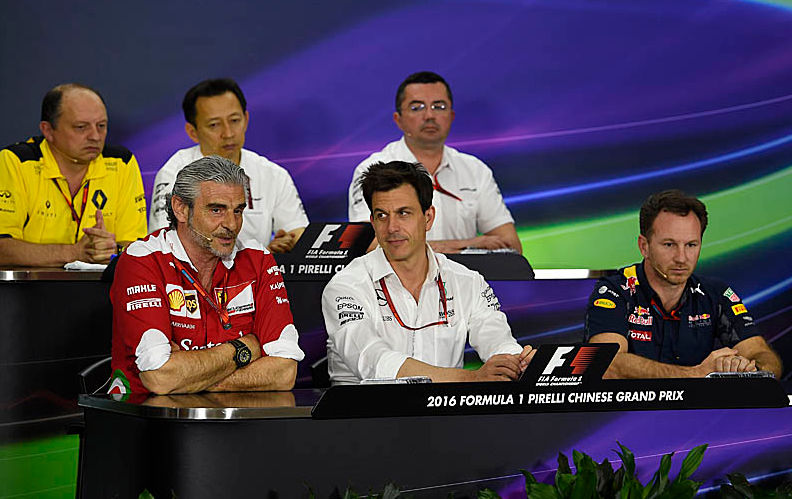
  • FIA Friday press conference – Chinese GP

    FIA Friday press conference – Chinese GP

    Here’s a look at who said what at the Friday Press Conference following practice ahead of the Chinese GP.

    TEAM REPRESENTATIVES – Frederic Vasseur (Renault), Yusuke Hasegawa (Honda), Eric Boullier (McLaren), Maurizio Arrivabene (Ferrari), Toto Wolff (Mercedes), Christian Horner (Red Bull Racing)

    PRESS CONFERENCE

    Maybe we could start with a general question for everyone. Obviously in the next couple of weeks there have got to be some decisions made on the future shape of Formula One, the regulations for 2017 and engines for 2018, so Christian, maybe we could start with you and how things are shaping up on the chassis side and where you think the discussion are, what shape we’re in and what we can look forward to?

    Christian Horner: Well, I believe that as far as the technical regulations are concerned, we’re pretty close to a conclusion on that. They were basically agreed at the last strategy meeting, so I think it’s just a formality to finalise those chassis regulations at the end of this month. I think most people are already tentatively looking towards next year based on those regulations anyway. As far as the engine regulations are concerned, again there have been some discussions recently, which again will go through the Strategy (Group) and subsequently onto the Formula One Commission but everything has to be fixed by the last day of this month for 2017, so I’m not expecting too many major surprises.

    And are you comfortable with where everything is at the moment, the shape of those regulations?

    CH: Well, they are the same for everybody at the end of the day. It represents a bigger change on the chassis side, so that inevitably is going to move things around a little. On the engine side there is obviously discussion still going on and that’s probably the bigger topic for the future, but as far as the chassis is concerned I think they are interesting rules, they add an element of variance compared to what we currently have, so you’ll see some different solutions no doubt from different teams, that you usually get from a regulations change such as that.

    Toto is that a situation that suits you, that there might be some variation in how the regulations suit the teams?

    Toto Wolff: Well, every variance challenges your organisation and I think we are well position to take up the challenge. Definitely making the cars look different, putting emphasis on new bits or innovation is interesting. Whether those rules can provide more interesting racing is another question. In hindsight, because we’ve voted on these regs already, we will see next if it works out. But yeah, I’m looking forward.

    Eric, what are your thoughts on this?

    Eric Boullier: Pretty similar to be honest to Toto and Christian. It’s exciting a little bit to have a new package. I guess the car will be faster and the drivers definitely will enjoy driving the car. So drivers happier, fans happier I guess. As far as we are concerned on the engine, we are seeking some stability, which would be the key to develop and have a better convergence in the future.

    Maurizio, Eric mentioned the fans there. These regulations are largely predicated on making Formula One more appealing, how important is it that Formula One gets these regulations right, now, for the next generation of Formula One fans?

    Maurizio Arrivabene: I think as my colleagues said, I think the regulations they are under discussion and nearly done, they are also especially to enhance the show in Formula One. Next year you are going to see a different car, tyres a bit larger and then if you want to make sure you do a good overtake you have to enlarge the track – no, I’m joking! I think it’s all following the direction to enhance the show and to make Formula One more interesting.

    Frederic, Renault has come back into the sport this year as a constructor, how difficult does it make it for you, or does it make it easier for you that everything changes next year?

    Frederic Vasseur: I don’t know if it will be easier or more difficult, but I think at least it’s new rules and it’s important for us also to start with this kind of game. But I think it’s not for sure much easier for us to start with a new regulation for next year, because we have to restructure the team and it’s not for us the best moment to change the regulations. But it doesn’t matter, it’s not the target, the FIA is not there to play the game for one team or another one but we have to try to push for Formula One and to find the most exciting way for the fan. And I think if the car is more impressive it will be much more fun for the fan and spectators.

    Hasegawa-san, welcome, your first time on this panel, and your second stint in Formula One. What’s Honda’s position on the engine regulations or the talks that are happening for 2018 in terms of power units for then? Are you satisfied with the progress that has been made there?

    Yusuke Hasegawa: As they mentioned still we need to have some further discussion but something like cost reduction and obligation. Yeah, from an engine manufacturer point of view, or as a member of Formula One society point of view, we have a kind of obligation to the fans and to this group, so Honda is happy to have that regulation, although we need to have some further discussion I understand.

    Just to the other people who engine manufacturers, what about the guaranteed supply that is being talked about for 2018. Is that something that you are comfortable with; is it deliverable? Toto?

    TW: It is a complex agreement. We have been given the task in coming up with solutions so that no team is left without an engine. I think all the engine manufacturers have acknowledged that, so we try to cover that. There is an aspect of price reduction, which is important to most of the teams, and we tried to cover that in the framework agreement. Obviously it’s very difficult to make everybody happy. Christian isn’t so happy. But I think we need to come up with a solution until the end of April. We need to ratify those regulations and at the moment everybody is working very hard to at least find the smallest common denominator.

    Christian, Toto mentioned that you may not be very happy. It’s obviously been an issue in the past. What’s your position on that supply going forward?

    CH: I think it’s a complex situation, but fundamentally there were four criteria that were requested by the governing body to be met to ensure stability moving forward. Those four criteria were: a significant reduction in cost to €12 million, the availability of supply or the guarantee of supply, power convergence to within a relatively small bandwidth and to address the noise. As we sit here now we are not anywhere near having met any of those criteria and I think unfortunately what will happen, as is often the case with these things, time will run out at the end of the month and nothing will be achieved and nothing will change. There is one more attempt in the Strategy meeting and the Commission meeting at the end of the month to discuss and table the concerns and where we’re at, but failing that regulations will inevitably stay as they are.

    Eric, Fernando back in the car today, maybe you could tell us what the process has been, how it worked with him today? And also maybe you could give us some insight into what Stoffel did at the last race and what he brought to the team.

    EB: Well, happily everything is back to normal. Fernando back in the car today was fine. The FIA wanted obviously to have another check and another go after practice one which was an easy one because he ran through practice one without any issues. He felt ready anyway before the Chinese GP weekend and I think this is a matter that is closed now. For Stoffel, obviously as far as we are concerned he did a very good job in Bahrain. Never easy to jump into an F1 car for a race weekend. I think he impressed everybody by how quiet he was and obviously by the good job he delivered. I think it’s a good driver for the future to have in our stable.

    Hasegawa-san, obviously the performance of McLaren has stepped up a little last year – what are your expectations for the rest of the season? Where do you see performance gains coming, when can you expect them to come?

    YH: It is too soon to say the exact number or position but obviously we’re not happy, we’re not satisfied with the current position. We can improve definitely with a decent level of step-ups so we are happy about that. Of course it is coming from the chassis as well but we can contribute with the power unit. It is important to show that we can improve in the step-ups. This is our target so far.

    Maurizio, one and two this afternoon, so a fairly good afternoon’s work. You’ve had two good results in Australia and Bahrain but a couple of technical issues as well. What’s been the response to those back at base and do you feel that that’s now been overcome?

    MA: What’s happened in Australia and Bahrain, we explained it very, very well and I think I don’t need to give further explanation because what we said, it was absolutely true, like it or not. Concerning here for the Chinese GP, it was a good Friday, not a bad one but unfortunately not gaining position on the grid or points in the championship. So, it’s a good short but the Chinese GP weekend is still long. Concerning the expectation of the season, I can say the Mercedes team of this year is the strongest one that I saw in the last ten years because it’s quite a lot of years that I’m around and, I mean, to be able to win against them, you have to work and be better than them. So, we are doing all our best to have good results.

    Toto, the best team in ten years! And Nico is performing very well at the moment. How have you seen him change over, not just the winter but if you look back to him in 2014-2015, do you think he came into the season with a different attitude? Is he a different driver?

    TW: Before answering the question I’d like to give the flowers back – they are pushing us very hard and you have seen today that it is raw performance and we have seen the performance in the last couple of races. Ferrari haven’t been able to pull it together because they made a big step from ’15 to ’16, similar to the step of ’14 to ’15 and in order to have the package rolled properly deliver and be reliable, that isn’t an easy task but in terms of sheer performance, they are really pushing us. And that is good; this is how the competition should be. In terms of Nico, he’s in a great place. I don’t see him oscillating a lot. People keep asking when Lewis had his winning streak last year, ‘is that going to knock Nico down?’ and then when he started winning after the championship was decided, ‘is it going to pull him up?’ Those guys perform on a very high level and it doesn’t particularly affect them whether they’ve had a good weekend or not. They’ve been in the job – or in motor racing – for 20 years or more, so the Nico I see today is developing as a personality, developing as a racing driver and learning – but also it’s not very much different to how I’ve known him the last couple of years.

    Frederic, you’re coming back to the grid as a constructor as we mentioned, you’ve had a couple of months now to assess where things are: what have you identified, or what did you identify as the things that needed immediate attention – and how is that progressing?

    FV: Nothing special and on every single matter because as we all know, we took over the company very late. The first challenge was to be on track for Barcelona and I think we did it but now, for sure, it’s a long term project and we have to improve on each area. There is no one, single matter to work on. We have to push on every single project and every single department of the company – but we know that it’s a long way and we are more than motivated and I hope that we will do it.

    Christian, these two gentlemen alongside you, they’re a little bit ahead but two fourth places in a row in Australia and Bahrain. Does that give you encouragement about the steps that have been made over the winter, not just on the chassis, on power unit as well. Where do you see it taking you this year?

    CH: Well we’re hoping to join their love-in. Sometimes two’s company, three’s a crowd… we’ve made good progress over the winter and I think at the last couple of races we’ve had arguably the third-fastest car. It’s a very tight pack fighting over that third place and the jump then to where these two teams are is quite a significant one. We’re hoping with further development on the power unit, that we expect around Montreal, to make good progress, certainly in the second half of the year and at certain circuits hopefully, try and get onto their shirt tails – but it’s quite a big gap that is inevitably going to take more than a season to close down.

    QUESTIONS FROM THE FLOOR

    Q: (Ben Edwards – Channel 4 TV) Frederic, about today, and about the tyre problem we saw on Kevin’s car and the decision not to run the car this afternoon; can you just explain that a little bit?

    FV: We investigated the problem at the end of FP1, that the problem came from the suspension and we had a lot of damage on the car and it was much better for us to stay in the garage for FP2 but we will be ready for tomorrow morning.

    Q: (Haoran Zhou – Top Driver) Question to everyone: during the last round of big regulation changes we heard that people like Ross Brawn were quoting downforce figures in the meeting to guide everyone how we should set these chassis rules. Presumably that sort of the discussion is present again in the strategy group; can you give us a rough range how much more downforce would next year’s car have on the chassis side? Is it one third or 20 points or something?

    TW: Interesting one! Around 80 percent! No, the numbers vary of course and they vary because of different interests so it goes from teams saying that it’s not a lot more than it is today until 30-35 percent.. So it could have quite a big effect on downforce which is in one sense good, because the cars will be more difficult to drive, will deploy much more G on the driver like in the past. But equally G isn’t visible for the spectator and the risk might be that overtaking could be more difficult and it will put an additional stress on the tyres. And all this is still in debate, but we have chosen the way forward and to come back to your question, that is the bit of the bandwidth I would say between zero and 30 percent.

    EB: It’s a little bit… yes, the debate was based as well on the tyres because we wanted to have more mechanical grip, let’s say, so there is a different tyre size, different compound and philosophy and all the discussion has been steered more about an improvement in lap time and on that point, I did agree with Toto. I think having a car with more downforce makes the drivers a little bit more confident to let’s say out-brake each other and obviously if you change the philosophy of the aero, less driven by the front wing, you improve the overtaking so I think it should be good.

    Q: (Joe van Burik – De Telegraaf) Mr Boullier, Stoffel Vandoorne received much praise for his performance in Bahrain; what more does he have to do to prove himself worthy of a fulltime racing seat or is that merely a matter of time?

    EB: Well, at this stage I don’t think he has to prove anything anymore, it’s just a question of having an opportunity.

    Q: (Haoran Zhou – Top Driver) Again, to presumably everyone: with the bigger tyre size for next year, presumably adding some weight, starting weight of the cars in race trim would be something like 820 kilograms and with Pirelli’s tyres being designed to degrade faster, that would significantly put a burden on how much the driver can push at the start of a race, which at the moment, at the start of the race, a Formula One car is not going that much faster than a GP2 car. Is there any way you can address that problem? And how much the drivers can push cannot really be solved by adding more aero to the cars in race trim.

    CH: First of all, I hope the cars aren’t 820 kilos. They’ve got a lot heavier with the new technology that’s been introduced over the last couple of years and compared to ten years ago, they’re more than a hundred kilos heavier than they were, almost approaching sports car weight, and that of course adds to the characteristic of making the car a little lazier than a lighter car but I disagree with you that by adding downforce and load back onto the car you’re going to give the driver a harder time. You’re going to give him much more of a workout. The drivers have been crying out for cars that are more challenging to drive. The cars that we have at the moment… it’s been discussed whether they are too easy to drive and I think that by making the cars edgier, by making them quicker you will get a bigger variance of drivers, the teams will get better value for money out of their drivers and they’ll have to start going to the gym again. So I think it’s a positive thing that we’ve got a regulation change but yes, the cars are a little bit on the heavy side. It would be nice to somehow get a hundred kilos out of them.

    FV: I think that Pirelli will adapt the tyres to the new regulations. It’s not a matter of downforce or degradation; it’s just the combination between the tyre regulations and degradation.