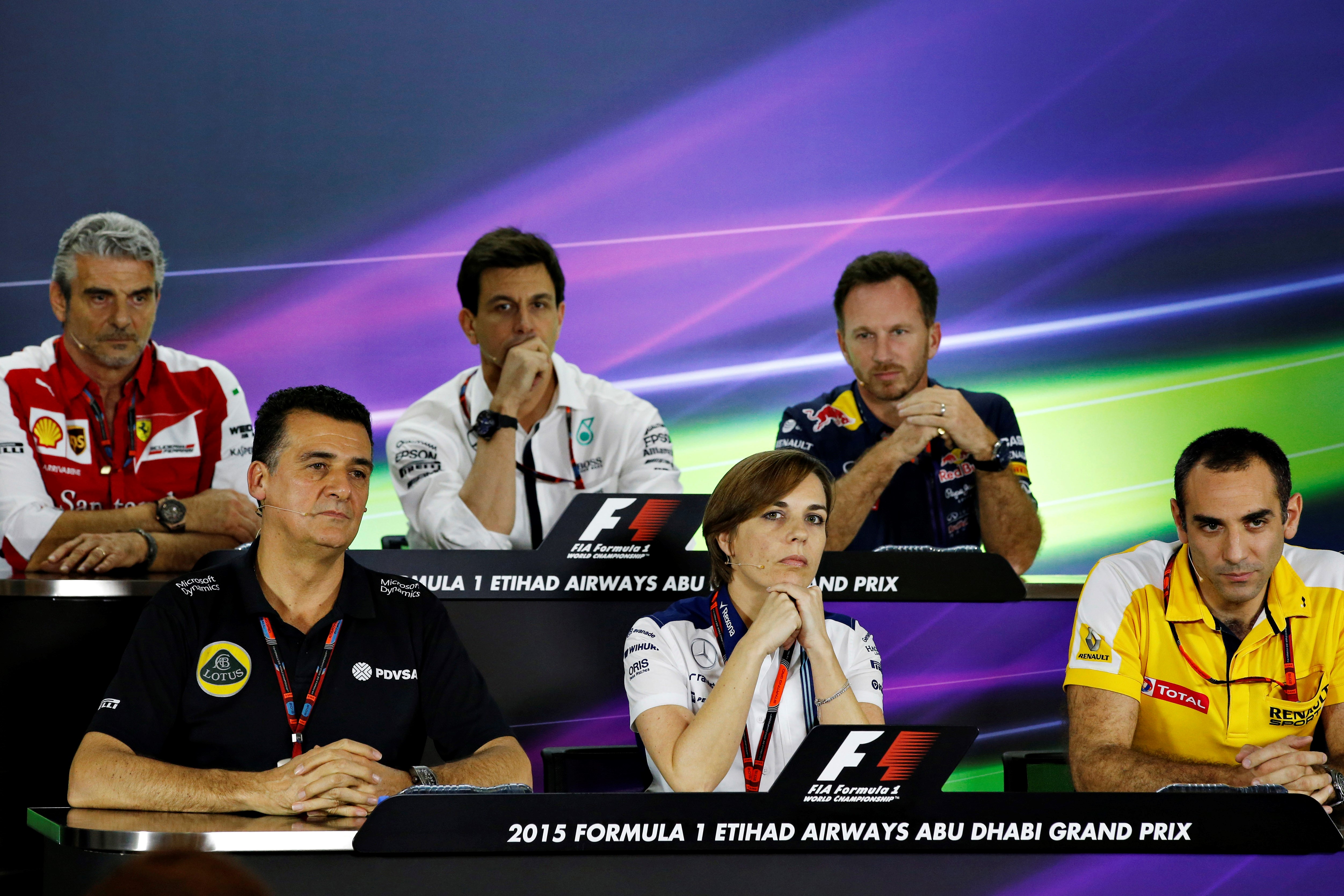
TEAM REPRESENTATIVES:
Cyril ABITEBOUL (Renault)
Maurizio ARRIVABENE (Ferrari)
Federico GASTALDI (Lotus)
Christian HORNER (Red Bull Racing)
Claire WILLIAMS (Williams)
Toto WOLFF (Mercedes)
PRESS CONFERENCE
Cyril, it’s been a little while since you’ve been here joining us in the press conference. You’ve been talking a little bit recently about next year – larger budgets etc – but can you tell us what exactly Renault will be doing next year in Formula One?
Cyril ABITEBOUL: Well I’m afraid I can’t answer to that question. I would like to be in a position to be able to answer to that questions, but I am not today. What I can say is that there will be no announcement regarding Renault’s future – short-term or middle-term future – over the weekend, but there will be an announcement, very likely, in the course of next week. We have always said that we would like to do that after the season. Thee season is ending on Sunday, around the start of December and that is what we will do stick to that plan, which is to make an announcement then.
OK, Federico, if I could come to you, where does that leave you and your thoughts on this?
Federico GASTALDI: Well, we are on the same page. As I keep saying we have been working, all the time, actually since the Singapore race. We have Renault people already at the factory and it doesn’t change anything. They are the ones who have to announce. We cannot push Renault to make the decision because it’s their call.
Christian, coming to you, you were quoted this morning as saying that you know now for sure what engine you are going to use next year, but clearly no announcement yet, so what’s holding that up?
Christian HORNER: Well, we have and agreement in place for next year, so it’s great news that we will be on the grid next year, but unfortunately due to circumstance beyond our control we can’t announce exactly what that is. Perhaps Toto can tell you?
Toto?
Toto WOLFF: Can I?
Coming back to you then Cyril, can you give us a sense of what it’s been like in the past weeks and months, the work that’s gone on behind the scenes and also your own personal ambitions for the brand?
CA: It’s typical Formula One. I think it has been a proper rollercoaster for us, for me, but also for the whole team, for a lot of people involved, I should say technical people involved in the engine programme. Clearly, Federico made reference to the work being done between Lotus and Renault and it’s fair to say that there is a process going on since the signing of the letter of interest on the 28th of September, there is a process involving a lot of people. I think 50 people have been working night and day on the realisation of a possible acquisition of a majority stake in Lotus. It’s just a project, It’s been a proper rollercoaster, very exciting. I have to say there has been a little bit of frustration on the track. We would have liked to do a better job for Red Bull and Toro Rosso engine-wise, but we always knew it was a long-term game to fix the issues we had. We have not managed to deliver a product that was in accordance to what we would have liked to do with those new regulations, so hopefully we will have the strategy, the time and the resouces to do that in the next few years.
Thank you for that. Coming back to you Federico, clearly this weekend again a race against time for the mechanics to get the garage and the cars prepared for today’s sessions. Not the first time this has happened. Can you explain the background?
FG: We have been open in explaining what happened with the team. As everyone knows we have some financial issues. We have been trying to work out a new procedure where the team spends less money. So fortunately between Renault and the shareholders and Mr Ecclestone we kept going but again it’s just the situation we are in in Formula One at the moment. Genii have done a fantastic since they got involved in the team in 2010. We have had podiums, won races, so for a small private team it’s not a bad job.
Tank you. Coming back to you Christian, can you give us your reaction to the outcome of this week’s F1 Commission meeting and the direction taken, the direction from here in terms of the minimum number of teams that a manufacturer should supply and things like the simplification and cost of the engines. Maybe you could give us your thoughts on those items?
CH: Earlier in the week there was a positive discussion in the Strategy Group where the independent engine was discussed as an alternative product to being into Formula One and I think the reasons that the FIA and the promoter are keen on that is because costs are obviously critically high and as we have seen availability is also a key issue. So that was discussed in the Strategy meeting and it passed through the Strategy meeting. It then went to he Formula One Commission where despite a lot of the teams voicing concerns about costs the vote for the independent engine at that point wasn’t carried through. However, as a compromise position the manufacturers agreed and were requested to report back to the Commission by the 15th of January a solution to the current issues – a cheaper product, a more affordable product, a more available product and something that could potentially entice other manufacturers to come into Formula One. I think that the situation as we see it is that subject to what the manufacturers come back with by the 15th will depend whether or not the FIA feel the need to proceed with an independent engine to meet that criteria. So, it’s going on at the moment obviously, the time between now and the 15th of January is going to be a critical and busy period to define what this new power unit should be and what the cost and availability criteria are going to be.
Can I throw that across to you then Toto, your thoughts on what Christian’s just said and the likelihood of a resolution?
TW: The outcome is public and the independent engine concept with a balance of performance has not been approved. Nevertheless we are all pretty aware that you need to work on your product and develop your product and there are certainly aspects of that engine which can be looked at – costs of supplies is a very legitimate cause. The situation where a team might end up having no engine needs to be addressed and this is the task we have taken away. Is there an alternative concept from 2018 onwards which can address some of these topics, including the noise factor, question mark. We are looking at this and mid-January we are going to come back with hopefully a concept that is workable, financeable and that ticks all those boxes.
Maurizio, can you give us Ferrari’s position on this?
Maurizio ARRIVABENE: Already at the Strategy Group level the power units manufacturers they were more than keen to discuss about the 2018 engine with all the characteristics described before by Toto. So it was not a new news. Afterwards, at the F1 Commission the alternative engine was stopped and tomorrow the power manufacture companies are going to meet and we are going to seriously work on the new solution.
Claire, coming to you, in a season where many independent teams have had a rocky road, you have managed to sail on fairly serenely. What’s been the secret?
Claire WILLIAMS: I don’t know what the secret is. I think we just tend to keep our heads down and get on doing what we love doing and that’s going racing. We’ve worked hard over the past two years in order to turn this team around. We’ve made a lot of changes within the team and fortunately a lot of those changes are paying off. We’ve managed to secure third in the Constructors’, which is fantastic and testament to all the hard work that has gone in behind the scenes to try to turn this team around over the past 18 months. I’m really proud of the team and the job they have done this year. I think everyone knows though that there is almost a sense of disappointment that we’re third at Williams. We want to be winning races and fighting for that world championship. We’ve made some mistakes this year that have been fairly visible for people to see and we need to improve upon our operations to make sure we don’t make those mistakes next year and we can continue to improve in 2016.
Tell us about the signing of Lance Stroll, former Ferrari Young Driver Academy prospect. You’ve signed him up, what’s the plan for him?
CW: Lance is joining our young driver programme, starting next year. We will doing some simulator work with him to try to improve him as a driver. As everyone knows Williams enjoys nurturing young talent and we’ve identified Lance to take on that role next year. He’ll be doing simulator work with our guys at the factory and he will be undertaking a team immersion programme, so similar to the programme we did with Valtteri many years ago now. So he’ll be doing that and we’ll be supporting his season in Formula 3 next year and hopefully he will have a great season and we’;ll see where he ends up at the end of ’16.
Thank you for that. Coming back to you Toto, a record-breaking season comes to an end this weekend. You’ve been beaten only by Ferrari and Maurizio this season. How do you assess that challenge and do you expect a title challenge from them next year?
TW: From the numbers it was indeed a very successful season and I am very happy and satisfied with how it went and there is a great buzz in the team and spirits are high but in Formula One as in many other sports and business only tomorrow’s result counts and this is why we are looking very much forward to next season. Ferrari is about best ‘frenemy’ and they have stepped up a lot over the winter. Clearly in Malaysia it came with a bit of a shock win and it was good for us to see that and I think generally they have done a good job and for F1 it is important that you have more teams competitive in the front fighting with each other, as much as you would like tot see it as a comfortable situation it is not sustainable and the better the platform is the better it is for us all.
Maurizio, your points of view? Is there belief in Maranello that you can come back here 12 months from now and be fighting for the championship?
MA: I hope so, because last time I said we would like to stay in front of them, this is an objective. Then last weekend somebody said in Italy, they make a statement in the newspaper ‘yeah, but where they want to go, they are going to be second, Mercedes is going to win’, and I was asking ‘So, what you want me to do in terms of objective? To tell to everybody that I would like to be second next year?’ Of course [to beat them] is our objective but it doesn’t mean we are going to achieve it. But we will try very hard.
QUESTIONS FROM THE FLOOR
Q: (Joe Saward – Grand Prix Special) Can I ask the three manufacturer teams: if there was an equivalency formula, would you still be here?
TW: Formula One is not a place, in my point of view, that should have an equivalency formula. It is very much the World Championship and the pinnacle of the best drivers, the best cars, the best engineering and I think it is important to understand what our DNA is and it has functioned very well over a long period of time. Doesn’t mean there shouldn’t be things we’re looking at and changing for the future but an equivalency formula, balance of performance wouldn’t be Formula One any more.
Cyril?
CA: It depends on the formula, y’know? Seriously, I think in addition to what Toto has mentioned about the DNA of the sport, the biggest hurdle I can see is that when there is distribution of something like a couple of hundreds of millions that are distributed on a yearly basis, I would not want to be the guy who has to sign off the formula that will decide the distribution. I think that will be opening the doors to an awful lot of discussions. There is already a lot of politics and talks in our sport, which I think is part of the game frankly, and of the show, but I think it will be simply way too much. So, clearly I believe, as a Renault representative, I recommend to Renault to stay away from that.
Maurizio?
MA: I think we already have an equivalent formula that is so-called Formula Indy. I mean, Formula One, it’s the pinnacle of motorsport so I agree that we need to think about the future in future to reduce the cost but to reduce the cost you need new regulation first. Due to new regulation you can reduce the cost but the competition is distinguished in Formula One and the research from any other motorsport.
Q: (Ian Parkes – Autosport) Question for Toto. Toto, Esteban Ocon has just announced on Twitter that he’s now a Mercedes AMG F1 driver. Does that mean that he’s taken up the reserve role from Pascal? And can we assume that Pascal is therefore moving on to Manor?
TW: So, yes, we’ve taken up the option on him because he has been with us now, or has been following the DTM team for a while, has been the test driver in DTM and integrated well and he’s doing a very good job in GP3 as well and he’s somebody we’d very much like to have in the family. This is why we’ve exercised the option. It doesn’t mean that we’ve found a solution for Pascal. The current driver market is a bit difficult because most of the teams have already announced their drivers and it need to be the right deal – but having taken up Esteban we are conscious that we need to find a suitable programme for both of them. It could well mean that it could eventually end up for both of them in a testing role, in a reserve driver role and in a DTM role – so it’s not done yet.
Q: (Dieter Rencken – Racing Lines) A question to all of you please. We’re currently talking about 2017 regulations, completely different underbodies etcetera, different aero packages, tyres. At the same time we’re talking about the possibility of a completely different engine concept. Isn’t this indicative of the sort of disjointed approach to Formula One that, on the one side we’re talking about a completely different chassis concept in, sort of, 15 months time, and on the other side, in 18 months or two years, we’re looking at a completely different engine. Should we not co-ordinate these packages together?
CH: I absolutely agree with you Dieter. We should bring it all in, in 2017.
Claire?
CW: I think the conversations are still on-going, I don’t think anything’s been decided yet and I think they’re very early days in those conversations and we’re trying to map out what the best course of action is – but I think you have to remember the reasons behind the fact we’re having these conversations is in order to try and improve our sport and make it the best that it possibly can be – and we’ve still got a bit of a way to go before we do that but I think if you look at the regs that the working groups are working on at the moment around the new car and the chassis etcetera what that’s going to look like and then you look at what we’re trying to do with the engines and bring down the costs of those. If we can get both areas right, then I think in ’17 – and if not, if we have to wait to ’18 so be it – but I think it could make Formula One a much more stable platform that we can all enjoy in the future.
Federico?
FG: Well we certainly need the stability but I think there’s still a lot of things to be discussed in order to find a solution that will suit everyone.
Cyril?
CA: I believe the processes are exactly the same. On chassis side I think we are trying to improve the product which is already a good product, while on the engine side we are trying to recover from a number of issues that are associated to the current regulations. I think we recognise that, that’s why I guess the process is different and the timing of those two exercises is slightly different.
Maurizio?
MA: I think this discussion, it looks less confused than what it is in reality. The chassis is still under discussion and it will be an evolution and not a revolution concerning the engine. The good news is for 2016 and 2017 everything, it’s very clear now, opening also the door to us, because we are still second, to Renault and also to Honda. We will continue to do our job especially. Tomorrow with the first meeting about the new power unit that is supposed to be in 2017. We try to do all of our best but I think even the Wizard of Oz couldn’t be able to do it for 2017. For sure for 2018. So, it’s much more positive than what it looks like.
Do you agree with that Toto?
TW: Yeah. There’s some good stuff coming. I think in terms of chassis regulation there’s interesting bits and synchronisation probably makes sense but you need, of course, to look at the costs.
Q: (Christian Menath – Motorsport-Magazin.com) Question for all of you. In the past it has always been almost impossible to find one way for all the teams, for all the parties in F1 Commission and Strategy Group and so on. Some people say that now things changed a bit in the last meetings. Why now? Is it the alternative engine that was there or…? Why is it possible now and not in the past?
CH: I suppose when you look at it, the teams have collectively been spectacularly incapable of coming up with solutions and sensible remedies to the problems – and I think the problem we face in Formula One is you’ve got vested interest. Within your own team you try to protect the elements that are your strengths, that offer you that competitiveness over your opponents. And I think this is where Formula One has tripped over itself over previous years and indeed, the engine formula that we’ve ended up with today arguably is a mistake. It’s expensive. The technology is fantastic but we’re not doing a great job of communicating that and I think it’s put a situation where probably half the grid is currently insolvent. I think there’s a fundamental question that needs to be answered and that is: what should Formula One be? I certainly believe that Formula One should be entertainment. It should have a technological interest to it but that needs the promoters and the owners of the sport, together with the regulators to decide what that product is, come up with a set of rules, not let engineers write those rules, they come up with those rules and put them in front of the teams and say “that’s what Formula One is going to be and that’s what it should be for the future,” and they need to bring in some people with the right skillset to be able to define what those regulations are. And there’s good people that aren’t currently in employment within teams at the moment that are impartial, that come up with a set of regulations that are in the best interests of Formula One, that’s going to provide the best show for the fans, for the public, for the paying spectators who are the backbone of what we do because without them there is no show, there is no Formula One and we need to get Formula One back to being a sport that is enthralling to the public.
Maurizio, do you share that view?
MA: I think if you are winning races, of course the show is perfect for you. If you are not winning races the show needs improvement. It’s normal. But I think at this stage, I’ve said so many, many times, we need to work all together, really to improve the show, to attract more spectator, especially on the segment, on the younger segment – and I think this is something, it’s an objective because the population of the world TV viewer, reader and so on is getting older and older and older and this is what we have to do. Of course, during the way you find it’s not an easy way to go because of course the people who have an advantage, they want to keep it. The people that doesn’t have any advantage, they are using sometimes this problem to criticize the overall system. I think with great cooperation between all of us, we can solve it.
Toto, back to the question about the level of consensus, what are your thoughts on that?
TW: I would just follow Maurizio on that one. Summed it up pretty well.
Q (Joe Saward – Grand Prix Special) This is for the three manufacturers again. You guys represent very, very large companies that have lots and lots and lots of money. Why in the world are you fighting over a few millions when you’re getting the technology that Formula One gives and you’re getting the exposure as well? Why don’t you just settle down, give people a decent price and let’s get on with it?
Cyril?
CA: Thank you! Frankly, it’s a good question. At the end of the day, at the end of the road that might be what’s at stake but I think maybe there is some road to cover before we get there. You’re talking about the amount of money that we all have, yes, absolutely, but you know times are difficult. Automotive car makers have their own challenge, they need to invest for their core business which is road car technology that you find on the road, not on the track. We’ve got a number of risks associated to what we do. I’m not talking about motorsport. You are aware of the ‘Dieselgate’ and a lot of us are exposed – maybe not Ferrari – but a lot of us are exposed to this difficulty, this challenge that the world of carmakers are facing but that’s not the only issue, we’ve got a number of issues, like the currency, like the markets, the lack of confidence of certain customers, so we need to be extremely careful. At the end of the sale, it’s a sales and marketing decision. Basically, we need to demonstrate that investing in Formula One, or spending – because it’s not an investment – spending in Formula One is more cost-efficient than spending, for instance, in the regular advertising or spending in badminton in China. So there is a number of KPIs that we need to follow, that we need to monitor and demonstrate that this is competitive as a marketing spend perspective. At least for a manufacturer, which is a mainstream manufacturer, like Renault, and for which Formula One has always been in the DNA but for which is not a must – there are many carmakers that are very successful and are not in Formula One. So, we need to be extremely careful about whatever can, I would say, threaten or destabilize our business case in Formula One and obviously subsidizing the cost of engines to independent teams – even though we appreciate it might be a necessity to be in the sport and to have a healthy sport but it is something that is endangering the business case. That is the situation.
TW: It is a situation where all those big OEMs – like everyone else out there – is trimmed on efficiency and particularly the car industry with the problems Cyril has described, are in a constant loop of margins, recalibrating margins, of trimming down costs and Formula One, although it is part of the DNA what we do at Mercedes, because it’s around the car, it needs to have the right price for what you do and this is why you can’t just apply easy-going mentality and say it doesn’t matter if you spend a little bit more or a little bit less. It does because somebody will look at the numbers and somebody will make a decision whether it makes sense or not. And this is why we are aware (that) although we have this big mothership behind us, that it needs to be the right price, it needs to have the right value and we are monitoring that and if we are a having a bad race with a bad audience or not the right viewing numbers in terms of what you deliver to your partners, that’s being considered and that is how we operate.
MA: You don’t have to mix up the big name of Ferrari. Ferrari has a name that is in a worldwide business, it’s at the top. That doesn’t mean that the budget is in a wordwide business at the top. We need to be careful. Mr Marchionne is not joking about that, to respect the budget that is assigned to us. We are not the kind of company that is throwing money out of the window. That’s the point. So don’t mix up the big name with budget. That’s another story.
Q: (Chris Lines – AP) Christian, does this new engine supply deal suggest that Red Bull has a fresh commitment to staying in the sport as a constructor, as an owner? And you describe the deal as a transition. I was wondering, a transition towards what?
CH: Well, to answer the first part of your question, I think it’s no secret that during the summer that Dietrich Mateschitz became fairly disillusioned with Formula One, with the direction that things were heading. He said in conversations that he’d personally had the undertakings that he had that didn’t come to fruition. He is probably the most committed supporter of Formula One over the last ten years, if you look at two Grand Prix teams, a Grand Prix on the calendar, the amount of promotion that Red Bull worldwide puts into Formula One, the young driver programmes, investing in youth and young talent, more than probably 1500 employees across the different teams and markets, regarding the two Formula One projects. So for Red Bull it’s a major major part of their promotional budget spend, that is committed to Formula One, and I think that during the summer months or the latter part of the summer, he was seriously concerned with the direction the sport was heading and what the return of Formula One could ultimately provide. I think that having sat and thought about it, he’s decided that there’s too much at stake, that Red Bull have invested so much into the sport that he wants to see the team get back to its former glory. We’ve got some challenges ahead to achieve that. I think the current constitution of performance obviously in a power unit dominated formula it’s a difficult situation if you’re not aligned to a competitive power unit at this point in time, so 2016 will be a transitional year for us and I think as hopefully regulations come to fruit or come to bear with the changes that Jean Todt is pushing for, that the promoter is pushing for, to achieve a more affordable, more available power unit, can only be a positive thing for any independent team, not just Red Bull but all the other independent teams that are currently on the grid.
Q: (Ian Parkes – Autosport) Christian, with regard to your remarks about a sole regulatory body, that would suggest that perhaps you’re calling for the abolition of the strategy group and the F1 commission. Is that the case, is that feasible and to the other five, do any of you agree with Christian’s remarks that you would again like to see a sole regulatory body, that the teams would no longer have an input?
CH: I believe that an input is fine and the teams obviously have an investment in the business, so there’s no reason why things shouldn’t be discussed among the key stakeholders and certain teams obviously are stakeholders. And the strategy group is supposed to be looking at the longevity of Formula One but what the strategy group continually gets embroiled in is fire-fighting issues of the current day. Instead of looking at what should a Formula One car be like in 2020 and beyond, we’re constantly dealing with issues of today and tomorrow, rather than further down the road. So I think that of course there has to be consultation with the teams but at the end of the day, somebody has to run the business, and somebody has to say this is the route that we’re going and a democratic approach to that will not work in our opinion.
CW: I think it’s a bit of a case of be careful of what you wish for. I think that we’re very lucky that we have – as Williams, as a team – that we have a seat at that table and can be part of the democratic process that we do have in F1 at the moment. I like that, I like being able to be involved but I do think that at the moment, as Christian said, we have a number of agendas on the table and it’s very difficult to get everybody to agree around that table when we’re having discussions and we all run our businesses in very different ways and we all have very different capability within our teams. But I’m not sure if I would subscribe to our sport having a single regulatory body. I think it would be very difficult for everybody around the table.
FG: Well, I agree with them and I’m sorry to keep repeating the same things but the problem for me is that we are not in the same boat, we are not on the same page and we are not on the same agenda. As Cyril has pointed out before, we are all looking for our own stability as a team individually. It’s hard to have a common approach that will benefit the sport at the end of the day.
CA: As a Frenchman I am for the dictature (dictatorship) as long as you can chose the dictator. I think it’s fair to say that if we want to be progressive, what Formula One is, maybe there needs to be some form of re-grouping of different groups and functions and something a bit more effective and again progressive. Having said that, there is always some dangers, that again the power can be in the hands of someone who has a particular agenda which can be the individual or collective, I’m not thinking of anyone in particular. But I think on balance, if you look at Formula One I would prefer it to be more progressive than it is, so if that involves a little bit of dictatorship maybe that would be better.
TW: Can I follow Claire on her opinion? That’s what I would say.
MA: I think a couple of years ago we had an aero dominating formula, today we have a power unit dominating formula. I think that the right balance should be defining to be sure to make everybody happy. Then the question if we go for a democratic decision or a kind of dictatorial decision is not for me to decide. I mean we have a commercial rights holder, we have a federation but of course we also have the interests of the teams so my aim is to find the right balance for the future and to make everybody happy and working to enhance the show and to go back to a spectacular Formula One.
Q: (Nahed Sayooh – Autosport Middle East) Maurizio, you have set a target of three wins this season and the team achieved it. What is the target for 2016?
MA: The target for 2016 is to cancel the smile from the face of my friend Toto.
Q: (Christopher Joseph – Chicane) Christian, you spoke earlier about the need to communicate the technology aspect of Formula One. Do you think that with the endless discussions about strategy direction, power units etc etc, are we losing the plot in terms of communicating this technology message?
CH: I think to a degree we are. What these cars achieve with 100 kilos of fuel and the fuel economy they are achieving is impressive but I’m not sure how many fans actually give a damn about that. I think that what they want to see is the drivers who need to be the heroes, racing wheel to wheel and competitive racing. Machines that are Formula One cars are truly spectacular to drive and I think Formula One is the pinnacle of motor sport and it’s competing against an awful lot of other sports that are now demanding television air time. And it’s got to be entertaining from start to finish. I think that that’s what we need to be striving for, that’s what we need to be looking to achieve. Now of course technology plays a role but I don’t believe it needs to be the primary role, that should be about the drivers and out-and-out racing.
Q: (Dieter Rencken – Racing Lines) Toto, from the pit lane in Brazil, you seemed to indicate that the difference in price to the teams of the new engine to the old engine is about plus twenty percent which works out at ten percent per annum, or if that price gets held for next year, about six percent per anum, which is roundabout six percent of a smaller team’s budget. What’s the big outcry about, why do you want to throw this engine out with the bathwater when in fact there’s only about a six percent difference from one to the other?
TW: I couldn’t follow you on that calculation. But the main point is that there are lots of numbers out there and lots of wrong numbers out there and as a matter of fact I can only speak for Mercedes because these are the calculations I know, it’s from a previous engine spec: the old eight cylinder engine plus KERS. About the difference to what we have today, it is what you have mentioned, 20 or 25 percent. Is that too much? Maybe. I remember times when I joined Formula One a couple of years ago, the price was around £30m, three-zero plus a driver. Nevertheless, I think it’s legitimate to question the price and obviously the lower the price, the better it is for Formula One, the more sustainable it becomes, the better it is for most of the teams and that is OK and we need to look at it. But the difference is not what’s been said.