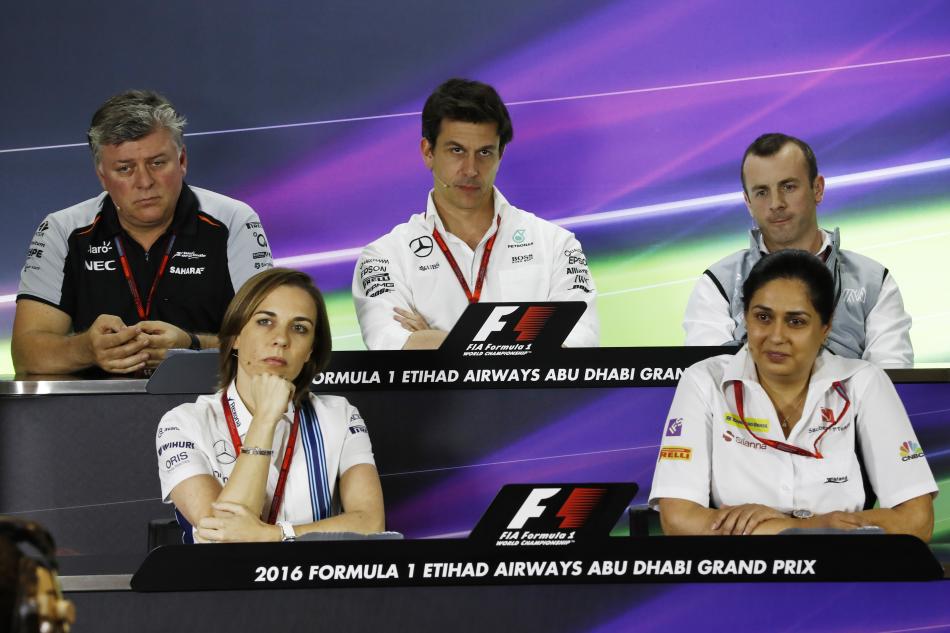
Tag: otmar szafnauer

  • 2019 Formula 1 Brazil GP: Friday Press Conference

    2019 Formula 1 Brazil GP: Friday Press Conference

    TEAM REPRESENTATIVES – Toyoharu TANABE (Honda), Otmar SZAFNAUER (Racing Point), Christian HORNER (Red Bull Racing), Frédéric VASSEUR (Alfa Romeo), Mario ISOLA (Pirelli)


    PRESS CONFERENCE


    Q: Mario, if we could start with you please. Cast our minds back a couple of weeks please, to Austin, when the 2020 tyres were tested by the teams. The feedback was mixed, what did the teams tell you, and what’s the plan going forward with these tyres?

    Mario ISOLA: Yeah, as you said, the feedback was mixed. I believed that we had quite difficult conditions in Austin. It was very cold and the new tyres are designed with a different philosophy. So the plan now is to test them again in Abu Dhabi where we have a two-day test planned specifically for testing the new construction and new compounds, so we will have a comparison that is more reliable compared to Austin. We tested this new construction during the year with the teams and with their cars and we found an improvement in terms of overheating, in terms of compounds with a wider working range – but mainly the new construction was designed because every year the performance of the cars is increasing and obviously we have to follow this increase in performance. If we don’t change the construction, the only possibility is to raise the starting pressure – and raising the starting pressure is making the overheating worse and the behaviour of the tyre in general worse. So, the new construction has been designed with the target to keep the pressure as low as possible, according to the improvement in the performance of the cars. So, I hope that we can have a test in Abu Dhabi that is more representative. I fully understand during the race weekend all the teams are focussed on the race weekend itself, so they cannot adjust the set-up of the car – the aero-balance of the car – and the new tyres have a different profile. They are wider, especially on the rear, and this has an impact on the downforce of the car, as well as the balance of the car. So, we need a bit more time to test them properly on long runs, to understand if we achieve this target. After that, obviously we are very happy to accept any… not accept any decision but to discuss the result of the test and to see what is better for the sport.

    Q: Looking further ahead, the 18-inch tyres for 2021 were tested by McLaren at Paul Ricard recently. What feedback did you get from the drivers and the team?

    MI: It was positive feedback. They said that the 18-inch tyres were better than expected. They are more reactive, we confirmed some results that we had with Renault at Paul Ricard in September. So now we are finalising the 2020 test plan. Obviously we will have another 25 car-days of tests but I’m very positive. And in any case, what we have developed for the 2020 tyres, we have some concepts that we can transfer to the 18-inch tyres. So, it’s useful to keep this direction for the future.

    Q: Fred, coming on to you. We’ve asked you this question for a while now and you’ve finally got an answer for us: Alfa Romeo have re-signed Antonio Giovinazzi. Can you tell us your reasons for that?

    Frédéric VASSEUR: I think he did a very strong second part of the season, he improved a lot. He is now matching Kimi in quali and I think the issue is not on the driver side. We have to stay focussed on this and keep a consistent line-up, and it will be the best thing to do.

    Q: You say the issue isn’t with the drivers. Let’s turn our attention to the team. How well has this year gone for you and what are your plans for the team in 2020?

    FV: The plan is to do a better job next year for sure. We started pretty well this season, we were P4 after five or six races and then we started to have an issue. Different issues, not always the same, but we didn’t score a point in the second part of the season – or one or two points – but it’s not an issue always with the pace and, at the end of the day, we are doing too many mistakes collectively and this is the big issue.

    Q: Otmar, Checo told us in the press conference yesterday that 2019 has been a difficult and disappointing year for Racing Point. Would you agree with him?

    Otmar SZAFNAUER: Well, it’s not what we wanted. We definitely wanted to be a little bit further ahead. We’re just one point ahead of Toro Rosso and 18 behind Renault, so yeah, we were hoping to be fifth or fourth this year, so from that regard, it’s a bit disappointing. However, having looked back at what happened the year before this, when this year’s car was in development, we were in a bit of turmoil, especially financially, so it’s not surprising – although as a team we always want to do better.

    Q: As you say, you’re 18 points behind Renault, two races to go. How do you fancy your chances of catching them and even beating them?

    OS: Well, we’ll do our best. If we can mind the weighbridge and not start from the pitlane, that should help. Collectively, if we do a good job… but I think it’s not just up to us. I think we’ll need a bit of luck to be able to catch them – but we’ll do the best we can.

    Q: Tanabe-san, has this been a better first season with Red Bull than you expected?

    Toyoharu TANABE: So far, after 19 races in this season with Red Bull, we achieved positive results compared to previous years. And then two wins, one pole position and then, additionally, both teams on the podium in German Grand Prix. We made considerable good progress in the year. We want to do our best in the rest of two races in this season and then we want to carry over this positive progress and the momentum for next year.

    Q: As you say, lots of progress but has it been better than you expected, coming into the relationship?

    TT: In terms of the relationship, I think very good. And then, so far the results of the race depends on the performance compared to other competitors. It’s not easy to say good or bad. As a result, as I said, we got wins and a pole position. It’s good progress in the relationship.

    Q: Thank you. Christian, perhaps I could bring you in on this. How would you sum up progress with Honda during this first season together?

    Christian Horner: I think it’s been really positive. It’s been a great relationship. The two companies are working really well together. In our first year we have achieved seven podiums to date, two grand prix victories, two pole positions – albeit that we only started from pole once – but yes, the progress that has been made with the introduction of each engine has been great to see. Reliability has been strong. This year was always going to be a transitional year in this first year of this new partnership but it feels like momentum has built through the year and with stability of regulations in all areas for 2020, we’re really looking to take the positive momentum from RB15, the current car, into RB16, which will be our 2020 contender.

    Q: Better than expected?

    CH: I think in many respects, yes. I think if you look at… there were a lot of questions as to why we had made the move to Honda. I think very quickly, at the first grand prix, we achieved a podium. We’ve scored more points than we had at this time last year. All around, reliability has been strong, performance has been getting better and better. I think on the chassis side we were affected more than we thought going into the year by the front wing regulation change and Honda have certainly exceeded our expectations in all areas. So, it has been a really very positive start to this partnership.

    Q: Christian, just one more question for you. You’ve re-signed Alex Albon for 2020. Just your reasoning behind that?

    CH: Obviously Alex has done a very good job in his first year in Formula 1. He started the year at Toro Rosso and we then took the opportunity at the summer break to promote him into the senior team. The reason behind that was to have a look at him within our own environment. And since stepping into that seat he’s finished in the top six at every grand prix, sometimes having to start from the back of the grid or even the pit lane. So, he’s driven exceptionally well. He’s given great feedback; his pace is improving and improving, at many circuits at which he’s never been to before or countries he’s never been in, like here in Brazil this weekend. He’s earned the seat on merit. We’re excited about his potential for the future. It was a relatively straightforward decision to come to, to extend his relationship with the team as the partner for Max in 2020.


    QUESTIONS FROM THE FLOOR


    Q: (Scott Mitchell – Autosport) Christian, on Alex: he’s had a pretty rollercoaster 12 or 13 months from thinking he’s racing in Formula E to getting his F1 opportunity, driving an F1 car for the first time just before pre-season testing in the shake down and then obviously the Red Bull call–up. Now he’s going to be going into next year in a car you hope is going to be fighting for the title. Have you ever seen a turnaround like this in someone’s career and how well do you think has Alex handled that? 

    CH: What it demonstrates from Alex’s side is great tenacity. Originally he was part of the junior programme, he was released from that early on in his career and he really had to fight to retain a career in motorsport and rely on his talent, tenacity and never-give-up attitude. And the way he applied himself, you know, driving for Fred’s team in Formula 3, he pushed Leclerc hard that year. Formula 2 he graduated to and he had a strong career in Formula 2 and then, as you say, he was off to another discipline and then, ironically, trigged by the events created by Daniel’s decision to leave to Renault created this opportunity for him to join Toro Rosso and then very quickly you could see that he had a decent talent and great race craft and that’s continued and grown. And then the opportunity came for us to have a look at him within Red Bull Racing. It just shows that if you have the right commitment, the right attitude then things can turn around and talent does always rise to the top.

    Q: As a follow-up to that, can you compare and contrast Alex with Pierre Gasly?

    CH: I think that obviously for Pierre it was very tough for him coming into the start of the season off the back off two accidents in pre-season and that I think definitely affected his confidence and of course being the team-mate to Max Verstappen is a very tough job to have, having that reference point. For Pierre, it was a difficult first half of the season for him. Obviously we felt that with the pressure building on him, the public pressure, the media scrutiny, it was right to remove him from that and put him into the slightly less pressured environment of Toro Rosso. And since that switch I think he has driven again exceptionally well. You can see his confidence is growing. He’s driven some very strong races and his pace is getting better and better. He looks happier in that environment, which is good to see.

    Q: (Jesus Balseiro – Diario AS) Christian again, also about your drivers. Carlos Sainz used to be a Red Bull driver. What’s your opinion about his performance this year. And also, at any point did you regret losing him, just considering him as a good option for the second Red Bull this season?

    CH: Well, I think it’s been good to see Carlos get into a good car this year and he has done a very good job. He has done a very good job. He has driven well. He has very much been the best of the rest after the group of the top three teams and he’s driven some very strong races this year. We elected to go our different ways but we are still proud that we gave him the opportunity to come into Formula 1 and that he’s managed to use that opportunity to carve himself our a career, albeit now with another team.

    Q: (Marcel Teixeira – Reuters) I would like to know from the three team bosses how useful was this first session, because of the climate conditions, of course? It seems we’re going to have wet weather again this afternoon.

    OS: We didn’t do much running so… We did a little bit of running on the intermediate tyres so it was useful to do that. We gained a bit of understanding and a bit of data on what to do here on the intermediate tyre but we’ll see what the rest of the weekend holds. I believe tomorrow and Sunday will be dry.

    CH: Well, for us it was quite an expensive session. It started good. Alex, first time in Brazil, first time on the track, went fastest on the intermediates and then as the circuit looked like it was starting to get dry, I think there were ten cars that went out on slicks and Max went off at turn two – but on his own this time…

    OS: On his own last time too, by the way!

    CH: And Alex unfortunately, with cold brakes, he locked up into the last turn and did a bit of damage so it’s dented the mechanics’ lunch break to get the car ready for the next session.

    FV: For sure it’s not an easy session, it was much less expensive for me than for Christian, but he has much more money also. But no, at the end, the evolution of the track was so huge that it was difficult to do comparison. You had some cars on track with slicks, with wets, with inters [so] I’m not sure it was the best session of the season.

    Q: (Emerson Furkim – Car Magazine) I would like you to talk a little bit about the new regulations for the 2021 season, so I have two short questions. The first one: do you think that the budget cap will really close the gap between the teams? And the second question is will the fans really see more overtakes on track with the new cars?

    TT: For the PU manufacturers, we don’t have a budget cap. In the regulations, we have a testing time limitation, big reduction required and in terms of the teams, I need to hear from the other people. Also that area of chassis development required (for more overtaking) we will see. From a PU point of view, we try to make a strong PU and then make the race more fun.

    OS: Well, the budget cap… we’re going to be nowhere near it so it will not have a big impact on us but some of the bigger teams that will have to perhaps downsize I’m sure it will have an impact in the short term and then they’ll hit some type of equilibrium where they’ll continue to be strong but I think it will have an impact at the beginning. Will the new regulations help overtaking? I can’t predict that. We thought that the new front wing this year was going to do that and it didn’t so I’m unsure. Hopefully the work that’s been put in with creating a different wake of the leading car will have an impact on the following car but whether it allows more overtaking, I can’t predict that.

    CH: Well the budget cap question… what you have to remember about the budget cap is that it’s fixed for a five year period so for certainly the top three teams it’s a considerable challenge to get into a position to obviously get under that cap for 2021 onwards. And then obviously once we are there we have to stay there for five years, so whilst there may still be some divergence between the smaller teams and the larger teams over a period of time and hopefully as revenues continue to grow within the sport with the plans that Liberty… and the growth that they expect to see during the next five years I think things will naturally converge. I think the frustration about the regulations are it makes next year very expensive because we have effectively three things going on: we have the current car to develop, we have tyre testing on behalf of Pirelli with a sort of an interim car and then we have the development of a new car to a new set of regulations, so next year is a big challenge. And in terms of the outcome to the rules, do they achieve the target? Only time will tell. I think the intention is great in what they are wanting to achieve with this high wake concept. Whether that’s achievable only time will tell. The cars are going to look a lot different, it’s very much a clean sheet of paper, the regulations, so with that you tend to get divergence rather than convergence and obviously the cars are a little simpler, there’s not as many aerodynamic influencing elements all over the car so it’s certainly going to be interesting and hopefully the intention is to get it to be more driver influenced which I think is only a positive thing.

    FV: Yeah, the situation is a bit different compared to the teams but for sure the budget cap won’t affect at all the six or seven teams on the grid. It will affect the top teams but on the other hand they will have more resources to develop the new car next year as Christian said before, but the most important thing for me is the stability of the regulations of other period but if we change the regulations another time in ’23 or ’24 but it will be very difficult for the small teams to have an advantage on this. And then on the overtaking, I think the target is clear but the FIA and the FOM worked pretty hard to reduce the wake of the cars and to have a better understanding of this but now we will see only in Melbourne ’21 what is the situation.

    MI: To reply to the question, we are not subject to the budget cap. About the regulations, I want to be positive because if it is true that the cars that are following are losing a lot less downforce, obviously this is a big help for the tyres not to overheat and to keep the performance and this should help overtaking, then obviously we will know in Melbourne 2021 but I want to be positive. I think we are taking the right direction.

    Q: (Scott Mitchell – Autosport) Christian, you mentioned Alex’s off in FP1. Obviously the conditions were quite a significant factor in that, so can you just sort of brush this one aside or has he got a little bit of a nasty habit of this, because we’ve seen a few times in practice this year he’s had quite costly accidents?

    CH: I think today wasn’t… you can’t put on Alex’s account. I think maybe we were a little bit too optimistic getting out there, trying to get him laps in on a track that was still pretty damp in the middle sector. Max, as I say, he had a moment at turn one, turn two. There were other cars that were running wide so I don’t think today we can blame that on Alex but he has had a few little incidents this year. Thankfully they’ve all been on Fridays and Saturday mornings. When it’s come to it in qualifying and the race he’s absolutely delivered.

  • 2019 Formula 1 Belgian Grand Prix: Friday Press Conference

    2019 Formula 1 Belgian Grand Prix: Friday Press Conference

    TEAM REPRESENTATIVES – Cyril ABITEBOUL (Renault), Franz TOST (Toro Rosso), Otmar SZAFNAUER (Racing Point), Guenther STEINER (Haas), Toyoharu TANABE (Honda)


    Q: Cyril, big change on the driver front for you for 2020 with Esteban Ocon joining the team. First, can you tell us why you made that call?

    Cyril ABITEBOUL: First, I’d like to say it’s been a difficult call to make. Obviously Nico’s contract coming to an end at the end of this season, a decision had to be made as to whether we wanted to stay put with our driver line-up, or include a bit of a change. It’s been difficult because we all love Nico in the team. He’s been instrumental to the progress that we’ve made. We have struggled this season but last year he’s been instrumental in securing P4 in the Championship. He had a good seventh place in the Drivers’ Championship, which is clearly the best that we can targets but, you know, frankly, when you make a decision like that, you don’t just look at pure pace, you also need to look at the collective dynamic. And there is a dynamic we need to restart, reset into the team. And probably, we need to project ourselves into the medium to long-term future. So not just 2020 but also 2021, and what’s happening to his team-mate and so on and so forth. So that’s all of that but in particular the collective dynamic and what Esteban can probably bring to the team. Probably starving for racing, being super-happy to come back into racing, by nature, by construction because also he’s been out of a seat for a year. It’s all of these elements that we factored into the equation. Plus, also it’s important to say that we have, not a certainty because you can’t be certain of anything, but very high chances that Nico will be able to continue his racing career. So, just like it counted for us with Carlos last year, it’s also counted for us this year with Nico.

    Q: And will Ocon retain any ties with Mercedes from 2020?

    CA: No. He’s a Renault driver, that’s very clear. Mercedes will have absolutely no right on him for the duration of his contract. So, small difference is that his management company happens to be a racing team, and that’s Mercedes – but it’s a slightly different set-up from the set-up we had with Carlos last year, where that was on loan and not under contract with Red Bull – but he will be a fully-fledged Renault driver.

    Q: Guenther, Cyril mentioned there that he’s hopeful that Nico Hülkenberg will stay in Formula One next year. Is he a driver that you would be interested in hiring?

    Guenther STEINER: I mean sure. As Cyril said, and I think he’s right, sometimes you have to look at the whole dynamic of a team. It’s not all about the speed of a driver and if people like Nico’s on the market, for sure we need to look at that. We haven’t taken a decision as you all know. This is a thing you need to do as a team. To look what is around, how you can bring the team forward. I mean, we are not at our best this year, we were better last year, so we need to see where we can make improvements. If good people are on the market – in every area of the team, not only drivers, we look around and see if we can better the team and with that, can we better the performance of the team?

    Q: You say you haven’t taken a decision yet – when can we expect a decision from you?

    GS: I hope, honestly, in two to three weeks – because it’s good for everybody; it’s good for the team; it’s good for the drivers. It Romain stays, it’s good for him to know so he doesn’t have to worry. If Nico comes, it’s also good to give people a chance to make other decisions or to look around, so our aim is to decide in the next weeks.

    Q: Franz, Alex Albon has switched to Red Bull for the remainder of the season. What is your reaction to that change? Do you feel he’s ready for it?

    Franz TOST: The future will show. Don’t know yet. Alex did 12 really good races with us, he’s got 16 points and I must say, from the very first test onwards, I was surprised by his performance. If you remember right, I said after the first test that maybe he could become the surprise of the year. He is on a good way and I think that Red Bull will provide him with a fantastic car and therefore I expect good results from his side.

    Q: And it’s difficult for Pierre Gasly who’s coming back to Toro Rosso. You’ve been there before with Daniil Kvyat, who took a similar route. How long will it be, do you think, until Pierre gets over the disappointment of returning to Toro Rosso?

    FT: I don’t hope it’s a disappointment to return to Toro Rosso, he is welcome with us. It was only a short time he was not with us. He came to my office, I said to him: “ah, it looks like you were here yesterday.” No, he is really welcome and we have a really good relationship together, also between the engineers and if we provide him with a good car, Pierre will be back soon, I am convinced about this.

    Q: He spoke yesterday about being disappointed. Do you think there will be any problems with his motivation?

    FT: No, I don’t hope so. A Formula 1 driver must always be motivated and must always push the car to the limit and he knows that’s his chance, and therefore the motivation will be on a very high level.

    Q: Otmar, we’re talking drivers, Checo said yesterday that he hopes to make an announcement about his future soon. Is there anything that you can say on the matter?

    Otmar SZAFNAUER: Yeah, soon might be today!

    Q: Well, how about now…?

    OS: Well, I think we have a formal process of announcing, and yeah, he’s right, we will announce soon.

    Q: Can you describe the role that Checo has played in the team and how integral he is to the team going forwards?

    OS: I think both Cyril and Guenther mentioned it. There’s more than just speed and what you do on Sunday. It’s also developing the car and knowing the team, being able to compare your previous developments to the developments that you’re bringing and, because of Checo’s history with the team, of six years, he brings all that to the table. Lance, having great potential and a great talent, doesn’t have that history with the team, so you need a good mix. I think we’ve got that in Sergio and Lance.

    Q: And this race marks the anniversary of Laurence Stroll’s takeover of the team. Can you compare where it is now, compared to before the takeover?

    OS: There are many things that are different. The one significant thing is that we don’t suffer with the financial instability that we used to have, at all. That means we can plan our developments on the car, we can plan when we bring upgrades and they actually happen. We can plan our salary payments, which is helpful for everybody in the team. Apart from that, we have plans going into the future. There’s a new factory coming; we should get planning permission for that in October, probably start, have ground-breaking in the first quarter of next year. The plan is to actually move into the new factory in the break of 2021. So, although that won’t come to fruition for another 18 months, or so, those plans are happening today. We’ve added about 40 employees: we were at 405 a year ago; we’re at 445. And, like Guenther mentioned, if there are good people on the market, we’re interested for good people. We’re adding, we’re growing and we want to be more competitive. So, those are our plans going forwards – but it takes time. It doesn’t happen overnight.

    Q: Tanabe-san, you’re running your spec-4 power unit here at Spa this weekend. What advantages is it bringing?

    Toyoharu TANABE: We bring performance improvement with the spec-4 PU. The purpose of the spec-4 is a performance gain. Because as always, as I’ve mentioned, we’re still catching up pace to make the gap between the top runners and then our teams. Honda should improve PU performance.

    Q: Only Daniil Kvyat and Alex Albon are using it this weekend. What’s the reason for that?

    TT: We discussed with our teams about the PU usage and then we considered the current position, and then usage for the rest of the season. So, then we decided this strategic application.


    QUESTIONS FROM THE FLOOR


    Q: (Dieter Rencken – Racing Lines/Racefans.net) A question to the four team principals. Next year’s calendar… according to the draft calendar announced yesterday will have 22 races, which you all had to agree to. Did any of you attach any specific conditions to agreeing to 22 races? And Cyril, more particularly, could you comment on suggestions that you requested an increase in the number of power unit components if the calendar went up top 22 races, please?

    CA: I can confirm that we did. We asked for the principle that is already agreed for 2021 to apply for 2020. The draft regulations, which are just draft regulations for 2021, there is a concept that if you go above 21 races there is extra component allocation. So that’s simply what we asked on the simple basis that it’s very late to change the duty cycle of any component for next year. There was a bit of a discussion, as always in Formula One, but eventually we reached a compromise in Budapest that everyone managed to stick to, for once in Formula One, and eventually it was good to confirm the 22 races. We are happy to have specifically the same number of MGU-Ks as internal combustion engines. That’s going to make the lives of the technicians, the mechanics in the garage, an awful lot of simpler. Sometimes we don’t really think about these type of things but they do make a difference, in addition to the prospect of penalty. That was the condition that from the outset we mentioned. Otherwise we are very supportive of an extension of the calendar.

    FT: As long as we get more money, if you have more races, I’m fine with it. On the technical side, from the power unit, has just been explained by Cyril, there’s nothing to add.

    GS: We kept a low profile and didn’t ask for anything.

    FT: Also not for money?

    OS: I think we also agreed to shorten the amount of test days we have because we’re increasing the calendar, which kind of makes sense and goes to wellbeing of the mechanics and all those that travel. One of the conditions we all agreed to, if I remember right, was a shortened winter test.

    Q: (Scott Mitchell – Autosport) To the four team principals please. Ross Brawn has talked about using the stable regulations next year to maybe trial some different race formats ahead of 2021. Would you be in favour of that and what sort of slightly different formats might we see?

    OS: I think last time we got together we did discuss about some formats on Saturday to maybe mix up the grids for Sunday. We’ve got further discussions I think between Monza and September (sic). If we are to improve the show there is nothing wrong with trying and seeing how it goes, get some fan feedback, and if people like it and it improves the show, I’m all for it.

    Q: Guenther?

    GS: Otmar said a lot there. What we are a little bit, I wouldn’t say concerned, but what we need to look at is that by changing the format the costs don’t go up – that we do more and don’t get more out of it. We need to carefully think about. There were a lot of things around but we didn’t get around to discuss the detail about it. So when we get to the detail there will be the difficulty because if we change format and it costs a lot more because we do everything differently, there is a point where it is not sustainable.

    Q: So, for example, what would you say to having qualifying races on a Saturday?

    GS: That costs more money, because you need more spare parts because you have two races a weekend, you know. You need more MGU-Ks, because they can break. So we need to consider all this stuff.

    Q: Franz, your thoughts?

    FT: You know, to change the race weekend format, maybe there are some good points in there. We will discuss it in two weeks, I think in Geneva we have another meeting. But the most important thing is that the teams and the cars are on an equal level on the performance side. You can have whatever format but if there are some cars far ahead of the others – one second or even more – then it doesn’t change anything. What we have to provide the fans is a good show and for this the performance of the different teams and of the cars has to be on a level within a few tenths of a second, like it is in the midfield. If you look currently there are three teams far ahead, but the midfield is fighting very close to each other with a difference of a couple of hundredths of a second and there are good fights in between the cars and they show good races and this is what the fans want to see and I don’t think this is so much to do with the format.

    Q: Cyril do you think the format needs changing in any area?

    CA: I think we could be a bit more progressive on the weekend format. I think we need to probably adapt slightly the format to the new audience, to the way that sport is being consumed. People are not really interested in sitting for two hours in front of the TV at two o’clock on Sundays, or three o’clock on Sundays. I think that’s something to take into account. Friday running in particular, with very empty grandstands, is for me a bit of a loss of an opportunity. So there is probably some improvement to be made. I think we need to be very careful about all detail associated with having some tests into next year, as again next year is tomorrow. The plans are made already; the engines are almost being built as we speak. So if you look at the amount of discussion we had to get to the 22 races, when we start talking about the detail of the consequence of changing the format even on a couple of races, I’m a bit afraid that we see that it is a bit difficult at this late stage of the season. So in my opinion we need to do that. But I think it needs to be done properly but with a global commitment, not just testing and maybe it’s a bit late already for next year, but clearly doing that for 2021.

    Q: (Luke Smith – crash.net) – A question for Franz. You said there were no concerns about Pierre’s motivation in returning to Toro Rosso, but we saw when Daniil when returning to the team initially in 2016 how difficult it was for him to adjust back and how long it took it him to get over the demotion. Are there any concerns about that with Pierre and are Red Bull and Toro Rosso doing anything extra to help give him the support he may need?

    FT: If we see any deficiencies then of course we will support him in any way. He knows our team very well. Therefore, I think it’s a very short period to adapt to this situation and once more if the car works well and if he had a good race result and he has some success then his self-confidence is coming back and then Pierre will have the form he had before. Don’t forget that last year in Bahrain he finished in the fourth position. He scored many points in the 2018 season and I’m quite sure we will see Pierre Gasly showing a good performance very soon.

    Q: (Dan Knutson – Auto Action and Speedsport) Cyril, the team is not where you want it to be in the Constructors’ Championship. What do you need to change to get back up there?

    CA: Well, I think first you are right. The team is not where we wanted it to be. It’s a very clear regression against last year. Less points, Constructors’ Championship – it’s clear. But at the same time what’s clear is the areas of the team that need to be improved. In my opinion we have made a good step on engine power, as demonstrated by top speed on a number of tracks that are sensitive to that. Driver line-up, apart from the comments made previously, is a strong one. Mechanically the car is good. We know what’s missing and that’s simply downforce and aerodynamics and that’s clearly the current focus right now. We are looking at improving that and we will draw an assessment pretty soon and we will move from there.

    Q: (Jon McEvoy – Daily Mail) To Cyril, how near did you get last year to signing Esteban. Were there discussions with him, were there discussions with Mercedes? Did you almost get it over the line?

    CA: You’re talking about last year?

    Q: Yes.

    CA: I think it has been publicly reported that it has been discussed. It’s been discussed to a certain level of detail. The old story is publicly reported also. We had the opportunity of signing Daniel, which was an opportunity also, which was an opportunity that was discussed but never really certain. When it became certain we had to make a quick decision. An opportunity like Daniel is not an opportunity that happens on many occasions for a team like us in construction and it’s an opportunity we decided to take. But frankly I’m very happy that we managed all together – Esteban, Renault, Mercedes, Toto, myself – we managed to put that behind and decide what was best for everyone this year.

    Q: (Julien Billotte – Auto Hebdo) Cyril, Nico mentioned nationality as one of the factors behind Renault’s decision to sign Esteban. How important is it for Renault to have a French driver and also how tricky can it become for you and him if the performance does not improve enough next year?

    CA: Each time we sign a driver we create an expectation and by creating an expectation it becomes tricky. Just look at the situation of the team this year. I think a lot of the critics we have this year are also due to the fact that we created a lot of expectation by signing Daniel. It’s the same. Each time you make a decision you need to accept the consequence. On the nationality, frankly, I would not put too much down to that. It’s a plus, it’s a bonus, but it’s not an element into the decision. Saying that it is an element into the decision would mean that we have sort of changed our factors or parameters when we evaluated Esteban and that would not be fair to Esteban, just like it would not be fair to Nico or Renault’s management. It’s a plus but what matters is that he ends up in a good car also.

    Q: (Dieter Rencken – Racing Lines/Racefans.net) There are suggestions that one or two teams could be coming in in 2021. Certainly there are some plans behind the scenes for these teams to try and enter. How do you feel about it? Should Formula One grow beyond the current ten teams?

    CA: Frankly and quickly – if it’s good teams, strong teams with good backing then it’s a sustainable project in my opinion, yes.

    FT: I agree. Twelve teams, it’s a good number and you never know what’s going on with any other team. That means we need as many cars as possible on the starting grid. I think 24 is also acceptable from the safety side and from the race track and also from the space on the tracks. I would welcome them, yes.

    GS: I think it would be a good thing to have more teams, as long as they are – as Cyril and Franz said – as long as they are well funded and high profile. But also what FOM needs to look after is the teams that are here. We shouldn’t go and just try to get new teams because new is better. It needs to be looked after, the teams that are here who are doing a good job, who made a big investment and just thinking more is better, that will not work as well.

    OS: Well, I think in the future with the cost cap being introduced and implemented then there might be room for 12 teams but we do have to be careful about getting the money distribution to be a little bit more equitable so that you can have 12 sustainable teams.

    Q: (Matthieu Mastalerz – FranceRacing.Fr) Cyril, you have said Renault underestimated the investments of top teams like Mercedes, which has increased more than expected. So is Renault, as a constructor, able or willing to increase its investment in order to reach its goal?

    CA: The problem with that is a question of timing, because even if you make the decision now, you are not going to be able to spend really more before a few years, because spending more means more people, more designers, more manufacturers, more people in production and so on and so forth. And if you compound that to the fact that there will be a budget cap introduced by 2021, it’s already too late. So no, I think in reality we have no choice but to a certain degree continue with our plan, carry on with our plan. Accept the change, accept the difficulty, not use that as an excuse but be extremely determined on what it takes to be more competitive in 2021. Some people will have to manage a reduction of their operation. We will be able to stay exactly where we are or increase slightly, because the budget cap is still a chunk higher than what we are operating right now. That’s the reason why we would have liked it to be a bit lower but we understand that it’s a good compromise and a compromise that should make us more competitive than where we are right now.

    Q: (Scott Mitchell – Autosport) Over the summer break, we had an update from F1 and the FIA on the progress of the 2021 car and the regulations. There’s obviously still a lot to sort before 2021 gets finalised on track and all of the off track stuff behind the scenes. How happy are you with how things are progressing? Is there any concern that the three big teams are going to veto or block the extent of changes that you want to make the field closer?

    OS: I think we’ve got from now until the end of October to review, understand and come to a final decision. There are a lot of opinions in the room as to what should happen for the future. I believe we all want closer racing, that’s for sure. We all want F1 to keep its DNA of development and differentiation, that’s for sure. And most of us want a bit of cost-savings as well. So I think those are the considerations and we’ll all get together and hash it out and hopefully come up with a set of regulations towards the end of October that meets everyone’s needs.

    GS: I would agree with what Otmar said. I think we just need to sit down, all the teams, and see where we can take it and hopefully have a regulation soon, because there are different opinions and to discuss them all here… we could sit here a long time. There will have to be compromises found to get this regulation over the finish line and I think one way or another it will happen. If the big teams try to change everything it’s difficult for us but it’s the FIA, the governing body and the promoters which have an opinion as well, so let’s see what we can come up with until the end of October. But I think it will be… we will come to a solution but for sure not everyone will be happy, 100 per cent, and that’s normally when you reach compromises.

    FT: Yeah, there are a couple of sporting working group and technical working group meetings where all these new technical regulations are being discussed. So far I must say that the FIA and the FOM is going in the right direction. We know that we can come down with the costs which is covered by the cost cap and the money distribution should be much fairer than… We’ll come up with a different governance which is covered from the sporting and technical regulations side. We are going in the right direction. FIA and FOM should make the decisions. The date is clear, it’s the end of October and then we go for it. Up to now, I think we’re going in the right direction.

    CA: As far as we’re concerned frankly we need to focus on three important aspects. The budget cap, all the refinements, even though the principle is agreed but we need to get that done and really put in stone. Money distribution, like Franz said, we need something that is more equitable otherwise we will end up with the same disparity that we have now. And governance. We are less concerned about the details of the technical and sporting regulations because these things will happen anyway and we are prepared to increase more power to Formula One and FIA that has gone up their team in order to think what’s right for the sport. They’ve done a lot of research; they know what’s good for the sport but we want these three elements to be fixed and agreed as quickly as possible.

    Q: (Luke Smith – Crash.net) Franz, another question for you: picking up… you were talking about Max in 2015. Would you be able to reflect on what it was like working with Max through his first season in Formula One, how exciting was it playing that formative role in his future and was it immediately clear you had such a star on your hands?

    FT: You know Max was coming from Formula 3 and in those days there were a lot of people who said it’s too early for him to come into Formula One but then we gave him some possibilities to do FP1 sessions and he showed that he can do it. He had fantastic car control and he, from the very beginning onwards, had everything from the technical side under control also and therefore we signed him, or Red Bull signed him and we had a fantastic season together and his learning gradient was quite steep and then we know in the second season, 2016, after five (sic) races he went to Red Bull Racing, won the first race in Barcelona and from then onwards he is there as a driver and he made really big, big steps forward, big progress and for me, Max, now, is the driver who is able – as I mentioned, just before – to win races and to win the championship. He has all the ingredients together, which you need for doing this.

  • 2019 Azerbaijan Grand Prix: Friday Press Conference

    2019 Azerbaijan Grand Prix: Friday Press Conference

    TEAM REPRESENTATIVES – Claire WILLIAMS (Williams), Christian HORNER (Red Bull Racing), Otmar SZAFNAUER (Racing Point), Toto WOLFF (Mercedes), Cyril ABITEBOUL (Renault)

    Q: Claire, if we can start with you and the incident in FP1. What’s your reaction, and what’s the state of the car?

    Claire WILLIAMS: I knew you were going to start with me! My reaction is probably not a surprising one, I’m pretty annoyed. However, we have had it explained to us, the circumstances around the manhole and what’s happened. I don’t necessarily believe it’s probably anybody’s fault, but still it’s pretty disappointing for us. It just seems like it’s one thing after another for our team at the moment. However, it’s happened, we’ve got to repair the damage. Our chassis is cracked so we have got to revert to chassis three, the floor is a write-off, and we’ve got some other small bits of damage around the car. The guys are obviously working pretty hard to make sure that we deploy chassis three; we clearly won’t get out for P2 and George will just have to get all his learnings in tomorrow.


    Q: As you touched on, it’s been a difficult season for Williams so far, but you drafted Patrick Head back into the fold on a short-term consultancy basis. What impact has he had so far, and what’s the plan going forwards to turn around your fortunes?

    CW: Ahead of this weekend I was kind of feeling there was a bit of light at the end of the tunnel and then this happens this morning, but I’m not going to worry too much about that. It’s one of those things. So Patrick coming in, obviously for us is a great thing. He’s acting as a guide for our team of engineers at the moment, just making sure that they’re doing everything that they should be doing. We haven’t had the best year, clearly everybody has seen that. It started with not getting our chassis to testing, and we’ve had to really play catch up off the back of that. So we are now in a position where we have all our race quantities, we have the quality on those race quantities that we needed, and now we’re looking to bring the upgrades that have literally been sitting on a shelf as we’ve cleared the backlog out of manufacturing. So there is some light at the end of the tunnel, I think China demonstrated that we’ve brought a little bit of performance to the car, but we’re still far too far behind the ninth-placed team at the moment. We’re doing a lot of work back at Williams. If anyone thinks that we’re just hoping for a miracle or that things will just go our way at some point, that’s not the case — a lot of work has been going on to make sure that we put ourselves in the right position. Obviously Patrick is playing a role in that as well.


    Q: Otmar, if we could come to you next. Baku’s been a pretty good hunting ground for you in the past, and you’ve scored points in each of the three races this year. What are your expectations looking ahead to this weekend?

    Otmar SZAFNAUER: Well, we hope that we’re a bit more competitive here than we have been in the first three races, but we’ve managed to score points in every one, which is good. We want to continue that trend and maybe pick up a little bit more than we have in the first three.


    Q: The mid-field battle’s once again a closely fought affair. What have you made of that battle and how hard is it going to be for you guys to get on top?

    OS: Well, I believe this year it’s even tighter than years past, and for us to get on top means we have to do everything right. And you know the margins are smaller, so pit stops have to be quick and precise, the drivers have to do a great job in qualifying and the race, you know it’s just all the details you have to get right if the margins are that tight — the little details matter all the more.


    Q: And you’ve had fresh investment in the team this year. Can you talk a little bit about the developments that are coming and the updates that we can expect from Racing Point?

    OS: Well, that’s the other thing. You know we had a big regulation change, so the way I view this year and probably next as well is it’s going to be a development race. The fact that we have funding now to bring the developments to the car as quickly as our internal procedures will allow is a big benefit. We won’t be hampered by not having the funds to actually buy the components. So that will be a benefit, but the real issue is bringing developments to the car that make a performance enhancement, a performance difference, and that’s what we’re focusing on doing.


    Q: Christian, if we could come to you next. Honda have brought an updated engine to Azerbaijan this weekend. How impressed have you been with their reliability and performance so far, and how encouraged are you about what to expect for the rest of the year?

    Christian HORNER: Well so far, the engine’s run absolutely problem-free throughout testing, throughout all the races to date. This engine’s been introduced based on an issue they saw with the Toro Rosso engine, but it also enables us to run slightly more aggressive modes in the race as as well. It’s been hugely impressive, the effort and quality of stuff that’s been coming through from Honda.


    Q: Red Bull took four wins last year. How optimistic are you that you can add to that tally this year?

    CH: Trying to specify an amount of wins is always going to be extremely difficult; our goal is to converge to the where the current benchmark is, which is currently Mercedes. I think we’re doing that. Obviously we grabbed some opportunistic opportunities last year, and by the end of the year we had a car that was genuinely capable of winning on merit of its own and wasn’t circuit-specific. The whole team’s focussed very hard on getting development through on the chassis, obviously engine bits are coming through as well. It’s a long season, we’re at race three, so we’ve done three races and we’re on race four obviously now and we’re confident that hopefully we can continue to close that gap to Mercedes and Ferrari ahead.


    Q: Just a quick word on Pierre – it’s obviously been a difficult start to life at Red Bull, but he seems to be getting more comfortable with the car. Where is he struggling in particular, and what can the team do to help him get on top of those issues?

    CH: He had a tough pre-season, two incidents in the pre-season put him on the back foot and also probably confidence wise as well, but each grand prix we’ve been through so far he’s got stronger and stronger. I think China he’ll take a bit of confidence from, getting the fastest lap at the end of the race there as well. And yeah, I think just more seat time is extremely beneficial to him, and as we come back to circuits that he’s more and more familiar with I think we’ll see him make significant further progress.


    Q: Cyril, if we could come to you. Renault were really positive ahead of this season; it’s then been a difficult few races for you. How would you assess how the opening three races have gone?

    Cyril ABITEBOUL: I think it’s fair to say that it’s not exactly the start of the season we were willing to have, that we’ve been working for. I think that it’s important also to take a bit of distance of the emotions and of the constant drama we are living for in Formula One. We are already sitting P4 into the championship. It’s a tight championship, but we are already sitting P4 with only two cars finishing out of the six cars that have started the season so far. So if with two cars we are capable of doing P4, that’s already an encouragement. Last year we had to do everything extremely right to be able to secure that position, so I think it does say something about the step that we’ve done. It’s not enough, it’s never enough for sure. As a starting point we clearly need to improve the reliability of the engine; as you know over the winter we have been very vocal about the expectation but also about the ambition in terms of power gain on the engine. I think we’ve accomplished that, but in order to secure that we had to on a number of occasions to fast-track some of the internal processes because it’s a Catch-22. You’re running against time, and sometimes also running against limitations in resources, and clearly every single time we could, we biased our internal processes towards performance. So we are paying a little bit for that, but I hope that it’s short term pain for long term gain. On the chassis side, I’m extremely positive about the rate of development, which is stronger than it’s ever been, which is saying something about also the new Renault that we are starting to see in action.


    Q: And just a quick word on Daniel Ricciardo, he had a tough couple of opening races but got on the board. How much of a relief was it to see him score points in China?

    CA: It’s always good to score his first points, you know, and the sooner the better. But I think more important, he now has a car in which he has more confidence. In the first race in Melbourne we finally had the capacity to understand what he wanted. We’ve made changes, we prioritised the changes that he wanted to have, in particular on the systems that are related to drivers, so that he has more confidence in the car. Not exactly yet to the level of competitivity that we want, but so that he can attack and wait for the upgrades to come and hopefully pay some dividends.


    Q: Toto, thanks for waiting, and welcome back to the press conference again. I think that probably shows how successful Mercedes have been this year. When you look back on those opening three races, how pleased are you with what’s gone on, and how much confidence does that give you going forward?

    Toto WOLFF: First of all, it’s always nice to be here. It was a great start of the season; we had a difficult Barcelona testing where we started to understand how to set up the car toward the end of the test only, and then we came to Melbourne and we had a very positive surprise. That was met with a little bit more scepticism then in the second race, where clearly the Ferrari package was the quickest on track. Charles, I think it’s clear, would have won the race if it wouldn’t have been for reliability, but reliability is part of the equation and part of performance. We came back in China very strong, and that is very pleasing, but three races out of 21 is very early and we mustn’t be carried away with a great start.


    Q: And a word on Lewis Hamilton, who was back to his dominant ways in China. How impressed have you been with him this year and the way that he continually re-motivates himself?

    TW: It’s always impressive to look at sportsmen who have been very successful in the past, been setting benchmarks that they’re always able to start a new season very motivated and very energised. Certainly the Lewis that I have seen is in a great place, he’s eager to perform at the highest level, and that is good for him and good for the team.


    QUESTIONS FROM THE FLOOR


    Q: (Scott Mitchell – Autosport) Claire, I know you’ve got more pressing short-term problems at the moment, but last week it was reported that there was interest in serious investment in Williams from Dmitri Mazepin, and I just wondered if you could clarify that from your position and tell us whether or not the team is for sale?

    CW: Yeah, I saw those stories; I paid little attention to them. I haven’t met Mr Mazepin to talk about that. We had a brief conversation in the mid-part of last year, but subsequent to that there have been no conversations. I’d just like to be really categorical about it: Williams is not for sale. I have no intention of putting Williams up for sale. I don’t see why we would. I think certainly in times like this, that the team is going through at the moment, these rumours always come up, but with a business head on, when you’re team isn’t doing well selling at this juncture wouldn’t be the right time to do so. I think you would only investigate that opportunity if you are doing well. That’s the right time to sell. But Williams is in this sport and has been for more than four decades and we’ve never wanted to sell. This is what we do; we don’t have anything else to do. So, it is not on the market. I don’t want to sell it to everybody. I want to go out and prove that we can do what we are in this sport to do – and that’s to get back on the podium and to win races again. That may take us a long time, but it took Frank more than 10 years to do it when he first started in this sport, and I’m sure we’ll have a lot more stuff thrown our way, like we’ve had today, like we’ve had this year, like we had last year. But you don’t give up when times get tough. For me it’s a test of your character that you continue and to prove to everybody that you can do it. That’s certainly the belief everybody has at Williams: that we can do this and we’re not going to just give up because the moments have got a bit hard for us.


    Q: (Dieter Rencken – Racing Lines/racefans.net) Claire, sorry to hone in on you again after the first question. However, there’s been a report floating around about gender gaps and Williams didn’t come off particularly well. As the only female leader of a Formula 1 team, this was rather surprising. Could you substantiate some of the comments or where do we stand on this please?

    CW: Yes, another stick with which people are beating us at the moment. For me, certainly, the regulations by which we have to report our gender pay gap, which we have to do now in the UK, are misleading or they can bring about misleading results. Certainly, for me, the means by which you test how well you are doing to ensure gender equality within your business is firstly by the number of women you actually have and year-on-year we have more and more women coming to work at Williams and I’m pleased to say not just in the more female-dominated roles we’ve had in motorsport in the past, of admin and marketing. More women are coming up now in engineering roles; we’ve got more women in our aerodynamics department, in vehicle design, development etc. But it’s about how you support that talent as well. We’ve just recently launched, about four months ago, at the start of this year, a women at Williams network, and I think we are probably the only team to do that. It’s about not only encouraging talent to come into our team but it’s about how you support them when they are there. And secondly, the most important number for me when we are looking at gender equality is how you much you pay your female staff versus your male, and we went through a big analysis on this two years ago, before we even had to report on gender pay, and we made sure that every woman that was doing the same job as a man was paid the same amount as that male employee for doing that same job. For me, those are the three greatest measures of gender equality within a business and so I have absolutely no qualms knowing that the women in our organisation are treated on an equal standing as our men.


    Q: (inaudible) A question for Toto and Christian. Toto, you said after the Chinese Grand Prix that managing the two drivers might be quite tricky for Ferrari. Do you guys think that this could be an advantage for you and as team bosses how difficult is it to manage these kind of situations and how difficult is it to explain to the drivers the different circumstances and decisions?

    TW: From my standpoint, we’ve been quoted a lot about the Ferrari situation and I don’t think it’s right. We are not in the right place to comment from the sidelines about what is happening in Ferrari. What I can say is that we have been in a situation with Nico and Lewis that was tricky to manage at times, and equally not easy with Valtteri and Lewis, because two drivers that want to win races and do have the potential to win championships, that can be conflicting interests sometimes, and you just need to talk about it. And it’s not trivial. It’s a situation that certainly has an advantage for the team, because drivers are pushing each other and extracting more performance out of the car, but equally in managing personalities and strong characters is never trivial, whether it’s drivers or engineers or managers in general.


    CH: Yeah I think different teams have different philosophies. Arguably having a very clearly defined number one and number two driver is almost easier to work with. That isn’t our philosophy at Red Bull. We allow the drivers to race and sometimes that can be uncomfortable, as we saw 12 months ago here in Azerbaijan. But the philosophy that we’ve always had is to give both guys the same opportunity and let them establish who is the lead driver on track. I think so long as you have clear rules of engagement then we’ve been, I would say, 90 per cent successful with that. I think in the three years that Max and Daniel raced with each other there were only ever two incidents, which considering they were starting next to each other at 90 per cent of the races is a pretty decent ratio. But each team has its own philosophy. It doesn’t make one right or one wrong, it’s just unique to each team, how they choose to racing.


    Q: (Christian Nimmervoll – motorsport-total.com) Cyril and Christian, maybe we can create a little bit more fun for the Netflix people here. I recently listened to Natalie Pinkham’s podcast with Adrian Newey and Adrian basically admitted that there a bit of strategy in the criticism you did towards Renault in terms of a) making them invest more into the programme or b) making them exit altogether – I assume to get a new engine manufacturer. Christian, do you want to put any more context to that? And Cyril, obviously asking for your comment too.

    CH: Well, I read with interest Adrian’s comments about that and I think what he is referring to is actually back in 2015, where we’d had several conversations, we’d been to Paris, we’d seen Carlos Ghosn, we’d presented what our concerns were and I think by 2015, when the engine was arguably worse than it was in 2014, then frustration boiled over to the point that it was like ‘OK, if we are more open about what our frustrations are, maybe it will force a reaction’. It didn’t! I don’t think you were even involved at that stage were you Cyril?


    CA: I was just on my way back. I don’t know if that was a good thing or bad thing!


    CH: So Cyril came back into the full brunt of it. You were a customer the year before! So yeah, it was one of things that you try every mechanism that you can to try to generate competiveness and at that time it was felt that maybe Renault couldn’t possibly afford the embarrassment of these engines not being competitive and not being reliable and not delivering, but yeah, unfortunately it didn’t work.


    CA: How to respond? It was very good until the last word – it didn’t work. One thing we can give credit to Christian and Red Bull is that they are fantastic at communication strategy and communication is part of this world, it’s part of Formula 1, it’s part of your strategy and your tactics. It’s not the first team and it’s not the last team to use all the weaponry of this world, and frankly you guys, to influence what is going on. I was reading yesterday that Max is happy to take an engine penalty – amazing! You know, that’s part of this world, but I don’t want to lose sight of the fact, and I would concur with Christian in relation to that, our engine was not at the required level in 2014 and 2015. There are mitigating circumstances. You know, we were extremely happy and Renault has contributed to making Red Bull what it is today by winning four championships in a row – from a financial perspective with sponsors, from a technology perspective with talent, recruitment – Red Bull is what it is today thanks also to Renault. Thank your for giving me the opportunity to say that. But then, later on, indeed we lost a little bit the momentum and sight of what needed to be done for 2014 regulations. The rest is history and we;’ll see what the future is holding.


    Q: (Julien Billotte – Auto Hebdo) A question to all five please. What’s the latest on the 2021 regulations? There was a big meeting one month and ever since we haven’t heard much more. Do you have any more details and generally how pleased are you with the way F1 is moving forward?

    OS: Well, I think with every meeting we iterate what the regulations are going to look like. I believe there is a deadline of med-year for something to be published and I think we’re getting closer now. The FIA have asked the teams for feedback, which we’ve given. There are still some outstanding issues on some components that will either be supplied or not and when we know more information then I think we’ll get closer to that but mid-year something should be published.


    Q: Christian?

    CH: Yeah, it feels like we’re converging. There are still a few elephants in the room but yeah, it feels generally like on all front we are converging in the right direction, so hopefully over the next few months something can get sorted.


    Q: Toto, do you have anything to add?

    TW: Yeah, as Christian said, it’s difficult because there are so many important balls in the air, whether it’s prize fund redistribution or the cost cap, technical and sporting regulations and it is progressing slowly. We’d like to have it done sooner rather than later and this is the joint objective of all stakeholders involved – the FIA, Formula 1 and the teams.


    Q: Cyril?

    CA: Nothing much to add. Maybe just on timing, we really see the end of June as the deadline. That is a necessary deadline for the sport, for the OEMs and for all teams really, to know what the future is holding and to start to make plans accordingly.


    Q: And Claire, anything to add?

    CW: Yeah, I would agree. I think that the versions that FIA and FOM presented to us a few weeks, we were really pretty happy with. I know that there are a few things still being discussed at the moment, to clarify, but we’d be very happy when they come out to sign them.


    Q: (Dieter Rencken – Racing Lines / racefans.net) Further to my question to Claire earlier on about the gender pay gap, how comfortable are the other four teams that you’re actually fulfilling the moral obligations in this regard as well – not only the legislative ones. And then Christian, I see you were asked to comment on Adrian’s comments. Would you like to comment on Dr Helmut Marko’s comment that he didn’t think a women driver was up to Formula One?

    CA: I think frankly it was extremely well put by Claire and there is little that I can add. I think those indicators are good, because we live in a world of indicators but there are quantitative and we live in a Formula One world which is much more qualitative. Statistics are, in terms of quantity, pool of resources is much lower. I think really what matters is that, for a given position, there is equality and parity of treatment for a given position. And that’s basically, the hurdle. As far as we are concerned, we are obviously very keen. We go up massively in terms of resources, that’s given us the opportunity to attract with equality – but also our executive committee, our management committee is almost 50:50 between men and women, so I think it’s a clear demonstration that we are serious about that. And I will leave Christian to comment on Dr Marko’s point…


    Toto, do you want to give a Mercedes standpoint?

    TW: I think a lot has been said within Daimler. Within the Daimler board there is more female representation and when you look at the motor racing side, Britta Seeger who is on the board for sales & marketing and Bettina Fetzer, vice-president for marketing, they were strongly behind us going into Formula E and they are very engaged, also they are at Formula One very often and they are there on merit. The same in small is within the F1 team. I’m really happy to see that, from the young ones that are going us, it looks like the proportion of young ladies is much higher than it was in the past. Being an engineer, technician or mechanic is more of a career route than it was in the past. As you know, my wife has done a programme that was called ‘Dare to be Different’ and has joined forces with the the FIA now, in order to promote young women into the sport, so I’m the first one to have seen how powerful that can be and I think the proportion of females in our organisation will grow, or is growing as we speak – and that’s good.


    Otmar, do you want to answer that question?

    OS: Well, at Racing Point and Force India before, we don’t really differentiate by gender at all. So, we differentiate by the ability to do the job. There are many – well, not many – but a few departments that I can think of now where we have both men and women and they’re led by women and that’s just because they’re better at what they do. I think if that’s the philosophy, the gender pay gap should naturally become zero, so that’s how we go about things. The only other thing I’ve got to say is that, in my household, there are more women than men. You’ve got to try to treat everybody like you would want another boss to treat your daughter. So, if that’s the case, I think you get to the right place.


    Christian, thanks for waiting, and to deal with Dr Marko’s comments as well.

    CH: Well, as you all know, I’m all for Girl Power. I think it’s quite obvious that Claire should be paying herself significantly more than she obviously is. But, again, within our team, somebody that performs a role, it’s irrelevant whether they’re male or female. They’re paid the same for the role that they perform. We have some great engineers, some great designers, a growing contingent of more and more females coming into the business, which is great to see. Quite often we have a strategist on the pit wall that’s currently on maternity leave, in key and prominent positions. As far as Helmut’s comments were concerned, I think they were off-the-record comments, I think they weren’t… maybe they’ve been converted slightly. From a Red Bull perspective we’d be delighted to see more girls coming into the sport; we’d be delighted to see a girl get into Formula One and ideally be competitive. I think what he was alluding to is that there is nobody in a position to be competitive in Formula One at the moment and I think what that needs is for more girls to get involved at the grassroots, to get involved, to go karting and there needs to be a bigger pool of them coming through the sport. I think that way more opportunities will present themselves. There’s obviously a Formula W category now that starts shortly but again, where will that lead on to? They need to be able to move on from there. I think from a Red Bull perspective, we’d be totally in favour of seeing girls in motorsport come through – but I think it needs more involvement, and to appeal more as a sport where girls can get involved at a grassroots stage.


    Q: (Rebecca Clancy – The Times) To Claire. I appreciate it’s only a couple of hours old but do you have an idea of the scale and the cost of the damage, and will you be seeking compensation as Haas did when Grosjean hit a drain in Malaysia in 2017?

    CW: We obviously know what damage has occurred. To actually quantify that cost, it’s a little premature to do that but we will be doing it and we clearly will be discussing that with the FIA.


    Q: (Christian Nimmervoll – motorsport-total.com) Toto and Cyril, the two of you came forward last year with the suggestion of, in terms of the race calendar, probably doing less races rather than more. The idea, I believe, being more exclusive events and probably promoters paying more. Cyril, you also mentioned something about being fresher. Maybe the two of you – also anyone else who wants to comment, can elaborate on whether that has gone any further, and add your opinions to that at the end?

    TW: The balance you need to strike is between understanding that Formula One is a very aspiration and glamorous sport and obviously less can be more. But equally, as a company, we want to grow our revenue and the obvious revenue trigger is doing more races. I think FOM is pretty clear that, if more races are being added to the calendar, they need to be creative and they need to make all the way down to the bottom line or be very attractive races, tapping new markets. I think the mix at the moment and the discussions we are having is right.


    Cyril, do you have anything to add?

    CA: No, I think it’s that balance between quantity, quality, being aspirational, being something special but still being capable of existing enough in that world that is full of content and proposition in terms of sports properties. We need to make sure that we are different in the space that exists right now, and the media focus for Formula One. In the current business model the only way to grow the revenue indeed is to add up more races – or at least to keep the current number, so if we really think that it needs to be changed in future, we need to change our business model, so that we don’t need to keep on growing the revenue – and that means reducing the costs, reducing the necessity to spend to be competitive. That’s maybe one of the positives for the budget cap. Maybe not for the next cycle but maybe one cycle from now, have the ability to reduce that cost so that we can think a bit more strategically, rather than being a slave or revenues.


    Claire, how would affect an independent team like Williams?

    CW: I agree with what Toto and Cyril have said around striking a balance, and maybe wanting to go to fewer because of the aspirational side of Formula One. I think you add more races and if you don’t get that balance and don’t get the necessary income in for going to four or five extra races, the pressure that it puts on our team… our guys are already going around the world 21 times a year, plus the tests. That’s a long time to expect people to be away from home. Great if you’re a team that can afford to have a support team, or a support structure that you take personnel in and out, or if you’ve got a second race team that you can send around the world – but clearly for smaller, independent teams, that’s a much harder piece of work and just puts far too much pressure on the system. Not just from a personnel perspective but also from how many additional parts we’re going to have to manufacture etc., So there’s a whole series of considerations around it.


    Christian, do you have anything to add from Red Bull’s perspective?

    CH: I think it’s been pretty well summed up. I think what you have to appreciate is that a grand prix weekend. Not for us but the people down in the garage, it’s a week-long event and for many other functions that are involved in going to grands prix. 21 is already a big ask. Going beyond that is, I feel we’re a tipping point. You then have to look at the construction of the grand prix weekend. Do we need to do as much testing as we do? The duration of the season. All those factors and what impact it has on cost and budget caps and so on and, is ultimately it going to make a better show? A book can only have so many chapters and we want to make sure as many of those chapters are as entertaining as possible and it crescendo’s to something. What you don’t want to have is saturation. And I think it’s finding that balance of what is the right number and what is the right construction of a race weekend.


    And Otmar, Racing Point is obviously a team that’s growing, new factory is coming on. How does it affect your team?

    OS: We are growing and we’re recruiting now – but not at a pace where we’d take a half-step backwards. We’ve got to really be careful that the new factory that’s being planned now as well as our recruitment drive and some other things that are changing  don’ affect the performance at the end of the season. So it’s a fine balance to strike but it’s one we’re conscious of and working hard to make sure we get right.

  • 2018 Russian GP: Friday Press Conference

    2018 Russian GP: Friday Press Conference

    TEAM REPRESENTATIVES – Cyril ABITEBOUL (Renault), Toto WOLFF (Mercedes), Otmar SZAFNAUER (Racing Point Force India), Mario ISOLA (Pirelli)

    PRESS CONFERENCE

    Q: Toto, third and fourth for your team in FP1 today but you’re unbeaten at this circuit, have won every Russian Grand Prix so far – so are you the favourites heading into this weekend’s race?

    Toto WOLFF: No. I never see ourselves as favourites. We were beaten in qualifying last year and Valtteri had a really brilliant started, towed the Ferraris and went into the lead. And how the season has been going this year, first of all, there’s no patterns any more, and I don’t want to put us in a favourite position, let’s see where we are tomorrow after qualifying.


    Q: Off-track we had another driver line-up confirmed today with Haas confirming its line-up. Is there any news concerning your young drivers, Esteban Ocon and George Russell?

    TW: No, not yet. We are still working on the alternatives, the remaining alternatives. I don’t expect there to be any news in the next week. We need to see how it all pans out at Williams and what we plan to do with Esteban long term and come up with a decision.


    Q: Otmar, speaking of Esteban. He was involved in that first-lap clash with Sergio in Singapore. Has there been any talks with the drivers since then? What’s the latest in terms of what they can do, in terms of racing each other?

    Otmar SZAFNAUER : Yeah, that was an unfortunate incident. We definitely spoke with them after. We analysed what happened and we’ll be speaking with them this weekend as well.


    Q: And what is going to be the protocol for your drivers going into races?

    OS: It’s going to be no different to how it’s been – it’s just I think they forgot, so we’re going to remind them that they have to give each other enough room, especially on lap one and even leave margin for error. So, if something does happen, they don’t run into each other. We’ll remind them of that and show them how that can be done.


    Q: You’re making those calls as team principal now of Force India and you’ve been in that role for three races. Having got a good view of the picture of the team now, what do you think is a realistic target for the rest of the season?

    OS: Well, if we continue to do a good job and don’t crash into each other, I think realistically we should be targeting at least sixth in the Constructors’ Championship, which is attainable but not easy to do. I think above that it will take some luck on our part or some misfortune on somebody else’s part.


    Q: Cyril, Otmar almost rules himself out of the fight for fourth place – but who are your main threats for that fourth position, going into the rest of the season?

    Cyril ABITEBOUL: Well, I think there is no real change in relation to that. Haas, since the season start, since the pre-season tests, has been really quick, fast but couldn’t really crystalize that pace advantage in the early part of the season. They would be our fiercest competitors but, as Otmar is saying, they are coming back very quickly in the Constructors’ Championship. They’re quick, very quick on one lap. I think our car is still very competitive in race trim but we know we’re suffering a disadvantage in qualifying, which is obviously playing a very big role in our capacity to maintain our fourth position. So, it’s all about defending on Sunday what sometimes we’re not capable of doing on Saturday.


    Q: Your team ran Artem Markelov in the first practice session today, continuing the momentum of Russian drivers coming into Formula One. How do you rate Artem and his performance?

    CA: I think he’s done a very good job this morning. He’s not made any mistakes, first and foremost and we had a number of new parts on the car, so we would not have wanted to lose those parts, obviously. Good also on the procedures, and God knows there is a lot in terms of engine, aero test and so on and so forth. In pace, he was very decent, more than decent, I should say. Eight-tenths off Nico, obviously who’s got a great track record of being able to extract maximum performance, in particular from the softest compound we have this weekend: the hypersoft. I think Artem struggled a little bit by degradation of the tyres. That’s an area where he needs to work and learn – but I guess an interesting referential point for his future hopefully.


    Q: Mario, moving on to you. Cyril referenced the tyres there. We’ve got a step in the compounds, with the soft, ultrasoft and hypersoft but with a very smooth circuit here, what does it do for the strategic options at this track?

    Mario ISOLA: We decided to nominate the hypersoft here because it is a smooth track but with some characteristics you need traction, especially for Sector Three, you need a strong tyre, especially the front for Turn Three, that is a very demanding corner. Then it is up to them to find the right setup of the car to preserve the tyres. We know that it is an aggressive choice, same choice as Singapore but with completely different characteristics of the circuit. Therefore I can imagine they will manage the tyres during the race. This is something that is happening since the beginning of the year. It’s a sort of reaction from the teams to our decision to go softer and with more degrading tyres, and we will see. This morning, FP1, I believe was not really representative, considering that we had a lot of track evolution – so probably in the afternoon we have a better picture of delta performance and the level of degradation.


    Q: Pirelli has also been busy since the Singapore Grand Prix doing testing at Paul Ricard, looking ahead to 2019. So just how are preparations going for next season?

    MI: The test was very good. We had Ferrari, Mercedes and we were able to complete all the programme, so the construction is now decided, so we are supplying all the data for the new construction to the teams by the 1st of October – that is the deadline. We are working on some fine tuning of the compounds, because the target for next year is to nominate five compounds. The target is five compounds. We may need to homologate an extra compound, so six, but hopefully we stay on five. That means that we will provide all five compounds with the new construction in Abu Dhabi at the test that is planned for after the race, similar to last year, to give the teams the opportunity to have an idea of the 2019 product.


    QUESTIONS FROM THE FLOOR


    Q: (Frederic Ferret – L’Equipe) Question to Otmar, Toto and Cyril. What are your thoughts about Russian companies investing in Formula One and motor racing and supporting Russian drivers?

    OS: We travel all over the world and it’s great to see many nations supporting their drivers. I think it’s natural that companies will support Russian drivers. I think it’s good for the sport.


    TW: Yeah, we’re seeing more Russian kids coming through the ranks. You can see them in go-karting. And if you look at even the small classes, the Bambini and the Juniors, there is more Russian kids inspired by Vitaly and all the ones that came early, and I think it’s good to have a mixture.


    And Cyril, your thoughts, especially just having run a Russian driver in FP1.

    CA: We have. And in addition to that, Renault has a very strong footprint in Russia. Russia might become one of the biggest and more important markets in the future mid-term plan of Renault, so it’s clearly a market that’s key for the future of the brand but there is no reason not to be also on the development path for Formula One. I guess for the rest it’s not really for us comment on any political aspects that goes a bit above this room frankly.


    Q: (Andrea Cremonesi – La Gazzetta dello Sport) Question for Cyril. I would like to know exactly what was the issue with the engine for Red Bull and McLaren and why did you decide to change the engines for those teams here. And for Toto, I would like to know if something changes in 2019 with the passage between Zetsche and Källenius?

    CA: Yeah, engine changes, lots of things said and written about that. Reality is a bit more straightforward. It’s simply the execution of a plan previously agreed with all stakeholders. In particular, with Red Bull. We had a driveability issue in Singapore in FP1, early into the weekend and, to a far less extent, in qualifying. But I think we have a very demanding user in the person of Max, and not very quiet also. But I think the team has done a great job in order to provide Max what was needed in order to have a good weekend in Singapore, it’s very clear. As far as the introduction of the previous-spec engine is concerned, again, that was part of the plan. The C-spec as we call it, is a good step, I think it is a good step that everyone recognises, that Red Bull has a clear step in power that comes also with a certain number of limitations. That was part of the plan to introduce, at a later stage, a B-spec. It’s a bit unusual in terms of pattern – but again it’s a pattern and a plan that was fully agreed, specifically on the request of Red Bull.


    And Toto, your comments on the changes at Mercedes next year.

    TW: Yes. Dieter and Ola Källenius have been strong supporters of Formula One all these years. Ola has been on the board of the team since a long time, has been running Mercedes High Performance Engines before, and was the managing director of AMG. So, we have a very good relationship with the two of them and Dieter is not leaving, he’s just taking a cool-off period and coming back into the supervisory board and Ola, obviously, as the new CEO provides stability for our Formula One project.


    Q: (Phil Duncan – PA) Toto, we’ve seen Lewis has arrived here off the back of two very impressive performances in Singapore and Italy. I just wondered if you could provide some insights into why you think he’s performing so well at the most and do you think this is the most complete and best Lewis that we have seen?

    TW: He’s certainly performing on a very high level. Singapore was definitely one of the best race weekends I’ve seen from him. I think he’s just in a good place. It’s been a while that we work together in Formula 1, that he’s been part of the team, and he’s become a very solid and reliable pillar within the team and in the car’s development. And generally, I think, without wanting to go into too much detail I think he is in a good place in his life and he enjoys racing. He enjoys the activities outside of racing and give him a good car and then he’s able to perform on a level that is unseen.


    Q: (Jonathan McEvoy – Daily Mail) Toto, Lewis said yesterday he had done work on how he works, or looked at how he works with his engineers this year. Is there anything that you have seen in how he goes about his day job, stuff that we wouldn’t ordinarily see that maybe has a bearing on how well he is doing at the moment?

    TW: What is impressive with him is the constant development and the search for the optimum performance, and this translates into every aspect of his life. It’s how the briefings are being down, how the interaction with the engineers happens, the analysis of his own driving. He’s the only driver I’ve ever heard saying, ‘I haven’t driven well, first we have to look at my driving and then we look at the data’. This constant drive for perfection happens every year and is, I believe, one of the reasons why he is such a complete racing driver.


    Q: (Andrey Kirsanov – Sputnik News Agency) My question is to Toto Wolff. As you know Saudi Arabia is preparing to provide its own Formula 1 driver. It’s a woman; her name is, as you know, Aseel Al Hamad. What do you think about her prospects for Formula 1 activities and what do you think in general for drivers for Formula 1 from Middle East countries. If anyone else wants to add something it would be great. Thank you.

    TW: Well, it was very interesting to see how Saudi starts to participate in motor racing activities. My wife was in Saudi a couple of days ago to launch the Formula E race that is going to happen on the 15th of December there and has been met very openly and I believe that with the country opening up for women driving in general it’s just a matter of time before we will see young boys and young girls from Saudi racing in go-karts and maybe making it into single seaters and Formula 1.


    Cyril, anything to add?

    CA: No, we had the chance to do a marketing activity with that lady at the French Grand Prix, offering her a drive around the track in one of our demo cars. She has done well. She had done some practice before that and it was happening the same day actually that women were given the licence in Saudi, so I guess it was a way to mark a milestone. There are very many more milestones necessary on a number of aspects but that was one milestone.


    Otmar, Mario, anything to add?

    OS: I agree with Toto.

    MI: No.


    Q: (Dieter Rencken – Racing Lines, Racefans.net) Otmar, there is all this talk about Esteban’s career next year. You’re a team of two unconfirmed seats. Is there a reason why you don’t put him into one of your cars?

    OS: He’s a great driver, Esteban; I must start with that. He’s been with the team for a bit now and we know him and like him quite well and in due course we’ll announce our drivers.


    Q: (Julien Billiotte – AutoHebdo) My question is also for Otmar. Yesterday we learned that the Uralkali company is suing the administrators of Force india over the sale of the team to Lawrence Stroll and his consortium. Are you worried by the situation? Are you confident that the administrator can defend their case in court?

    OS: So I learned about it just like you did, I think I read Dieter’s story. We’re not involved at all, so that’s between Uralkali and the administrators, so from a team perspective absolutely zero worries. There is no involvement, so there is no focus on it whatsoever.


    Q: (Livio Oricchio – Globoesporte.com) My question is to Otmar. Did you ever feel anything concerning the new partners of the team, from the practical point of view, arrives money, you can develop more programmes? And what does it mean for the future? You could plan alright? For example, next season and next year’s project car if you have the benefit of more money arriving?

    OS: Yeah, we have to be careful that the ethos of the team doesn’t degrade. We still have to spend our money wisely, but for sure financial stability helps in this sport. I can give you some examples. This year our launch car, or our first race car, that we should have had in Australia, came in, I believe, Barcelona. Had we had the money this year, for example, our performance would have been much better, much earlier. And that we will not suffer from next year. As an example, you mentioned over the winter, we will be able to realise all our developments that we come up with through some experimentation, we’ll be able to put them on the car because of the improved financial stability and that will for sure help performance.


    Q: (Livio Oricchio – Globoesporte.com) What about the budget?

    OS: We are going through the budgeting process now, as we do every year, and we will increase that budget for sure, especially in capital expenditure. The team has lacked capital expenditure for quite some time. And then other areas of operating expenditure that will bring performance, we’ll have the ability to increase that too. But that budgeting process for next year is happening now and should finish around December time frame.


    Q: (Scott Mitchell – Autosport) Cyril and Toto, we know the engine manufacturers, while we are preparing for the 2021 engine regulations, have been keen to keep the MGU-H, but that was initially part of what the FIA and F1 wanted to drop. How is that situation progressing? Do you have an update on whether you will be able to keep the MGU-H and is that what you two respectively want?

    CA: I believe the FIA is still yet to confirm a package of measures and regulation changes for 2021, so I would not want to override their credibility on that. But I think what we can say is that most of the technical regulations are set and similar to the current regulations, but it is the way we are using the engine – with more fuel, more fuel flow, higher revs, more fuel also, in terms of allocation. That is also confirmed because we all accept that we need to do better, provide a better product for the show, for the fans, for the car – cars that are getting heavier and heavier – so we need more power, because it needs to remain a power-to-weight formula. I think where there is still quite a lot to be done is on the Sporting Regulations and financial discipline in relation to engines, so exact number of Pus, supplier obligations, possible dyno limitations. We are just kicking off that process, which is an important process, because all of that will really define the business model, which needs to be attractive at the same time for the manufacturers and for the customer teams.


    Toto, where do Mercedes stand?

    TW: Nothing to add; Cyril summed it up well.


    Q: (Dieter Rencken – Racing Lines, Racefans.net)  This is a two part question regarding the 2020 onwards tyre supply. And that is that we now, for the first time since 2007, have two competitors for the tyre tender. The three team bosses; are you in favour of a possible change to another brand with a different philosophy and Mario, how does this complicate your negotiations with Formula One Management?

    OS: Well, we’re obviously interested. We’re going to have to use the tyres. Pirelli have done a fabulous job for us and for Formula One and for that we have to congratulate them. Yeah, there are two people tendering and we’re happy to work with whomever is the winning bidder or the winning tender.

    TW: Like Otmar said, Pirelli has been with us for a long time and a stable partner. They have been given an impossible task that whatever specification we ask for and they deliver, it’s not as good as it should be so Mario has stood firm with the teams complaining. Pirelli’s a great brand and a pillar of the sport and that needs to be considered, obviously, and the teams have no say in that. It is a commercial and political decision that’s going to be taken by FOM. They need to look at the numbers, they need to look at the brand values and on the impact that a new tyre supplier can have versus the one that we know. I’d like to leave it with them, but we’ve worked with Pirelli really well over the past years.

    CA: Nothing to add really, on the tender process. What I think is really important is to make sure to define what’s good for the sport, for the fans, for the show, for the mid-term future and really stick to it because as Toto has said, every single time we come up with a request and I think,  in fairness, Pirelli has delivered but it seems to make us even more unhappy than the situation before. I think we are all complaining about the pit stop situation, the number of pit stops, optimum race strategy that is a bit straightforward, the fact that we need to drive very slowly on occasions and manage the tyres. It’s true that there is no point in doing all the investment that we will be doing in new engines if we are still limited by another component, another factor, so that’s really important that we have a good thinking about that and that we give proper time to stability to Pirelli or anyone else to develop the right product.

    MI: As you know, we just finished the technical side of what is called phase one. We received confirmation from FIA that we are technically eligible to supply tyres for Formula One – it’s not a surprise, honestly – and now there is the commercial discussion with F1. There is no deadline for that so I cannot tell you how long it will last. They summarise very well what we did in the last eight years. We always tried to deliver what we have been asked to deliver. Sometimes it wasn’t easy, especially now you can see… Cyril was talking about pit stops and what is happening now but we know that if you add an extra pit stop to the strategy you lose 20 plus seconds. That means that you have to recover this time on track so there is a completely different approach from the teams compared to 2011, 2012 for example. They have to save the package, not only the tyres. That means that they try to plan a strategy with a minimum number of stops possible and this was clear, for example, in Singapore where the potential for the hyper soft was much higher so they could lap much quicker but the decision of more or less everybody was to save the tyres in order to plan a strategy with one stop – just have a look at the average degradation in free practice two that was more than 0.3s per lap and during the race was less than one tenth per lap and this gives you an indication of what is going to happen. How we can solve this is probably necessary to analyse the data from the first part of the championship and to understand which is the right direction in terms of the regulations and then we will see.


    Q: (Julien Billiotte – AutoHebdo) Cyril, coming back to the spec C engine, we heard some comments from your friend Max yesterday, saying that at high altitude the engine doesn’t perform as well, in places like Mexico or Brazil. Are these comments accurate and also are you worried by Honda’s latest updated package

    CA: I think that any engine – you can ask to Toto – but I believe that it’s fair to say that any engine performs not as good at high altitude but I guess the power increase that we have seen would have been equal in a track like Mexico so no, I don’t agree with those comments in general. I think Max would focus on the car. But we do have reliability concerns and therefore it was clear that the engine introduced for Max would not have been able to do all the races so it was decided obviously to go to a different spec but again that’s going to the plan that I was mentioning before, agreed with Red Bull engineering department and not driving department.

    Then going back to your question about Honda, yes, well, frankly I’m worried about everything in general, in life, but in particular about a situation on the engine side. Honda, as we’ve seen since last year, it was already very clear, is making big steps, big gains. Red Bull has been very clear that they are investing massively, massively, probably and apparently much more than us which we are happy for Red Bull and Honda. Frankly we have our way to do things. We have a plan and we are executing that plan. It’s not just about arms race. We have all the aspects of the package to develop. No one is providing anything to us, either in the power train or on the chassis, so it has to be step by step. We are very confident in our upgrade for next year. We want to play the long term game.


    Q: (Jens Nagler – Bild) One question for Toto and one for Mario Isola. Toto, Valtteri yesterday said that he has a mind just to get on pole and to win here. Is he allowed, since the championship fight is still ongoing? And Mario, we’ve heard that there was a fire in the Haas garage last night, destroying two sets of Kevin Magnussen’s tyres. Have you already learned something, how that could happen to your tyres and how they caught fire?

    TW: The most important is that you accept that a driver will always want to be on pole and win the race and closing that perspective down, at the beginning of a race weekend, is certainly not something that I’m going to do. We take it step by step, see what happens tomorrow in qualifying. Hopefully he’s going to be very strong and put it on pole and then have a strong race and then we decide what the race situation is and the points situation.

    MI: Yes, there was fire in the Haas garage. It was because of malfunctioning of the blankets, or the control unit of the blankets and two sets of tyres have been damaged. We have already replaced them with the agreement of the FIA but nothing special. You know that teams are allowed to keep the tyres in blankets at a maximum temperature of sixty degrees for the slick tyres, so usually they keep the blankets (on) during the night and they are allowed to do that. Then it happened. Luckily somebody was able to extinguish the fire very quickly so the damage was very limited.


    Q: (Cesary Gutowsky – Przeglad Sportowy) Mr Szafnauer, yesterday Sergio confirmed that he is staying at Force India but there is no confirmation from the team yet so it’s kind of confusing so if you could explain the current status.

    OS: Well, we’ll… like I said earlier, we will make the announcement in due course and we’d like to announce both drivers at once. We don’t see a big need to hurry into it so you’ll know very soon.


    Q: (Dieter Rencken – Racing Lines, Racefans.net) Mario, getting back to my earlier question: I had asked how complicated it becomes now that you have a competitor for the commercial side of the tyre tender negotiations. Can you see it becoming a lot more expensive, Liberty putting greater commercial demands on your board in terms of income etc?

    MI: Our CEO already announced our position so I don’t want to add anything to that. There is a commercial discussion now. We have our position, we will make our offer and so I don’t know anything about a competitor. So it’s quite easy.


    Q: (Livio Oricchio – Globoesporte.com) Cyril, you’ve said at the beginning that the problem of Max is related to the way he conducts in the last race. My question is, as far as we understand, all the secure system of having the power unit today, the driver won’t be able to damage one engine or am I wrong?

    CA: I’m not sure I said that. What is true is that Daniel managed to find some work around, some way to drive around the limitation of the engine in FP1 in Singapore but anyway, it doesn’t remove the fact that we should have done a better job on having the right drivability for the two drivers in Singapore which is again something that we’ve done. There are always limitations in the way that you can simulate on the dyno, the behaviour that you will then experiment on the car. We don’t have the sort of very complex full car dyno to test the engine in its ultimate environment. That’s something we are looking at. We think it’s a bit unreasonable to have to invest in such equipment but if we have to do it, we will eventually do it. We would prefer that the FIA takes action not to encourage crazy investment like that but that we may be something that would have helped in the circumstances.


    Q: (Dieter Rencken – Racing Lines, Racefans.net) Cyril and Toto, there’s talk that possibly from 2021 onwards there could be some sporting restrictions on engines in terms of restricted dynamometer or simulation time etc. Are you in favour of this as a cost-saving thing, so it would be very similar to what we have currently on wind tunnel restrictions etc?

    TW: Yes, in favour. I think the ATR functions well on the aero side and if we find a sensible way to do it on power units and cap the ability of spend, it’s something which we need to do.

    CA: Fully agree.

  • 2017 Formula 1 Malaysia Grand Prix: Friday Press Conference – Part 1

    2017 Formula 1 Malaysia Grand Prix: Friday Press Conference – Part 1

    PART ONE: TEAM REPRESENTATIVES – Frédéric VASSEUR (Sauber), Christian HORNER (Red Bull Racing), Otmar SZAFNAUER (Force India).

    PRESS CONFERENCE

    Christian, let’s begin with you and the announcement of the Aston Martin deal. Tell us the scope of that, the ambition and whether there is an engine dimension to it going forward?

    Christian HORNER: Well, it’s great news for our team. We have been working with Aston over the last 18 months now on a project, starting with the Valkyrie road car, and out of the upturn there has been within the Aston business over the last couple of years, they have decided that Formula 1 is the right platform to invest in and have taken up the title sponsorship of our team for the next three years. That collaboration will not only see an on-track, with the team being named Aston Martin Red Bull Racing, it also sees behind the scenes a collaboration on future products that Aston are working on and then producing some of those cars in Milton Keynes, producing more jobs in Milton Keynes – over 100 new positions are going to be created in the future – to hopefully produce some great looking cars.

    And the engine dimension?

    CH: There is no engine dimension at this point in time but what we await with interest is what will the regulations be, what are Liberty’s plans regarding engines and chassis from 2021 onwards. So in an ideal world it would allow an independent manufacturer such as an Ilmor or a Cosworth to be able to compete with the big guns. But until we can see what the scope of those regulations are, it’s difficult to make any assumptions.

    And on the subject of engines, your sister team Toro Rosso has the Honda engines next season and you collaborate technically with that team, so how closely will you be monitoring the progress of Honda?

    CH: I think it’s a really exciting development for Toro Rosso. It’s an opportunity for them to move forward. It keeps Honda in Formula One, which I think is also a positive and we’ll certainly be keeping an interested eye on how things are developing in Italy.

    Otmar, you’ve kept the same two drivers for next season – a very exciting pairing – how are things working out between them since you had a talking to them in Spa and do you feel you have got on top of their issues without blunting their competitiveness?

    Otmar SZAFNAUER: Yeah, they’ve always gotten on. They have their on-track incidents, like you mentioned in Spa. That event kind of focused both their minds and now they have a good understanding that if they come together you never know who the winner or loser is, but for certain the team loses. We all work for a team, we all pull together, we’re all team members. They understand that and they’ll be working for the team going forward.

    You’re a clear fourth in the Constructors’ Championship now, and likely to stay there. Obviously next year with Renault likely to move forward, with McLaren pairing up with Renault and all the other moves going on, will it be an achievement to just stand still in fourth next year, or are you pushing the team to get third?

    OS: Well, it will be difficult next year. Like you say, Renault have shown great steps forward this year from where they started to where they are now. I think it’s no secret that McLaren have a lot of resources and are also capable. It will be difficult for us to remain fourth, but we always set our sights on achievable goals and we will push hard next year to at least stay fourth and someone makes a mistake ahead of us, you never know what can happen.

    Frédéric, you ran Charles Leclerc in FP1. How did he do? And how do you rate him, given that you’ve had so many great young drivers pass through your hands – the Hamiltons, the Hulkenbergs, the Rosbergs – how do you rate Charles against them?

    Frédéric VASSEUR: I won’t rate Charles, only on the FP1 this morning, and it was a tricky session. He did very well this morning. He had not so many laps to do but he was at a good pace from the start and he did a very good session, even on the technical feedback everything went well. If you look on the global picture, he did very well in the junior series, he is doing very well in Formula 2. So far I think he had to be focused on the last part of the championship, to win the title and then you will see for next year.

    It looks like Sauber could be more closely linked to Ferrari next season. You’re obviously an expert in bringing young drivers on, as we’ve just discussed. Is that the best direction, you believe, for Sauber to take?

    FV: For sure there is a huge gap today between Sauber and the top teams and we need to find a way of collaborating with a top team fi we want to improve and if we want to improve quickly. Because the most important thing is to bring the team back into the field and then to be able to compete. OK, with the Ferrari deal we will improve and we will improve a lot and then we have to build up our own project to be able to fight with the guy in front of us.

    QUESTIONS FROM THE FLOOR

    Q: (Dieter Rencken – Racing Lines) To all three of you: there has been a resignation this week from a senior member of the FIA’s technical team. He has three months’ ‘gardening leave’, which would then allow him to go to another team in a technical capacity. Does it concern you that he could be taking some secrets from teams with him?

    CH: Well, we take major issue with that if he does end up with another team. Obviously in these individuals you place an enormous amount of trust. In the role that Marcin has been responsible for he has been in an extremely privileged position and extremely recently he has been in people’s wind tunnels and looking at intimate details of knowledge of next year’s cars and I think three months’ notice period for him to then turn up in a competitor team in Formula One is entirely inappropriate. I certainly hope that isn’t the case and I’m sure it will get discussed quite seriously at the next strategy group meeting. It’s an important and vital role and it’s vital that the teams have trust and faith in the governing body that they can discuss their technical know-how, their technical secrets in many respects, which cost millions and millions of pounds, in confidence that that information doesn’t have the ability to end up in a rival team.

    FV: First, we need to know where Marcin will go but I agree with Christian, it is a big issue, because the FIA is fully aware of all the teams’ project and at the end of the day if we can’t be open with the FIA it’s a tricky situation. But first we need to know where Marcin will go.

    OS: I do agree and it would have been nice to know the notice period. Three months I don’t think is long enough and had we known it was three months earlier, perhaps we would have hired him. But I think three months is nowhere near long enough.

    What is?

    OS: I think a year. I mean, it has to be long enough such that the technology that he is aware of becomes, if not obsolete, then not leading edge. There are some sporting regulations as well that prohibit us from selling current-year cars for exactly the same reason. The cars have to be at least one year before we can dispose of them and it’s for that reason and I think notice periods should follow along the same lines.

    Q: (Dan Knutson – Auto Action and Speed Sport) For the other two gentlemen: what do you think would be an appropriate time, one year or more?

    FV: For sure, one year would fit with the spirit of the regulations but three months is really too short.

    CH: I think industry standard for the type of role that Marcin has been performing would be anywhere between 12 and 18 months. We would look to place senior personnel within our team on at least 12 months.

    Q: (Jake Michaels – ESPN) To all three of you: How can concerning was what we saw at the end of the session, with Romain Grosjean going off?

    FV: For sure it was a huge crash. I am not an expert on the drain cover but I think we have to find a solution for tomorrow because it will be very, very risky, but I think that the FIA is focused on this point and I hope that we will be able to find a solution for tomorrow morning.

    Christian you have experienced this before.

    CH: Yeah, we had an incident quite a while back similar to that. The good thing is that nobody was hurt. Obviously the session was stopped and I’m sure all the covers here will be inspected rigorously before tomorrow’s running. I’m pretty confident and hopefully we won’t see a repeat issue.

    Otmar?

    OS: I think it just teaches that in future we should do it before it happens, have good inspection before something like this happens.

    Q: (Ysef Harding – Xiro Xone News) This question’s for Christian, since your announcement with Aston Martin for 2018, social media has been very creative coming up with some liveries for next year – would you be considering taking some of those ideas from social media, maybe getting the fans involved – because Red Bull’s very good at fan engagement.

    CH: We enjoy the work we do on social media, we have great interaction with the fans and followers of the teams. The livery is pretty much decided for next year but it’s great to see people’s interpretations and ideas and they should keep putting them out there.

    Have you seen anything that’s on the right track?

    CH: No!

    Q: (Dieter Rencken – Racing Lines) Christian, your team has recently published its financial results – or rather submitted them, filed them with Companies House. When I look at them, first of all, there’s about a £40million contribution from the parent company, but apart from that your budget’s about two and a half times the size of Otmar’s. Do you actually get 250 per cent the value compared to theirs or is this not really proof that there should be some form of budget cap in place?

    CH: Well, I think what you have to look at is what are the cost-drivers in Formula One, and they are absolutely the sporting and technical regulations. We see costs spiralling out of control. We’re not by any means the biggest spender in Formula One as you’re well aware. And I think what’s going to be fascinating to see, hopefully over the next month or so, is what are Liberty’s and FIA’s plans regarding the future – because a budget cap becomes far less emotive if it goes hand-in-hand with sporting and technical regulations that absolutely deal with the costs, because they are the cost drivers. So I think, if the sporting and technical side are dealt with, some form of cap will be easier to bring in but if you put all of the pressure on the cap, then it becomes an accounting world championship and I think that some of the issues we have today with disparity of performance, with the amount of spend that’s going on, with the situation that’s regarding… Red Bull Racing is the only British registered team to be registering a profit, albeit a moderate one, and that shouldn’t be right in this level of sport.

    Otmar?

    OS: We welcome a budget cap or some cost controls within the sport. I mean, even with a cap I don’t think we’ll have the resources to spend up to it but I think it will help reduce some of the disparity in performance and that can only be good for the fans.

    Fred?

    FV: Yeah, we spoke about this in Monza, as I told you, I think the cap won’t be an issue for me.

    CH: Just coming back on Dieter’s point, I think one of the key things within Red Bull’s cost is how much goes into promotion, and promotion of the sport as well, that are contained within that budget. I think Red Bull does more than any other team on the grid with its running show car activities around the world, with the way that we try to promote not just the team and the brand but obviously the sport in general as well.

  • Force India’s VJM10 Breaks Cover

    Force India’s VJM10 Breaks Cover

    The Sahara Force India Formula One team launched their 2017 contender, the VJM10, today at the Silverstone Circuit.

    With all the sponsors and media around the two driver for Force India, Sergio Perez and Esteban Ocon, pulled off the covers off the VJM10. The car cuts an imposing figure with it’s low and wide stance.

    “I can’t remember being more excited ahead of a new season,” said Force India Team Principal Vijay Mallya.

    “The VJM10 looks aggressive and purposeful, and is the result of a huge effort behind the scenes over the last twelve months,” he added.

    Mallya hit back at Renault Team Principal Cyril Abiteboul saying: “It’s not the amount of weapons but the quality in your armory!”

    Force India have targeted a top 3 finish in the constructors championship this season after a very strong 4th place finish in 2016.

    “This year the cars are completely new and nothing can be carried over from previous years,” explained Chief Operating Officer, Otmar Szafnauer.

    “Although we have completely new aerodynamics on the VJM10, it’s fair to say that our aero philosophy is very similar to 2015 and 2016.”

    Talking about the technical challenge of designing the 2017 car, Technical Director Andrew Green said that his team was under no illusions in designing the 2017 car and that it was a steep learning curve for them.

    “It’s definitely a big overhaul; one that requires a change in mentality,” said Green.

    “It took a bit of time to adjust at first, but we are there now and I am confident we know where to look and where the performance is coming from with this car.

    “The development slope is incredibly steep and we are going to see significant updates to the cars at regular intervals, right from the start; it’s going to be big updates and I don’t think development will start to taper off any time soon.”


    Photo credit: Sahara Force India Formula One Team

  • 2016 Formula 1 Abu Dhabi Grand Prix: Friday Press Conference

    2016 Formula 1 Abu Dhabi Grand Prix: Friday Press Conference

    TEAM REPRESENTATIVES – Toto WOLFF (Mercedes), Stephen FITZPATRICK (Manor), Otmar SZAFNAUER (Force India), Monisha KALTENBORN (Sauber), Claire WILLIAMS (Williams)

    PRESS CONFERENCE

    Q: Monisha, can we start with you? Congratulations on the points in Brazil. Describe the emotions and the reaction within the team?

    Monisha KALTENBORN: Well of course it was very relieving considering that it was a long race. You didn’t know are we really going to make it to the end with the points, because you could see how Manor was right behind us and it was so important that the car stays in the race and we could see other cars coming, overtaking us. Yeah, it was a bit of a nightmare. We were all extremely relieved. They are so important for all of us, these points. It’s not only financially, which of course plays a role, but also of course for the morale of the team. We didn’t want to end the season again like we did in 2014. So it was extremely relieving on the track and of course at home as well.

    Q: We had your driver Felipe Nasr, who of course delivered those two points, in the press conference yesterday. He says he hopes it’ll swing things his way. If you do confirm that 10th place in Sunday what does it do for his chances?

    MK: Well, there is no direct link there you know. We have our options, we are looking at them and we know Felipe very well. We’re just going to continue our assessment and when we’re ready we’ll announce.

    Q: OK, thank you. Stephen, coming to you, welcome to your first FIA Press Conference. You rescued Manor a couple of years ago from administration, what has team ownership been like in the interim?

    Stephen FITZPATRICK: I can recommend it to anyone. It’s been a fascinating two years. It has been exhilarating, races like Bahrain this year, obviously Austria and then Brazil. So lots of ups and downs. But also humbling I would say. Coming into this sport as a beginner let’s say, but as a lifelong fan, but new to the inside of the sport, you don’t quite appreciate just how many things you need to get right to bring two cars home at the end of a race and I’ve learned a lot about just how difficult it is to build a car, to race the car, to put the team together. So I would say I’m full of respect for the people around me in the sport, the other teams, the other team principals. It’s been a huge challenge, but also a little bit frustrating. One of the things that makes sport great is the belief that anything can happen and we didn’t come into the sport, or I didn’t come into the sport believing that we would win races or be on the podium in our first couple of years but to be in a sport like F1 you have to believe that incredible can happen and one of the challenges we have at the moment is that that sport has become very predictable. It’s a problem for all of us here, even Toto – who’s winning almost too much – and maybe it’s even becoming a problem for him. I think that’s one of the big frustrations and I think it’s clear that it takes a long time to build a great F1 team. We’ve made a big step forward from 2015 to 2016 but there’s a lot of work still to do clearly.

    Q: There are some stories in the press this week about your team being sold and you CEO appears to have confirmed it. What can you tell us about that?

    SF: Well, I can’t talk too much about the specifics but we have been in discussions with several investors, well, for the last six months let’s say. One of the things I was quite clear on, right from the start, was that I accepted that in the current F1, money equals performance, so anything that was going to bring more funding to the team and help the team develop and progress I was very open and if that meant bringing another investor, even a majority investor, hat was something I was happy to do. We have agreed terms with an investor at the moment and we are still working through that and I can’t really talk more about the specifics.

    Q: Thank you for that. Otmar, coming to you, another championship dogfight going on a bit further up the grid involving you. It’s looking good for beating Claire’s team to P4. How have you done it?

    Otmar SZAFNAUER: Well, we’re not there yet. We’ve got this weekend to go and we’ll work hard, as we usually do, to perform to the best of our ability and hopefully that will result in fourth place. That’s what we’re shooting for. But the building blocks have been put in place for the last five or six years, it’s not something that happens overnight. We’ve been working towards having a better team and a more performant car for a good six years and there’s a lot that goes in it: good decision-making; having the right tools and the right people, having the right engine partner – thanks for that, Toto – but also understanding the tyres, aerodynamically efficient car. You’ve got to do all those things and then the performance comes. Not to mention two good drivers.

    Q: Esteban Ocon joins you next year. It’s been a while since you’ve had a young driver, a relative rookie in fact. What are your expectations and why did you go for him over other candidates?

    OS: Well, we deliberated long and hard. We know Esteban and that helps. We ran him in two different tests and we were impressed with both his speed and his ability to learn, and also with his attitude to racing and his attitude towards learning and we thought he was a good fit for us and that’s why we chose him over some of the others.

    Q: Thanks for that. Claire, you’ve not been at a race for a while, we understand that you have been with your father. How is Frank?

    Claire WILLIAMS: He is good now, thank you. He is on the mend. It’s nice to be back at the track.

    Q: As we were just hearing from Otmar, it’s beginning to look like P4 is slipping away from you. How did that happen from your side?

    CW: I don’t think we’ve delivered where we needed to deliver this year, across a number of key elements. I’m not going to go into detail on the areas of weakness we have in the team this year, but we know where those weaknesses are and we just need to make sure that we improve upon those areas over the winter. But Force India have done a fantastic job. You asked him where they are where they are and they have just done a better job than we have and we need to look into that. We don’t want to finish fifth in the world championship. It’s a bit of a disappointment having come third in two consecutive seasons, in 2014 and 2015. We just need to do a better job.

    Q: With that in mind, tell us about your expectations for Lance Stroll, he’ll be joining you next year, he’ll be 18. After all for Williams to compete for third, fourth place in the championship, he’s going to have score a lot of points?

    CW: Yeah, he is. The Constructors’ Championship is really important for us at Williams and we need to have two strong drivers in our car. Obviously off the back of Felipe’s decision to retire we had a number of options available to us. Lance has been part of a development programme that we’ve run since about this time last year and I think that he’s absolutely proved that he has the credentials to come into Formula One next year and we’re delighted that we were able to make that decision. He has dominated in F3 this year and he’s won the F4 championship. He’s absolutely got the talent, we feel. As with any rookie when they come into Formula One you’ve got to give them a bit of slack in the beginning but we are going to have high expectations of him next year, but anyone that has meet Lance knows and understands that he deserves that promotion into Formula One and he’s extremely intelligent, he’s a very quick learner, we’ve learned that through the work that we have done with him in the ‘3-to-1’ programme, and he’s incredibly charming and I think he’s going to be a great addition to the paddock next year. I think it’s nice to see… as much as it’s sad to be losing a couple of the Formula One legend drivers that we have I think it’s going to be really exciting next year to have a number of rookies lining up on the grid.

    Q: Ok thank you. Toto, you win too much! For the second time in three years your drivers have a title showdown here in Abu Dhabi. How do you assess their mindset and I’d be interested to know how does it differ from the first time they were in this position back in 2014? How have they matured and matured in relation to each other, in their mindset and what you see this weekend?

    Toto WOLFF: Obviously the longer you work with each other the better you get to know each other and it’s the third season that we have had a car that was able to win races and win championships. I said it before, that in the last couple of races we had a great amount of serene… almost a serene environment. Very good for the team because they have worked together to make the car faster. Very productive and then it was very good for the dynamics within the team. Although, I must say that the championship was getting tougher and tougher for both of them. It was clear that they would be the greatest rivals for winning the Drivers’ title and we’ve seen that this weekend is somehow a bit different; you can see that there is pressure coming up, which I guess is pretty normal at this stage of the season.

    Q: Red Bull looked fast this afternoon and earlier on in the long runs, but I’m interested, has the gap really closed up at the back end of the season or have you just done enough to keep everybody at arm’s length?

    TW: We have seen over the last couple of races that the gaps between us and Red Bull and Ferrari have stayed pretty stable, for the simple reason that everybody must have switched off development of the 2016 car. Not all at the same time, there will have been teams that have done it sooner than others, but what you see now in terms of performances gaps or the difference in performance gap, is that somebody just gets it right on a particular track with a set of tyres, but generally it’s been on a similar level for the last, I would say, four or five races.

    QUESTIONS FROM THE FLOOR

    Q: (Andrea Cremonesi – La Gazzetta Dello Sport): Toto, you know what Lewis said here in the press conference yesterday about the mechanics, the book and so on. I would like to have your comment and that you don’t have any regret over that decision at the beginning of the season?

    TW: You know it’s always dangerous because there is one statement that is being picked out from a press conference between the two of them and as I said before I find it very remarkable how they’ve managed the relationship between the two of them for the benefit of the team, taking into consideration that it must be very intense and very high pressure for them. So that one comment was taken out and it is clear that if you change a crew that is directly involved with a drivers, such as mechanics or a number one that a driver constantly looks at when he’s pulling out of the garage, it can have a psychological effect and we acknowledged that and it was part of our thinking when we shuffled it around. But as a matter of fact we are 1,500 people in Brixworth and Brackley and it’s about developing personnel. Somebody who was working on one corner of the car today as a mechanic might be a number one next year, might be a chief mechanic afterwards and maybe has even more potential within the organisation. In a similar way we have done all through the organisation we are not keeping it static. It’s a dynamic structure and the same happens in the garage. This is a fact. I appreciate the effect on the singular driver and it was taken into consideration and maybe I’ll write a book in 10 years and we’ll put some things in there.

    Q: (Ysef Harding – Xero Xone News) To follow up on that question Toto. Isn’t it important to keep your number one satisfied and to give him the best of everything he needs to be successful – especially in the beginning of the season when he was aiming for a fourth world championship?

    TW: It’s very important. It is, in terms of keeping the performance up in the team, you need to consider what your high-performance need; what kind of environment they need, what kind of framework they need in order to perform best. And we’ve considered that. And there is not just one position like the chief mechanic that is important for the performance of the team and the drivers but we have to take decisions for many, many hundreds of people and develop them. It is our duty and obligation towards these 1500 people and the great brand to take the right decisions and not one single individual – although taking into mind what is important for the driver itself. What you are seeing here on the race track is the tip of the iceberg. And by the sheer nature there is a large block underneath that brings performance and has brought the team to where we are today. And part of that is to have the most effective organisation. Not only today but also tomorrow – and that is just part of the normal procedure.

    But if you knew that was going to psychologically affect your number one driver, why would you make that decision?

    TW: I’ve explained it to you already once before that weekend. There’s 1500 and we need to take care that these 1500 perform well. Not one. 1500.

    Q: (Jerome Pugmire – AP) Question for Toto. You said that the pressure is coming up. Just speaking about Nico, do you think that this season he’s been able to deal with pressure better and perhaps he’s a bit more focussed and blocking things out more than he was in the previous two campaigns?

    TW: Yes, he deals with it very well and there is nothing that somehow affects him. This is at least my impression. Whether it’s a difficult weekend, he has learned to assess it in the right way at the right time and move on – or whether it’s a good weekend, to stay humble, both feet on the ground and try to understand why that was. Whether spirits are high or spirits are down it was all pretty stable with him – and certainly, as far as I can see, that is one of the keys why he’s leading the championship today.

    Q: (Dieter Rencken – Racing Lines) Stephen, the Brazilian Grand Prix was obviously from a personal perspective, your own perspective, rather disappointing. Can you try and tell us exactly how you felt when you realised that the cost of this could possibly run to $13 or $15million and potentially even more in the longer term?

    SF: Yeah, I think the first reaction wasn’t really a financial one. It would have been a very exciting race and coming to the end of what was an exhilarating season, lots of ups and downs. We had held tenth place for, I think, ten races, Brazil was number ten and at many points during the race there were lots of different scenarios and there was a lot of furious calculations about finishing the race at different points throughout. The first reaction I had was one of real disappointment for the team. I think they’ve worked incredibly hard for the last, let’s say, 18 months since the start of last season without much reward and it looked like we were heading for a tenth-place finish which was a big step forward for us. So one of immediate disappointment for the team who worked so hard all year back at the factory and here on the circuit. But my next reaction was actually one of… I thought of the opposite feeling that must be going on in the Sauber garage and I thought that the guys in the Sauber team had been fantastic competitors for us all year, we’d enjoyed a great battle with them and I knew how much those points meant to the Sauber team and I was trying to imagine the joy they would be having and they worked so hard all season to bring it back in the end. So in the end I think the season doesn’t come down to one race. Obviously the way the points are structured that was a critical race for us. Very unexpected. But that’s racing. On that day it didn’t go our way but I think we all want to see more of that unpredictability, that excitement. So, in the end, it was a difficult night, let’s say, and then back to business.

    Q: (Graham Harris – Motorsport Monday) Question for Stephen again, and Monisha. Monisha, potentially for you, you could have tenth place locked in at the end of the season. Both teams, Monisha, you’ve got a new investor on-board already, Stephen you potential have a new investor on-board. Does the swapping of positions have any influence on the business decisions made. Obviously it’s more attractive for you Monisha but Stephen, does that put your deal in any particular jeopardy or is it going to hurt you financially? Things planned that you can’t do?

    SF: It doesn’t help financially but the terms of our agreement have been… refinalised, let’s say. It was clear that in tenth place with one point on the board, two races left, that there are lots of scenarios and you plan for those in advance, so, from my point of view it’s disappointing but it’s not unexpected – or at least not a surprise.

    Not a deal-breaker?

    SF: Not a deal-breaker. And, most importantly, we’re not finished yet. We’re looking good today, at least, on Friday, so we’ve still got one race left.

    MK: Well, in our case, the investors came in at a time when we were on P11, so the risks were very well known. So the risks were very well known. And of course we said we are going to do all we can to actually still get to P10. So, it looks better if you end the season, of course,  on P10, that’s clear – but there’s not any other impact.

    [off-mic follow-up] adding more staff?

    MK: Well no. As I said, with the investors we have, our future is secured. There’s nothing out there that would cause us any dramas like in the past – but you simply look better if you have our business case and if you have that additional funding it’s just easier to achieve what you want in your business case.

    Q: (René Hofmann– Süddeutsche Zeitung) I wanted to ask all five of you, concerning the upcoming season: what the rule changes mean for your particular team, what are your hopes, what the challenges you’re facing?

    OS: Well, for a team like ours it’s a big challenge, starting over without any carryover parts whatsoever has a massive impact on us – so it’s a big challenge. We also don’t have some of the infrastructure in place of the bigger teams. We source a lot of our parts to suppliers; we don’t make them ourselves – so that adds extra time. So yeah, it’s a big challenge. Our hopes are we’ve done a good job and others have screwed-up!

    Claire?

    CW: We hope the same! That everyone else has screwed-up as well. No, y’know, for us, fortunately we’re in quite a comfortable financial position at the moment and with the regulations coming out when they did, we were able to start development work on next year’s car pretty early but that’s not to say we know where our performance is. Nobody does until we get to the first test and probably not until we get to the first few races where we know where everybody shakes out. But I think it presents a great opportunity for Formula One to potentially shake up the order. I hope that we’ve found something spectacular over the winter. I know that the guys back at the factory have worked really hard on next year’s car to try and find that performance and improve upon where we finish this year’s championship next year. But I think we just have to wait and see. For the sport, I think it’s pretty exciting.

    Monisha?

    MK: Well, we share that hope as well. We know that we have to take a very big step ahead so we see these rule changes as an opportunity because we want to be back next year in the midfield and we now also have the means to do that. Overall, we do hope that it’s going to make the sport exciting. I think everyone’s been quite critical about certain things which have been introduced so let’s just hope and see if it really mixes up the grid and we have something different next year.

    Stephen?

    SF: Well, interestingly in 2016 we had to build a completely new car: Manor didn’t build a 2015 car because of the administration, so we feel that we’ve been through this already. There was such a big gap between where we were in 2014 and the other teams this year, so we’ve had to make that big step already. I gave the team quite clear instructions this year they were to focus as much of their efforts as possibly on the 2016 programme until we were able to put some points on the board and try to secure tenth place. From Austria onwards the team have been working exclusively on the 2017 programme, so there’s been a lot of work gone in. We’ve really built up the resources of the team this year, we’ve moved to a great new facility; the wind tunnel facility at Mercedes and that’s led to a big step forwards in our aerodynamic development. So the team are hopeful. The thing I guess I’m not really hoping for is that everyone else has screwed-up, because like I said, I’ve developed a lot of respect for all the other teams and I think that might be too much to hope for. It’s certainly going to be a very interesting 2017 season.

    Toto, you pick up where you left off do you, next year?

    TW: Yeah, I tend to go with Otmar! Honestly, we weren’t big supporters of a regulation change. Not because we wanted to freeze the current situation. It’s clear that when regulations stay stable that eventually performance is going to converge. But because we weren’t sure that it is the right way for Formula One. But as it is, we are where we are and the cars, certainly in the wind tunnel, look very spectacular, very wide with the big tyres and I am personally very excited to see them on track for the first time. For the drivers it will be much harder; the cars will be pulling more g through the corners. The simulations that we have seen are very exciting. The corners will be flat that are far from flat today – and we will be breaking records in terms of lap time. So, I guess, an exciting season that will be ahead of us. I hope that overtaking is not going to be too difficult because of the width of the car and the dirty air behind it – but let’s see. In hindsight, now that we are where we are, we have to do the best out of it.

    Q:  (Andrew Benson – BBC Sport) Stephen, when this investment deal happens, will you still be involved and/or in charge? Is it a buy-in or a buy-out?

    SF: I’m not going to talk anything about the specifics.

    Q: (Dieter Rencken – Racing Lines) To Toto specifically but if the others would like to join in please feel free. Toto, you’ve been on the strategy group since its inception basically. Do you honestly believe that it best serves Formula One’s interests? At the latest one, for example, I believe the teams on either side of you put in certain proposals. These were blocked before they could even reach the Formula One commission so therefore they can’t be voted on properly. Does this really work and is there an alternative to this because there’s been an awful lot of criticism about the group?

    TW: You are a number one fan of the strategy group, we’ve found out. It is what it is. In Formula One, the difficulty is that every team has got to have an opinion and it is very much focused of course on your own performance but then we are responsible enough, within the group, to take into consideration what’s good for Formula One and most recently I’ve seen a development that even within the very big rivals on the strategy group and in the F1 commission there is consensus and we’re trying to seek consensus. Some of the things are not being accepted or not voted on. You refer to two specific proposals which, with all due respect to my friend Otmar, were on the agenda half a year ago. They were referred to the technical regulations meeting, so the competent group, not the dangerous group! The competent group decided that it was not the right way forward and for whatever reason these regulations appeared back on the agenda on the strategy group and this is why it was voted against, that is the fact. But that governance is in place until 2020 and if there is a possibility that we can improve it next time around in order to better the approval process, I’m the first one to vote in favour.

    SF: I never attended this strategy group. I have no idea what happens in the strategy group but I joked earlier on that Toto and Mercedes were winning too many races and maybe it’s been a problem for him but really I know that the Mercedes team is a fantastic organisation and has earned these victories but the sport is not a level playing field, that’s pretty obvious and the structure of the F1 commission and the F1 strategy group is part of that bigger picture. And I think the sport will be much improved and speaking now, as the eleventh placed team this weekend, I know that it’s obviously what I will be saying but the sport will be much improved with a leveller playing field and how that comes about and all of the necessary components – whether financial, organisational, structurally – I think it’s something that should be looked at for the benefit of everybody on the grid but it’s a very complex picture.

    Q: (Jerome Pugmire – AP) Toto, there have been some stressful moments this season. If you were to give your podium of the top three between the first lap incident in Spain, the last lap in Austria and the engine failure for Lewis when he was about to win, which is the one-two-three for you?

    TW: You mean number one is the worst one? Shall we start from the back? Third place, for me, of the worst races is certainly Lewis’s engine failure in Malaysia because it heavily influenced his championship.  He was in the lead, solid in the lead in a race – in races –  where it was going back and forth with Nico. Nico had a great race in Singapore which he dominated. Then Malaysia was very much Lewis’s weekend and it continued that way in – what was the next one? – Suzuka, Mexico. So that’s third place – and it came out of nowhere, really, so still a bit of a traumatic race. Number two? Barcelona. It’s rare that you have a complete wipe-out, one and two in the front and you end up with zero points and for the team, obviously not a nice situation. We stood in front of the screens… I remember, I had the CEO of Daimler, Dieter Zetsche, next to me and he says ‘what are we doing now?’ which was a new experience. But it was OK because it didn’t happen for a long time, since Spa 2014. So number one, for me, the worst, was Austria because it came a couple of races after Barcelona. We made it very clear that we saw Barcelona as a one-off and wasn’t acceptable going forward and here we go, we’re on the last lap of that particular race at the Red Bull-ring, home turf for our great rivals and we nearly lose both cars on the last lap, being in one and two. This is where, for me, the mark was over-stepped and we made that clear, but that was my winner. Not.

    Q: (Dan Knutson – Auto Action and Speed Sport)  Monisha, Banco do Brasil announced today they will not sponsor Felipe next year. How much of an impact does that have on you deciding if he remains with the team?

    MK: Well that’s correct that the bank informed us as well that they’ve interrupted their 2017 sponsorship programme. Our seat is still open. We aren’t choosing that in our assessments we’re making and that’s all there is to say of it.

    Q: (Dieter Rencken – Racing Lines) On that vein, Toto, your driver Pascal Wehrlein, Mercedes driver, has basically only got one chance left for a seat next year. Could you see him actually racing in a car with a Ferrari engine?

    TW: It’s two, two chances.

    Q: (Dieter Rencken – Racing Lines) Yes, but then you’d have to provide a budget, wouldn’t you?

    TW: First of all, I must say, really, having had the opportunity with Esteban and Pascal in Manor was great and the development slope of that team is impressive and it’s a great place for both of them and Manor is still very much an opportunity for next year. Well obviously Esteban is going to Force India and we are in discussion with Monisha and in discussion with Stephen and his management group and nothing is decided yet. That’s where we are.

    Q: (Andrea Cremonesi – La Gazzetta dello Sport)  Toto, do you think that at this moment Lewis Hamilton fully trusts your team or if not are you doing something to rebuild the relationship?

    TW: Absolutely trusts. We under-estimate the pressure under which these guys are, not only in the spotlight of a global audience. You have to deliver every single weekend, you have to race your teammate, it’s down to the last race to win the championship and it’s all coming up, all the frustrations and all the happy moments. If a microphone is being put under the nose and you’re being asked the right question, sometimes it produces a good headline like it did yesterday. For me, it’s a bit of a boomerang which keeps coming back, this odd story which internally in the team is a closed chapter and we will not come back to this so it doesn’t change anything in my approach to Lewis or an approach towards Lewis because I think it’s well understood that things are sometimes taken out of context, sometimes over-exaggerated and as I said before, sometimes you just need to allow that the drivers can express their feelings and their emotions. We don’t want to streamline them too much.

    Q: (Ysef Harding – Xiro Xone News) Claire and Monisha, we’ve seen a lot of history for women this year. We saw the second female prime minister elected and we also saw the first female elected for president of the United States. As two pioneers in this sport, what are your hopes for the future for women on the business side and on the track in F1?

    CW: That’s a nice question! I think what you see across probably a wide variety of industries in recent years and particularly what you see in the UK with Theresa May coming in as our first female prime minister for – what is it? – three decades I think,  that the landscape is shifting slowly but surely. I think there is a lot of work to do but personally – I don’t know what Monisha does – but I go out and do a lot of talks about women in industry and promoting females in not just leadership roles but throughout different sorts of organisations and I think that’s really important and I think one of the things about Formula One that you don’t necessarily…  yes, you see Monisha and I in the roles that we’re in but there are so many women now who are working across different areas within Formula One, across different disciplines within teams, whether that be in aerodynamics, within engineering, not just the traditional marketing roles and I think that’s a really important shift that we’re seeing in our sport and I think that that can be used as case studies and great story telling, to go out into different businesses because I think if you can be a woman and do well in Formula One.  I think that’s a very powerful message but personally for me, it’s not necessarily about gender and it shouldn’t be about gender I think. But every individual brings different personalities to the roles that they do and particularly in a sport like this, where you have to operate at your peak performance if you’re going to be successful and achieve and that’s what every team is going after, it’s the people who are at the best at their jobs. If they’re going to win in this sport then it shouldn’t necessarily be about gender, it should be about how good you are at your job and how committed and dedicated and what you can do, the team around you. But I would like to see more women come in to Formula One and I would like to see more women come into industry as a whole. I think it’s a really important conversation that we’re having in society as a whole at the moment.

    MK: Yeah, like Claire said, you see that there are far more women in Formula One. It’s been happening over the last few years, actually, where you simply see more on the track. I think the most important responsibility we have here is to actually encourage people to give women the opportunity, because that’s what it’s about. You have enough women out there who have the education, who have the competence and the confidence to actually get the job done at least equally as good and usually they have to be a little bit better to maybe get the same kind of recognition, so what you really need is to give women a fair chance and opportunity.

    Q: And it was a woman in charge of strategy in your team who played a part in bringing you the points in Brazil, right?

    MK: Absolutely. We gave one a chance.

  • 2014 Formula 1 Etihad Airway Abu Dhabi Grand Prix: Friday Press Conference

    2014 Formula 1 Etihad Airway Abu Dhabi Grand Prix: Friday Press Conference

    TEAM REPRESENTATIVES

    Federico GASTALDI (Lotus)

    Finbarr O’CONNELL (Caterham)

    Christian HORNER (Red Bull Racing)

    Otmar SZAFNAUER (Force India)

    Toto WOLFF (Mercedes)

    Claire WILLIAMS (Williams)

    Marco MATTIACCI (Ferrari)


    PRESS CONFERENCE

    Toto, we have to start with you. Obviously the showdown this weekend between your two drivers Lewis Hamilton and Nico Rosberg; how tense is the atmosphere in the garage this weekend and how do you feel about today’s performance?

    Toto WOLFF: Hi everybody. The tension is on I would say, and it is pretty normal. It has come to the last race now, it’s between the two of them, it’s the all-defining, decision-making race and it’s pretty normal. I wouldn’t say that there is more tension than expected in the garage. There is a good spirit. Today was a good day. It might sound a bit boring but we did our programme, lots of running. We did the long runs we expe3cted so all OK for Friday.

    Now I don’t know if you know this but the last time that one engine maker managed to take every pole position during a season was back in 1969. How does it feel to be on the verge of that particular record?

    TW: I wasn’t so much into statistics before this season but breaking these kind of records is a great achievement for the team and makes me really proud. I remember when I was a child the McLaren records, these orange and white cars would dominate everything and now us being in such a position and having equalled those records and beaten some of the records is very satisfying indeed.

    Thank you for that, Finbarr, coming to you. At the other end of the grid, obviously your team is also in the spotlight this weekend. Can you give us an idea of the logistics of getting the team here this weekend?

    Finbarr O’CONNELL: Yes, it’s been absolutely crazy. I think about two-and-a-half weeks ago I met all the employees of the Caterham company. They weren’t my employees at the time, I wasn’t even appointed to 1MRT at that stage. And we just spoke about the position they were in and how they hadn’t heard anything from 1MRT. We moved from that to a couple of days later thinking if we could get here and actually showcase the team, show the world it was still there and needed new ownership that I would have a much better chance of getting someone in to buy it, to thinking up the idea of going for the crowd funding – we got 6,500 fans and supporters who have put money in there and huge support from the all of the people we work with, and that’s basically Red Bull and Renault, Pirelli, Dell and Total as well. With their support we’ve raised the money, raised the support, amazing. We’ve signed a new English driver, which is extremely exciting as well. We’re there today. Our purpose here to show people we are here. We’re not a blank canvas, but we are an operational team that somebody can effectively buy an F1 team off the shelf and become part of the most amazing club in the world I would say.

    The other half of that question is, how optimistic are you that you will find a buyer? Have you got any interested buyers that you think might come through?

    FO’C: Yeah, I’ve got a number of people who could acquire. It’s just persuading people to make that decision. It’s a huge acquisition decision because of everything… everybody knows what you have to do, those budgets you have to meet etc etc. But we have people who could do it and with the achievements we’ve had up until now I really hope and believe we’re going to get there.

    Thank you very much. Claire, coming to you. A slightly tricky start to free practice one for the Williams team. Do you think you have the pace though to get involved at the front?

    Claire WILLIAMS: We have to; we don’t have a choice. We’re here to secure P3 in the championship and with the double points that’s going to be even harder for us. We do always tend to have, not a difficult Friday, certainly not as strange as the one we had today but we’ve resolved the problem. So we’re looking forward to going into qualifying tomorrow. We’ve just got to do the job on Sunday and that’s all that we’re focused on.

    You’ve had the second-fastest car very often this season. Do you think it should have been quick enough to have finished second in the championship rather than third and what have you got in the pipeline to try to move things forward for next year?

    CW: I think Red Bull have done a great job, as you would expect them to do. We didn’t start really scoring the points or the podiums that we needed to in order to take that challenge to them until much later on in the season. To make that transition, to make that jump that we’ve done this year, from where we were last year in P9 and then to take that up to P3, I think the team can be really proud of the job we’ve done. And, you know, moving forward it’s just about making sure that we can sustain that position and to be closing the gap to Mercedes next year and to Red Bull and to hopefully taking the challenge to them.

    OK, thank you. Marco, obviously this weekend you have announced the departure of Fernando Alonso and the arrival of Sebastian Vettel. Can you say a few words about both situations and why you feel that Vettel is the right man for you going forward?

    Marco MATTIACCI: First, we need to thank Fernando for all he has done for us, what we have done together over the last five years. But at the same time it is clear to everybody that we want both to open new cycles but it was important to do it with the utmost motivation and commitment. With Sebastian we get one of the youngest world champions ever, four championships. I met him personally in the last few months. He is an extremely hard-working guy, humble, disciplined. I’m sure he will bring the phenomenal experience that he went through Red Bull and the enthusiasm needed to go through certain difficult moments that are waiting for us, but again sharing the overall project that I think is to go back to the top.

    It’s been quite a year for you. Twelve months ago you were in America thinking a 2014…

    MM: Seven months ago I was in America!

    Exactly! You were then thinking about selling road cars and now you find yourself here at the end of your first part season as a team principal. What have you learned from this whirlwind year?

    TW: He hopes to wake up from this nightmare!

    MM: (Laughs) No, the intensity, the complexity but also the incredible amount of talented people that are in Formula One. How amazing is this sport, that is a global platform, the visibility that specifically in my case I don’t like for myself, but which is a consequence of the job. But it’s definitely the pinnacle of motor sport. The level of competition, aggression is really high, so a lot to learn, but at the same time I think I brought understanding of people, choosing the right people and from here how to create an organisation for the future.

    Thank you very much. Christian, I guess the other half of the question I just put to Marco a moment ago. Obviously this is Sebastian’s final race for Red Bull Racing. Your feelings on losing him to Ferrari and what you’ve achjeved together and any lingering sadness or regret about this?

    Christian HORNER: Obviously we’ve had a wonderful relationship with Sebastian. He’s been with the Red Bull family since he was 12 years of age. He’s grown through the junior programme, through the junior categories, into his opportunity in Formula One with Toro Rosso, winning a grand prix in Toro Rosso and then coming to Red Bull Racing. Four world championships and 38 grand prix victories later I think we can look back with a huge amount of pride. We’ve grown together. He came to the team, which was still a young team at the time, and together we’ve grown into a race-winning and championship-winning combination. But as in life all things move on and evolve. Obviously this opportunity has come up for Seb, he’s felt it’s the right time for him and I think probably in reality it’s the right time for the team too. Whilst we’ll be very sorry to him go and close his career with Red Bull on Sunday evening, we’ll wish him the very best of luck and he’ll be a good friend of the team for life and as of the first of January he’s a competitor. Obviously more than that, I think it’s not just the experiences you share on track, we’ve got some wonderful memories from this circuit, it’s outside the cockpit and as not much more than a boy when he arrived, he now leaves us a young man, as a father and he can be incredibly proud of what he’s achieved and I think he’s been a tremendous ambassador for the sport and we’ll certainly miss him.

    Well Daniel Ricciardo is going to be third in the championship, with three wins this season. He now becomes the team leader, how do you feel about that: him as your man going forward?

    CH: I think Daniel has had the most amazing year this season. I think that anybody that could have predicted the performance from Daniel… we couldn’t have predicted it, I don’t think even he could. The way he has raced, the way he has driven this year has been outstanding. I think that what he has done on track, he deserves that third place. He’s the only driver to have beaten a Mercedes driver this year and he’s done it three times so far. So obviously we’re hoping for some kind of misdemeanor between the two Mercedes drivers and a huge points deduction and Daniel to be crowned world champion but obviously that’s rather unlikely in the circumstances we’ve got.

    Thank you. Otmar coming to you. You’re running Jolyon Palmer next week, the GP2 champion, in the test here at Abu Dhabi. Is he under consideration for something in 2015?

    Otmar SZAFNAUER: That’s not the purpose for running him. Shortly, maybe even later on this weekend, we’ll announce our full driver line-up. It’s for the future. As you know we’ve run young drivers in the past. We’ve often run them in FP1 even during the season to help out. Jolyon having won the GP2 championship, we thought he’d be a good driver for us to run in the test post this weekend. He’s driven our simulator and has performed very well. We also want to see how that correlates to track performance but we anticipate he will do a good job for us. It’s also a test for us, so we need good feedback from him as well.

    Going into this weekend, yourselves, Lotus and Sauber called for a meeting on revenue sharing. Where are you at with those discussions?

    OS: Fortunately I haven’t been in any of those meetings, so it’s hard for me to answer that question. I focus on other things at the team – mainly performance and seeing how we can compete with some of these people behind me and that’s what I’ll be doing this weekend.

    Thank you. Federico, same question to you really. What are your feelings on the financial discussions going on at the moment?

    Federico GASTALDI: Well, to be honest, Gerard [Lopez] has been involved in dealing and wheeling and leading with the rest of the guys all the conversations, all the meetings with Mr Ecclestone. So it’s up to them, they are putting together a programme that they are working with, so not much to say, obviously.

    On the young driver front, Esteban Ocon ran for you this morning in FP1. How did he do and what plans do you have for him?

    FG: Well, we’re very happy because he comes from Gravity’s young driver programme and he won the FIA F3 championship and we are now looking to put him on the next step, so we are trying to work out on the GP2 team programme for next year, we are talking to different teams at the moment. So very pleased with the experience this morning so we will see how it goes next week in the test.

    QUESTIONS FROM THE FLOOR

    Q: (Joe Saward – Grand Prix Special) I’d like to know from all of you what you consider the demographic of your target audience in Formula One, both in terms of sex and age, and geographic location? Marco?

    MM: I know where you are going but to be honest, you know, as Toto was saying my previous background is on the car side, selling cars, and I met a lot of customers that told me they decided to dream of Ferrari when they were between eight or 10 years old, when they had the first poster hanging in their room or watching Gilles Villeneuve racing. I think it depends on the purpose, it depends on the objective. But for an aspirational brand like Ferrari definitely our demographic is from the moment they can switch on TV or they can enter in a Ferrari store until when they can afford a car. Our brand is more a culture, a passion, so we really don’t have that kind of segmentation less than we discuss about when we sell cars, but Formula One is a great platform to attract, to engage with a wide range of audience. The sooner we start that engagement, the sooner we start that connection, because you can foster and nurture that kid to become someone in the Ferrari family. Geographically, today, as Ferrari we are in almost 65 countries, so we target the world, that’s why I think Formula One is a great platform. Female, male, I don’t think it’s a debate for us, we sell cars to everybody, that’s not under discussion.

    Toto?

    TW: There’s not a lot to add actually to what Marco said. I think it needs early education that this is the highest form or competition with cars and obviously for Mercedes this is important as well. Educate the children and you grow them into being customers and understanding that Mercedes is successful on the racing track in Formula One and, yeah, what Marco said.

    Christian, obviously Red Bull is a fairly youth-oriented brand?

    CH: Yeah, Red Bull is very much about youth and absolutely the team has a huge following from the youth segment, that’s male or female it’s irrelevant of sex, or age or race, it’s a sport as well that is accessible to everybody. I know where Joe’s question is getting at and the comments it’s referring to but what you have to remember is that when you’re 84, a 70-year-old is still pretty young.

    Otmar?

    OS: Well, our brands on the car are varied and, like Christian says, Red Bull focuses on the young and ours might be a little bit older than that. We have Smirnoff and Kingfisher so there’s some age restrictions on drinking some of those products, so we’re focussed on a bit older – but maybe not 70. We also have Claro and Telcel and teenagers these days are on the phone all the time so, we’ve got a varied audience that follows the team.

    Finbarr, anything to add?

    FO’C: I think all I would say is that we’ve got the Renault engine and the Red Bull gears and that’s what people associate with our car and the name, a number of people I’m talking to have said that they would probably change the name if they acquired the team, so I think it is just at the moment the Renault engine and the Red Bull.

    Federico?

    FG: Well, we’re not a car manufacturer as everyone knows but we are linked to very big sponsors that actually are linked with the youth market so yes, we need to try to educate as soon as possible the next generations in order to make sure that we are all in the same boat.

    And final word on this subject from Claire.

    CW: Not a lot – except that we’re not discriminatory. We want everyone to love Williams and we want everyone to love Formula One.

    Q: (Jerome Pugmire – AP) Question for Toto. Yesterday there appeared to be some tension here between Lewis and Nico – is there any message that you’re going to give to them before the race tomorrow? What will you say to them?

    TW: No. I think at that stage the team doesn’t need to interfere anymore in the relationship between the two. It’s down to them, we need to give them the best car so that they can fight it out on track. It makes no sense to try to pretend a… schmoosing – it that how you say it? – environment. They are out there to win the World Championship. It’s man against man and the tension is there, all in a respectful manner.

    Q: (Dan Knutson – Auto Action / National Speedsport News) Finbarr, what will a buyer get besides the entry? Will they get the factory, equipment? And will they have to assume some or all of the debt outstanding?

    FO’C: They will get the factory, equipment, the entry. Any purchaser will then have to enter into negotiations with all the race partners. This car, as I said earlier, is linked into Renault and to Red Bull. Pirelli is clearly an important race partner for us, and also Dell, so it will have to enter into discussions with all those people.

    And the debt?

    FO’C: Well, that will be a matter of discussion with all of those as regards, this will be a new relationship and how do both parties see that relationship going. And I think depending on the answer to that question will be the answer to the first question.

    Q: (Kate Walker – crash.net) I have a question for the members of the strategy group. We’re now coming to the end of the first season where you’ve had significant input and we had a number of misses in terms of things of overthrowing cost control, the radio communications flip-flop. I was wondering first what the long-term strategy you guys had for the sport: what it was, how you see it, and secondly, what role the strategy group has a regulatory body?

    CH: Lovely to get all the easy questions. I think that, look the strategy group is a forum to sit down and discuss the bigger issues. Y’know, we’ve done that, we haven’t always agreed – obviously – this year and of course we have another meeting coming up next week followed by a Formula One Commission meeting. As far as the regulatory value of the strategy group, anything that the strategy group discusses has to still go through the Formula One Commission that every team is represented on, as are the promoters and the FIA, before it’s passed into being a regulation. So it’s very much a discussion forum. Of course there are some big issues at the moment and y’know, a team like Caterham is in this situation because of the costs. The costs are too high and I think one of the crucial aspects in those costs is the power unit and that’s something the strategy group, as well as the other players within Formula One have a duty of care to look at very carefully and I think, whilst probably not a lot can be done for 2015, I think an awful lot can be done for 2016 and maybe we need to even go as far as looking at a different engine, y’know, a new engine. Maybe still a V6 but maybe a more simplified V6 that controls the cost. Cost of development, cost of supply to a team and to the privateer teams. I think that’s something we need to have a serious discussion about during the next strategy group.

    Toto, what do you think about that?

    TW: On governance, everything has been said. I think that the big teams have a responsibility towards Formula One. We need to be open-minded, we need to discuss, we need to keep the small teams alive, keep the grid together and all that is being addressed. As Mercedes we take that responsibility pretty seriously. We have addressed the issues and will continue to address the issues.

    Marco, do you agree with Christian about maybe looking at a different kind of power unit for 2016?

    MM: Definitely we need to look at something different 2016. In terms of power unit and in terms of regulation. 2015 is clear we will have to – at the moment – accept the status quo but definitely we are not going to accept the status quo for 2016. The cost of the power unit is a problem. The fact that we cannot enhance our power unit during the season is a cost for us, for not performing. So, the difficulties that that the small teams are facing is an issue on the table – so I think all these problems are very well connected. I think that the strategy group and the F1 Commission are the proper arena where to touch these points trying to find a common direction but, indeed, 2016 is sort-of different.

    Claire, what’s your perspective on that?

    CW: The strategy group, I think it provides a forum for debate which I think is always sensible in a sport when we haven’t had that necessarily before. This year it’s obviously been exploratory. It’s been it’s first year and everybody’s got their agendas and their own issues that they want to talk about. For Williams, that group, the purpose of it, has always been to ensure the sustainability of our sport. I think we’d like to see more conversations around that. I think with the kind of comments around engines and looking at potentially changing the engines, I think potentially it’s too soon but Williams has always been very vocal about our position around cost control. I think that’s one of the disappointments for us this year – that the strategy group wasn’t able to come to achieve any cost control within Formula One. I think we have to consider very carefully any changes around the power units. We’ve already ploughed a huge amount of money into them, into developing them. The manufacturers have done that, all the teams have had a… a fifth of our budget is spent on our engine. There are important messages around those engines as well, with their hybrid technologies which are relevant to us and relevant to the sponsors that we’re trying to pitch to at the moment. I think making a U-Turn so quickly, I’m not sure is a way we want to go. I’m not sure it puts us in a very credible position. But again, the strategy group is a forum for that debate and one that we’ll probably end up having.

    And finally a word from Federico.

    FG: All has been said. I think, again, cost control, a cost cap has been a major failure this year. I mean, after all the meetings we have had. On the other hand, I think that we pretty much should, all the teams here, on each of their capacities to put the best possible…  to push for a better situation for all of us and be more secure and more stable in the future.

    Q: (Dieter Rencken – Racing Lines) Based on what’s just been said about the strategy group. Claire, you used the word ‘forum’, Christian, you used the word ‘forum’. You also said that everything that’s been discussed needs to go to the Formula One Commission. Claire, you said that consensus wasn’t reached on cost controls. If we take these two statements, does this not imply that the strategy group is, in fact, not a forum? Because if it needs to reach consensus, that’s not a forum for discussion. But apart from that, looking at it from a legality perspective, if everything needs to go to the Formula One Commission, why did cost control not go to the Formula One Commission if it was, in fact, blocked by the strategy group in the first place.

    CW: It’s a forum for debate, that’s exactly what it is – but there’s a process around voting within that group in order to send proposals up to the Commission. FOM have a number of votes, FIA do and the teams as a collective do as well. So if that doesn’t reach majority in there, it doesn’t go up to the Commission.

    Christian?

    CH: I think what you have to remember about the stragegy group is that the members of that group are the teams that have given a guarantee that they will be in the sport until 2020 – and so they’ve got a vested interest and long term interest in the sport being attractive, sustainable and addressing all of those issues. Now, of course, there has to be a process that things are agreed on or disagreed on, otherwise what’s the point of that group at all? We have a simple majority basis of it being moved on to the Commission or not. Therefore should a team – even Finbarr will be able to sit on the Commission next week and, if there’s something he doesn’t like he has the opportunity, certainly for 2015, to either block it or voice his position for 2016.

    Toto?

    TW: Nothing to add.

    Q: (Luigi Perna – La Gazetta dello Sport) A question for Mattiacci. What kind of arguments did you use during your meetings with Sebastian Vettel to let him join this new challenge with Ferrari. And what kind of guy is he, in your opinion?

    MM: [no sound] …very straightforward. I think I was really impressed with how clever he is, and being an extremely clever person and with great passion for Ferrari. I think the arguments have to be solid arguments. That was a discussion about the project, the investment, typical when you want to bring in a four time world champion, you don’t just over-sell, you talk about a few things.

    Q: (Dieter Rencken – Racing Lines) Christian, sorry to belabor the point but you said that Finbarr can actually vote for/against something at the Formula One Commission next week. It if doesn’t reach it because it’s been blocked by the strategy group, how could he for example, vote for or against cost control because it didn’t reach the Formula One Commission, having been blocked before then?

    CH: Well, each team obviously participates in different forums as well for items to arrive in the strategy group. So, there are discussion forums where issues can be discussed, whether that’s technical or sporting, before it gets to the strategy group but the strategy group are the teams that have given a parent-company guarantee to be in the sport for the long term, up to a minimum of 2020. I think they’re the teams that do have the right to say, potentially, what the future does hold, that have a responsibility strategically, to discuss where or not the sport should go. Obviously there are some big issues on the table at the moment.

    Q: (Walter Koster – Saabrucker Zeitung) Mr Wolff, how do you appreciate the share of Mercedes success in person under the management of Ross Brawn, and your time, your start and the team. Secondly, how does the team celebrate the title Sunday evening, and why without winner T-shirts?

    TW: Welcome back to the press conference! Ross had a big influence in the team. When he joined the team in 2010, or when he took it over into the Mercedes era, it went through a couple of difficult years but then he initiated the first crucial steps of what we see today, the success we see today. So, he has played a very important role in this year’s success. In terms of the winners T-shirt, we will have a driver who is going to win the world championship and a driver who is going to come second. I think through the year as a team we have tried to balance it out between the two of them and keep it neutral. They are valuable members of the team, we are going to continue with them next year, and although we are going to honour and celebrate the world championship-winning driver, you need to respect that, for the other guy, it’s going to be a very difficult day in his life. This is why we would like to maintain our role as being fairly neutral in that situation.

    Q: (Hoaran Zhou – F1 Express) Two questions, both for Toto, Christian and Marco. The first one is, do you have a deadline on the engine freeze because now it’s effectively the end of November and you can’t release a press release on December 31 at 11.59pm, can you? The second question is now the first year of the V6 turbo hybrid has passed, you’ve gathered enough data. Can you give us a figure as to how much fuel-saving has been done through the combustion engine and how much fuel-saving is done through the hybrid part, because Toyota, this year, in the World Endurance Championship has shown that a nice-sounding, naturally aspirated engine, partnered with a huge hybrid can give topline performance and good fuel efficiency?

    TW: I have a difficult one. There is a governance in place, a governance states a certain timing, the timing is clear for 2015. For 2016, power unit regulation changes, that needs to happen until March 1, so that’s 2015, March 1 2016. The answer to your second question is, I can’t really tell you the exact percentage. What we can see is that the development on the internal combustion engine and on the hybrid system has been tremendous this year, with the fuel reduction of a third. We’ve had almost equal performance today, comparing free practice one to free practice one last year in Abu Dhabi with a car that has been sized down in aerodynamic performance so that is a pretty impressive performance.

    Q: Marco, any thoughts on deadlines with regards to the engines?

    MM: Let’s say at the moment we are targeting what the regulations are telling us so we are working on what governance, as Toto was saying, has suggested, so there is no difference to what we did this year.

    Q: And do you have a view on the amount of fuel saved with these V6 hybrid turbos?

    MM: No, at the moment no. I would have to talk with the engineers. There’s a great focus on making the combustion engine as efficient as possible to weekly improve the energy recovery but I can’t give you figures.

    Q: And Christian?

    CH: I think the engine question is an interesting question. If you roll back the clock for when this engine was thought about, you go back to Max (Mosley’s) rule, we’re talking about a four cylinder engine and it was quite different. Those regulations were given to engineers, engineers then discussed them and there was a compromise sought because a four cylinder was felt to be wrong for Formula One. The four cylinder at the time was supposed to bring in more manufacturers into Formula One and the compromise was to go to a V6. And then, unfortunately when a bunch of engine engineers are left on their own to come up with a set of regulations, they’ve come up with something tremendously complicated and tremendously expensive. The engines that we have today are incredible bits of machinery, incredible bits of engineering but the cost to the collective manufacturers has probably been close to a billion euros in developing these engines, and then the burden of costs has been passed on, unfortunately, to the customer teams so unfortunately, I think we have to recognise what’s been done from an engineering point of view and now look to simplify things, potentially retaining the V6 philosophy, perhaps going to a twin turbo that would address the sound issues that we’ve had this year and maybe even a standard energy recovery system would dramatically reduce the costs, dramatically reduce development and therefore the supply price to the customer teams also. So I think that’s something that the strategy group need to discuss and look at.

    Q: When you say a standard energy recovery system, do you mean standard across all teams like a standard ECU?

    CH: Absolutely, we’ve had a standard ECU, why not potentially take it a step further and it would negate obviously an enormous amount of development cost.

    Q: (Joe Saward – Grand Prix Special) Just a quick first question: anyone here who’s not committed until 2020, can you please raise your hand?

    CH: You ought to ask who’s guaranteed they’ll be here, it is a different question, Joe, I think.

    Q: (Joe Saward – Grand Prix Special) Alright, who has to guarantee they’ll be here until 2020 and what do you have to pay if you don’t turn up?

    (Visual reaction)

    Q: Right, I think you’ve got your answer there.

    Q: (Joe Saward – Grand Prix Special) OK, the last one is on a question of philosophy: is it logical that the competitors in the sport make the rules, philosophically speaking?

    CW: I knew you were going to do that to me. It is what it is, isn’t it? We don’t have an alternative and until we do, that’s the option available to us. From Christian’s comments, you can tell we all care about Formula One, we all care about its future and the group that sits around that strategy group table… our overarching agenda is to ensure that we protect the future of our sport and we’re looking at ways to do that. There’s an argument perhaps to say well, who better to make the rules than the competitors? Failing an alternative, there isn’t an alternative at the moment and if there’s one in the future, then that could bring its disadvantages as well.

    OS: If we all get a chance to make the rules then I’m all for it but it shouldn’t be a small group.

    Q: (Ian Parkes – Press Association) Christian, two weeks ago in Russia you suggested the possibility but the highly unlikely possibility of reverting back to the V8 engine. Now you’re talking about a V6 engine with lots of different standardised parts. Why would three manufacturers that have spent a billion euros developing this current power unit for the sake of the motor sport industry itself and the car industry per se, want to revert back to something that’s similar? Are you not sounding like someone who’s desperately clutching at some of straws because your team is no longer winning the championship? Just give us your thoughts please.

    CH: Well, first of all, two weeks ago I wasn’t in Russia. Look, I think that… you know, I can understand your question but I think the scenario is such that it’s unsustainable, it’s unsustainable for manufacturers, any of the manufacturers, to keep spending at the level that they are, and therefore, rather than perhaps going backwards with the V8, maybe we should potentially keep the basis of what’s been achieved but look at simplifying it because if the development costs stay at where they are, we will not attract new manufacturers into the sport and we may well drive current manufacturers out of the sport. So we have to think, not just about today but about the future. 2015, there’s very little that can be done with the regulations but for 2016, an awful lot can be done and I think that the teams, together with the FIA and the promoter, have to have that responsibility to ensure that those issues are addressed and the sport is sustainable and attractive to new manufacturers to come in.

    Q: Toto, you haven’t spoken on this. Do you have a rebuttal?

    TW: Yes. First of all, I fully agree that we have a big responsibility for all teams and we need to look at the costs but you can’t turn the time back. Formula One is the pinnacle and the pinnacle of technology as well and it is important to attract engine manufacturers in the sport, and actually have brought Honda back into the sport. The current format of power units was actually being proposed by Renault back then and for us, as Mercedes, it’s a hugely important showcase of technology, road-relevant technology, hybrid technology, the future. It helps us to attract sponsorship and for us, as a car manufacturer – and I guess the same was the case for Renault when they came up with the idea –  that is very important. It’s less important for Red Bull, for sure, but for us it’s crucial.

    Q: (Michael Schmidt – Auto, Motor und Sport) Toto, for next year, the other two manufacturers cannot do very much if you don’t agree on what they want, but are you not afraid that in 2016 they could force you either into complete open development of the current engine or as Christian just said, into a completely different format or let’s say a similar engine format which costs less and you can’t do very much about it because the others have the majority?

    TW: We are all talking about costs and if you would open up the regulations in the way it has been described in that press conference, that clearly means you don’t care about costs because that would be like digging a grave for Formula One. We have spent considerable amounts in the development of the power unit, far away from the billion, I would say it’s ten percent of that in our case. But anyhow, I think we need to be sensible and we need to come up with solutions which enable the small teams to survive and which still enable the big teams to showcase the technology. Reversing everything, changing the format, changing the engines would just increase costs, it would be the opposite for what we need for Formula One at the current stage. And to come back to your question: yes, in terms of the governance, if we become insensible and if these decisions are being made for 2016, in my opinion that would be disastrous for the sport. We will be very vocal in addressing that issue.

    Q: (Kate Walker – crash.net) Finbarr, the vast majority of crowd-funding sites actually return money to donors if the target is not met. Does Crowdcube work like that and if so, how are you going to go about returning funds to your six and a half thousand fans?

    FO’C: Kate, the principle of what we did was to set it up on the basis… the objective was to get here and to race and to showcase the team and that’s clear on the website. So the fact that we are here shows that we have reached that objective and the funds we’ve raised have actually been spent in actually getting here. If we hadn’t made the decision to come which we made on November 14, then the funds raised at that stage would have been returned.

    Q: (Leigh O’Gorman – Walker Watson Ltd) Finbarr, how long do you have to make a final decision on a buyer and in addition to that, how far down the line were the design team with the ’15 car? And bearing in mind how much it’s going to cost to actually buy a new team, can you actually make it worthwhile for any buyer, considering the new season only starts in four months time?

    FO’C: Sure. I’m talking to a number of people who have got different interests. I’m talking to some people who are interested in making a decision in the next few weeks and if that happens, they can take over the team as it currently stands. The employees have all kept together, they’ve all been made redundant. Even though they’ve been made redundant, it meant they are absolutely fantastic people. They’ve come here to showcase the team and between themselves, 120 of them have all agreed that they will come back and work for any purchaser. So one option is, in the next few weeks, that something like that happens. I’m also talking to people who are interested in the facilities, in the building, in the facilities we have and in looking at a longer strategy, whereby they would use that as the basis for beginning a new team, and that team, clearly would look for a new racing licence in the future. As regards the car, my engineering team tell me that it’s not hugely advanced but that if a purchaser comes along now, it will race in the championships next year.

    Q: (Thomas Maher – formulaspy.com) Finbarr, first of all, are you enjoying your time in Formula One and is your current position one that you consider may be long term? And secondly, we’ve been reading that Mike Gascoyne has said that he has greater faith in your administration in terms of safety. Can you shed any light on why he might have had any doubts about the previous management’s running of the cars?

    FO’C: I cannot. I know there were issues in the press in a previous race which did shine a torch on safety issues in the car. The business I’m in, I’m not somebody who just decides I’m going to have a punt and race this car. Safety is absolutely huge and we wouldn’t be here racing these cars unless I was absolutely certain they were completely safe and I think people have seen the cars out there today. Going back to your other question, this is a sport that people love, they are hugely enthused by it and that’s fantastic but all I can feel really is a responsibility, responsibility for this team, the absolutely wonderful people who have come here and I would happily hand over my team principal badge straight away to anybody who would take it out of my hands and then I could go and sit in the stands and enjoy the Grand Prix. I will enjoy it if I can achieve my objectives, but it is a professional assignment and a responsibility and the team are probably watching this and that’s the sort of person that I think they would want to be him.

    Q: (Chris Medland – crash.net) Finbarr, how difficult is it for you to try and convince a buyer to buy your team when, as the contents of this press conference has shown, there’s squabbles over how much it costs for engines, no one can agree on what to do with them? You’ve got groups where the members can’t always get voted in what they want to do and when the sport’s in this situation.

    FO’C: Yes, I think that any potential purchaser would prefer there to be more certainty on the way forward. I don’t think the uncertainty is unusual or strange. Every sport, every business goes through times like this. It probably doesn’t help any potential purchaser, I would say.

    Q: (Daniel Ortelli – Agence France Presse) I would like an instant survey: we have a team who is considering using 2014 engines next year to save costs. Is anybody on this panel – that’s six other teams – against this perspective, that is, to save costs and maybe save Caterham?

    CH: We’d have absolutely no problem in Caterham or any other team using 2014 power unit if that assisted cost-saving, but that would mean a change in the regulations.

    OS: No issues for us. For sure we would support that.

    FG: No issues for us either.

    TW: We would need to look at the regulations how we can make that happen and whether it saves costs and if it does, we need to find a way.

    CW: Yeah, agreed.

    MM: No problem, that’s why no issues for us.

    Q: (Joe Saward – Grand Prix Special) Claire, you said that there was no choice but to use the strategy group. Surely the FIA is an alternative rule-making body which it has been for many many years. Surely that would be the most logical thing to do?

    CW: It would but that’s not my decision to make. At the moment, the structure that we have is that we have a strategy group that the FIA is a part of, that was the group that was set up at the start of this year. We agreed to it and that’s how the sport is run currently.