Tag: monisha kaltenborn

  • Frédéric Vasseur Announced as Sauber Team Principal

    Frédéric Vasseur Announced as Sauber Team Principal

    The Sauber Formula One Team has announced Frédéric Vasseur as their new Team Principal following the departure of Monisha Kaltenborn last month.

    Vasseur, who was the former Renault team boss, will start his role at Sauber from 17 July 2017. That means the Sauber team will be without a team principal for the British Grand Prix.

    “I’m very proud to be joining Sauber Motorsport AG, and wish to thank the company’s shareholders for their trust in me,” said Vasseur on his appointment.

    “I’ve been impressed by the facilities in Hinwil and by the talent and ambition of the workforce, and I very much look forward to complementing the team with my experience and determination and drive all people in the right direction in everything they do: I am convinced that all together we will achieve ambitious targets.

    “I cannot wait to start working with our drivers, engineers and all the staff. I look forward to contributing to the next important phase in the development of the team.”

    Vasseur’s appointment comes just when reports are emerging that the Honda engine deal for 2018 has been cancelled by Honda. Initial reports are saying that the deal was cancelled after Kaltenborn left the team. If true, it leaves Sauber without engines for next season.

    The cancellation of the Honda deal and with Vassuer being appointed may lead to Sauber acquiring Renault engines from 2018. Vassuer, undoubtedly still has ties to his former Enstone team and a Renault engine deal does seem to make sense.

  • 2017 Spanish GP: Friday Press Conference – Part 2

    2017 Spanish GP: Friday Press Conference – Part 2

    PART TWO: TEAM REPRESENTATIVE – Maurizio Arrivabene (Ferrari), Christian HORNER (Red Bull), Monisha Kaltenborn (Sauber)

    PRESS CONFERENCE

    Q: Christian, there was talk of the Red Bull for this Spanish Grand Prix being a substantial step ahead of the car that started the season. How different is it in the end, and how satisfied are you with the performance on day one?

    Christian HORNER: I think it’s probably been overstated slightly in various media outlets but it’s a pretty significant upgrade, it’s an aerodynamic upgrade, most of which is pretty visible. It’s the knock-on from those elements and probably the bits that you can’t see that obviously involve a great deal of work, a great deal of time and effort from back in the factory. They’ve done an incredible job to get it all turned around and on the car in time for today’s running.

    Q: Cyril Abiteboul was with us a few moments ago in part one and told us that the full potential of the Renault 2017 engine would really come with the third iteration of the season. What’s your view?

    CH: Well I was trying to ask him the question at the back that you wouldn’t give me the microphone for in the previous version, because I was very keen to learn when that third edition will come. Obviously for us, the sooner the better. It seems that Renault has chosen a path that is showing true potential but I think they’ve got some complications in terms of being able to extract the power unit’s full potential. Hopefully they’ll be able to release that sooner rather than later.

    Q: Yesterday, here in the press conference, we talked with the top drivers about the driver market and possible moves for next year. Is it the case that you know already that both of your drivers are locked into your team for 2018?

    CH: Yes, absolutely.

    Q: Monisha, moving on you. Obviously you announced the Honda deal which means that eight months from now you’ll be bolting a Honda into your 2018 car to go testing. How far up the road from where they are today do you expect them to be at that point?

    Monisha KALTENBORN: Well, we certainly expect that they’ll have sorted out all the issues they have been facing so far and we expect that to also happen still in this season. Looking at the talks we’ve had with Honda and having seen their facilities, knowing how determined they are, we have no reason to doubt that.

    Q: Are these conversations that you’ve had with them for some time? In Honda just generally about participation together with you?

    MK: It’s been going on for some time but, you know, we looked at all the options we had. We had a couple of talks going on for a long time.

    Q: What does the Honda partnership allow you to do from the point of view of sponsorship, driver choices etcetera, does it open things up for you?

    MK: Well, regarding drivers, I’ve said before, at the end of the day it’s the team’s decision, and also the team’s responsibility to have good drivers. And like we’ve done in the past, even with our current engine supplier, Ferrari, that we’ve discussed these kind of issues with the key partner. And we have also taken drivers from our engine supplier because it was the right thing to do there. It’s something that we’re open to and we’ll see how it pans out. In terms of sponsorship I think it’s far too early to look at these things. We’ve just announced the deal. So we’ll see how that develops as well.

    Q: Maurizio, could you have imagined that, after four races, your driver would be two wins to the good and 13 points in the lead of the Drivers’ Championship, much of that, I guess, you would say, by being bold, which is what you called for the team to be, you and Sergio Marchionne.

    Maurizio ARRIVABENE: OK, we are happy, of course, we were not expecting to be here but I’ll add that the hard work is paying back, so, I mean I’m very, very pleased for the overall team, for the guys that are here, the guys in Maranello, that they are working very, very hard. Having said so, I saw how Red Bull was growing here in Barcelona and how they are competitive. Mercedes have to defend the title of the World Champion, and we are still focussed on the race after race work and we try to do all our best to make the race interesting.

    Q: We spoke with Toto a few minutes ago in part one of this press conference about the dramatic-looking car that Mercedes have brought here this weekend and asked him if he was satisfied with the performance of it. What are your thoughts on how of the balance of competitiveness between you and them, where that lies now going forwards through this weekend and the next few races ahead of us?

    MA: One of the lessons that we learned last year is to look at all of our competitors. Visually the Mercedes is very impressive because yesterday we were looking at the Mercedes but we were looking also at the Red Bull and you have two schools: one that is the one of Mercedes that is quite interesting, creative and surprising, the other one is the Red Bull school where maybe something is not really evident but it’s extremely efficient. We need to take in consideration what they do, to be able to compete with them and to continue our development. One of the mantra this year is that we are looking, if there is something interesting, we are investigating, but we follow our way, we have our programme and we want to continue to follow our programme without distraction.

    QUESTIONS FROM THE FLOOR

    Q: (Kate Walker – Motorsport network) I’m sure you’re aware that the FIA are currently celebrating all of the volunteers who allow motor sport to happen in every category. I was wondering if you could give us your thoughts on the importance of celebrating these men and women and any sort of positive experiences you’ve had with circuit officials around the world?

    CH: It’s quite incredible the job that they do, not just at Formula One events but racing events and categories around the world, from club racing upwards and quite an awful lot of them are doing it out of the love of their hearts, their passion for the sport. Again, all the medical assistance, the doctors etc etc, I’m only full of admiration for them and without them we quite simply wouldn’t be able to operate. They make it look easy but do a wonderful wonderful job.

    MA: I’ve a good case that is when I was young and crazy for Formula One that I tried to apply to be a voluntary marshal but my objective was only – the money was not a lot in my case – just to be near by the car and to see the race. Then they asked a couple of questions, they discovered that I was just a Formula One supporter and they threw me out. This is really… I have to say Chapeau to the Federation because that means that the guys are not only passionate for Formula One, they are here  working for free but they are also experts in the world that they are doing for all of us who have a great respect for all of them.

    MK: Well, I think it’s very important that you have a day like this because this is really the moment that you can focus on all the volunteers who are doing such a great job. They are doing it really out of passion and without them, like Christian said…  such difficult  situations can be sorted out and just have such a smooth way things go so we should try to really show, like this, so many more examples where people are in the sport at whatever their level, whatever category , that it takes so much more than just what you maybe see during the race, the teams or the drivers, it takes so many more people to bring across all this.

    Q: (Flavio Vanetti – Corriere della Sera) Maurizio, we saw in P1 big time differences between the Ferraris and the Mercedes. Did you have any issue and how was it so big? And the second question: do you believe that Mercedes still have an advantage on a single lap and it’s tough to catch them now?

    MA: I received the same question in Australia on Friday, I remember, and the gap in FP1 was the same, it was one second between us and Mercedes. On that occasion, I answered the question as I answer today. Chapeau to Mercedes for what they have done but we are not going to change our programme. We have a programme for this weekend, starting from Friday, improving Saturday and looking also for Sunday. This is what we want to do and what we are focused to do. Having said that, as I’ve said many many times, they are the World Champions and they have to defend their title of course. They are stronger, they are the reference for all of us and what we have to do is just try to create them some problems.

    Q: (Alan Baldwin – Reuters) Maurizio, nice to see you here on a Friday. We’re seeing more of your drivers on a Sunday but a lot less of you; Liberty Media want the teams to do more for the fans, more media. I think I’m right in saying your team is probably the one that does less media this year than last year. Could you perhaps explain some of that and is that because it was a distraction last year, is it stress reduction or… what is the thinking behind it?

    MA: I’m surprised, honestly, because we were doing social media for two races on Thursday with one driver and then we continue to do what we were doing last year, so what are we talking about? This is my simple answer. Liberty, of course, they would like to have more and more and more interviews but they are also talking about digital so we try to balance the first two races and now we are back to what we were doing in the past so my opinion… all of you have the newspaper (version) but they also have a digital version of the newspaper so I don’t see where the problem is. We are really focused on what we are doing, that’s true.

    Q: (Jon McEvoy – Daily Mail) Maurizio, just to follow up on that, but I thought you would usually speak after the race…

    MA: Yes, if you received the press release, I’m putting a statement on paper what we are going to think. It’s also true – your colleague mentioned Liberty before. One of the things we are pushing for is to have the driver that somehow they are the heroes of the show. The role of the team principal is to manage the team, to put the driver up, to do their job. At the moment, we are really really focused and I am focused with all the team to do their job and I tell you, it’s quite hard to fight with a monster like Mercedes and to look at what these guys are doing, so that’s a question of concentration, to give statements to the media when we have to do it, on Sunday after the race. That’s it, there is no other intention.

    Q: (Jon McEvoy – Daily Mail) Sure, I was slightly distracted. What I was going to ask you – though it’s useful in a sense than just a statement, that we can ask you things and you can respond to them rather than it’s just a blank statement that we can’t really get back to. But that’s slightly by the by. I was actually going to ask you, before that, was would you rule out having Fernando Alonso back as a driver at Ferrari or not?

    MA: Ah, this is the real question! Is there a reason why you want me to talk… It’s not different to the answer that I gave to you before. You need to understand the spirit of our team this year. We are really working as a team and the two guys, the two drivers, they are part – an integral part – of this team. We are so concentrated on what we are doing, we are working so hard, all together that the conversation about contracts is not a priority. I don’t want to be… I tell you the truth. We are working well together, we are feeling very very well together so we want to do our best, to work on the performance of the car and for us it’s… the contract is not a priority. The atmosphere is great, why we have to start talking about something that is distracting us? We look each other in the eyes and we understand that we are a team.

    Q: (Martin Vriezema – NOS) Christian, we just had an interview with Max and he said in a very realistic way ‘we are still the third team.’ And there was also a bit of frustration, maybe he was a little bit sad even. How do you deal with this ambitious driver who realises he’s not the number one yet… which also counts for Ricciardo of course, and do they ask for a different approach from your side?

    CH: Well, first of all, he’s probably right in his observation that yes, today we are still currently the third team but I think it has concertina-ed, I think we are closer to Ferrari and Mercedes than we’ve been at any points so far this season. I think we’ve bought some performance to the car. There’s still some fine tuning that needs to be done and understanding of what we’ve introduced but I don’t sense any frustration with him. He’s focused, he’s motivated, he goes for it on every lap that he’s out on the track. He’s enjoying being a Grand Prix driver. Of course he’s hungry and ambitious but that applies to Daniel as well. I don’t sense any frustration; he’s certainly not requesting any change to our approach. He can see the effort that’s going on behind the scenes, the hours that people are working, because it is a sport at the end of the day and department after department are competing against some enormous adversaries in the likes of Ferrari here and obviously Mercedes.

    Q: (Dieter Rencken – Racing Lines) Christian, about six or seven years ago you seemed to be totally opposed to any form of cost-control, cost caps etc, yet recently you’ve been reported as coming out as saying that you’re in favour of some sort of budget cap. Why do you think it could now be controlled when a couple of years ago it couldn’t be and also some input from the other two if they would like to comment on that as well?

    CH: Well, firstly, just to clarify, I’m not at all in favour of cost caps. I think they’re unworkable, un-policeable and our biggest concern throughout that whole discussion four or five years ago was how on earth do you equate what’s going on within a subsidiary company of an automotive manufacturer within research and development? So I’m not in favour of a cost cap, what I am in favour of and I would expect probably every Grand Prix team to be in favour of is to try and control the amount that we’re currently spending through perhaps simplicity of the regulations, perhaps de-cluttering the regulations because Formula One moves at such a pace that every area is under scrutiny and that means spend and that drives spend and I think there’s an opportunity with a new commercial rights holder in conjunction with the FIA to really look at what are the key cost drivers and go upstream and deal with those and then that will naturally have an effect on the outcome of how much you can and can’t spend, and there’s certain aspects that, you know, people sitting in the grandstand today have no idea about and probably know interest about in terms of some of the technology that we’re all spending a fortune on, so I think simplification would definitely be an effective way forward.

    MK: Well, it’s good to hear that from Red Bull because we, together particularly with Force India, have been exactly saying this, that we need to get the costs down and at the end of the day it doesn’t really matter to us if you have a budget cap or you have other tools of cost control, they should look at prescriptive parts if you makes the rules simpler. The important thing is to bring these costs down and actually make sure that the teams can be run in a sustainable way and then focus on the show and I think now, listening to the new owners of the sport, we certainly see that they share this view and they will actively work on this, I hope very soon, and present their proposals.

    MA: I think before talking about a cost cap we need to understand how in the future the actual commercial owner wants to grow the business of Formula One, to create more interest and also to work on the split-up of the relationships of Formula One and how we are in the hands of everything we are doing, especially (inaudible). I remember that we were talking about digital – I mean Liberty, not us – they were talking about digital that is representing only the one per cent of the potential commercial business for the future, so this is an area that we need to work on. Concerning the cap, I always said that we are in favour of cost reduction, then there is not a perfect formula to do it but for sure we are ready to take into consideration any kind of sporting regulation that they could help to reduce the costs without touching  the performance, because if you reduce the costs and the performance is going down then you have no spectacularisation somehow. So I think this is what I said in the past and what I continue to remark for the future. It’s also important to understand how is the commitment of the so-called small teams because compared to other sports they are not small at all. I think we also need people who are really committed to this sport. They want to work in the profession and they are also well-equipped financially. I think the worst image that Formula One could have is people who are building up a team, they are coming in for two or three years and then they are going out. Those are question that we need to ask of ourselves together with, as Christian said very very well, together with regulations  that are helping all of us to reduce the costs.

    Q: (Peter Windsor – F1 Racing) Christian, you have had a couple of brake issues this year which have hurt your race performance. You seem to be on the same brake material as Ferrari; I’m assuming therefore it’s not related to that. I wonder if you could just talk us through that. It’s a bit strange.

    CH: We’ve had two issues, one in Bahrain and then one obviously at the re-start in Sochi. Whilst the outcome was the same, the failure was different. In the failure that Max had in Bahrain… it was actually a crack that allowed hot air to blow over a seal on the caliper which then failed and then he lost hydraulic fluid in the caliper itself, so that was an incident within the brake drum. The incident with Daniel was far harder to understand because it was after a safety car so the car had been going slowly, the brake temperatures were all under control and then he obviously had what was an instantaneous failure pretty much at the restart and there’s been an awful lot of work and analysis going into that and we believe we have a solution that we’ve tried and tested hopefully today

  • 2017 Chinese Grand Prix: Friday Press Conference

    2017 Chinese Grand Prix: Friday Press Conference

    TEAM REPRESENTATIVES – Cyril ABITEBOUL (Renault), Monisha KALTENBORN (Sauber), Robert FERNLEY (Force India), Franz TOST (Toro Rosso), Guenther STEINER (Haas)

    PRESS CONFERENCE

    Cyril, clearly you’ve made a lot of progress with your power unit over the winter,but it hasn’t all been plain sailing. Can you give us an insight into where it still needs a little bit of work and when you expect to have some solutions in place?

    Cyril ABITEBOUL: Well, I think it’s fair to say we had a pretty good 2016 season from a power unit perspective, but we’ve made a bit of a brave decision to actually re-start from scratch again, because frankly in Formula One if you don’t move forward you just die. So we had no choice but to accept to take some risks by, again, starting with a whole new architecture, which we had to do from a performance perspective and we saw that a bit of short-term pain for a longer-term gain. So we are in that period of a bit of pain because we have some weakness related to the, I would say, the health of that power unit, but which on the positive sign is really delivering good promise and good results from a performance perspective. So there is much more to come but that will only come when the reliability is here and that will come in the very soon future.

    Can you be a bit more specific about when that’s going to come. When can we expect you to be firing on all cylinders effectively?

    CA: We don’t want to go too much into the specifics, because when you start to give planning, everyone is now expecting and in particular we have very demanding customers and they are right to be demanding customers, but we want to continue to control our destiny and our programme. What I can say is that we are making sure reliability is under control and is as transparent as possible for the customer teams. We will have some fixes in the next few races and there will be some performance upgrades with the introduction. But the problem is that with the new regulations, with fewer power units used during the season, obviously you need to sync up the performance, reliability upgrades and the introduction of new power units.

    There was a recent meeting in Paris to discuss the future engine regulations in Formula One. What can you tell us about that meeting? How productive was it?

    CA: It was a good meeting. It was a productive meeting, very functional, chaired by the FIA in Place de la Concorde, but with the attendance of current engine manufacturers, plus a number of people interested in becoming engine manufacturers in the future, plus also to get an answer of Ross – Ross Brawn. So it was good, a good meeting which has allowed us to share the diagnosis of the current engine regulation, what we think it was good, what we think is less good and what could be done in order to improve, and the associated process and timing. So I don’t think it’s my duty to communicate upon the result of that meeting. But in general, I believe, and that’s good, that it is a positive sign for where Formula One is going which is in my opinion is a bit more constructive and forward looking than it has been recently.

    Monisha, that was some debut by Antonio Giovinazzi in Melbourne. How impressed were you?

    Monisha KALTENBORN: Well, we were all very impressed, considering how quickly it happened. When we came to Melbourne with Pascal, there was no indication at all that we’d end up in this situation, because Pascal, being a very ambitious driver, really wanted to driver but when he realized he does have a responsibility to the team and if he is not 100 per cent fit he really needs to say that. We more or less overnight had to make this call and then to see Antonio, who drove the first test for us in Barcelona for, but that’s of course not in any way comparable with the car, what it is now, he still came in there, did a great session, did a good race, no major issues or dramas, so we’re very impressed by him.

    What can you tell us about Pascal’s condition and when will he be back?

    MK: Well, from a medical perspective he was declared fine to race, already at the tests. The rest is a question of his fitness to the extent that he wants to be able to deliver 100 per cent during the entire race. We’ve heard also now in between from doctors and all that, it is very challenging for the drivers. We heard that from the drivers themselves. He’s working flat out on his fitness. It is very difficult to say, because the body is not that logical or analytical in its development, on what day it’s going to be there but his target and our target is to have him as soon as possible in the car, ideally at the next race, but if not, it will the next one. But clear is that he is our second driver and that’s not going to change.

    We’ve just heard from Cyril about the engine meeting that took place in Paris last week. As a privateer team, in what direction would you like to see the engine regulations go?

    MK: Well, for a private team it’s extremely important for the costs to come down again. We had reached with the earlier engines a point where we were talking about $8m engines and it was meant to be coming down further and now we just went the totally opposite way. So we want them to come down to an affordable level. But more importantly there should be a certain parity amongst the powertrains. We wouldn’t want that the engine should be the main denominator or differentiator in performance. So what’s very important is the parity and the costs.

    Q: Bob, coming on to you, the team was fourth last year, first of the privateers teams, if you like. Can you give us some insight into how difficult it has been to prepare for these new rules in 2017.

    Robert FERNLEY: Well it’s not actually been hugely different than normal. We obviously look at the following year’s car very early on anyway. We had a very clear development programme for the ’16 car which the technical team delivered perfectly and, obviously, resulted with the fourth place – but we were also well ahead for the ’17 car. So I think, obviously there is a significant cost involved, simply because there is no carryover in the new regulations but like everything it’s an interesting challenge. We’re starting with a clean sheet of paper and you’d like to think that your technical team can build a car that can do exactly the same again.

    Q: You’ve already raced this year’s car once. There’s quite a large gap from you to the front, how to you assess the pecking order at the minute?

    RF: I don’t think there’s any question or doubt about that. You’ve got the three top teams that are spending significantly more than the rest of the field and I think that’s the difference.

    Q: Is fourth in the Constructors’ Championship a realistic goal for you guys this year?

    RF: Absolutely. Absolutely. I think we’ll be fighting, it will be very tough because there’s some very good competition around but that’s probably going to be one of the most exciting positions that’s going to be fought over for the whole season.

    Q: Guenther. Melbourne. Positives and negatives for the team. How do you reflect on that race.

    Guenther STEINER: The positives, for sure you try to think on the positives but then the negatives always come up. I think qualifying with Romain qualifying sixth on good speed, no luck or nothing, that was good. Kevin wasn’t so good because he struggled in all the practice sessions with one problem or another and he just wasn’t delivered but after qualifying we were pretty happy and pretty positive and then in the race we had the failure, the water leak and the turbo failure consequentially, and you go home empty-handed. You go away knowing that the car is there. We just need now always to get always the potential fulfilled and the potential out of the car in each race track. So, I think in the end it’s positive, even with a little bit of a sour taste.

    Q: It’s a very tight midfield this year. Do you think the team has the development capacity to keep at the front of it?

    GS: I don’t know. I don’t know what the other people are planning to do. It’s always trying to shoot a moving target here. So, I think I know what we are going to do. We are going to introduce developments. We have a good plan in place but I don’t know if the others have a better plan or if their updates are better. That I don’t know. Looking back in the past, I think our quantity and what we want to do is equal to the other midfield teams. For sure it’s nothing compared with the big three but let’s hope the quality we bring to the race track in development and updates is to be in the race with them.

    Q: Franz, great start for the team in Melbourne. How much of a surprise was it to get both cars in the points given your lack of reliability during winter testing.

    Franz TOST: Winter testing we were suffering a little bit in the first test with reliability issues but fortunately we could sort out most of the topics for the second test already. Therefore I was not so surprised by our performance – but of course it was good to have two cars in Q3 and then at the finish with both cars in the points. This is always a good start.

    Q: You’ve got the most experienced driver line-up in the team’s history, you’ve got a stable technical team. What do you think you can achieve this year?

    FT: The target is the fifth place in the Constructors’ Championship – but as my friends here around, they have nearly the same target and we will see. I think that we have a very competitive package, we have a very good car, we have to experienced drivers and the team is also making progress, we have also some development steps during the year and it will became a hard fight between Renault, Force India, Haas and ourselves.

    Q: Do you think you can challenge Red Bull Racing?

    FT: No. Red Bull Racing is not our target. Red Bull Racing is in another league. I am happy if we challenge successfully the teams which I just before mentioned.

    QUESTIONS FROM THE FLOOR

    Q: (Jia Hui Huang – Guangdong Television & Radio sports channel) To all of you. Someone says listening to F1 drivers is wrong, it’s bad for F1 racing. As we’ve seen in the first race the drivers are happy because they can push harder – but the fans are not. They are not satisfied. It’s boring. No overtaking. Standard one stop. What do you think. F1 should listen to who?

    GS: I don’t fully agree with the comments, that the new cars are boring and everything negative. I’d rather see the glass half-full than half-empty. I think the race in Melbourne was by no means boring, in my opinion. We had a different winner than last year. I think that the fight between Ferrari and Mercedes and Red Bull will be very close. We have got an interesting midfield, there will be fights, the overtaking was not very good but I would not jump to a conclusion yet that this will be the whole year. Like this, it looks like it’s difficult but other elements will come in to overtake, so I wouldn’t say that all the fans are negative about it. There’s a lot of enthusiastic people out there that think the new cars are good – so I’m pretty… I don’t see it like this.

    Franz, do you have anything to add?

    FT: I agree with Guenther. For me, the race in Melbourne was quite an interesting race because it was a close race. There were many cars within a few tenths of a second and the overtaking manoeuvres in Melboure are always difficult, it was always in the past the case. We must wait now the first three races to get a clearer picture – but the cars are looking much better, much more aggressive and I think the direction was OK. The rest we will see during the season.

    Cyril, anything to add?

    CA: No, nothing much to add. I believe it’s a little bit too early to judge. We need to give a chance to the product. It’s an interesting formula in many aspects. I think strategy will play a different role, qualifying will play a different role. You will have in this new formula to execute everything perfectly well, so I think it puts the onus on the teams here at track to make sure you get also to the right setup, so everything is perfectly executed. It’s a different challenge, an interested challenge, certainly it is to live from inside. Obviously we also need to care about the fan out there, so answering your question about who we should listen to. We should also listen to the fans – but that’s one of the things I believe Liberty and FOM in its new format, which is also to look at surveys, trying to understand what the fan really wants. Not think for the fan but listen to the fan for themselves.

    Bob?

    RF: From our side, sitting on the pitwall, we had two drivers that did two incredible overtaking manoeuvres. Certainly it got my attention on both occasions. I think they were exceptional manoeuvres and, from a strategy point of view it’s actually quite interesting because it’s bought a new dynamic into it. We now have both the undercut and the overcut process and I think it’s going to be one of those things that’s going to prove very interesting as we move into the year.

    Monisha, anything to add?

    MK: Well, it’s all been said. You have to wait and see. It’s just the first race, it’s a very unique race and that’s always been the case. When these rules were bought in, we all knew what the negative sides would be and that the positives side was mainly to have more attractive cars, and I do think most of the fans actually like that. So we’ve achieved one target. And the other issues are to do overall with the competition. We should just take it from here and try to find other things, other rules that we can also target more at the other issues you raise. It’s an ongoing process but I think it’s kicked off very positively.

    Q: (Dieter Rencken – Racing Lines) To the four independents or privateer teams and then a separate follow-up to Cyril. Could you see yourselves, given that there’s no clear guarantee of engine parity going forward regardless of regulation changes, could you see yourselves clear to retaining the current engine formula provided the price is dropped? And then to Cyril, given that the manufacturers have spent most of the money already on this particular engine formula, does it really make sense to consider dumping it just when it’s on the cusp of being reliable and highly competitive?

    MK: Well, as a private team, we understand that from the engine manufacturer’s perspective you have to represent certain technologies and that doesn’t go against our businesses or our business models as such. Where it’s gone terribly wrong is on the costs. We certainly want a movement that is irrespective of the technology which is being used. The other aspect we  – like all other teams, irrespective of if you’re private or not – have to consider is what it’s done to the show and that’s where a lot of criticism is coming from –  all the discussions around the sound – and so  as a private team, these are more important issues to us and we have to find a balance overall that what is necessary for manufacturers to stay in there, what do they want to showcase in here… but it has to be making the competition a good one, so that we all actually have certain chances in there; it has to be affordable and the fans should like it, because at the end of the day we’re doing this for the fans.

    GS: I think, on the cost, sometimes what we were thinking is that the engine which is developed now it’s never finished being developed but it’s at a good level, so I think the cost should come down or you freeze the engine. Sometimes, keeping something you know – and like it was done with the V8s, to freeze the engine spec –  that would make it cheaper, if we go for the cheap and a very high technology. So now, jumping to a potentially cheap version of some kind of engine, but starting development from new, could be more expensive than keeping this engine with the high technology just to freeze  or to reduce investment, so that’s another idea which needs to be discussed, between the engine manufacturers, but I’m sure they will come up with some ideas and that will be one of the things I guess somebody will come up with, if we keep this. The technology in this engine is amazing for everybody involved in engines, this is an amazing technology, so now we go backwards and maybe invest more money to develop something which is actually not as sophisticated as this. So I think it needs to be evaluated as well, if maybe from a certain point on. All their engines are the same, we freeze the engine like we did with the V8s, that would be a possibility. But again, in the engine group, we as independents have not got a lot of influence so we can just voice our opinion outside of the group and say maybe that’s an option. So I hope they weigh up that option as well because I don’t know, just to go to a potentially cheaper engine, if that’s the right way, and reduce the technology. As Monisha said, there may be an issue with the noise but it will never be perfect whatever we do so there is some give and take and maybe we could live with that.

    RF: I think there is a little bit of work which could perhaps be done to address some of the issues, particularly the noise and simplify the base technology, but I think I agree with everybody else. I think that the principle of the current engine shouldn’t just be abandoned, a lot of work has gone into it but I think it could be simplified a little bit. I think a lot of the things that we’re doing perhaps go beyond what even the most sophisticated of fans is understanding, so we could come back a little bit, get the cost right, obviously get the power and the noise right and move forward but you don’t have to throw the baby out with the bathwater.

    FT: I nearly agree with what’s been said so far. For me the pillar for the new engine is the parity – there must be a chance that there is parity between the different manufacturers because without it they can’t contribute anything to the show and they do something. It cannot be that some cars are far ahead. We will see now what’s going on during the rest of the season. The second pillar is the costs. The current engine is simply far too expensive. From the technology side, it’s a fantastic engine, it’s extraordinary technology but it’s therefore also very very expensive. And the third point is the noise;  we need to bring in some music and these are the criterias and I think, regarding the parity and the costs, this is now in the hands of the people who make the regulations and if the development is restricted from the beginning onwards with very strong regulations then I think we will achieve the goals with the parity and the costs and the sound, it should be able to find a solution that the fans are happy with, the music of this new engine.

    Q: So let’s get the view of a manufacturer now? Cyril?

    CA: I feel a bit under the spotlight. I think one thing is that we cannot be stubborn, or we cannot be deaf to what obviously we’ve been constantly hearing since we introduced those new engine regulations. I think fundamentally there were very good things introduced with that new engine formula. With the previous V8s, we believe that clearly Formula One had lost contact with the direction that automotive was taking so something had to be done. Maybe we’ve been a step too far, we’ve been a bit moving from something that was a bit too old-fashioned to something that is maybe too modern, too complex, too sophisticated, too expensive. We need to be a bit careful about solutions that seem to be easy like freezing current engines because if we freeze the current engine we will freeze something that is extremely expensive and costs will not go down. Development costs for manufacturers may go down but supply costs to the teams will not go down simply because the bill for material of the engine is extremely expensive because of its sophistication. So I think that again that it seems there is a common view about the diagnosis of the current regulations and what we would need in order to build from there, without starting again from scratch, over and over again, but I think the devil will be in the detail and it’s not going to be that easy to find a solution that satisfies everyone and achieves everything, so I think it will be about prioritising and that’s where I hope that the new process in partnership between the FIA and FOM with Ross Brawn – who has a fantastic understanding of all the complexity involved – will provide a good leadership for the discussion. I think everyone agrees that there should be some element of electrification. We don’t necessarily see some road relevance or contribution to the show to an element like MGU-H, so that this orientation for the future, I think the whole debate would be on the architecture of the internal combustion engine which will be an interesting debate and some things that I guess will keep us busy for the next few months.

    Q: What would you like to see, how many cylinders?

    CA: There is what I like and there is what we need. I don’t think that Formula One can afford to turn its back on some things that are relevant to the manufacturer, given the current business model of Formula One. Formula One could completely change to a different business model and go for something that is really different  and not road-relevant but that would be a brave manoeuvre. As far as I’m concerned, I started with the sound of the V10 and that’s something that I will never forget obviously, but that’s just me. The new generation, the generation that we need to attract – because it’s not just about the current fans of Formula One, we also need to think about the fans that we do not have – those fans have never heard the sound of a V10 and maybe for those fans, getting back to a V10 or V8, is not so relevant. So it’s a complex debate and an interesting debate and I hope it’s going to be done in a constructive and also documented manner and again that’s where I believe all the surveys that are going on, all that will also go on in the course of this year will be instructive for the direction that we need to take.

  • F1 2017: Australian Gp Review – Ferrari On Top Down Under

    F1 2017: Australian Gp Review – Ferrari On Top Down Under

    For the first time since the hybrid era started in Formula 1 a team other than Mercedes is leading the world championship. That team is Ferrari and the driver is Sebastian Vettel.

    It shouldn’t come as a big surprise that a Ferrari claimed the top step of podium as all signs in testing pointed to the fact that the Italian team had built a good car. While not too surprising, it was a breath of fresh air. Consider how refreshing it is to have a red car cross the finish line when you take into account that this is the Ferrari victory since the 2015 Singapore grand prix and the first time since November 2008 that Ferrari has led the constructor’s championship.

    It was a measured start to the grand prix that Lewis Hamilton led into turn one from pole position with Vettel in close attendance. There was however a coming together of Kevin Magnussen’s Haas and Marcus Ericsson’s Sauber a bit later in the lap. While the rest of the pack sorted themselves out Vettel was glued to the back of the Mercedes exhaust, this time Hamilton wasn’t simply scampering off into the distance.

    1169This meant while Hamilton could control the front of the race he couldn’t run at too conservative a pace. This meant that Hamilton was not able to extend the life of the ultrasoft tyres and was forced into the pitlane ahead of the Ferrari. This gave Vettel the impetuous to push ahead and take the lead of the race.

    Hamilton’s early visit to the pits came a surprise too many as the new-for-2017 pirelli tyres have a much long lifespan than their 2016 counterparts. Nevertheless, the three-time champ emerged behind the Red Bull of Max Verstappen and was stuck behind the Dutchman for a handful of laps while Vettel pulled away up front.

    Mercedes, and Hamilton, would have you believe that this is where the race was lost but Verstappen didn’t play as big a role. Firstly, Hamilton dived into the pitlane because he’d exhausted the tyres and was losing grip. Secondly, while he did lose a few seconds behind Verstappen he wasn’t stuck behind him for the remainder of the race, in fact, it wasn’t even half distance yet. The simple fact is that the Mercedes just didn’t have the pace to beat the Ferrari.

    Post-race Hamilton bemoaned the inability to overtake Verstappen. Given the unique characteristics of Albert Park it’s not yet clear whether overtaking in 2017 will be more difficult. Shangai, in two weeks time, should be a better barometer. But again, this didn’t seem like a valid point as several other drivers pulled of overtakes, including a stunning double-overtake from Force India’s Esteban Ocon on Fernando Alonso and Nico Hulkenberg. But we’ve seen before that the Merc isn’t a car that runs as efficiently as others in dirty air, and it seems, at least from Australia that it’s an issue that haven’t gotten on top yet.

    1142Valtteri Bottas impressed with his performance in third only two seconds off Hamilton. Ideally he’ll want to be ahead but he’ll take a lot of confidence from the margin to his teammate in only his first race with the team. Kimi Raikkonen came home a distant fourth and said that understeer in the first stint on the ultrasoft tyres put him in no-mans land. But when he swithced to the soft tyre he was able to run the pace of the top three and set the fastest lap of the race. Was fourth ideal? No, but the important thing is that Raikkonen and the team indicated that they knew where they’d gone wrong on the set-up and know what to fix for China in two weeks time.

    Max Verstappen, in fifth, brought the Red Bull home in a predictable position given the team’s pace. Daniel Ricciardo never recovered from a qualifying crash as he first broke down on the lap to the grid then joined the race two laps down only to break down again.

    Verstappen, in fifth, ended up pretty much where you’d have predicted for Red Bull. The unretired Felipe Massa was sixth for Williams ahead of the Force India of Sergio Perez and the Toro Rosso of Carlos Sainz in seventh and eighth. Daniil Kvyat was ninth in the other Toro Rosso ahead of Esteban Ocon’s Force India in tenth.

    1166It was a day to forget for McLaren as Stoffel Vandoorne finished last and Fernando Alonso retired with suspension failure. What is evident for the Honda-powered team is that 2017 will be another painfully long season.

    After Friday practice Hamilton was crowned champion at least seventeen different times and Ferrari had no chance of even getting close to the Mercedes. Just as it was premature to write off Ferrari after Friday it is equally unwise to declare them the team to beat after one race. It’s a new formula with a lot of room for improvement throughout the season. Even if a team dominates the first races it doesn’t mean that they will be the team to beat at the end of the year. The learning curve on these cars will be enormous.

    But Ferrari’s victory is no fluke, or once-off, the SF-70H is a good car that has every possibility of taking the fight to Mercedes through all of the nineteen remaining races.

  • Wehrlein Joins Sauber for 2017

    Wehrlein Joins Sauber for 2017

    The Sauber F1 Team has completed driver line up by announcing Pascal Wehrlein will partner Marcus Ericsson for the 2017 season.

    Wehrlein’s future has been in the balance at the end of the 2016 season. He was in the running for a seat at Force India until Esteban Ocon was announced. A few weeks later Wehrlein’s name was being mentioned with a potential move to Sauber. Mercedes have seen quite a bit of potential in the young German and were keen to keep him in F1. This move to Sauber keeps him in the running for a potential Mercedes drive in the future.

    “I am very delighted at being a part of the Sauber F1 Team for the upcoming Formula One Season. It is a new challenge in a new team, and I am really excited and looking forward to this new adventure,” said Wehrlein.

    “Our objective is to establish ourselves in the mid-field and to score points on a regular basis. That being said, I will do my best to support Sauber.

    “Now I am looking forward to meeting everyone in the team and to tackling the preparations for the 2017 season.

    “I want to say a big thank you to Sauber for trusting in me and giving me this great chance. And surely, a huge thanks also goes to Mercedes for the support.”

    Monisha Kaltenborn, Team Principal had the following to say about Wehrlein’s move to Sauber:
    “We are very pleased to confirm Pascal Wehrlein as our second race driver for the 2017 Formula One World Championship.

    “Pascal has shown his talent throughout his career – in single seater racing as well as in the DTM.

    “Last year in his rookie Formula One season, he proved his potential by scoring one point in the Austrian GP in Spielberg.

    “There is surely more to come from Pascal, and we want to give him the chance to further grow and learn at the pinnacle of motorsport.

    “I am confident Marcus and Pascal will form a solid combination for 2017.”

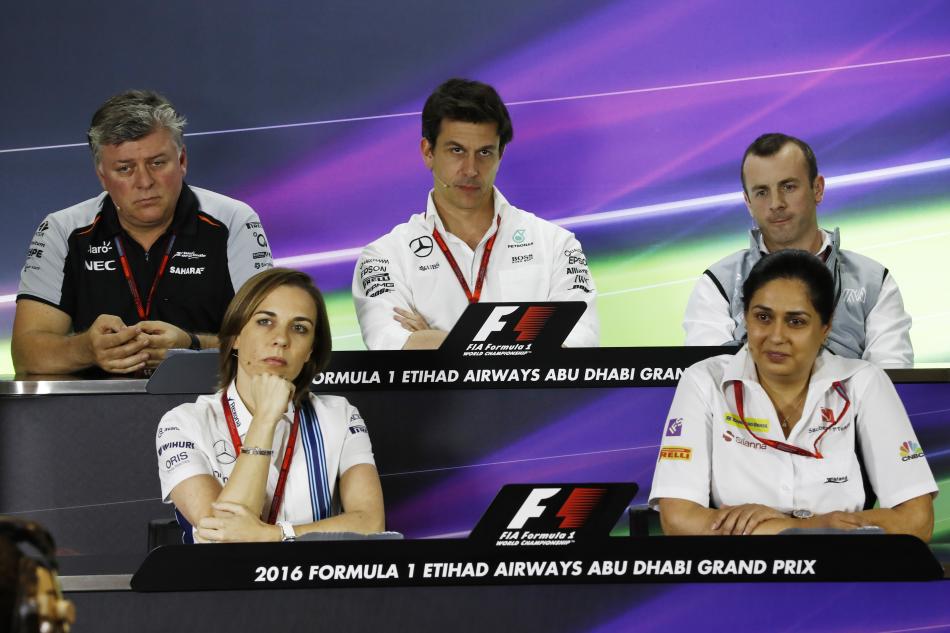
  • 2016 Formula 1 Abu Dhabi Grand Prix: Friday Press Conference

    2016 Formula 1 Abu Dhabi Grand Prix: Friday Press Conference

    TEAM REPRESENTATIVES – Toto WOLFF (Mercedes), Stephen FITZPATRICK (Manor), Otmar SZAFNAUER (Force India), Monisha KALTENBORN (Sauber), Claire WILLIAMS (Williams)

    PRESS CONFERENCE

    Q: Monisha, can we start with you? Congratulations on the points in Brazil. Describe the emotions and the reaction within the team?

    Monisha KALTENBORN: Well of course it was very relieving considering that it was a long race. You didn’t know are we really going to make it to the end with the points, because you could see how Manor was right behind us and it was so important that the car stays in the race and we could see other cars coming, overtaking us. Yeah, it was a bit of a nightmare. We were all extremely relieved. They are so important for all of us, these points. It’s not only financially, which of course plays a role, but also of course for the morale of the team. We didn’t want to end the season again like we did in 2014. So it was extremely relieving on the track and of course at home as well.

    Q: We had your driver Felipe Nasr, who of course delivered those two points, in the press conference yesterday. He says he hopes it’ll swing things his way. If you do confirm that 10th place in Sunday what does it do for his chances?

    MK: Well, there is no direct link there you know. We have our options, we are looking at them and we know Felipe very well. We’re just going to continue our assessment and when we’re ready we’ll announce.

    Q: OK, thank you. Stephen, coming to you, welcome to your first FIA Press Conference. You rescued Manor a couple of years ago from administration, what has team ownership been like in the interim?

    Stephen FITZPATRICK: I can recommend it to anyone. It’s been a fascinating two years. It has been exhilarating, races like Bahrain this year, obviously Austria and then Brazil. So lots of ups and downs. But also humbling I would say. Coming into this sport as a beginner let’s say, but as a lifelong fan, but new to the inside of the sport, you don’t quite appreciate just how many things you need to get right to bring two cars home at the end of a race and I’ve learned a lot about just how difficult it is to build a car, to race the car, to put the team together. So I would say I’m full of respect for the people around me in the sport, the other teams, the other team principals. It’s been a huge challenge, but also a little bit frustrating. One of the things that makes sport great is the belief that anything can happen and we didn’t come into the sport, or I didn’t come into the sport believing that we would win races or be on the podium in our first couple of years but to be in a sport like F1 you have to believe that incredible can happen and one of the challenges we have at the moment is that that sport has become very predictable. It’s a problem for all of us here, even Toto – who’s winning almost too much – and maybe it’s even becoming a problem for him. I think that’s one of the big frustrations and I think it’s clear that it takes a long time to build a great F1 team. We’ve made a big step forward from 2015 to 2016 but there’s a lot of work still to do clearly.

    Q: There are some stories in the press this week about your team being sold and you CEO appears to have confirmed it. What can you tell us about that?

    SF: Well, I can’t talk too much about the specifics but we have been in discussions with several investors, well, for the last six months let’s say. One of the things I was quite clear on, right from the start, was that I accepted that in the current F1, money equals performance, so anything that was going to bring more funding to the team and help the team develop and progress I was very open and if that meant bringing another investor, even a majority investor, hat was something I was happy to do. We have agreed terms with an investor at the moment and we are still working through that and I can’t really talk more about the specifics.

    Q: Thank you for that. Otmar, coming to you, another championship dogfight going on a bit further up the grid involving you. It’s looking good for beating Claire’s team to P4. How have you done it?

    Otmar SZAFNAUER: Well, we’re not there yet. We’ve got this weekend to go and we’ll work hard, as we usually do, to perform to the best of our ability and hopefully that will result in fourth place. That’s what we’re shooting for. But the building blocks have been put in place for the last five or six years, it’s not something that happens overnight. We’ve been working towards having a better team and a more performant car for a good six years and there’s a lot that goes in it: good decision-making; having the right tools and the right people, having the right engine partner – thanks for that, Toto – but also understanding the tyres, aerodynamically efficient car. You’ve got to do all those things and then the performance comes. Not to mention two good drivers.

    Q: Esteban Ocon joins you next year. It’s been a while since you’ve had a young driver, a relative rookie in fact. What are your expectations and why did you go for him over other candidates?

    OS: Well, we deliberated long and hard. We know Esteban and that helps. We ran him in two different tests and we were impressed with both his speed and his ability to learn, and also with his attitude to racing and his attitude towards learning and we thought he was a good fit for us and that’s why we chose him over some of the others.

    Q: Thanks for that. Claire, you’ve not been at a race for a while, we understand that you have been with your father. How is Frank?

    Claire WILLIAMS: He is good now, thank you. He is on the mend. It’s nice to be back at the track.

    Q: As we were just hearing from Otmar, it’s beginning to look like P4 is slipping away from you. How did that happen from your side?

    CW: I don’t think we’ve delivered where we needed to deliver this year, across a number of key elements. I’m not going to go into detail on the areas of weakness we have in the team this year, but we know where those weaknesses are and we just need to make sure that we improve upon those areas over the winter. But Force India have done a fantastic job. You asked him where they are where they are and they have just done a better job than we have and we need to look into that. We don’t want to finish fifth in the world championship. It’s a bit of a disappointment having come third in two consecutive seasons, in 2014 and 2015. We just need to do a better job.

    Q: With that in mind, tell us about your expectations for Lance Stroll, he’ll be joining you next year, he’ll be 18. After all for Williams to compete for third, fourth place in the championship, he’s going to have score a lot of points?

    CW: Yeah, he is. The Constructors’ Championship is really important for us at Williams and we need to have two strong drivers in our car. Obviously off the back of Felipe’s decision to retire we had a number of options available to us. Lance has been part of a development programme that we’ve run since about this time last year and I think that he’s absolutely proved that he has the credentials to come into Formula One next year and we’re delighted that we were able to make that decision. He has dominated in F3 this year and he’s won the F4 championship. He’s absolutely got the talent, we feel. As with any rookie when they come into Formula One you’ve got to give them a bit of slack in the beginning but we are going to have high expectations of him next year, but anyone that has meet Lance knows and understands that he deserves that promotion into Formula One and he’s extremely intelligent, he’s a very quick learner, we’ve learned that through the work that we have done with him in the ‘3-to-1’ programme, and he’s incredibly charming and I think he’s going to be a great addition to the paddock next year. I think it’s nice to see… as much as it’s sad to be losing a couple of the Formula One legend drivers that we have I think it’s going to be really exciting next year to have a number of rookies lining up on the grid.

    Q: Ok thank you. Toto, you win too much! For the second time in three years your drivers have a title showdown here in Abu Dhabi. How do you assess their mindset and I’d be interested to know how does it differ from the first time they were in this position back in 2014? How have they matured and matured in relation to each other, in their mindset and what you see this weekend?

    Toto WOLFF: Obviously the longer you work with each other the better you get to know each other and it’s the third season that we have had a car that was able to win races and win championships. I said it before, that in the last couple of races we had a great amount of serene… almost a serene environment. Very good for the team because they have worked together to make the car faster. Very productive and then it was very good for the dynamics within the team. Although, I must say that the championship was getting tougher and tougher for both of them. It was clear that they would be the greatest rivals for winning the Drivers’ title and we’ve seen that this weekend is somehow a bit different; you can see that there is pressure coming up, which I guess is pretty normal at this stage of the season.

    Q: Red Bull looked fast this afternoon and earlier on in the long runs, but I’m interested, has the gap really closed up at the back end of the season or have you just done enough to keep everybody at arm’s length?

    TW: We have seen over the last couple of races that the gaps between us and Red Bull and Ferrari have stayed pretty stable, for the simple reason that everybody must have switched off development of the 2016 car. Not all at the same time, there will have been teams that have done it sooner than others, but what you see now in terms of performances gaps or the difference in performance gap, is that somebody just gets it right on a particular track with a set of tyres, but generally it’s been on a similar level for the last, I would say, four or five races.

    QUESTIONS FROM THE FLOOR

    Q: (Andrea Cremonesi – La Gazzetta Dello Sport): Toto, you know what Lewis said here in the press conference yesterday about the mechanics, the book and so on. I would like to have your comment and that you don’t have any regret over that decision at the beginning of the season?

    TW: You know it’s always dangerous because there is one statement that is being picked out from a press conference between the two of them and as I said before I find it very remarkable how they’ve managed the relationship between the two of them for the benefit of the team, taking into consideration that it must be very intense and very high pressure for them. So that one comment was taken out and it is clear that if you change a crew that is directly involved with a drivers, such as mechanics or a number one that a driver constantly looks at when he’s pulling out of the garage, it can have a psychological effect and we acknowledged that and it was part of our thinking when we shuffled it around. But as a matter of fact we are 1,500 people in Brixworth and Brackley and it’s about developing personnel. Somebody who was working on one corner of the car today as a mechanic might be a number one next year, might be a chief mechanic afterwards and maybe has even more potential within the organisation. In a similar way we have done all through the organisation we are not keeping it static. It’s a dynamic structure and the same happens in the garage. This is a fact. I appreciate the effect on the singular driver and it was taken into consideration and maybe I’ll write a book in 10 years and we’ll put some things in there.

    Q: (Ysef Harding – Xero Xone News) To follow up on that question Toto. Isn’t it important to keep your number one satisfied and to give him the best of everything he needs to be successful – especially in the beginning of the season when he was aiming for a fourth world championship?

    TW: It’s very important. It is, in terms of keeping the performance up in the team, you need to consider what your high-performance need; what kind of environment they need, what kind of framework they need in order to perform best. And we’ve considered that. And there is not just one position like the chief mechanic that is important for the performance of the team and the drivers but we have to take decisions for many, many hundreds of people and develop them. It is our duty and obligation towards these 1500 people and the great brand to take the right decisions and not one single individual – although taking into mind what is important for the driver itself. What you are seeing here on the race track is the tip of the iceberg. And by the sheer nature there is a large block underneath that brings performance and has brought the team to where we are today. And part of that is to have the most effective organisation. Not only today but also tomorrow – and that is just part of the normal procedure.

    But if you knew that was going to psychologically affect your number one driver, why would you make that decision?

    TW: I’ve explained it to you already once before that weekend. There’s 1500 and we need to take care that these 1500 perform well. Not one. 1500.

    Q: (Jerome Pugmire – AP) Question for Toto. You said that the pressure is coming up. Just speaking about Nico, do you think that this season he’s been able to deal with pressure better and perhaps he’s a bit more focussed and blocking things out more than he was in the previous two campaigns?

    TW: Yes, he deals with it very well and there is nothing that somehow affects him. This is at least my impression. Whether it’s a difficult weekend, he has learned to assess it in the right way at the right time and move on – or whether it’s a good weekend, to stay humble, both feet on the ground and try to understand why that was. Whether spirits are high or spirits are down it was all pretty stable with him – and certainly, as far as I can see, that is one of the keys why he’s leading the championship today.

    Q: (Dieter Rencken – Racing Lines) Stephen, the Brazilian Grand Prix was obviously from a personal perspective, your own perspective, rather disappointing. Can you try and tell us exactly how you felt when you realised that the cost of this could possibly run to $13 or $15million and potentially even more in the longer term?

    SF: Yeah, I think the first reaction wasn’t really a financial one. It would have been a very exciting race and coming to the end of what was an exhilarating season, lots of ups and downs. We had held tenth place for, I think, ten races, Brazil was number ten and at many points during the race there were lots of different scenarios and there was a lot of furious calculations about finishing the race at different points throughout. The first reaction I had was one of real disappointment for the team. I think they’ve worked incredibly hard for the last, let’s say, 18 months since the start of last season without much reward and it looked like we were heading for a tenth-place finish which was a big step forward for us. So one of immediate disappointment for the team who worked so hard all year back at the factory and here on the circuit. But my next reaction was actually one of… I thought of the opposite feeling that must be going on in the Sauber garage and I thought that the guys in the Sauber team had been fantastic competitors for us all year, we’d enjoyed a great battle with them and I knew how much those points meant to the Sauber team and I was trying to imagine the joy they would be having and they worked so hard all season to bring it back in the end. So in the end I think the season doesn’t come down to one race. Obviously the way the points are structured that was a critical race for us. Very unexpected. But that’s racing. On that day it didn’t go our way but I think we all want to see more of that unpredictability, that excitement. So, in the end, it was a difficult night, let’s say, and then back to business.

    Q: (Graham Harris – Motorsport Monday) Question for Stephen again, and Monisha. Monisha, potentially for you, you could have tenth place locked in at the end of the season. Both teams, Monisha, you’ve got a new investor on-board already, Stephen you potential have a new investor on-board. Does the swapping of positions have any influence on the business decisions made. Obviously it’s more attractive for you Monisha but Stephen, does that put your deal in any particular jeopardy or is it going to hurt you financially? Things planned that you can’t do?

    SF: It doesn’t help financially but the terms of our agreement have been… refinalised, let’s say. It was clear that in tenth place with one point on the board, two races left, that there are lots of scenarios and you plan for those in advance, so, from my point of view it’s disappointing but it’s not unexpected – or at least not a surprise.

    Not a deal-breaker?

    SF: Not a deal-breaker. And, most importantly, we’re not finished yet. We’re looking good today, at least, on Friday, so we’ve still got one race left.

    MK: Well, in our case, the investors came in at a time when we were on P11, so the risks were very well known. So the risks were very well known. And of course we said we are going to do all we can to actually still get to P10. So, it looks better if you end the season, of course,  on P10, that’s clear – but there’s not any other impact.

    [off-mic follow-up] adding more staff?

    MK: Well no. As I said, with the investors we have, our future is secured. There’s nothing out there that would cause us any dramas like in the past – but you simply look better if you have our business case and if you have that additional funding it’s just easier to achieve what you want in your business case.

    Q: (René Hofmann– Süddeutsche Zeitung) I wanted to ask all five of you, concerning the upcoming season: what the rule changes mean for your particular team, what are your hopes, what the challenges you’re facing?

    OS: Well, for a team like ours it’s a big challenge, starting over without any carryover parts whatsoever has a massive impact on us – so it’s a big challenge. We also don’t have some of the infrastructure in place of the bigger teams. We source a lot of our parts to suppliers; we don’t make them ourselves – so that adds extra time. So yeah, it’s a big challenge. Our hopes are we’ve done a good job and others have screwed-up!

    Claire?

    CW: We hope the same! That everyone else has screwed-up as well. No, y’know, for us, fortunately we’re in quite a comfortable financial position at the moment and with the regulations coming out when they did, we were able to start development work on next year’s car pretty early but that’s not to say we know where our performance is. Nobody does until we get to the first test and probably not until we get to the first few races where we know where everybody shakes out. But I think it presents a great opportunity for Formula One to potentially shake up the order. I hope that we’ve found something spectacular over the winter. I know that the guys back at the factory have worked really hard on next year’s car to try and find that performance and improve upon where we finish this year’s championship next year. But I think we just have to wait and see. For the sport, I think it’s pretty exciting.

    Monisha?

    MK: Well, we share that hope as well. We know that we have to take a very big step ahead so we see these rule changes as an opportunity because we want to be back next year in the midfield and we now also have the means to do that. Overall, we do hope that it’s going to make the sport exciting. I think everyone’s been quite critical about certain things which have been introduced so let’s just hope and see if it really mixes up the grid and we have something different next year.

    Stephen?

    SF: Well, interestingly in 2016 we had to build a completely new car: Manor didn’t build a 2015 car because of the administration, so we feel that we’ve been through this already. There was such a big gap between where we were in 2014 and the other teams this year, so we’ve had to make that big step already. I gave the team quite clear instructions this year they were to focus as much of their efforts as possibly on the 2016 programme until we were able to put some points on the board and try to secure tenth place. From Austria onwards the team have been working exclusively on the 2017 programme, so there’s been a lot of work gone in. We’ve really built up the resources of the team this year, we’ve moved to a great new facility; the wind tunnel facility at Mercedes and that’s led to a big step forwards in our aerodynamic development. So the team are hopeful. The thing I guess I’m not really hoping for is that everyone else has screwed-up, because like I said, I’ve developed a lot of respect for all the other teams and I think that might be too much to hope for. It’s certainly going to be a very interesting 2017 season.

    Toto, you pick up where you left off do you, next year?

    TW: Yeah, I tend to go with Otmar! Honestly, we weren’t big supporters of a regulation change. Not because we wanted to freeze the current situation. It’s clear that when regulations stay stable that eventually performance is going to converge. But because we weren’t sure that it is the right way for Formula One. But as it is, we are where we are and the cars, certainly in the wind tunnel, look very spectacular, very wide with the big tyres and I am personally very excited to see them on track for the first time. For the drivers it will be much harder; the cars will be pulling more g through the corners. The simulations that we have seen are very exciting. The corners will be flat that are far from flat today – and we will be breaking records in terms of lap time. So, I guess, an exciting season that will be ahead of us. I hope that overtaking is not going to be too difficult because of the width of the car and the dirty air behind it – but let’s see. In hindsight, now that we are where we are, we have to do the best out of it.

    Q:  (Andrew Benson – BBC Sport) Stephen, when this investment deal happens, will you still be involved and/or in charge? Is it a buy-in or a buy-out?

    SF: I’m not going to talk anything about the specifics.

    Q: (Dieter Rencken – Racing Lines) To Toto specifically but if the others would like to join in please feel free. Toto, you’ve been on the strategy group since its inception basically. Do you honestly believe that it best serves Formula One’s interests? At the latest one, for example, I believe the teams on either side of you put in certain proposals. These were blocked before they could even reach the Formula One commission so therefore they can’t be voted on properly. Does this really work and is there an alternative to this because there’s been an awful lot of criticism about the group?

    TW: You are a number one fan of the strategy group, we’ve found out. It is what it is. In Formula One, the difficulty is that every team has got to have an opinion and it is very much focused of course on your own performance but then we are responsible enough, within the group, to take into consideration what’s good for Formula One and most recently I’ve seen a development that even within the very big rivals on the strategy group and in the F1 commission there is consensus and we’re trying to seek consensus. Some of the things are not being accepted or not voted on. You refer to two specific proposals which, with all due respect to my friend Otmar, were on the agenda half a year ago. They were referred to the technical regulations meeting, so the competent group, not the dangerous group! The competent group decided that it was not the right way forward and for whatever reason these regulations appeared back on the agenda on the strategy group and this is why it was voted against, that is the fact. But that governance is in place until 2020 and if there is a possibility that we can improve it next time around in order to better the approval process, I’m the first one to vote in favour.

    SF: I never attended this strategy group. I have no idea what happens in the strategy group but I joked earlier on that Toto and Mercedes were winning too many races and maybe it’s been a problem for him but really I know that the Mercedes team is a fantastic organisation and has earned these victories but the sport is not a level playing field, that’s pretty obvious and the structure of the F1 commission and the F1 strategy group is part of that bigger picture. And I think the sport will be much improved and speaking now, as the eleventh placed team this weekend, I know that it’s obviously what I will be saying but the sport will be much improved with a leveller playing field and how that comes about and all of the necessary components – whether financial, organisational, structurally – I think it’s something that should be looked at for the benefit of everybody on the grid but it’s a very complex picture.

    Q: (Jerome Pugmire – AP) Toto, there have been some stressful moments this season. If you were to give your podium of the top three between the first lap incident in Spain, the last lap in Austria and the engine failure for Lewis when he was about to win, which is the one-two-three for you?

    TW: You mean number one is the worst one? Shall we start from the back? Third place, for me, of the worst races is certainly Lewis’s engine failure in Malaysia because it heavily influenced his championship.  He was in the lead, solid in the lead in a race – in races –  where it was going back and forth with Nico. Nico had a great race in Singapore which he dominated. Then Malaysia was very much Lewis’s weekend and it continued that way in – what was the next one? – Suzuka, Mexico. So that’s third place – and it came out of nowhere, really, so still a bit of a traumatic race. Number two? Barcelona. It’s rare that you have a complete wipe-out, one and two in the front and you end up with zero points and for the team, obviously not a nice situation. We stood in front of the screens… I remember, I had the CEO of Daimler, Dieter Zetsche, next to me and he says ‘what are we doing now?’ which was a new experience. But it was OK because it didn’t happen for a long time, since Spa 2014. So number one, for me, the worst, was Austria because it came a couple of races after Barcelona. We made it very clear that we saw Barcelona as a one-off and wasn’t acceptable going forward and here we go, we’re on the last lap of that particular race at the Red Bull-ring, home turf for our great rivals and we nearly lose both cars on the last lap, being in one and two. This is where, for me, the mark was over-stepped and we made that clear, but that was my winner. Not.

    Q: (Dan Knutson – Auto Action and Speed Sport)  Monisha, Banco do Brasil announced today they will not sponsor Felipe next year. How much of an impact does that have on you deciding if he remains with the team?

    MK: Well that’s correct that the bank informed us as well that they’ve interrupted their 2017 sponsorship programme. Our seat is still open. We aren’t choosing that in our assessments we’re making and that’s all there is to say of it.

    Q: (Dieter Rencken – Racing Lines) On that vein, Toto, your driver Pascal Wehrlein, Mercedes driver, has basically only got one chance left for a seat next year. Could you see him actually racing in a car with a Ferrari engine?

    TW: It’s two, two chances.

    Q: (Dieter Rencken – Racing Lines) Yes, but then you’d have to provide a budget, wouldn’t you?

    TW: First of all, I must say, really, having had the opportunity with Esteban and Pascal in Manor was great and the development slope of that team is impressive and it’s a great place for both of them and Manor is still very much an opportunity for next year. Well obviously Esteban is going to Force India and we are in discussion with Monisha and in discussion with Stephen and his management group and nothing is decided yet. That’s where we are.

    Q: (Andrea Cremonesi – La Gazzetta dello Sport)  Toto, do you think that at this moment Lewis Hamilton fully trusts your team or if not are you doing something to rebuild the relationship?

    TW: Absolutely trusts. We under-estimate the pressure under which these guys are, not only in the spotlight of a global audience. You have to deliver every single weekend, you have to race your teammate, it’s down to the last race to win the championship and it’s all coming up, all the frustrations and all the happy moments. If a microphone is being put under the nose and you’re being asked the right question, sometimes it produces a good headline like it did yesterday. For me, it’s a bit of a boomerang which keeps coming back, this odd story which internally in the team is a closed chapter and we will not come back to this so it doesn’t change anything in my approach to Lewis or an approach towards Lewis because I think it’s well understood that things are sometimes taken out of context, sometimes over-exaggerated and as I said before, sometimes you just need to allow that the drivers can express their feelings and their emotions. We don’t want to streamline them too much.

    Q: (Ysef Harding – Xiro Xone News) Claire and Monisha, we’ve seen a lot of history for women this year. We saw the second female prime minister elected and we also saw the first female elected for president of the United States. As two pioneers in this sport, what are your hopes for the future for women on the business side and on the track in F1?

    CW: That’s a nice question! I think what you see across probably a wide variety of industries in recent years and particularly what you see in the UK with Theresa May coming in as our first female prime minister for – what is it? – three decades I think,  that the landscape is shifting slowly but surely. I think there is a lot of work to do but personally – I don’t know what Monisha does – but I go out and do a lot of talks about women in industry and promoting females in not just leadership roles but throughout different sorts of organisations and I think that’s really important and I think one of the things about Formula One that you don’t necessarily…  yes, you see Monisha and I in the roles that we’re in but there are so many women now who are working across different areas within Formula One, across different disciplines within teams, whether that be in aerodynamics, within engineering, not just the traditional marketing roles and I think that’s a really important shift that we’re seeing in our sport and I think that that can be used as case studies and great story telling, to go out into different businesses because I think if you can be a woman and do well in Formula One.  I think that’s a very powerful message but personally for me, it’s not necessarily about gender and it shouldn’t be about gender I think. But every individual brings different personalities to the roles that they do and particularly in a sport like this, where you have to operate at your peak performance if you’re going to be successful and achieve and that’s what every team is going after, it’s the people who are at the best at their jobs. If they’re going to win in this sport then it shouldn’t necessarily be about gender, it should be about how good you are at your job and how committed and dedicated and what you can do, the team around you. But I would like to see more women come in to Formula One and I would like to see more women come into industry as a whole. I think it’s a really important conversation that we’re having in society as a whole at the moment.

    MK: Yeah, like Claire said, you see that there are far more women in Formula One. It’s been happening over the last few years, actually, where you simply see more on the track. I think the most important responsibility we have here is to actually encourage people to give women the opportunity, because that’s what it’s about. You have enough women out there who have the education, who have the competence and the confidence to actually get the job done at least equally as good and usually they have to be a little bit better to maybe get the same kind of recognition, so what you really need is to give women a fair chance and opportunity.

    Q: And it was a woman in charge of strategy in your team who played a part in bringing you the points in Brazil, right?

    MK: Absolutely. We gave one a chance.

  • 2016 Formula 1 Brazilian Grand Prix: Friday Press Conference

    2016 Formula 1 Brazilian Grand Prix: Friday Press Conference

    TEAM REPRESENTATIVES – Christian HORNER (Red Bull Racing), Maurizio ARRIVABENE (Ferrari), Paul HEMBERY (Pirelli), Monisha KALTENBORN (Sauber), Guenther STEINER (Haas), Frédéric VASSEUR (Renault)

    PRESS CONFERENCE

    Christian, can we start with you: just looking at the track action that’s been going on today, the long run pace obviously looks quite close to Mercedes, but is it really that offers you the chance to fight for victory, or can you be a little more optimistic after today?

    Christian HORNER: Well, I think under normal circumstances the usual business will happen. Mercedes have been the dominant force all year and there’s no reason to expect any different this weekend. But, race pace over the last few race, on a Sunday we’ve managed to get close to them particularly their tail car. Perhaps with a little bit of weather… there are some unpredictable forecasts over the next few days and opportunities can hopefully present themselves to put a challenge on.

    Either way, there is a pretty good chance that you are going to wrap up second place in the Constructors’ Championship this weekend. Given where you’ve been, in transition from 2015 to 2016, does that constitute a success?

    CH: It would represent an enormous achievement for the whole team. We came into the year thinking, ‘you know what, to get into the top five will be difficult’. But the guys have produced a great car. The people at Renault have done a good job with the engine over the winter. Our season has just grown stronger and stronger. To be sitting here having achieved 14 or so podiums, two grand prix victories, Max’s first victory in Barcelona, Daniel with a one-two finish in Malaysia and to be sitting here ahead of Ferrari on points and the nearest competitor to Mercedes represents and extremely impressive season for the whole team.

    Maurizio, what about your side of that story: the battle with Red Bull. It’s not the team you set our to be battling against this year in the world championship but how and why did they get ahead of you?

    Maurizio ARRIVABENE: I think first of all we need to take into consideration… it’s not an excuse but it is circumstances that happened where we lose position on the grid and you know when you start a bit in front the story is going to change. Having said so, they have a strong reaction, as Christian said, and we are below of our expectation. By the way, as I said many, many times, we are not giving up here and not either in Abu Dhabi. I know it’s tough, but the championship is still not finished.

    Now you told Sebastian yourself, personally over the radio in Mexico, to “calm down”, quote-unquote, and he admitted sitting here yesterday that he did lose his cool in Mexico but he said it was not down to frustration, so how happy have you been in general with his performance?

    MA: I have zero problem with Sebastian. I mean, as I said many, many times, Sebastian is quite emotional. Sometimes he looks a bit more Latino than German. I think Christian knows the matter like I do. He’s very emotional, he’s very passionate, especially when he’s driving and it’s in a racing battle. It’s not a question of frustration. Sometimes he can be unhappy as we are unhappy because our expectations are different. But he’s not a guy who is giving up; he’s a guy that is pushing like hell. Sometimes when the adrenalin is going up to the sky, maybe he’s choosing a word more than what is expected, but then my role, like in Mexico, is also to call him and to invite him to be focused on what he’s doing.

    Paul, you brought soft and medium again this year to Interlagos, but also the hard tyre. It’s quite an unusual move, only the second time this season you’ve brought a harder tyre than the one that came last season. How’s that looking?

    Paul HEMBERY: Well, you wouldn’t want the supersoft here that’s for sure, so it sort of chose itself from that point of view. The soft tyre is suffering. It’s hot, an aggressive track, high wear, so it’s pretty much as we expected, but that was the majority choice as well of the teams.

    Important test coming up for you in Abu Dhabi. Can you give us a preview of what to expect and a general overview on progress, where you are with next year’s tyres?

    PH: Well, we’re clearly homing in on final solutions now. There are still going to be a lot of combinations tested next week in Abu Dhabi. Still some compounding work, we’re still working on some internal aspects of the tyre but we’re progressing as planned.

    Fred, coming to you, you’ve retained Jolyon Palmer for 2017 to drive along Nico Hulkenberg. What were the reasons for that and what do you expect from him in his second year?

    Frédéric VASSEUR: First we had to secure the first one. It was done with Nico around Suzuka, something like this. Then we were able to postpone a little bit the decision. If you have a look at the last event, I think that Jo did a very good job; he is improving. If you have a look also to what he did in the past in the junior series he was always able to improve step by step, year after year and we took the decision to move forward with Jo and I would expect that he will have the same improving curve that he did in the junior series and it will be good.

    Now, a lot hinges for next season, for you team and for Christian’s team, on the Renault engine taking a decent step. So will it?

    FV: I hope so! It’s in the pipe… I think Christian also thinks so… no, no we are working on the project of the new engine and I think everything is going well so far and we will see in Barcelona.

    Guenther, coming to you and continuing on the theme of the drivers, Esteban Gutierrez has said on social media this weekend that he is leaving your team and there are strong suggestions that Magnussen will be leaving Fred’s team to come and join you. What’s most important for you over the next couple of years? Is it to have consistent drivers that you can work with to develop the team and the cars or would you look to bring in an American or a rookie? What’s the most important thing?

    Guenther STEINER: I think the most important… just if somebody hasn’t seen the press release, it just came out maybe 10 minutes ago, we confirmed that Romain and Kevin will join us next year, that just came out 10 minutes ago. We want to grow the team and therefore we wanted some experience of drivers that have been on the podium and that have scored points and Kevin was fitting the bill, therefore we moved forward with him. I would like to take this moment to thanks Esteban for what he did for us over this year. I think he has got a good future; he did a good job and whatever people say he is a good driver. He helped us develop the team from nothing to be where we are so thanks a lot to him.

    Q: The Ferrari partnership has obviously got you started in 2016; you’ve scored plenty of points but as you now move forward, are you now looking to build your own capability in the future to be able to take control of your own destiny.

    GS: No, we have a long-standing contract in place with Ferrari that we can continue the business model we are doing. We are going forward like this for the next few years and then we see, we rethink. But at the moment we are very happy with Ferrari, what they did for us over the year to get again to the point where we are now. Hopefully we finish eighth if Fred’s team doesn’t pull out something very special, and we hope we move up next year. But in the moment, for sure you always develop your team and you keep on getting better and more people in and that will happen – but in general it stays like we are now.

    Q: Coming to you Monisha, staying again on the theme of the drivers, the other teams clearly as we’re hearing have been tying down their drivers and making their announcements, just a few moments ago in the case of Haas. You did yours here a couple of years ago I think. How far off being able to do the same thing are you and should we expect any changes?

    Monisha KALTENBORN: Well we are still in the process of analysing our options but it’s not going to take that long any more. We still have the target that we do want to announce in the season, so there’s not that much time left. So that’s all I can tell you now.

    Q: Jörg Zander has returned to the team. How had he benefitted from his years with Audi in particular and what will that bring to your team?

    MK: Well, we know Jörg Zander for quite a while. He was the chief designer in our team earlier and now, as we decided to actually take up a technical director again it was quite an obvious person to look at. He’s been working at Audi for very long, he has a lot of motorsport experience now, inside Formula One, outside Formula One, so we do think he fits in very well with that because we also have third party business outside Formula One. I’m sure he’ll bring many new ideas and the team can only benefit from that because we are now in a new era, you know it’s a new chapter in the team history and this kind of influence and these ideas will only be beneficial to move into the right direction.

    QUESTIONS FROM THE FLOOR

    Q: (Alessandro Giannini – Agência O Globo) For you Monisha, I would like to ask you a direct question about Felipe. How are the talks with him and if he has one chance to stay at the Sauber team?

    MK: Well, Felipe is certainly one of our options, that’s clear, we know him well, we know his skills. We’ve had a lot of experiences together with him: good ones, bad ones, so we can assess him very well. So talks are taking place, that’s what I can tell you.

    Q: (Andrea Cremonesi, La Gazzetta dello Sport) Question for Maurizio, yesterday you present an appeal now for the podium win in Mexico. I would like to know some more details, when you find out the new elements. If you can give us some more details about which are these elements.

    MA: Yes, if we present according with the International Sporting Code Article 14.1, we presented new elements, of course, as we said, what we think are new elements and we have the right to present it. If you want me to present all the elements here, is not something that I’m going to do because in 40 minutes we have a conference call and we have to discuss the matter. I think it’s not correct to share this kind of information here.

    Q: (Dieter Rencken – Racing Lines) As the previous question proves, there’s been a lot of controversy about the regulations etc and Christian, you and Maurizio have been particularly outspoken about them. You’re both members of the Strategy Group: would you like to take them up in the Strategy Group. Would you like to take them up in the Strategy Group? What would you like to see changed? And if anybody else would like to comment, feel free, please.

    MA: Back, if you refer to Mexico and many other races, I think, I understand the difficulties of the stewards because sometimes they have to take a decision immediately and to take this decision they need to collect in quick time all the available data and material – and it’s not an easy job, I think. That is further complicated by what we said many, many times at the strategy group level about sometimes the complication of the regulation. We ask many, many times to try to find a way to simplify the rules, so I think this is something that we need to think further for the future, making sure that we don’t have a Rule A that is covered by the Rule B that is covered by the Rule C and D and E and F and so on. If there is a rule it is A dot. And then we go to the B. I’m expressing my thought with all the respect for the people that is making the rule. But I think this sport, it is already complicated in terms of technology, in term of what we have to do to build-up the car and to make competitive the car. I think simplifying the rules could be a good help for everybody.

    Christian, your view.

    CH: Yeah, I think that we’re over-regulated in many respects, that the drivers need to take a rulebook with them really on a Sunday now in the car and consult it before they either defend or make an overtaking manoeuvre these days and there’s too much subjectivity and interpretation of different events. So Lewis Hamilton going straight on at the first turn last weekend, comes out half a kilometre up the road, is that an advantage or a disadvantage compared to Max going off and coming back in the same position he went off with, with dirty tyres later in the race. It’s very difficult for the teams, for the drivers and one can only think for the viewers as to what’s permitted and what isn’t. I think, like all things in life, keep it simple. Keep it straightforward. I’d say less rules in terms of… but more clarity in terms of what the rules of engagement are. Nobody wants to see dangerous driving but let the drivers race, let them go wheel to wheel. I mean everybody’s talking about the last five or six laps in Mexico because, let’s face it, the rest of the race was pretty boring. The last ten laps were fantastic and of course there’s been a whole bunch of discussion about it since then and that’s what Formula One needs to be and I think let’s avoid the situation that drivers can cut corners and gain an advantage. Put a gravel trap there. Put something to slow the cars down, and then it takes that subjectivity away from stewards having to interpret ‘well, is that result different to this one. Is that incident different to that?’ We can see so many examples of that that I think for the teams, for the drivers and most importantly for the fans, let’s come up with something straight forward and simple that’s easy to understand and interpret.

    Monisha, do you agree?

    MK: Well I agree with that but I think there’s another element to it which is how you actually apply the rules, and you would need to try to bring some consistency in there. At the end of the day it’s always up to an interpretation, it’s up to the discretion of the people who are doing it, so apart from making things simpler it’s also that you try to have consistency on the people. That you have somebody who is always there, or a group of people because this is how you will bring in certain consistency on how rules are applied. So I think you have to look at both sides: look at the rules themselves but also how they are implemented.

    Fred?

    FV: It’s not an easy point and to know if we are to take the decision during the race or not, the first one is that you will always have someone to complain: that if you take the decision during the race you will say that OK, the steward has to take time before to take a decision and, if they take the decision after the race, OK you will affect the results of the race, after the podium and so on. But for sure we’ll have always issue with the chicane and probably the only solution would be to do all the races in Monaco but even Monaco will be tricky. The solution to slow down the car when they cut the chicane would be the best one to be sure. We have to find a solution that the guy will be directly penalised, that will avoid discussion and the stewards and so and so and so because it will be always the same mess after the race.

    Final thought on this Guenther

    GS: I think everything was said. I think I’m good, y’know, they all spoke and I agree with all of which was said. It’s just to try to simply what we are doing.

    Q: (Silvia Arias – Parabrisas) Maurizio Arrivabene, just two days ago Bernie Ecclestone said that in his opinion maybe the problem with Ferrari not winning races is because it is 100 percent an Italian team. I would love to know if you agree with that and in which way the passion which we know the team has and which we know is fantastic is a handicap for your work?

    MA: First of all, we all know Bernie. The day after he said the opposite and he also came to me to explain himself without being requested to do so. If I’m not wrong, it’s said that I need somebody nearby me to help. I don’t need it. I’m part of the Ferrari racing department and I have hundreds of people who are nearby me. We have a new technical group led by Mattia Binotto. They are enthusiasts, they are working very very well. So we have a team. In terms of the passion, I was always passionate about Ferrari, all my life, I have to say, even before doing this job and Ferrari is about passion, it’s about emotion. When I’m at the factory and I cross the street to go in the GT department and I’m looking at new GT cars that are coming out from the factory, for me it’s a big emotion. And this is something that is not a handicap, it’s a dream.

    Q: (Andra Cremonesi – La Gazzetta dello Sport) Maurizio, it’s about the arguments of the last Grand Prix. Have you talked to Sebastian, have you tried to make a different approach for this Grand Prix, even because the FIA said they will not forgive another situation like this in the future?

    MA: Listen, first of all I think… I don’t know if you know but Sebastian asked… he excused himself in writing with Charlie and the FIA and the FIA responded to Sebastian in a way that we really appreciated. I spoke every day with Sebastian, and not only after the Mexican race. Somebody maybe thinks we have tension or things like this. No, we are honest  with each other. The word honesty must sometimes be put in the script or in the article, because we have an honest, open, straightforward relationship and if you are asking me, we are always in agreement, like all human beings, sometimes yes, sometimes no. We have a fantastic relationship and it’s based on an honest, day after day feedback. I respect him as a driver, he was four times World Champion. He’s putting all of himself into the job that he’s doing. A couple of months ago, I said sometimes even too much but it was not a criticism. I want to make it clear, once and forever. It’s because he’s putting all of himself – he tries to put all of himself into everything he’s doing and sometimes you just have to say, like in Mexico, ‘hey Seb, calm down, head down, look in front of you and push.’ And there’s nothing wrong with that so you ask me, you can ask him and you have the same version.

    Q: (Dieter Rencken – Racing Lines) I’m not Italian but the question’s for you, Maurizio, and I’d like to refer to yesterday’s teleconference call by your president to investors after your Q3 results. One of the things that Mr Marchionne didn’t do is rule out Ferrari possibly going into Formula E. And the second thing is that he said that Ferrari can’t continue throwing money at Formula One, which would indicate that the investors are starting to seek more value for money. How do you feel about these two comments? Could we see a red Formula E car and how do you see this for Ferrari’s future, that just maybe investor pressure could turn Ferrari away?

    MA: The strategy in terms of investment at Ferrari is not under my responsibility. Formula E, I think Mr Marchionne was very very clear, at the moment it’s not in the programme of Ferrari. If we’re talking about hybrid, we have Formula One, we are building up our experience in Formula One on that side. We could be but it’s not up to me to decide or to indicate the right strategy but Formula E, I don’t think so.

    Again, it’s not my responsibility to talk to the investors. I can talk about the word pressure. Everybody is talking about pressure when they are referring to our job and everything we are doing but there’s nothing strange in that. If you are working  in a team like this, the day that you sign a contract you know what you are doing, you know that the sport is pointing at you because we are Ferrari. Sometimes I am hearing ‘are you guys under a lot of pressure?’  It makes me laugh. So what, it’s expected when your name is Ferrari

  • 2016 Formula 1 Hungarian Grand Prix: Friday Press Conference

    2016 Formula 1 Hungarian Grand Prix: Friday Press Conference

    TEAM REPRESENTATIVES – Rémi TAFFIN (Renault Sport), Monisha KALTENBORN (Sauber), James KEY (Toro Rosso), Pat SYMONDS (Williams), Jock CLEAR (Ferrari), Guenther STEINER (Haas)

    PRESS CONFERENCE

    Monisha, if we could start with you: a very positive news story both for Sauber and for Formula One following the buyout of the team by Longbow Finance. Can you tell us a little bit more about the new owners? Who are these people who have bought one of the most prestigious brands in Formula One?

    Monisha KALTENBORN: Well, Longbow Finance is a Swiss company. They have been active in financial investments for more than 20 years, from Switzerland. Their operation involves, well typically private equity investment for international client and of course investment portfolio management.

    So when are we going to start seeing the benefits and when are you going to start seeing the benefits of the buyout – something this year?

    MK: Well, we are working on that, but you know these things take time. We have had a rough time these past few months and the first target of course of the new owners is to stabilise the entire group. So you have to settle matters and then of course, again, to get back to your business as usual to have then a basis for being competitive. I’m sure we’ll have a few things still coming up this year, I mean we still have a few things to do, we don’t want to end up where we are, but of course we are focusing more on next year and there I am very confident you will see a lot more.

    Thank you. Guenther, coming to you, we’re half way through your first season in Formula One, can you just give us a half-term report? How do you feel it’s gone?

    Guenther STEINER: I think it has gone pretty well. I would just like to take this occasion to thank Gene Haas for the trust he has put in all of us, you know that we can come here, because I think the Haas story, an F1 team from America is good news, like good news that Sauber found an investor. Back to where it has gone, we had a very good start, for us, sure some people might think differently, if you are Mercedes or Ferrari, but we are very happy. Then we had a bit of a downturn, which wasn’t massive, I mean we still finished 11th. We finished 11th three times, so we were almost there but not really there. But we got back. The team has grown a lot in these 10 races up to now, if you saw it in the beginning. I wouldn’t say we were bad in the beginning, but if you are new it take some to gel and we always knew this and maybe we were lucky to get these points in the beginning because it gave us confidence, we knew where we were, that the car is good or that it is decent and we were building on it. And then when we had the four races where we didn’t score, we didn’t lose our head or get nervous. We just kept on working, we said “we know we can do it, we just have to do it again”, and I think we did it again, we finished eighth and then in Austria we finished in the points again, so all in all, very happy. Now we are at the point where we look to next year, well we started before now to look to next year, but now it’s full steam ahead on the new car and the race team is just getting better and better because they learn more and more every weekend. We are getting more people in on aero development for next year because we want to be even better next year. I hope we can achieve that. Everybody in the team can be proud of what they achieved and I would like to thank everybody in them because they worked hard because the first three races weren’t easy. They were difficult for everybody. People worked day and night. But they pulled through and now we are where we are, we’ve got 28 points and we are proud of them.

    You say the team is growing, you’ve got more people in the aero department, what about the infrastructure in Banbury? Do you feel confident enough to take on more of the manufacturing of next year’s car in-house?

    GS: No, that was never our plan. We continue a few years like we are. We want to grow in a few areas like race engineering and aero development, but design staff and manufacturing we don’t want to take, because we don’t want to get distracted. I think our principle works – to buy as much as we can from somebody else. We want to keep doing that because there is not a lot in it if you go to do it yourself, not a lot of speed we think is in it in the car. We would just distracted we don’t want anything of that to happen, so we keep on with our business plan, as we set out in the beginning.

    Thank you. James if we could come on to you please. An impressive double points finish for the team at Silverstone. Do you think you pre-season target for the season of fifth in the Constructors’ Championship is still on? Can you catch Force India?

    James KEY: Well, we’ve got a long way still to go, so you’d hope so, we’ve done just about half the season so far. Force India have done a really good job recently and they’ve made the most of some good opportunities, where perhaps we haven’t. We’re not happy with the number of points we’ve scored. We’ve got developments to come to the car, which could give us a chance later in the season, so there’s more to come from us. You clearly can’t give up in the middle of the season; you have to keep pushing. I know a bit of a gap has developed, that was really only made over a couple of races, a couple of big scoring races for them. So the same has got to happen for us to close up, so we’re not going to give up on our chase but it’s not easy.

    You say you’ve got some chassis developments coming but there will be no power unit developments because you’re using the year-old Ferrari engine. How much of a frustration is that for you now?

    JK: Well, we knew it was going to get more and more difficult as the season went on. The pace of power unit development has continued at a pretty high level. It was never an advantage for us to have an established power unit but one that was a year old, it was always a disadvantage – that’s no disrespect to Ferrari, but clearly they have made good steps on their own ’16 unit and we’re not benefiting from any of that. So it’s deeply frustrating really, but we knew what to expect. We have to try to compensate with chassis and make better use of our opportunities.

    Thank you. While we’re on the subject of power units, Rémi, if we could turn to you please, how satisfying has the development of the power unit been, given where you were a year ago?

    Rémi TAFFIN: I think it only be a good satisfaction, because where we were coming from was a difficult year last year and now we can see the improvement on track and everything we got out from the factory to the track was working well, so that was a good step forward, either first race or actually Monaco/Montreal specification we introduced. It’s all working well. I just have to say we’re on it, but we have a good way to go.

    What’s next on the roadmap fro Renault? When are we going to see the next upgrade?

    RT: I think it will be next year. The big step we will have will be next year’s engine, race one. Until we get to the end of the season now we will be working on the specification we have now, trying to extract the most out it, but there won’t be any more let’s say big step as we had for race one and six.

    Thanks. Pat if we could turn to you now please, it’s been a difficult year for Williams, not least in Austria and Silverstone, the last two races, two tracks where you went so well in recent years. Have you discovered the cause of the problems at those two tracks? Were they track specific or was there something more serious at hand?

    Pat SYMONDS: Well, I think we’re getting on top of it. It does seem that Canada was a long while ago – we were on the podium there – but it was only five weeks ago. But three races since then, Baku, Austria, Silverstone, and I feel in all three of those we haven’t performed in the way I expected to. S we are looking into it. We are looking at various things that we have introduced. We’re making sure that we understand them; that’s a process that’s been going on even today. But it’s quite an intense period, you know. Over a period of just five weeks we’re actually doing four races and one test – five events in five weeks. It’s hard to catch your breath when it’s going at that sort of pace. But I’m pretty confident we’re getting on top of things. We had a good day today. I was pleased with how it went, particularly on the long runs, and I think we’re getting back where we should be.

    Where’s the focus in Grove now, is it on 2017? Do the 2017 technical regulation changes come at a good time for you, a chance for you to press the reset button if you like?

    PS: Well, they come at the same time for everyone. We all have equal opportunities and I really do regard it as an opportunity. In answer to the first part of your question, we’re pretty focused on 2017 now, as I’m sure all the teams are, because there is so much work to do. There is so much to be gained in the early part of the learning curve that you can’t afford to leave things too late. It makes it quote challenging of course. If you are in a fight in 2016, as indeed we are, but you’ve still got an eye on the future, you have to balance things pretty carefully. But of course not all development is aerodynamic and while the wind tunnel is pretty devoted to 2017 work, there are other areas where principles do carry over, so we’re still carrying on in those areas.

    Thank you, Pat. Jock, turning to you: like Williams, Ferrari hasn’t been able to maintain the momentum it built up towards the end of last year. Why is that? Are you simply losing ground in the development race or are there more fundamental problems than that?

    Jock CLEAR: Firstly, apologies for keeping everybody waiting. I don’t thing we feel that we are losing a huge amount of ground if you see what I mean. From my point of view I have recent knowledge of the opposition and a huge respect for what we are trying to beat effectively. Our performance has come under a bit more scrutiny now that Red Bull are putting us under pressure, but again that is a testament to how strong they are as a team. We haven’t lost a huge amount of ground to the leaders. If you look at it over the course of the last couple of races, in Canada we were very close and in Silverstone we were a long way off. I think we have learned a lot about some of the areas where the car is weak and that has helped us to identify where we need to work and we are under no illusion that Mercedes are going to continue to be strong and Red Bull are going to continue to be strong. All the teams are working hard. It’s the ongoing challenge. We are working as hard as we can on closing that gap and sorting out the issues, but as everybody has said already, we can’t take our eyes off next year, because that’s a big opportunity. So we’re now having to measure that resource and measure that balance between keeping some momentum or looking to get some momentum later in the year but also putting a lot of resource on what, as Pat says, is a huge challenge for everybody next year. That balancing act is very difficult for all of us. And as I say, it’s just a testament to the guys at the front how well they are continuing to develop and that puts us under pressure because we are not closing the gap as quickly as we’d want to be and that’s racing.

    You say you have recent knowledge of Mercedes. That gives you a unique perspective on the two teams. How are Mercedes and Ferrari different from an operation point of view?

    JC: Sorry to be no fun but I’d rather not share those details if you like. Obviously my own experience at Mercedes I take with me into this position and those sort of insights are really helpful to Ferrari and we’ve talked about those long and hard – the areas where actually Ferrari are stronger, the areas where Ferrari are weaker, again filling in all those details. It doesn’t happen overnight. I was never going to arrive and change things overnight. Far be it from me to think I’ve got anything like that much influence. I’m just here to try and get the race team to do the best we can with the package we’ve got and make sure we’re feeding back the right things to Ferrari at Maranello. That’s the same structure as all the teams I’ve ever worked at. The dynamic is different, the people are different, but again that’s probably true wherever you go. There are no obvious stark differences that I can share with you, but there are those details that obviously I’ve shared with Ferrari.

    Maybe no differences, but many similarities?

    JC: Oh absolutely, many similarities. The passion. If anybody was under any illusion that Ferrari is not as passionate as they used to be in the halcyon days of Ferrari, it’s incredibly for the passion. That is a huge, huge boos for all of us. It’s a pleasure to be part of that passion. Some times it’s our Achilles heel, sometimes we know very well that passion can make things quite difficult for you, but on the whole it is just a huge positive and it is a joy to be part of.

    QUESTIONS FROM THE FLOOR

    Q: (Dieter Rencken – Racing Lines) Question for Monisha. Following the non-starts that were Qadbak and with the Russian investors, I’m sure that you did some due diligence on Longbow Finance, so you are in a position to confirm or deny that the Rausing family are participants in Longbow Finance please?

    MK: What I can tell you is that our partner is Longbow Finance, it operates in Switzerland. All disclosures that are required in Switzerland are done and that is important to us, who exactly our partner is. And that is Longbow Finance.

    Q: (Viktor Bognár – Magyar Szó) Question to Pat. We have some new technical directives about the radio communication between the engineer and the drivers. Is there any fear that it causes some over-complication of the rules? What would be the best solution in your opinion?

    PS: It’s an interesting question. I think that the interpretation that’s been put on the rules is quite harsh. The rules that are taking about is a rule that says the driver must drive the car alone and unaided. I think it was put there many, many years ago to perhaps limit some of the electronic controls and things like that. Indeed it was that very rule that was cited in the banning of traction control, for example. To bring it in to the sphere of communication with the driver is odd. I’ve always through of Formula One as being a team sport and I’ve always thought, as teams, we should participate together to assist our driver. And you know, you can ask where the limit is. If the driver is to do everything alone and unaided, should he change his own tyres at the pitstop? Clearly ridiculous but that could be the logical extension of it? But I think what’s particularly interesting is that, I think it’s rather a shame that something that’s really unique in motorsport is something that we are doing away with. If you cast your mind back just a few weeks, we have the Euro football championship going on, that fantastic game, Italy and Germany, it’s going to penalties, wouldn’t you have loved to have heard what was being said? Three penalties missed. Would you have not wanted to hear what the goalkeeper was saying? Would you not wanted to hear what those strikers were saying? Now in Formula One we actually have the ability to engage our fans and allow them into the cockpit to get that sort of level of immersion… and we’ve allowed it to go away. I think that’s the biggest shame of all.

    Q: (Joe Saward – Auto X) This is a question for everybody, specifically based on what Pat was saying. We’ve got six races in eight weekends. Is that sensible?

    Guenther, why don’t we start with you?

    GS: You’re asking me about sensible! It is a lot of work, it is tough. I think for us we didn’t feel the difference so much because we started off new and we were just running anyway, so a littlebit more or less is not a difference. Is it sustainable? I don’t think so. I think we should try to make it a little bit more scheduled. A better schedule that you don’t have six events in six weeks because it gets old pretty quick. Sometimes these things happen and maybe change is in the future, I don’t know – but asking if it’s sensible… no.

    James, your thoughts

    JK: I think when you have 21 races you’re always going to get a compressed timescale for things – unless you lengthen the season, which I don’t think any of us would like to see. So, whether it’s sensible or not, difficult to say but I think as long as you’ve got that many races in a season, you’re going to get a situation where you get six weeks of enormous activity, particularly in the middle of the year.

    Pat?

    PS: I think that… we examined, I think around 2008, how we were going to go racing in the future and we decided that 20 races was very much the tipping point. Now, of course, you say, “20 races, what about testing and things like that,” we do still have two in-season tests, we have reduced to only two pre-season tests – but what we’ve done is get rid of test teams, so there’s an awful lot for the race team to do. On top of that next year… well, firstly, we’re not at 20 races any more, we’re at 21 and who knows whether that will go beyond, but we’ve also got tyre testing to take into account next year, so I think we’re way past the tipping point and we, as a team, and I think most teams, are looking at a completely different structure because we cannot ask our personnel to maintain the level of activity that’s being asked of them. And therefore we’re going to have to look at rotation. It’s an incremental cost, we have to put people in there and, y’know, I’ve been in racing now for 40 years and this is the first time when I’m starting to see people say, “well, actually, y’know, we don’t want to go racing. We love Formula One, we enjoy working in the factory but it’s actually too much of a drain on family life and quality of life to be on the road all the time.

    Jock, Monisha or Remi, do you have anything to add?

    JC: Just to support Pat, his point on pushing people and people making that level of commitment. Big sports play very well off the bench these days – and that’s a big part of rugby, big part of football is what you do with your substitutes. We don’t have that luxury I’m afraid, and we’ve got a lot of guys out there who, during this five-week period who are really, really up against it to get enough sleep and, as you say, to find time to look after their families. It’s beyond the tipping point, as Pat says. I don’t think it’s necessarily not sensible, I don’t think we’re worried about the safety of it, we’re still very comfortable that we can put those cars out there safely for Seb and Kimi every week – but people are just very, very tired and we’re only halfway through that five week four race period.

    Q: (Ralf Bach – Auto Bild Motorsport) A question to Jock. One of your drivers told us yesterday that we shouldn’t write that negative about Ferrari, we should write more positive. So maybe we could start right now. Could you tell us some areas where Ferrari is stronger than Mercedes?

    JC: Ha! I would rather not share those areas. As I say, I’m sorry to not play to the party. The comparisons are very, very difficult. It’s a very different culture, it’s a very, very different way of working. Just the geography of the setup is very different. And that naturally arrives at a different solution. The people involved are all very, very experienced in F1. They’ve all had different upbringings through either the British teams or the Italian teams and that arrives at a different result. As I say, the difference are not necessarily those that are going to make the difference between whether you’re on the front of the grid or not. That still boils down to how well you can get the results out of your wind tunnel, how well you can develop your power unit, and I would say the key, key point with Ferrari and all of the teams is that with this new hybrid engine, it’s much more integrated than ever before. You can’t just say “right, that’s your aero, that’s your chassis, that’s your engine,” and those three will come together. They’re all so closely linked nowadays and that integration is a strength of Ferrari because nobody has a closer relationship with their engine manufacturer than we do. Even at Mercedes, geographically, they’re not in the same place. So we have that advantage. That’s one that’s obvious to everybody – but it is an advantage. And having that close community with the engine side and the chassis side, not that we have this hybrid unit where they’re so closely integrated, with the aero, with the cooling systems, that is a strength that we need to work on and we need to make the most of.

    Q: (Kate Walker – motorsport.com) I’ve got a question for all of you please. Recently we’ve heard comment from Paul Hembery of Pirelli talking about his preference to return to some form of warm-weather testing for 2017, particularly with the changes in the tyres and everything else. Could each of you please tell me what your position is on warm-weather testing, whether you’re pro- or against it and what you see as the key advantages and disadvantages?

    Remi, if we start with you.

    RT: I’m not sure I’m really well-placed to comment on tyre testing. The only thing I maybe would comment on that one is something we already covered: the resources we’d have to put in front and the people we have to get on board for that. Apart from that, I guess I’m not going to comment on tyres, to be fair.

    Monisha?

    MK: Technically, it’s difficult for me to argue anything on that but I think the picture I have here is we had good reasons to get rid of these kinds of testing activities. We’ve seen times where there was unlimited testing, lot of tyre testing was done at the time, basically with one team and we all got those tyres. And we had at that time, when there were many manufacturers actually in the sport, where money was not that much an issue, we still got rid of these kind of things and, step-by-step, we are getting back to areas again that we never wanted at that time. So, I just wonder where this is all going to. We’ve again got in-season testing, fine, we got something else away, but it’s just becoming more and more expensive, costs are just going up and I just feel it will end up somewhere in a very, very bad situation and I think we should learn from the steps we have taken in the past and not again wait for something to happen where people again may be leaving the sport. It’s not always just the small ones. It could equally happen, which we’ve seen years ago, how bigger… how manufacturers have left. I think we should be very cautious in opening up these kind of shows again. I think as teams we should probably not have that much liberty with regard to tyres. It would probably be easier if we were to just let the tyre manufacture do what he does and focus on other things.

    PS: We are actually evaluating the costs at the moment. It is an incremental cost, there’s no doubt about it. If you have the situation where you could test in the venue where you were racing, you can limit some of those costs, and indeed many years ago we used to do that. We used to start the season in Brazil and test there. We started the season in South Africa and we tested there. You can stop on the way and this is the sort of Middle East on the way to Australia and you can mitigate your costs by not bringing things back to base, in our case, back to the UK. It is an incremental cost and one of the problems is that you’re always sending a lot of people to these tests; there are so many systems that need looking after. From the UK, a flight to Barcelona is £50 or something. To Abu Dhabi, it’s significantly more and so it doesn’t come at no cost. But I think that we have got a problem but the problem is probably greater than you might realise because the rule that came in for this season, which allows the teams to chose their tyres and chose three tyres from the five available – which incidentally, I think is a very good rule and it has done quite a lot to spice up the racing and to bring a little bit of randomness into some of the strategies – it really does fall down next year because we have to make those tyre choices before Christmas, before we’ve even run a car with the tyres and indeed, I think by the time we’ve done our testing, we will have supposedly chosen tyres for the first five or six races. Now that hands an enormous advantage, in my opinion, to the teams that have done the testing, even if it’s blind testing, even if we’re getting that data, you won’t pick up all the nuances that the test teams have had. So I think what’s far more important is that we look at that problem and perhaps for a year or for the first half of the season or something like that we suspend the right of the teams to make that tyre choice so that we all live together, we don’t hand that advantage to Ferrari, to Red Bull and to Mercedes, because we would love to have been involved in that testing and we got quite a long way down the path to designing a car for it but we simply couldn’t afford to do a test like that and these costs just keep on adding up all the time.

    JC: Yeah, obviously we were very much like Pat, very keen to be involved in that and we have the advantage of having the resource and being able to put a car together, not specifically because we thought it would give us a huge advantage. I think we’re all comfortable – I would like to hope – with the way that data is going to be shared and the way the tests are going to be run but Pat is absolutely right, there will be nuances that you will get out of it by being there at the time and the drivers involved will get a feel for it so there’s an advantage there and certainly, for all of us, I think we’re well aware that making decisions for what tyres we’re going to be racing at the beginning of next year when even we will have had very little touch on them is very difficult to do, so Pat’s very correct on what he says. That probably needs to be looked at. We certainly don’t… and we never envisaged our involvement with the Pirelli testing as an opportunity to steal a yard on everybody else and as such, we would be quite happy to go along with that if some way were found to even out that possible advantage early season. More about the Pirelli testing: I think we sympathise with Pirelli in their plight to make the best tyres they can. They come under a lot of pressure every now and then and they don’t have much testing opportunity in the same way as we don’t  and obviously, they’re always going to be pushing to do testing and warm weather testing is important because a lot of these races are in the warm weather. So again, I think we have to sympathise with Pirelli’s position and a season that is long, and as we’ve discussed before, has 21 races and doesn’t have test teams any more, those sort of long distance, long haul tests that you could put after the flyaway races are just going to add to a hugely busy programme already. So it’s finding the team as well as the resources as well as the money; it’s all pushing the boundaries in every direction. We’re almost at explosion point in fitting everything into a year.

    JK: I think I’d add a query to Jock’s points. I think to be fair with Pirelli they do need to be given a bit of a break with this. We’ve had a significant demand on them from our new regulations. There’s some targets for them to try and meet which are tough and they haven’t got so long to do it. Tyres are big players now, tyre management and all the science that goes into it just from the tyre point of view is significant and I think it’s going to be the same or probably more so next year, they’re going to be a very big part of the 2017 regs. A cold Barcelona isn’t the best place to try and learn exactly what these things are going to do, neither for Pirelli nor the teams so although of course there’s a financial implication which has to be carefully considered, the bang for buck of going somewhere which is more representative and gives both the tyres – well, both Pirelli tyre information and the teams the sort of tyre information which is useful and makes testing useful – is significantly better perhaps at going to warm weather conditions than the cold Barcelona.

    Q: (Peter Farkas – Auto Motor) This is primarily for Pat, Jock and James: could you tell us how you found the new asphalt (here) in terms of grip, in what way is it different from the old one, the kerbs and what kind of driver feedback did you get today?

    PS: I think we were pleasantly surprised. There were some problems in the European F3 race that was held here a little while ago, there was quite a lot of blistering on the tyres and we were aware of that so we were thinking that maybe we were going to have a tough day today but in actual fact, even the supersoft tyre has actually held up very well today in the longer runs, better than we had expected. The track is quite smooth, the kerbs are quite good, we’re pretty happy with the work that’s been done.

    JC: Yup, absolutely the same feedback as Pat really. We had some fears and they’ve not really been founded today. We’ve had a reasonably comfortable day on the tyres, both the types that we’ve tried. The kerbs are smoother, I think you see that the lap times are considerably quicker than last year but I think a lot of that is the softer kerbs, basically. The grip level for us is similar to last year but certainly the kerbs are making a difference on lap time.

    JK: It’s similar for us. We had a troublesome day today so it’s a bit difficult to make quite the same judgements but it hasn’t been as big a surprise as we thought.

    Q: (Dieter Rencken – Racing Lines) Remy, when the 2014 engine regulations were introduced, one of the points was in fact the token system to save costs etc. That of course has been changed totally going forward. You’re talking about a big upgrade for next year. This is a time when major companies  start putting together their budgets so what has the effect of the change of the regulations been on budgets?

    RT: I think the short answer is not a lot to be fair, because we’re not really limited already by the number of tokens so that’s not really changed our world and since we look at what we’re going to be doing next year and the year after, it’s not going to be changed so I guess the short answer is nothing.

    Q: (Joe Saward – AutoX) We have these fantastically efficient hybrid engines at the moment and it takes 350 trucks to move the Formula One circus from one race to another. Are we getting confused, here?

    GS: We haven’t got 350, I think we’ve got nine. I think if that is what it needs, you know, we are highly efficient, absolutely. I don’t know what to say to this one. It’s like we are putting a show on, if this is what it takes to put the show on we need to do it. I don’t think it has a lot to do with what we are doing out on the track, how we bring it here. It’s actually a good number. I never knew that number, that there are so many trucks involved in getting this circus up and running. We try to be efficient, just to let Joe know. We have got only nine out of… there’s 11 teams so everybody should have about 30. We’ve only got nine so we are very efficient which goes along with the efficient engine in our F1 car.

    Q: Jock, Ferrari would have more than nine trucks, what’s your take of it? 

    JC: Well, obviously in my new role I suddenly became aware of how much of this we ship around the world. It was one of the first questions I asked and they told me that most of them are there to deliver the breakfasts for the journalists! But no, as Guenther says, we’re putting a show on. Are we getting confused? We’re here to race racing cars as fast  we can around the track, that’s never been any confusion for me. What the circus looks like is just as much a part of what you guys want, what the fans want, what we want. I don’t think Ferrari are chosing to put more and more trucks on the road. I think we’re just part of this circus and if it wants to go in a different direction, Ferrari are willing to with it. It’s our sport, it’s your sport but from my point of view, I’m here to make a racing car go fast around the circuit.

    PS: Well, I think like you, Joe, I was quite surprised as I walked into Silverstone and thought I’d arrived at the truck Grand Prix rather than the Formula One Grand Prix. I think we shouldn’t confuse things. We have produced a very very efficient power unit. It is the way of the future and I think it is a pretty good contribution to automotive engineering. If you start looking at the fuel used going Grand Prix racing where do you stop? Do you count all the cars in the car park? I’ve often argued that actually the person who is sitting at home watching our race on television is not using any fuel and if we didn’t have a race, he would probably be driving around the countryside going shopping or something so where do you draw the line? I don’t think we should confuse the fabulous job that the power unit manufacturers have done with putting on a bit of a show.

    MK: I know that Joe got a bit confused the other day when he saw a few Sauber trucks going in different directions and he wondered if we’d got lost. I think there are other points we’d rather look at if we talk about confusion but I do agree that if you compare us to other big sporting events – if you look at, for example,  the  entire carbon footprint we have – I think Formula One in spite of being  racing and the automotive factor, is much better than compared to football or so because most of our audience is at home it’s been said, as compared to at these big games or big events, 80,000 that are travelling actually to the event. So I think we’re not doing a bad job on that.

    Q: (Daniel Johnson – The Telegraph) Jock, you’ve worked with lots of drivers. Fernando left Ferrari after five years, I think, because he became frustrated that there wasn’t a championship there. What’s your impression of Sebastian and how patient he will be, because he’s been very admirable on what he’s said about how you’re doing this year but he’s a winner and wants to keep winning?

    JC: Yeah, as you say I’ve worked with a lot of drivers and I think I said in Australia when that comparison was asked of me in that sense, Seb is every bit the four time World Champion that you people know him to be and he is a very very integral part of what we’re trying to do to win another World Championship at Ferrari. How patient will he be? He is a racing driver who is used to winning and passionate about winning – all racing drivers are passionate about winning – but as I say, he’s used to winning so it hurts, it cuts him deep to be not being able to compete side by side with Lewis and Nico at the moment. But having spoken to him, he’s up for the battle. He enjoys the fight, he said as long as we can go there on a Sunday and we can have a battle, even if it’s not at the front, if it’s with the Red Bulls, he enjoys racing, he just loves racing racing cars. He’s a bit like Michael when he came back into Mercedes; he just loves racing racing cars. Now, yes of course he wants to win but he believes in us, we believe in him, he’s part of this Ferrari team, he doesn’t consider himself an outsider. He’s part of this as much as we are and he considers his contribution will be measured by whether we make it or not as well. We often talk about whether we can deliver a winning car to the driver; well I think we all now know over the last few years it’s probably been true for many years in F1 that the driver is an integral part of bringing that together. It’s no coincidence that the great drivers end up at the best teams if you see what I mean; that’s because they’re part of creating the best teams and Seb will be a central part of that and we look to him to help us get there and he looks to us to help him get there and we’ll do it together.

    Q: (Silvia Arias – Parabrisas) Mr Clear, I would love to know if it’s true or not that Ferrari had a contact with Ross Brawn and in this case, if Ferrari’s looking for a somebody – an engineer or somebody like that?

    JC: Honestly, that sort of discussion is certainly not something we would talk about in public. I don’t know anything about it directly, so I really can’t comment. I’m obviously well aware that it might be speculation in the press but it’s not a conversation we’ve had at Ferrari that I know of and as I say, those sort of discussions, anyway, would certainly not be for public consumption.

    Q: (Daniel Johnson – The Telegraph) Just a quick one again on drivers. Pat how would you feel about having Jenson at the team? Is that something you’d push for internally?

    PS: I think Jenson’s a great driver and of course he started his career at Williams, so there’s quite a lot of affection for him. As a person, I regard him as someone I have been friendly with for many years. He drove for us at Benetton when I was there, he’s a great driver, he’s still showing to be very strong. I hope that he’s in Formula One next year, whether it be with Williams or elsewhere.

    Q: (Dieter Rencken – Racing Lines) Guenther, obviously a team in your situation needs stability going forward and one of those components is on the driver front. What are your plans for next year, when can we expect to know what your driver line-up will be like for next year?

    GS: We decided to wait, to talk internally even about drivers until the European season is over so after Monza, because at the moment we are quite happy with what we are doing. So we don’t want to get distracted or get the drivers distracted by talks, what will happen, what will not happen. We just wait until after Monza and then we sit down and try to make a decision as soon as possible so we keep that stability going.

  • F1 2015: Malaysia GP Preview – Sepang First True Test

    F1 2015: Malaysia GP Preview – Sepang First True Test

    The first race of the season around Australia’s Albert Park circuit is a highly anticipated one. It’s the keenness to kick off a new F1 season which gives the streets of Melbourne that distinctive feeling of excitement. Its twenty-five points awarded to the winner are no less important than some of the more iconic races on the calendar but it can often disguise the teams’ true form and potential.

    The second round of the season, around Malaysia’s Sepang International circuit, will highlight those who have taken a genuine step forward. Equally, the dazzlingly high-speed corners and tantalising long straights of Sepang is also going to emphasize any shortcomings a car might have.

    Not much has changed at the sharp-end of the grid which Mercedes still, comfortably, dominate. But behind the silver arrows’ Williams and Ferrari appear to have traded places in the competitive order. Much of the Ferrari turnaround is down to the notorious power unit. Not long ago the Ferrari power unit more closely resembled a slow trotting donkey than its famed emblem of the prancing horse. But the Maranello team has produced a unit worthy of its heritage with a rumoured initial 80 horsepower gain since last year. It even has Williams raising a few eyebrows and admitting that the Ferrari unit may be “a bit quicker” than their Mercedes. This has made such a big change at Ferrari that it’s even spurred to normally tacit Kimi Raikkonen into a notably bullish state. “I believe in the race, we are not far from Mercedes. I’m sure we can be up there and fight at the front,” said Raikkonen.

    Valterri Bottas, Australian GP QualifyingAt this stage no there has been no news on Valtteri Bottas’ readiness after suffering a partial muscle tear in the Oz quali session. If Bottas is not Finn he will undoubtedly be missed by Williams who will likely find themselves in a spicy fight for the podium with Ferrari. The lofty predictions for an all-out fight could not happen thanks to the temperamental weather system in the area.

    Of the things that will happen this weekend Red Bull whinging and finding fault with Renault is a given. If their problems were evident Down Under then they will be glaring in Malaysia because Sepang is a power hungry circuit and Red Bull has nothing to feed it. So unhappy is Red Bull with the competitive order that Helmut Marko, Red Bull’s motorsport advisor, has threatened that Red Bull will quit the sport because of its current regulations. Team boss Christian Horner suggests that the FIA should look into an equalising engine performance to close up the field. It’s quite ironic, and perhaps even a bit hypocritical, given Red Bull plethora of victories during Vettel’s four consecutive championship seasons.

    Christian Horner Pit WallLet’s be clear Red Bull may have won four consecutive drivers and constructors championships but it doesn’t have the legacy of a Ferrari or Williams or McLaren so its threat to quit the sport doesn’t elicit the same fear. In the meantime, they’ll do their PR image a huge favour by taking it on the chin and focusing on the track. The form suggest that their fight will be for the lower points paying positions with Lotus and Toro Rosso and perhaps on a good day they may even challenge for a top five place.

    Malaysia will provide a more realistic pecking order which will unquestionably be headed by Mercedes. It is ridiculous to suggest that the mighty Silver Arrows will face any form of pressure but it will be fascinating to see Sepang reveal Ferrari’s true progress.

  • Kaltenborn: Bigger teams have an agenda to force small teams out of F1

    Kaltenborn: Bigger teams have an agenda to force small teams out of F1

    Sauber team principal Monisha Kaltenborn has come out guns blazing saying that F1’s bigger teams have an agenda to drive the smaller teams off the grid and ultimately alter the DNA of the Formula One championship.

    Marussia has already been forced to shut its doors and Caterham are fighting for their future, resorting to crowd funding to try and get their cars back on the grid for the Abu Dhabi Grand Prix.

    Kalteborn claims that certain proposals had been made to the smaller teams which led them to believe that the bigger teams have an end goal in mind to push the smaller teams off the grid. The larger teams quickly refused suggestions they should give up a share of their revenues to aid the smaller teams with the high costs of competing in the sport.

    Kaltenborn said: “Looking at the proposals which have been made you have to believe there is some agenda, don’t you? The agenda seems to be that people are looking at four or five names to stay in here, and when ideas are offered to us of a year-old chassis or engines which are maybe a different spec or series, there must be agenda. As there’s no-one reacting to it in front we don’t know whose agenda it is.

    “That’s why it’s important we said what we had to on this point because these things are changing every day, but the fact is it cannot remain like this. It’s no way we want to work and can work and the more these ideas are coming up the more we three get the feeling that maybe some people don’t want us to be around and maybe the sport is supposed to be changed in a very different way.”

    Kaltenborn also believes that one of the biggest problems is that the bigger teams no longer think about F1 as just a sport.

    “The big teams out there use this as a simple sporting marketing platform. It’s nothing more for them. They talk of it as being a sport, about Benetton, all this stuff where is that now? We are not out here with, as they are saying, begging bowls.

    “We also work quite well in times, if you look back, when you had a Toyota with a horrendously high budget, and we had our little budget but we used to be on the podium often. We don’t need to be a threat to them but we are part of the show and it’s very disrespectful to behave like this to teams within the sport and even more disrespectful towards the fans.”

    “Basically it is the end of the fascination of F1,” she went on to say. “They are totally disregarding what the fans want. You are just destroying the whole series. It’s short-sighted business thinking.”

    Sahara Force IndiaForce India’s deputy team boss Bob Fernley echoed Kaltenborn’s sentiments saying, “We were given a clear direction there is no money on the table. There is a very clear programme coming in. The goal is to move to customer-car teams and the three cars will be the interim. That would allow them to keep the numbers while the customer cars are brought in.”

    He went on to tell The Guardian, “Again this comes back to short-termism for profit. Simply how much money can we generate for the shareholders of CVC. End of story.

    “Sell it off and the consequences they don’t care about. They walk away from it, they’ve got the money in. It’s someone else’s problem. And the fans? Irrelevant.”

    Lotus owner Gérard Lopez also weighed in saying, “Gordon Gekko said ‘greed is good’ and look what happened to him. He ended up in jail. I’ve never threatened any kind of protest but this is a £1.6bn business and teams are going to the wall for the sake of a couple of tens of millions.

    “Three-car teams will be the death of the championship. People just don’t seem to care enough about the sport to do something.”

    It was reported during the Brazilian Grand Prix weekend that Ferrari and Red Bull will be running three-car teams next season. Both teams have denied these reports.

    Christian HornerRed Bull boss Christian Horner, further refuted any claims of an agenda.

    “Red Bull’s position is we want to see a full grid of two-car teams,” he said.

    Agreements between F1’s commercial rights holders CVC Capital Partners and the teams state that if the number of cars on the grid drops below 20, the bigger teams have an obligation to field a third car.

    But Horner insisted that running a third car, which would likely cost around 40 million Euros per year, is not something that Red Bull are considering at this point in time.

    “The numbers haven’t dropped significantly low enough, and we haven’t been requested by the promoter to run a third car,” he said.

    “It’s not something we’re planning; it’s not something that we’re pushing for. If we’re requested to do it then obviously we’ll have to look at it at that point.

    “Our preference is we have at least 10 healthy competing two-car teams.”

    Photo Credits:

    Monisha Kaltenborn – Sauber F1 Team; Force India team pit stop – Sahara Force India (Facebook); Christian Horner – Red Bull Racing Instagram