Tag: mclaren

  • 2014 Formula 1 United States Grand Prix: Friday Press Conference

    2014 Formula 1 United States Grand Prix: Friday Press Conference

    Team representatives:

    Eric Boullier (McLaren)

    Monisha Kaltenborn (Sauber)

    Toto Wolff (Mercedes)

    Vijay Mallya (Force India)

    Gerard Lopez (Lotus)

    Q: Let me start with a general question to all of you if I may, about Formula One and the United States. Many of your teams have been involved in activities in the build up to this event. How do you assess the growth of Formula One here and what’s the potential for Formula One in the USA? Eric, maybe you would start?
    Eric Boullier:
     Well, good question. We have seen, obviously, after the first year, which was very well attended and crowded, you could see the interest in Austin went through the roof. We obviously have some American partners on our shirts but it is true that all the fans here… I mean, it’s been fully crowded. You can see the activation and the activities as well in the city. It’s just unbelievable how the weekend is built around F1 and it became one of the major events in the F1 season. It’s very promising to see the interest massively growing around this race in Austin and obviously we all know that F1 is maybe looking at having another race in the US. It’s very promising for F1, for the fans and I think F1 needs the US market.

    Q: Thank you for that. Toto, your thoughts on that and the possibility of other races here in the US?
    Toto Wolff: 
    It’s a great place and it feels almost like it has been on the calendar, at least for me, since a long time. It’s part of Formula One. They’ve done a really awesome job over here. We’ve had some events before coming to Austin. We’ve had Lewis and the Formula One car in New York. We’ve been with NBC and you can see there is a momentum in the US behind Formula One and that’s great. Next year… 2016, we have an American team joining us and the interest in the US has grown. We have a new shareholder in Williams, who is an American entrepreneur and it’s nice to see that Formula One is starting to make an impact in the US.

    Q: Vijay, your thoughts?
    Vijay Mallya: 
    Well, you know the United States is a large continent and could have more than one Formula One race. The motor racing culture and passion exists in this country, in terms of NASCAR, in terms of Daytona, in terms of the Indy 500, I mean motor sport is basically a very, very popular sport here in the United States and there is no reason why Formula One should not be equally entertaining and gather a lot of fans in this continent. I mean, if we can have as many races [as we do] in the geographical region of Europe then one or maybe even two races in the United States would hardly be enough. But more significantly given the overall financial situation of Formula One, I mean a market as huge as the United States can help revenues on one side and help those teams that need more and more sponsorships on the other hand.

    Q: What about you Monisha? Do you think that more races in this region would be the secret to growth?
    Monisha Kaltenborn: 
    Well, definitely that’s something we are going to have to have a look at. If you look at the race here, the first race we had here was an excellent event and then we were concerned if next year is going to stay like this or maybe it will decline but the opposite happened and you still see it’s a fantastic atmosphere, so many fans coming over. You look at the synergies which you can create with the race coming up in Mexico as well, so you see it’s starting to grow on the continent itself. It’s interesting to see when we came here earlier on, you landed usually at some other airport when you came in and then when they asked you why you were here and you said Formula One, people didn’t really know much about it. This time when I landed the person said “well, that’s taking place in Austin isn’t it?” That tells you how it is expanding and the interest is growing in this country.

    Q: Gerard, a final word on this?
    Gerard Lopez: 
    I think everything has been said, but I would just say the US is the largest professional sports market in general and any sport that succeeds here tends to be economically viable, so I think it’s a key market and indeed having one or two more races wouldn’t be bad.

    Q: Okay, secondly, again to all of you, with the events of the last two weeks, with two teams going into administration, where should the initiative come from for controlling costs and is there a sense now amongst your peer group that this time effective measures must be achieved? Toto maybe you’d like to start with that?
    TW:
     Why don’t you start with Gerard – the other way round this time?

    Vijay Mallya_Press Conference 2014Q: Okay, we’ll start with Vijay in fact!
    VM:
     I have been very vocal about this. I have said that you can’t have Formula One with only manufacturer teams. You need smaller teams, it’s part of the DNA of Formula One for several decades and the FIA on one hand, and the commercial rights holder on the other hand must both work closely to ensure that it is viable and sustainable going forwards. We’ve talked about cost caps a number of times and finally I think the large teams or the manufacturer teams were opposed to it. But I think that was a good initiative that didn’t quite see the light of day to make any meaningful difference. On the other hand, as far as the revenue share is concerned, I think it’s probably a unique sport, where the participating teams get the least amount of revenue as compared to the income. When you compare it to any other sporting activity globally, we unfortunately are at the rough end. I am very sad that two teams are no longer with us on the grid here in Austin and I think such a thing should not be allowed to happen and that’s my firm view.

    Q: Gerard?
    GL:
     Toto mentioned, because I tend to have a pretty brutal view on things, but I think the disappearance of two teams is pretty unfortunate but it actually… probably now is the time to say things as they are. Number one: the distribution model of revenues is completely wrong. Whether the size of what is distributed or not is right or wrong is debatable and Vijay has mentioned one side of the thing. But then, you know, when you’ve got teams showing up to the championship that get more money just for showing up than teams spending a whole season then something is entirely wrong with the whole system and so that cannot be allowed to happen, number one. And now is the time to not be talking about it but the time to be acting about it, so we will see what’s going to happen in the next couple of weeks. The second thing is the cost cap. We always find excuses not to have a cost cap. There are reasons why certain areas should not be capped but there are also reasons why certain areas should be. And, again, now is the time to be acting rather than talking about it. And finally, this is an odd sport. We say things and then we tend to do the opposite. I’ll just give one example. The birth of the new engines happened when we started talking about cutting costs and so forth. The fact is that the new engine, which from a technology perspective is a great thing, the costs were passed on to all the teams. In our case this year, between the engine and development we probably spent something like US$50-60 million. That’s not cost cutting in our books, that’s essentially throwing money out the window. So we tend to also do completely the wrong things in terms of… if we unfreeze the engines now, which is the next topic that is coming up. All we are going to do is again essentially force everybody to keep developing and so on and so forth. At the end of the day, the revenue split, the capping of costs, have an immediate impact on the sport and not taking decisions has had an immediate impact on the sport in the last couple of weeks with two teams disappearing. So, as far as I am concerned… it’s really interesting to have the press conference but it’s going to be really interesting to find out what’s going to happen in the next couple of weeks around this topic.

    Q: Okay, thanks. Monisha?
    MK:
     Well, I mean, if we don’t act now together then you have to ask yourself what else needs to still happen? You look at simply the facts: we are sport here, in my view still one of the best global sporting platforms, we have turnovers of billions of dollars and the sport as such, together with the stakeholders, are not in a position to actually maintain 11 teams. And we’ve often enough discussed what it means to have a third car, where that can go to, and we could probably sit very long, arguing the pros and cons about it but that’s not what we should do in this sport. It’s time that we focus on reducing the costs. We’ve discussed that enough times, what we can do. Like Gerard has said, if you don’t want to do something, you’ll never get to a point where you agree. But you really have to ask yourself what is being done to the sport here? We are sending out messages where fans are being involved in topics they really don’t want to talk about. They should be talking about the excellent races we have, what a great experience it is to come here but yet they are discussing financials, costs, teams going into administration. That is a very bad image we are creating to the outside where new partners are going out and saying “do we really want to enter this kind of a sport with all these troubles, which are normally not meant to be in sport but into other economic areas”. So we really need to react, look at that, we need to look at the equitable sharing of the income we have, so that you can really maintain more teams than just the big ones. We also need to see on the technical side that there is a certain stability and continuity there, because you often hear from bigger teams that whatever we have agreed has always led to more cost but you should first of all see who has agreed to it – it’s usually the high end. So everything is lying there but it is high time we take some action now.

    Q: Well, there you go Toto, you’ve heard the views. Is it time to act or is it just two of 135 teams that have come and gone in the history of the sport?
    TW:
     It’s probably a longer answer now! You know I read an article in the Financial Times two months where they had exactly the same topic in the English Premier League. How can you – and they have the Financial Fair Play – how can you bridge the gap between the very top and the very bottom and if you look at the budgets of Marussia and then you compare the highest spender, whoever it is, Ferrari or Red Bull, you are talking about a gap from US$70 million to US$250 million, so if you want to start with a cost cap, how do that? Where do you cap it? And if you cap it on the lower end, well, do you make two thirds of the people redundant in the big teams. How does it function? That’s one point. The other point is: how do you control it? The competition is so fierce at the very top that the cost cap… the cost cap was never implemented because there was no way of policing it and controlling it. Some of the teams have various set-ups, various companies all around the world, multi-nationals behind them in Japan, in Germany, in Italy. If you look at Ferrari, they have a severe issue of being transparent enough to cope with a cost cap. If you have everything in one entity and you are building road car and you are building engines and you are building race cars, various race cars from GT to Formula One, well, how does it function? Because it is so competitive, we need to have clarity, how do you control that. So this is the problem I see on the cost cutting side. Obviously two teams disappearing, I have an emotional and a pragmatic view. The emotional view is that there is personal drama behind it. There are families who need to pay mortgages, there are kids going to school and these people don’t have any jobs today anymore and that is a drama and it is painful and I am sorry for that. The rational side of things is that we have seen in the past that teams come and go. We have seen great teams who have folded, went into liquidation or administration. Great names: Brabham, Arrows, Ligier, Prost, Larousse, Leyton House… I mean there are 20 others. That was part of Formula One. Now, is that something that should happen? No, of course it shouldn’t. But when Formula One was opened up for new teams to join, you can’t compare the agenda of the teams. You know in our case we are representing a multi-national car company. This is a branding exercise, we are showcasing our technology. And on the other side if you look at Marussia and Caterham when they joined the sport it was an entrepreneur deciding to join Formula One and maybe underestimating what itTotoWolff_Mercedes2014 meant joining that field. You have other examples, such as Vijay, who is extremely successful in his business and who had stamina and size enough to cope with the challenges until today. I have great respect for what Tony Fernandes and Andrey Cheglakov have done in their businesses but maybe Formula One is just a different ball game, because you have these various agendas. So I think it is time to sit down and reflect and think what can we do? Because the remaining nine teams are part of the DNA of Formula One, they are heart and soul, names like Sauber, Force India and Lotus need to stay in the business. I think we all need to sit down, not with our own little narrow agenda of wanting to win the championship – and this is why I am paid, and why Eric is paid – but by looking at the whole of Formula One. But I think there are… like in any other sport, like in any other industry, this is the pinnacle. This is the pinnacle of motor racing and if you want to complete at the pinnacle of motor racing then you need to have the resources of competing there. This is a high entry barrier sport. I’m getting overboard now, but if you want to set up an airline tomorrow, it’s going to be difficult, because Lufthansa is going to eat you up. If you want to go motor racing and you want to do Formula One like the new teams decided four or five years ago, you need to understand that this is the very top. So it’s a very difficult topic, I could go on for another two hours.

    Q: Well, I’m sure we’ll be here for a little while longer. Eric, you’ve gone from a team that very much supports the idea of a cost cap to one of the grandee teams – McLaren. Do you feel you have a responsibility to ensure the sustainability and the depth of the grid or do you have a different perspective now that you are in the situation you are in?
    EB:
     Definitely maybe a different perspective, yes! But back to the comments that have been said before. Obviously we are all sad to not see our colleagues in the paddock this weekend. I think there is a common sense to say, yes, we need maybe to definitely get to actions now to make sure the sustainability of the existing teams in the pit lane is assured or guaranteed in the future. At the same time, talking about the cost cap, yes my perspective has changed a little bit, for the same reason Toto said. Marussia and Caterham were joining as part of an entrepreneur scenario and was told in these days that there would be a US$40m or something like this budget cap in these days. So their business model was built around, I guess, these kind of figures. But when you see teams, especially teams like McLaren, that have been in Formula One more than 50 years, invested heavily in terms of image and whatever technology there is and participating to make Formula One is today, you can’t accept to run such a budget cap. As you said we lost two teams today and this is very sad for the families and the people working there because they were all friends but if you start to cut by two thirds in the top teams it’s going to hurt Formula One much more. We need to be emotionless but we need to be rational in what we need to do. Is it a question of how the money is shared? Is it a question of how the business is growing, fast or not? There are many questions that still need to be answered. What is sure today is I think we all have a common sense to regroup and to make sure we want a sustainable business, even for the teams.

    QUESTIONS FROM THE FLOOR

    Q: (Ian Parkes – PA) I think I’d politely like to suggest that we’ve just witnessed over the past few minutes the perfect example of where Formula One stands at the moment. We have three teams on the back row pleading for cost cuts, pleading for any kind of restrictions. We have two teams on the front row ready to argue against it. How on Earth do you ever propose to ever come together when over the past few minutes we can see that you don’t agree at the moment?
    EB:
     It’s a very good question but, once again, I guess this is the wrong forum. Each of us wants to beat everybody. We are competitors. If we compete with a bottle of water, if we compete with a Formula One team, we want to beat the others – and we will do it by any means. So, this is normal. Even, actually, as you say in the back row, they want to still compete and actually beat everybody. So, this is not… we can… I’m pretty sure we can sit down and agree drastic decisions altogether – but this has to be led by the governance body and by the people who are running the show. Not the competitors. Do you ask football players about the Fair Play problems in Premier League? No. Ask the clubs or ask the people who own or who run Premier League.

    Q: Vijay – you were smiling…
    VM:
     Well, if you work for a team, you have a different view, if you own a team you have a radically different view. That’s also pretty obvious. If you own a team, you’re writing the cheque. If you run a team, you’re receiving a cheque so… there’s got to be a divergence of opinion. I respectfully disagree with what Toto said about a cost-cap leading to redundancies of workman of the big teams. The same thing applies if small teams shut down. The same redundancies occur then as well. I don’t think there’s rocket science involved in people sitting down together to find a mechanism. It doesn’t necessarily have to be policing. It can be self-certification of what they spend. I agree that when one team spends $60million or less and another team spends $250million or more, then it’s perhaps difficult to bridge the gap. We have to find some viable medium here – but what is actually compounding the problem is that the revenue-share model is skewed completely towards the teams who can afford to race at the pinnacle of sport at the direct expense of those who perhaps are marginal. And that’s why two of the smaller teams have disappeared. I would also like to take this opportunity of saying that sustainability in F1 is necessary for the sport but when large corporations like Toyota and Honda decide, for corporate reasons, that they want to walk out, they go. At the end of the day there has to be a fine balance. The DNA of F1 – I repeat myself – is to include big and small teams and to provide as level a playing field as is practically possible. I think that if all the stakeholder sit together we can find a solution. It doesn’t have to be a radical solution that would dent the hopes, aspirations and passion of the big teams – but equally it could make sure that everybody survives and the sport continues to be enjoyed with the same level and a growing fan following globally as well.

    Q: Gerard?
    GL:
     I’d like to comment on the numbers a little bit because they tend to give some fun reading, y’know? Because people in F1 actually do care about racing, some of them forget some economic realities – and there’s something called the Law of Diminishing Returns. I take a GP2 team, or a GP2 car, and I make it race around this track. It’s not going to be ridiculous. It’s going to be down by a couple of seconds, four, five, six, maybe seven seconds. The whole GP2 team for the whole season is going to cost €4million. Are we really that much better? I mean are we really better to the point that a team needs to spend €300 million to be six seconds faster? We’re not. I wouldn’t accept that argument from anybody. We’re not €300 million better if you take the top teams compared to a GP2 team. So it’s a bit ridiculous to say that you need to spend that kind of money to have that kind of performance – because that makes us the worst managers in the world. If I took a financial view of this sport, comparing GP2 to F1, and the so-called Law of Diminishing Returns, we are most probably the worst managers there are. And we pride ourselves of not being. So, if we’re not, we really need to think about… and I’m not saying that suddenly Mercedes needs to cut down because I understand that for Mercedes it’s a small portion of their overall budget but a very important budget in terms of image. So, nobody’s saying Mercedes suddenly need to spend 20 per cent more than the cheapest team in F1, if I may say so, but what we’re saying is, where the money goes – which is essentially developing the cars and so on and so forth, if we need to spend €300 million more than a GP2 team to make the car go six or seven seconds faster, that’s not a very efficient use of capital – and so that’s where the issue is. So nobody – certainly I am not saying – that we should take the budgets down to a fixed amount. What I’m saying is we should take the budgets down to an amount where everybody can spend whatever they want on whatever they want – as long as the technological development, the development of the car [unintelligible] is done within a framework that makes financial sense – and that can be measured. Because it doesn’t have to be measured in dollars, euros or pounds, but it can be measured in wind tunnel, number of packages, updates, so on and so forth. That’s the difference. I’m not going to argue with… and I love Eric to bits, so I’m not going to argue with his joining the dark forces but the fact is that there is a certain issue with the way we see money in F1, compared to the performance we’re getting out of that capital – and it’s not very efficient.

    Q: Monisha, do you have a comment on this? And perhaps where the initiative is going to come from, getting back to that point.
    MK:
     Well, first maybe saying a few things about what’s been said earlier. We’ve been around in times when nobody really spoke about costs. You had at that time private teams, you had manufacturers in there but this was never really a topic because the whole setting was so different. And that’s what we need to realise, that today we don’t live in those times. Through manufacturers coming in, bigger companies coming in, costs have Monisha Kaltenborn_Press Conference 2014just gone sky-high. We experienced that ourselves not too long ago when we were a manufacturer team ourselves. This is where, like Gerard says, we have to start right there and bring it down to decent levels. We can endlessly argue about if you can control it or not – and I could probably give you five reasons you could – but it’s not really going to get us anywhere. We have to realise that the sport has gone into a direction that can no longer be kept up like this for the entire group of participants, not just for single ones out there. The other thing which was asked earlier was how you think we can agree. I don’t think there’s any basis at all. And that’s again a big difference to not too long ago. We had more manufacturers in the sport not too long ago and yet I do remember and incident from that time where there was a team which was in a difficult situation and the manufacturers got together to support that team. They were willing to even support that team financially. I’m not saying now that we expect this – not at all – but this is just to tell you what the thinking was at that time, even from five or six teams which could easily have afforded to spend double the amount they were at that time – which didn’t even need money probably from the commercial rights holder because it took long ‘til we got it when we signed our deals. Even there, we realised that you do have to have all teams in there. And this kind of common basis is not there at the moment because, if as a small team you go and say something out there you immediately get the response that we’re just scrabbling around because we’re not getting enough. And that thinking is so wrong. We have a right to be in the sport. We are not expecting that we get that much that we can be a world champion, we know we have to do that on our merits like Mercedes has done. But at least we should be getting enough share that we should be to live decently and not to always think ‘are we going to make it to the next season or not’. In our case, we’ve been now more than 22 years in the sport and there’s nothing you can just wipe out because things have gone in the wrong direction. And about the initiative, I think it doesn’t really get us very far if we start pinpointing at each other and saying ‘it’s this side or that side’. We really have to all sit together. We teams sent a letter to the FIA as our federation, which should be in charge of the sport, the reputation of the sport and the FIA had actually agreed that they will take measures to reduce the costs – so I don’t know what more it takes for them to react that two teams are now not also on the grid.

    Q: Final word on this question Toto. Would you accept the idea of Gerard, of a framework of a reduced number of packages, things that can be audited, things that can be controlled?
    TW:
     I think many of the arguments we have heard are valid arguments. For us, again, you could probably reduce it to a very brutal reality. Gerard mentioned the words ‘economic reality.’ If today you run a team, it’s like running a company. And this shouldn’t be sounding arrogant in any way – but you’re not obliged to spend more than you have. There are different agendas. If you run a company today and you own it, you should probably run it in a sensible way. And that means spending what you have. And if you decide to invest or to go into debt because you believe that there is a sound business case behind it, this is what you should do. Now, I find it disturbing as well that you need to spend one hundred million, or you want to spend one hundred million if your income is only 60 or 70 million. In my time back at Williams that was the philosophy. You spent what you have. And if you decide to follow a more aggressive strategy, you need to know what happens tomorrow. I have a lot of respect for everybody sitting on the stage, from an entrepreneurial view, but that is the economic reality and the economic reality is valid for any company out there and for any sports team.

    Q: (Kate Walker – Crash.net) I have a general question for everybody. The one thing that you do seem to agree upon is the fact that you can’t agree. You all have competing interests. Given that it’s impossible for your competing interests to see you all on the same page, would any of you, particularly you two in the front row, support the disbanding of the F1 Strategy Group? Because you shouldn’t really have a say in the regulations. And also, would either of you be interested in refusing any constructors’ bonus payments that you receive before you even start racing – just to level-up the playing field and give everyone else a chance?
    EB:
     No.

    Q: Toto?
    TW:
     We laugh about Eric’s answer but this is why he’s paid. He’s paid to bring performance to the team, sporting performance and financial performance. And, again, this is like it is out there in any other businesses. Now, I think we are all… and here we are having good relationships and we understand that we need to look at Formula One in total and overall… but would you… I wouldn’t know any entrepreneur out there – and I’m getting a cheque and I’m writing one actually so I’m in a different role – any entrepreneur giving up on an upside… would you let a client go, would you not accept the income. The answer is no. None of us, none of the five of us would.

    Q: Gerard would like to make a point…
    GL:
     I would like to make a point, which is very simple. If you take… I take the example of Marussia, of Caterham. I kinda guess what they must have paid for the engine this year and what they have paid for developing around that engine and I guarantee that in the budgets that they have, there was not a whole lot left – so it’s not like they had a choice. And the choice of the engine was not made by these guys – and this is one of the examples I gave before. It’s all good and fun and so on to say that you shouldn’t spend more than what you what you have or not. But at the end of the day, certain decisions on budget are forced up on you. Just by the fact that that’s what the market is giving you. If I went to Pastor or Romain, I told them that next year they’re pedalling their car, they’re not going to be particularly excited. It would be way cheaper for us, and financially for me, as an entrepreneur it makes a lot of sense for me ‘cos I might actually make money – but it’s not going to be very competitive. So if you want to stay competitive at a minimum level, you are forced to spend at a certain level. And again, nobody is sat here – and Monisha made a point that we should get the same amount of money, that, y’know whatever other teams get – and I’ve said it before, there are teams that get 160-170 million just for showing up – but what I have said is that the amounts need to be given should allow a team to perform at a basic level, given the costs that are forced onto that team which have nothing to do with any luxury. I mean, taking an engine today, I guarantee you that of the teams, let’s say the back row teams, if there was an engine manufacturer out there that could offer an engine for five million, or six or seven, that would have decent performance, I guarantee you that everybody would take that engine. Now, we’ve in the lucky position, we took a Mercedes engine for next year. Seems to be the better engine – it clearly is – but the fact is we still have to pay. And I’m not finger-pointing because they’re the same price, all of them, but the fact is there’s a minimum budget that is required today to even exist in Formula One. And that minimum budget has actually killed two teams. And they did not decide to spend their money on the kind of things that they had to spend it on.

    Q: Monisha?
    MK:
     Well, most of it has already been said, before we start repeating ourselves there. But, it’s been mentioned often that entrepreneurship and thinking like that and ideas coming from there… and entrepreneur should also think a bit long term at least. If you do that, it would be interesting where that strategy leads to. We just go on the way we are and too bad for some teams that can’t make it because they’re not investing enough and it’s such a high motorsport level that you really have to have maybe three-digit million figures of budget that then in F1 are normal, for the outside world, not really. Let’s see where that will lead us to. Eventually you’ll have four – probably – participants with endless amount of cars. Let’s see where that show will gets you. How much of income you have there. And amongst the four participants, you probably all have big names, so you’ll have three losers every year. So, it’ll result into that. As a big name – and we’ve experienced that again – if you lose, you have to invest more. But a big corporation does that maybe for one year, for two years but the third year, it definitely gets too much for them. Because, surprisingly, those corporations do have budgets they control, they can control, and they have ways to measure what they are doing – and that system will just collapse at some point in time. So, I think, we probably could, most of us, agree on that kind of development happening. I don’t think anybody can say this could change Formula One in such a way that it would be far more exciting than it is with the nine or the 11 teams today. And that’s where I think we really should realise that we have to change something in the system now. Which is about all what’s been said before.

    Q: Vijay, anything to add?
    VM:
     No, I think it’s all been said.

    Q: (Daniel Ortelli – Agence France Presse) Since the cost cap is impossible to put in place – obviously, since there is a very big gap between the small teams and the big teams – do you think the sport is now ready to face a change in its organisation with two leagues instead of one: one for the manufacturers who wish to spend as much money as possible and one for the smaller teams who are likely to agree on the cost cap or all of them? And these two leagues would participate in the same races, on the same tracks as opposed to other major sports where you have a Pro A and Pro B or league one, league two. Do you think the time is right to now make that decision all together? And the second question is: do you think it’s about time, since the Concorde Agreement has not been validated in its new version, to decide on a radical change about the revenue share, which is at the core of the problem, because you have been discussing it for ages? So that’s two questions: two leagues instead of one, and revenue share modified radically to allow the smaller teams to survive?
    TW:
     I think it (two leagues) could be a concept which needs to be explored. It’s the first time I’ve heard about it. You see that in sports car racing and other series. Is that the way forward for Formula One? I think Formula One should stick to its roots somehow. That’s my gut feeling. Obviously if that doesn’t get us any further and you see more teams leaving the sport, then maybe it’s one of the paths to explore. I don’t know.
    MK: I would like to say that if you compare to another championship, for example you have three big car manufacturers like in DTM. We see where that’s led to. They have similar problems in competitiveness. They don’t have the problem of money which some teams have here in Formula One and we’re seeing where that concept is going to. DTM also had to react, because there was suddenly a big gap and if one of those big names, like I told you before, is not doing so well, then you have to find other ways so maybe look at the technical side there because again, money is no issue. So I don’t think that that’s the way Formula One should go. It would totally distort the sport.

    Q: About the Concorde Agreement revenues? Is it contractually bound for the future? Is that it?
    GL:
     Yeah, it is. A lot of people like to criticise CVC for instance and unfortunately sometimes I have to take their side because in my real life that’s where I work, that’s the type of business I do, and the fact is that close after taking over the business, I think the sport was distributing about around $300m to the teams, something like that – three, three-forty. Today it’s almost $900m but it’s not distributed equally otherwise we would all be smiling here and saying there is no issue. So the amount might be an issue but certainly the distribution is a huge issue because – I’m not going to say it’s pareto rule, it’s not like 80% goes to 20% but close enough. A lot of the money goes to the top teams and it’s almost like – how can I say this? – it’s a self-fulfilling prophecy, essentially, that the ones that have more, get more and as a result want more and want to spend more and so on, and the ones that have less, get less. There is something entirely wrong with the distribution model right now.

    Q: (Dieter Rencken – Racing Lines) A question primarily aimed at Eric and Toto: were there to be a more equitable distribution of wealth, of income, then one of your major concerns is the fact that your employees would actually have to be reduced but is it not logical that if the teams in the back row, they could afford to pay more people and therefore whatever people you would lose would actually still be employed and therefore the sport wouldn’t lose anyone whatsoever, if there was an equal distribution of wealth?
    TW:
     I think that is a nice idea but it doesn’t work in reality. As I said before, I think the gaps and the agenda are completely different. The gaps are huge, the agenda is different. I think it is very difficult to close that gap and you see us arguing, discussing, there is lots of frustration in the room. I don’t know how to solve it.
    EB: Well it’s a discussion we’ve had since the beginning. The real problem, in fact, is nothing as… to be competitive, you need to spend a Eric Boullier_Press Conferenceminimum amount of money and today this level of money spent is too high with the economic. You can blame the distribution model, you can blame the revenue, you can blame anything, but the reality is that to be competitive, you have to spend a minimum. Because we are all competitors, we all want to spend this money to be competitive. We all want to be competitive and we have to spend this money. At the end, there is so much emotion this weekend because of the absence of these two teams. It’s true that maybe by making the revenue higher for the poorer teams, yes, the first thing they will do is to hire people, they will be going to big numbers because they want to be competitive. You don’t fix the problem by doing this. So yes, you save jobs but nothing else.

    Q: (Michael Schmidt – Auto, Moto und Sport) Question mainly to Toto and Eric Boullier: we now have only nine teams, so P8 and P9 are last and last but one. Three weeks ago it was P10 and P11. Next year it might be P6 and P7, last and last but one. If only big teams are left, are you not afraid that one day you might be among them and then your whole business model doesn’t pay off any more because you’ve spent much more money to lose than the current teams are spending to lose, which are at the bottom of the field?
    TW:
     We are nine teams today, 18 cars and we have lost two teams which is not nice and I’ve said that before. I think the teams who are in Formula One today should stay in Formula One and we should all look at the situation and come up with a short term plan: how to have a healthy grid, and a long term plan. We are talking about money distribution that is an issue for the commercial rights holder, and I don’t have a solution. I can come up with many ideas which can be short term solutions but it comes back to the principle and what’s been said before: whatever you give to the teams, they are going to spend it.
    EB: Not much to add, to be honest. It’s always the same story: either you get more revenue or you spend less, so at the end it’s a question of… as you said, distribution should be discussed with the commercial rights holder and then, as we also said before, I think there is a wake-up call maybe, for everybody, to make sure we can act all together. We will try in the best effort for Formula One.

    Q: ( Agustino Fontevecchia – Forbes Magazine) The sport generated an estimated $1.7bn in revenue in 2013. We said distribution was something like $900m. Maybe isn’t the problem that not enough is being distributed and then there should be the issue of – speaking of distribution – shouldn’t maybe that increase?
    VM:
     I’ve always said that the model has to be more equitable. The commercial rights holder is entitled to make its profit by owning the commercial rights for the sport, and as far as the distribution is concerned, I think Gerard very clearly explained that it was skewed mainly towards the big teams which is basically what is causing the problem with the smaller teams. I think what I’ve heard in the last few minutes is that if the smaller teams got more by way of income, that they would necessarily spend a lot more. I disagree with that completely because I think that the three of us sat here in the back row are smart enough to know how much to spend without going the Marussia and Caterham way. And as Toto said, if I can use his expressions as an indicator of how the big teams think, well if you can afford to be in Formula One, you’re welcome. If you can’t, get out. Fine. I think the FIA must decide this, not the participants because after all it is the FIA Formula One World Championship and if it is to be designed to be affordable to those big boys in the business, who of course benefit hugely in terms of their regular core businesses. That’s one way of looking at it and if it is meant to be racing in sportsmanlike terms, with big teams, small teams that compete with each other… Look at Williams: I’m sure Williams doesn’t spend a fraction of what the big teams are spending and look at their performance this year. Until the last race, Force India and McLaren were competing head-to-head. So money doesn’t necessarily buy performance. Equally, spending is discretionary and if the big teams want to spend $300m, it’s discretionary. That cannot be used against the smaller teams. The smaller teams must get a revenue share that makes it financially viable or sustainable. That’s the point.

    Q: (Pablo Juanarena – Marca) I want to ask about sport but I don’t know if it’s the day. In this building we are talking about money and Eric, Toto, don’t you think it’s a mistake for all the sport to talk about money for one hour in this room? Money, the drivers have to pay, the tracks are losing money, small teams disappear, big teams lose money too. Do you think it’s a big mistake for this sport to talk so much time about money?
    EB:
     If you ask me… obviously we are sitting here and we have to answer your questions so we are not leading the show, if I may say this. So if you ask questions about money it’s because there is obviously some concern and we know why, this weekend. As we always say, I guess, there was too much negative said about the sport and I think this is another wake-up call we should all have, to stop being negative about our sport because there are also some positives. We don’t want to hide, obviously, we have to raise and to act and to fix all the issues but we also need to be positive about our sport and we have spent one hour, as you’ve said, talking about money where we should have talked about the big show which has been set up outside and what happened on the track today.
    TW: Yes, I agree, it’s an absolutely valid question. We haven’t heard the names of Hamilton, Ricciardo, Vettel, Rosberg – none of the drivers today. We haven’t talked about McLaren’s performance today. What we are talking… we are using this as a panel to express our frustration and how everything is bad and we are talking the whole thing down. It’s like a vicious circle, so I tend to agree with your question.

    Q: (Graham Harris – Motorsport Monday) On the question of drivers, Eric, have you made a decision yet for next year? What’s going to happen? You’re the only leading team yet to announce some definitive plans for either driver.
    EB:
     No. Sorry, no, I’m just joking. Your first question: no, we have not made our decision yet so obviously we have nothing to announce or to decide.

    Q: (Graham Harris – Motorsport Monday) When do you plan to?
    EB:
     Before the end of the season, as we said.

    Q: (Daniel Ortelli – Agence France Presse) Toto, there’s a big debate about third cars. You said recently that a third car would cost twenty or thirty million dollars or euros per year. Don’t you think it could be exciting for the fans if the third car in the big teams, allowed by the budget, was given to a younger driver and whether it scores points or not, do you think it would be more exciting to see a guy – it could have Jules Bianchi in a Ferrari or anybody else – and we in this room are also moved because of what happened to Jules, so that’s why everybody is so emotional – but don’t you think it would be more exciting for the fans to see a promising talent in a third Ferrari or a third Mercedes instead of in a Caterham or Marussia that goes as fast as a GP2 car?
    TW:
     I think, first of all, I’m not a big fan of third cars. I think if there is money left over, it should be distributed to the smaller teams to secure the grid. That’s my personal opinion. If a third car is needed, because the level of cars on the grid drops to a critical number, now we could discuss what the critical number is, and the big teams are being asked to fill in a third car then we should make it exciting and the ideas which have been discussed is giving it to a young driver like you say, to somebody who hasn’t had an awful lot of experience in Formula One. It would be exciting to see how he performs against the superstars. Definitely some interesting ideas around that, making it a rookie championship.

    Q: (Dieter Rencken – Racing Lines) A question to the three at the back: much has been made now and I fully understand your concerns about the distribution of income etc, but why did you people then sign contracts that allowed this situation to happen?
    GL:
     As I’ve said before: there’s a number of things that have changed, even in a very short period of time. I’m one of those who complains about the distribution of amount. I wish the pot was bigger but I’m not necessarily complaining about that but we haven’t seen in the last 24 months, we haven’t seen any major sponsors trying this sport. We’ve said that 135 teams have come and gone. Well, I can tell with the current cost hurdle to enter Formula One, you’ve got to have a lot of courage to come and try to compete at whatever level, even to be dead last. That’s why, when there was an opening for teams to actually participate there wasn’t a whole lot of teams that appeared. It was not that there was a waiting line of teams to actually enter the sport, so what might have been true, what seemed OK on an individual basis a couple of years ago is not OK today. The other thing is the leverage that we would have, for instance, compared to other teams that received much more, is very limited, so that at the end of the day, that if your leverage is no big amount, smaller amount of nothing, guess which one you’re going to take, right? So there are a number of components there, it’s not just black and white, there’s a lot of greys in there. As I said, one of them is… the world has probably not developed in the way we all expected but secondly, I’ll be very frank, there wasn’t a whole lot of leverage to get a whole lot more. At the end of the day, if I had gone to Bernie, for instance, and said you know what, I just don’t want to do this any more, he might have been sad – maybe – to see me go, but he might have thought OK, that’s the way it is. If somebody wearing red had done the same thing, that’s a whole different leverage effect.
    MK: I think that’s exactly the point. You have to make sure that your team is going to be there, that you can have stability from that perspective and then you simply have so much that you can do and you just have to accept things. Of course, all of us expected other things to happen. When you look at the last Concorde, it even said teams have to actually sign up to cost control. That’s no longer there today. So much changed but at the end of the day, you have the responsibility towards your team and your employees.
    VM: I think I agree with what Monisha and Gerard said. There’s been many game changes that have happened in the last two years but nevertheless, as every sensible organisation or any group of stakeholders must necessarily do every so often, is review and update the situation and to make it workable and pragmatic for all stakeholders involved. Just because we signed something, based on a certain set of assumptions and things have changed, doesn’t mean that we’re stuck in the sands of time. We need to move on, we need to review, we need to correct things so that the show can become bigger and bette

  • Button to Drop 5 Places Due to Gearbox Change

    Button to Drop 5 Places Due to Gearbox Change

    McLaren’s Jenson Button will drop 5-places down the grid at this weekend’s United States Grand Prix due to a gearbox change.

    This is because his previous gearbox only lasted him 2 races. Formula 1 Technical Regulation 28.6 (a) states that a driver may use no more than one gearbox for six consecutive races. Button’s gearbox was changed at the Singapore Grand Prix. That same gearbox lasted him till the Russian Grand Prix.

    Speaking to AutoSport, Button seemed rather annoyed at the gearbox rule.

    “I’ve got a gearbox change, which is a bit of a pain in the arse – a five place penalty,” said Button.

    Button is hoping that they can carry over the strong pace they showed at the Russian Grand Prix and finish high up the order.

  • F1 2014: US GP Preview – Formula 1 Goes Country

    F1 2014: US GP Preview – Formula 1 Goes Country

    Judging by the harmonious blend of NASCAR and beer the Americans have a pretty good idea on how to spend most of their weekends. More recently they struck on another golden combination by bringing the world’s premier racing serious to the lone star state of Texas.

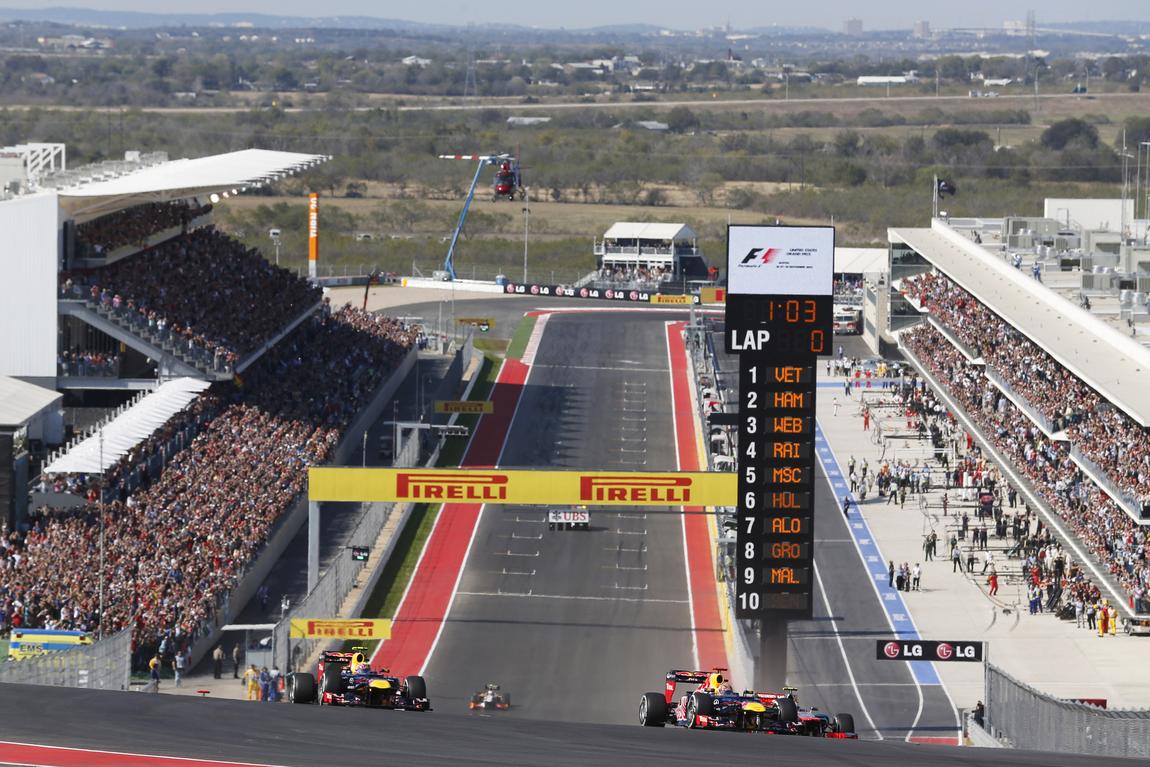
    Dubbed the Circuit of the Americas, or COTA, Formula 1’s return to the US was celebrated with a rowdy return in 2012. This circuit too was designed by Herman Tilke but unlike his other occasionally tedious attempts at modern circuit design COTA has been lauded by drivers and fans. “Hand on heart, this is probably the date on the calendar I look forward to the most,” says Red Bull’s Daniel Ricciardo. “The Circuit of The Americas, in my opinion, is the best of the new breed of circuits. The nature of the corners is interesting. It’s also a very busy track where you don’t get much respite. The first sector is very special and that first turn, blind up the big hill is like nothing else in Formula 1. It’s also a good example of the excitement a late apex can create: you can have a really good lunge there. They’ve done a very good job.”

    A storm is brewing towards the back of the Formula 1 grid as two teams in particular are having a difficult time in coping with the new turbo-charged-money-pit-era of the sport. It has led to the announcement that neither Caterham nor the Marussia team will be taking part in Texas this weekend. The great hopes once held for Caterham now lay in shards as administrators Smith and Williamson, who now own the team, set out to look for a possible buyer. Its debut in 2010 and the following season for Caterham seemed to suggest a lot of potential. They were the team most likely to be snapping at the heels of the mid-field and possibly score a point or two, such was their progression. However, in the last two seasons the team seems to have hit a brick wall and was overtaken by main rivals Marussia. Caterham’s absence, with permission from Bernie Ecclestone, will also include the team missing the Brazilian GP.  At Marussia financial woes have meant that team cannot run either.

    sebusThis should make for an interesting qualifying session. Along with the four cars already missing from the line-up Red Bull has already announced that Sebastian Vettel will not take part in the qualifying session. Vettel has chosen not partake as he will incur a ten-place grid penalty for using a sixth power unit, one more than is allotted for a season.

    Not that long ago the announcement that Formula 1 would transform to hybrid, turbo-charged cars for 2014 was met with serious speculation as to the cost involved. Several teams, some of the big-wigs too, had genuine fears about the financial implication of such an imposing transformation.   With two teams not making the trip to Texas or Brazil; a few others like Lotus and Sauber are in quite a fight to keep their head above water; and with Vettel missing in action from quali you have to wonder if those who pushed for the comprehensive rule changes are still as boisterously confident as before.

    Formula 1 is a sport of extremes and over on the other side of the grid Mercedes is making merry and raking in the prize money. The circuit in Austin, Texas isn’t as power-hungry as Russia’s Sochi track but this will do little to eat into the colossal competitive advantage that Mercedes wields.

    America – the land of opportunity so goes the famous saying. With three consecutive victories Lewis Hamilton has been making the most of hisCOTA and now sits seventeen points clear of teammate Nico Rosberg. What can Rosberg do to break the ominous momentum of his champion teammate, more importantly; does he have the mental fortitude to beat an extremely confident and ridiculously comfortable Lewis Hamilton on an equal playing-field? There isn’t a doubt that Rosberg is a quick driver with some savvy skills. As this championship draws to a climax he’ll need to call on all of it to prove that he has what it takes to be the 2014 world champion. How deep can Nico Rosberg truly dig?

  • Di Montezemolo Confirms Ferrari Exit for Alonso

    Di Montezemolo Confirms Ferrari Exit for Alonso

    Former Ferrari President, Luca Di Montezemolo confirmed last night that Fernando Alonso will be leaving the Maranello based team at the end of the season.

    Speaking on a television show yesterday, Di Monetzemolo told Italian media that Alonso is leaving for two reasons. “One, he wants another environment. Two, because he is an age when he cannot wait to win again,” he said.

    Di Montezemolo also revealed that Alonso asked him to release him from his contract during the summer break as he believed Ferrari will be unable to provide him a race winning car in the near future.

    His role as Ferrari Chairman came to an end this week after it was announced that Fiat CEO Sergio Marchionne would take over the role as Ferrari Chairman.

    It’s no secret that Alonso wants to leave Ferrari at the end of the season. The Spaniard has remained tight lipped about his future in F1 with the strongest rumors saying that he may have a drive with McLaren next year. The other rumor is that he will take a year off and work on a deal with to drive for Mercedes in 2016.

    Alonso dropped a few hints at the at the Russian Grand Prix saying that he does not think that he will be in a Mercedes powered car in 2015. He also added that he thinks that there isn’t a big risk that he wont be in F1 next season.

    We are yet to hear anything from Alonso or Ferrari at this point. Alonso has said that once the announcement on his future is made it will be “obvious”. Lets wait and see, Fernando.


    Photo Credit: Suderia Ferrari Formula 1

  • F1 2014: Sochi Success For Hamilton

    F1 2014: Sochi Success For Hamilton

    The most exciting thing about the first ever Russian Grand Prix was … nothing. If truth be told the only moment that induced  any sort of eyebrow-raising was a 60 meter lock-up by Nico Rosberg as he tried to steal the lead of the race from Mercedes teammate Lewis Hamilton.

    Other than Rosberg’s rather frantic attempt at getting ahead, the Sochi Autodrom turned out to be a bit of damp squib. The layout, once again designed by Hermann Tilke, provided a technical challenge to drivers when it came to stringing a perfect lap together but as far as the track surface is concerned it most definitely did not want to play ball with Formula 1. Pirelli had the difficult task of predicting what the track surface would offer up and based their decision on how other new tracks had performed. While keeping this in mind it is difficult to blame the Italian tyre manufacturer for bringing tyres to Russia which are almost literally bulletproof.

    russian-gp-start-rosbergSo indestructible were the Pirelli’s that Nico Rosberg, forced to pit on lap 1 with severely flat-spotted tyres, was able to run a 52 lap stint on one set of tyres. It wasn’t a gigantic risk nor was Rosberg, at any point, required to tip-toe around and nurse his tyres. No, he was able to push and for most of the stint set a pace comparable,  and sometimes even quicker, than the race leader.

    We commend thee Pirelli for producing the world’s first everlasting F1 tyre. But we implore you to chalk this up to a frightening one-off incident that should never again be repeated.

    Saturday’s qualifying certainly provided more entertainment as Williams’ star Finn Valtteri Bottas nearly snatched pole position from Lewis Hamilton’s grasp. It wasn’t to be for the Williams driver but he put himself in the best position possible to fight for a podium finish.

    The early part of the race and the Finn’s pace suggested that he could perhaps have a go at the leading Mercedes. But this too fizzled out towards the middle part of race as Hamilton started steadily building the gap to the Williams. Bottas eventually finished third and set the fastest lap of the race.

    Jenson Button followed through on the pace McLaren had promised in the free practice sessions with a fine fourth place finish. It was a lonely drive for the Brit who ran as high as third during the opening stint of the race. The second McLaren of Kevin Magnussen recovering from a five place grid penalty induced by a gearbox change,

    Ferrari’s Fernando Alonso finished an uninspired sixth and remained as coy as ever as to his future in the sport. Many have already plopped theLewis Hamilton Sochi 2014 Spaniard into a McLaren seat for 2015 but Sky’s Ted Kravitz hinted, post-race, that the double champ could be off to Lotus.

    Daniel Ricciardo did his level best to get past the Ferrari of Alonso but ultimately could do nothing about it and finished ahead of teammate Sebastian Vettel in seventh.

    Kimi Raikkonen spent most of the 53 laps embroiled in scrap with the two Toro Rosso drivers but eventually got the better of them and finished a distant ninth. Sergio Perez nearly cut it too close on fuel consumption but held on to bring the Force India home in tenth.

    Felipe Massa attempted an aggressive two-stop strategy but never quite recovered from a technical issue in qualifying; the Brazilian finished eleventh.Only Caterham’s Kamui Kobayashi and Marussia’s Max Chilton failed to see the chequered flag. As a sign of respect to Jules Bianchi the Marussia team chose to run only one car this weekend.

    The Russian Grand Prix most probably didn’t even register a blip on the thrill meter. But it did give us another bit of insight into the title fight. Now that Mercedes has been crowned worthy Constructor’s champions it leaves a straight-up fight for the driver’s crown. Rosberg’s crack at snatching the lead was a tad anxious. Still the German has not beaten Hamilton on a level playing field. We’ve talked a lot about the psychological battle between these two. Is it now finally starting to tell on Nico Rosberg?


  • Hamilton dominates in final Russian practice

    Hamilton dominates in final Russian practice

    Lewis Hamilton set a dominant pace during the final practice session at the Sochi Autodrom ahead of this weekend’s Russian Grand Prix.

    Hamilton’s time of 1:38.726 was comfortably faster than the rest of the pack, despite a spin at the penultimate corner which saw him destroy his tyres and unable to complete his lap. At the time he had over a second advantage over his rivals and was on course to improve his own lap time.

    Nico Rosberg and Valtteri Bottas did improve and Rosberg ended the session 0.29s down on his team mate’s time.

    Daniel Ricciardo finished the session in fourth spot for Red Bull, followed by Felipe Massa and Daniil Kvyat.

    Kimi Raikkonen finished the session ahead of his Ferrari team mate Fernando Alonso. The two were 7th and 8th respectively. Jean-Éric Vergne and Sebastian Vettel rounded out the top 10.

    Jenson Button finished in 11th place, unable to match the awesome pace McLaren had showed during the Friday practice sessions. He repeatedly complained about balance saying that it was “just aweful”.

    His McLaren team mate, Kevin Magnussen had himself a bit of trouble on track. His gear box failed and the Danish driver found himself doing some scary stunt driving to keep his car out of the wall. He managed to do that but the gearbox change will mean a 5 place grid penalty for him.

    Pastor Maldonado did not set a time due to an ERS problem.

    Top times for the session are below. Please join us on Twitter, @F1_Madness for live commentary and chat during this afternoon’s qualifying session.

    sochi-fp3-times

  • F1 2014: Friday Practice Round-up – Mercedes Lead The Way

    F1 2014: Friday Practice Round-up – Mercedes Lead The Way

    Nico Rosberg and Lewis Hamilton finished the first two practice session at Russia’s Sochi Autodrom on top of the timing sheets.

    For the first time in its illustrious history Formula 1 commenced an official F1 race weekend in Russia. The circuit, 5.8 km in length and designed by Herman Tilke, was praised by several drivers.  “It’s got a really nice flow to it, it’s not too bumpy, the corners are challenging – if you can get the lines just perfect you can put together really nice sectors,” said Lewis Hamilton.

    The new track surface also delivered a substantial amount of grip considering that it has never before been used. Set in the undoubtedly inspiring setting of the Olympic Park is providing some challenge for the drivers. “It is more technical and difficult than it looked on paper,” said Red Bull’s Daniel Ricciardo. “It seemed quite hard to get the lap together and has quite a few off camber corners, which isn’t always fun for a driver, but it does make it challenging.”

    Spain’s Robert Merhi ran in the first of today’s two free practice sessions for Caterham. Elsewhere, Russia’s Sergey Sirotkin made his debut for the Sauber team in place of Esteban Gutierrez. Sirotkin finished the session only four tenths off the sister car of Adrian Sutil.

    According to Daniel Ricciardo the Red Bull team are bracing for a difficult weekend. The Australian’s car broke down during the closing stages of the second free practice session. The three-time grand prix winner described that the weekend would be an exercise in “damage limitation.”

    Reports from the McLaren garage were decidedly more upbeat. A closer analysis of the long-run simulations in free practice two revealed that Jenson Button’s laptimes were comparable to that of the Mercedes drivers. JB was especially heartened by the pace he was able to deliver on Friday.

    “We were very quick from the word go on the prime tyre. On the option tyre and with low fuel I didn’t really have the balance, so hopefully we can improve that tomorrow.,” said Button. “We are obviously behind the Mercedes, but we have a chance to fight everyone else this weekend.”


    russia

  • 2014 Formula 1 Russian Grand Prix: Thursday Press Conference

    2014 Formula 1 Russian Grand Prix: Thursday Press Conference

    Drivers:

    Fernando ALONSO (Ferrari)

    Jenson BUTTON (McLaren)

    Daniil KVYAT (Toro Rosso)

    Felipe MASSA (Williams)

    Adrian SUTIL (Sauber)

    Sebastian VETTEL (Red Bull Racing)


    PRESS CONFERENCE

    Q: It’s just five days since we were in Suzuka, I would just like to hear your views on the events of last weekend – starting with Fernando.

    Fernando ALONSO: I think it was a very tough race. Obviously all of our thoughts are with Jules. All of our minds are there because we have huge respect for our work but when there are big accidents there are no words to describe – but you can feel. As I said, it was a tough weekend and right now we are here, a difficult weekend again. Emotionally very difficult. Ready to race, to race for him, being as professional as we can but definitely our minds, or my mind, is with him in this moment, praying for him.

    Adrian.

    Adrian SUTIL: So hard to say in words. Of course, very shocking moment for everyone, for myself. Nothing really to say about anything. Probably everyone has seen it. It’s just… we have to pray right now. This is all we can do. We can hope that we get some better news. It’s just that we are now here in Sochi, a grey cloud over us but try to be professional enough, more professional and focus on the race weekend again and also good to get rid a little bit of this mood but still it affects everyone. My thoughts are the same. Pray for the best and race for him.

    Felipe.

    Felipe MASSA: For me I think it was the worst race of my life. It’s a really bad race, worse than the race of my accident – because I didn’t remember. It was the worst race of my life. Yeah. It’s so difficult to be everyday because I can just be thinking about him, thinking about Jules. It’s a very difficult weekend for all of us. Maybe tomorrow it will get a little bit better because at least you are working, at least you have something to think about, some issue put inside your brain. Try to race and do the best we can for him, for his family. But anyway, it was the worse race of my life.

    Daniil.

    Daniil KVYAT: Obviously it is a shock for me as well. Wouldn’t expect to hear quite negative news after the race finished. All I can wish now is that we can hear better news, positive news about Jules. I really wish him to recover, it’s the only thing that matters. Nothing like this has happened for a long time and we all hope, here in Formula One that the health to Jules. I’m thinking of him very often, like all of us. We’re all united to support him. I run out of words so I stop here.

    Jenson.

    Jenson BUTTON: I think, listening to everyone, I think we all echo the opinions of the guys sat here so far. It’s a very horrible feeling knowing what one of your fellow drivers went through and is going through. I think the only thing to say, and the most important thing is that we wish him well and our thoughts are with him. I think we all feel the same in the Formula One world.

    You’re a council member on the GPDA and so are you Sebastian. What lessons can be learned, do you think?

    Sebastian VETTEL: I think first of all you need to see that it was an extremely difficult race for all of us. I think I join on what the other drivers said, in terms of how difficult, it is probably the most difficult race to digest so far. But I think difficult conditions, leaving a very, very small margin for error. Obviously for Jules at that time it was too small. On top of that, very unlucky circumstances led to a catastrophe really. I think at this stage, for of all, all of our thoughts are will Jules, with his family, and we wish him all the strength that we can send. About the accident, I think it is very difficult. Obviously there is a lot of stuff going on now but surely if something happens there is always the chance to learn something for next time and avoid these things happening. Also, you need to understand that the cars we race, the speeds we travel, yeah, accidents can happen. But obviously, as I said, extremely unlucky circumstances led to much more than the usual type of crash that you see when you lose control of the car.

    Q: Daniil, we move on to this weekend. I suspect a very proud moment for you. Tell us your feelings when you come into your first home grand prix and our first Russian Grand Prix.

    DK: Quite mixed feelings as you see here the atmosphere and all our thoughts are still about Japan. So, I think it will be like this for a while. Another side of course, it’s my home grand prix. I’m pleased to see what I see here. Big structures, big track and I think around ten years ago, when I was starting my career, we couldn’t have even dreamed about this. And not this thing becoming reality. So, obviously it’s a special moment for me and the first time racing in Russia. In the end it’s our work and we carry on doing  what we’ve been doing for such a long time.

    Q: For the rest of you, can I just have your general impressions of the country, if you wish to, and the circuit as well.

    AS: It was a positive surprise, or a positive experience when I got here. Flew over Moscow but already went in there without problem. They really welcomed us into the country. I haven’t seen so much – straight into the hotel, the hotel is very big but incredible what they’ve built around there. The infrastructure is really good, the track looks very modern and interesting to drive. I haven’t even walked the circuit yet, I will do it after. Of course there is not so much information about the circuit for me and for our team because we have no simulator – so it will be the first time for us, driving on Friday morning. Exciting to have a new circuit, a new country on the calendar. Hopefully it will be a nice weekend with a lot of fans coming and making a good atmosphere. So yeah, pretty good so far. Looking forward to it.

    Felipe?

    Felipe Massa_Press ConferenceFM: I agree totally with Adrian. It was nice to be here, I think it is a nice circuit, the infrastructure is pretty good so yeah, I think what I’ve seen until now is pretty positive. I hope we can have a nice race for these guys, these fans. So yeah, tomorrow we’ll have a better idea how is the track but it looks pretty OK, pretty interesting. Hope we can have a good weekend, good first weekend and first impression for all these Russian people and fans. Hope they enjoy the first race of Formula One here.

    Sebastian, what are your thoughts on the major factors needed around the circuit. I assume you’ve been around the circuit.

    SV: Yeah, I have. Also I’ve been here a couple of weeks ago for promotional activity with Infiniti. I had the opportunity to take a car around and have a look at the track. I think it’s a difficult one to find the right compromise. Obviously you have a lot of corners but also you do have a lot of long straights. Especially the start-finish straight is very long. You definitely need some speed down the straights but overall it looks like an interesting track. A lot of 90° corners, especially I think two and three will be an interesting challenge. Generally obviously it’s a unique feeling to drive around in an Olympic Park. So, obviously as has been touched on before, a bit of a shadow going into the weekend due to the events last weekend but for sure it is very exciting to have the first Russian Grand Prix and great to be part of that very first grand prix here.

    Fernando?

    FA: I share all the comments. I think it’s always a nice feeling when you arrive into a new circuit because it’s a new challenge. For everyone: for engineers, for drivers, for teams, etcetera. The other side, the feelings are there, especially for our team, which has been very close to Jules all the career, it’s an especially tough weekend. We have to be professional, we have to be working in the best way, just to race for him because we need to show we are a strong team – but it’s going to be tough.

    Jenson, your feelings about the circuit. Presumably you’ve driven it on the simulator, have you been around and had a look at it?

    JB: Yeah, I’ve done a few laps on the simulator. I haven’t walked around circuit yet, I’m going to do that in a couple of hours. I think we all look forward to a new challenge and this is definitely a new challenge. I think the most important thing this weekend in terms of the grand prix is that we put on a good show. It always is. The first year of a new circuit, hopefully we’ll have full grandstands and a good fight out on the circuit. So that’s what we’re hoping for.

    QUESTIONS FROM THE FLOOR

    Q: (Ian Parkes – Press Association) Gentlemen, you’re obviously all aware of the inherent risks of motor racing but partly that’s why you love Formula One. Is there any part of you, going into this weekend, that makes you reconsider taking part in this sport after what happened on Sunday? That’s for all drivers. Felipe, I can see that you’re the most cut up about this. After your accident maybe you could start with this as well please?

    FM: Well, for sure you think about it, but it doesn’t mean that’s the right thing to do. What I love to do is to race. What I love to do is to be competing. That’s where I feel happiness. That’s where I feel pleasure. We know that in what we’re doing we have a risk in this sport, but I think it’s what I like to do. It’s where I really feel happy, it gives me motivations and give me some, yeah, happiness. Sometimes you think about it but then you’re thinking more and you understand that this is my world, this is what I like to do.

    Sebastian?

    SV: I think Felipe expressed it very well. We all share a common passion for racing; we all share a passion for competing. Obviously we are all very fortunate to find ourselves in Formula One racing the best and quickest cars in the world, which give the best excitement and probably the best satisfaction. But there is always some risk involved, which is, I think, always a part, or a great part, of the feeling why you feel so alive. I think if you have to make the decision, I’m fairly confident for us you’d always prefer to go racing.

    Fernando:GP RUSSIA F1/2014

    FA: Same.

    Jenson? Daniil?

    DK: I agree with all the comments before mentioned. In my case I just started my career as well. Every sport is risky. You never wish anyone to get hurt, but these things happen. I completely share all the comments of the other guys.

    Adrian?

    AS: Nothing to add.

    Q: (Luis Fernando Ramos – Racing Magazine) A question to all drivers: just to clarify whether you are a GPDA member or not. But regardless of whether you are a member or not, how do you think the drivers can contribute to help F1 to learn the lessons of what happened last Sunday?

    FM: Well, I’m not a member but I’m for sure trying to do everything I can trying to help on the safety because for me safety is the most important thing. I think this is not the right place to comment about any point, just comment about safety. Safety is what I care about.

    Sebastian?

    SV: Well I think it’s very difficult right now to give you the golden answer. As I said there were a lot of circumstances that probably led him to that type of accident. For sure, though, there is always something you can learn. I think for now we need to first of all digest what happened and then make the right conclusions. I think it would be wrong only a couple of days after, with all the events going on, with all the happenings we’ve had since Sunday, to come out with something that hasn’t been though through.

    Fernando?

    FA: I don’t really have anything to add. There is an investigation going on. We don’t have all the details. We don’t have all the information necessary to suggest any change. So we let the people work and whatever idea, whatever things come from the drivers’ point of view we will share it.

    And are you a member of the GPDA?

    FA: Yes.

    Jenson, your thoughts on this?

    JB: I think everything’s been said already. Obviously we work as hard as we can to help our… to help the GPDA and to help the safety of the drivers, as the FIA does as well. Obviously it will be talked about a lot over the next few weeks and months and we can always learn. There’s always more to learn better ways to help our sport.

    Adrian?

    AS: Yes, very similar opinion about it. I’m not a member yet but that might change. We have a new director now and some good ideas. Whatever we can do, I think all the drivers, we’re together and we have the same thoughts: to make things better, especially for safety. It’s something you can never learn enough. Development goes always on and research has to go on. We are living in a very modern world and improvement is done every day. The most important thing is to learn out of mistakes and make it better.

    Daniil?

    DK: Yeah, I think of course in the next GPDA meetings we will have a talk about all that has happened. I think there can’t be any rash decisions right now. They have to be progressive and calculated decisions to improve. But of course, like Sebastian mentioned, there was many different circumstances that are yet to be considered but we will be still talking about this for sure.

    Q: (Haoran Zhou – F1 Express) A question to Adrian Sutil. Obviously being a witness you know, probably more than anyone else, what happened. I want to ask were you consulted, did the FIA ask you to consult your opinion or what you saw of the accident after the Japanese Grand Prix?

    AS: Yes, just how much I could see. Of course I was standing there but I think the pictures and the video which was on the internet it was very clear what happened, so there’s not really more I can say. I think we have to wait for the investigation there and there’s nothing more I can right now to be honest.

    Q: (Andrea Cremonesi – La Gazzetta dello Sport) Sorry Adrian if I continue on this matter because I think that for you it’s quite hard and painful but we can see of course the beginning of the accident. What happened before he went off? Maybe you can give some more details if you are watching him? And for Sebastian, changing the matter, we know you split from Red Bull and we would like to know when you can announce the new team and why you wait for the announcement please?

    AS: I was standing there and of course I was not expecting anyone to go off and when I realised that there was a car coming it was in the gravel already. I just saw the last seconds. I don’t know what happened before. I can’t really say. I was just a witness until when the fatal crash really happened. But I haven’t seen what happened before. That’s it.

    SV: No update really. I hope I will be able to make an announcement soon and once the announcement is out I think you are probably clever enough to draw the conclusion why I had to wait.

    Jenson Button_Press Conference 2014Q: (John Burns – New York Times) One of you has spoken about there being a shadow, obviously as a result of last weekend’s accident. A few weeks ago Ari Vatanen raised another shadow over this race over events occurring 300 miles to the north and northwest of here. I wonder whether any of you would like to comment on the question of politics and sport. Is it realistic to draw a wall between the two and say they shall never intersect or do you as individuals think about this, worry about it, wrestle with it and come to the conclusion, as you seem to have done in every case, to race notwithstanding?

    JB: I think you know it’s a very difficult question for any of us sat here to give you an answer to. I think the correct people to speak to would be the governing body and if you have to, speak to our team principals but us as drivers I don’t think it’s the correct question for us.

    Q: (Ian Parkes – Press Association) Fernando, just to change tack completely to cycling. I believe the UCI have announced that your team won’t be competing next year. Can you offer any explanation behind that? What’s the situation going on with your team there?

    FA: Well, I think two weeks ago we announced a partnership with Novo Investment from Qatar and they are in control of our next projects, which we are very excited [about]. For them it was not the right moment to create the team. We will have another, as I said, exciting project that will be announced maybe next week or maybe in 10 days’ time and, yeah, follow their wishes and try to enjoy that part of cycling that I love so much.

    Q: (Sylvia Arias – Parabrisas Argentina) Daniil, next year you are going to be in Red Bull. I would love to know your feeling about that. It’s such a very important step forward for you.

    DK: Obviously I’ve been told about it in Japan. I was very happy about it, very honoured. Joining Red Bull Racing next year means a lot. Obviously the name of the team says it all and we will do our best to fight for the highest position possible. So I think that’s all.

    Q: (Andrea Cremonesi – La Gazzetta dello Sport) We are talking about closed cockpits; I would like to know your feelings about this option?

    FA: I probably tend to agree to at least check and try or test the idea. I think we are in 2014, we have the technology, we have aeroplanes, we have had many other samples that they use in a successful way so why not think about it? All the biggest accidents in motor sport over the last couple of years have been head injuries so it’s probably one part where we are not at the top of safety. Even in my case, in 2012 at Spa, I could probably have died there in corner one if it had been 10 cms closer to my head. If the technology is there and available,  and there is the possibility, I would not exclude it, for sure.

    SV: Sort of a mixed feelings to be honest. If you look at Formula One cars since the beginning of Formula One and open-wheeled racing, I think it’s one of the things that are very special about Formula One. On the other hand, as Fernando touched on, there’s a lot of reasons why we should look into closed cockpits for the future. As I said, at this stage, after what happened, I don’t think it’s right to… I don’t really have an opinion to be honest.

    FM: I totally agree with what Fernando said, so I think it would be interesting to try, it would be interesting to work on that possibility. Definitely, for my accident it would have been perfect. Maybe for Jules, I don’t know. But I think maybe it could have been interesting for so many different types of accident, including the one I had, but I totally agree with Fernando. I think it could be an option and we will see when we could try something or see something to understand if it’s positive or not, but I totally agree with him.

    AS: I think definitely it would be worth a try to test it out. We don’t know how it would be but I think these cars have been open for a long time in this category but maybe it has a future also with closing them. I think this is the category where things are tried to make it better and more modern and going in the right direction, so I think it’s definitely worth a try and maybe it works. For sure, we have seen airplanes where it looks quite similar from the cockpit and there it’s closed. If we can minimise a risk without losing anything, of course it’s very interesting.

    JB: It’s a difficult one. As Seb said, there are positives obviously, in terms of the safety point of view but this is Formula One that’s been open cockpit since the start of time so it’s a very big change for the sport to make. Safety is something that, as I said, we can always improve on so I’m sure it will be looked at whether it is possible to change or not for the future.

    DK: There are many sides to this decision if it will be taken. Like I said, I think now, when these kind of things happen, you have to take a little break and calculate everything, try everything and calculate what would be the best solution. Like everyone else said, why not but it has to be tried and has to be very well calculated.

    Q: (Dieter Rencken – Racing Lines) Obviously race driving consists of managing risk to be the best of your ability, be it drivers’ risks, sporting risk, mechanical and technical risk. Is there are such a thing as acceptable risk and where does that level lie? When would you decide something is unacceptable and when is it acceptable?

    SV: I think our passports say that we are all old enough to make our own decisions in life and I think generally we all have a brain that we are allowed to use, so it’s our conscious decision if we want to go racing or not. I think we expressed the love that we share for racing, for the thrill, managing the car on the limit etc. Obviously there’s always the risk that something can go wrong. I think it lies in the nature of the sport, if you look at the speeds involved etc. I think we’ve come a long way in terms of safety if you look back and a lot of improvements have been made but I think if anyone is not happy, he’s old enough to say no. Surely, I think we’ve been very fortunate that in our generation there have been crashes with limited outcome. Obviously last week reminded us all of how apparent the risk is and how quickly things can change but surely if you look at the type of accidents that we had in the last couple of years, how violent they looked and fortunately nearly nothing happened,  shows that improvement has been made. Obviously that’s a great feeling but you should never lose the respect, I think, for what you do.

    FM: Well, I think over the last years, all these improvements that we had in Formula One was good, it was impressive. To be honest, we saw so many accidents when drivers just jumped from the car and nothing happened which was pretty impressive. I think that’s what we need to fight for. We need to fight to have everything the most safe way around, so what happened last weekend was not exactly like that – it was a tractor on the track – and we cannot do anything when it’s like that. I think it’s two different things. I think we have  good working to make the car safer all the time and this is going in the very good direction  but in the normal situation around the track.

    AS: I think it’s clear for everyone that racing can be dangerous but I’m here because I’m aware of it and I like it. I’m here because I want to race and I know and I’m aware of the danger but that doesn’t mean that I just accept it. Of course, we all try to make it better and make it more safe because we don’t want to see this happening frequently. We’ve done – GPDA, Formula One – have done a great job in safety over the last years so it has been improved unbelievably but we can always make it better but yeah, still I’m sitting here and I will race because this is my passion and I want to do it and as soon as I feel different and I don’t feel like that any more, I will stay at home, this is for sure.

    DK: I agree with Adrian. We are here, we are racing and we know that the risks are still high, as we had the confirmation, unfortunately. The speeds are very high, over 300kph but we don’t want to race at 100kph because it’s not racing any more so on any circuit you cannot exaggerate but we always want to have maximum safety and this is what the GPDA, for example, is doing. And I think we have seen that the improvement has been huge but these kind of things, unfortunately, remind us that there is always something that can be improved.

    JB: I think enough has already been said on this matter.

    Q: (Carlos Miguel – La Gaceta) Fernando, in the last races you have had some problems in the car. Are you expecting to finish on the podium in the last races of this year?

    FA: Well, I think it’s our wish. We have some races to go now and the car is picking up the pace. We are becoming more and more competitive in the last events. We lost some opportunities but we will try our best in the remaining races, especially, as I said, now I think the team is quite in shock with Jules and we are all worrying for him but it’s time to be united and to deliver a good result and that will also show him great respect so let’s try this weekend.

    Q: (Andrea Cremonesi – La Gazzetta dello Sport) Fernando, this is the last Grand Prix with Mr Montezemolo as president. I would like to ask you your feeling about it. Everything is overshadowed by Jules but this is also the fact.

    FA: I think that president Monzemolo has been very successful in his career and has helped Ferrari in a big way, on the track, outside, as an industrial power. He’s done many things for Ferrari so huge respect for his career there. I have a very close and good relationship with him so I’m wishing him the best for the future.

    Q: (Andrea Cremonesi – La Gazzetta dello Sport) For everybody, Felipe said before that we have also to improve the environment around us. I think that more safety cars in circumstances like Sunday should be alright.

    FA: As I said, there is an investigation going on at the moment. Once I was not on the track at that moment, so I cannot judge the conditions very precisely so I don’t have an opinion.

    SV: I think with hindsight I think it’s always easy to say ‘this could have been avoided, this should have been done.’ I think there are definitely some lessons. I think everyone is obviously thinking about what we can improve and improve within a week’s time. I think here we have a completely different circuit, completely different conditions so I think – as I said earlier and Felipe touched on – it was a very special accident with unique circumstances leading into a very bad outcome. But surely, if the answer is as easy as bring in the safety car then I don’t think that’s a big thing for people to do in the future. On the other hand, I don’t believe the answer is as easy as that either.

    Q: (Silvia Arias – Parabrisas) I would like to know if you’ve found the pit lane is wide enough here or do you think you’re going to be very careful coming into the pits to change tyres during the race?

    SV: It’s quite narrow, especially the pit entry looks very narrow. I don’t know, I think in the first place they had a lot of space to build the track so sometimes you wonder why some areas like the pit lane didn’t get a bit bigger.

    JB: It fits a car, so that’s a start. We’ll go from there.

    FM: Looks a bit tight but we will see tomorrow.

  • F1 2014: Russian GP Preview – From Russia With Love

    F1 2014: Russian GP Preview – From Russia With Love

    For as long as can be remembered Formula 1 Racing has always been the considered the pinnacle of motor racing. It seems apt then that F1, for the will run a race at a former Olympic site. After all in the world of sport there is no more prestigious achievement than being an Olympic Champion.

    For the first time in its history Formula 1 heads to Russia to run on its 5.8 km long Sochi Autodrom. In a similar fashion to Canada’s Circuit Gilles Villeneuve the Sochi International Circuit, designed by F1 architect Herman Tilke, will run around the Sochi Olympic Park which hosted the 2014 Winter Olympic Games.

    Whether a rookie or a seasoned campaigner, for all driver’s a new circuit is a step into the unknown. Despite the technologically advanced simulators that teams sport these days it is still just that – an imitation.  “What the simulator does is let you speed up this process and make initial decisions about car set-up and so on. What the simulator can’t do for a new circuit is give a precise idea of the grip levels you will find as it’s a surface we’ve never raced on before,” said Lotus’ Romain Grosjean.

    Canada 2014_Pirelli Soft and SupersoftThe circuit’s layout, divvied up into 18 corners, is a mixture of medium speed corners with a couple of fast straights for good measure. “There are definitely similarities to other tracks, perhaps the best comparison is Singapore,” Sebastian Vettel summed up. “But unlike Singapore, the layout is more fluid, so it will be much faster. Some sectors remind me a bit of South Korea or Abu Dhabi.” As a result the circuit should dictate a relatively high downforce set-up.

    The tyres supplied by Pirelli in 2014 has, mostly, performed predictably but with a new track surface in Russia and a changeable weather forecast teams are in the unfamiliar position of having no forecast for tyre performance. “In terms of overall tyre energy demands, Russia is somewhere in the middle, and measurements also indicate low-abrasion asphalt,” Pirelli motorsport director Paul Hembery.

    What then does all of this mean for racing? One thing a new venue for Formula 1 will do is even out the playing field between the two Mercedes drivers. Seeing as they’ve never set a wheel of this particular bit of asphalt neither Lewis Hamilton nor Nico Rosberg can claim a performance advantage.

    On the forefront of many team’s mind this weekend will the possibility of incurring a grid penalty. As the season draws to its end a few teams andHamilton-Rosberg drivers are running their allotment of power units on a wing and prayer. Not least of Sebastian Vettel could be the first of the front-runners to incur a 10 place grid penalty as the German is already on power unit number five for the season.

    Yet another miserable weekend, this time in Japan, will have rubbed salt in Ferrari’s wounds. A retirement for Fernando Alonso and a non-points scoring finish for Kimi Raikkonen has done little to aid the Italian team in their fight for third place in the Constructor’s championship. They will need a solid performance this weekend against rivals Williams who should be in better shape than a week ago.

    For every year since 1950 a Formula 1 world champion has been crowned; and for almost all of these 64 years this majestic sports has continued to break new ground and make superhuman advances. In its 2014 incarnation the irresistible lure of Lewis Hamilton and Nico Rosberg and a championship of a knife edge still fuels an irrepressible passion that’s about to be unleashed in Russia.


  • 2014 Formula 1 Japanese Grand Prix: Friday Press Conference

    2014 Formula 1 Japanese Grand Prix: Friday Press Conference

    Team representatives:

    Pat Fry (Ferrari)

    Andy Cowell (Mercedes)

    Remi Taffin (Renault)

    Paul Monaghan (Red Bull Racing)

    Yasuhisa Arai (Honda)

    Jonathan Neale (McLaren)

     
    Q: Arai-san, if I can start with you please. What’s the current state of the Honda project? Is Honda on target with development?
    Yasuhisa Arai:
     First of all, thank you very much to sit in centre. I am glad to be here again after Shanghai. Our progress is right now almost on schedule and I hope that in the year 2015, March we will make [a good start] together with our partner, get a good start on the grid.

    Q: Would you like to run the power unit in a McLaren before the end of the year? Is that feasible? Are you allowed to do that?
    YA:
     Everyone asks this to me! McLaren and Honda work together to design and create an experimental test vehicle to check the power unit system but unfortunately we don’t have an actual test plan but I hope if possible we will drive just before next season.

    Q: You can’t say any more than “just before next season”?
    YA:
     Just before next season. End of the season and next season, during that time. That’s my hope.

    Q: What lessons have you learned from the efforts from the other power unit manufacturers? Are there particular areas that you’ve noticed they’ve had troubled with?
    YA:
     I’ve learned very small things because most of the data we don’t know. So, very difficult to learn on the track.

    Q: You’ve seen the failures that they have had. Are there particular areas you have concentrated on?
    Jonathan Neale: 
    If I may, just to help my partner here, as Arai-san says it’s very difficult at arm’s length to focus on any particular area. Honda and McLaren have a lot of work to do together in a short period of time and I’m sure if you were to ask – I don’t want to put words in the mouth of either Andy or Remi here – but if you were to ask them what it felt like for them at this time of year before they were starting with the V6 engines, they’ll know what we’re going through at the moment.

    Q: Thank you for that. If I can come to the back row now: a couple of questions for all of you. First of all, what is your state of development at this stage for 2015 with your engines? Remi, if I can start with you?
    Remi Taffin: 
    It’s all about on plan. It’s basically now a few months we are working on that and we now have got a few examples on the dyno, so it’s a work in process. I think we are going in the right direction. It’s always difficult to know if we’ll hit all our targets but that’s where we are at the minute.

    Q: Andy?
    Andy Cowell: 
    We’ve been doing lots of development ever since we froze the specification of this year’s engine in February, so we’ve been doing lots of development on research engines and using this year’s engine as a prove-out but our final specification of engine won’t be complete until the early part of next year, because for all of us we’re in the development phase until the.

    Q: Thank you. And Pat?
    Pat Fry: 
    Our development is very similar to Andy’s really. As soon as the engine was frozen we’ve obviously been developing as hard as we can and trying to improve the power unit in all areas. There is a huge amount for us still to do. Very little of next year’s spec engine actually exists, which I expect to be the same for everyone here. It will all finally be coming together at the start of January.

    Q: Can I ask you your feelings about unfreezing in-season power unit development and where is that discussion actually going? Remi?
    RT:
     Where is that discussion? I think at the moment it is at the upper level than the one we are here and what I think about it, or what Renault thinks, is that it is not going to really change the way we are working. As Andy says we are developing our engine for next. There won’t be many parts that will be looking like the one from this year. Whether we will be able to put all the parts, all the development into one engine for Melbourne is difficult to say. Of course we will push as much as we can, because the more we put for the first race, the more performance we will get for the whole season. If we’ve got a slot at some point in the season to introduce some more development, they will be on the shelf, because obviously we just keep on working all through the year. It’s not really decisive in how we achieve our development. We will just take the opportunity if it is there.

    Q: What are your feelings about this Andy?
    AC:
     I think it would be a change to the way we are structured. We froze the performance specification of this engine in January/February of this year and started working on a 12-month development programme and if you’ve got one introduction point or two introduction points, it is a change. And often it is the prove-out – taking that performance specification into something that is reliable enough to do five race weekends – that’s the costly aspect, because you’ve got to have several sets of bits and often you have to go back around, because fatigue failures occur and you’ve got to redesign and go again. The regulations were put together several years ago with the opportunity to do an annual performance update. If we change to a mid-season as well as a start-of-season update, we all just need to consider that carefully. I think we all acknowledge that it would affect the financial situation. Perhaps the engineering directors would love the opportunity but the finance directors would have a furrowed brow at the thought of doing it. It needs to be discussed and considered carefully.

    Q: Pat, what does Ferrari think of this?
    PF:
     I think we are continually developing all through the year. It’s not like we’re targeting a fixed point, we’re developing as quickly as we can in every single area – some parts of that will be ready in January and some might not. But even then we don’t stop, we’ll carry on developing all through the following year. I think the changes that are being discussed still stay within the technical regulations and the number of tokens that you are allowed – it’s exactly the same number – it just gives you the opportunity to upgrade in one extra point, mid-season. I think for us the cost implications are not huge. As I said we would be doing all that development work anyway and also trying to improve the reliability of bits, so it doesn’t make a huge difference for us from that point of view.

    Q: Jonathan, we’ve heard the state of the engine development for next year. What’s the state of the chassis development?
    JN:
     Well, as Arai-san has said, we’ve been developing an experimental vehicle to support the engine and transmission integration. We continue to develop the car on the circuit this year, aerodynamically. And while we are not comfortable with where we’re at, we’re much more confident about the direction in which we’re taking the team and the progress that we’re seeing on the track. The gap to Mercedes still looks pretty eye-watering at times, so we’ve got a lot of work to do. The changes that Eric and I have made to the organisation, I’m happy that that’s going in the right direction. We’ve just got to get out heads down now and get on with it now. It’s going the right way.

    Q: We’d remember in the past McLaren and Honda would be pounding around here for weeks on end… not possible these days.
    JN:
     Well the world has changed a bit since that time, not least of which the engine regulations, chassis regulations, aerodynamic restrictions – it’s an energy-constrained series. All of these things, I think, have been good for the sport. They have their challenges, the rate of development, or the rate of aerodynamic development has definitely been restricted by the amount of wind tunnel time that’s available – not so sure that that’s actually restricted the amount of aerodynamic cost because the reality is that a unit of time in capacity is worth so much more at the moment but that’s probably a wider discussion – but we are very optimistic that the steps we’re taking in the organisation are the right ones and we will be a competitive team.

    Q: And finally – and I’m sure you’re expecting this one – when are going to hear about the drivers? What are the criteria for choosing the drivers for next year?
    JN:
     That’s a really interesting question and I think it depends on who you ask. I’ll give you my view. We have two very good drivers in the car who have been working incredibly hard this year, not always with the easiest car but with an improving car nonetheless. Having a world champion in the team is fantastic from a development and a confidence part of view, and having the Viking charger is also a joy to work with and good for us. In terms of setting our stall out for the future, then in our longer range, longer term conversations both with the shareholders and with our colleagues in Honda, then we have an eye on what’s happening in two, three, four, five years’ time. Where does the team want to be? In the short term, I read the same magazines that you do. I look with interest and note that everybody’s in contracts – but this is Formula One and anything can happen at a moment’s notice. I’m never surprised by what Formula One will throw up.

    Q: Paul, Sebastian in particular is on five units of certain parts of the engine. Is there any way you can manage that? Is there any way of managing how you take those penalties if there’s going to be a penalty? He says there’s going to be a penalty. How do you manage that?
    Paul Monaghan: 
    As carefully as you can, with the minimum damage to the team’s performance. Obviously we have a few people breathing down our necks for second place in the Constructors’ title, so we have to keep ourselves in a competitive situation. I think on a race-by-race basis we review where we are, what we’ve got, how far we think we can take it? When is it least damaging to take any penalty? And we’ll have to make that call in the near future.

    Q: Unless it springs up on you beforehand…
    PM:
     We’ll deal with it if it does.

    Q: You are entering into a much closer relationship with your engine manufacturer Renault. How is that coming along, what are the benefits of that?
    PM:
     I think we’ve always had a close relationship with Renault. Don’t forget we’ve got four Drivers’ and Constructors’ titles with them. I think a closer collaboration will only benefit both parties. So if we can bring some additional skill-sets to the party to complement those which Renault possess, we’ll get a better package out of it, not just the power unit but its integration into the car, and ultimately our performance. That’s our aim, and that’s what we’ll do.

    Q: How far advanced is that?
    PM:
     It’s taking shape at the moment and I think a few early projects are starting to bear fruit looking towards next year. We hope to pick up a few more and, as Remi said, when all the pieces come together, then we’ll see how big a step we can make with it all.

    QUESTIONS FROM THE FLOOR

    Q: (Paolo Ianieri – La Gazzetta dello Sport) Arai-san, there are rumours today saying that Alonso has signed with McLaren-Honda. Can you confirm this, and if not, how desperate or hungry is Honda to have Alonso in its car next year?
    YA:
     [to JN] Should I answer? McLaren-Honda know this idea, what driver should be used to drive our car. There is many rumours but my understanding that Formula One driver is just 22 drivers in the world. All of the drivers, I have great respect and so of course not only McLaren-Honda but also the other teams want to keep the good driver. Not only McLaren-Honda but also the team, everyone keeps the good driver. We don’t decide yet.

    Q: (Kaz Kawai – Fuji Television) Pat, we’ve all heard that Steve Clark has won his job back. Do you have any idea when he’s coming back or have you been told by your boss when he’s coming back in?
    PF:
     I think that’s all being negotiated and sorted out at the moment, so I’m sure we’ll know in a few days.

    Q: (Kate Walker – crash.net) Pat, we’ve heard some stories today about the movement of technical staff from Red Bull, possibly moving to your team. Does this mean that Seb has signed for Ferrari as has been rumoured?
    PF:
     Technical team… we have had a few people join in the recent months but in terms of drivers, it’s got no link to drivers whatsoever.

    Q: (Sumie Dan – The Hochi Shimbun) Question for Arai-san: I understand that your new engine power target is over 600hp. Did you achieve this target now?
    YA:
     Sorry, I never said the number of our target. Where did you get such kind of a number? But of course our target is very clear. This season, the Mercedes is top of top so next season we shall achieve that same competition or power. Everyone understands that and wants to exceed that power. Lots of work.

    Q: (Dieter Rencken – Racing Lines) To Andy, Remy and Arai-san if he would like to comment as well: obviously any change to the engine freeze situation requires regulation change. Given Formula One’s present governance process, that means that the teams would actually be voting for that rather than the engine suppliers. How much of a frustration is it that your destiny is not ultimately in your own hands?
    RT:
     Difficult to answer or difficult question, I don’t know, but I will give one. That’s the way it is, as you say, that’s the regulations so obviously we have to follow that, and again, as I said a bit earlier, it’s not going to be changing the way we are working so whether we are going to have a change or not, we’re just pushing like elves to try to get back to where we should be, so at the upper level and whatever we will get for next year… it will just be a plus, I would say, if we have this change. I would not say we are frustrated.
    AC: Yeah, I would support Remy’s comments. It’s not frustrating, that’s how Formula One is set up and one of the great things about Formula One is that the boundary conditions do change and you do well if you can adapt quickly, if you can react quickly, change your organisation, not slow down but accelerate and make sure that you’re in a strong place. And that’s what we’ll do. So as soon as we’ve got any change to the regulations, we’ll all react, we’ll all take the race on and we’ll all see who’s done the best job when we get to the first race.

    Q: (Dieter Rencken – Racing Lines) Andy, I must come back to your comment earlier on that it’s got to be very carefully managed, any changes, and yet you won’t have any input into that process and that’s really what I’m getting at. How would you ensure that it is carefully managed?
    AC:
     You’re asked your opinion, so collectively we’ve got lots of years’ experience developing engines, KERS systems, ERS systems and we’ve all got a clear breakdown as to how many people we’ve got, how much we spend on material, how loaded our dynos are so based on a different set of criteria, different set of regulations, we can all work out what the consequences are, what the opportunities are and do we want to take on those opportunities or not. So of course we’re all consulted on that and regulations are often a compromise, not everybody is completely happy but as soon as the regulations are clear and fixed, you react, you respond quickly, motivate the staff and you go racing into the first race with those regulations as we’ve seen at the start of this year.
    YA: Just a small comment: from the engineers and many fans, they and we want to keep the competition so in a season, to develop the many parts and to keep the competition is very important, just from engineering and fans’ side.

    Q: (Kate Walker – crash.net) Arai-san, when you first announced your engine development programme, you said that there would be the possibility of supplying more than one customer team from 2016 onwards. Have you already entered into any negotiations or discussions with potential customers?
    YA:
     Not yet, because no one knows of our potential. Of course, we prepare many cards but no one has checked my card.

    Q: (Paolo Ianieri – La Gazzetta dello Sport) Mr Arai, what is your target for next year, realistically. What level do you think your power unit will be able to perform at and do you think that you have been doing enough at this stage, to convince a top driver to join your team?
    YA:
     Our development progress is still on plan but we need to be careful to achieve top competition power within five months, so I need more time but finally our target, the McLaren-Honda target will be to keep a good position to compete in the championship. That’s our target.

    Q: (Ken Kawakita – Weekly Playboy Magazine) Arai-san, we’ve seen at the debut this year, a lot of engine manufacturers facing problems in testing as this whole system is so complicated and integration of the whole components is a colossal issue. And as far as we’ve heard, you start properly testing from next year with only one partner. That means that the information and data that you can gather from that is quite limited. Do you think this could be a disadvantage for your engine programme? Do you have any concerns about this situation?
    YA:
     I don’t think so. Our partner is very strong and I think one of the best teams. Of course that means just one team’s data, but maybe that’s enough, I think. So we already discussed with our partner and set a target and already we have agreed whether the target is good or not. Then finally, maybe in March 2015 we will be in a good position.

    Q: (Dieter Rencken – Racing Lines) Paul, obviously Adrian has started moving out and moving on within the group. What will the restructure look like? Who will be appointed in what positions, come next year?
    PM:
     As I understand, a group of four will step into the void created by Adrian’s step-back. That’s Rob Marshall, Dan Fallows, Pierre Wache and myself. So we all get a dose more responsibility. Adrian hasn’t left, he will still be involved in the F1 programme and that’s how it will be divided up