Tag: guenther steiner

  • F1 2020: Breaking News – F1 Calls Off Season-Opener

    F1 2020: Breaking News – F1 Calls Off Season-Opener

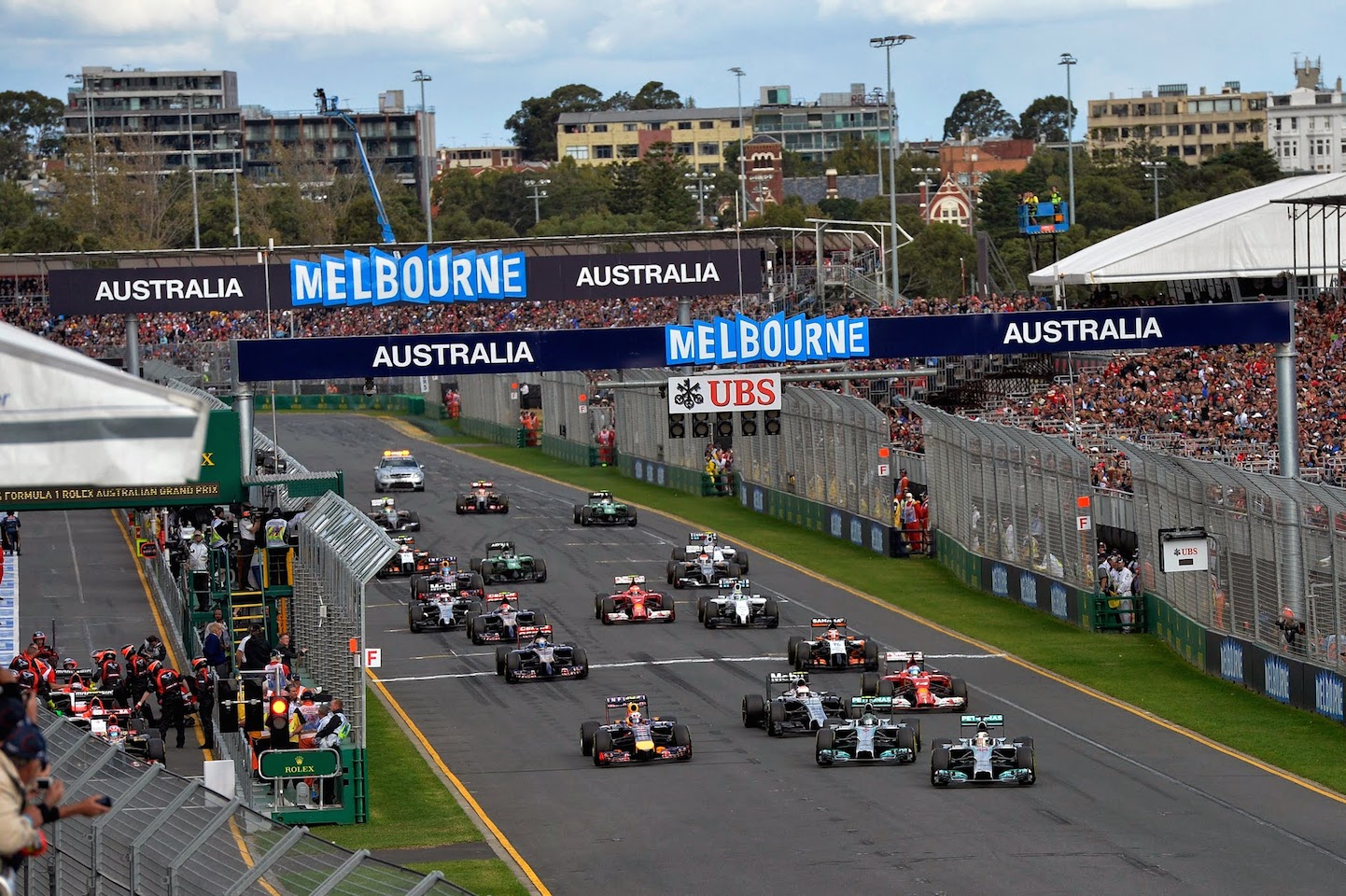
    Formula 1 has announced that it is calling off the opening round of the 2020 season.

    The first race of the new F1 season was scheduled to take place around Australia’s Albert Park circuit this weekend. Despite fears of the coronavirus pandemic F1 surged ahead with plans to kick of its season of racing while several other major sporting codes have called a halt to activities.

    Earlier on Thursday afternoon the McLaren team released a statement detailing their withdrawal from the race weekend due to a positive coronavirus test by a team member.

    Towards midnight on Thursday all team principals were huddled in a meeting to discuss the way forward. By three am Australian time no decision had been made despite several rumours running rampant that the season-opener was to be postponed. Fans and journalists alike waited seemingly in vain for an official update from the power that be but nothing was forthcoming. It wasn’t until several hours later than an announcement was made that a majority of the teams had decided against racing this weekend.

    “We appreciate this is very disappointing news for the thousands of fans due to attend the race” the official statement read. “All parties took into consideration the huge efforts of the AGPC [Australian Grand Prix Corporation], Motorsport Australia, staff and volunteers to stage the opening round of the 2020 FIA Formula One World Championship in Melbourne, however concluded that the safety of all members of the Formula 1 family and the wider community, as well as the fairness of the competition take priority”.

    Though there are several aspects that needed to have been considered the amount of time that was taken before an official announcement was forthcoming has not endeared F1 to the racing community of its fans.

    While Bahrain has already announced a race ‘behind closed doors’ it is difficult to imagine that it can go ahead. Similarly, the threat that Vietnam could soon be added to the postponement list, along with Australia and China, remains very real. The best-case scenario for F1 2020 is a season-opening race in Zandvoort. But even this remains up in the air.

  • 2019 Formula 1 Japanese Grand Prix: Thursday Press Conference

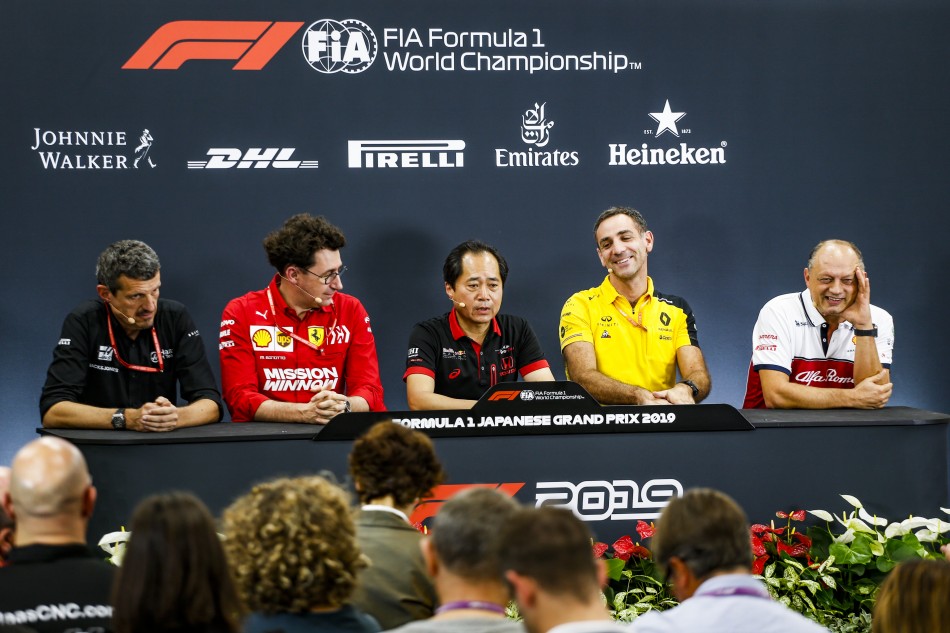
    2019 Formula 1 Japanese Grand Prix: Thursday Press Conference

    TEAM REPRESENTATIVES – Guenther STEINER (Haas), Mattia BINOTTO (Ferrari), Toyoharu TANABE (Honda), Cyril ABITEBOUL (Renault), Frédéric VASSEUR (Alfa Romeo)

    Q: Tomorrow’s programme has been called due to the typhoon. Can we get your thoughts on that decision and could you explains how it has affected your programme today. Perhaps we can start with Fred?

    Frédéric VASSEUR: I think that it’s safety first and probably it makes no sense to ask the spectators to come on track and then to be in a big mess. In terms of schedule and programme for the team. We already thought about this yesterday evening honestly. OK, it will change the programme but I think we can afford the weekend with two free practices. Perhaps it will be a good exercise for the future.

    Q: Thank you. Cyril?

    Cyril ABITEBOUL: Well, nothing really to add. It has happened before and it will happen in the future. There is enough time on Sunday to conduct both qualifying and the race. I think maybe it will give us an impression of Formula E, maybe a little bit, so not a bad thing. That’s for my neighbor on the left, and on the right.

    Q: Tanabe-san?

    Toyoharu TANABE: First, I’m sorry to the fans willing to be here Saturday, but in terms of our programme we will just prepare for the qualifying and the race this afternoon and then maybe analyse the data and then ready for the qualifying on Sunday and the race.

    Q: Mattia?

    Mattia BINOTTO: I would join certainly his comment, as first I think it’s a shame for the fans but it’s a fully respectable decision, safety is first. In terms of programmes, certainly it’s a lot more intense now. We are certainly skipping one session, which is FP3. Qualifying may be occurring on Sunday morning. But it means that today it will be a lot more intense. We’ve got, eventually, more tyres to be used – the ones from FP3. We need to set up the car for the Quali on Sunday morning. There’s just a session less. Things are more complicated but certainly a great challenge but I’m pretty sure it should be a good show and spectacle on Sunday.

    Q: Guenther?

    Guenther STEINER: Nothing to add from a sporting side. I think it was the right decision from the organisers, safety is first, and the rest is set.

    Q: Thank you gentlemen. Tanabe-san, if I could come back to you, please? It’s always special to race here at Suzuka and Honda has a good chance of getting a good result this weekend. How exciting is it to be in that situation?

    TT: Yes, it is a very special race. The Japanese Grand Prix is our home race, and then the Suzuka circuit is owned by Honda. All Japanese fans are willing it to have a good result from Honda-powered cars. On the other hand, it’s kind of pressure for us, but fans give us more power. In terms of the weekend preparation, the setting is the same as the other races. So, we just set up the PU accordingly and do our best.

    Q: Can we get a word too on the performance of Naoki Yamamoto this morning in the Toro Rosso. He was only one tenth slower than Dany Kvyat. How would you assess his performance today?

    TT: Considering it’s his first run on a grand prix weekend I think he did a good job. Comparing the lap time against Dany is a bit difficult because they are doing different strategy in the practice. But he did a decent job for the team to set up the car in the first session of the weekend and then his run today will definitely encourage Japanese young drivers. So, thank you Toro Rosso and Red Bull and it’s good for the Japanese fans as well.

    Q: Thank you. Fred, coming back to you: there are five races left this year, so when you look back at this season, has it been a success?

    FV: It was a really up and down season. We had the first four or five races where we scored a lot of points and then we had a bad momentum around Monaco and Barcelona and then we went back. The last four races were very difficult. It’s up and down. But let’s see in the last five if it’s up and hopefully the last five will be OK.

    Q: What can you do to level out the performances?

    FV: It’s small things and small details honestly. If you compare with Sochi that we were, with Antonio, we were P13 in Quali but we were two tenths off compared to P7 in Q2 and it’s very, very tight and for small details sometimes you can be completely out of the classification but we have to take care when you are doing the analysis. But it’s true also that we made too many mistakes over the last three or four weekends – teams, drivers, everyone in the same basket – but at the end of the day we have to wake up a little bit and to come back to the pace and top score points in the last four events.

    Q: And how has the experience of Kimi Räikkönen helped the team?

    FV: He’s staying calm. He’s not a big nervous. I think it’s good also for us to stay focused on the real issue and not to start to try to go in every single direction. We know what did wrong on the last two or three events and I hope that we will be able to correct it for Suzuka and the next ones, and that’s it.

    Q: Guenther, if we could come to you now please. In Russia, Kevin Magnussen scored his first points since the German Grand Prix. What aero was he running on his car that weekend and is that the direction going forward?

    Guenther STEINER: I don’t know what aero he was running because we are mixing it up a little bit. There is no definitive spec what we could call it. It’s a hybrid, we call it and, going forward, in the moment we are on a very similar spec like we had in Russia. Going forward, we test a few things and I cannot tell you what we do in the next race because we just try to get better and get a better understanding so we are not in this position next year. But, I mean, it seemed to be working a little bit better in Russia. So, let’s hope we can find a few more points on our way to the end of the season.

    Q: Knowing what you know now, what would you have done differently with the development of this year’s car?

    GS: A lot. It’s like… I don’t want to go into the specifics of technical stuff but we should have listened a little bit more to the drivers when they gave their opinion about what the car is doing and whatnot. And sometimes listen more to drivers than look at numbers. That’s what we have to learn out of this. And now I think we need to get what drivers say correlated with what the numbers say and get an understanding so we can move forward. As I said, we would have done a lot different from Barcelona onwards.

    Q: Cyril, tell us about the progress with your car, particularly this weekend, and what feedback you’ve had from your drivers about the new front wing?

    Cyril ABITEBOUL: It’s as always when you bring this type of parts, in particular with these current regulations, it’s a very sensitive part. I think everyone here would say the same thing. So, it always takes a little bit of time to understand properly, to measure, we’ve done a number of back-to-back tests. The guys are currently looking at the data at the factory – and also listening to drivers, Guenther, we are also doing that – and no, there is nothing really bad but I think there is more to come in pace and in balance in particular. But this is a very complex area of development of the car. It’s highly loaded so it creates some instability. It’s complex.

    Q: Can you tell us any more about what the drivers were saying about the car this morning?

    CA: I don’t want to go into specifics but I think the balance was not exactly where it was supposed to be, so we need to review that in particular, make sure that the data do back up what they were experiencing on track. And if that does, we’ll be making some set-up change in FP2 to see if we can indeed get it to work a bit better.

    Q: OK, and looking a bit further ahead, it looks like you won’t be supplying any customer teams in 2021. How will that impact on your power unit development?

    CA: In particular for next year there is no impact because the engine for next year is done, it’s on the dyno already, you know that it’s a long lead-time development, so nothing is going to impact what we are doing for 2020. It’s going to impact what we could be doing for 2021 on the basis that, when you have multiple customers, in particular the way that Renault is doing it, we always try to satisfy everyone to take on board all the comments in terms of installation, and so on and so forth, so that will be one less distraction. We will be able to focus on ourselves and just on ourselves. And that’s it. From an economic perspective, there is absolutely no impact and nothing in it, because we sell, more or less, at a cost. Due to the price cap limitation. So, frankly, it’s nothing, that it’s good news, because, you know, it’s always satisfying to see your product being used by multiple teams but in terms of what we need to achieve and deliver for Renault it has absolutely no impact.

    Q: Mattia, we understood from Charles yesterday that you spoke to both drivers in Maranello last week. How confident are you that another situation like the one we saw in Russia won’t arise again?

    Mattia BINOTTO: First, it’s not the first time we are speaking in Maranello. It’s true that I met both of them this week, they were in Maranello for some activities: simulator etc., I think we had positive, constructive, honest, fair, transparent discussions with both of them, individuals. I think what happened in Sochi, nothing really bad but certainly something that needs to be improved and addressed and I think it’s only an opportunity of lesson learned and trying to do better in the future. But how much I’m confident it will not happen, I’m not at all. I think these are both very good drivers. They are all going for a single objective which is winning themselves but I think what again is more important is that at least we between us we’ve got clarity and fairness and I think that’s key.

    Q: You say they’re both very competitive drivers. What have you learnt about Sebastian and Charles over the last two grand prix weekends?

    MB: I think that they are both performing very well and, as I’ve often said this season, it’s somehow a luxury for a team principal having this situation. I’m very pleased for the racing performance of Sebastian, as I am for the one of Charles since, let’s say, the start of the season and his progresses. What I’ve learned, that we’ve got a very competitive line-up. But I don’t think I learned it. It’s not a surprise, it’s something on which we’re simply happy.

    Q: And what about this weekend. How’s your car performing and what do you make of the pace of the Mercedes this morning in FP1?

    MB: It’s only FP1, very difficult normally to judge. We cannot neglect that we set the four poles in the last four grands prix but we’ve seen as well that our competitors have brought some upgrades here. The Red Bull and the Honda will be very competitive this weekend as well. The weekend will be shortened because of tomorrow. Sunday morning the conditions can be very difficult for everybody after, let me say, the bad weather of tomorrow. So, I think it will be a difficult and challenging weekend for everybody. More important that we are focused on ourselves. We’ve got some homework after FP1 certainly to do. A few balance issues to be addressed. Again, I think the benchmark are still the cars which are ahead in the Championship and we are still the challengers but I’m pretty sure we can be competitive and this is our objective.


    QUESTIONS FROM THE FLOOR


    Q: (Eric Bielderman – L’Equipe) To all managers: would you regard this afternoon’s FP2 as a potential qualification session due to the fact that Sunday morning, with the wind, it might not be possible… there is a slight chance it might not be possible to run the qualification process?

    GS: I wouldn’t say a qualification but I think a lot of us will try to put in a fast time to prevent…  if qualifying is cancelled on Sunday morning, they are discussing it now, we need to look at the weather. But for sure, we have got more tyres available as well because we are not running tomorrow so it’s a judgement for everybody to do, to see if they can do a good lap but I think it will be quite interesting as Mattia said before, this afternoon, with not having FP3, there will be a lot of running out there this afternoon so hopefully we have got an interesting programme going.

    MB: Not much more to add. I think the answer was completely clear. I don’t think the main objective of this afternoon will be to set the best lap time. The main activity, certainly, will be to address any set-up issues that we got in the morning, making sure that we are ready for Sunday because still, I think, the most likely will be to have qualifying on Sunday morning and then the race in the afternoon. But no doubt, if we can, we will try to do at least a good lap, just in case.

    TT: In terms of a PU settings point of view, we just set up our PU for the qualifying and the race this afternoon and we will see. I hope the typhoon goes very quick after landing on the Japan island.

    CA: Yeah, it’s going to be a bit of a balancing exercise because we still need to prepare the race and particularly, in our case, because of the development parts, we still need to understand (them) a bit better and look at that but in parallel, we will keep that in the back of our minds. As far as we are concerned, we have elected to stay with our Friday engine, which is down on power because it’s an engine which we were using initially at the start of the season, so it’s costing a little bit but on balance we still believe that Sunday will be decent enough so that qualifying can be run so we prefer to stay with that plan.

    FV: Not much to add that I think at the end it will be a mix between FP2 and FP3 and in case of non-quali on Sunday, I hope that we won’t take the race number for Antonio!

    Q: (Dan Knutson – Auto Action, Speedsport) Fred, when will the team decide who Kimi’s team-mate will be next year?

    FV: We will take the decision quite soon but honestly, if you have a look at the last event I think that Antonio is doing a very strong job, that he was matching Kimi in the last six or seven qualifyings in a row. He was in front in Sochi. OK, the first lap was not a good one for us but he’s doing the job and he’s improving step-by-step but this morning we had an issue on the car and he was not able to show the pace but he’s doing the job, he’s improving and I’m very confident with Antonio.

    Q: (Kate Walker – Financial Times) I have a two-part question for Mattia: first off, I was wondering if you could talk us through the progress on the 2021 rules from the perspective of Ferrari and secondly, what is your current position on the use of the veto?

    MB: 2021, there will be a meeting with the FIA and F1 next week on the 16th which I think will be very important because that’s the last one, altogether, before the end of the month when there will be a new vote. I think there are still a lot of open points and discussions are still ongoing so how will be the conclusion of all these discussions, it is very difficult to say at the moment. There are various interests between teams, between the teams and the F1 and the teams and the FIA. But certainly, as Ferrari, we are intending to play our role, we believe as Ferrari because of what Ferrari represents for F1, we’ve got a voice, an important voice in the discussions but no doubt that there’s still a lot of points to be addressed. In terms of the veto – you mentioned the veto – as I said I think last time in Sochi that will really be a shame. I don’t think that should be the case at all. I think we’ve got a good and open discussion with the stakeholders at the moment and I’m as well somehow hopeful that we can find the right compromise at the end.

    Q: (Julien Billiotte – AutoHebdo) Gunther, you’ve been summoned to the FIA stewards for what you said over the radio in Sochi. Are you surprised, are you upset, do you believe you have a strong defence case?

    GS: I don’t know what they’ve got to say. I’m going to see them in five minutes, I will be leaving here early actually, because the two dates clashed. I don’t know what they’re going to tell me. You read the same as I read so I don’t know any more information than that. I can tell you something a little bit later but I hope I don’t get a penalty for leaving the press conference early!

    Q: (Martin Moravec – dpa) Mattia, when you look at this intense rivalry between Sebastian and Charles, do you fear that at some point you could lose control of your drivers?

    MB: No, no I don’t think there is the risk of losing control because there is a difference between not managing drivers and at least having the intent to manage them. There is always a solution which is not manage them, maybe someone may do so, I think our intention is to try to manage the situation to the benefit of the team and secondly to the benefit, overall, as well, of the drivers. We may do a few things that can be addressed or improved and I think that is what we are building and trying to do for the future.

  • 2019 Formula 1 Belgian Grand Prix: Friday Press Conference

    2019 Formula 1 Belgian Grand Prix: Friday Press Conference

    TEAM REPRESENTATIVES – Cyril ABITEBOUL (Renault), Franz TOST (Toro Rosso), Otmar SZAFNAUER (Racing Point), Guenther STEINER (Haas), Toyoharu TANABE (Honda)


    Q: Cyril, big change on the driver front for you for 2020 with Esteban Ocon joining the team. First, can you tell us why you made that call?

    Cyril ABITEBOUL: First, I’d like to say it’s been a difficult call to make. Obviously Nico’s contract coming to an end at the end of this season, a decision had to be made as to whether we wanted to stay put with our driver line-up, or include a bit of a change. It’s been difficult because we all love Nico in the team. He’s been instrumental to the progress that we’ve made. We have struggled this season but last year he’s been instrumental in securing P4 in the Championship. He had a good seventh place in the Drivers’ Championship, which is clearly the best that we can targets but, you know, frankly, when you make a decision like that, you don’t just look at pure pace, you also need to look at the collective dynamic. And there is a dynamic we need to restart, reset into the team. And probably, we need to project ourselves into the medium to long-term future. So not just 2020 but also 2021, and what’s happening to his team-mate and so on and so forth. So that’s all of that but in particular the collective dynamic and what Esteban can probably bring to the team. Probably starving for racing, being super-happy to come back into racing, by nature, by construction because also he’s been out of a seat for a year. It’s all of these elements that we factored into the equation. Plus, also it’s important to say that we have, not a certainty because you can’t be certain of anything, but very high chances that Nico will be able to continue his racing career. So, just like it counted for us with Carlos last year, it’s also counted for us this year with Nico.

    Q: And will Ocon retain any ties with Mercedes from 2020?

    CA: No. He’s a Renault driver, that’s very clear. Mercedes will have absolutely no right on him for the duration of his contract. So, small difference is that his management company happens to be a racing team, and that’s Mercedes – but it’s a slightly different set-up from the set-up we had with Carlos last year, where that was on loan and not under contract with Red Bull – but he will be a fully-fledged Renault driver.

    Q: Guenther, Cyril mentioned there that he’s hopeful that Nico Hülkenberg will stay in Formula One next year. Is he a driver that you would be interested in hiring?

    Guenther STEINER: I mean sure. As Cyril said, and I think he’s right, sometimes you have to look at the whole dynamic of a team. It’s not all about the speed of a driver and if people like Nico’s on the market, for sure we need to look at that. We haven’t taken a decision as you all know. This is a thing you need to do as a team. To look what is around, how you can bring the team forward. I mean, we are not at our best this year, we were better last year, so we need to see where we can make improvements. If good people are on the market – in every area of the team, not only drivers, we look around and see if we can better the team and with that, can we better the performance of the team?

    Q: You say you haven’t taken a decision yet – when can we expect a decision from you?

    GS: I hope, honestly, in two to three weeks – because it’s good for everybody; it’s good for the team; it’s good for the drivers. It Romain stays, it’s good for him to know so he doesn’t have to worry. If Nico comes, it’s also good to give people a chance to make other decisions or to look around, so our aim is to decide in the next weeks.

    Q: Franz, Alex Albon has switched to Red Bull for the remainder of the season. What is your reaction to that change? Do you feel he’s ready for it?

    Franz TOST: The future will show. Don’t know yet. Alex did 12 really good races with us, he’s got 16 points and I must say, from the very first test onwards, I was surprised by his performance. If you remember right, I said after the first test that maybe he could become the surprise of the year. He is on a good way and I think that Red Bull will provide him with a fantastic car and therefore I expect good results from his side.

    Q: And it’s difficult for Pierre Gasly who’s coming back to Toro Rosso. You’ve been there before with Daniil Kvyat, who took a similar route. How long will it be, do you think, until Pierre gets over the disappointment of returning to Toro Rosso?

    FT: I don’t hope it’s a disappointment to return to Toro Rosso, he is welcome with us. It was only a short time he was not with us. He came to my office, I said to him: “ah, it looks like you were here yesterday.” No, he is really welcome and we have a really good relationship together, also between the engineers and if we provide him with a good car, Pierre will be back soon, I am convinced about this.

    Q: He spoke yesterday about being disappointed. Do you think there will be any problems with his motivation?

    FT: No, I don’t hope so. A Formula 1 driver must always be motivated and must always push the car to the limit and he knows that’s his chance, and therefore the motivation will be on a very high level.

    Q: Otmar, we’re talking drivers, Checo said yesterday that he hopes to make an announcement about his future soon. Is there anything that you can say on the matter?

    Otmar SZAFNAUER: Yeah, soon might be today!

    Q: Well, how about now…?

    OS: Well, I think we have a formal process of announcing, and yeah, he’s right, we will announce soon.

    Q: Can you describe the role that Checo has played in the team and how integral he is to the team going forwards?

    OS: I think both Cyril and Guenther mentioned it. There’s more than just speed and what you do on Sunday. It’s also developing the car and knowing the team, being able to compare your previous developments to the developments that you’re bringing and, because of Checo’s history with the team, of six years, he brings all that to the table. Lance, having great potential and a great talent, doesn’t have that history with the team, so you need a good mix. I think we’ve got that in Sergio and Lance.

    Q: And this race marks the anniversary of Laurence Stroll’s takeover of the team. Can you compare where it is now, compared to before the takeover?

    OS: There are many things that are different. The one significant thing is that we don’t suffer with the financial instability that we used to have, at all. That means we can plan our developments on the car, we can plan when we bring upgrades and they actually happen. We can plan our salary payments, which is helpful for everybody in the team. Apart from that, we have plans going into the future. There’s a new factory coming; we should get planning permission for that in October, probably start, have ground-breaking in the first quarter of next year. The plan is to actually move into the new factory in the break of 2021. So, although that won’t come to fruition for another 18 months, or so, those plans are happening today. We’ve added about 40 employees: we were at 405 a year ago; we’re at 445. And, like Guenther mentioned, if there are good people on the market, we’re interested for good people. We’re adding, we’re growing and we want to be more competitive. So, those are our plans going forwards – but it takes time. It doesn’t happen overnight.

    Q: Tanabe-san, you’re running your spec-4 power unit here at Spa this weekend. What advantages is it bringing?

    Toyoharu TANABE: We bring performance improvement with the spec-4 PU. The purpose of the spec-4 is a performance gain. Because as always, as I’ve mentioned, we’re still catching up pace to make the gap between the top runners and then our teams. Honda should improve PU performance.

    Q: Only Daniil Kvyat and Alex Albon are using it this weekend. What’s the reason for that?

    TT: We discussed with our teams about the PU usage and then we considered the current position, and then usage for the rest of the season. So, then we decided this strategic application.


    QUESTIONS FROM THE FLOOR


    Q: (Dieter Rencken – Racing Lines/Racefans.net) A question to the four team principals. Next year’s calendar… according to the draft calendar announced yesterday will have 22 races, which you all had to agree to. Did any of you attach any specific conditions to agreeing to 22 races? And Cyril, more particularly, could you comment on suggestions that you requested an increase in the number of power unit components if the calendar went up top 22 races, please?

    CA: I can confirm that we did. We asked for the principle that is already agreed for 2021 to apply for 2020. The draft regulations, which are just draft regulations for 2021, there is a concept that if you go above 21 races there is extra component allocation. So that’s simply what we asked on the simple basis that it’s very late to change the duty cycle of any component for next year. There was a bit of a discussion, as always in Formula One, but eventually we reached a compromise in Budapest that everyone managed to stick to, for once in Formula One, and eventually it was good to confirm the 22 races. We are happy to have specifically the same number of MGU-Ks as internal combustion engines. That’s going to make the lives of the technicians, the mechanics in the garage, an awful lot of simpler. Sometimes we don’t really think about these type of things but they do make a difference, in addition to the prospect of penalty. That was the condition that from the outset we mentioned. Otherwise we are very supportive of an extension of the calendar.

    FT: As long as we get more money, if you have more races, I’m fine with it. On the technical side, from the power unit, has just been explained by Cyril, there’s nothing to add.

    GS: We kept a low profile and didn’t ask for anything.

    FT: Also not for money?

    OS: I think we also agreed to shorten the amount of test days we have because we’re increasing the calendar, which kind of makes sense and goes to wellbeing of the mechanics and all those that travel. One of the conditions we all agreed to, if I remember right, was a shortened winter test.

    Q: (Scott Mitchell – Autosport) To the four team principals please. Ross Brawn has talked about using the stable regulations next year to maybe trial some different race formats ahead of 2021. Would you be in favour of that and what sort of slightly different formats might we see?

    OS: I think last time we got together we did discuss about some formats on Saturday to maybe mix up the grids for Sunday. We’ve got further discussions I think between Monza and September (sic). If we are to improve the show there is nothing wrong with trying and seeing how it goes, get some fan feedback, and if people like it and it improves the show, I’m all for it.

    Q: Guenther?

    GS: Otmar said a lot there. What we are a little bit, I wouldn’t say concerned, but what we need to look at is that by changing the format the costs don’t go up – that we do more and don’t get more out of it. We need to carefully think about. There were a lot of things around but we didn’t get around to discuss the detail about it. So when we get to the detail there will be the difficulty because if we change format and it costs a lot more because we do everything differently, there is a point where it is not sustainable.

    Q: So, for example, what would you say to having qualifying races on a Saturday?

    GS: That costs more money, because you need more spare parts because you have two races a weekend, you know. You need more MGU-Ks, because they can break. So we need to consider all this stuff.

    Q: Franz, your thoughts?

    FT: You know, to change the race weekend format, maybe there are some good points in there. We will discuss it in two weeks, I think in Geneva we have another meeting. But the most important thing is that the teams and the cars are on an equal level on the performance side. You can have whatever format but if there are some cars far ahead of the others – one second or even more – then it doesn’t change anything. What we have to provide the fans is a good show and for this the performance of the different teams and of the cars has to be on a level within a few tenths of a second, like it is in the midfield. If you look currently there are three teams far ahead, but the midfield is fighting very close to each other with a difference of a couple of hundredths of a second and there are good fights in between the cars and they show good races and this is what the fans want to see and I don’t think this is so much to do with the format.

    Q: Cyril do you think the format needs changing in any area?

    CA: I think we could be a bit more progressive on the weekend format. I think we need to probably adapt slightly the format to the new audience, to the way that sport is being consumed. People are not really interested in sitting for two hours in front of the TV at two o’clock on Sundays, or three o’clock on Sundays. I think that’s something to take into account. Friday running in particular, with very empty grandstands, is for me a bit of a loss of an opportunity. So there is probably some improvement to be made. I think we need to be very careful about all detail associated with having some tests into next year, as again next year is tomorrow. The plans are made already; the engines are almost being built as we speak. So if you look at the amount of discussion we had to get to the 22 races, when we start talking about the detail of the consequence of changing the format even on a couple of races, I’m a bit afraid that we see that it is a bit difficult at this late stage of the season. So in my opinion we need to do that. But I think it needs to be done properly but with a global commitment, not just testing and maybe it’s a bit late already for next year, but clearly doing that for 2021.

    Q: (Luke Smith – crash.net) – A question for Franz. You said there were no concerns about Pierre’s motivation in returning to Toro Rosso, but we saw when Daniil when returning to the team initially in 2016 how difficult it was for him to adjust back and how long it took it him to get over the demotion. Are there any concerns about that with Pierre and are Red Bull and Toro Rosso doing anything extra to help give him the support he may need?

    FT: If we see any deficiencies then of course we will support him in any way. He knows our team very well. Therefore, I think it’s a very short period to adapt to this situation and once more if the car works well and if he had a good race result and he has some success then his self-confidence is coming back and then Pierre will have the form he had before. Don’t forget that last year in Bahrain he finished in the fourth position. He scored many points in the 2018 season and I’m quite sure we will see Pierre Gasly showing a good performance very soon.

    Q: (Dan Knutson – Auto Action and Speedsport) Cyril, the team is not where you want it to be in the Constructors’ Championship. What do you need to change to get back up there?

    CA: Well, I think first you are right. The team is not where we wanted it to be. It’s a very clear regression against last year. Less points, Constructors’ Championship – it’s clear. But at the same time what’s clear is the areas of the team that need to be improved. In my opinion we have made a good step on engine power, as demonstrated by top speed on a number of tracks that are sensitive to that. Driver line-up, apart from the comments made previously, is a strong one. Mechanically the car is good. We know what’s missing and that’s simply downforce and aerodynamics and that’s clearly the current focus right now. We are looking at improving that and we will draw an assessment pretty soon and we will move from there.

    Q: (Jon McEvoy – Daily Mail) To Cyril, how near did you get last year to signing Esteban. Were there discussions with him, were there discussions with Mercedes? Did you almost get it over the line?

    CA: You’re talking about last year?

    Q: Yes.

    CA: I think it has been publicly reported that it has been discussed. It’s been discussed to a certain level of detail. The old story is publicly reported also. We had the opportunity of signing Daniel, which was an opportunity also, which was an opportunity that was discussed but never really certain. When it became certain we had to make a quick decision. An opportunity like Daniel is not an opportunity that happens on many occasions for a team like us in construction and it’s an opportunity we decided to take. But frankly I’m very happy that we managed all together – Esteban, Renault, Mercedes, Toto, myself – we managed to put that behind and decide what was best for everyone this year.

    Q: (Julien Billotte – Auto Hebdo) Cyril, Nico mentioned nationality as one of the factors behind Renault’s decision to sign Esteban. How important is it for Renault to have a French driver and also how tricky can it become for you and him if the performance does not improve enough next year?

    CA: Each time we sign a driver we create an expectation and by creating an expectation it becomes tricky. Just look at the situation of the team this year. I think a lot of the critics we have this year are also due to the fact that we created a lot of expectation by signing Daniel. It’s the same. Each time you make a decision you need to accept the consequence. On the nationality, frankly, I would not put too much down to that. It’s a plus, it’s a bonus, but it’s not an element into the decision. Saying that it is an element into the decision would mean that we have sort of changed our factors or parameters when we evaluated Esteban and that would not be fair to Esteban, just like it would not be fair to Nico or Renault’s management. It’s a plus but what matters is that he ends up in a good car also.

    Q: (Dieter Rencken – Racing Lines/Racefans.net) There are suggestions that one or two teams could be coming in in 2021. Certainly there are some plans behind the scenes for these teams to try and enter. How do you feel about it? Should Formula One grow beyond the current ten teams?

    CA: Frankly and quickly – if it’s good teams, strong teams with good backing then it’s a sustainable project in my opinion, yes.

    FT: I agree. Twelve teams, it’s a good number and you never know what’s going on with any other team. That means we need as many cars as possible on the starting grid. I think 24 is also acceptable from the safety side and from the race track and also from the space on the tracks. I would welcome them, yes.

    GS: I think it would be a good thing to have more teams, as long as they are – as Cyril and Franz said – as long as they are well funded and high profile. But also what FOM needs to look after is the teams that are here. We shouldn’t go and just try to get new teams because new is better. It needs to be looked after, the teams that are here who are doing a good job, who made a big investment and just thinking more is better, that will not work as well.

    OS: Well, I think in the future with the cost cap being introduced and implemented then there might be room for 12 teams but we do have to be careful about getting the money distribution to be a little bit more equitable so that you can have 12 sustainable teams.

    Q: (Matthieu Mastalerz – FranceRacing.Fr) Cyril, you have said Renault underestimated the investments of top teams like Mercedes, which has increased more than expected. So is Renault, as a constructor, able or willing to increase its investment in order to reach its goal?

    CA: The problem with that is a question of timing, because even if you make the decision now, you are not going to be able to spend really more before a few years, because spending more means more people, more designers, more manufacturers, more people in production and so on and so forth. And if you compound that to the fact that there will be a budget cap introduced by 2021, it’s already too late. So no, I think in reality we have no choice but to a certain degree continue with our plan, carry on with our plan. Accept the change, accept the difficulty, not use that as an excuse but be extremely determined on what it takes to be more competitive in 2021. Some people will have to manage a reduction of their operation. We will be able to stay exactly where we are or increase slightly, because the budget cap is still a chunk higher than what we are operating right now. That’s the reason why we would have liked it to be a bit lower but we understand that it’s a good compromise and a compromise that should make us more competitive than where we are right now.

    Q: (Scott Mitchell – Autosport) Over the summer break, we had an update from F1 and the FIA on the progress of the 2021 car and the regulations. There’s obviously still a lot to sort before 2021 gets finalised on track and all of the off track stuff behind the scenes. How happy are you with how things are progressing? Is there any concern that the three big teams are going to veto or block the extent of changes that you want to make the field closer?

    OS: I think we’ve got from now until the end of October to review, understand and come to a final decision. There are a lot of opinions in the room as to what should happen for the future. I believe we all want closer racing, that’s for sure. We all want F1 to keep its DNA of development and differentiation, that’s for sure. And most of us want a bit of cost-savings as well. So I think those are the considerations and we’ll all get together and hash it out and hopefully come up with a set of regulations towards the end of October that meets everyone’s needs.

    GS: I would agree with what Otmar said. I think we just need to sit down, all the teams, and see where we can take it and hopefully have a regulation soon, because there are different opinions and to discuss them all here… we could sit here a long time. There will have to be compromises found to get this regulation over the finish line and I think one way or another it will happen. If the big teams try to change everything it’s difficult for us but it’s the FIA, the governing body and the promoters which have an opinion as well, so let’s see what we can come up with until the end of October. But I think it will be… we will come to a solution but for sure not everyone will be happy, 100 per cent, and that’s normally when you reach compromises.

    FT: Yeah, there are a couple of sporting working group and technical working group meetings where all these new technical regulations are being discussed. So far I must say that the FIA and the FOM is going in the right direction. We know that we can come down with the costs which is covered by the cost cap and the money distribution should be much fairer than… We’ll come up with a different governance which is covered from the sporting and technical regulations side. We are going in the right direction. FIA and FOM should make the decisions. The date is clear, it’s the end of October and then we go for it. Up to now, I think we’re going in the right direction.

    CA: As far as we’re concerned frankly we need to focus on three important aspects. The budget cap, all the refinements, even though the principle is agreed but we need to get that done and really put in stone. Money distribution, like Franz said, we need something that is more equitable otherwise we will end up with the same disparity that we have now. And governance. We are less concerned about the details of the technical and sporting regulations because these things will happen anyway and we are prepared to increase more power to Formula One and FIA that has gone up their team in order to think what’s right for the sport. They’ve done a lot of research; they know what’s good for the sport but we want these three elements to be fixed and agreed as quickly as possible.

    Q: (Luke Smith – Crash.net) Franz, another question for you: picking up… you were talking about Max in 2015. Would you be able to reflect on what it was like working with Max through his first season in Formula One, how exciting was it playing that formative role in his future and was it immediately clear you had such a star on your hands?

    FT: You know Max was coming from Formula 3 and in those days there were a lot of people who said it’s too early for him to come into Formula One but then we gave him some possibilities to do FP1 sessions and he showed that he can do it. He had fantastic car control and he, from the very beginning onwards, had everything from the technical side under control also and therefore we signed him, or Red Bull signed him and we had a fantastic season together and his learning gradient was quite steep and then we know in the second season, 2016, after five (sic) races he went to Red Bull Racing, won the first race in Barcelona and from then onwards he is there as a driver and he made really big, big steps forward, big progress and for me, Max, now, is the driver who is able – as I mentioned, just before – to win races and to win the championship. He has all the ingredients together, which you need for doing this.

  • 2019 Canadian Grand Prix: Friday Press Conference

    2019 Canadian Grand Prix: Friday Press Conference

    TEAM REPRESENTATIVES – Toto WOLFF (Mercedes), Guenther STEINER (Haas), Franz TOST (Toro Rosso), Mario ISOLA (Pirelli), Toyoharu TANABE (Honda)

    Q: Guenther, last time you were in this press conference you talked about the need to unlock the potential of Pirelli’s tyres. What solutions have you found in the last couple of races?

    Guenther STEINER: We haven’t found any! I think sometimes when you get the tyre to work it is working and sometimes it isn’t. I think in Monte Carlo, with the family of the softer tyres, we got them to work, but we don’t have a solution. If you ask me ‘what is your solution for the next race?’ I don’t know. Maybe we haven’t got one. It’s like we fall into it or not. We are working hard and for sure by going on and using the tyres you learn more and more but do we have a proper understanding of it, I would say, no.


    Q: What did you learn during FP1 this morning?

    GS: Again, the track is very dirty. It seems like we can get the tyre up to temperature. I said ‘it seems’, I didn’t go conclusive here because FP2 will be a lot more relevant because the track will be cleaner and we can learn more. At the moment everything seems to be OK, so let’s see what in the next hours is coming.


    Q: What can you tell us about Ferrari’s upgraded power unit? You had it for the first time in Monaco, but what difference are you expecting it to make here in Montréal?

    GS: I think the difference it should make here, because here the power is much more needed than in Monte Carlo. We had it in Monte Carlo just to see that everything works and for sure it helps there as well. But at the moment we are not running it; we are running it only tomorrow, so I cannot come to a conclusion here.


    Q: Tanabe-san, this is the first real power track of the season. How much are Honda looking forward to it?

    Toyoharu TANABE: It is a very good question and a bit difficult to answer for me. But anyway, I frequently told you that we are still in the position of catching up the top PU manufacturers, in terms of power and also the reliability. We are still developing for both. It means we know our position is a little bit down from these top competitors. But in terms of the performance since the first race of this year, our forecasts showed good performance on the track, so I’m looking forward to seeing tomorrow and then the race here,.


    Q: What do you think is the gap to Mercedes no?

    TT: I cannot tell you an exact number, but we will see the gap.


    Q: When can we expect the next Honda upgrade?

    TT: Our development is ongoing and we are considering when we introduce the next step up. But we are observing the current situation on the PU, mileage and then damage, and we are discussing with the teams when is the best timing to introduce new, updated PU to the trackside. It’s not only a Honda matter; we are closely working with the teams, for both Toro Rosso and Red Bull. At the moment I cannot tell exactly when but we are looking for a new, updated PU.


    Q: Thank you Tanabe-san, good luck this weekend. Toto, we’re talking engine upgrades. You’ve got one here this weekend. Where is it better?

    Toto WOLFF: Well, we hope it’s a tiny bit better than what we had before in terms of specification, but the biggest difference is just that it’s a fresh unit. The other one has had quite some high mileage. With mature regulations it becomes more and more difficult to extract pure lap time performance out of the engines. You’re trying to find a bit more reliability, maybe run a bit harder, longer, but you are not finding these kind of big jumps that we used to see in past years.


    Q: Where do you the balance of power this weekend, between yourselves and Mercedes in particular?

    TW: If I would know! Guenther surprisingly summarized it well! The track is pretty dirty after FP1 so there is not really clear picture, people have been sliding all over the place. We were very competitive but you need to sceptical as to whether this is really the balance of performance. FP2 is going to give us more guidance.


    Q: We’ve got the same tyre compounds this weekend that we had in Monaco. What lessons have been learned from your Monaco strategy with Lewis Hamilton?

    TW: Quite some lessons. We got it wrong in Monaco, in our assessment of how long the tyre would last, so that was an important step for us.


    Q: Thank you and good luck this weekend. Mario, talking about that strategy in Monaco, how surprised were you that the mediums lasted 66 laps?

    Mario ISOLA: The problem was not related to the wear life of the tyre, more on the performance life. On a track where it’s so difficult to overtake, like Monaco, Lewis was able to keep everybody else behind him – that’s the point. The hard was working well. The best information for us was that all the three compounds in Monaco, that usually is a track where everybody is using just the two softest of the three chose, all three compounds were working well.


    Q: And what can you tell us about tyre wear this weekend?

    MI: We need to wait until FP2 because it is a session where all the teams are collecting relevant data on tyres. We have some estimation. I believe it is not a surprise that everyone is targeting a one-stop race in Montréal because the wear in not high. It is a circuit where the rear degradation can make a difference, so saving the rear tyre is probably a target for everybody here. If we make a comparison to Baku rather than Monaco, because Monaco is a street circuit that is quite unique, we have tyres that are one step softer. The weather conditions expected are good, so they probably struggle a bit less with warm-up. I will talk to Guenther later in the afternoon to understand. But I can tell you, he was coming here with a jacket and outside it’s 28 degrees so probably he has a problem with the temperature in general himself.


    Q: It’s been a busy few weeks for Pirelli, looking ahead for 2020. You’ve been testing F1 tyres and F2 tyres. What can you tell us about those tests?

    MI: Yeah, we made a plan with F2 where at the moment we have eight sessions already planned. Obviously we have to concentrate the development this year to be ready latest in December. If necessary we are also planning some back-up sessions in the Middle East at the end of the year. For F1 the plan is confirmed. We have three sessions, one in the middle of September at Paul Ricard with Renault, one at the beginning of November at Paul Ricard as well, with McLaren, and we are trying to find a solution with Mercedes for the last session, that will probably be in December. All dry sessions for the moment. We will start soon to make a plan for 2020, where we have 25 days of testing to distribute to the teams that are willing to test 18-inch tyres.


    Q: And how was the F2 18-inch tyre holding up in testing?

    MI: We did just one shakedown in Mugello, but it was really a shakedown to understand the driveability of the car with an 18-inch tyre. Don’t forget that the F2 car is without power steering, so the first target was to understand if they need to adapt the car, and if how to adapt the car with the new tyres. And we are going to test in Aragon in mid-June, so in one week’s time.


    Q: Thanks. Franz, a double points finish for the team in Monaco, your first since Spain 2017. Just how pleased are you with progress at Toro Rosso this season?

    Franz TOST: So far Toro Rosso has a competitive package together. We have a car that is fast, a car that works well from the mechanical side as well as the aerodynamic. And with Honda we have a very strong partner on the power unit side. We have two competitive, high-skilled drivers. Both of them are doing a really good job and the team is improving as well. The complete package, I must say, currently is quite good.


    Q: Tell us about the team, because Daniil Kvyat said yesterday in this press conference that the team has improved in many areas since he was last with Toro Rosso. What are those areas?

    FT: We reshuffled our aerodynamic department. We changed a lot in the production to increase the quality. Also in the assembling we changed many working methods and processes and I think everything together came up with the result that the car is quite good.


    Q: And what about Kvyat himself? How much has he improved since he was last with you?

    FT: Daniil is much more experienced now. He is much more mature. He understands the technical side much better. Last year, as well all know, he was working at Ferrari in the simulator. I think that he learned there also a lot and everything is coming together with him and therefore he is showing a good performance. But also I must say that Alex is coming up with a very good performance and I think he is a surprise and he also this morning was quite fast, because we must not forget that he is here the first time and he has to learn the track. It looks very easy from the outside but also Canada has some tricky corners, as we know, and he is making good progress. As I said before, we have two real competitive drivers. They have high natural speeds; they are quite good, talented.


    QUESTIONS FROM THE FLOOR


    Q: (Dan Knutson – Auto Action / Speed Sport) For Guenther and Franz, Liberty is on record saying they want to increase the number of races. Unlike the big teams, you cannot afford to have extra staff to rotate. How concerned are you about the stress and strain on your staff and their families?

    FT: I don’t care about the families. If we have a lot of races… we have 52 weekends, we can have 26 races. Where’s the problem? If we get the money for all the races, that’s important. Then I don’t have a problem.


    Guenther, anything you can add?

    GS: Yeah, I care about the families! That’s what I would like to add. Because then the people working are happy. I think if we reorganised a little bit the weekend, how we run it, we maybe could make some savings there. With days at the track. We cannot save days but we can adjust it a little bit. I agree with Franz, if the new races bring financial benefits, why not do it? But we need to be clever about it and try to find the days somewhere else. Just putting more and more on is maybe not productive. And also, we need to be careful what the spectator wants. There is a saturation factor which I am not entitled… or I have not the knowledge. Maybe Toto has because he knows a lot of things. When the saturation happens. In general, if we can make the weekends a little bit shorter for the people that work here, I think we can do a few more races.


    Toto, shall we just open this up to you as well. What are your thoughts?

    GS: He’s the expert!

    TW: We’re a good combination. He knows all about tyres and temperatures and I do about saturation! I think Guenther summarised it very well. I think we… saturation is something that needs to be considered. Formula One is exclusive and adding more races is not adding to the exclusivity factor. On the other hand, we are all asking Liberty to increase revenue and doing more races is obviously the biggest leverage in that respect. In my opinion it’s a fine balance. We need to respect that, at the moment, the travelling population, all the race team, is pretty flat out. I don’t think you can really do much more than 21 races. You need to work with a second shift. We have started to rotate a little bit – but then you can’t really rotate the very senior personnel. So, if we do more races, my opinion is that it needs to be linked with more income and spectacular new tracks or markets that we open up. That would be important.


    Q: (Éric Desrosiers – Le Devoir) Sorry, I have to ask, maybe to the three team managers: how do you like the new installations here on the circuit?

    FT: It’s a very nice facility, thank you for this. Generally, I like to come here to Montreal, and especially now, we have much more space. People have – not only teams, also journalists and the marketing side – have much more space for working . A big thank you to Montreal, to the city, to the government that they approved this and authorised the building. I think it’s a big improvement.


    Toto, the facilities…?

    TW: It’s a bit cold here, that’s the only one in the new facilities. But like Franz said, it’s fantastic that Montreal has committed to Formula One racing by building such a state-of-the-art facility. They have done it really well, because we have keep the authenticity of the track and the island but equally built a purpose-built facility that’s great.


    Guenther?

    GS: There’s nothing to add, just to say thank you for what the city did here. It’s always good to have new facilities, because the old ones were run down – but very good that they came up with the money to do this. Thank you.


    Q: (Dieter Rencken – Racing Lines / racefans.net) Tanabe-san  and Toto. As engine suppliers, as well as, in your case Toto, the team principal of the race team, the current engine formula was originally devised in 2009. It was given a reprieve and will now run through until 2024. What sort of formula would you like to see from 2025-onwards that would keep your wo companies in Formula One. And then, to the other two team principals: what sort of engine formula would you like to see?

    TW: I think that we are in the middle of a transition of technology, at least on the road car side, and as much as we, most of us, are fans of the loud, traditional engines, it not where the technology goes and where the perception on sustainability goes – so I believe we’ve done the right thing in keeping the regulations almost stable for the next term – because it would have caused a tremendous amount of development to come up with the new formula. Also, it is not quite clear where this next generation of power unit actually should be. Listening to our chairman of Daimler, we expect 50 per cent of our fleet to be either hybrid or electric by 2030, so I think if this is the direction technology goes, we could as well have an engine that will have a higher hybrid component, renewable energies or electricity. Today, it’s maybe around 20 per cent, maybe that ratios going to go to 50 per cent. As long as it’s an exciting engine – the sound is something that we need to address or at least talk about it – but I believe the hybrid component is going to increase after 2025.


    Tanabe-san, what’s Honda’s position?

    TT: As Toto said, we think the a kind-of transition phase now and then we just finish discussion over the 2021 PU regulation and then we keep current concept until 2024/25. Then, one of the reasons, we couldn’t find any next step, green, sustainable and then high efficiency PU confirmation now. So, it means we need to discuss again and start again, what should be the pinnacle of Formula One race PU technology. I believe the same thing as Toto. We keep a hybrid and then what we can do is improve the current principle of the current Formula One PU.


    Guenther and Franz, your thoughts…

    GS: I think we need to stay current with technology. I don’ t know that the technology will be in 2025. Toto and Tanabe-san know much better what is happening there. It was asked from Dieter, what do you like? We all like a loud, screaming V10 or V12 but that is not, in this time, it is just not acceptable any more. So, I think I would like that Formula One stays current in technology with what is happening. The engine manufacturers know what it needs to be: it needs to be sustainable, adding more electrical element, as Toto said, so, I go with them. For me, the point is, we need to stay up with technology in F1 and not go back to what I like, because I was young then.


    Franz?

    FT: I think currently we have a power unit which is on a very, very high technical level and, unfortunately, this has not been communicated in a way the power unit deserved. We have a small engine, two energy recovery systems and all these components together is the technology for the future because with this engine also in a normal street car, maybe you can do 100km with one litre, two litres of fuel, and then you come home with a filled battery. They all are talking about the electric cars, and I’m just asking where from do they get the energy? It’s not like in Formula E when 20 cars are outside on the track and behind there are 50 diesel aggregates spending their energy. This is nothing serious in my opinion – but the great manufacturers go to the Formula E or have built electric cars. I’m just asking where they get the energy from? I think we have, in Formula One, the technology for the future. As Toto said, maybe the hybrid part, electric part will increase to 40 per cent or even more. That’s fine, but from the technology itself, for me, this is the solution for the future.


    Q: (Scott Mitchell – Autosport) – A question to the three team bosses. We’re all quite excited to see what we’re going to get for the 2021 regulations, sooner rather than later. Guenther, in one of your earlier answers you mentioned maybe condensing the schedule down. That might be a way to fit in more races or reduce the load. I believe one of the suggestions for5 2021 has been to move parc fermé to the beginning of Friday, shuffle the Friday practice sessions back later. Where do you stand on parc fermé to before you’ve run on track. I guess that would cause slightly more headaches for the engineers and move the preparations to simulations before the weekend?

    GS: I’m OK with that, because that’s what I said before. We just need to plan it well, how we do it. So that we are prepared for it. We adapt all pretty quick here. There’s enough people working at it. That would be one of the solutions – to start on Friday the event, which now starts on Thursday, because we are all here, but we could do that job also from other places. That would be one of the solutions and that I think is the intent of it.

    TW: I think if you can compress without reducing the show, then that is something we should look at. I believe that for the promoters it is not great. The Friday is an important day when they are able to generate some revenue and attract some audiences. We are not keen on the parc fermé format from Friday to Sunday. There is no motor racing formula out there that doesn’t allow the cars to be touched over the weekend and I don’t think we should start with Formula One, the pinnacle of motor racing. You open up a can of worms with penalties because cars will end up in the wall and they will need to rebuilt and I think from the sheer idea of how we can add more variability, more unpredictability, have more cars braking down, I think we will achieve the contrary. We will spend more time and resource in the virtual world, runs cars harder on dynos to make them last, because we know we can’t take them apart over three days, so I don’t think this is something we should touch. There are many other areas that make sense, but this one, not for us.

    FT: Of course there are a lot of discussions going on and I’m not a big friend of this solution to be honest. As Toto mentioned before, Friday is an important day also for the organisers from the financial side. Whether we are now here one day earlier or later at the track, I don’t think this makes a big difference. We have to increase the show, we have to reduce the costs, we have to distribute the money in a fair way. I think these are the most important points. The parc fermé story is absolutely secondary. OK, it’s being discussed now among the teams but I don’t think these changes are important for the topics I just mentioned before. I think we don’t need to change anything in this way.


    Q: (Andrea Cremonesi – La Gazzetta dello Sport) Two questions for Toto: one is about the complaining of Lewis yesterday. He said he wanted a different Formula One. He’s the most successful driver in the hybrid era. I would like to know your comment about this. And the second question: it could be ugly at this moment but I would like to know what has happened about Niki’s 10 percent of the team. Are you going to buy it?

    TW: I think, on the first topic, drivers want machines that are difficult to drive and that are challenging and that is clear. I think when we need to look at chassis regulations going forward, that can be a point of discussion. I’m not entirely sure that we can go back in time. I think if you put a car on track it’s going to vibrate, not drive in a straight line and not do what the driver wants; I’m not sure the drivers would be happy about it but I kind of get the point that when you look at the images of Mansell and Senna collapsing after the end of a race that is exciting and they should be gladiators, so I can understand where he’s coming from.

    On the Niki situation, we haven’t discussed that yet. It’s too close to the tragic event. That is going to be a topic we will address with Daimler in the next few weeks and months.


    Q: (Maxime Sarasin – 98.5 FM) I want to go back to what Lewis told us yesterday. He told us that it was too easy for pilots to drive, that he was not exhausted at all after a Grand Prix and he could maybe do two or three others in the same day. And he didn’t feel that at that time, he was saying that new pilots were coming in are maybe the best athletes that they should be and he told us that that shouldn’t happen right now. So I really want to know what you think about that, what are your thoughts about that and do you think that going with technology should at least make an obligation to have drivers to be the best athletes possible for Formula One.

    FT: In my opinion, the current level of the drivers from the fitness side is the highest I’ve ever seen in Formula One. You must not forget that we now have drivers who started motor sport when they were six or seven years old. That means that when they come to Formula One, they’ve already done 10 to 15 years of karting first and then the junior categories and I’m not talking about the Red Bull and Toro Rosso drivers. Our drivers have special physical training plans. They have their own coach, they have a nutrition plan. That means they are so well prepared that the driving itself is no longer so exciting for them and of course, you cannot compare this time with – let me say – twenty or thirty years ago when Nelson Piquet and Nigel Mansell or whoever collapsed after a race. They never saw a fitness centre from the inside and some of them were smoking as well and in former days, I remember that some cars did not finish the race and then they talked about gearbox problems. Hey, they were smoking beforehand and they were not fit enough to finish the race and then they put it in any gear so that the car stopped. They were not fit enough. This is the reality and nowadays we have really really good drivers in Formula One and we have a very high level and therefore you don’t see accidents – which on one side is very good – from the entertaining point of view is boring. Friends of mine say you don’t even see a crash after the start in the first corner because they all manage to do it. It’s because the driving level is very very high, I think the highest we’ve ever seen in Formula One and this we continue. But this is nothing to do only with Formula One; this is in all the other sports as well, in skiing and so on, therefore I think we should be happy to see these drivers.

    MI: This is for the team managers, he said. I agree, it’s a completely different… we cannot compare the era of Senna, Piquet and so on with the current drivers. I believe that the level of the drivers is very good. We are changing the car from 2016 to 2017; it became a lot more physical to drive, I don’t know if it is (difficult) enough or not, for Lewis probably not. But talking about tyres, I would say that we are always trying to supply to Formula One what they want so just ask and we try to do our best. In terms of cars and so on, it’s more Toto that can give you an answer.

    Q: Well, Toto, what about Lewis’s thoughts yesterday?

    TW: You can look at the lap times. I think we have the quickest cars by now. We have changed the aerodynamic formula to take a few seconds off the cars and we are going faster than last year, so the levels of downforce are enormous and like Franz said, it’s very right that the level of perfection has just increased enormously and you don’t see these kind of mistakes any more. You could, artificially, make it much harder: take the power-assisted steering out, then you will have drivers like bodybuilders and they will struggle to finish races because it will be so tiring – that is easy – but it would be a step back in technology but maybe that is something we should consider in the future for the entertainment factor.

    GS: Or we could ban the drivers from going to the fitness studios as Franz said, so they will be tired at the end of the race. It would be a lot cheaper. And to eat fast foods all the time! No, without joking, I think Franz explained it very well: the fitness level is just so high and the cars are so sophisticated so it’s just getting better and it’s evolution. It isn’t that they are easy to drive, we are just so well prepared – they are so well prepared altogether. That is why they now complain about it.

    TT: I just remember 20 or 30 years ago, after the race, drivers got wet and then sometimes they couldn’t get out of the car. But with technology improvement, the current drivers work not only physically but also their heads. I don’t know which is good but Formula One wins, I think.


    Q: (Dieter Rencken – Racing Lines, Racefans.net) Toto, continuing what Lewis said yesterday, he actually said that Formula One should be a man’s sport. I was wondering how this sat alongside the women in motorsport initiative and also what your wife (Susie Wolff) thinks about that comment?

    TW: He was on a roll yesterday, I think! I don’t think he meant it in the way that it was seen as discriminatory. On the contrary, he’s someone who is very open to diversity and somebody who raced against Susie in Formula Renault. I think that what he meant was that it needs to be a gladiator’s sport, the toughest machines for the best drivers out there. In terms of the FIA initiatives that have been merged with Dare to be Different, I think this is wonderful to see that there are more girls now looking at go-karting and when in the past there were a hundred boys there were one or two girls now you can see there are five or six and that it’s starting to have an impact. We will see where that is in five years. I would very much hope that in our lifespan in Formula One we will see a girl racing competitively in F1.


    Q: (Scott Mitchell – Autosport) Toto, again referencing something that Lewis said yesterday, hopefully not something that has been taken out of context. It was when he was asked about the engine upgrade here and he said that one of the things that had impressed him was the fact that Mercedes had not had the smoothest ride with developing the engine or working on upgrades at the start of the year. I just wondered if we could get your thoughts on whether there was anything in particular that was troubling with the development of these engine upgrades or has that been par for the course over the last few years when you’re pushing the envelope and trying to push the engines as hard as you can?

    TW: I think we had times at Mercedes where the engine was described as the determining factor in the team’s success and then it has somehow transitioned to the chassis side and people nowadays are talking that the chassis is the leader of the pack but what really needs to be said is that with mature regulations it becomes more and more difficult to extract additional performance and keeping reliability and the guys in Brixworth are doing a fantastic job. Obviously I live in it and I’m seeing the struggles and the boundaries they are trying to push and the targets they set and sometimes they don’t reach them completely but they keep pushing and pushing and pushing and that is very inspiring to see that the group of people have not stopped chasing performance.


    Q: (Trago Mendonca – O Dia) Franz, Indycar is testing a new system to protect the drivers, the aeroscreen, a partnership with Red Bull. What do you think about the system comparing to the halo that we have now in Formula One?

    FT: The most important thing is that the safety is guaranteed. If this new system is working from the optical side, from the aesthetic side, I like it more and then we will see because the car looks more sophisticated but together with Red Bull Technology they will test everything and then we will see what the solution will be.

  • 2019 Spanish Grand Prix: Friday Press Conference

    2019 Spanish Grand Prix: Friday Press Conference

    TEAM REPRESENTATIVES – Mattia BINOTTO (Ferrari), Frédéric VASSEUR (Alfa Romeo Racing), Guenther STEINER (Haas), Franz TOST (Toro Rosso), Mario ISOLA (Pirelli)


    Q: Guenther, a promising start for the Haas team here in FP1 but it’s been another difficult start to the season for Romain Grosjean. Are we seeing a repeat of last year or is it a different set of problems for him?

    Guenther STEINER: I hope that he hasn’t got the same problems here as he had last year. I think a lot of people would not enjoy that. I think we’ve struggled as everyone has seen. In Australia we were performance-wise not too bad but we had the pit stop issue. In the races afterwards… I shouldn’t say it because I’ve got Mario beside me, but we had some issues, we couldn’t get the tyres to work, which he will disagree with heavily, I forewarn you. But here it seems to be working. But it’s too early to say, it’s FP1, you know. We at least have to go through FP2 to get to some conclusions. This morning was a good session; it was enjoyable again. Let’s hope we can repeat it for the rest of the weekend and we don’t do any damage in the race.


    Q: But from Romain’s point of view are you seeing more consistency from him this year than at the same stage last year?

    GS: Absolutely. He’s very calm. He cannot do anything about it. He stays very calm, he stays focused, and I’ve all the confidence that he doesn’t repeat what happened last year.


    Q: Now, you’ve already touched on tyres. You were quite outspoken about them after the race in Baku two weeks ago. Just tell us what the issues were?

    GS: Mario knows better than me. He’s the expert on tyres, not me you know. We have got issues, we cannot get them to work, we cannot get the heat into them on certain kinds of tracks and that is our problem. I said in Baku that we would be struggling, beforehand. Here I was more confident, not completely, be should get them to work here and we get them to work here. But we have an issue that we cannot get the tyres to work at each track, so that is our issue.


    Q: Thank you and good luck this weekend. Mario, perhaps we could get your reaction to some of the comments Guenther came out with in Baku?

    Mario ISOLA: Yeah, I believe that Baku is quite a unique circuit, where you have an asphalt that is very smooth and so is not going to generate energy into the tyre, you have a long straight, cold weather conditions, the tyres are losing a lot of temperature and we know from the past the characteristics of the circuit. Last year, when we developed the current product, we were require to have a product without blistering – you remember last year we had some race with blistering – and to reduce overheating. That was a clear request from the drivers. So basically, our tyres have been developed with this in mind. Also, the working ranges are probably a bit higher than last year. But we didn’t experience any issue here in Barcelona in the pre-season test. We had good weather, but it was February, March, and the same in Melbourne. In Bahrain, OK, I had a chat with Guenther, I know their situation, and I hope they find a solution to that but I cannot say that it is a common problem to everybody. In Baku, because of the circuit characteristics it was a bit more difficult to keep the front and rear tyres in the right operating window. The operating windows cannot be narrower than last year because don’t forget that we have two compounds, that we call C3 and C4, that are the same compounds as we had last year, so at least with these two compounds we have the same operating window, and this is the analysis I can do now.


    Q: Apart from the two compounds that are the same as last year, have the new compounds become harder to work with for the teams?

    MI: I don’t think so, because the C1 and C2 are slightly softer than last year and with the C5, which is equivalent to what we called the hypersoft in 2018, the main issue was the graining and the new compound has a better mechanical stability with the same or wider operating window. Obviously we have to discover that in the next few races, where we are going to use this compound. They tested this compound in Abu Dhabi, they tested it in Barcelona, because it was a free choice of all the five compounds, and I believe that the new compounds are not more difficult to manage.


    Q: Looking a little bit further ahead, you announced yesterday that Formula 2 will use 18-inch tyres in 2020. What can you tell us about your testing programme ahead of Formula 1 making the same changes in 2021? Have you decided how that’s going to work yet?

    MI: Yeah, for Formula 2 we obviously have a very packed test programme because we have to develop the tyres in six or seven months. We already agreed a test schedule with the promoter and with the FIA. For Formula 1 the intention is to have three sessions – September, October and November – and three teams are going to supply the mule car, and they are Mercedes, McLaren and Renault. And we are going to offer the opportunity to provide a mule car for 2020 again to all the teams, it’s their choice if they want to do that or not. So it’s the same system and the same procedure that we have used in the last few years. We offer to everybody, teams can accept or not and then we make a plan according to the number of teams that accept it. We have 25 days of testing for next year, as it was in the last few years, so we have a short development plan for 2020 in the first half of the season and then we switch on 18-inch tyres from September onwards.


    Q: Thanks. Franz, perhaps we could move on to you. We heard from Guenther an overview of Haas’ start to the season, perhaps you could give us your thoughts after the opening four races from Toro Rosso’s point of view?

    Franz TOST: Toro Rosso has a competitive package. We have a car that works well, we have a powerful engine from Honda, and two drivers that are also competing quite good. We scored points in all the races apart from Baku but I think Daniil could have finished there in the ninth or tenth position but unfortunately he was involved in a collision with Ricciardo. I’m quite positive that we can also be here within the first ten. Generally speaking I think we are in the position to come with at least one car in qualifying three and to score points.


    Q: OK. A word about Alex Albon as well. He was something of an unknown quantity coming into this season. Has he surprised you with how quickly he has adapted to Formula 1?

    FT: Yes, it was a positive surprise, because as you know, if a young inexperienced driver is coming into Formula 1 there is always a questions mark, but I said already during the test sessions here in Barcelona in February that Alex could become the driver surprise of the year and so far he has done really a very good job, with good technical feedback on the mechanical side and the aero side, but also regarding the tyres he understands how to use the tyres in the best possible and we are really very happy to have him in the team.


    Q: Thank you, Franz. Fréd, coming to you, we saw some compliance issues with the front wing of Kimi Räikkönen’s car in Baku a couple of weeks ago. How have you resolved that for this race? Have you reverted to an older spec or have you updated the Baku wing?

    Frédéric VASSEUR: Just to clarify, that I think first we were out of the spec, we did a mistake, and perhaps you could consider that the decision was a bit harsh, but it’s like this, we have to clean in front of our door first and I think the mistake was on our side and for sure that we are not coming in Barcelona with the same wing.


    Q: It’s been a strong start for Alfa Romeo this year, particular on Kimi Räikkönen’s side of the garage. But we saw progress from, Antonio in Baku. How confident are you that he’s made a breakthrough and that he can progress and challenge Kimi for the rest of the season?

    FV: I think if you look at the first four races I think he was into the pace but I think we made on his side too many mistakes. He had some reliability issues. He got the penalty in China first, he didn’t do the quali and then in Baku… OK it’s far too much, we have to give him a clean sheet one week and to do a proper job, but I think he is improving. He was in front of Kimi in Baku, and he did a very strong quali also in Melbourne. No, I’m quite confident that he is very focused and motivate and the results will come and will help.


    Q: OK, thanks Fréd, good luck with that. Mattia, we’re back Barcelona, where two months ago Sebastian in particular was singing the praises of your car. The driveability then seemed to drop away when we went racing. After FP1 today can you tell us, are you back where you were in March?

    Mattia BINOTTO: I think we never dropped away. I think that certainly we had a strong winter testing, but I think that our main competitors were as strong as we were at the time, and on the last day of winter testing they scored the same lap time as us. As a matter of fact, I think we already mentioned that they would have been very strong as well. I think that since then we are both developing our car. The car developed, so coming here it’s certainly not any more the same car we had at the time, the weather conditions are completely different, the heat is certainly a different factor. So, are you exactly, let me say, on the same page? I don’t think you can compare. I think more important that it’s a relative competition so it’s more important that we are focusing on the weekend and trying to optimize the car and the package, and we are doing our best.


    Q: You’ve bought a host of upgrades to this race. A lot has been made of the power unit upgrade that is a couple of races early. Can you just tell us what’s been going on in Maranello to bring these updates forward? Are people working even harder than normal?

    MB: Obviously when you are planning such a change on your schedule you need to do it a few weeks ago. It’s not something we decided within that week. Having started the season in Melbourne we recognized that somehow we may have been late on our let me say performance compared with our competitors and we tried simply to push on all the main items where we were already planning developments. We were simply looking for opportunities in anticipating some of the programmes. We did it already with an aero package in Baku which was somehow introduced earlier compared to our initial programme. We did it here as well for the power unit. You simply achieve that by trying maybe sometime to shortcut or intensify the activity. I have to say that the people back at Maranello have worked very hard, we intensified our activities, and we are working still very hard, as it seems that’s what we need to do at the moment.


    QUESTIONS FROM THE FLOOR

    Q: (Frederic Ferret – L’Equipe) Question to all of you: has the success of the Netflix series helped you to have an agreement with them for the Season Two?


    Franz, have you signed something with them for the second season?

    FT: No, not that I’m aware of.

    Will you sign with them?

    FT: We will see.


    Do any of you just want to give us your thoughts on the success of the Netflix series, and what you think it’s done?


    GS: I didn’t see it – but everyone tells me. I don’t know how successful it is because there were no ratings, so I’m told and Netflix never gives them, but I think everybody was positive about it, so I guess it helps. It should help to bring people in who don’t normally watch the races, who see this. There are more people watching Netflix than F1, I would say. If the people watch it and then get interested in F1, that should help us. That should help us all, and it’s a good thing in my opinion.


    And Guenther, to follow up on Fred’s question, would you be willing to help Netflix with a Series Two.

    GS: Yes!


    Mattia, will we see Ferrari involved?

    MB: I think that, as Guenther said, it’s certainly an interesting programme. We were not participating last season as Ferrari. We are considering it at the moment. We have not taken our final decision, so it’s something we will do in the next few weeks.


    Q: (Sam Collins – Racecar Engineering) Looking to the future, in 2021 to 2024, we’re going to have single make brakes and wheels. I’m a little bit interested to know how that’s going to affect your teams and, in terms of Pirelli, how it’s going to affect your company, both commercially and technically. That’s to everybody.

    MI: On our side, having a standard rim is obviously… you know that at the moment each team is designing his own rim and that could make things a bit complicated for us. Sometimes it’s difficult to fit a tyre. And heat exchange with the rim is also an item we are able to consider so, for sure, it’s a standardisation that could help on our side. The brakes as well.

    GS: Standardisation. First of all, I think it hasn’t been decided how much we do standardisation so I think we’re getting ahead of ourselves here to say that it’s been decided for ’21. I don’t know if anyone signed an agreement that it will be standardised. A lot of parties looked into it because the tenders went out – but it could go both ways, y’know? Sometimes you get some parts which just work, and sometimes you get parts that everybody’s got the same and some people get them to work with their car. The worst bit for me, we need to make sure that Formula One keeps its DNA. And the DNA of F1 for me, it’s developing… it’s the only motorsport that is free for technology. Once you start standardisation, it can be a slippery slope in my opinion. We need to be careful not going down that slope and all of a sudden ending up with all the same cars. A lot of people are interested in our technology and that is why they’re watching F1. I don’t know. First of all, we need to see what is happening with standardisation before I make a final comment how I think about it.


    Mattia, what’s your view?

    MB: Very much aligned with Guenther. So, first it’s not decided yet, yes, true there are some tenders and discussions are on-going. As Ferrari, we always relay that we are against the standardisation principle – but we know as well that we need to control the costs and expenses – and obviously there is a budget cap so we need to find the right balance. Standardisation only makes sense if you may save money, which has to be proved first. And as well we need to take care of the DNA of F1, as Guenther said. For example, if we take the rims, all the cars with exactly the same rims – I think that, in terms of aesthetics, is not good for F1 from the outside, because you’re not differentiating any more the cars from one car to the other, maybe just the paint. But it’s not something we should look at. We are going through an entire process, together with the FIA tenders. I think first we should look at the result of the tenders and then to a proper evaluation and make it carefully.


    Fred?

    FV: F1 was able to do it on the ECU 15 years ago. I think that we can manage a situation on the brakes or the rims. The only issue, for me, would be the timeline. We need to be aware quite soon, and we need to have more details quite soon about the technical aspects. If we are in a rush then everything is more and more expensive.


    And Franz?

    FT: First of all we have to wait, what the regulation at the end will say. Standardisation of parts, there are two reasons: first to come down with the costs; the second also to bring the performance together of the different teams. I don’t agree to say the DNA of Formula One is just to develop, we have to find a way to come down with the costs and no-one takes care which brakes we have in the car, or which rims they have. The people want to see some interesting races, some overtaking manoeuvres. They don’t care about the form of the rims or about the brakes. They just want to see interesting races. And we have to come down with the costs. Therefore I am in agreement with as many standardised parts as possible.


    Q: (Scott Mitchell – Autosport) Mattia, you talked about the upgrades and the earlier upgrades and rejigging the schedule. I just wanted to check what the longer-term consequences of that will be this season – because obviously it’s a long season. Does this, by bringing it at race five, does that lock you into probably a fourth engine at the end of the year – and could you introduce an additional spec at the end of the season?

    MB: No, that’s not the plan. The early introduction doesn’t mean that we cannot still use PU1 in some races. Maybe that can be an option – but certainly we are not hoping to have four engines per season per driver plan.


    Q: (Dieter Rencken – Racing Lines / racefans.net) Mario, given all the talk about the tyres etc., obviously when you came into the season, you had some form of objective list, your target letter etcetera. Are you quite comfortable that you’ve achieved all of those in terms of compounds, of degradation etcetera – and at which stage do you phase-out of developing 13-inch tyres and concentrate purely on 18-inch?

    MI: I would say, as I’ve said before, one of the targets was to eliminate the blistering that we had last year. And the other one was to reduce the overheating to give the opportunity for drivers to push more. I believe we are in the right direction. Last year we started the development of the new produce with some other ideas – and we want to conclude this phase for 2020. That’s why we have decided to keep the development of 13-inch tyre in the first part of the season for next year, so the plan is also to find new compounds with a wider working range, that is what they are asking for. And to upgrade another step in the construction. Then obviously we will focus on 18-inches, that is a big challenge.


    Q: (Ian Parkes – New York Times) Question to all four team principals. Given your respective starts to the season, could you give us an idea as to whether it has been worse, or better than expected, and the reasons behind that. And what your expectations are for the rest of the season, now you have a decent idea as to where you are performance-wise.

    FT: From Toro Rosso’s side, I must say we had a reasonably good start into the season. As I mentioned beforehand, we scored points and we have a competitive package. From the different race tracks, I must say Australia was really a big success. Many people were there, it was also not so bad in Bahrain and Baku. From the race entertainment itself, I must say it was not so exciting because we have two cars in front which are winning race after race and that’s not, I think the best for Formula One because it starts to become boring as far as friends of mine say to me: don’t watch F1 any more because always the same are winning. This I think is not good.


    Alfa Romeo’s perspective?

    FV: For Alfa Romeo racing, probably a good start to the season that we score points on every single event and it’s so tight in the midfield that you can – as Franz said before – that from one session to another one, or one race to another one, you can move from P4 to P10 and it’s very difficult to make any prediction. But I think at least at this stage of the grid it’s exciting, and when you arrive in Barcelona, you never know if you will be P7 or P20. I think that the fun is there and everybody is pushing like hell to bring updates and to push and get results on the next one. I think I’m quite happy with the job done so far – and for Alfa Romeo Racing it was a good one.


    Mattia?

    MB: Difficult answer. Certainly we are not happy for the points we’ve scored so far. I think we have missed a great opportunity in Bahrain where we certainly could have done a fantastic result compared to the one we did. I think as well in Baku we could have done a better race and certainly a better quali – so if you make the sum at the end, we are missing points, we are missing points compared to where we believe is our potential. Our objective certainly is not to be where we are in terms of – again – points and classification, so we cannot be happy on the start of the season. But assessing that from the performance overall, it’s not a drama at all. I think we have got still a good car. The competition is very, very strong and that, I think, was known and it’s not a surprise but I think we are still in the battle and we could to every single racing with the willing to do well – and we can do it.


    GS: I think we clearly underperformed from Australia onwards, because of our issues which we cannot get a grip of, and we need to do a better job going forward on that one. I think, as Fred said, the competition in the midfield is very tight which makes it interesting for F1 but I think, if you ask, maybe we should have more points but we don’t. The good thing is, it’s very close together. Nobody in the midfield went away with 30 or 40 points so you can make up a lot in one race. As long as we don’t keep on doing what we did up until now, we should be OK – but I would say, I’m happy on one side – the car is very competitive – but we didn’t get the maximum out of it. We just need to do a better job as a team altogether.


    Q: (Alan Baldwin – Reuters) Mattia, you mentioned earlier about Netflix. Another area that Ferrari have not been involved and I’m sure it’s well down your list of priorities is e-sports. I just wondered if you’d made the decision whether you were going to be competing in it and what are the pros and cons for a team like Ferrari of getting involved?

    MB: I think e-sports and Netflix – both of them are certainly great programmes. E-sport is increasing in terms of interest and certainly as Ferrari we are looking seriously into it. We are not yet fully committed to the programme but it’s something where the discussions are ongoing and we will very soon make our own decision.


    Q: (Joe van Burik – Racing News 365) It seems very likely, a year from now, we will be racing in Zandvoort for the Dutch Grand Prix. What are your personal experiences with that track and what do you expect of that event?

    MI: I don’t have a lot of experience in Zandvoort. We go there with GT racing but to be honest, I don’t know the circuit very well.

    GS: I have been once in Zandvoort with DTM, a long time ago and I think it’s a great place to go racing. It’s a race track near cities, for sure there will be a lot of Dutch fans there and I think it’s always exciting to go to new places. I know Zandvoort is not new but it’s new again for Formula One. I think it’s exciting because we reach out to more people who are sometimes in areas where they cannot go to other races and it’s interesting, new things to learn, new things to see and I actually look forward to it.

    MB: It’s new for me as well, I have never been in Zandvoort so it will be the very first time. Quite interested and exciting to be there. I think it’s good to have another race in Europe and the Netherlands, as Guenther said, a lot of Dutch fans so I’m pretty sure it will be a good race so I’m looking forward (to it).

    FV: Yeah, I went a couple of times to Zandvoort for the F3 and DTM and it was always a great and exciting event with a lot of fans. I think it’s a good place.

    FT: We did a lot of races in Zandvoort in Formula Ford, Formula Three. It was very positive, I must say I like it there, it’s close to the sea, it’s close to Amsterdam. They have, I think a fantastic infrastructure, interesting track and I expect many many spectators will come there and it will become a very exciting race for Formula One, therefore I hope that we go there.


    Q: (Christian Menath – Motorsportmagazin.com) First part of the question for you, Mario: can you talk us through the process, how you chose the three teams for the 18 inch tyre tests this year and how many teams offered the possibility? And for the team principals: what are your feelings about that, you were probably not chosen or you didn’t offer your cars? Do you think this could be a disadvantage, especially for Mattia? Your main competitor, Mercedes, is delivering a car. Could this be a disadvantage for you?

    MI: OK, the process is the one I described before. We offered the opportunity to test to all the teams and three teams replied in a positive way and obviously everybody knows that the development is not just in these three sessions in 2019, so as I said, all the team can decide to participate in 2020. The three teams that replied positively have been chosen and we are planning three sessions so it’s quite easy to give one session each.

    MB: Yeah. Obviously we have been offered. It has been our own choice not to participate. Been short on time and the resources for the programme so as Ferrari we decided simply not to take part in this test in ’19 but we are preparing ourselves to do it obviously in 2020. I’m pretty sure that we will have the opportunity to do it. Will that be a disadvantage? Certainly you cannot do everything and you need to make your own priorities as some stage and that again has been our own choice but there is still a process put in place where Pirelli anyway are sharing the data with all the teams, of the output and the results of the new tyre testing so we are certainly counting on that one for actually the very first test.

    FT: Everybody could decide. We from Toro Rosso can not afford to do this test because we simply don’t have the manpower and also not the financial resources and therefore three teams decided to do it and that’s fair.

    FV: If Mattia is short of resources to do the test, you can imagine that for us it’s not easy.

    GS: We are working hard to figure out the ’19 tyres so we have no time for the ’21 tyres.


    Q: (Sergio Rodriguez – Formula Rapida) Yesterday we saw that PIrelli will use F2 as a way to develop the 18 inch tyres. Do you think that F2 can be used as a development platform for the new revolutions coming in 2021? Not only that but in the future as well? Do you think F2 can be used as a platform test?

    FT: Of course. First tests with F2 makes sense. Pirelli can get a lot of information, data about it and in parallel to this, anyway test with the three Formula One teams and I think the way they are doing it is the right one.

    FV: Yeah, they will get live experience with Formula Two. I think it’s also good for young drivers in F2 to be used to drive with the 18 inch tyres and then I think each team will try to build up a collaboration with GP2(F2) teams and to have a look.

    MB: The question has been asked of the four team principals but for me Pirelli is the best person to reply, whether that is useful or not as a platform. The cars are quite different, the level of performance is certainly quite different. The level of downforce and loads on the tyres are different but those are things that Pirelli is obviously aware of but at least it’s a good starting point. They can get some experience on a different platform, a different formula and whatever they can do there will be of help for Formula One, but I’m pretty sure that they are pretty aware that on the F1, the exercise will be much more difficult.

    GS: I think there are no negatives to test them in F2 but the technicalities… I will leave that one to Mario to explain because as Mattia said, the loads and the forces, I think they are different, unless Mario disagrees with me!

    MI: No, no. I never disagree with you. He’s right. The forces, especially after 2017 when Formula One decided to move on to the wider size and the cars are faster and faster, it’s a good opportunity to get some experience from our side but we cannot compare the F2 tyre with a Formula One tyre. We will develop the Formula One tyre with the new cars, with a representative performance and otherwise we make a mistake for sure. We have to develop a bespoke tyre for Formula One but the effect we are anticipating with Formula Two is helpful because we can have some experience with single-seaters on 18 inches but don’t forget we are supplying a lot of other championships with 18 inch tyres, like GT and touring cars and so on, but the stress and the energy that is going into the tyre on a Formula One car is not comparable.


    Q: (Dieter Rencken – Racing Lines, racefans.net) Mattia, the way that I understand it, the veto that Ferrari has is a contractual right, not a lifetime right. How important is it to Ferrari to retain this veto right after 2020, in other words from 2021 onwards? Is it a sticking point in your negotiations or are you happy to forfeit it?

    MB: No, certainly the veto right is something important for Ferrari but I believe it’s something important for F1 overall as well because somehow it’s not only protecting us but it’s protecting all the teams maybe against some decisions which could be against the spirit or the interest of the teams themselves, something that we are starting discussing with both the FIA and F1. I think we are doing well in that respect and hopefully we can keep the same rights.


    Q: (Scott Mitchell – Autosport) Fred, just wanted to clarify what you said at the beginning about the front wing hereafter what happened in Baku. So is it correct to say you haven’t had to change the specification, it’s just that you’ve had to replace it with one of the other front wings that you had?

    FV: No, we changed the hook and the fixation.

  • 2018 Formula 1 Bahrain Grand Prix: Friday Press Conference

    2018 Formula 1 Bahrain Grand Prix: Friday Press Conference

    TEAM REPRESENTATIVES – Claire WILLIAMS (Williams), Zak BROWN (McLaren), Guenther STEINER (Haas)

    PRESS CONFERENCE

    Guenther, we’ll start with you: that looked like an encouraging first session, with Romain up in sixth place. Does that help you move ahead from the disappointment of Australia and start to put it behind you?

    Guenther STEINER: Yeah, absolutely, it will help. It keeps the morale up with the guys, from the disappointment of Australia. But then again, FP1 doesn’t mean a lot. But it’s better to be there than to be last. It helps the guys to keep going and I hope we keep going in FP2, FP3 and Qualifying. And then hopefully in the race we have a flawless race.


    And how did you pick up the guys after Australia?

    GS: I think we just regrouped and said ‘these things can happen; they shouldn’t happen, we all know that’. You don’t have to beat anybody up; they all feel bad about it. Nobody does this intentionally. It was a series of things that went wrong and it just happened in one race and when we were in a good position. But you always have to take out the positives. We learn, it seems like we have a good car, we just have to keep pushing and we will be fine the rest of the year.


    Thank you. Claire, Melbourne was quite a difficult weekend for Williams, certainly in the race. Was that race a fair reflection of where the team stands in the pecking order at the moment?

    Claire WILLIAMS: Yeah, you’re right – it wasn’t our finest hour in Melbourne. I think we probably came into the season following testing knowing that we wanted to be. I think we would have hoped that we made some greater inroads into the performance delta to the frontrunners, however that didn’t transpire in Melbourne. But I’m not necessarily convinced that Melbourne was particularly representative, I hope it wasn’t. We know that there are three key areas of weakness that we need to focus on, which we’re doing now. We certainly believe we have more performance to extract from the car and that’s what the team are working on at the moment.


    How do you move forward from here to improve the car in those areas?

    CW: As I said, we know the three key areas of weakness and we just need to focus on those. The team needs to a good job trackside to make sure that our race ops are where they need to be. The drivers need to ensure that they’re doing what they needs to do from the start of the weekend. And then we need to make sure that we’re improving the performance of the car race to race. Probably it’s the car that’s our greatest weakness at the moment, so everybody at Grove is galvanised to make sure that we bring the upgrades that we need to bring and that we keep working on it. It’s just about keeping our heads down and not getting too stressed out but the first result in Melbourne. I think that’s really important – this is a long season and we need to look forward rather than back.


    Thank you. Zak, coming to you, it’s a home race of sorts for McLaren and you had a strong result on the first race weekend, but was the pace where you expected it to be at the start of the season?

    Zak BROWN: Our pace was there or thereabouts. It was a good race for us. We wanted to get both cars home, reliably and in the points. It was a good weekend. The drivers did an exceptional job, the pit stops were good, we’re in the rebuilding process, it’s a long season, but that was a long season for us.


    Yesterday, Fernando Alonso said that the next two months are crucial for McLaren. Is that a sentiment that you share?

    ZB: I think the next two months are crucial for every Formula 1 team, with the pace of development. No one is sitting still. This race is important, the following race is important, every race is important, but we need to build on Australia, find some more speed, make sure we continue with the reliable and good team work, and I think we’ll have a good season.


    QUESTIONS FROM THE FLOOR


    Q: (Kate Walker– New York Times) This week we saw the results of the gender pay gap figures published – I know Guenther your team was exempt – but what sort of efforts are you guys making to rectify any imbalances in pay in your workforce and to what extent are the existing imbalances down to people of different gender being in different roles, rather than any deliberate effort to underpay women?

    CW: I can get on my soapbox now! Gender equality at Williams, and I’m talking on behalf of our team, is obviously an issue that we have been looking at and addressing for a number of years now. It’s hugely important as part of a wider societal conversation that we’re having and it’s really important that we tackle and we address these issues. I do think the report that came out this week is misleading. I think the criteria by which we have to report has been particularly misleading. You look at the tables of teams that have had to report and Williams is pretty far down the bottom, but they are looking at the mean and the median. And actually the most important thing when you’re looking at gender pay is that women are paid the same amount as their male counterparts for doing the same role. That’s the most important thing. At Williams we tackled that issue a while ago, probably 12-18 months ago. We know, and I can sit here with total transparency, saying all women at Williams are paid for doing the identical roles that men are paid. I think that’s the most important issue that we have to address. I think that these reports that have come out this week can be extremely misleading, because they are comparing situations where actually there are far fewer women in our roles in our teams, because this is a very male-dominated sport and always has been. However, we’ve done a huge amount of work to tackle that over the past 12 months and we continue to do so. I think at Williams we probably do more work than most of the teams in the paddock, and I’m really proud to say that, either through the initiatives we’ve set up over the past two years to address the situation, or through the work we do with external parties such as F1 in Schools and Dare to be Different. And we will keep plugging this conversation and keep doing this work to ensure that we have more females coming into our team and into motorsport as a whole. It’s so important when we’re looking at a shortage of engineers coming up. We have to be talking to all students, male and female, in secondary and tertiary education if we’re to make sure that at the end of the day this sport survives. But it is also really important to say that we recruit on merit. Sport has to be done on a meritocracy, it’s not just a box-ticking exercise for us to make surer that we have more women in. It’s to make sure that we have quality people coming into our racing teams to work.

    ZB: I echo Claire’s comments, I think she laid that out very well. What I would say is that it is a very important issue for McLaren. It’s something that we speak about frequently. It’s something that we are doing something about, so we recognise its importance and there is definitely room for improvement.

    GS: After Claire, what she said, I don’t know what to say! It was so good. Even if we are exempt, we are equal, it’s the job position, we don’t look at gender. It’s very transparent, we are very new, so we never had any history there. When we started it needed to be equal anyway. That is the position and that is the pay. It doesn’t matter whoever it is that is what gets paid. So we are very fair on that one. Even if we don’t have to report, we have no issues with that and we just keep it fair.


    Q: (Dan Knutson – Auto Action and Speed Sport) Liberty presented its broad outline for the future. It’s going to require co-operation from the teams. You’ve all observed Formula 1 for a long time and you know that teams rarely agree unanimously on everything. What’s different now than it has been in the past 30 or 40 years?

    ZB: I can’t really speak to the last 30 or 40 years because I haven’t been around that long… but I have watched it. Yeah, I look like it! Thanks! I think we all recognise that the sport starts with the fan and that’s what Liberty are focused on – putting on a better for the fan. And if the fan wins, we all win. The sponsors win, the m4edia wins, television ratings win. I think we all recognise that the sport is not where it needs to be today so it’s in our collective interest to improve the show. That means we’re all going to have make varying degrees of compromises but I think we’ll ultimate get there at the end and I’m excited about the future of Formula 1.

    CW: I was extremely positive about today’s meeting, I have to say. I think we’ve all hoped for change under our new management and I think today they presented change. I think for a team like ours, based on what they presented, it was an extremely good day for us. I came back thinking let’s crack open some champagne, because from our perspective if we can get these new regulations through, and if Liberty/FOM do everything they say they are going to do, that they presented this morning, then from our perspective I know that Williams’ future is safe. That’s not to say that we were on the brink, or anywhere close, but with today’s sport and the way it is structured and with the financial disparity between teams then the likelihood of Williams’ survival into the medium and long-term was looking pretty bleak. Everything they presented from revenue redistribution to cost caps is absolutely everything that we want to see from 2021 and beyond, so I’m personally delighted with the proposals that they laid down. I know that in the past you can have these conversations and they come out and not necessarily anything is ever done about it, but I’m not sure these discussions are negotiable. That’s not the message I got anyway.

    GS: I think I echo what Claire and Zak said. We are looking all positive after our meeting. But to answer Dan’s question, there’s a different owner of the sport in place so they will do things differently. We knew what was before, there was always the same tactics. With the new owner that is what you have got the chance to make it happen different this time. That’s my opinion about it, to answer Dan’s question straight. I think it was good today. The presentation went well. For sure, everybody goes away and comes back with questions but I think as Claire and Zak said we are at the point where we need to change something to attract people, to attract new fans to do what we need to do to make the sport the leading sport in the world.


    Q: (Jerome Pugmire – Associated Press) Just to follow up on that, is there anything – for all three of you – that you had any reservations about regarding the proposals? Any particular point?

    ZB: I think we’re going to avoid getting into specifics of what was discussed this morning. That was what was agreed amongst the teams, Chase and Ross. But, as Claire and Guenther have said, I would say overall the impression is very positive and I think the direction they’re taking is the right direction. There’s obviously a lot of details, questions – but we’ll do that behind closed doors.


    Guenther, anything to add?

    GS: No. Nice try to get more information. But no, nothing more to add. The detailed discussions are behind closed doors, we all agreed on that one, and so we should keep it like in any other business and hopefully we bring back a better sport that is better for all of us.


    Claire, you’re very happy but I assume you’re going the say the same?

    CW: Yeah, the same. Thank you.


    Q: (Dieter Rencken – Racing Lines, Racefans.net) Sorry to continue along the same sort of line but referring to this morning’s meeting, is it not… the presentation was more a Liberty wishlist rather than proposals for the future, given the fact that they aren’t actually the regulatory body. So, do you actually see this as a blueprint for the future or a discussion point?

    CW: I believe it was a proposal rather than a wishlist. It was presented as such and I think that everyone felt it was a blueprint for the future. There are obviously elements in that proposal are under FOM’s control and others which fall under the FIA’s control – but I believe that FOM and FIA are working together and, as I’ve always said, if we’re going to protect the future of this sport then we need to work collaboratively. All three stakeholders.


    Zak, did you see it like that?

    ZB: Yep. I was in the same meeting.


    Guenther?

    GS: Yes – but there is something between a blueprint and a wishlist, which is called a proposal. That’s what it was. It’s not a blueprint but it’s not ‘oh, let’s try to do this’. It’s something in between but it’s a good starting point. A very good one, actually.


    Q: (Jonathan McEvoy – Daily Mail) To Zak. As you’re chairman of McLaren and non-executive director at Motorsport Network, do you think it’s right that one of your drivers advertises a link to the magazine and the website.

    ZB: Yeah, it was a free offering. I think some other drivers are going to be doing it. So yeah, it’s a free opportunity for consumers and hopefully more drivers will help share accordingly.


    Q: (Scott Mitchell – Autosport) Just a quick one back on the topic of the meeting this morning. One of the things that was pointed out was a reiteration of the need for a cost cap. So, how much do you think is a sensible target for that and how to you think it would be employed?

    ZB: I think that falls into the realm of items that we’re not going to discuss. I think there’s a lot of detail of what goes into a cost cap and what doesn’t. I think at the end of the day we’re trying to get the sporting field levelled so wherever we land on cost caps should be based around what makes a race car fast on the track – not necessarily some of the other items that go around a Formula One programme: marketing, things of that nature. What you see in the paddock – I think that’s quite special and unique to Formula One.


    Guenther, do you have a figure in mind that you think would be good?

    GS: No. I think as Zak said, it’s behind closed doors and we have to go back to that one because we agreed on it. It will come out when the deal is done. Or maybe it never will – but it needs to be reasonable that we can put a good show on, the technology still to showcase it, and what we put in and what we take out, we have to still obviously decide on it but again it will be done behind closed doors.


    And Claire, if I could ask, if a figure was given, was it one that would actually affect many of the teams at the moment, or was it quite a high ceiling?

    CW: I don’t know whether to say it was behind closed doors or not – because that’s what everyone else keeps saying. I think it’s a balanced figure. I think obviously whenever you talk about cost caps there are going to be winners and losers, aren’t there? And it’s about compromise at the end of the day.


    Q: (Dieter Rencken – Racing Lines, Racefans.net) Question to Guenther – and I won’t ask what you could do with a $150million cost cap – but you’ve obviously played the listed parts regulation to the absolute limit and your performances and commercial performances to date in your last two years prove that it’s actually worked for you. Is this how you intend continuing going forward? To actually continue still getting all the listed parts from your favoured team supplier – or do you intend changing that model? And to the other two, do you believe that this is the way forward for Formula One? To basically be a semi-customer team acquiring as many parts as possible.

    GS: We are doing it until 2020. We were waiting for this proposal and see where we get with the proposal with Liberty Media. And then we decide what we are going to do in the future. We haven’t taken this decision yet, what we are going to do but, for sure, it seems to be working and I don’t see any point to do it different at this moment in time. But it was this morning, the meeting, we have still have not the decision of what will be done with the sport for 2021. How the new contract looks. As soon as we have got that one, we will take a decision in the months after that one, how we continue there.


    Zak, is this a future direction that you think Formula One should be exploring?

    ZB: Yeah, I think it… Haas has done an outstanding job. Gene Haas is a very smart businessman, he obviously saw an opportunity to enter the sport and get competitive with less resources than a lot of the other teams out there and I think it does point to future regulations where you do talk about some standardisation of some parts that maybe aren’t visible to the race fan – therefore it doesn’t compromise the integrity of the sport, the customisation. So, I think it is something that they’ve done a very good job on and I think we need to look at some of that, or all of that, some of the basis on which we move forwards as we try to drive cost down.


    Claire, your thoughts.

    CW: Yeah, I think Haas have done a fantastic job. They’ve come into the sport and are now a hugely competitive. Obviously we are not very happy about that – but as a model I think certainly it is not one that Williams subscribes to. I think everybody knows our philosophy around being a constructor in our sport. For us, personally – I wouldn’t criticise the way other people want to do it – but we want to retain our constructor position. So it’s not something that I would want our team to subscribe to – to go and buy a whole load of another team’s parts. For me, success for us is us designing, developing and building our race car, ourselves, in-house. And success has to come from us doing it our own way. But, as  a philosophy for other teams, we totally accept that.

    Q: (Arjan Schouten – Ad SportWorld) Zak, Formula Two is also starting this weekend. Last week, Nyck de Vries told on Dutch television that you said to him that he will definitely get a chance with McLaren in Formula One in 2019 when he wins the championship. Two questions: is that true and what does a chance mean?

    ZB: That is not an accurate reflection of the conversation but Nyck’s a very good driver. McLaren will always look to put the two best drivers that it can in the car and no one has any promises from McLaren verbally or contractually as to who is going to be in our car in 2019.

    Q: Indistinct

    ZB: We won’t comment on our contracts but I can tell you that no one has a guarantee to be in our seat for 2019, regardless of any race results.


    Q: (Louis Dekker – NOS) Do you think the Liberty plans secure the future of the ten teams?  For instance, will it keep Ferrari on board?

    GS: I cannot speak for Ferrari so I think we need to ask Dr Marchionne that one but I think there is… I’ve no idea. Mr Marchionne wasn’t present and nobody committed this morning, nobody made any comment if they would join or not. I hope they stay on board, obviously, because Ferrari’s a big part of Formula One. I hope everybody stays on board because I think they’ve got ten good teams at the moment and we should try to all work together to keep it going like this.


    Q: Claire, you said you came out very happy from that meeting. Do you think every team came out very happy from it?

    CW: I’m sure that some people aren’t going to be very happy. If you hear the intricacies of that meeting then, as I said earlier, there are always going to be winners and losers in this situation and sometimes it’s about compromise if we’re to protect the future health of this sport. Like Guenther says, I can’t comment on Ferrari’s feelings around the proposals that were laid out. All I can comment on is our team and if their proposal is blue-printed then it does protect the survival of Williams and at the end of the day that’s all that matters to me. I want our team to be competing and hopefully winning in this sport for the next two, three, four decades.

    ZB: No, nothing to add, I think we’ll find out soon who’s on board and who’s not. Hopefully everyone will be on board, that’s what’s going to be best for the sport and I believe for all the teams as well.


    Q: (Julien Billiotte – AutoHebdo) Claire, you mentioned key areas of your car that need progressing, improving. Can you be more specific? Is it a case of lack of downforce, issues with stability or something else? And regarding the updates, do you think you can have them ready perhaps for Baku or will you have to wait for the start of the European season?

    CW: Yeah, we don’t really like airing our dirty linen in public at Williams. It’s not fair. We know the areas and that’s half the battle, to make sure that you understand the weaker areas of your car. Clearly everyone always wants more downforce, that’s certainly something that we need to work on. But it’s across the whole car. We do believe that there is more performance to find, that we didn’t manage to get it out in Melbourne and so that’s the work moving forward. We do have some significant upgrades coming in the next few races and I’ll be really looking forward to seeing how those perform on the track but as I said earlier, it’s a long season but we have work to do. We’re not happy finishing where we finished in Melbourne, we’ve got to make progress but unfortunately a lot of the other teams that we thought we’d be fighting with have made greater progress than us and really we haven’t done a good enough job and we need to really dig deep if we’re going to make progress this year. It’s going to be a really tough year which is great for the fans, just not so great for us at Williams.


    Q: (Dieter Rencken – Racing Lines, RaceFans.net) Zak, the new regulations post-2020, whatever is in the public domain and other stuff that we’ve heard etc, would this incentivise McLaren to actually become a complete manufacturer and provide their own engines, because obviously the manufacturers will receive bonuses and with you sourcing an engine from a French production car company doesn’t qualify you for that yet you are also a supercar manufacturer?

    ZB: You know it’s very early days, hours into understanding directionally which way this sport’s going to go with engines, so it is something that we discuss from time to time but with all that we have to accomplish right now, our heads are focused a little bit more on tomorrow and Sunday. As things become clear, then we’ll have that discussion.


    Q: (Louis Dekker – NOS) We heard a lot about 2021, there’s a couple of years to go. Isn’t it frustrating that nothing much can be done to get more attractive races in the short term?

    CW: Yeah, I think we’re probably all slightly disappointed by the race in Melbourne, that it didn’t bring the track action that we’d like to hope for. I think there are probably circuits coming up where we may see some more interesting racing. Melbourne’s not necessarily an easy circuit to overtake on. I hope that improves. I know that the TWG have been talking about means by which to improve the racing, to overtaking, in the coming weeks, so I think we probably have to wait and see the outcomes that they discuss to hopefully effect change for the next couple of seasons, because probably we can’t wait and our fans certainly can’t wait until 2021 for us to improve things.

    GS: I would go back to the comment that we didn’t have a lot of interesting races; we’ve had one, one swallow doesn’t make a summer. I think we should wait a little bit longer to see if it is interesting or not. As Claire said, Australia’s not the easiest circuit to overtake on anyway. I would wait a few races before we jump to conclusions but in the meantime, again as Claire said, the TWG has started its own ideas to make overtaking better and to see what’s coming out there. I stay calm. We didn’t have three years of uninteresting races, we had one this year so give us a little bit of time.

    ZB: I agree with Guenther, it’s been one race. I they’re also talking about some modifications of that particular circuit and then hopefully we can have discussions. We’ve got an upcoming strategy group meeting where we will discuss things for 2019 so hopefully we don’t have to wait until 2021 to impact some change but let’s see what’s necessary after a few more races.

  • 2017 Belgian Grand Prix: Friday Press Conference – Part 1

    2017 Belgian Grand Prix: Friday Press Conference – Part 1

    PART ONE: TEAM REPRESENTATIVES – Christian HORNER (Red Bull Racing), Cyril ABITEBOUL (Renault), Guenther STEINER (Haas)

    PRESS CONFERENCE

    Cyril, it seems that in terms of patterns of performance, Nico generally qualifies well but finishes behind his qualifying position – couple of exceptions to that but in general that has been the picture – whereas for Jolyon the opposite is the case. Can you shed any light on that?

    Cyril ABITEBOUL: Well, I think indeed we started the season with generally a good pace on Saturday that we were not managing to convert on Sunday. So at this point in time and as we were waiting for some big developments that came further into the season we sort of trade some quali performance for some race performance by playing mainly with set-ups – by playing mainly with set-ups, stiffness and so on and so forth – which we did, which we achieved, which delivered some points. Then at some point, in Silverstone, we managed to bring that big development I was referring to. So that pattern that you are referring that you sort of underperform on Sunday compared to Saturday is not so true anymore. We will have to see here if that pattern, if that step that we made in performance both on Saturday and on Sunday in Silverstone and as confirmed in Budapest, which are two very different tracks, is confirmed here or not. When it comes to driver difference, no I can’t… I think that indeed, Jo doesn’t necessarily have the sort of pace as Nico on Saturday. Clearly, Nico is an amazing qualifier. Maybe he is one of the best of the grid. It doesn’t always… it’s not always visible because he didn’t maybe have the car to demonstrate that but it is really amazing what he’s capable of doing and Jo maybe doesn’t have that pace on Saturday but was managing to extract more from the car on Sunday. We’ll see. The short answer to your question is that the car is improving. The car is now fourth in terms of pace after the top three teams, which is clearly where we wanted to be at this point of the season. Obviously the championship position is slightly different so that’s what we need to focus on.

    Comprehensive answer; thanks very much for that. On Robert Kubica, everything was built up to the Hungary test. Things gained their own momentum; he did well. So what happens next?

    CA: What happens next: good question. That was a test. Frankly, we said that we wanted to be extremely methodical and analytic about the way we were approaching things with Robert. It’s not a PR exercise; it’s not a coup. It’s something we are taking very seriously and we are trying to leave the emotion on the side. We don’t have all the answers that we potentially wanted to get from that test, after his test. In relation to that, Formula One is very restrictive in terms of tests you can do, so in a perfect world we would want to do more of this type of test to see if he can race again at the level that he and we could have wanted. It may or may not be possible. We will see.

    Thank you. Christian, coming to you: performance today, it looked like you were in touch. Last year you were front-row qualifiers and got a podium. Do you think that’s possible again this year, and also could you explain why you went for such a radically different selection of tyres for your two drivers compared to Ferrari and Mercedes? It’s not usually such a radical difference among the frontrunners?

    Christian HORNER: Firstly, today: it’s been a relatively sensible day. We’ve been looking at different set-ups and configurations and fourth and sixth in the second session is reasonably encouraging, particularly at this type of circuit. I’m sure the others have still got a little bit up their sleeves for tomorrow, if it’s dry. But hopefully we can consolidate where we are and be competitive on Sunday afternoon. Regarding the tyre choice: you obviously don’t see what others are doing before you submit your choice so our engineering team felt that this is the best way to attack the weekend. As we often see, you start off with a different hand of tyres but by the time you’ve gone through the practice sessions it always seems to converge by the time you get to qualifying anyway. What on paper looks quite racy at the beginning of the weekend, by the time you’ve gone through the practice sessions tends to even itself out. I think by the time we end up in qualifying we won’t be too far out of kilter and obviously we quite like the ultrasoft tyre.

    Clearly. Can we explore what Red Bull’s attitude now is to the young driver programme. You’ve produced some great drivers over the last decade – world champions, race winners – but it’s not so easy to see where the next candidates for Formula One apprenticeship are coming from. In the meantime, your rivals such as Mercedes, McLaren and Ferrari have stepped up on that side and all have exciting candidates on the doorstep ready to go. Is it still a priority for you and Red Bull?

    CH: Very much so. We still have Pierre Gasly, who won his first last weekend in Japan. We have Nico Kari in GP3, we have Dan Ticktum in Formula Renault and Verschoor and Verhagen. I think there are periods of stellar drivers that seem to come through the sport. For me if I look outside of Formula One at the moment, there seems to be a bit of a gap. There are a couple strong drivers in F2, there are a couple of strong drivers in GP3, but there seems to be a bit of a void. We’re going to grass roots, we’re looking at karting, we’re supporting some youngsters even in karting at the moment. But talents like Max Verstappen or Sebastian Vettel or Daniel Ricciardo don’t come along every season.

    OK. Guenther, a question to you on drivers as well: you have confirmed both of your current drivers for next year, not taking either of Ferrari’s development drivers, Giovinazzi or Leclerc. Can you give us the thinking on that?

    Guenther STEINER: Our drivers have got a contract when we signed them. Romain two years ago now, he had a three-year contract and Kevin last year has a two-year contract, so it’s quite clear what we are doing. There is no reasoning or nothing behind it. We, at the time, wanted the best drivers available on the market to get as much points as possible and that’s why we did it and there is no other reason behind it.

    OK, that’s the drivers sorted out. When you look ahead to season three, where else do you think you need to strengthen the team personnel in order to move forward?

    GS: I think everywhere a little bit. It’s not like there’s one void [to fill] to grow the team. We are still very small, I think the smallest one, we have got not more than 200 people at the moment. We need to strengthen it everywhere. That’s what we are doing. We are now already looking for people for next year because it takes quite a long time to get good people, but we will increase again by 10 or 15 per cent – nothing compared with the big teams, how they grow – but that is what we are doing and that is what we want to continue to do. But we keep on getting… I wouldn’t say bigger, we try to get better without getting bigger, which is very difficult, but at least we try to stay efficient because that is where we want to be.

    QUESTIONS FROM THE FLOOR

    Q: (Pierre Van Vliet – F1i.com) A question for Cyril about the Robert Kubica situation. You are telling is that you have some questions with no answers yet. What are they? And after the Budapest test – 142 laps in the heat and the lap times he did – he seems to be ready, no?

    CA: Well, obviously we have access to some information that the public, the media don’t have access to and I feel that is privy information to the team and Robert and I would not want to speak without his control. But no, you know, there are various things to do to come back into a racing car at this level, a car that is extremely different from the car that he’s been driving six or seven years ago, as well the car that he drove in the test that he has done in Le Castellet, which was a car from 2012, much lighter, less downforce. So without going into too much detail, you could see what it could involve to go one step further. The problem, as I said, is we are restricted in our ability to test and to reproduce this test. And addition to that, testing in isolation, private test, one car, in control on the amount, without rain, without the first-lap action you can always encounter. All of that needs to be factored into the decision of pursuing or not pursuing, so as I said I don’t want to go further than this, I don’t want to create speculation and I don’t want to put in the team that the team would have some obligation to go further because there is an interest, a willingness from the public to see Robert back. We would all like Robert to be back, but it has to make sense.

    Q: (Dieter Rencken – Racing Lines) Guenther, I see from the internet that your sporting director, either former, ex-, present or whatever, Dave O’Neill, has started his own company, together with one of Christian’s former employers Kenny Handkammer. Could you confirm that? Is he still with you? Is he leaving? And what are you going to do about replacing him if that is the case?

    GS: He’s leaving. He’s not here but he is coming to a few more races. I don’t know about Kenny Handkammer, and Christian I think doesn’t know any more. But Dave is leaving because for family reasons he relocated to the United States. I don’t know any details about his company but he’s free to do that. We have got a good relationship. He helped a lot in bringing us to where we are. But for family reasons he had to relocate to the US and that doesn’t work for us. So he will be around for a few more races and then he will be gone.

    And a replacement?

    GS: Replacement: we have got plans in place and we will announce them when there are ready to be announced.

    Q: (Jerome Pugmire – Associated Press) A question for Cyril. Do you have a date in mind when you will take a decision with regard to Robert and can you say when that is?

    CA: Deciding on Robert is deciding our line-up the second part of our line-up for next year. It’s well reported that Nico has a multi-year contract when Jo has a one-year contract. So obviously we have one driver to decide for next year. So we have also the restrictions I was referring to on Robert and we’ll also need to consistent with the timing of deciding for a second driver and as the market is starting to sort of go, with the different announcements this week of Ferrari and McLaren, and I expect there will be some other announcements at some points, because usually these things do not go in isolation, so we cannot just be sitting on our work and making up our plans and our timing ourselves. It has to follow the timing of all the drivers.

    Q: (Louis Dekker – NOS) A question for Christian. The orange army will invade the country again like last year, especially on Sunday. Is it realistic to dream of a Max victory?

    CH: Everybody is free to dream, but realism and dreams are sometimes a little bit different. It’s fantastic to see the support for a driver that there is here in Spa. It’s a sellout crowd, everything is absolutely rammed and to see so much orange around the place for Max is quite phenomenal and obviously last year was quite disappointing for all those fans that turned up when his race was effectively over within 50 or 60 metres and we’re hoping that it will last a little bit longer this year. He’s had a lot of bad luck so far this season and where better place for it change but than here at what is effectively his home grand prix.

    Q: (Alan Baldwin – Reuters) A question for Cyril about engines. There has been a lot of talk about McLaren talking to Renault about an engine supply, about Toro Rosso talking to Honda. Can you give an update, because it seems that neither of those two avenues have gone very far? And also, how many teams could Renault actually supply engine with next season, because I think Christian said three is the maximum?

    CA: Well, the situation is that we have multi-year contracts with Red Bull Racing and Toro Rosso, so frankly we are open to discussions. I can confirm that there has been discussion with McLaren. But as you mentioned at the end, right now there is a restriction in the regulation, if we wanted to supply more than three teams first. And in addition to that, I don’t think it would be reasonable to believe that we could supply more than three without degrading the level of service, the quality of the service for the other teams, so we’ve had discussions. Frankly, again, we have contracts in place. We value the relationship with Red Bull. It’s a longstanding relationship and we would like to carry this relationship until it’s term in 2020 but if there is something to be done, why not, but right now understand that things are very quiet and certainly we are not necessarily proactively pushing for anything.

    Q: (Alan Baldwin – Reuters) It’s a rather historical question for Guenther. Amongst all the anniversaries this weekend, it’s also the 50th anniversary of the only win in Formula One by an all-American team. I was wondering how much that historic win influenced your team and whether that is something Haas is aware of and pushing to become the next?

    CH: Were you aware of it?

    GS: No! Thank you for making me aware of it. I didn’t know that it was an anniversary but it’s good to know. I think it will be a few more years until we get down to that level. It’s a lot more difficult than it was 50 years ago. It’s different; it’s not more difficult. It was difficult at the time; I’m not trying to say it was not difficult. What we will try to do is get an American team on the podium as soon as possible but for a victory I think we are a few years out. But it’s always good to know these things and thanks for letting me know.

    Q: (Dieter Rencken – Racing Lines) Question for Christian, the Toro Rosso-Honda negotiations that apparently happened during the shutdown. I know that you’re not directly responsible for Toro Rosso but how would such a deal fit into the overall Red Bull Racing scheme of things?

    CH: Well it doesn’t really affect Red Bull Racing so whatever engine Toro Rosso takes, the only affect it has is the synergies between the teams in terms of gearboxes and so on. We need to know pretty quickly, within the next couple of weeks, what the scenario is. I think the gentlemen in the next press conference, Zak and Hasegawa, they should be able answer all of your questions in extreme detail.

    Q: (Louis Dekker – NOS) Have you got a predictable weather forecast for me for Sunday and, if not, what would you hope?

    CA: Forecast, I think the forecast for today was that it would be dry, so it says a lot about the quality and accuracy of forecast in Spa. So otherwise it will be about being capable of reacting and being on the right tyre at the right time.

    Christian, presumably you feel you could win in the wet?

    CH: Well, we’d love it to absolutely piss down with rain for the whole day but I don’t think that’s likely to happen. It’s going to be usual Spa weather: bring your suncream and an umbrella.

    GS: I was told two hours ago it will rain for about two minutes but it will dry out quite quickly. So, I’m a little bit with Cyril on that, y’know? Let’s see what is happening. Normally I don’t hope: we just deal with what is happening. Whatever comes we will deal with it as best we can.

    Q: (Ysef Harding – Xiro Xone News) We asked drivers what their preparations were during the holiday, and getting ready for the second half of the season. So what did you all do to prepare yourself for the second half of the season during the holiday?

    CH: Well, obviously training hard, like my drivers, dieting, all the usual stuff… no, in all seriousness, it was an important time to have a bit of time out with family, for them to remember who you are. I think it’s a good thing within the Formula One calendar to have that time out. Not so much for us but for the mechanics and all the people in the backroom that work such incredibly long and hard hours. So to have that period of time as a bit of downtime, to spend time with family and friends, is very important. The only exciting thing that happened to me was getting stung by a jellyfish.

    Cyril, any jellyfish in your summer?

    CA: No, no-no. Sleeping a lot. All that Christian said is absolutely accurate. Time with friends aand family. Sleeping, because I personally do not get enough of that and in addition to that I think it’s important to come back with this willingness of being back racing again. We’ve got a long calendar and sometimes you motivation is sort of fading away with what the sport is demanding in terms of energy. So it’s good to be back and being willing to go for it for that second half.

    Guenther?

    GS: Same for me. I stayed with my family and I can just say what Christian said. It’s good for all the mechanics which work far harder that we do, to be honest. So for them to have some time off, to spend some time with family, and just did some things that I don’t get to do during the season because I am sitting a lot in an aeroplanes. I stayed in Europe. Happy to be back.

    Q: (Dieter Rencken – Racing Lines) Cyril, could you confirm that your team coordinator has resigned recently and is it coincidental that that position is resigned at the same time Haas has a new position in a similar capacity?

    CA: You’re talking about Geoff? Our racing coordinator. Yes, I can confirm that – and we may or may not be making some announcements in relation to him. Geoff was, and is, an important person at Enstone. Because not just Renault, Lotus, Enstone Benetton before if I go in reverse order. Geoff has been part of the Enstone family, so we have to prepare a big farewell party, even though he’s not going… he may or may not be going very far. But I can confirm the first part of the move at least.

    Q: (Graham Harris – Motorsport Monday) To all three of you, Chase Carey has recently said that he’s looking at increasing the number of races each year. Possibly up to as many as 25. Now, the number of weekends available between March and November is limited: would you be prepared a)to agree to that type of number and b)we’d be seeing a lot more back-to-backs and even triples – would it not be a better idea to perhaps lengthen the season, start earlier and perhaps end first week in December.

    CH: Look at next year’s calendar, we’ve got a triple header this time next year followed by a double-header with a weekend gap in between, so already the calendar is… my feeling, at saturation point. 21 races is, I think, the absolute limit. To go beyond that, I think we’re pushing teams, we are pushing engineers, we’re pushing travelling staff too far. So then you’re going to end up in rotational shifts. As soon as you do that then the costs will become exponential with it because you’ll end up with a much bigger workforce to accommodate that. And it will be expensive. Of course ultimately anything is possible but it comes at a price – and to increase to that amount would be significant. I’d far rather look at the venues we’ve got and pick… y’know if there are ones that aren’t coming up to scratch at the moment, replace them with better ones and have the competition to be in a tighter championship than going to 25 races. That’s pretty much every other weekend during the year. At some point you reach saturation.

    Guenther?

    GS: I think it’s a fine line here. If it makes economical sense for Chase how to do this, I think it can be done. To answer the question, should the season be longer or should there be more back-to-backs, I think it will be both of them because you cannot get it in otherwise. Otherwise you have just back-to-backs and that is almost not possible, and also there are other ways to accommodate 25 races. Maybe shorten the weekends, shorten the time we setup our garages and stuff like this. Control that a little bit more. Again, in the moment, Chase is saying it but there is not the fact that it is 25 races and he never came back to the Strategy Group proposing this in a way, as you just say it. He said he likes to do it – but I think Chase, before doing it, will come back to the Strategy Group and get real answers of actually what teams can do and cannot do. He’s not going to go ahead and organise something which we then cannot do – because then he hasn’t got a show. I think it’s a plan but I think there are more than one way to do it, and one way would be to not do it, one way would be to make a longer season, shorter race weekends, shorter events. But first of all he must come back. What happens if it costs money for us and there is no revenue coming back in. Why should we be willing to do it.

    Cyril?

    CA: It think all has been said by Christian and Guenther. I think it’s all about quality over quantity and I would focus on quality rather than quantity. I think we need races that are absolutely iconic, huge races, something that is really, really big and create the expectation of seeing those races. If you look back in the history of Formula One, you didn’t need to have that many races in order to have Formula One popular, and in not even more popular than it is today. So that will be my answer, in addition to the economic factor which should not be underestimated with the cost to Formula One and all the teams travelling.

    Q: (Joe Saward – Auto Week) On the subject of saturation, do you think that more races is something that the public actually want – or do you think they’re happy with what they’ve got now?

    GS: I think you will get different views on that but in general I think it’s a 50-50. Some people want more races, some are happy with it, some want less. I think it’s quite equally split, and the good thing with a lot of races is that you can decide not to watch them – if you don’t have them, you cannot decide to watch them because they are not there. So, in the end it’s a little bit like ‘what is saturation’? That’s my opinion about it.

    Christian, is there a risk that if people watching sometimes they might stop watching all together, do you think?

    CH: I can’t even remember what happened earlier in the season, let alone if we go up to 25 races. It’s like any good book. There’s so many chapters that make up a good book and not all the chapters are going to be exciting and riveting – but you do reach a point where you can overfill it and I think that, as Cyril was saying earlier. Pick the premium events, pick big events, promote them, make them fantastic and go for quality over quantity would certainly be our preference.

    CA: I would only add that we need to be careful. We will never reach the number of events like American sport, NASCAR, or even NBA. It’s hundreds of games, so we may move from 21 to 25 but it’s not going to hugely impact on the profile of Formula One. It’s still on a limited number of weekends. I don’t think we should work on quantity. We should focus on quality.

    Q: (Luigi Perna – La Gazzetta dello Sport) Question for Guenther Steiner. We recently read in an interview to F1.com from Gene Haas that he will confirm your actual driver line-up for 2018. That means the Danish Magnussen and the French Romain Grosjean – but you recently also tested the Italian Antonio Giovinazzi of Ferrari and last year Charles Leclerc that is another young driver of Ferrari. Do you see a chance for them in the next future? In the short term, I mean.

    GS: Next year it was made pretty clear also from me that in ’18 we are set with our drivers. In ’19 we don’t know and we haven’t talked about it. Yes, we they tested for us both. Charles and Antonio. Charles last year and Antonio this year, and he will do more FP1’s this year, Antonio – but there is no decision taken for ’19. There is no plan. What we know is Antonio will do another six FP1s this year and that’s about it and then we need to see again what we do next year.

    Q: (Jerome Pugmire – AP) Just to follow up on the 25 races for all three of you. You spoke about costs and putting the quality before the quantity but what about the drivers? Do you think they could handle 25 races or would they not want to? It seems a lot.

    CA: I can’t see why not but like any sportsman there is a time for recover but it doesn’t look to me that they are particularly struggling when there is a back-to-back. 21 or 25 isn’t going to make a huge difference – but, as always, I think that every single individual working in Formula One needs to have some form of huge motivation in order to be racing and providing the best in terms of sporting performance or show and so on and so forth. I don’t think that if we wereto go too far in terms of figures, that motivation may be impacted. Physically, I don’t see any limitation, as far as I can see.

    CH: I think as far as the drivers are concerned, most of these guys are in their 20s, early 30s, most of them are paid several million pounds to drive the best cars in the world 21 weekends of the year. It doesn’t sound that bad a deal to me. They don’t have to go testing any more. So, if you look at the demands on a driver now, compared to where it was ten or 15 years ago, they’d have been leaving here on Sunday to go straight to Jerez to run around there for three days and then on to the next grand prix. So, life as a grand prix driver, compared to what it used to be, is far more focussed on racing, and they get a lot more free time than they would have done, as I say, ten or fifteen years ago.

    Anything to add Guenther?

    GS: No, I have nothing to add. I think physically it’s no problem for the drivers and, as Christian and Cyril said, life is pretty good for them. So, to do four Sundays more, it wouldn’t bother them.

  • 2017 Chinese Grand Prix: Friday Press Conference

    2017 Chinese Grand Prix: Friday Press Conference

    TEAM REPRESENTATIVES – Cyril ABITEBOUL (Renault), Monisha KALTENBORN (Sauber), Robert FERNLEY (Force India), Franz TOST (Toro Rosso), Guenther STEINER (Haas)

    PRESS CONFERENCE

    Cyril, clearly you’ve made a lot of progress with your power unit over the winter,but it hasn’t all been plain sailing. Can you give us an insight into where it still needs a little bit of work and when you expect to have some solutions in place?

    Cyril ABITEBOUL: Well, I think it’s fair to say we had a pretty good 2016 season from a power unit perspective, but we’ve made a bit of a brave decision to actually re-start from scratch again, because frankly in Formula One if you don’t move forward you just die. So we had no choice but to accept to take some risks by, again, starting with a whole new architecture, which we had to do from a performance perspective and we saw that a bit of short-term pain for a longer-term gain. So we are in that period of a bit of pain because we have some weakness related to the, I would say, the health of that power unit, but which on the positive sign is really delivering good promise and good results from a performance perspective. So there is much more to come but that will only come when the reliability is here and that will come in the very soon future.

    Can you be a bit more specific about when that’s going to come. When can we expect you to be firing on all cylinders effectively?

    CA: We don’t want to go too much into the specifics, because when you start to give planning, everyone is now expecting and in particular we have very demanding customers and they are right to be demanding customers, but we want to continue to control our destiny and our programme. What I can say is that we are making sure reliability is under control and is as transparent as possible for the customer teams. We will have some fixes in the next few races and there will be some performance upgrades with the introduction. But the problem is that with the new regulations, with fewer power units used during the season, obviously you need to sync up the performance, reliability upgrades and the introduction of new power units.

    There was a recent meeting in Paris to discuss the future engine regulations in Formula One. What can you tell us about that meeting? How productive was it?

    CA: It was a good meeting. It was a productive meeting, very functional, chaired by the FIA in Place de la Concorde, but with the attendance of current engine manufacturers, plus a number of people interested in becoming engine manufacturers in the future, plus also to get an answer of Ross – Ross Brawn. So it was good, a good meeting which has allowed us to share the diagnosis of the current engine regulation, what we think it was good, what we think is less good and what could be done in order to improve, and the associated process and timing. So I don’t think it’s my duty to communicate upon the result of that meeting. But in general, I believe, and that’s good, that it is a positive sign for where Formula One is going which is in my opinion is a bit more constructive and forward looking than it has been recently.

    Monisha, that was some debut by Antonio Giovinazzi in Melbourne. How impressed were you?

    Monisha KALTENBORN: Well, we were all very impressed, considering how quickly it happened. When we came to Melbourne with Pascal, there was no indication at all that we’d end up in this situation, because Pascal, being a very ambitious driver, really wanted to driver but when he realized he does have a responsibility to the team and if he is not 100 per cent fit he really needs to say that. We more or less overnight had to make this call and then to see Antonio, who drove the first test for us in Barcelona for, but that’s of course not in any way comparable with the car, what it is now, he still came in there, did a great session, did a good race, no major issues or dramas, so we’re very impressed by him.

    What can you tell us about Pascal’s condition and when will he be back?

    MK: Well, from a medical perspective he was declared fine to race, already at the tests. The rest is a question of his fitness to the extent that he wants to be able to deliver 100 per cent during the entire race. We’ve heard also now in between from doctors and all that, it is very challenging for the drivers. We heard that from the drivers themselves. He’s working flat out on his fitness. It is very difficult to say, because the body is not that logical or analytical in its development, on what day it’s going to be there but his target and our target is to have him as soon as possible in the car, ideally at the next race, but if not, it will the next one. But clear is that he is our second driver and that’s not going to change.

    We’ve just heard from Cyril about the engine meeting that took place in Paris last week. As a privateer team, in what direction would you like to see the engine regulations go?

    MK: Well, for a private team it’s extremely important for the costs to come down again. We had reached with the earlier engines a point where we were talking about $8m engines and it was meant to be coming down further and now we just went the totally opposite way. So we want them to come down to an affordable level. But more importantly there should be a certain parity amongst the powertrains. We wouldn’t want that the engine should be the main denominator or differentiator in performance. So what’s very important is the parity and the costs.

    Q: Bob, coming on to you, the team was fourth last year, first of the privateers teams, if you like. Can you give us some insight into how difficult it has been to prepare for these new rules in 2017.

    Robert FERNLEY: Well it’s not actually been hugely different than normal. We obviously look at the following year’s car very early on anyway. We had a very clear development programme for the ’16 car which the technical team delivered perfectly and, obviously, resulted with the fourth place – but we were also well ahead for the ’17 car. So I think, obviously there is a significant cost involved, simply because there is no carryover in the new regulations but like everything it’s an interesting challenge. We’re starting with a clean sheet of paper and you’d like to think that your technical team can build a car that can do exactly the same again.

    Q: You’ve already raced this year’s car once. There’s quite a large gap from you to the front, how to you assess the pecking order at the minute?

    RF: I don’t think there’s any question or doubt about that. You’ve got the three top teams that are spending significantly more than the rest of the field and I think that’s the difference.

    Q: Is fourth in the Constructors’ Championship a realistic goal for you guys this year?

    RF: Absolutely. Absolutely. I think we’ll be fighting, it will be very tough because there’s some very good competition around but that’s probably going to be one of the most exciting positions that’s going to be fought over for the whole season.

    Q: Guenther. Melbourne. Positives and negatives for the team. How do you reflect on that race.

    Guenther STEINER: The positives, for sure you try to think on the positives but then the negatives always come up. I think qualifying with Romain qualifying sixth on good speed, no luck or nothing, that was good. Kevin wasn’t so good because he struggled in all the practice sessions with one problem or another and he just wasn’t delivered but after qualifying we were pretty happy and pretty positive and then in the race we had the failure, the water leak and the turbo failure consequentially, and you go home empty-handed. You go away knowing that the car is there. We just need now always to get always the potential fulfilled and the potential out of the car in each race track. So, I think in the end it’s positive, even with a little bit of a sour taste.

    Q: It’s a very tight midfield this year. Do you think the team has the development capacity to keep at the front of it?

    GS: I don’t know. I don’t know what the other people are planning to do. It’s always trying to shoot a moving target here. So, I think I know what we are going to do. We are going to introduce developments. We have a good plan in place but I don’t know if the others have a better plan or if their updates are better. That I don’t know. Looking back in the past, I think our quantity and what we want to do is equal to the other midfield teams. For sure it’s nothing compared with the big three but let’s hope the quality we bring to the race track in development and updates is to be in the race with them.

    Q: Franz, great start for the team in Melbourne. How much of a surprise was it to get both cars in the points given your lack of reliability during winter testing.

    Franz TOST: Winter testing we were suffering a little bit in the first test with reliability issues but fortunately we could sort out most of the topics for the second test already. Therefore I was not so surprised by our performance – but of course it was good to have two cars in Q3 and then at the finish with both cars in the points. This is always a good start.

    Q: You’ve got the most experienced driver line-up in the team’s history, you’ve got a stable technical team. What do you think you can achieve this year?

    FT: The target is the fifth place in the Constructors’ Championship – but as my friends here around, they have nearly the same target and we will see. I think that we have a very competitive package, we have a very good car, we have to experienced drivers and the team is also making progress, we have also some development steps during the year and it will became a hard fight between Renault, Force India, Haas and ourselves.

    Q: Do you think you can challenge Red Bull Racing?

    FT: No. Red Bull Racing is not our target. Red Bull Racing is in another league. I am happy if we challenge successfully the teams which I just before mentioned.

    QUESTIONS FROM THE FLOOR

    Q: (Jia Hui Huang – Guangdong Television & Radio sports channel) To all of you. Someone says listening to F1 drivers is wrong, it’s bad for F1 racing. As we’ve seen in the first race the drivers are happy because they can push harder – but the fans are not. They are not satisfied. It’s boring. No overtaking. Standard one stop. What do you think. F1 should listen to who?

    GS: I don’t fully agree with the comments, that the new cars are boring and everything negative. I’d rather see the glass half-full than half-empty. I think the race in Melbourne was by no means boring, in my opinion. We had a different winner than last year. I think that the fight between Ferrari and Mercedes and Red Bull will be very close. We have got an interesting midfield, there will be fights, the overtaking was not very good but I would not jump to a conclusion yet that this will be the whole year. Like this, it looks like it’s difficult but other elements will come in to overtake, so I wouldn’t say that all the fans are negative about it. There’s a lot of enthusiastic people out there that think the new cars are good – so I’m pretty… I don’t see it like this.

    Franz, do you have anything to add?

    FT: I agree with Guenther. For me, the race in Melbourne was quite an interesting race because it was a close race. There were many cars within a few tenths of a second and the overtaking manoeuvres in Melboure are always difficult, it was always in the past the case. We must wait now the first three races to get a clearer picture – but the cars are looking much better, much more aggressive and I think the direction was OK. The rest we will see during the season.

    Cyril, anything to add?

    CA: No, nothing much to add. I believe it’s a little bit too early to judge. We need to give a chance to the product. It’s an interesting formula in many aspects. I think strategy will play a different role, qualifying will play a different role. You will have in this new formula to execute everything perfectly well, so I think it puts the onus on the teams here at track to make sure you get also to the right setup, so everything is perfectly executed. It’s a different challenge, an interested challenge, certainly it is to live from inside. Obviously we also need to care about the fan out there, so answering your question about who we should listen to. We should also listen to the fans – but that’s one of the things I believe Liberty and FOM in its new format, which is also to look at surveys, trying to understand what the fan really wants. Not think for the fan but listen to the fan for themselves.

    Bob?

    RF: From our side, sitting on the pitwall, we had two drivers that did two incredible overtaking manoeuvres. Certainly it got my attention on both occasions. I think they were exceptional manoeuvres and, from a strategy point of view it’s actually quite interesting because it’s bought a new dynamic into it. We now have both the undercut and the overcut process and I think it’s going to be one of those things that’s going to prove very interesting as we move into the year.

    Monisha, anything to add?

    MK: Well, it’s all been said. You have to wait and see. It’s just the first race, it’s a very unique race and that’s always been the case. When these rules were bought in, we all knew what the negative sides would be and that the positives side was mainly to have more attractive cars, and I do think most of the fans actually like that. So we’ve achieved one target. And the other issues are to do overall with the competition. We should just take it from here and try to find other things, other rules that we can also target more at the other issues you raise. It’s an ongoing process but I think it’s kicked off very positively.

    Q: (Dieter Rencken – Racing Lines) To the four independents or privateer teams and then a separate follow-up to Cyril. Could you see yourselves, given that there’s no clear guarantee of engine parity going forward regardless of regulation changes, could you see yourselves clear to retaining the current engine formula provided the price is dropped? And then to Cyril, given that the manufacturers have spent most of the money already on this particular engine formula, does it really make sense to consider dumping it just when it’s on the cusp of being reliable and highly competitive?

    MK: Well, as a private team, we understand that from the engine manufacturer’s perspective you have to represent certain technologies and that doesn’t go against our businesses or our business models as such. Where it’s gone terribly wrong is on the costs. We certainly want a movement that is irrespective of the technology which is being used. The other aspect we  – like all other teams, irrespective of if you’re private or not – have to consider is what it’s done to the show and that’s where a lot of criticism is coming from –  all the discussions around the sound – and so  as a private team, these are more important issues to us and we have to find a balance overall that what is necessary for manufacturers to stay in there, what do they want to showcase in here… but it has to be making the competition a good one, so that we all actually have certain chances in there; it has to be affordable and the fans should like it, because at the end of the day we’re doing this for the fans.

    GS: I think, on the cost, sometimes what we were thinking is that the engine which is developed now it’s never finished being developed but it’s at a good level, so I think the cost should come down or you freeze the engine. Sometimes, keeping something you know – and like it was done with the V8s, to freeze the engine spec –  that would make it cheaper, if we go for the cheap and a very high technology. So now, jumping to a potentially cheap version of some kind of engine, but starting development from new, could be more expensive than keeping this engine with the high technology just to freeze  or to reduce investment, so that’s another idea which needs to be discussed, between the engine manufacturers, but I’m sure they will come up with some ideas and that will be one of the things I guess somebody will come up with, if we keep this. The technology in this engine is amazing for everybody involved in engines, this is an amazing technology, so now we go backwards and maybe invest more money to develop something which is actually not as sophisticated as this. So I think it needs to be evaluated as well, if maybe from a certain point on. All their engines are the same, we freeze the engine like we did with the V8s, that would be a possibility. But again, in the engine group, we as independents have not got a lot of influence so we can just voice our opinion outside of the group and say maybe that’s an option. So I hope they weigh up that option as well because I don’t know, just to go to a potentially cheaper engine, if that’s the right way, and reduce the technology. As Monisha said, there may be an issue with the noise but it will never be perfect whatever we do so there is some give and take and maybe we could live with that.

    RF: I think there is a little bit of work which could perhaps be done to address some of the issues, particularly the noise and simplify the base technology, but I think I agree with everybody else. I think that the principle of the current engine shouldn’t just be abandoned, a lot of work has gone into it but I think it could be simplified a little bit. I think a lot of the things that we’re doing perhaps go beyond what even the most sophisticated of fans is understanding, so we could come back a little bit, get the cost right, obviously get the power and the noise right and move forward but you don’t have to throw the baby out with the bathwater.

    FT: I nearly agree with what’s been said so far. For me the pillar for the new engine is the parity – there must be a chance that there is parity between the different manufacturers because without it they can’t contribute anything to the show and they do something. It cannot be that some cars are far ahead. We will see now what’s going on during the rest of the season. The second pillar is the costs. The current engine is simply far too expensive. From the technology side, it’s a fantastic engine, it’s extraordinary technology but it’s therefore also very very expensive. And the third point is the noise;  we need to bring in some music and these are the criterias and I think, regarding the parity and the costs, this is now in the hands of the people who make the regulations and if the development is restricted from the beginning onwards with very strong regulations then I think we will achieve the goals with the parity and the costs and the sound, it should be able to find a solution that the fans are happy with, the music of this new engine.

    Q: So let’s get the view of a manufacturer now? Cyril?

    CA: I feel a bit under the spotlight. I think one thing is that we cannot be stubborn, or we cannot be deaf to what obviously we’ve been constantly hearing since we introduced those new engine regulations. I think fundamentally there were very good things introduced with that new engine formula. With the previous V8s, we believe that clearly Formula One had lost contact with the direction that automotive was taking so something had to be done. Maybe we’ve been a step too far, we’ve been a bit moving from something that was a bit too old-fashioned to something that is maybe too modern, too complex, too sophisticated, too expensive. We need to be a bit careful about solutions that seem to be easy like freezing current engines because if we freeze the current engine we will freeze something that is extremely expensive and costs will not go down. Development costs for manufacturers may go down but supply costs to the teams will not go down simply because the bill for material of the engine is extremely expensive because of its sophistication. So I think that again that it seems there is a common view about the diagnosis of the current regulations and what we would need in order to build from there, without starting again from scratch, over and over again, but I think the devil will be in the detail and it’s not going to be that easy to find a solution that satisfies everyone and achieves everything, so I think it will be about prioritising and that’s where I hope that the new process in partnership between the FIA and FOM with Ross Brawn – who has a fantastic understanding of all the complexity involved – will provide a good leadership for the discussion. I think everyone agrees that there should be some element of electrification. We don’t necessarily see some road relevance or contribution to the show to an element like MGU-H, so that this orientation for the future, I think the whole debate would be on the architecture of the internal combustion engine which will be an interesting debate and some things that I guess will keep us busy for the next few months.

    Q: What would you like to see, how many cylinders?

    CA: There is what I like and there is what we need. I don’t think that Formula One can afford to turn its back on some things that are relevant to the manufacturer, given the current business model of Formula One. Formula One could completely change to a different business model and go for something that is really different  and not road-relevant but that would be a brave manoeuvre. As far as I’m concerned, I started with the sound of the V10 and that’s something that I will never forget obviously, but that’s just me. The new generation, the generation that we need to attract – because it’s not just about the current fans of Formula One, we also need to think about the fans that we do not have – those fans have never heard the sound of a V10 and maybe for those fans, getting back to a V10 or V8, is not so relevant. So it’s a complex debate and an interesting debate and I hope it’s going to be done in a constructive and also documented manner and again that’s where I believe all the surveys that are going on, all that will also go on in the course of this year will be instructive for the direction that we need to take.

  • 2016 Formula 1 Brazilian Grand Prix: Friday Press Conference

    2016 Formula 1 Brazilian Grand Prix: Friday Press Conference

    TEAM REPRESENTATIVES – Christian HORNER (Red Bull Racing), Maurizio ARRIVABENE (Ferrari), Paul HEMBERY (Pirelli), Monisha KALTENBORN (Sauber), Guenther STEINER (Haas), Frédéric VASSEUR (Renault)

    PRESS CONFERENCE

    Christian, can we start with you: just looking at the track action that’s been going on today, the long run pace obviously looks quite close to Mercedes, but is it really that offers you the chance to fight for victory, or can you be a little more optimistic after today?

    Christian HORNER: Well, I think under normal circumstances the usual business will happen. Mercedes have been the dominant force all year and there’s no reason to expect any different this weekend. But, race pace over the last few race, on a Sunday we’ve managed to get close to them particularly their tail car. Perhaps with a little bit of weather… there are some unpredictable forecasts over the next few days and opportunities can hopefully present themselves to put a challenge on.

    Either way, there is a pretty good chance that you are going to wrap up second place in the Constructors’ Championship this weekend. Given where you’ve been, in transition from 2015 to 2016, does that constitute a success?

    CH: It would represent an enormous achievement for the whole team. We came into the year thinking, ‘you know what, to get into the top five will be difficult’. But the guys have produced a great car. The people at Renault have done a good job with the engine over the winter. Our season has just grown stronger and stronger. To be sitting here having achieved 14 or so podiums, two grand prix victories, Max’s first victory in Barcelona, Daniel with a one-two finish in Malaysia and to be sitting here ahead of Ferrari on points and the nearest competitor to Mercedes represents and extremely impressive season for the whole team.

    Maurizio, what about your side of that story: the battle with Red Bull. It’s not the team you set our to be battling against this year in the world championship but how and why did they get ahead of you?

    Maurizio ARRIVABENE: I think first of all we need to take into consideration… it’s not an excuse but it is circumstances that happened where we lose position on the grid and you know when you start a bit in front the story is going to change. Having said so, they have a strong reaction, as Christian said, and we are below of our expectation. By the way, as I said many, many times, we are not giving up here and not either in Abu Dhabi. I know it’s tough, but the championship is still not finished.

    Now you told Sebastian yourself, personally over the radio in Mexico, to “calm down”, quote-unquote, and he admitted sitting here yesterday that he did lose his cool in Mexico but he said it was not down to frustration, so how happy have you been in general with his performance?

    MA: I have zero problem with Sebastian. I mean, as I said many, many times, Sebastian is quite emotional. Sometimes he looks a bit more Latino than German. I think Christian knows the matter like I do. He’s very emotional, he’s very passionate, especially when he’s driving and it’s in a racing battle. It’s not a question of frustration. Sometimes he can be unhappy as we are unhappy because our expectations are different. But he’s not a guy who is giving up; he’s a guy that is pushing like hell. Sometimes when the adrenalin is going up to the sky, maybe he’s choosing a word more than what is expected, but then my role, like in Mexico, is also to call him and to invite him to be focused on what he’s doing.

    Paul, you brought soft and medium again this year to Interlagos, but also the hard tyre. It’s quite an unusual move, only the second time this season you’ve brought a harder tyre than the one that came last season. How’s that looking?

    Paul HEMBERY: Well, you wouldn’t want the supersoft here that’s for sure, so it sort of chose itself from that point of view. The soft tyre is suffering. It’s hot, an aggressive track, high wear, so it’s pretty much as we expected, but that was the majority choice as well of the teams.

    Important test coming up for you in Abu Dhabi. Can you give us a preview of what to expect and a general overview on progress, where you are with next year’s tyres?

    PH: Well, we’re clearly homing in on final solutions now. There are still going to be a lot of combinations tested next week in Abu Dhabi. Still some compounding work, we’re still working on some internal aspects of the tyre but we’re progressing as planned.

    Fred, coming to you, you’ve retained Jolyon Palmer for 2017 to drive along Nico Hulkenberg. What were the reasons for that and what do you expect from him in his second year?

    Frédéric VASSEUR: First we had to secure the first one. It was done with Nico around Suzuka, something like this. Then we were able to postpone a little bit the decision. If you have a look at the last event, I think that Jo did a very good job; he is improving. If you have a look also to what he did in the past in the junior series he was always able to improve step by step, year after year and we took the decision to move forward with Jo and I would expect that he will have the same improving curve that he did in the junior series and it will be good.

    Now, a lot hinges for next season, for you team and for Christian’s team, on the Renault engine taking a decent step. So will it?

    FV: I hope so! It’s in the pipe… I think Christian also thinks so… no, no we are working on the project of the new engine and I think everything is going well so far and we will see in Barcelona.

    Guenther, coming to you and continuing on the theme of the drivers, Esteban Gutierrez has said on social media this weekend that he is leaving your team and there are strong suggestions that Magnussen will be leaving Fred’s team to come and join you. What’s most important for you over the next couple of years? Is it to have consistent drivers that you can work with to develop the team and the cars or would you look to bring in an American or a rookie? What’s the most important thing?

    Guenther STEINER: I think the most important… just if somebody hasn’t seen the press release, it just came out maybe 10 minutes ago, we confirmed that Romain and Kevin will join us next year, that just came out 10 minutes ago. We want to grow the team and therefore we wanted some experience of drivers that have been on the podium and that have scored points and Kevin was fitting the bill, therefore we moved forward with him. I would like to take this moment to thanks Esteban for what he did for us over this year. I think he has got a good future; he did a good job and whatever people say he is a good driver. He helped us develop the team from nothing to be where we are so thanks a lot to him.

    Q: The Ferrari partnership has obviously got you started in 2016; you’ve scored plenty of points but as you now move forward, are you now looking to build your own capability in the future to be able to take control of your own destiny.

    GS: No, we have a long-standing contract in place with Ferrari that we can continue the business model we are doing. We are going forward like this for the next few years and then we see, we rethink. But at the moment we are very happy with Ferrari, what they did for us over the year to get again to the point where we are now. Hopefully we finish eighth if Fred’s team doesn’t pull out something very special, and we hope we move up next year. But in the moment, for sure you always develop your team and you keep on getting better and more people in and that will happen – but in general it stays like we are now.

    Q: Coming to you Monisha, staying again on the theme of the drivers, the other teams clearly as we’re hearing have been tying down their drivers and making their announcements, just a few moments ago in the case of Haas. You did yours here a couple of years ago I think. How far off being able to do the same thing are you and should we expect any changes?

    Monisha KALTENBORN: Well we are still in the process of analysing our options but it’s not going to take that long any more. We still have the target that we do want to announce in the season, so there’s not that much time left. So that’s all I can tell you now.

    Q: Jörg Zander has returned to the team. How had he benefitted from his years with Audi in particular and what will that bring to your team?

    MK: Well, we know Jörg Zander for quite a while. He was the chief designer in our team earlier and now, as we decided to actually take up a technical director again it was quite an obvious person to look at. He’s been working at Audi for very long, he has a lot of motorsport experience now, inside Formula One, outside Formula One, so we do think he fits in very well with that because we also have third party business outside Formula One. I’m sure he’ll bring many new ideas and the team can only benefit from that because we are now in a new era, you know it’s a new chapter in the team history and this kind of influence and these ideas will only be beneficial to move into the right direction.

    QUESTIONS FROM THE FLOOR

    Q: (Alessandro Giannini – Agência O Globo) For you Monisha, I would like to ask you a direct question about Felipe. How are the talks with him and if he has one chance to stay at the Sauber team?

    MK: Well, Felipe is certainly one of our options, that’s clear, we know him well, we know his skills. We’ve had a lot of experiences together with him: good ones, bad ones, so we can assess him very well. So talks are taking place, that’s what I can tell you.

    Q: (Andrea Cremonesi, La Gazzetta dello Sport) Question for Maurizio, yesterday you present an appeal now for the podium win in Mexico. I would like to know some more details, when you find out the new elements. If you can give us some more details about which are these elements.

    MA: Yes, if we present according with the International Sporting Code Article 14.1, we presented new elements, of course, as we said, what we think are new elements and we have the right to present it. If you want me to present all the elements here, is not something that I’m going to do because in 40 minutes we have a conference call and we have to discuss the matter. I think it’s not correct to share this kind of information here.

    Q: (Dieter Rencken – Racing Lines) As the previous question proves, there’s been a lot of controversy about the regulations etc and Christian, you and Maurizio have been particularly outspoken about them. You’re both members of the Strategy Group: would you like to take them up in the Strategy Group. Would you like to take them up in the Strategy Group? What would you like to see changed? And if anybody else would like to comment, feel free, please.

    MA: Back, if you refer to Mexico and many other races, I think, I understand the difficulties of the stewards because sometimes they have to take a decision immediately and to take this decision they need to collect in quick time all the available data and material – and it’s not an easy job, I think. That is further complicated by what we said many, many times at the strategy group level about sometimes the complication of the regulation. We ask many, many times to try to find a way to simplify the rules, so I think this is something that we need to think further for the future, making sure that we don’t have a Rule A that is covered by the Rule B that is covered by the Rule C and D and E and F and so on. If there is a rule it is A dot. And then we go to the B. I’m expressing my thought with all the respect for the people that is making the rule. But I think this sport, it is already complicated in terms of technology, in term of what we have to do to build-up the car and to make competitive the car. I think simplifying the rules could be a good help for everybody.

    Christian, your view.

    CH: Yeah, I think that we’re over-regulated in many respects, that the drivers need to take a rulebook with them really on a Sunday now in the car and consult it before they either defend or make an overtaking manoeuvre these days and there’s too much subjectivity and interpretation of different events. So Lewis Hamilton going straight on at the first turn last weekend, comes out half a kilometre up the road, is that an advantage or a disadvantage compared to Max going off and coming back in the same position he went off with, with dirty tyres later in the race. It’s very difficult for the teams, for the drivers and one can only think for the viewers as to what’s permitted and what isn’t. I think, like all things in life, keep it simple. Keep it straightforward. I’d say less rules in terms of… but more clarity in terms of what the rules of engagement are. Nobody wants to see dangerous driving but let the drivers race, let them go wheel to wheel. I mean everybody’s talking about the last five or six laps in Mexico because, let’s face it, the rest of the race was pretty boring. The last ten laps were fantastic and of course there’s been a whole bunch of discussion about it since then and that’s what Formula One needs to be and I think let’s avoid the situation that drivers can cut corners and gain an advantage. Put a gravel trap there. Put something to slow the cars down, and then it takes that subjectivity away from stewards having to interpret ‘well, is that result different to this one. Is that incident different to that?’ We can see so many examples of that that I think for the teams, for the drivers and most importantly for the fans, let’s come up with something straight forward and simple that’s easy to understand and interpret.

    Monisha, do you agree?

    MK: Well I agree with that but I think there’s another element to it which is how you actually apply the rules, and you would need to try to bring some consistency in there. At the end of the day it’s always up to an interpretation, it’s up to the discretion of the people who are doing it, so apart from making things simpler it’s also that you try to have consistency on the people. That you have somebody who is always there, or a group of people because this is how you will bring in certain consistency on how rules are applied. So I think you have to look at both sides: look at the rules themselves but also how they are implemented.

    Fred?

    FV: It’s not an easy point and to know if we are to take the decision during the race or not, the first one is that you will always have someone to complain: that if you take the decision during the race you will say that OK, the steward has to take time before to take a decision and, if they take the decision after the race, OK you will affect the results of the race, after the podium and so on. But for sure we’ll have always issue with the chicane and probably the only solution would be to do all the races in Monaco but even Monaco will be tricky. The solution to slow down the car when they cut the chicane would be the best one to be sure. We have to find a solution that the guy will be directly penalised, that will avoid discussion and the stewards and so and so and so because it will be always the same mess after the race.

    Final thought on this Guenther

    GS: I think everything was said. I think I’m good, y’know, they all spoke and I agree with all of which was said. It’s just to try to simply what we are doing.

    Q: (Silvia Arias – Parabrisas) Maurizio Arrivabene, just two days ago Bernie Ecclestone said that in his opinion maybe the problem with Ferrari not winning races is because it is 100 percent an Italian team. I would love to know if you agree with that and in which way the passion which we know the team has and which we know is fantastic is a handicap for your work?

    MA: First of all, we all know Bernie. The day after he said the opposite and he also came to me to explain himself without being requested to do so. If I’m not wrong, it’s said that I need somebody nearby me to help. I don’t need it. I’m part of the Ferrari racing department and I have hundreds of people who are nearby me. We have a new technical group led by Mattia Binotto. They are enthusiasts, they are working very very well. So we have a team. In terms of the passion, I was always passionate about Ferrari, all my life, I have to say, even before doing this job and Ferrari is about passion, it’s about emotion. When I’m at the factory and I cross the street to go in the GT department and I’m looking at new GT cars that are coming out from the factory, for me it’s a big emotion. And this is something that is not a handicap, it’s a dream.

    Q: (Andra Cremonesi – La Gazzetta dello Sport) Maurizio, it’s about the arguments of the last Grand Prix. Have you talked to Sebastian, have you tried to make a different approach for this Grand Prix, even because the FIA said they will not forgive another situation like this in the future?

    MA: Listen, first of all I think… I don’t know if you know but Sebastian asked… he excused himself in writing with Charlie and the FIA and the FIA responded to Sebastian in a way that we really appreciated. I spoke every day with Sebastian, and not only after the Mexican race. Somebody maybe thinks we have tension or things like this. No, we are honest  with each other. The word honesty must sometimes be put in the script or in the article, because we have an honest, open, straightforward relationship and if you are asking me, we are always in agreement, like all human beings, sometimes yes, sometimes no. We have a fantastic relationship and it’s based on an honest, day after day feedback. I respect him as a driver, he was four times World Champion. He’s putting all of himself into the job that he’s doing. A couple of months ago, I said sometimes even too much but it was not a criticism. I want to make it clear, once and forever. It’s because he’s putting all of himself – he tries to put all of himself into everything he’s doing and sometimes you just have to say, like in Mexico, ‘hey Seb, calm down, head down, look in front of you and push.’ And there’s nothing wrong with that so you ask me, you can ask him and you have the same version.

    Q: (Dieter Rencken – Racing Lines) I’m not Italian but the question’s for you, Maurizio, and I’d like to refer to yesterday’s teleconference call by your president to investors after your Q3 results. One of the things that Mr Marchionne didn’t do is rule out Ferrari possibly going into Formula E. And the second thing is that he said that Ferrari can’t continue throwing money at Formula One, which would indicate that the investors are starting to seek more value for money. How do you feel about these two comments? Could we see a red Formula E car and how do you see this for Ferrari’s future, that just maybe investor pressure could turn Ferrari away?

    MA: The strategy in terms of investment at Ferrari is not under my responsibility. Formula E, I think Mr Marchionne was very very clear, at the moment it’s not in the programme of Ferrari. If we’re talking about hybrid, we have Formula One, we are building up our experience in Formula One on that side. We could be but it’s not up to me to decide or to indicate the right strategy but Formula E, I don’t think so.

    Again, it’s not my responsibility to talk to the investors. I can talk about the word pressure. Everybody is talking about pressure when they are referring to our job and everything we are doing but there’s nothing strange in that. If you are working  in a team like this, the day that you sign a contract you know what you are doing, you know that the sport is pointing at you because we are Ferrari. Sometimes I am hearing ‘are you guys under a lot of pressure?’  It makes me laugh. So what, it’s expected when your name is Ferrari

  • 2016 Formula 1 Hungarian Grand Prix: Friday Press Conference

    2016 Formula 1 Hungarian Grand Prix: Friday Press Conference

    TEAM REPRESENTATIVES – Rémi TAFFIN (Renault Sport), Monisha KALTENBORN (Sauber), James KEY (Toro Rosso), Pat SYMONDS (Williams), Jock CLEAR (Ferrari), Guenther STEINER (Haas)

    PRESS CONFERENCE

    Monisha, if we could start with you: a very positive news story both for Sauber and for Formula One following the buyout of the team by Longbow Finance. Can you tell us a little bit more about the new owners? Who are these people who have bought one of the most prestigious brands in Formula One?

    Monisha KALTENBORN: Well, Longbow Finance is a Swiss company. They have been active in financial investments for more than 20 years, from Switzerland. Their operation involves, well typically private equity investment for international client and of course investment portfolio management.

    So when are we going to start seeing the benefits and when are you going to start seeing the benefits of the buyout – something this year?

    MK: Well, we are working on that, but you know these things take time. We have had a rough time these past few months and the first target of course of the new owners is to stabilise the entire group. So you have to settle matters and then of course, again, to get back to your business as usual to have then a basis for being competitive. I’m sure we’ll have a few things still coming up this year, I mean we still have a few things to do, we don’t want to end up where we are, but of course we are focusing more on next year and there I am very confident you will see a lot more.

    Thank you. Guenther, coming to you, we’re half way through your first season in Formula One, can you just give us a half-term report? How do you feel it’s gone?

    Guenther STEINER: I think it has gone pretty well. I would just like to take this occasion to thank Gene Haas for the trust he has put in all of us, you know that we can come here, because I think the Haas story, an F1 team from America is good news, like good news that Sauber found an investor. Back to where it has gone, we had a very good start, for us, sure some people might think differently, if you are Mercedes or Ferrari, but we are very happy. Then we had a bit of a downturn, which wasn’t massive, I mean we still finished 11th. We finished 11th three times, so we were almost there but not really there. But we got back. The team has grown a lot in these 10 races up to now, if you saw it in the beginning. I wouldn’t say we were bad in the beginning, but if you are new it take some to gel and we always knew this and maybe we were lucky to get these points in the beginning because it gave us confidence, we knew where we were, that the car is good or that it is decent and we were building on it. And then when we had the four races where we didn’t score, we didn’t lose our head or get nervous. We just kept on working, we said “we know we can do it, we just have to do it again”, and I think we did it again, we finished eighth and then in Austria we finished in the points again, so all in all, very happy. Now we are at the point where we look to next year, well we started before now to look to next year, but now it’s full steam ahead on the new car and the race team is just getting better and better because they learn more and more every weekend. We are getting more people in on aero development for next year because we want to be even better next year. I hope we can achieve that. Everybody in the team can be proud of what they achieved and I would like to thank everybody in them because they worked hard because the first three races weren’t easy. They were difficult for everybody. People worked day and night. But they pulled through and now we are where we are, we’ve got 28 points and we are proud of them.

    You say the team is growing, you’ve got more people in the aero department, what about the infrastructure in Banbury? Do you feel confident enough to take on more of the manufacturing of next year’s car in-house?

    GS: No, that was never our plan. We continue a few years like we are. We want to grow in a few areas like race engineering and aero development, but design staff and manufacturing we don’t want to take, because we don’t want to get distracted. I think our principle works – to buy as much as we can from somebody else. We want to keep doing that because there is not a lot in it if you go to do it yourself, not a lot of speed we think is in it in the car. We would just distracted we don’t want anything of that to happen, so we keep on with our business plan, as we set out in the beginning.

    Thank you. James if we could come on to you please. An impressive double points finish for the team at Silverstone. Do you think you pre-season target for the season of fifth in the Constructors’ Championship is still on? Can you catch Force India?

    James KEY: Well, we’ve got a long way still to go, so you’d hope so, we’ve done just about half the season so far. Force India have done a really good job recently and they’ve made the most of some good opportunities, where perhaps we haven’t. We’re not happy with the number of points we’ve scored. We’ve got developments to come to the car, which could give us a chance later in the season, so there’s more to come from us. You clearly can’t give up in the middle of the season; you have to keep pushing. I know a bit of a gap has developed, that was really only made over a couple of races, a couple of big scoring races for them. So the same has got to happen for us to close up, so we’re not going to give up on our chase but it’s not easy.

    You say you’ve got some chassis developments coming but there will be no power unit developments because you’re using the year-old Ferrari engine. How much of a frustration is that for you now?

    JK: Well, we knew it was going to get more and more difficult as the season went on. The pace of power unit development has continued at a pretty high level. It was never an advantage for us to have an established power unit but one that was a year old, it was always a disadvantage – that’s no disrespect to Ferrari, but clearly they have made good steps on their own ’16 unit and we’re not benefiting from any of that. So it’s deeply frustrating really, but we knew what to expect. We have to try to compensate with chassis and make better use of our opportunities.

    Thank you. While we’re on the subject of power units, Rémi, if we could turn to you please, how satisfying has the development of the power unit been, given where you were a year ago?

    Rémi TAFFIN: I think it only be a good satisfaction, because where we were coming from was a difficult year last year and now we can see the improvement on track and everything we got out from the factory to the track was working well, so that was a good step forward, either first race or actually Monaco/Montreal specification we introduced. It’s all working well. I just have to say we’re on it, but we have a good way to go.

    What’s next on the roadmap fro Renault? When are we going to see the next upgrade?

    RT: I think it will be next year. The big step we will have will be next year’s engine, race one. Until we get to the end of the season now we will be working on the specification we have now, trying to extract the most out it, but there won’t be any more let’s say big step as we had for race one and six.

    Thanks. Pat if we could turn to you now please, it’s been a difficult year for Williams, not least in Austria and Silverstone, the last two races, two tracks where you went so well in recent years. Have you discovered the cause of the problems at those two tracks? Were they track specific or was there something more serious at hand?

    Pat SYMONDS: Well, I think we’re getting on top of it. It does seem that Canada was a long while ago – we were on the podium there – but it was only five weeks ago. But three races since then, Baku, Austria, Silverstone, and I feel in all three of those we haven’t performed in the way I expected to. S we are looking into it. We are looking at various things that we have introduced. We’re making sure that we understand them; that’s a process that’s been going on even today. But it’s quite an intense period, you know. Over a period of just five weeks we’re actually doing four races and one test – five events in five weeks. It’s hard to catch your breath when it’s going at that sort of pace. But I’m pretty confident we’re getting on top of things. We had a good day today. I was pleased with how it went, particularly on the long runs, and I think we’re getting back where we should be.

    Where’s the focus in Grove now, is it on 2017? Do the 2017 technical regulation changes come at a good time for you, a chance for you to press the reset button if you like?

    PS: Well, they come at the same time for everyone. We all have equal opportunities and I really do regard it as an opportunity. In answer to the first part of your question, we’re pretty focused on 2017 now, as I’m sure all the teams are, because there is so much work to do. There is so much to be gained in the early part of the learning curve that you can’t afford to leave things too late. It makes it quote challenging of course. If you are in a fight in 2016, as indeed we are, but you’ve still got an eye on the future, you have to balance things pretty carefully. But of course not all development is aerodynamic and while the wind tunnel is pretty devoted to 2017 work, there are other areas where principles do carry over, so we’re still carrying on in those areas.

    Thank you, Pat. Jock, turning to you: like Williams, Ferrari hasn’t been able to maintain the momentum it built up towards the end of last year. Why is that? Are you simply losing ground in the development race or are there more fundamental problems than that?

    Jock CLEAR: Firstly, apologies for keeping everybody waiting. I don’t thing we feel that we are losing a huge amount of ground if you see what I mean. From my point of view I have recent knowledge of the opposition and a huge respect for what we are trying to beat effectively. Our performance has come under a bit more scrutiny now that Red Bull are putting us under pressure, but again that is a testament to how strong they are as a team. We haven’t lost a huge amount of ground to the leaders. If you look at it over the course of the last couple of races, in Canada we were very close and in Silverstone we were a long way off. I think we have learned a lot about some of the areas where the car is weak and that has helped us to identify where we need to work and we are under no illusion that Mercedes are going to continue to be strong and Red Bull are going to continue to be strong. All the teams are working hard. It’s the ongoing challenge. We are working as hard as we can on closing that gap and sorting out the issues, but as everybody has said already, we can’t take our eyes off next year, because that’s a big opportunity. So we’re now having to measure that resource and measure that balance between keeping some momentum or looking to get some momentum later in the year but also putting a lot of resource on what, as Pat says, is a huge challenge for everybody next year. That balancing act is very difficult for all of us. And as I say, it’s just a testament to the guys at the front how well they are continuing to develop and that puts us under pressure because we are not closing the gap as quickly as we’d want to be and that’s racing.

    You say you have recent knowledge of Mercedes. That gives you a unique perspective on the two teams. How are Mercedes and Ferrari different from an operation point of view?

    JC: Sorry to be no fun but I’d rather not share those details if you like. Obviously my own experience at Mercedes I take with me into this position and those sort of insights are really helpful to Ferrari and we’ve talked about those long and hard – the areas where actually Ferrari are stronger, the areas where Ferrari are weaker, again filling in all those details. It doesn’t happen overnight. I was never going to arrive and change things overnight. Far be it from me to think I’ve got anything like that much influence. I’m just here to try and get the race team to do the best we can with the package we’ve got and make sure we’re feeding back the right things to Ferrari at Maranello. That’s the same structure as all the teams I’ve ever worked at. The dynamic is different, the people are different, but again that’s probably true wherever you go. There are no obvious stark differences that I can share with you, but there are those details that obviously I’ve shared with Ferrari.

    Maybe no differences, but many similarities?

    JC: Oh absolutely, many similarities. The passion. If anybody was under any illusion that Ferrari is not as passionate as they used to be in the halcyon days of Ferrari, it’s incredibly for the passion. That is a huge, huge boos for all of us. It’s a pleasure to be part of that passion. Some times it’s our Achilles heel, sometimes we know very well that passion can make things quite difficult for you, but on the whole it is just a huge positive and it is a joy to be part of.

    QUESTIONS FROM THE FLOOR

    Q: (Dieter Rencken – Racing Lines) Question for Monisha. Following the non-starts that were Qadbak and with the Russian investors, I’m sure that you did some due diligence on Longbow Finance, so you are in a position to confirm or deny that the Rausing family are participants in Longbow Finance please?

    MK: What I can tell you is that our partner is Longbow Finance, it operates in Switzerland. All disclosures that are required in Switzerland are done and that is important to us, who exactly our partner is. And that is Longbow Finance.

    Q: (Viktor Bognár – Magyar Szó) Question to Pat. We have some new technical directives about the radio communication between the engineer and the drivers. Is there any fear that it causes some over-complication of the rules? What would be the best solution in your opinion?

    PS: It’s an interesting question. I think that the interpretation that’s been put on the rules is quite harsh. The rules that are taking about is a rule that says the driver must drive the car alone and unaided. I think it was put there many, many years ago to perhaps limit some of the electronic controls and things like that. Indeed it was that very rule that was cited in the banning of traction control, for example. To bring it in to the sphere of communication with the driver is odd. I’ve always through of Formula One as being a team sport and I’ve always thought, as teams, we should participate together to assist our driver. And you know, you can ask where the limit is. If the driver is to do everything alone and unaided, should he change his own tyres at the pitstop? Clearly ridiculous but that could be the logical extension of it? But I think what’s particularly interesting is that, I think it’s rather a shame that something that’s really unique in motorsport is something that we are doing away with. If you cast your mind back just a few weeks, we have the Euro football championship going on, that fantastic game, Italy and Germany, it’s going to penalties, wouldn’t you have loved to have heard what was being said? Three penalties missed. Would you have not wanted to hear what the goalkeeper was saying? Would you not wanted to hear what those strikers were saying? Now in Formula One we actually have the ability to engage our fans and allow them into the cockpit to get that sort of level of immersion… and we’ve allowed it to go away. I think that’s the biggest shame of all.

    Q: (Joe Saward – Auto X) This is a question for everybody, specifically based on what Pat was saying. We’ve got six races in eight weekends. Is that sensible?

    Guenther, why don’t we start with you?

    GS: You’re asking me about sensible! It is a lot of work, it is tough. I think for us we didn’t feel the difference so much because we started off new and we were just running anyway, so a littlebit more or less is not a difference. Is it sustainable? I don’t think so. I think we should try to make it a little bit more scheduled. A better schedule that you don’t have six events in six weeks because it gets old pretty quick. Sometimes these things happen and maybe change is in the future, I don’t know – but asking if it’s sensible… no.

    James, your thoughts

    JK: I think when you have 21 races you’re always going to get a compressed timescale for things – unless you lengthen the season, which I don’t think any of us would like to see. So, whether it’s sensible or not, difficult to say but I think as long as you’ve got that many races in a season, you’re going to get a situation where you get six weeks of enormous activity, particularly in the middle of the year.

    Pat?

    PS: I think that… we examined, I think around 2008, how we were going to go racing in the future and we decided that 20 races was very much the tipping point. Now, of course, you say, “20 races, what about testing and things like that,” we do still have two in-season tests, we have reduced to only two pre-season tests – but what we’ve done is get rid of test teams, so there’s an awful lot for the race team to do. On top of that next year… well, firstly, we’re not at 20 races any more, we’re at 21 and who knows whether that will go beyond, but we’ve also got tyre testing to take into account next year, so I think we’re way past the tipping point and we, as a team, and I think most teams, are looking at a completely different structure because we cannot ask our personnel to maintain the level of activity that’s being asked of them. And therefore we’re going to have to look at rotation. It’s an incremental cost, we have to put people in there and, y’know, I’ve been in racing now for 40 years and this is the first time when I’m starting to see people say, “well, actually, y’know, we don’t want to go racing. We love Formula One, we enjoy working in the factory but it’s actually too much of a drain on family life and quality of life to be on the road all the time.

    Jock, Monisha or Remi, do you have anything to add?

    JC: Just to support Pat, his point on pushing people and people making that level of commitment. Big sports play very well off the bench these days – and that’s a big part of rugby, big part of football is what you do with your substitutes. We don’t have that luxury I’m afraid, and we’ve got a lot of guys out there who, during this five-week period who are really, really up against it to get enough sleep and, as you say, to find time to look after their families. It’s beyond the tipping point, as Pat says. I don’t think it’s necessarily not sensible, I don’t think we’re worried about the safety of it, we’re still very comfortable that we can put those cars out there safely for Seb and Kimi every week – but people are just very, very tired and we’re only halfway through that five week four race period.

    Q: (Ralf Bach – Auto Bild Motorsport) A question to Jock. One of your drivers told us yesterday that we shouldn’t write that negative about Ferrari, we should write more positive. So maybe we could start right now. Could you tell us some areas where Ferrari is stronger than Mercedes?

    JC: Ha! I would rather not share those areas. As I say, I’m sorry to not play to the party. The comparisons are very, very difficult. It’s a very different culture, it’s a very, very different way of working. Just the geography of the setup is very different. And that naturally arrives at a different solution. The people involved are all very, very experienced in F1. They’ve all had different upbringings through either the British teams or the Italian teams and that arrives at a different result. As I say, the difference are not necessarily those that are going to make the difference between whether you’re on the front of the grid or not. That still boils down to how well you can get the results out of your wind tunnel, how well you can develop your power unit, and I would say the key, key point with Ferrari and all of the teams is that with this new hybrid engine, it’s much more integrated than ever before. You can’t just say “right, that’s your aero, that’s your chassis, that’s your engine,” and those three will come together. They’re all so closely linked nowadays and that integration is a strength of Ferrari because nobody has a closer relationship with their engine manufacturer than we do. Even at Mercedes, geographically, they’re not in the same place. So we have that advantage. That’s one that’s obvious to everybody – but it is an advantage. And having that close community with the engine side and the chassis side, not that we have this hybrid unit where they’re so closely integrated, with the aero, with the cooling systems, that is a strength that we need to work on and we need to make the most of.

    Q: (Kate Walker – motorsport.com) I’ve got a question for all of you please. Recently we’ve heard comment from Paul Hembery of Pirelli talking about his preference to return to some form of warm-weather testing for 2017, particularly with the changes in the tyres and everything else. Could each of you please tell me what your position is on warm-weather testing, whether you’re pro- or against it and what you see as the key advantages and disadvantages?

    Remi, if we start with you.

    RT: I’m not sure I’m really well-placed to comment on tyre testing. The only thing I maybe would comment on that one is something we already covered: the resources we’d have to put in front and the people we have to get on board for that. Apart from that, I guess I’m not going to comment on tyres, to be fair.

    Monisha?

    MK: Technically, it’s difficult for me to argue anything on that but I think the picture I have here is we had good reasons to get rid of these kinds of testing activities. We’ve seen times where there was unlimited testing, lot of tyre testing was done at the time, basically with one team and we all got those tyres. And we had at that time, when there were many manufacturers actually in the sport, where money was not that much an issue, we still got rid of these kind of things and, step-by-step, we are getting back to areas again that we never wanted at that time. So, I just wonder where this is all going to. We’ve again got in-season testing, fine, we got something else away, but it’s just becoming more and more expensive, costs are just going up and I just feel it will end up somewhere in a very, very bad situation and I think we should learn from the steps we have taken in the past and not again wait for something to happen where people again may be leaving the sport. It’s not always just the small ones. It could equally happen, which we’ve seen years ago, how bigger… how manufacturers have left. I think we should be very cautious in opening up these kind of shows again. I think as teams we should probably not have that much liberty with regard to tyres. It would probably be easier if we were to just let the tyre manufacture do what he does and focus on other things.

    PS: We are actually evaluating the costs at the moment. It is an incremental cost, there’s no doubt about it. If you have the situation where you could test in the venue where you were racing, you can limit some of those costs, and indeed many years ago we used to do that. We used to start the season in Brazil and test there. We started the season in South Africa and we tested there. You can stop on the way and this is the sort of Middle East on the way to Australia and you can mitigate your costs by not bringing things back to base, in our case, back to the UK. It is an incremental cost and one of the problems is that you’re always sending a lot of people to these tests; there are so many systems that need looking after. From the UK, a flight to Barcelona is £50 or something. To Abu Dhabi, it’s significantly more and so it doesn’t come at no cost. But I think that we have got a problem but the problem is probably greater than you might realise because the rule that came in for this season, which allows the teams to chose their tyres and chose three tyres from the five available – which incidentally, I think is a very good rule and it has done quite a lot to spice up the racing and to bring a little bit of randomness into some of the strategies – it really does fall down next year because we have to make those tyre choices before Christmas, before we’ve even run a car with the tyres and indeed, I think by the time we’ve done our testing, we will have supposedly chosen tyres for the first five or six races. Now that hands an enormous advantage, in my opinion, to the teams that have done the testing, even if it’s blind testing, even if we’re getting that data, you won’t pick up all the nuances that the test teams have had. So I think what’s far more important is that we look at that problem and perhaps for a year or for the first half of the season or something like that we suspend the right of the teams to make that tyre choice so that we all live together, we don’t hand that advantage to Ferrari, to Red Bull and to Mercedes, because we would love to have been involved in that testing and we got quite a long way down the path to designing a car for it but we simply couldn’t afford to do a test like that and these costs just keep on adding up all the time.

    JC: Yeah, obviously we were very much like Pat, very keen to be involved in that and we have the advantage of having the resource and being able to put a car together, not specifically because we thought it would give us a huge advantage. I think we’re all comfortable – I would like to hope – with the way that data is going to be shared and the way the tests are going to be run but Pat is absolutely right, there will be nuances that you will get out of it by being there at the time and the drivers involved will get a feel for it so there’s an advantage there and certainly, for all of us, I think we’re well aware that making decisions for what tyres we’re going to be racing at the beginning of next year when even we will have had very little touch on them is very difficult to do, so Pat’s very correct on what he says. That probably needs to be looked at. We certainly don’t… and we never envisaged our involvement with the Pirelli testing as an opportunity to steal a yard on everybody else and as such, we would be quite happy to go along with that if some way were found to even out that possible advantage early season. More about the Pirelli testing: I think we sympathise with Pirelli in their plight to make the best tyres they can. They come under a lot of pressure every now and then and they don’t have much testing opportunity in the same way as we don’t  and obviously, they’re always going to be pushing to do testing and warm weather testing is important because a lot of these races are in the warm weather. So again, I think we have to sympathise with Pirelli’s position and a season that is long, and as we’ve discussed before, has 21 races and doesn’t have test teams any more, those sort of long distance, long haul tests that you could put after the flyaway races are just going to add to a hugely busy programme already. So it’s finding the team as well as the resources as well as the money; it’s all pushing the boundaries in every direction. We’re almost at explosion point in fitting everything into a year.

    JK: I think I’d add a query to Jock’s points. I think to be fair with Pirelli they do need to be given a bit of a break with this. We’ve had a significant demand on them from our new regulations. There’s some targets for them to try and meet which are tough and they haven’t got so long to do it. Tyres are big players now, tyre management and all the science that goes into it just from the tyre point of view is significant and I think it’s going to be the same or probably more so next year, they’re going to be a very big part of the 2017 regs. A cold Barcelona isn’t the best place to try and learn exactly what these things are going to do, neither for Pirelli nor the teams so although of course there’s a financial implication which has to be carefully considered, the bang for buck of going somewhere which is more representative and gives both the tyres – well, both Pirelli tyre information and the teams the sort of tyre information which is useful and makes testing useful – is significantly better perhaps at going to warm weather conditions than the cold Barcelona.

    Q: (Peter Farkas – Auto Motor) This is primarily for Pat, Jock and James: could you tell us how you found the new asphalt (here) in terms of grip, in what way is it different from the old one, the kerbs and what kind of driver feedback did you get today?

    PS: I think we were pleasantly surprised. There were some problems in the European F3 race that was held here a little while ago, there was quite a lot of blistering on the tyres and we were aware of that so we were thinking that maybe we were going to have a tough day today but in actual fact, even the supersoft tyre has actually held up very well today in the longer runs, better than we had expected. The track is quite smooth, the kerbs are quite good, we’re pretty happy with the work that’s been done.

    JC: Yup, absolutely the same feedback as Pat really. We had some fears and they’ve not really been founded today. We’ve had a reasonably comfortable day on the tyres, both the types that we’ve tried. The kerbs are smoother, I think you see that the lap times are considerably quicker than last year but I think a lot of that is the softer kerbs, basically. The grip level for us is similar to last year but certainly the kerbs are making a difference on lap time.

    JK: It’s similar for us. We had a troublesome day today so it’s a bit difficult to make quite the same judgements but it hasn’t been as big a surprise as we thought.

    Q: (Dieter Rencken – Racing Lines) Remy, when the 2014 engine regulations were introduced, one of the points was in fact the token system to save costs etc. That of course has been changed totally going forward. You’re talking about a big upgrade for next year. This is a time when major companies  start putting together their budgets so what has the effect of the change of the regulations been on budgets?

    RT: I think the short answer is not a lot to be fair, because we’re not really limited already by the number of tokens so that’s not really changed our world and since we look at what we’re going to be doing next year and the year after, it’s not going to be changed so I guess the short answer is nothing.

    Q: (Joe Saward – AutoX) We have these fantastically efficient hybrid engines at the moment and it takes 350 trucks to move the Formula One circus from one race to another. Are we getting confused, here?

    GS: We haven’t got 350, I think we’ve got nine. I think if that is what it needs, you know, we are highly efficient, absolutely. I don’t know what to say to this one. It’s like we are putting a show on, if this is what it takes to put the show on we need to do it. I don’t think it has a lot to do with what we are doing out on the track, how we bring it here. It’s actually a good number. I never knew that number, that there are so many trucks involved in getting this circus up and running. We try to be efficient, just to let Joe know. We have got only nine out of… there’s 11 teams so everybody should have about 30. We’ve only got nine so we are very efficient which goes along with the efficient engine in our F1 car.

    Q: Jock, Ferrari would have more than nine trucks, what’s your take of it? 

    JC: Well, obviously in my new role I suddenly became aware of how much of this we ship around the world. It was one of the first questions I asked and they told me that most of them are there to deliver the breakfasts for the journalists! But no, as Guenther says, we’re putting a show on. Are we getting confused? We’re here to race racing cars as fast  we can around the track, that’s never been any confusion for me. What the circus looks like is just as much a part of what you guys want, what the fans want, what we want. I don’t think Ferrari are chosing to put more and more trucks on the road. I think we’re just part of this circus and if it wants to go in a different direction, Ferrari are willing to with it. It’s our sport, it’s your sport but from my point of view, I’m here to make a racing car go fast around the circuit.

    PS: Well, I think like you, Joe, I was quite surprised as I walked into Silverstone and thought I’d arrived at the truck Grand Prix rather than the Formula One Grand Prix. I think we shouldn’t confuse things. We have produced a very very efficient power unit. It is the way of the future and I think it is a pretty good contribution to automotive engineering. If you start looking at the fuel used going Grand Prix racing where do you stop? Do you count all the cars in the car park? I’ve often argued that actually the person who is sitting at home watching our race on television is not using any fuel and if we didn’t have a race, he would probably be driving around the countryside going shopping or something so where do you draw the line? I don’t think we should confuse the fabulous job that the power unit manufacturers have done with putting on a bit of a show.

    MK: I know that Joe got a bit confused the other day when he saw a few Sauber trucks going in different directions and he wondered if we’d got lost. I think there are other points we’d rather look at if we talk about confusion but I do agree that if you compare us to other big sporting events – if you look at, for example,  the  entire carbon footprint we have – I think Formula One in spite of being  racing and the automotive factor, is much better than compared to football or so because most of our audience is at home it’s been said, as compared to at these big games or big events, 80,000 that are travelling actually to the event. So I think we’re not doing a bad job on that.

    Q: (Daniel Johnson – The Telegraph) Jock, you’ve worked with lots of drivers. Fernando left Ferrari after five years, I think, because he became frustrated that there wasn’t a championship there. What’s your impression of Sebastian and how patient he will be, because he’s been very admirable on what he’s said about how you’re doing this year but he’s a winner and wants to keep winning?

    JC: Yeah, as you say I’ve worked with a lot of drivers and I think I said in Australia when that comparison was asked of me in that sense, Seb is every bit the four time World Champion that you people know him to be and he is a very very integral part of what we’re trying to do to win another World Championship at Ferrari. How patient will he be? He is a racing driver who is used to winning and passionate about winning – all racing drivers are passionate about winning – but as I say, he’s used to winning so it hurts, it cuts him deep to be not being able to compete side by side with Lewis and Nico at the moment. But having spoken to him, he’s up for the battle. He enjoys the fight, he said as long as we can go there on a Sunday and we can have a battle, even if it’s not at the front, if it’s with the Red Bulls, he enjoys racing, he just loves racing racing cars. He’s a bit like Michael when he came back into Mercedes; he just loves racing racing cars. Now, yes of course he wants to win but he believes in us, we believe in him, he’s part of this Ferrari team, he doesn’t consider himself an outsider. He’s part of this as much as we are and he considers his contribution will be measured by whether we make it or not as well. We often talk about whether we can deliver a winning car to the driver; well I think we all now know over the last few years it’s probably been true for many years in F1 that the driver is an integral part of bringing that together. It’s no coincidence that the great drivers end up at the best teams if you see what I mean; that’s because they’re part of creating the best teams and Seb will be a central part of that and we look to him to help us get there and he looks to us to help him get there and we’ll do it together.

    Q: (Silvia Arias – Parabrisas) Mr Clear, I would love to know if it’s true or not that Ferrari had a contact with Ross Brawn and in this case, if Ferrari’s looking for a somebody – an engineer or somebody like that?

    JC: Honestly, that sort of discussion is certainly not something we would talk about in public. I don’t know anything about it directly, so I really can’t comment. I’m obviously well aware that it might be speculation in the press but it’s not a conversation we’ve had at Ferrari that I know of and as I say, those sort of discussions, anyway, would certainly not be for public consumption.

    Q: (Daniel Johnson – The Telegraph) Just a quick one again on drivers. Pat how would you feel about having Jenson at the team? Is that something you’d push for internally?

    PS: I think Jenson’s a great driver and of course he started his career at Williams, so there’s quite a lot of affection for him. As a person, I regard him as someone I have been friendly with for many years. He drove for us at Benetton when I was there, he’s a great driver, he’s still showing to be very strong. I hope that he’s in Formula One next year, whether it be with Williams or elsewhere.

    Q: (Dieter Rencken – Racing Lines) Guenther, obviously a team in your situation needs stability going forward and one of those components is on the driver front. What are your plans for next year, when can we expect to know what your driver line-up will be like for next year?

    GS: We decided to wait, to talk internally even about drivers until the European season is over so after Monza, because at the moment we are quite happy with what we are doing. So we don’t want to get distracted or get the drivers distracted by talks, what will happen, what will not happen. We just wait until after Monza and then we sit down and try to make a decision as soon as possible so we keep that stability going.