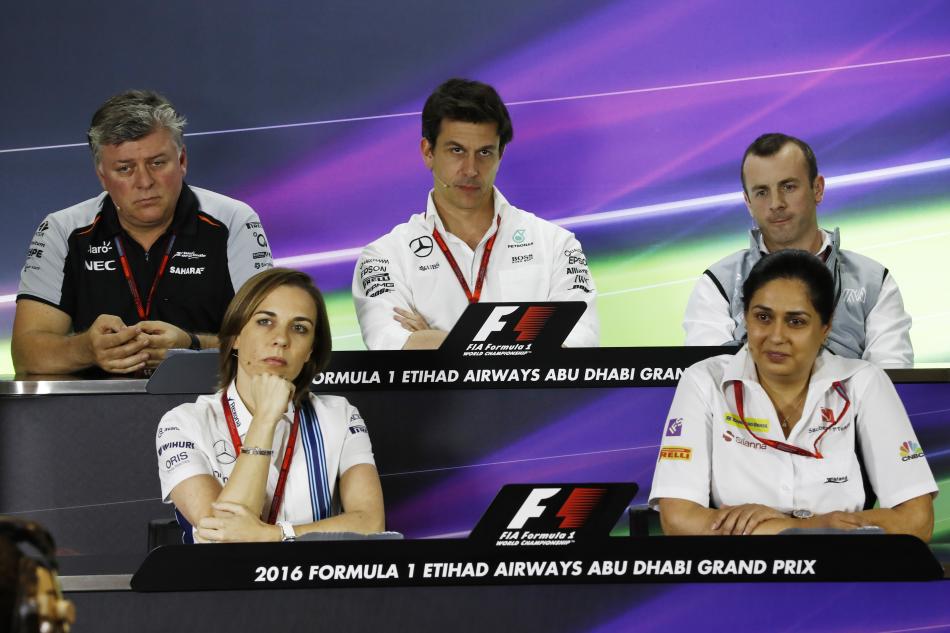
Tag: friday press conference

  • 2017 Hungarian GP: Friday Press Conference Part 1

    2017 Hungarian GP: Friday Press Conference Part 1

    PART ONE: TEAM REPRESENTATIVES – Frédéric VASSEUR (Sauber), Mattia BINOTTO (Ferrari), Mario ISOLA (Pirelli)

    PRESS CONFERENCE

    Q: Mattia, it’s very tight at the top of the timesheets this afternoon. How did today go for you, Ferrari, and how do you assess the pace of nearest rivals?

    Mattia BINOTTO: Obviously we just finished the session so we are looking at the data. I think it has been a difficult session because of a lot of traffic, red flags, so difficult somehow to complete the programme. We had to do some compromises on the programme but trying to collect as much data as possible. As you said, the field is very close but nevertheless we are concentrating on ourselves. Trying to optimise the balance of the car will be very important for qualifying and the race. It will be quite hotter Sunday compared to what we got today, so preparing and working on the balance will be very important and key.

    Q: And knowing what you know now, are you confident you can be more competitive here than you were at Silverstone two weeks ago? 

    MB: I think it’s always difficult to judge but certainly today was less negative, let’s say, compared to what we have seen in Silverstone. But Silverstone is in the past. I think somehow we need to forget it, being focused on what is this weekend. I don’t think the comparison is really necessary. More important just being focused on Hungary.

    Q: In the past week it has been announced that the Halo head protection is going to be introduced in 2018. Can I ask you about the practicalities of including the Halo on next year’s car, just from a cooling point of view, an aerodynamic point of view, how far down the road are you with those developments?

    MB: Obviously the decision has been made at the last Strategy Group meeting in the last week. It’s quite a late decision compared to the project but nevertheless, because of the safety it’s important everybody tries to work very hard on it. The implications are from the chassis structure point of view. So we need to make sure that we are fitting well the Halo on the chassis and the chassis is resisting to the loads that are required by regulations. As well from the aero point of view it may affect certainly the back of the car and that has to be taken into account when designing the new car.

    Q: Mario, just a word on today’s running. What have we learned about tyre performance, tyre wear, degradation? How many pit stops can you foresee on Sunday?

    Mario ISOLA: Difficult question, because, as Mattia said, during FP2, which is the most representative for us to collect some data, we had two red flags. In terms of delta lap time between soft and supersoft we saw something like 0.8s, 0.9s per lap. It is a bit more than we expected. Our estimation was 0.6, but more or less in this range. We know that the medium is not going to be used during this weekend. The temperature is very high, so degradation will be a key factor on the supersoft, especially on the supersoft, but we don’t have a number now. The number of pit stops will be dictated by the degradation of the supersoft. The tarmac is new. Last year the circuit was resurfaced. Very smooth, but very black. So the temperature is going up easily and we expect more than 50 degrees tarmac on Sunday, so it could be quite a challenge.

    Q: You’ve done a lot of analysis since Ferrari had their tyres problems at Silverstone two weeks ago. Can you just tell us about the conclusions you have drawn and whether or not they were freak incidents? 

    MI: We made a lot of analysis to be sure that we were not underestimating any potential issue on the tyres. So we didn’t want to say anything about Vettel’s tyre, because we saw together with Ferrari the loss of pressure starting from Turn One since Sunday afternoon. We wanted to take some time to analyse deeply both the tyres. We saw two different failures. One was a puncture. The conclusion was, on Vettel’s tyre, that it was a puncture with a loss of air starting in Turn One and obviously at a certain point the construction is not able to support the load and in Turn 6 it failed. For Kimi, it was more difficult, because it was not clear at the beginning. The carcass was still in one piece. We had a part of the tread missing and we had two points in which the belt was damaged, on the inside shoulder. So we had to analyse not only Kimi’s tyre but most of the tyres used during the race to exclude that there was any other potential issue. We can away with the conclusion when we were 100 per cent sure that we didn’t have any other issues. I cannot say it was debris or an impact or something like that because I don’t have the evidence but the evidence is that we have the belt that is damaged in two specific points and the rest of the tyre is still OK, but Kimi had to stop to replace the tyre, so this is the result of the investigation.

    Q: Fred, welcome back. Hefty accident for Pascal this afternoon. Just a word on his condition and also the state of the car? 

    Frédéric VASSEUR: It’s a bit too early to have a clear conclusion on the reason of the accident, but we will do the investigation. The monocoque looks OK, but we have to investigate a little bit more. I left the garage straight after the end of the session.

    Q: You’ve been in the new job, team principal, for just a week or so, but it’s been a busy week. I just wondered if you could talk us through the reasons behind the switch from Honda power in 2018 to Ferrari power? 

    FV: Yeah, Sauber and Honda signed a memorandum of understanding a couple of weeks ago but things move forward quite fast in our world and I think that the situation was a bit unclear also regarding the collaboration between McLaren and Honda and on our side the engine supplier had to find a solution for the gearbox. We had a deal with McLaren and the situation was a bit more complicated. On the other end, the collaboration with Ferrari is based on a long-term relationship and we had the opportunity to discuss with Ferrari to get the new-spec engine and I think it was a good choice and we found a mutual agreement with Honda to stop the collaboration.

    Q: Just to confirm, it will be a current-spec Ferrari engine that the team has…

    FV: Not the current one, the next one!

    Q: Exactly! Just to finish, I know you have only been there a week but I’d love to get your thoughts on Sauber as a team, both in the short term and in the long term?

    FV: The short term, that will be difficult to achieve something – it’s a long-term project for sure. But I think the basics are there. The facility is impressive compared to the other teams. I think we are in a good move. The wind tunnel is a good one and the team, I think that Sauber is still in F1 an iconic name and there is a real team spirit, quite comparable to the team spirit I had last year at Enstone. Everybody is really dedicated, pushy, and now that the financial structure is stabilised I think we can have some hope for the future.

    QUESTIONS FROM THE FLOOR

    Q: (Roksana Cwik – SwiatWyscigow) A question for Mr Vasseur. When you brought Robert Kubica to Spa and he drove the RS01, did you think he would be here?

    FV: No, at this stage he did some test sessions in the simulator before. I tried to help him for different reasons. We had the opportunity to do a race in the RS01 in Spa. He did it and he did a good job, but it’s not my project anymore!

    Q: (Dieter Rencken – Racing Lines) Question to Fred, I wonder if you could clarify exactly what your position is please? Are you responsible for the total Formula One programme, including marketing, sponsorship, whatever, or only the sporting side. And if not, who else reports to Mr Picci?

    FV: My position is quite clear, that I’m the CEO of the company and team principal. It means that at the end of the day I am in charge of all the departments.

    Q: (Peter Farkas – Auto Motor) Mattia, this track might be a completely different story but in the last few races we’ve seen Mercedes maybe gaining a bit on Ferrari. Do you think it was because there has been some decisions like the restrictions regarding the floor or engine oil burning, or just because you’re at different phases of development during the year and it will ebb and flow between you?

    MB: I think that each race is different to the others. There have been races at the start of the season where we have been competitive and others where Mercedes has been competitive. If you look, for example, Bahrain very early in the season, they have been very competitive in qualifying, we have been in the race. I don’t think that there is a clear tendency and a clear trend on the competitiveness of the two teams. Certainly the development is very important. That has to be done race by race. There are still many races to go, we are just half of the season and I don’t see any reasons why this should be one trend or another one. I think that oil burning, as you mention, is something that is not directly related to Ferrari and the floor, honestly I don’t think there is any impact on our performance.

    Q: (Peter Farkas – Auto Motor) This is again to Mattia. We have seen that both of your drivers are now on their fourth turbochargers. Is it just normal as you are playing around with the element or is it cause for concern and now basically you are sure you will have to take a penalty later this year?

    MB: Certainly it is somehow a concern in the fact that we had failure on the turbo at the start of the season and we have to replace them at the very start and you introduce very early in the season turbo number three and turbo number four. Having said that, we introduce as well in the following turbos some modifications for reliability. They are running well at the moment, so we’ve got all the pool at the moment that have been introduced but we’ve got all the mileage available on each turbo, so we are rotating them and, obviously it’s our objective to conclude the season with the current pool of turbos.

    Q: (Dieter Rencken – Racing Lines) Mattia, a lot of your motorsport and road car competitors are embracing Formula E with a vengeance. Could you see Ferrari ever doing that?

    MB: That’s something that sometimes we have discussed internally but no decision have been taken and honestly it’s a decision that is not down to my responsibility. So, I have no clue and no answer for you.

  • 2017 British Grand Prix: Friday Press Conference – Part 2

    2017 British Grand Prix: Friday Press Conference – Part 2

    PART TWO: Cyril ABITEBOUL (Renault), Andy COWELL (Mercedes), Jonathan NEALE (McLaren)

    Q: Cyril, 40th anniversary for Renault in Formula One. The retro look that we saw in London, I hear it might roll out again with the team again later this weekend, retro cars on parade. Tell us about this moment and what F1 has meant to Renault?

    Cyril ABITEBOUL: How long have you got! Forty years, that’s a lot. Lots of success. I think the best way I would summarise it, every time we’ve been in Formula One and attacking Formula One we’ve been successful, whether in the late 80s-90s with Williams, 2005-6 obviously with Fernando in the blue car and then later with Red Bull Racing. That’s why obviously the pressure is very big, that we’ve been successful and the expectations are high, that we get back at that level. For Renault it meant also that Renault has moved from being a French carmaker to a European and then a global carmaker. A global brand. Part of a very large alliance and about to become the largest carmaker in the world with Nissan and Mitsubishi. So obviously everything has changed. Formula One has changed. We have changed and that’s what we want to celebrate with this anniversary.

    Q: Now, Robert Kubica. The comeback seems to be gathering pace. He had a second test this week at Ricard. What can you tell us about that. What are the plans for the Hungary post-grand prix test in the 2017 car, and how close is he to being ready to race in Formula One again?

    CA: Well, that’s a second test after obviously a first test. The first test was nothing more than an opportunity for him to get back behind the steering wheel into a Formula One car – but there is a big caveat, is that it’s a Formula One car from 2012 with demo tyres, with V8 engine, normally-aspirated, fantastic noise but doesn’t exactly match the current F1 car. So, whatever we do is not quite representative. That second test, however, we sort-of walked more towards what could look like a plan in order to assess, to give both him and us the opportunity to assess a little bit more his limitation and his abilities. What I can tell you is that he is still quick, he is still very consistent and, more importantly, he still has this energy, this drive, this sort of enthusiasm that he has always had, he always carried to him and to the team. Really too early to talk about next steps. I don’t want to add to the speculation. Right now the focus is on, y’know, getting the most out of the overall line-up and package that we have and then we’ll be thinking about 2018 in due course – which is not just now.

    Q: Has the evaluation shown that he is capable of racing a Formula One car?

    CA: I would not say that – and I don’t want to say yes or no. It’s not like a test that you’re passing at an exam. We’ve not seen any obvious road blocks. Having said that, you know, again testing in this circumstance and testing in a more modern car is something completely different. So, you know, again, this situation is complex. We are not doing that for PR purposes, even though we see that it is creating a lot of media expectation and focus. It’s not what we’re doing. We care so much more for Robert than this.

    Q: Andy, coming to you. New engine for both the works drivers. How far ahead is it from the previous one.

    Andy COWELL: Yes. Phase 2.1 engine, installed for both Lewis and Valtteri today. In terms of improvement compared to the previous one, it’s actually very similar. It’s exactly the same spec as we installed with the customers in Canada and today’s been an exercise in checking the health of it and dialling it in from a calibration perspective.

    Q: We had an interesting discussion in the previous session about the next generation engines – obviously it’s a big decision. Christian Horner was saying that it could be around for ten years. The car industry in 2030 could be unrecognisable compared to where it is today, but it does seem that there is a bit of consensus from the high-ups about what Formula One should do next on the engine rules in terms of parts. From your point of view, as an engine builder, what do you feel about the direction going forward? What would you like to see?

    AC: I think there have been two very constructive meetings held in Paris, chaired by the FIA but with Ross Brawn and his team present, with the existing manufacturers and other OEMs that might be interested in coming in and also independent engine manufacturers and suppliers as well, component suppliers. And everybody’s expressed their opinion on what 2021 should bring and I think you touch on a very good point that we need to make sure that the technology that’s introduced in Formula One in 2021 is ahead of the road car world in 2021 and perhaps mimicking  what will be in the showrooms in 2026, so that it’s a lead in to it but there’s a whole load of other topics that need to be discussed and the conclusion of the second meeting is that we need to do some more work. We need to break out into expert groups and that’s not necessarily us, that’s people from outside of Formula One that understand about engine noise and how that brings pleasure to people that are hearing it and that’s not necessarily (indistinct), the musicality of it, and then more scientific studies that we will be involved in like removing the MGU-H –  we have single turbo or twin turbos. And so the FIA are going to chair several meetings, several working groups that conclude over the summer on their particular subject matter and then in September, bring that back together and try and condense that into one overall package. As ever, there will be compromise but I think if we come up with the best package for Formula One, for the manufacturers, for the fans, for the drivers, for the chassis teams etc then it will be a good step.

    Q: Jonathan, coming to you: obviously now, six, seven months into the new management structure, working with Zak Brown, can we expect restructuring of the McLaren team as you look to the future? What do you… so good evaluation period, six, seven months, what can we expect going forward now?

    Jonathan NEALE:  I think it’s great for the whole business that we have the kind of footprint that we do, where we have the premium sports car business, a Formula One and the applied technology business, the opportunity to bring that back together under one shareholding is something that I think all of us internally are pleased about. Certainly in terms of our customers, then they don’t really differentiate between which group of shareholders own which bit of the product range, so that simplifies things. The executive committee with Mohamed and Mansour are steadfast in terms of the direction of travel of the business and I think what we will see is progressive evolution. I don’t think we are going to see another step change or complete restructuring, just a bringing back together, some re-clarification of what the brand is and what the brand isn’t and we’ve got an exciting growth agenda, both in the sports car business and in the applied technologies group and obviously we’ve got a job of work to do to make our Formula One programme competitive again.

    Q: Obviously there’s an awful lot of talk about the relationship with Honda; can you clarify the decision-making process and timescale from here; does it depend on the step they make later this year to define where the relationship goes and indeed, whether it even continues?

    JN: The simple answer to both questions is no. I can’t clarify the process or the timescale because there is no track or no set path. We have a contract with Honda and we’re working through some of the challenges that we have and I can’t duck the issue that for both Honda and McLaren we’re not where we need to be and that this season is not only challenging but frustrating. I think when Hasegawa-san was here last week he recognised some of that frustration and whilst making progress he also acknowledged – and I thought that was very honest of him – that there is still a long way to go between where Honda are currently and the benchmark with the gentlemen either side of me. So, Formula One is all about where the best come to compete and competition is tough and unforgiving. I don’t think it’s something that we can just sit on lightly – either Honda or McLaren – so that we’re having those kind of conversations. They’re uncomfortable conversations as you would expect and they’re things that we best do behind closed doors. I recognise the speculation, it’s Formula One. I’ve only been in it for 17 years now so one thing I recognise is that when anybody says they’re not talking to anybody, the answer is everybody’s talking to everybody. Drivers talk to everybody, teams talk to everybody so I don’t want to duck that. But we’re working through our issues with Honda. We need to get it fixed. It is not sustainable in its current form.

    QUESTIONS FROM THE FLOOR

    Q: (Marc Surer – Sky Germany) Cyril, you have a new floor on your car. Does it work?

    CA: When you say that, everyone wants to keep from everyone, everyone knows everything about everyone too. I’m sorry about that… it’s a decent step, you know, but more importantly it’s a completely different function philosophy. So it’s not just one part in isolation, it’s also the start of something: a development programme that we’re going to carry through the break and through the later part of the season. And it’s going in the direction that we’re hoping as far as we are talking on Friday afternoon.

    Q: (Dieter Rencken – Racing Lines) Jonathan, you said everybody talks to everybody, so that obviously leads to the assumption that you’ve been talking to Cyril, you’ve been talking to Andy, you’ve probably been talking to Honda again and again, and whatever else. But where do you go from here? I mean have you set a deadline for any form of performance improvement whereby you say ‘right, that’s the notice period’ and can you then just simply tear up the contract and go and strike a deal with Andy? What do you do?

    JN: It’s like speed dating, isn’t it? You can’t tear up contracts… let’s start there. As Cyril and Andy will attest, there are no performance guarantees, looking forward, so of course we all set our plans. We set plans for chassis, plans for drivers, plans for engines, in terms of making that level of progression where nothing is guaranteed. As I said earlier about there being a set process or some set timescale, then I think that’s unrealistic. I think naturally we reach a point of inflection with Honda where we ask ourselves, internally, where do we go from here? What do we have to do differently to restore that level of competitiveness? There are clear constraints and  rules, within the sporting regulations… as you pitched at me this morning, you’re right, in order for an engine manufacturer to supply more than three teams does require FIA approval. The precedent for that –  both the gentlemen either side of me have supplied four teams, I think Andy in ’15, ’16 and I think Cyril 2014. Ferrari have also supplied four teams in the past but there is a… what we want to do is to try and make sure that what we’re doing is professional and good for the sport. It is good having Honda in Formula One and there isn’t anybody who doesn’t want to see a successful Honda in Formula One. And I say that regardless of anything that’s currently going on. Honda are investing a lot and putting a lot of resource into the programme and we’re working very hard with them but the fact is, given where we are in the Constructors’  championship at the moment, we’re not getting the job done. So there are constraints, as I say, in the sporting regulations. Everybody’s talking to everybody, we are making sure that we maintain our good relationships with FOM and the FIA during this process, while we work through a difficult situation.

    Q: (Graham Harris – Motorsport Monday) Cyril and Andy, possibly some comments. You are both manufacturers and you both would like to keep Honda in Formula One because more competition is good but clearly they are lagging far behind. Would either of you be prepared to assist them in perhaps improving their performance and have they come to you yet or is that something you are not prepared to say or if they do, would you be prepared to help them?

    CA: I think there has been some speculation in the past about that and the speculation was not in relation to Renault. But you know from here, in Formula One – in today’s Formula One – the engine has become a performance differentiator and even though at the end of this season, as part of the  Constructors’ definition, I think that as soon as it becomes a performance differentiator, it should be in keeping in the spirit of the regulations that there should not be any IP transfer or support for something that is making a primary impact on the overall performance of the package. So frankly I don’t remember anyone volunteering for helping us when we had our problems in the past. I don’t think it’s something that we would love and I don’t think it’s something that Honda would really entertain, in all honesty. I think it’s really a time issue. I don’t think it’s a matter of resource, it’s not a matter of skill set, it’s a matter of… basically when they stepped out of Formula One and when you get out, it takes an awful lot of time to rebuild and that’s the sort of time for the manufacturers on the one hand and the customer on the other hand, that is the main limit. It’s not about an interim measure and plus, it’s extremely difficult to implement such support because their engine architecture will be very different from mine so apart from supplying an engine to Honda, I’m not going to be about to help them. No, I don’t think this is really credible.

    AC: I think collectively we’ve helped with convergence in Formula One in the opening season, performance development through the year, but then the opportunity to do a big change with Honda coming in, we all agreed that Honda could have that same opportunity to change everything in the first year and then the request came from manufacturers in addition to Honda saying ‘please can we take this crazy token table away because it’s bad for the sport?’ It’s bad if somebody can’t train to get better and so we agreed, yeah, take the table away because it’s better for the sport because it means that you can innovate, you can introduce whatever you like and I think none of us should underestimate the technical prowess of Honda and of McLaren and I think my money is on that combination coming good and coming good pretty quickly. No pressure!

    Q: (Matthieu Piccon – Motorsinside) Cyril, you’re lying eighth in the championship. For you is it more linked to the performance of your car or the fact that you’re only scoring points with one driver and not two?

    CA: You know, it’s a combination. I can’t break down the elements like that. It’s true that if we had two times 18 points that it would be 36, we may have a different position in the championship but equally Jo has had several reliability issues that has hurt him, starting in winter, then in the opening races of the season where in particular we were a bit more competitive than we have been in recent races which has sort of eroded the confidence that he had in himself, in the package which we are trying to rebuild. So it’s a combination, but what I can say is that standing eighth in the championship is absolutely not in line with what both the plan and expectation and history that we were mentioning before, of the 40 years of Renault in Formula One. So action must be taken to make a quick change. These things take a bit of time, there are still a number of things happening in the background, we’ve just had our new head of aero who started last week. Obviously that person is not going to make an impact in the next few races, it’s going to take a bit of time but we have to… more importantly, we have to build confidence in ourselves and in the team that what we have, what we are doing will help us be where we want to be which is fighting for the podium in the next few years.

    Q: (Dieter Rencken – Racing Lines) Andy, last year in September, I think, Tobias Moers announced the AMG Project One Hypercar project. Further details have come to light. I wonder if you could confirm some of them please. I believe 275 engines will be built by your factory and also something like a 30,000 service interval or something like that. Will you be building them, do you have that durability in those engines and is it based on your Formula One power unit?

    AC: It’s a fascinating project, the AMG Project One Hypercar. It is taking the Formula One power unit and putting it into the back of a two seater sports car and then two MGU-Ks on the front axle, so independent drive to the two wheels, so 160hp per wheel. So the combined power is over 1000hp. It is a pretty incredible power train, to be honest, both in terms of creating a car that can go round the Nurburgring in impressive lap times but also in terms of driving across town and on a dual carriageway. The fuel economy is impressive; this is something that… Tobias came up with the idea, rang me up, said is it possible? I rang him back after two weeks of doing a little bit of work during lunchtimes, to see what we could. We’ve now got a group of about 150 people. At Brixworth, that group will grow over the coming year and the target is to build 275 power trains so the power train will be built at Brixworth, having done the development work. Fascinating actually doing that development work and doing the transition from Formula One to road car. The vast majority of it carries across. Clearly things like fuel and emissions need to be managed but that works fairly seamlessly. We’re targeting 50,000 kilometers so about that and in terms of the duty cycle it is quite considerably different. If you look at a high performance road car – Jonathan will know this from his McLaren  road cars – if you’ve got somebody that drives at five percent of the time at full throttle, that’s quite remarkable. Today we’ve got people driving Formula One cars round this track with 70 per cent full throttle and so that’s where you gain an awful lot of the benefit, swapped from the bespoke fuels that all the fuel companies develop for Formula One into a pump fuel, the cylinder pressure drops, the loading drops and everything comes to you, so in terms of that, that durability, that’s the easy bit.

  • 2017 British Grand Prix: Friday Press Conference – Part 1

    2017 British Grand Prix: Friday Press Conference – Part 1

    PART ONE: TEAM REPRESENTATIVES – Christian HORNER (Red Bull), Claire WILLIAMS (Williams), Vijay MALLYA (Force India)

    PRESS CONFERENCE

    Q: Vijay, the target for this year was to match, or even improve, on last year’s Constructors’ standings. So far you’re pretty clearly in fourth. Tell us about that and the upgrade you have on the car this weekend.

    Vijay MALLYA: Well, there is a specific upgrade for Silverstone. We take this particular race very seriously because it’s our home race and there’s no question that development must continue through the season, given that this is a brand-new car, and we are in fourth with a fairly comfortable lead over Williams but nothing can be taken for granted and we wouldn’t like to be complacent. When I launched the car I said we must retain fourth or even aim higher. That still remains the objective – because I believe in setting the bar high – but whether we can actually catch Red Bull or not remains to be seen, particularly towards the tail-end of the season but we are pretty focussed on getting the job done.

    Q: What’s the strategy, could you share it with us, with regards to the name and the brand of your team going forward?

    VM: When I bought this team ten years ago – and we’re all very proud of the fact that, as an independent team we have survived amidst a great amount of speculation for ten years and are still going strong. It was Force India because it was the first time an Indian team showed up on a Formula One grid. It met the aspirations of millions of young Indians who never thought that would be possible but then we were running around in P23 and P24 and the then management seemed very happy about it. Since we have consistently now improved and are a serious contender on the grid, it’s time to broaden our horizons, attract more international sponsors and sadly there is no Indian Grand Prix any more. Indian sponsors seem to be passionate about putting all of their money into cricket and so we must appeal to a more international audience and so the idea of changing the name of the team was mooted. We’ve had several discussions, no decision has been taken but we have listed a few options and we’ll take it forward at the appropriate time.

    Q: Christian, Daniel was here in the press conference yesterday, talking about the upgrades situation, saying a decent step is expected for Budapest. From what you’re seeing from your relative development rates to the top two teams, are you likely to converge, do you think, in the second half of the season?

    Christian HORNER: I think certainly since the first European Grand Prix in Barcelona we’ve consistently managed to chip away and get closer to the front of the field. Daniel’s had a great run: five consecutive podiums including a victory in Azerbaijan, and I think our most competitive race of the season to date was actually last weekend in Austria, finishing within six seconds of the leader without any safety cars and obviously beating a Mercedes. So, incrementally, we’re getting the performance on the cars and hopefully that can continue over forthcoming grands prix.

    Q: You were with your peers in London at the live event this week. As the boss of a leading team and particularly one that has a strong marketing background, give us your opinion of that and what it all meant.

    CH: Well, of course, as Red Bull we’ve done an awful lot of those kind of events around the world with a team that we have dedicated to running show car activities but I think the London event was fantastic: it was taking Formula One to the public, it was free of charge, it was combining a music festival with running the Formula One cars, under the background of Big Ben, up to Trafalgar Square, around, y’know, from Whitehall. It was fantastic to see it so well supported and so many people coming out and the enthusiasm and passion and excitement. I think also to see the drivers having fun and enjoying it as well was a great advert. So hats off to FOM and the Liberty guys for putting the event on… As their first big statement of promoting Formula One.

    Q: The same question to you Claire, really. Your thoughts on what it did for Formula One in the UK – and is there open support from the teams for this kind of thing?

    Claire WILLIAMS: As Christian said, it was a fantastic event for all of us to be involved in. It’s great to see the new owners are thinking and having that kind of vision and involving all of the teams in doing something like that. And to come to London, it’s an iconic venue for us. To have all the teams there, the cars, the drivers, was just great to be able to take Formula One to a new audience and I’m sure a lot of those people probably haven’t been to a race before or watched us on TV, so hopefully it will extend our audience but the activities going on ahead of the actual running itself were fantastic as well – the education pieces that are so important as well. We had Dare to be Different, Formula One in Schools was there, we had a presence there, it was just really good to see all the children there as well.

    Q: Big weekend for Williams at the moment, for the team and for the family with the anniversary, with the film. Tell us what the feeling is about where the team – and the family – is at this major milestone.

    CW: It’s been quite a busy week! We launched the Williams film on Tuesday, which was very nice. It’s been a long time coming. It’s been about three years in the making. We had 300 people in London watching that on Tuesday night. We had a bit of rain which kind of dampened things a little bit but it was reviewed really positively, which is nice to see, and obviously it doesn’t tell the traditional story that that you might expect: a chronological tale of Williams and our track performance over our four decades in Formula One but rather the human story and the kind of story of my parents’ involvement in the team over those 40 years. So it’s a very personal account of Williams and one that we just hope Formula One fans, and fans maybe that aren’t fans of the sport, will enjoy seeing as well. Then, obviously, we’re celebrating 40 years here, so we seem to be celebrating 40 years a lot this year! The marketing team at Williams have been really busy but it’s been really good fun and it’s just great to be able to do all of that, and this weekend we’re showcasing a couple of our heritage cars: Nigel’s 1992 Red Five and the six-wheeler as well. Great to be able to show those to the fans here.

    Q: Just a quick one, Felipe Massa seems to be going along well, are you both thinking of going again next season?

    CW: Yeah, there’s a lot of talk already isn’t there, about drivers across the paddock. For us, we’ve decided we’re going to hold off a bit on our driver decision. We’ve got a fight on our hands on the race track at the moment and to be distracted by those kinds of conversations isn’t something that we want to be happening at the moment. As Vijay said earlier, they’ve got a nice points haul on us at the moment we need to focus on, rather than anything else.

    QUESTIONS FROM THE FLOOR

    Q: (Dieter Rencken – Racing Lines) Given that the mission of a Formula One team is effectively to market performance and Wednesday in London was actually a major marketing exercise, both for the teams and for the sport, would you ever consider making attendance at an event optional for your drivers?

    Christian?

    CH: Good old Dieter, he gets stuck in. Look, all the drivers were there, bar one. I thought it was a great turnout from the drivers. We didn’t insist our drivers had to be there, we asked them to attend and they were very happy to turn up and take part and I think they actually really enjoyed it as well. So, it was a shame there wasn’t a full complement but I don’t think it detracted from the show. The reaction from all the fans to pretty much all the drivers was fantastic.

    Vijay, your thoughts on that?

    VM: I thought it was an excellent event. I’m glad to see, at least in my ten years of time in Formula One, some very serious marketing that Liberty has commenced. Whether it’s social media, whether it’s the F1 event in London, I think Chase Carey summarised it when he said he wants every Formula One weekend to be like a Superbowl final. That can be only good for the sport. It will only promote the sport, get more revenue and hopefully we’ll get a share of it too.

    And on the subject of drivers turning up being optional Claire?

    CW: Yeah, I don’t want to get sit in judgement on anyone who didn’t turn up on that day when I don’t know the real facts behind it. I’d rather focus on the drivers that were there and the great job that they did. Ricciardo did a fantastic job – I think breaking a lot of the rules that all the drivers were told in the briefing!

    CH: They were controlled turns!

    CW: They were great turns. I thought they were fantastic turns! He did a great job, they all did a great job and to see our drivers… when Lance came in and was able to do the controlled turns, etc., the grin on their faces was great. I think they did a great job to promote Formula One, the drivers out there. To see them all in one place and to see them walk down Whitehall was a fantastic event. Talking about that, and the positives rather than anything else is what I would rather do.

    Q: (Dan Knutson – Auto Action / Speed Sport) Vijay, now that you’re spending all of your time in the UK, have you changed how much time you spend on the day-to-day running of the team?

    VM: In the past I used to be at the race track but, as I’ve always said, in any enterprise, there’s the front office and the back office. Both the front office and the back office are equally important. The team has enjoyed considerable success, particularly over the last two years. I’ve been more a part of the back office than the front office over the last year or so – but I’m delighted at the way things are going for us.

    Q: (Marc Surer – Sky Germany) Question for Christian. What is your opinion about the start of Bottas in Austria?

    CH: It was the perfect start. He had an unbelievable reaction and didn’t get caught – so in that case it was the perfect start. Daniel came on the radio and said that he thought Valtteri had jumped the start because he saw a little bit of movement. But I think a little bit of movement has been permitted because sometimes when the cars select a gear there’s a bit of movement, etcetera, etcetera. I think perhaps it’s something for the FIA to look at, the tolerances that are allowed because of course because sometimes a precedent gets set and then engineers try to grab that little bit of an advantage. Of course if you are moving slightly then it helps to pick up traction, you can see exploitation happening – so hopefully the relevant guys in the FIA will look to tighten it down so there’s very little tolerance.

    Q: (Pierre Durocher – Montréal Journal) Question for Claire. We made the trip to follow naturally Lance, I would like to get your comments on the progress Lance has made since the Canadian Grand Prix and, the second part of the question, it’s a weekend of celebration for Williams but at the same time I would like to know how you feel about the recent comments that Jacques Villeneuve made about Lance. He’s been quite hard on him. I wonder how you feel about it?

    CW: Hopefully I’ll have forgotten the second part of your question by the time I come to it. Lance has done a fantastic job in the last few races but he has actually all year. You may have only just seen the results on the race track but if you could see the hard work he’s put in behind the scenes over the course of the year, it’s been really impressive. We came out at the start of the year and said he, as a rookie, is going to take some time in order in order to familiarise himself with Formula One. This is a big step-up from the junior formulae. I think people can underestimate that step at times. So he’s taken the first few races to get used to Formula One, acclimatise himself, acclimatise himself with the engineering side of things, with the new circuits that he hasn’t been on before. And that’s taken some time but as you saw in Canada he broke that duck and scored his first points and then went to Azerbaijan and had a fantastic race and similarly in Austria after a really difficult weekend for the team, both our drivers managed to score points. So he’s delivered against everything we expected of him and I’m looking forward to seeing how he’ll move forward for the rest of the year. It’s great to now have two cars that are scoring points for us in the Constructors’ Championship. With regard to Jacques’ comments, he’s obviously been pretty vocal in the media. I don’t want to go into a huge amount of detail about it. I don’t think there’s any need. The way that Lance describes it, he just wants to get on and let his track performance do the talking. I think that’s what we should do – because that’s when the critics will stop: when Lance proves he deserves to be in Formula One, which we all at Williams believe anyway.

    Q: (Rob Harris – AP) Question to Vijay. Is removing India from the name of the team some sort of retaliation? Because obviously you have been charged with money laundering and they are fighting your extradition.

    VM: I’ve been charged with a whole variety of things – but let that be kept to one side and let the legal process take its own course. The potential removal of the word ‘India’ from the team name is nothing to do with the events surrounding me. As I’ve said before, we need to appeal to a more international audience. We need to cater to the needs of sponsors who have global businesses – and sponsoring Formula One isn’t exactly cheap. It was ten years ago that the team was named Force India in the hope that there would be an Indian Grand Prix, which took place but sadly stopped after that, in the hope that we would have a whole bunch of Indian sponsors – but they preferred to put their money into cricket. So I have to look elsewhere. And in doing so I also need to give a more international platform for the team for the next ten years. You can’t keep thinking of name changes every year or every other year. So, this is in a work-in-progress stage right now but certainly it’s something we are seriously thinking about.

    Q: (Ysef Harding – Xiro Xone News) To shift gears a little bit, this is for Vijay Mallya. As well as the success of the team you’ve also brought in a new sponsor and with that you’ve brought a unique colour to the grid but along with that it has allowed you to bring in a great organisation like breast cancer care. What is it like working with that group and what about your new sponsors this year?

    VM: Well, the car is pink because the sponsor, BWT, wanted a pink car. They sponsor other forms of motorsport and if you notice they also insist on pink cars. Now, at the end of the day I think that pink looks pretty attractive. As far as association with the breast cancer initiative is concerned, I have always supported charities. I have supported more than 20 different charities in my life. It came naturally to us, with a pink car, so we are very happy to be able to assist in this initiative.

    Q: (Graham Harris – Motorsport Monday) A question to all three of you: you’re sitting third, fourth and fifth in the race for the world championship and none of you are works teams. A question in two parts: one, what would you name as the single thing you most want to take you to that next step to fight Ferrari and Mercedes constantly, and second, with the new engine formula for 2020 are you looking further afield to bring in, possibly, new automotive suppliers to make you into works teams. Is it something you are discussing?

    CH: I think the first part of your answer is, we would love the engine to be a non-performance differentiator. Obviously there is still a pecking order and these engines are also extremely expensive, so as a customer it’s disproportionate the amount of money we are spending on these engines. I think what’s really interesting is that Formula One is effectively at a crossroads with the new regulations, because those regulations theoretically come in 2021 and there will be probably and eight to ten-year life on those engines, so what we are looking at is actually is Formula One’s relevance pretty much up to 2030. Now, by 2030 how many people are actually going to be driving cars? Are they going to be autonomous? Are they going to be electric? The world is changing so fast in that sector. So Formula One has some serious questions that it needs to answer today in the choice it makes for the engine for the future. What is Formula One’s primary purpose? Is it technology or is it a sport and entertainment, and man and machine at the absolute limit? I sense that with the new ownership that has come into Formula One that creating great entertainment, creating great content, the noise, the sound, the exhilaration of seeing the drivers as the star is of absolute primary concern to them. So I hope that with the opportunity there is with the regulation change that is being discussed at the moment that the fundamental aspects of cost, performance and attractiveness to the fans, therefore the noise, the acoustics of these engines, are a key factor in the set of regulations they come up with and I think that in turn will produce good racing, reduce costs and bring back some to the appeal that engines of a bygone era used to produce.

    CW: In answer to your first question, which was how would Williams improve on our position, lying currently in fifth. Probably the answer is twofold. We have to make sure that we have the resource in place back at Grove so that we could achieve that, whether that be personnel, equipment or budget. A lot of it is down to budget, as obviously the former doesn’t come without the latter. Budget for us comes through greater sponsor acquisition, a partnership with a manufacturer for example, or the redistribution of income in Formula One. So any of those would be great, they would considerably help us. As much as I always say it’s not about the money, it’s what you do with it, when you are competing with teams with three times the size of your budget it’s always going to be really difficult to make that jump into the top three in the championship. When it comes to engines, I think Christian answered it more eloquently than I probably could. We are looking at a road map for the next decade in Formula One where the engines are going to be and we must make sure that they probably aren’t as dominant as they have been, as much as we have benefited from our wonderful partnership with Mercedes, I think for engines not to play such a role in the performance differentiation would be a good thing and then, equally, as an independent team, for engines not to cost as much money would be really useful for us. But then the wider aspects of fan engagement, having engines that are lovely and noisy is something that we would like to see back in Formula One.

    VM: Well, we have always had a limited budget compared to the big teams in Formula One. We have a culture within our team to spend our money wisely and to get the maximum bang for buck and at the end of the day everybody is passionate about pushing that last pound as hard as you can. Having said that, if we get more sponsors we might spend a little bit more money, but I wouldn’t spent all of it, I would give some back to shareholders because I don’t believe that money can necessarily ensure that I’m going to be at the front of the grid. There may be people who spend a lot of money and who are able to therefore develop a car that is more easily at the front of the grid than we can, but if somebody turned up and gave me a hundred million more and asked me “well, can you beat Mercedes?” I don’t think I’m going to say “yes, I will”. It’s how you spend your money that is more important. The income distribution pattern: I think everybody knows my views, it’s completely lopsided and needs to be addressed. With a little bit more in our pocket we can make that incremental step and certainly fight in the top three consistently. As far as engines are concerned, as Claire has mentioned, we have also benefited from a fantastic power unit with Mercedes. I have been with Mercedes for nine years already and they are a fantastic partner but they are expensive. Going forward, as Christian said, looking ahead to let’s say 2030, we definitely need an independent engine our there at a reasonable cost, which is available to anybody.

    Q: (Luis Aguirre – Reforma Group) A question for Mr Mallya. I would like to ask you about the situation between Checo and Esteban in Baku and Montreal. How was it for you to see that fight and to watch your team having the big team’s troubles, no, I mean the fight between them and how is going to be the approach of the team to avoid those kind of things in the future?

    VM: You know, what happened in Montreal is not something that really concerns me. Esteban wanted to overtake Checo because he felt he could attack Ricciardo. Checo felt he was better placed to do the same job. Ultimately none of them succeeded in doing that but nevertheless the team scored points. What happened in Baku clearly was a great loss to the team, otherwise there was almost a podium for us. That’s unacceptable with our two cars hitting each other. I don’t think it’s road rage. I don’t think it was deliberate in any way. It was just the excitement of the moment and an error of judgement. Both drivers have been spoken to. We don’t believe in making team rules or giving team orders but at the end of the day I think both of them fully appreciate that is their responsibility to bring the cars home and score as many points for the team, because that’s precisely what Claire is going to be doing with her drivers and we need to stay ahead.

    Q: (Dieter Rencken – Racing Lines) Taking everything that has been said earlier on about the Mercedes advantage, the engine differentiation, going to the next step etc there is a team/engine partnership that appears to have got its calculations wrong and they are looking at possibly taking a Mercedes engine next year. Given that this would require certain regulatory concessions, or so it appears, how do you feel about the fact that Mercedes could actually be supplying a team with substantially better resources than both the Mercedes engines and Christian how do you feel about a team that could suddenly possibly beat you?

    CH: First of all, it’s got to happen first. We’ve been there before, from our side of the fence, and it didn’t happen. Speaking to Zak the other day he said he thought he was watching the same movie that we lived through a couple of years ago, so it didn’t sound particularly hopeful that there was going to be a Mercedes in the back of a McLaren next year. But whatever issues there are it’s McLaren’s business and if they had that engine… they have had it before… if they had that engine they would be more competitive than they are today.

    CW: I’m not privy to the conversations that may or may not be going on between McLaren and Mercedes. Clearly, it would not be ideal for us but I don’t think Williams have a place to interfere with that. Those are conversations that need to going on without us.

    VM: We all want McLaren to be competitive. It’s a team with great history, a great presence in Formula One and I’m personally sorry to see them struggling the way they are. So it would be good for the sport in general if McLaren returned to being as competitive as they have been always. But having said that, if they want a Mercedes engine it’s really between Mercedes and them. As far as regulatory aspects are concerned well those have to be ironed out, because I don’t believe that the FIA are going to silent spectators to a situation where McLaren has no engine. But that’s a second step. Clearly, Mercedes has to agree to supply McLaren, if McLaren indeed disengages with Honda. But, if I remember correctly, at the last press conference that happened, I believe in Austria, both McLaren and Honda confirmed that they were still together.

  • 2017 Azerbaijan GP: Friday Press Conference – Part 2

    2017 Azerbaijan GP: Friday Press Conference – Part 2

    TEAM REPRESENTATIVES: Jock CLEAR (Ferrari), Rob SMEDLEY (Williams), Beat ZEHNDER (Sauber)

    Q: Jock, can we start by talking about the car? What’s the standout characteristic of the SF70H?

    Jock CLEAR: I think we could say that the standout characteristic is that there is no standout characteristic. It just seems to be a very well-behaved car in all areas. The drivers are certainly giving us good feedback in all conditions, all circuits: slow speed, high speed, medium speed. So, it’s a very benign car, let’s say.

    Q: Is it bringing the best out of both Kimi and Sebastian?

    JC: I think so. I think they’re both very happy with the feel they have for it. For getting into the car. Certainly, drivers like to have a car they feel they can attack, especially in qualifying: if they feel they can attack a qualifying lap, and have confidence in the car, and I think from day one – day zero in this car in pre-season – both of the drivers have said that it just gives them a lot of confidence when they’re in the car.

    Q: And it’s day one here in Baku. How do you assess your pace so far this weekend? Fourth and fifth this afternoon. Sebastian in particular looked very quick in his long run…

    JC: Yeah, I think Fridays are notoriously difficult to read the exact picture from and I think we’ve all understood that here in Baku with a street circuit that’s taking a while to clean up and a very tricky grip level, getting a clean lap certainly on those short runs, on ‘low-fuel’ was very difficult for people – so I don’t think the ultimate lap times you see there are particularly representative for many of the cars. I think they all feel they could have got a better lap in there. Perhaps more representative is the long-run pace and, yeah, we’re very comfortable with where we’re at. Again the car felt good and it’s behaving and everything’s under control, so we’re happy with today.

    Q: And looking specifically at your battle with Mercedes this year, on a day when both you and them are on song – who has the faster car?

    JC: I think that’s impossible to say. I was just saying to some of the journalists outside, it hangs on tiny margins and I think when you’re spending 1m20s going at over 200km/h around a circuit, those tiny margins can be anywhere at any time, and I think we both have cars that are very, very well-matched in most conditions and we’ve got four very, very good drivers in the Mercedes and the Ferrari and actually, on any given day, any of them are capable of putting it on the front row and putting it on pole. The races we’ve seen so far, again they swing on very fine margins of exactly what sort of tyre degradation you can get out of the first qualifying set, or how well you can work the Option tyre, and that makes the difference. And it is tiny margins.

    Q: Beat, the last few years have been difficult for Sauber and just when some stability seemed to be emerging it’s all change again. Can you give us a picture from inside the team about what’s going on? 

    Beat ZEHNDER: No, I cannot, no. You’ve seen the official press statement from Mr Picci and it seems that Mr Picci and Mrs Kaltenborn had different views how to operate the company. We shouldn’t forget that it’s not only a race team, it’s a home team as well with 350 people or so, but I cannot give you more information because I’m not actively involved in that decision.

    Q: So who is running the show this weekend in Azerbaijan? 

    BZ: We’ve been – Jorg Zander, the technical director and myself – we’ve been entrusted to run the operation of the team this weekend but this is only temporary. It doesn’t change a lot for us because our job is to have two cars running as quickly as possible around the circuit and for me it’s a little bit more media work.

    Q: When can we expect news about a new team principal? 

    BZ: I hope soon. We were talking to some candidates and I hope we can announce it sooner rather than later.

    Q:  OK, on a different note, have you started with Honda yet? It was announced a couple of months ago that you are going to work with them next year. Have you had engineers go to Japan and vice versa? 

    BZ: Yeah of course. We have started with the project and there is an exchange of information on the logistical side, on the set-up side and the garages. We have to organise computers and IT stuff and things like this so the work has started, yes.

    Q: Rob, there are changes at Sauber, there have been changes at Williams this year as well, notably Paddy Lowe coming in as the technical chief. Can you just explain the impact he’s had on the team, any new processes he’s brought in?

    Rob SMEDLEY: Well, it’s been positive, it’s definitely been positive. Paddy comes with a great pedigree of working in teams that, if they weren’t winning, they were certainly expected to win for the past probably about 30 years. He’s got 30 years of experience. We were adding up between us that we’ve got 50 years of experience, but it’s a bit more biased towards him so he’s got the 30, I’ve got the 20. But it’s been really really positive. He’s a very collaborative guy, he’s super intelligent, obviously and he has a great deal of experience and it’s just about him instilling that culture into the team of how to win really. That’s probably one of the biggest things that we need to pick up on at Williams is not only that we want to win – that it’s implicit. If you take 60 people around the world 21 times a year you want to win, of course you want to win but it’s how to win and then it’s putting those processes in place and you can’t really put a timeline on it – or it’s difficult to put a timeline on it but certainly we’re initiating those processes, we’re starting them or they’ve already started, a lot of them. And then it’s when and how those processes bear fruit. Some of them will immediately be very visible to the outside and some of them less so. Formula One is very much about marginal gains and it’s just about the marginal gains that we need to make now but he’s been very positive with the team, a real good breath of fresh air.

    Q: OK, so marginal gains there but also huge gains it seems for Lance Stroll. It’s amazing what a couple of points can do, him finishing ninth in Montreal last time out, sixth fastest in second practice here in Baku this afternoon. It seems like he’s got the monkey off his back. 

    RS: Yeah, possibly. For younger drivers is predominantly about confidence. Once they start to get that confidence then they get into a virtuous circle if you like and I think within the team, certainly the more senior members of the team, it’s always been apparent that the talent is there and we have been making progress but it’s just that that progress is not always visible to the outside world. You’ve got a guy on the other side of the garage who’s got 16 years of experience, who was one point away from being a World Champion, he’s nobody’s fool. He’s one of the quickest guys in Formula One still and you’re being measured against him every other weekend and it’s tough because Formula One cars – especially this generation of Formula One cars – they’re generally quite difficult to drive. I think all of the drivers will attest to that and it’s just about acclimatising yourself in this environment: in the car, in the actual environment, because everything that you’ve done before, including Formula Three in Lance’s case, is just a huge huge step away from Formula One. There’s Formula One and there’s everything else in terms of how difficult it is. So we’ve got to expect that it’s going to take some time, he’s going to take some time to acclimatise to it and he is doing… he’s making progress from Australia to practice today, he’s made progress. And as I said, some of that’s visible to the outside world and some of it isn’t but certainly what we saw in Canada was visible to the outside world and that helped.

    Q: Does he seem more relaxed this weekend?

    RS: Definitely, I think he gets more and more relaxed… more and more comfortable probably is a better way of putting it, as the events go on and of course he would. The first time you walk in the paddock in Australia as an 18-year old rookie, that’s difficult. I wouldn’t like to have walked in as an 18-year old engineer – thankfully I never did – but certainly as an 18-year old driver, I think that must be hugely difficult with all the pressures that not only go on inside the car but outside the car as well and he’s just got more and more comfortable, more and more comfortable, more and more relaxed and more and more confident and with that, the results start coming.

    Q: And just a word on your pace this weekend; what do you think you can achieve?

    RS: Yeah, it would be – for where we are at the minute – it would nice to be the fourth quickest car, I think that’s got to be our target for 2017 in Azerbaijan, at least. I think Ferrari and Mercedes are having their fight out at the front and hopefully that’s going to be another good one this weekend. Red Bull are probably – with the development that they’re putting on their car – are a little bit far in front but I would like to see a good fight between us and Force India. Certainly Force India appear to have their car hooked up quite well around here as they did last year as well so that’s going to be quite a fight for us but we’ve got two good drivers, one who’s emerging as a very good driver in the car and hopefully we can have a good fight with them.

    Q: Jock, do you feel that Red Bull are in the mix this weekend? Is their pace genuine? 

    JC: Well yeah, you only have to look at today and the lap times you see at the top of the sheets today are not one-offs. As I say, FP1, FP2 are generally not a true reflection on where things end up on a Saturday and a Sunday but if you pick through the details of it, you can clearly see the cars that are hooked up, as Rob says, and the Force India is certainly one of them and Red Bull is certainly one of them and indeed the Williams looked quite quick today as well so there’s a number of cars at the front today.

    QUESTIONS FROM THE FLOOR

    Q: (Ben Edwards – Channel 4) Jock and Rob, from an engineering point of view, we saw a lot of cars going off today. Clearly the demands of the track were very particular and the tyres perhaps weren’t working. Can you just talk us through the difficulties of getting through today and what you see improving tomorrow as the track rubbers in?

    Who’s first, Jock?

    RS: Old Jock has more experience.

    BZ: For twenty years.

    RS: No, no, he’s more got experience of cars going off!

    JC: I think you’ve got a street circuit that’s obviously very dirty to start with and taking time to clean up. We saw a huge amount of track evolution last year and as such the grip level is low but as we’ve seen a number of times this year, getting warm-up certainly in the front tyres is really tough and that’s always a challenge in qualifying but certainly today it’s been very challenging to get some temperature in those front tyres. All the time there’s no grip, you don’t get any grip, you can’t brake late, you can’t get any energy in the tyres and when they don’t get hot they don’t have any grip so you’re in this vicious cycle of not being able to get the fronts to work so to speak and that’s certainly what our drivers were reporting early on in their runs until you get into a good six, seven, eight lap run where the tyres starting to get some heat in them. It is all about tyre temperature and that’s been the story of many many qualifyings this year so far and all you’re seeing today is a manifestation of that issue really, on a track that’s very dirty. I think it will be a lot grippier tomorrow and even grippier again on Sunday, so less issues, I think.

    RS: I think Jock’s explained it very eloquently. I think what possibly exaggerates it is the run-offs here. The run-offs are quite narrow and you can’t spin turn the car so when a driver does go off, as Jock says, they lock the inside front and then they’ve got to bail out at that point. You can’t try and make the corner because there’s a wall on the other side so you have to bail out and go straight on and once you get down the escape road it’s then a bit of a chore to get out because they’ve got to reverse out, so you saw almost every single driver today using their reverse and that just takes time and double waved yellows come out and because of that, it’s the vicious circle that I think Jock mentioned which is that then the drivers are doing slower laps and later on, very quickly after the track will go green but then it happens again because people have lost tyre temperature so it is pretty much as Jock said, just about tyre temperature.

  • 2017 Azerbaijan GP: Friday Press Conference – Part 1

    2017 Azerbaijan GP: Friday Press Conference – Part 1

    PART ONE: TEAM REPRESENTATIVES – Cyril ABITEBOUL (Renault), Eric BOULLIER (McLaren), Robert FERNLEY (Force India)

    PRESS CONFERENCE

    Q: Eric, if I could start with you, we saw another engine failure for Fernando Alonso this afternoon… you’re shaking your head.

    Eric BOULLIER: Yes, it wasn’t an engine failure. It was a gearbox failure.

    Q: A gearbox failure, but regarding that thorny subject of Honda. The regularity of the criticism from McLaren senior management suggests that the situation is now irretrievable. Is there anything that can be done to repair the relationship?

    EB: Well, first of all, your question is a suggestion, as you said, which is not exactly the truth or the case. Both organisations are working very, very hard to get to where we want to be. The level of friction, let’s say, if there is any, is a little bit exacerbated by the media. It is true that we have to deliver what we need to do, we have to be where we want to be but both organisations are working hard to deliver and I don’t think there is such a drama like in your questions.

    Q: But Eric, both you and Zak Brown have said it’s not good enough what Honda are doing. So what have Honda got to do to satisfy you, McLaren?

    EB: Well, we have to compete these guys, not to be in the back of the grid. As a partner we expect obviously a certain level of performance, not commitment, because they have that in terms of resources, it’s just a level of performance and today we need another step, a big step.

    Q: And have Honda given any indication as to when the next big step will come?

    EB: Yes, they have some plan and obviously they will be able to respect them.

    Q: OK, let’s talk drivers then. How does the state of flux, if I can call it that, leave you regarding driver for 2018?

    EB: Well, we don’t have any contract with Fernando. Fernando has been very clear. He likes the team, he would like to stay with us, but we need to be competitive. So there is also… say, after summer he will take his decision, so we know the agenda, the calendar for us, what we have to do and Alonso knows what he has to do as well.

    And Stoffel? 

    EB: Stoffel is a long-term contract with McLaren, so there is not any concern for the future.

    Q: Final question for now. How do you assess the performance of the car this weekend in Baku?

    EB: Well, the global performance is very easy, you just see the lap time. We are very slow this weekend; we were expecting to be slow. Then, if you want to be more in detail, we all have GPS traces of each, this is shared data between all the teams so then you can work more about where you need to improve your car in terms of performance.

    Q: Bob, that accident involving Sergio Perez in that first practice session: what are the ramifications of that crash, is there much damage to the car? 

    Robert FERNLEY: The damage wasn’t quite as bad as we thought. The credit goes to the team really for that. They were very well prepared and we were able to effect what were considerable repairs in a very short period of time, so a more than credible effort by the team.

    Q: Let’s cast our minds two weeks, to the Canadian Grand Prix. Quite a lot of controversy after the race regarding team orders, so can you give us your version of events about those closing laps in Montreal? 

    RF: Well, we don’t run team orders to race, which we did. If you look at the difference in tyre performance it’s very, very small. If you at Checo’s history of being able to pass other drivers, it’s incredibly high, and he felt he had the3 opportunity to do so. From our side, there was a suggestion to let us have a turnaround, but he felt quite confident and we were happy to back that and support that, and we will continue to do so.

    Q: Was there a feeling in the team afterwards that somehow Sergio was wrong?

    RF: No, I don’t think so. You can speculate many, many things in terms of what ifs, and hindsight is wonderful, but in reality we were dealing with a Red Bull and we mustn’t underestimate it. A Force India trying to pass a Red Bull isn’t the easiest of things. And we had Ferraris coming back and whether we had pitted or not pitted there is a second a lap difference on optimum, optimum. I think we did the best we could and I have had no recriminations from the team whatsoever and we will continue to follow that path and evaluate things on a race-by-race basis.

    Q: Vijay Mallya said after the race that there would be some new rules of engagement from Baku onwards. What are those rules? 

    RF: No I don’t think he said that. He said he would look at the rules of engagement and we discussed it at the management meetings, which we normally do, and what I am telling you now I think are Vijay’s sentiments entirely.

    Q: Cyril, let’s also start with the on-track action as well. We saw an accident involving Jolyon Palmer today. What is the situation with Jolyon regarding his future? What does he have to do to keep his seat at Renault? 

    Cyril ABITEBOUL: I think it’s a bit unfair to link today and the future. Today we saw a lot of drivers going a bit outside of the track – a lot, and I mean a lot. Clearly, indeed, Jo has been one of those at a Turn that unfortunately doesn’t forgive, unlike other turns. Which means there is a bit of damage on the car but it’s not huge. Not really different to what Checo did this morning. If you want to link that to the bigger picture for Jo, our situation is very clear: he has a contract with us; we are completely committed to helping him get through the period, which is a tough period, that’s obvious. He has no ultimatum, but having said that he has to deliver, like every single member of the team. But I think what will help him is that frankly we take him out of the spotlight under which he is constantly, in particular in starting the first day, Friday, and all the media focus, all the media attention, is not necessarily helping. Obviously you have to do what you have to do, and ask the questions, which you feel are the right ones. But that doesn’t help. That’s part of the job, part of the pressure that every Formula One driver has to go through. He has to live with that. We are trying our best to protect him but at the same time to do the best as a team to explain to him what we are expecting and we had that type of conversation with him yesterday – go through the metrics and try to define the targets short to medium terms so that he can improve. So that’s the situation really.

    Q: And can you just clarify the situation with Robert Kubica. He tested with the team just prior to the Canadian Grand Prix. Why did the test come about and is he going to be testing in FP1 ahead of the Italian Grand Prix? 

    CA: Easy answer on the last one – no, absolutely not. I don’t know where this is coming from and I can completely wipe that one out. Also I would to make it clear that I guess the questions are unconnected – the question regarding Jo and the question regarding Robert. Robert has been a family member of the Enstone team, and Eric on my right knows what I mean. He has been very close and very loyal. The team in Enstone, which is a very small group of people, actually have been very loyal to a number of drivers. In particular Robert made a huge impression on people who’ve been around, Alan Permane, Bob Bell, Ricardo on the Viry side. People feel very loyal and feel they owe something to Robert for making something big in their life and there was this opportunity that we give to him, that we could afford to him to drive again, because it was actually a marketing event that got cancelled, so we had a car available at the track and we offered that opportunity to him. Robert is going through some form of programme to try to understand what he can do. He has been driving a number of cars, Formula E, GP3, F2, LMP2, you name it, so I think he wants to understand what he can do as part of his sort of rehabilitation programme. We’ll see. There is nothing else that is planned for the time being, apart from a marketing event at Goodwood, where he will be driving the same car, E20, in front of Lord March’s house.

    Q: Just looking at performance, you said recently there are no magic bullets in Formula One. How should we translate that comment?

    CA: Yeah, I think I was trying to make reference and clarify as situation regarding engine upgrades and actually it’s not so easy to be clear in that respect. Just to make it clear, I think there was some speculation, some expectation that we do on the engine side this year the same thing that we did last year, with a major upgrade that was very visible to everyone, particular our customers and I think there was this sort of expectation that we were about to do the same. No, unfortunately it’s not happening. But I’m not saying that because it’s not happening that there won’t be any improvement. There is improvement. For instance, this weekend, we have two tenths of an upgrade in the engine. We were not expecting to make huge publicity on that but I feel that I have to make that clarification. And that upgrade is coming despite the fact that we are not changing the engine. That’s why it’s important to disconnect the different aspects. It would be the same thing on the chassis side. We are having a sort of arms race. All teams are bringing big upgrades, we are doing the same but same thing as on the engine, there won’t be a golden bullet.

    QUESTIONS FROM THE FLOOR

    Q: (Ben Edwards – Channel 4) Bob, can I just ask quick question about the accident this morning for Sergio. We saw the week come off but it certainly didn’t look like the tether failed because it didn’t look like that was involved in that – so can you just explain what happened with the wheel coming off?

    RF: It’s not something we’ve seen before. As you rightly say, the entire wheel came off the hub. We need to look into it to see. The tethers were fine. It’s the first time I’ve ever seen that. In fact Eric and I were talking about it coming up – he hadn’t seen anything like it either. We’ll just have to have a look at what that is and make sure if there needs to be any changes across the board for Formula One.

    Q: (Ben Edwards – Channel 4) Eric, quick question about Stoffel’s season so far. Obviously, it’s not been an ideal season for him – it’s always tough being up against Fernando – but can you talk us through his season and what has been his struggles and what he’s going through?

    EB: First of all, he’s had a lot of issues with his cars since the beginning of the season. Not only the engine but also the car. A lot of little glitches y’know that stop him, let’s say, doing complete runs during free practices and various qualifyings. I think his confidence level then went a little bit lower – that’s why a couple of times in qualifying he was not ready to deliver on the first lap and that cost him actually a Q2 because there was a yellow flag or something else. I think it’s just for him to find his place in the team to make sure he can voice his needs to setup the car the way he likes to drive it. Formula One is also a bit different when you talk about driving style so you need to maybe both need to move toward each other. We are now since a couple of races addressing this seriously with a working group around him – his engineers first but some others, trying to address this and get his confidence back.

    Q: (Gunel Safarova – BBC Azerbaijan) So you say today three accidents happened. It’s interesting, why do you think these accidents happened so much. At the moment there is speculation this road in Baku is very dangerous and it has very dangerous turns. Do you think it’s because of this?

    CA: We’ve seen a lot of accidents and also our drivers escaping from accidents. Frankly I think we should put a bit more walls to create a bit more penalty and incentivise the drives to stay on track. I think there is a combination. I understand that it is not easy on some corners actually to see with the sun in the drivers’ eyes, struggling to see the apex. That’s one, another thing to take into consideration, without wanting to start a debate, it’s maybe the grip from tyres which is maybe not where it should be for a track like that and the sort of braking energy that you need to dissipate. So that might be an explanation – maybe more than last year in particular with the shift in compounds that we’ve seen this season. That might be one explanation also.

    Eric or Bob, do you have anything to add?

    EB: Cyril answered mostly. The only reason why you have got these cars going into the escape road is just because of the grip and the braking energy. Track is also very green today, obviously a lot of dust everywhere, so this is even more difficult to generate some energy in the tyres.

    Q: Bob, Pérez, why did he crash, what did he say when he got back to the garage?

    RF: I don’t think it was anything to do with them. He was trying to find the limit and found it! I agree with Eric and Cyril. It’s about tyres – and obviously the track was green. Tyres are probably a little bit hard compound. And maybe next year we’ll start going softer.

  • 2017 Spanish GP: Friday Press Conference – Part 2

    2017 Spanish GP: Friday Press Conference – Part 2

    PART TWO: TEAM REPRESENTATIVE – Maurizio Arrivabene (Ferrari), Christian HORNER (Red Bull), Monisha Kaltenborn (Sauber)

    PRESS CONFERENCE

    Q: Christian, there was talk of the Red Bull for this Spanish Grand Prix being a substantial step ahead of the car that started the season. How different is it in the end, and how satisfied are you with the performance on day one?

    Christian HORNER: I think it’s probably been overstated slightly in various media outlets but it’s a pretty significant upgrade, it’s an aerodynamic upgrade, most of which is pretty visible. It’s the knock-on from those elements and probably the bits that you can’t see that obviously involve a great deal of work, a great deal of time and effort from back in the factory. They’ve done an incredible job to get it all turned around and on the car in time for today’s running.

    Q: Cyril Abiteboul was with us a few moments ago in part one and told us that the full potential of the Renault 2017 engine would really come with the third iteration of the season. What’s your view?

    CH: Well I was trying to ask him the question at the back that you wouldn’t give me the microphone for in the previous version, because I was very keen to learn when that third edition will come. Obviously for us, the sooner the better. It seems that Renault has chosen a path that is showing true potential but I think they’ve got some complications in terms of being able to extract the power unit’s full potential. Hopefully they’ll be able to release that sooner rather than later.

    Q: Yesterday, here in the press conference, we talked with the top drivers about the driver market and possible moves for next year. Is it the case that you know already that both of your drivers are locked into your team for 2018?

    CH: Yes, absolutely.

    Q: Monisha, moving on you. Obviously you announced the Honda deal which means that eight months from now you’ll be bolting a Honda into your 2018 car to go testing. How far up the road from where they are today do you expect them to be at that point?

    Monisha KALTENBORN: Well, we certainly expect that they’ll have sorted out all the issues they have been facing so far and we expect that to also happen still in this season. Looking at the talks we’ve had with Honda and having seen their facilities, knowing how determined they are, we have no reason to doubt that.

    Q: Are these conversations that you’ve had with them for some time? In Honda just generally about participation together with you?

    MK: It’s been going on for some time but, you know, we looked at all the options we had. We had a couple of talks going on for a long time.

    Q: What does the Honda partnership allow you to do from the point of view of sponsorship, driver choices etcetera, does it open things up for you?

    MK: Well, regarding drivers, I’ve said before, at the end of the day it’s the team’s decision, and also the team’s responsibility to have good drivers. And like we’ve done in the past, even with our current engine supplier, Ferrari, that we’ve discussed these kind of issues with the key partner. And we have also taken drivers from our engine supplier because it was the right thing to do there. It’s something that we’re open to and we’ll see how it pans out. In terms of sponsorship I think it’s far too early to look at these things. We’ve just announced the deal. So we’ll see how that develops as well.

    Q: Maurizio, could you have imagined that, after four races, your driver would be two wins to the good and 13 points in the lead of the Drivers’ Championship, much of that, I guess, you would say, by being bold, which is what you called for the team to be, you and Sergio Marchionne.

    Maurizio ARRIVABENE: OK, we are happy, of course, we were not expecting to be here but I’ll add that the hard work is paying back, so, I mean I’m very, very pleased for the overall team, for the guys that are here, the guys in Maranello, that they are working very, very hard. Having said so, I saw how Red Bull was growing here in Barcelona and how they are competitive. Mercedes have to defend the title of the World Champion, and we are still focussed on the race after race work and we try to do all our best to make the race interesting.

    Q: We spoke with Toto a few minutes ago in part one of this press conference about the dramatic-looking car that Mercedes have brought here this weekend and asked him if he was satisfied with the performance of it. What are your thoughts on how of the balance of competitiveness between you and them, where that lies now going forwards through this weekend and the next few races ahead of us?

    MA: One of the lessons that we learned last year is to look at all of our competitors. Visually the Mercedes is very impressive because yesterday we were looking at the Mercedes but we were looking also at the Red Bull and you have two schools: one that is the one of Mercedes that is quite interesting, creative and surprising, the other one is the Red Bull school where maybe something is not really evident but it’s extremely efficient. We need to take in consideration what they do, to be able to compete with them and to continue our development. One of the mantra this year is that we are looking, if there is something interesting, we are investigating, but we follow our way, we have our programme and we want to continue to follow our programme without distraction.

    QUESTIONS FROM THE FLOOR

    Q: (Kate Walker – Motorsport network) I’m sure you’re aware that the FIA are currently celebrating all of the volunteers who allow motor sport to happen in every category. I was wondering if you could give us your thoughts on the importance of celebrating these men and women and any sort of positive experiences you’ve had with circuit officials around the world?

    CH: It’s quite incredible the job that they do, not just at Formula One events but racing events and categories around the world, from club racing upwards and quite an awful lot of them are doing it out of the love of their hearts, their passion for the sport. Again, all the medical assistance, the doctors etc etc, I’m only full of admiration for them and without them we quite simply wouldn’t be able to operate. They make it look easy but do a wonderful wonderful job.

    MA: I’ve a good case that is when I was young and crazy for Formula One that I tried to apply to be a voluntary marshal but my objective was only – the money was not a lot in my case – just to be near by the car and to see the race. Then they asked a couple of questions, they discovered that I was just a Formula One supporter and they threw me out. This is really… I have to say Chapeau to the Federation because that means that the guys are not only passionate for Formula One, they are here  working for free but they are also experts in the world that they are doing for all of us who have a great respect for all of them.

    MK: Well, I think it’s very important that you have a day like this because this is really the moment that you can focus on all the volunteers who are doing such a great job. They are doing it really out of passion and without them, like Christian said…  such difficult  situations can be sorted out and just have such a smooth way things go so we should try to really show, like this, so many more examples where people are in the sport at whatever their level, whatever category , that it takes so much more than just what you maybe see during the race, the teams or the drivers, it takes so many more people to bring across all this.

    Q: (Flavio Vanetti – Corriere della Sera) Maurizio, we saw in P1 big time differences between the Ferraris and the Mercedes. Did you have any issue and how was it so big? And the second question: do you believe that Mercedes still have an advantage on a single lap and it’s tough to catch them now?

    MA: I received the same question in Australia on Friday, I remember, and the gap in FP1 was the same, it was one second between us and Mercedes. On that occasion, I answered the question as I answer today. Chapeau to Mercedes for what they have done but we are not going to change our programme. We have a programme for this weekend, starting from Friday, improving Saturday and looking also for Sunday. This is what we want to do and what we are focused to do. Having said that, as I’ve said many many times, they are the World Champions and they have to defend their title of course. They are stronger, they are the reference for all of us and what we have to do is just try to create them some problems.

    Q: (Alan Baldwin – Reuters) Maurizio, nice to see you here on a Friday. We’re seeing more of your drivers on a Sunday but a lot less of you; Liberty Media want the teams to do more for the fans, more media. I think I’m right in saying your team is probably the one that does less media this year than last year. Could you perhaps explain some of that and is that because it was a distraction last year, is it stress reduction or… what is the thinking behind it?

    MA: I’m surprised, honestly, because we were doing social media for two races on Thursday with one driver and then we continue to do what we were doing last year, so what are we talking about? This is my simple answer. Liberty, of course, they would like to have more and more and more interviews but they are also talking about digital so we try to balance the first two races and now we are back to what we were doing in the past so my opinion… all of you have the newspaper (version) but they also have a digital version of the newspaper so I don’t see where the problem is. We are really focused on what we are doing, that’s true.

    Q: (Jon McEvoy – Daily Mail) Maurizio, just to follow up on that, but I thought you would usually speak after the race…

    MA: Yes, if you received the press release, I’m putting a statement on paper what we are going to think. It’s also true – your colleague mentioned Liberty before. One of the things we are pushing for is to have the driver that somehow they are the heroes of the show. The role of the team principal is to manage the team, to put the driver up, to do their job. At the moment, we are really really focused and I am focused with all the team to do their job and I tell you, it’s quite hard to fight with a monster like Mercedes and to look at what these guys are doing, so that’s a question of concentration, to give statements to the media when we have to do it, on Sunday after the race. That’s it, there is no other intention.

    Q: (Jon McEvoy – Daily Mail) Sure, I was slightly distracted. What I was going to ask you – though it’s useful in a sense than just a statement, that we can ask you things and you can respond to them rather than it’s just a blank statement that we can’t really get back to. But that’s slightly by the by. I was actually going to ask you, before that, was would you rule out having Fernando Alonso back as a driver at Ferrari or not?

    MA: Ah, this is the real question! Is there a reason why you want me to talk… It’s not different to the answer that I gave to you before. You need to understand the spirit of our team this year. We are really working as a team and the two guys, the two drivers, they are part – an integral part – of this team. We are so concentrated on what we are doing, we are working so hard, all together that the conversation about contracts is not a priority. I don’t want to be… I tell you the truth. We are working well together, we are feeling very very well together so we want to do our best, to work on the performance of the car and for us it’s… the contract is not a priority. The atmosphere is great, why we have to start talking about something that is distracting us? We look each other in the eyes and we understand that we are a team.

    Q: (Martin Vriezema – NOS) Christian, we just had an interview with Max and he said in a very realistic way ‘we are still the third team.’ And there was also a bit of frustration, maybe he was a little bit sad even. How do you deal with this ambitious driver who realises he’s not the number one yet… which also counts for Ricciardo of course, and do they ask for a different approach from your side?

    CH: Well, first of all, he’s probably right in his observation that yes, today we are still currently the third team but I think it has concertina-ed, I think we are closer to Ferrari and Mercedes than we’ve been at any points so far this season. I think we’ve bought some performance to the car. There’s still some fine tuning that needs to be done and understanding of what we’ve introduced but I don’t sense any frustration with him. He’s focused, he’s motivated, he goes for it on every lap that he’s out on the track. He’s enjoying being a Grand Prix driver. Of course he’s hungry and ambitious but that applies to Daniel as well. I don’t sense any frustration; he’s certainly not requesting any change to our approach. He can see the effort that’s going on behind the scenes, the hours that people are working, because it is a sport at the end of the day and department after department are competing against some enormous adversaries in the likes of Ferrari here and obviously Mercedes.

    Q: (Dieter Rencken – Racing Lines) Christian, about six or seven years ago you seemed to be totally opposed to any form of cost-control, cost caps etc, yet recently you’ve been reported as coming out as saying that you’re in favour of some sort of budget cap. Why do you think it could now be controlled when a couple of years ago it couldn’t be and also some input from the other two if they would like to comment on that as well?

    CH: Well, firstly, just to clarify, I’m not at all in favour of cost caps. I think they’re unworkable, un-policeable and our biggest concern throughout that whole discussion four or five years ago was how on earth do you equate what’s going on within a subsidiary company of an automotive manufacturer within research and development? So I’m not in favour of a cost cap, what I am in favour of and I would expect probably every Grand Prix team to be in favour of is to try and control the amount that we’re currently spending through perhaps simplicity of the regulations, perhaps de-cluttering the regulations because Formula One moves at such a pace that every area is under scrutiny and that means spend and that drives spend and I think there’s an opportunity with a new commercial rights holder in conjunction with the FIA to really look at what are the key cost drivers and go upstream and deal with those and then that will naturally have an effect on the outcome of how much you can and can’t spend, and there’s certain aspects that, you know, people sitting in the grandstand today have no idea about and probably know interest about in terms of some of the technology that we’re all spending a fortune on, so I think simplification would definitely be an effective way forward.

    MK: Well, it’s good to hear that from Red Bull because we, together particularly with Force India, have been exactly saying this, that we need to get the costs down and at the end of the day it doesn’t really matter to us if you have a budget cap or you have other tools of cost control, they should look at prescriptive parts if you makes the rules simpler. The important thing is to bring these costs down and actually make sure that the teams can be run in a sustainable way and then focus on the show and I think now, listening to the new owners of the sport, we certainly see that they share this view and they will actively work on this, I hope very soon, and present their proposals.

    MA: I think before talking about a cost cap we need to understand how in the future the actual commercial owner wants to grow the business of Formula One, to create more interest and also to work on the split-up of the relationships of Formula One and how we are in the hands of everything we are doing, especially (inaudible). I remember that we were talking about digital – I mean Liberty, not us – they were talking about digital that is representing only the one per cent of the potential commercial business for the future, so this is an area that we need to work on. Concerning the cap, I always said that we are in favour of cost reduction, then there is not a perfect formula to do it but for sure we are ready to take into consideration any kind of sporting regulation that they could help to reduce the costs without touching  the performance, because if you reduce the costs and the performance is going down then you have no spectacularisation somehow. So I think this is what I said in the past and what I continue to remark for the future. It’s also important to understand how is the commitment of the so-called small teams because compared to other sports they are not small at all. I think we also need people who are really committed to this sport. They want to work in the profession and they are also well-equipped financially. I think the worst image that Formula One could have is people who are building up a team, they are coming in for two or three years and then they are going out. Those are question that we need to ask of ourselves together with, as Christian said very very well, together with regulations  that are helping all of us to reduce the costs.

    Q: (Peter Windsor – F1 Racing) Christian, you have had a couple of brake issues this year which have hurt your race performance. You seem to be on the same brake material as Ferrari; I’m assuming therefore it’s not related to that. I wonder if you could just talk us through that. It’s a bit strange.

    CH: We’ve had two issues, one in Bahrain and then one obviously at the re-start in Sochi. Whilst the outcome was the same, the failure was different. In the failure that Max had in Bahrain… it was actually a crack that allowed hot air to blow over a seal on the caliper which then failed and then he lost hydraulic fluid in the caliper itself, so that was an incident within the brake drum. The incident with Daniel was far harder to understand because it was after a safety car so the car had been going slowly, the brake temperatures were all under control and then he obviously had what was an instantaneous failure pretty much at the restart and there’s been an awful lot of work and analysis going into that and we believe we have a solution that we’ve tried and tested hopefully today

  • 2017 Spanish GP: Friday Press Conference – Part 1

    2017 Spanish GP: Friday Press Conference – Part 1

    PART ONE: TEAM REPRESENTATIVES – Cyril ABITEBOUL (Renault), Robert FERNLEY (Force India), Toto WOLFF (Mercedes)

    PRESS CONFERENCE

    Q: Today is the FIA Volunteers’ Day and there will be a ceremony later this afternoon on the pit straight to honour their contribution to motor sport. Perhaps a word from you all on the work of the volunteers?

    Toto WOLFF: Well, we wouldn’t be able to go racing without the volunteers and it’s something that isn’t so visible to the public that with the many devoted and engaged people, all around the world on the racetracks, they enable us to put on a show, so it’s definitely a good little exercise to do and honour them.

    Cyril ABITEBOUL: Nothing much to add. Motor sport is a bit strange in that it’s just a few that get elected to race or even be in the garage but it’s a sport that involves a lot of people, whether in the garage, mechanics, at the factory, but also around the track and taking part with the federations around the world. Yeah, it’s a great opportunity to honour their ongoing commitment.

    Robert FERNLEY: Yeah, without doubt they are the unsung heroes of motor racing across the board, not just for Formula One. We must remember that they do great work outside Formula One, which we’re very focused on. I think people forget that weekend-in, weekend-out they’re there, so great honour.

    Q: Thank you. Moving back to you Cyril. Good qualifying pace so far this season, but perhaps not unlocking all the race results you might have hoped for. Why is that?

    CA: Well, part of that is it’s still a year where we are still in a construction phase. So in talking about construction it’s easier to qualify and extract maximum performance off a given package on one lap, on a short run, which is what we are doing consistently since the start of the season. We know also that we have fragile reliability and that’s really our area of focus. It is hitting us regularly, during races and also during Fridays, in the preparation of the race typically. Usually we have a good group of people who is managing or setting up the car properly for qualifying but when it comes to really managing the car and fixing the issues for a longer run, that’s really down to how reliable we have been over the weekend. So that’s really something that is hitting, which is biting on regular occasions, so that is the area of focus for the time being. We also have a great qualifier in Nico. He’s also clearly leading the way on race pace. Jo has not been very favourite in the conditions… he’s had on many occasions adverse conditions in his weekend. The only weekend he had a clean weekend, which was in Bahrain, he managed to be in Q3. So that is what we are trying to repeat because we think that the car also has a better pace on Sundays, so that’s the target for this weekend.

    Q: From which race onwards are you hoping to unlock the full potential of this 2017 Renault engine?

    CA: The full potential of the engine is something that will take a number of races with the existing hardware. You know that constant development, that constant improvement… based on the existing hardware there is more to come in performance and that’s really down to how quickly we can fix the reliability issues. I guess that will be down to the introduction of power unit number three. We may or may not change the hardware to extract more power but irrespective of the hardware there will be more power coming that’s for sure. So it’s all down to the engine introduction plan.

    Q: You mentioned Jolyon Palmer there, obviously he has had a few difficulties. What are you saying to him behind the scenes and what do you foresee for him for the rest of the season?

    CA: Well, the main thing we have done is that we’ve been through what has happened since the start of the season, including the winter test, when we were in Barcelona and he already had difficult conditions to deal with. So, limited mileage over the winter, a number of reliability issues in preparation for the first four races, which has not been helpful, and clearly he has a very talented team-mate, which is clearly showing what the car is capable of. But having said, Nico is not a magician, and that’s what I’m telling him. He has shown that on occasion he has definitely the pace to match his team-mate, so it is on that we are focusing. And we are making sure that he now has a clean weekend so that he can build his confidence, that we can rebuild his confidence in himself.

    Q: Robert, double points in every race so far, you’ve got to be happy with the way your 2017 season has started and with both of your drivers appearing to be well and truly on it?

    RF: Yeah, from our point of view, after the testing in Barcelona we knew we had a slight performance deficit and it was always going to be down to making sure that we extracted the optimum from the races and the team, the drivers, fantastic job, absolutely superb.

    Q: So the big question is can you keep it going? You’re up against some fairly tough opposition in this midfield, not least Cyril. Of course you’ve got Williams to think about, Toro Rosso as well. How important is the update pack you’ve brought here this weekend and what has it given you so far?

    RF: I think like all teams we’re looking for direction more than physically upgrading at the moment. It’s the direction that we need to be able to develop for the rest of the season. I think what we have seen so far is very promising and we’ll take it through going forward for the next races. Hopefully Renault’s problems will remain large ones and we can keep going!

    Q: Toto, first of all a word on this dramatic looking, updated car that you’ve brought here this weekend. Did it perform according to expectations during the practice sessions?

    TW: Yes, so far we are happy with the correlation and the results of the two Friday sessions and the car certainly looks very sophisticated. But it’s the interaction of all those bits that overall should make us achieve a performance gain. But Friday is pretty early days in the weekend. Tomorrow afternoon you’re going to see whether there is a real effect.

    Q: Valtteri Bottas won his first race last time out. You’ve had an interest in him for many years, what did you feel personally to see him winning a Formula One grand prix?

    TW: I’ve known Valtteri for 10 years so it’s clear that achieving his target to win a race is something special but in my position it’s about the team’s interests and having a Mercedes winner is great. Having a Mercedes challenger for the world championship or even winning a world championship and I’m behind both of them and we’ll be cheering whoever wins.

    Q: It was important that he won, with an all-Ferrari front row for that race in Russia. It could have been costly for you in the world championship, when Lewis was clearly having an off day. What did the debrief reveal?

    TW: Valtteri had a very good day because he was able to exploit P3, which is probably the best starting position in Sochi and used the slipstream down to Turn One and from thereon controlled the race. Considering that a four-time world champion was close behind him in those last laps, he did a very good job. As for Lewis, he was in traffic. We were a bit marginal with the cooling and that’s why he had a car that was not able to deliver maximum performance at all times. We could see that there were glimpses of performance but if you run into hot air and the car is heating up too much there’s not a lot you can do. From there it’s a difficult situation for the driver and the team and there wasn’t a lot we could do.

    QUESTIONS FROM THE FLOOR

    Q: (Peter Windsor– Motorsport Network) Toto, what about Lewis’ problems in sector three? We heard talk of diff, traction that wasn’t that happy with. What were you able to look at after Russia? I presume there was nothing broken on the car or anything like that, but can you give us more insight into what the problem was for him?

    TW: The interaction between the chassis, the suspension and the tyres is new ground for every team. And you need to understand how you make each of those various tyre compounds function. We tried to fix out, we tried to cure a problem that was created in the interaction of those two components by giving different diff settings or by trying to switch the brake balance back and forth. Just to give it a go or give it a try. It is a more fundamental issue. You need to have a car that is stable in the window, that has the basic performance and then translate that into qualifying performance and race performance and if you add to the equation a new compound or various new compounds it becomes a difficult exercise and that is one of the key topics we are looking at the moment.

    Q: (Graham Harris – Motorsport Monday) The FIA has mandated that all driver numbers and driver names are clearly displayed on cars from this race onwards. Looking at it this morning it seems that some teams have embraced it wholly and included it in their new colour schemes and that others have perhaps paid lip service to it. Could all three of you give your opinion on it and whatever you think it’s a good move?

    RF: I think it’s a good move from the FIA, probably overdue in all fairness. I think that perhaps some time out, when all the commercial agreements that we currently have, that’s across all the teams, come to an end they should standardize where the numbers go and make sure everything is clear for everybody going forward. At this point I think you have to do the best you can with whatever you have from a commercial agreement and I think all of the teams have tried their very best to embrace it.

    TW: Bob just summarized it pretty well. It’s trial and error. We played around with various designs. Some of us like the look of it, some of us don’t. We took a little bit off after P1 and just have the number now. But with all aesthetics, it’s mixed feelings.

    CA: Exactly the same. It’s a good move from the FIA. It’s something that maybe should have happened earlier and hopefully they will make sure to standardize. Just like in any other sport, where you know where to find the name and number of any player on the soccer field or anything. That’s the sort of thing where you want to have a standard position, so as mentioned as soon as the sponsorship contracts are falling out you want to make sure to seize the opportunity, that window, to impose what it is should be. Formula One. Formula One should be at the top of the sport in terms of presentation, the standard of presentation, so that’s what should happen sooner rather than later.

    RF: Just to add to that, I think it’s the number that is more important element, because now that the drivers have got numbers throughout their career I think the promoters would ideally like to see the number prominent rather than worrying too much about the same, so I think that would be the right move going forward.

    Q: (Sven Haidinger – motorsport-total.com) Toto, the Mercedes car is a little bit difficult in terms of the set-up to get it into the right window. Are you missing Nico Rosberg a little bit in terms of that, because Lewis has taken the set-up a couple of time from him and he’s one of the most experienced guys in the team or has been?

    TW: Certainly if you have the experience of Nico who has been in the team for a long time it is always helpful, but Valtteri has filled those shoes pretty well. He’s similar to Nico, an engineering-minded driver, and it’s more in those early stages of the season to understand the basic product, the car, the architecture of the car, suspension, kinematics, so I wouldn’t see it as a deficit.

    Q: (Sam Collins – Racecar Engineering) It looks like the UK is heading towards a so-called hard Brexit and that could have serious implications for the Formula One teams based in the UK, especially for the ones with engine suppliers who are based outside the UK, such as Cyril and his customers. With no single and no freedom of movement of EU citizens into and out of the UK, what implications do you forecast it having for you, what contingency plans have you put in place – that in respect of customs reflecting the lead times and recruitment going forward for the 2019 season?

    CA: Thank you for the question! We will have to see, because there were already a number of forecasts when Brexit happened that a number of things would happen which have not happened so I don’t think it’s for me to comment on what’s going to happen or not. The main elements will be currency and it has had frankly a positive impact on all of the UK-based teams so in that respect that’s good news for us strangely. We have to see long-term how that evolves because that is not a situation that is sustainable. Then we will have to look at the movement of staff, because clearly we need to attract talent from everywhere around the world and we need to make that the UK remains a place that is welcoming talents from wherever they are. We have lots of movement of staff between France and the UK. That’s something we will look at carefully. When it comes to transfer or goods that is something that is not bothering us, in the sense that the engine, if that’s what you are referring to, are actually leased, the ownership is not passed on to the UK entity and that’s the same with all our customers, so VAT should be neutral in that respect. Obviously we have to be careful but when it comes to be contingency plans, no, we don’t really have a plan as we are building new buildings in Enstone in the UK, we don’t really have a plan to move that we are currently building somewhere else. We are still assuming that people will be reasonable and we trust the UK to protect their industry and motorsport is an important industry for the UK.

    TW: Cyril has given us a 360˚ view. There’s nothing to add to that. We are monitoring it. Hopefully it will turn out well. I like to work in the UK and I’d like to continue to work there.

    RF: Unfortunately I’m probably a little bit older than these two and I remember when we used to do it before we had the EU, so it’s not an issues and we still do an awful lot of races today where we still go through an awful lot of compliance issues so I don’t really see it as an issue at all.

    Q: (Alan Baldwin – Reuters) A question for Bob really. Some projected figures came out during the week about FOM payouts to teams for 2017. There are no great surprises but yet again your team, despite finishing fourth, seems to be getting less than half than the top three and less than McLaren even. Just some comments on how you see things panning out with the new owners and whether you see any progress being made on redistribution in the future?

    RF: I think my position on this is pretty clear. I have been very much a strong voice against these type of things for the last couple of years. But I think what we have to do now is support Liberty and the new owners as they are making noises and definitely looking into trying to address both costs and income distribution. Let’s give them an opportunity, the key thing is to support them going forward. The disparities are not acceptable as far as we are concerned, but as I say I think time will tell.

    Q: (Sergio Alvarez – One Magazine) Question for Toto: do you believe the changes in your technical direction may have hindered your understanding of the car? How are you managing the transition in the technical department from Paddy to James Allison?

    TW: There are figureheads that are present in the media: some more, some less, that represent the team – but it’s an organisation of 1,000 people – almost 1,000 people – that run a team and especially in the area of tyres, race delivery, race track engineering, the situation is unchanged. We have a great team that is there, that has been in place for many years, that is looking after these components – and I’m extremely happy with how they’ve tackled the situation until now.

    Q: (Sef Harding – Xiro Xone News) This is for all three of you, since Fernando Alonso’s announcement to go to the Indy 500 there’s now a debate created between IndyCar and the comparison to F1 and the differences in terms of show, presentation, and as you Mr Fernley said earlier, the presentation, would you be willing to work in depth with the new owners to make a better show for the viewing audience as well as the fans in attendance that come from all over the world to watch the sport in terms of opening up the paddocks more, making it more accessible for the drivers, making it more accessible for the pits. We saw that they bought down a two-seater car and are giving tours now. Would you be willing to do the same for viewing fans that are coming to the race?

    RF: Having done both IndyCars and Formula One I can speak from a reasonable amount of experience on that. IndyCars is a fantastic show, especially the Indy 500, there’s no question of that. Can we get more access? I think we can. I think we can learn a little bit from IndyCars but overall we are Formula One and we’ve got to keep that identity as well. I think that Liberty understand that. I think they’re working to getting it more inclusive but, on the other hand, keeping it where it needs to be – which is slightly exclusive as well. So it’s a balancing act and I’m sure they’ll do a great job. They have all the expertise to be able to look at that.

    Toto?

    TW: Yes, the Indy 500 is one of the great races and the concept is completely different to what we have. The oval, per se, gives different access and it’s a one-a-year event. If you look at the IndyCar series overall, they’re far away from where we are. Having said that, I think Fernando going to Indy is a great opportunity for him, it’s an opportunity to create some good news around the team again, and they need that, and it has given Formula One more exposure in the US, so overall I think it is a good exercise.

    Cyril?

    CA: Yeah, I would agree that there is definitely lots to learn from other sports. To a certain degree we tend to, y’know, we’re not necessarily all very old but we still spend quite a lot of time in Formula One, so having some people showing us what can done outside – whether it’s new owners, new management but also F1 drivers getting experience outside F1 and returning to Formula One, I think it’s great. We need to constantly benchmark. We are in a competition – not just in Formula One but Formula One is in a competition against other sports properties – whether motorsports or other forms of sports – because that’s where all sponsors, all carmakers, all fans will look. They are benchmarking us, even if they don’t realise they benchmark: they always have multiple choices when it comes to looking at a programme, buying tickets… they cannot follow all the sports so we have to make sure to remain at the top of the offer. And that’s great, to finally have the opportunity of a fresh breathe of new air coming and influencing us – but as mentioned by Bob, we need to keep our identity. I think this exercise will kick off under the influence of all these new sorts of people: what is the core identity of Formula One? That will be an exciting exercise to do, starting with, for instance, engine topics.

    Q: (Dieter Rencken – Racing Lines) Primary question to Toto and then a follow-up question to the other two. Toto, there’s a very strong rumour, or suggestions, that Mercedes-Benz is going to offer some form of technical assistance to Honda. Would you care to comment on that please. And then to the other two, should such a concept of one winning engine manufacturer helping another one, should that be allowed in Formula One.

    TW: At that stage I wouldn’t want to comment.

    You’re not excluding it then?

    TW: I’m not commenting.

    Cyril?

    CA: I cannot comment on a no comment.

    Bob?

    RF: I’ll comment! As a team that’s not only paid for its engines but contributed to the development of them I would certainly be very negative towards sharing that technology with another team that it a competitor of ours.

    Q: (Ralf Bach – Autobild Motorsport) A question to Toto. Is there a possibility or, let me say, how big is the possibility that next year drivers, by example Fernando Alonso or Stoffel Vandoorne, driving a Mercedes engine without moving to your team?

    TW: What are the options? They are driving a Honda engine like it is today and it looks like this is the current situation or different engines. I think it’s important for Formula One… Honda is important for Formula One. It’s a massive and very successful company and I have no doubt they will eventually be where they expect themselves to be. So, I don’t think they are going to drive a Mercedes engine.

    Q: (Mike Doodson – Auto Action) This is for Toto. Bit more lighthearted. You and your fellow Austrian Niki Lauda seem to be the TV face of Mercedes AMG. You’ve known each other a long time. I wonder if ever you’ve ever had any disagreements with him on strategy or whatever – if you could let us in on any of the little disagreements you might have had in the course of your association.

    TW: Well, we’ve been doing that for quite a while. We had a certain period at the beginning of our relationship where we were both thrown into the team, where we needed to find a way of making decisions in a committee and not alone like we’ve both done our whole lives. But since then our relationship has contributed in a good way, I believe. He’s a completely different personality. For me, he’s the personification of pressure – and pressure’s good sometimes. He certainly has a lot of experience and has been around for many years and I enjoy working with him. Niki says he has no friends – but when we won one of the last races, we were on a flight together and in the plane he had an emotional moment and said he hasn’t got any friends – but he has a half-friend now. So I consider myself our-performing some others. He’s somebody that I value and enjoy being around. Disagreements? Permanent disagreements for the benefits of the company. We are able to come into discussions with two different standpoints and walk out with one – and that’s good.

    Q: (Jon McEvoy – The Daily Mail) Toto, just building on what Dieter said, in this new open world of disclosing things to the media, which Liberty Media say that they’re in favour of. Can you really not elaborate, in the name of openness, about what you’re doing with Honda? The work that I’m sure many thousands or millions of fans in Formula One would wish to know, which in a sense, strikes me as quite straightforward, to be upfront about the work that you guys might be doing with them in developing their engines.

    TW: I understand your standpoint. We are not doing anything for Honda. That is the current status quo. So, unless that situation changes, I don’t want to contribute to rumours out there, that are false and I think are damaging for Honda and create hardened standpoints from teams or from other stakeholders. We’ll see what happens

  • 2016 Formula 1 Abu Dhabi Grand Prix: Friday Press Conference

    2016 Formula 1 Abu Dhabi Grand Prix: Friday Press Conference

    TEAM REPRESENTATIVES – Toto WOLFF (Mercedes), Stephen FITZPATRICK (Manor), Otmar SZAFNAUER (Force India), Monisha KALTENBORN (Sauber), Claire WILLIAMS (Williams)

    PRESS CONFERENCE

    Q: Monisha, can we start with you? Congratulations on the points in Brazil. Describe the emotions and the reaction within the team?

    Monisha KALTENBORN: Well of course it was very relieving considering that it was a long race. You didn’t know are we really going to make it to the end with the points, because you could see how Manor was right behind us and it was so important that the car stays in the race and we could see other cars coming, overtaking us. Yeah, it was a bit of a nightmare. We were all extremely relieved. They are so important for all of us, these points. It’s not only financially, which of course plays a role, but also of course for the morale of the team. We didn’t want to end the season again like we did in 2014. So it was extremely relieving on the track and of course at home as well.

    Q: We had your driver Felipe Nasr, who of course delivered those two points, in the press conference yesterday. He says he hopes it’ll swing things his way. If you do confirm that 10th place in Sunday what does it do for his chances?

    MK: Well, there is no direct link there you know. We have our options, we are looking at them and we know Felipe very well. We’re just going to continue our assessment and when we’re ready we’ll announce.

    Q: OK, thank you. Stephen, coming to you, welcome to your first FIA Press Conference. You rescued Manor a couple of years ago from administration, what has team ownership been like in the interim?

    Stephen FITZPATRICK: I can recommend it to anyone. It’s been a fascinating two years. It has been exhilarating, races like Bahrain this year, obviously Austria and then Brazil. So lots of ups and downs. But also humbling I would say. Coming into this sport as a beginner let’s say, but as a lifelong fan, but new to the inside of the sport, you don’t quite appreciate just how many things you need to get right to bring two cars home at the end of a race and I’ve learned a lot about just how difficult it is to build a car, to race the car, to put the team together. So I would say I’m full of respect for the people around me in the sport, the other teams, the other team principals. It’s been a huge challenge, but also a little bit frustrating. One of the things that makes sport great is the belief that anything can happen and we didn’t come into the sport, or I didn’t come into the sport believing that we would win races or be on the podium in our first couple of years but to be in a sport like F1 you have to believe that incredible can happen and one of the challenges we have at the moment is that that sport has become very predictable. It’s a problem for all of us here, even Toto – who’s winning almost too much – and maybe it’s even becoming a problem for him. I think that’s one of the big frustrations and I think it’s clear that it takes a long time to build a great F1 team. We’ve made a big step forward from 2015 to 2016 but there’s a lot of work still to do clearly.

    Q: There are some stories in the press this week about your team being sold and you CEO appears to have confirmed it. What can you tell us about that?

    SF: Well, I can’t talk too much about the specifics but we have been in discussions with several investors, well, for the last six months let’s say. One of the things I was quite clear on, right from the start, was that I accepted that in the current F1, money equals performance, so anything that was going to bring more funding to the team and help the team develop and progress I was very open and if that meant bringing another investor, even a majority investor, hat was something I was happy to do. We have agreed terms with an investor at the moment and we are still working through that and I can’t really talk more about the specifics.

    Q: Thank you for that. Otmar, coming to you, another championship dogfight going on a bit further up the grid involving you. It’s looking good for beating Claire’s team to P4. How have you done it?

    Otmar SZAFNAUER: Well, we’re not there yet. We’ve got this weekend to go and we’ll work hard, as we usually do, to perform to the best of our ability and hopefully that will result in fourth place. That’s what we’re shooting for. But the building blocks have been put in place for the last five or six years, it’s not something that happens overnight. We’ve been working towards having a better team and a more performant car for a good six years and there’s a lot that goes in it: good decision-making; having the right tools and the right people, having the right engine partner – thanks for that, Toto – but also understanding the tyres, aerodynamically efficient car. You’ve got to do all those things and then the performance comes. Not to mention two good drivers.

    Q: Esteban Ocon joins you next year. It’s been a while since you’ve had a young driver, a relative rookie in fact. What are your expectations and why did you go for him over other candidates?

    OS: Well, we deliberated long and hard. We know Esteban and that helps. We ran him in two different tests and we were impressed with both his speed and his ability to learn, and also with his attitude to racing and his attitude towards learning and we thought he was a good fit for us and that’s why we chose him over some of the others.

    Q: Thanks for that. Claire, you’ve not been at a race for a while, we understand that you have been with your father. How is Frank?

    Claire WILLIAMS: He is good now, thank you. He is on the mend. It’s nice to be back at the track.

    Q: As we were just hearing from Otmar, it’s beginning to look like P4 is slipping away from you. How did that happen from your side?

    CW: I don’t think we’ve delivered where we needed to deliver this year, across a number of key elements. I’m not going to go into detail on the areas of weakness we have in the team this year, but we know where those weaknesses are and we just need to make sure that we improve upon those areas over the winter. But Force India have done a fantastic job. You asked him where they are where they are and they have just done a better job than we have and we need to look into that. We don’t want to finish fifth in the world championship. It’s a bit of a disappointment having come third in two consecutive seasons, in 2014 and 2015. We just need to do a better job.

    Q: With that in mind, tell us about your expectations for Lance Stroll, he’ll be joining you next year, he’ll be 18. After all for Williams to compete for third, fourth place in the championship, he’s going to have score a lot of points?

    CW: Yeah, he is. The Constructors’ Championship is really important for us at Williams and we need to have two strong drivers in our car. Obviously off the back of Felipe’s decision to retire we had a number of options available to us. Lance has been part of a development programme that we’ve run since about this time last year and I think that he’s absolutely proved that he has the credentials to come into Formula One next year and we’re delighted that we were able to make that decision. He has dominated in F3 this year and he’s won the F4 championship. He’s absolutely got the talent, we feel. As with any rookie when they come into Formula One you’ve got to give them a bit of slack in the beginning but we are going to have high expectations of him next year, but anyone that has meet Lance knows and understands that he deserves that promotion into Formula One and he’s extremely intelligent, he’s a very quick learner, we’ve learned that through the work that we have done with him in the ‘3-to-1’ programme, and he’s incredibly charming and I think he’s going to be a great addition to the paddock next year. I think it’s nice to see… as much as it’s sad to be losing a couple of the Formula One legend drivers that we have I think it’s going to be really exciting next year to have a number of rookies lining up on the grid.

    Q: Ok thank you. Toto, you win too much! For the second time in three years your drivers have a title showdown here in Abu Dhabi. How do you assess their mindset and I’d be interested to know how does it differ from the first time they were in this position back in 2014? How have they matured and matured in relation to each other, in their mindset and what you see this weekend?

    Toto WOLFF: Obviously the longer you work with each other the better you get to know each other and it’s the third season that we have had a car that was able to win races and win championships. I said it before, that in the last couple of races we had a great amount of serene… almost a serene environment. Very good for the team because they have worked together to make the car faster. Very productive and then it was very good for the dynamics within the team. Although, I must say that the championship was getting tougher and tougher for both of them. It was clear that they would be the greatest rivals for winning the Drivers’ title and we’ve seen that this weekend is somehow a bit different; you can see that there is pressure coming up, which I guess is pretty normal at this stage of the season.

    Q: Red Bull looked fast this afternoon and earlier on in the long runs, but I’m interested, has the gap really closed up at the back end of the season or have you just done enough to keep everybody at arm’s length?

    TW: We have seen over the last couple of races that the gaps between us and Red Bull and Ferrari have stayed pretty stable, for the simple reason that everybody must have switched off development of the 2016 car. Not all at the same time, there will have been teams that have done it sooner than others, but what you see now in terms of performances gaps or the difference in performance gap, is that somebody just gets it right on a particular track with a set of tyres, but generally it’s been on a similar level for the last, I would say, four or five races.

    QUESTIONS FROM THE FLOOR

    Q: (Andrea Cremonesi – La Gazzetta Dello Sport): Toto, you know what Lewis said here in the press conference yesterday about the mechanics, the book and so on. I would like to have your comment and that you don’t have any regret over that decision at the beginning of the season?

    TW: You know it’s always dangerous because there is one statement that is being picked out from a press conference between the two of them and as I said before I find it very remarkable how they’ve managed the relationship between the two of them for the benefit of the team, taking into consideration that it must be very intense and very high pressure for them. So that one comment was taken out and it is clear that if you change a crew that is directly involved with a drivers, such as mechanics or a number one that a driver constantly looks at when he’s pulling out of the garage, it can have a psychological effect and we acknowledged that and it was part of our thinking when we shuffled it around. But as a matter of fact we are 1,500 people in Brixworth and Brackley and it’s about developing personnel. Somebody who was working on one corner of the car today as a mechanic might be a number one next year, might be a chief mechanic afterwards and maybe has even more potential within the organisation. In a similar way we have done all through the organisation we are not keeping it static. It’s a dynamic structure and the same happens in the garage. This is a fact. I appreciate the effect on the singular driver and it was taken into consideration and maybe I’ll write a book in 10 years and we’ll put some things in there.

    Q: (Ysef Harding – Xero Xone News) To follow up on that question Toto. Isn’t it important to keep your number one satisfied and to give him the best of everything he needs to be successful – especially in the beginning of the season when he was aiming for a fourth world championship?

    TW: It’s very important. It is, in terms of keeping the performance up in the team, you need to consider what your high-performance need; what kind of environment they need, what kind of framework they need in order to perform best. And we’ve considered that. And there is not just one position like the chief mechanic that is important for the performance of the team and the drivers but we have to take decisions for many, many hundreds of people and develop them. It is our duty and obligation towards these 1500 people and the great brand to take the right decisions and not one single individual – although taking into mind what is important for the driver itself. What you are seeing here on the race track is the tip of the iceberg. And by the sheer nature there is a large block underneath that brings performance and has brought the team to where we are today. And part of that is to have the most effective organisation. Not only today but also tomorrow – and that is just part of the normal procedure.

    But if you knew that was going to psychologically affect your number one driver, why would you make that decision?

    TW: I’ve explained it to you already once before that weekend. There’s 1500 and we need to take care that these 1500 perform well. Not one. 1500.

    Q: (Jerome Pugmire – AP) Question for Toto. You said that the pressure is coming up. Just speaking about Nico, do you think that this season he’s been able to deal with pressure better and perhaps he’s a bit more focussed and blocking things out more than he was in the previous two campaigns?

    TW: Yes, he deals with it very well and there is nothing that somehow affects him. This is at least my impression. Whether it’s a difficult weekend, he has learned to assess it in the right way at the right time and move on – or whether it’s a good weekend, to stay humble, both feet on the ground and try to understand why that was. Whether spirits are high or spirits are down it was all pretty stable with him – and certainly, as far as I can see, that is one of the keys why he’s leading the championship today.

    Q: (Dieter Rencken – Racing Lines) Stephen, the Brazilian Grand Prix was obviously from a personal perspective, your own perspective, rather disappointing. Can you try and tell us exactly how you felt when you realised that the cost of this could possibly run to $13 or $15million and potentially even more in the longer term?

    SF: Yeah, I think the first reaction wasn’t really a financial one. It would have been a very exciting race and coming to the end of what was an exhilarating season, lots of ups and downs. We had held tenth place for, I think, ten races, Brazil was number ten and at many points during the race there were lots of different scenarios and there was a lot of furious calculations about finishing the race at different points throughout. The first reaction I had was one of real disappointment for the team. I think they’ve worked incredibly hard for the last, let’s say, 18 months since the start of last season without much reward and it looked like we were heading for a tenth-place finish which was a big step forward for us. So one of immediate disappointment for the team who worked so hard all year back at the factory and here on the circuit. But my next reaction was actually one of… I thought of the opposite feeling that must be going on in the Sauber garage and I thought that the guys in the Sauber team had been fantastic competitors for us all year, we’d enjoyed a great battle with them and I knew how much those points meant to the Sauber team and I was trying to imagine the joy they would be having and they worked so hard all season to bring it back in the end. So in the end I think the season doesn’t come down to one race. Obviously the way the points are structured that was a critical race for us. Very unexpected. But that’s racing. On that day it didn’t go our way but I think we all want to see more of that unpredictability, that excitement. So, in the end, it was a difficult night, let’s say, and then back to business.

    Q: (Graham Harris – Motorsport Monday) Question for Stephen again, and Monisha. Monisha, potentially for you, you could have tenth place locked in at the end of the season. Both teams, Monisha, you’ve got a new investor on-board already, Stephen you potential have a new investor on-board. Does the swapping of positions have any influence on the business decisions made. Obviously it’s more attractive for you Monisha but Stephen, does that put your deal in any particular jeopardy or is it going to hurt you financially? Things planned that you can’t do?

    SF: It doesn’t help financially but the terms of our agreement have been… refinalised, let’s say. It was clear that in tenth place with one point on the board, two races left, that there are lots of scenarios and you plan for those in advance, so, from my point of view it’s disappointing but it’s not unexpected – or at least not a surprise.

    Not a deal-breaker?

    SF: Not a deal-breaker. And, most importantly, we’re not finished yet. We’re looking good today, at least, on Friday, so we’ve still got one race left.

    MK: Well, in our case, the investors came in at a time when we were on P11, so the risks were very well known. So the risks were very well known. And of course we said we are going to do all we can to actually still get to P10. So, it looks better if you end the season, of course,  on P10, that’s clear – but there’s not any other impact.

    [off-mic follow-up] adding more staff?

    MK: Well no. As I said, with the investors we have, our future is secured. There’s nothing out there that would cause us any dramas like in the past – but you simply look better if you have our business case and if you have that additional funding it’s just easier to achieve what you want in your business case.

    Q: (René Hofmann– Süddeutsche Zeitung) I wanted to ask all five of you, concerning the upcoming season: what the rule changes mean for your particular team, what are your hopes, what the challenges you’re facing?

    OS: Well, for a team like ours it’s a big challenge, starting over without any carryover parts whatsoever has a massive impact on us – so it’s a big challenge. We also don’t have some of the infrastructure in place of the bigger teams. We source a lot of our parts to suppliers; we don’t make them ourselves – so that adds extra time. So yeah, it’s a big challenge. Our hopes are we’ve done a good job and others have screwed-up!

    Claire?

    CW: We hope the same! That everyone else has screwed-up as well. No, y’know, for us, fortunately we’re in quite a comfortable financial position at the moment and with the regulations coming out when they did, we were able to start development work on next year’s car pretty early but that’s not to say we know where our performance is. Nobody does until we get to the first test and probably not until we get to the first few races where we know where everybody shakes out. But I think it presents a great opportunity for Formula One to potentially shake up the order. I hope that we’ve found something spectacular over the winter. I know that the guys back at the factory have worked really hard on next year’s car to try and find that performance and improve upon where we finish this year’s championship next year. But I think we just have to wait and see. For the sport, I think it’s pretty exciting.

    Monisha?

    MK: Well, we share that hope as well. We know that we have to take a very big step ahead so we see these rule changes as an opportunity because we want to be back next year in the midfield and we now also have the means to do that. Overall, we do hope that it’s going to make the sport exciting. I think everyone’s been quite critical about certain things which have been introduced so let’s just hope and see if it really mixes up the grid and we have something different next year.

    Stephen?

    SF: Well, interestingly in 2016 we had to build a completely new car: Manor didn’t build a 2015 car because of the administration, so we feel that we’ve been through this already. There was such a big gap between where we were in 2014 and the other teams this year, so we’ve had to make that big step already. I gave the team quite clear instructions this year they were to focus as much of their efforts as possibly on the 2016 programme until we were able to put some points on the board and try to secure tenth place. From Austria onwards the team have been working exclusively on the 2017 programme, so there’s been a lot of work gone in. We’ve really built up the resources of the team this year, we’ve moved to a great new facility; the wind tunnel facility at Mercedes and that’s led to a big step forwards in our aerodynamic development. So the team are hopeful. The thing I guess I’m not really hoping for is that everyone else has screwed-up, because like I said, I’ve developed a lot of respect for all the other teams and I think that might be too much to hope for. It’s certainly going to be a very interesting 2017 season.

    Toto, you pick up where you left off do you, next year?

    TW: Yeah, I tend to go with Otmar! Honestly, we weren’t big supporters of a regulation change. Not because we wanted to freeze the current situation. It’s clear that when regulations stay stable that eventually performance is going to converge. But because we weren’t sure that it is the right way for Formula One. But as it is, we are where we are and the cars, certainly in the wind tunnel, look very spectacular, very wide with the big tyres and I am personally very excited to see them on track for the first time. For the drivers it will be much harder; the cars will be pulling more g through the corners. The simulations that we have seen are very exciting. The corners will be flat that are far from flat today – and we will be breaking records in terms of lap time. So, I guess, an exciting season that will be ahead of us. I hope that overtaking is not going to be too difficult because of the width of the car and the dirty air behind it – but let’s see. In hindsight, now that we are where we are, we have to do the best out of it.

    Q:  (Andrew Benson – BBC Sport) Stephen, when this investment deal happens, will you still be involved and/or in charge? Is it a buy-in or a buy-out?

    SF: I’m not going to talk anything about the specifics.

    Q: (Dieter Rencken – Racing Lines) To Toto specifically but if the others would like to join in please feel free. Toto, you’ve been on the strategy group since its inception basically. Do you honestly believe that it best serves Formula One’s interests? At the latest one, for example, I believe the teams on either side of you put in certain proposals. These were blocked before they could even reach the Formula One commission so therefore they can’t be voted on properly. Does this really work and is there an alternative to this because there’s been an awful lot of criticism about the group?

    TW: You are a number one fan of the strategy group, we’ve found out. It is what it is. In Formula One, the difficulty is that every team has got to have an opinion and it is very much focused of course on your own performance but then we are responsible enough, within the group, to take into consideration what’s good for Formula One and most recently I’ve seen a development that even within the very big rivals on the strategy group and in the F1 commission there is consensus and we’re trying to seek consensus. Some of the things are not being accepted or not voted on. You refer to two specific proposals which, with all due respect to my friend Otmar, were on the agenda half a year ago. They were referred to the technical regulations meeting, so the competent group, not the dangerous group! The competent group decided that it was not the right way forward and for whatever reason these regulations appeared back on the agenda on the strategy group and this is why it was voted against, that is the fact. But that governance is in place until 2020 and if there is a possibility that we can improve it next time around in order to better the approval process, I’m the first one to vote in favour.

    SF: I never attended this strategy group. I have no idea what happens in the strategy group but I joked earlier on that Toto and Mercedes were winning too many races and maybe it’s been a problem for him but really I know that the Mercedes team is a fantastic organisation and has earned these victories but the sport is not a level playing field, that’s pretty obvious and the structure of the F1 commission and the F1 strategy group is part of that bigger picture. And I think the sport will be much improved and speaking now, as the eleventh placed team this weekend, I know that it’s obviously what I will be saying but the sport will be much improved with a leveller playing field and how that comes about and all of the necessary components – whether financial, organisational, structurally – I think it’s something that should be looked at for the benefit of everybody on the grid but it’s a very complex picture.

    Q: (Jerome Pugmire – AP) Toto, there have been some stressful moments this season. If you were to give your podium of the top three between the first lap incident in Spain, the last lap in Austria and the engine failure for Lewis when he was about to win, which is the one-two-three for you?

    TW: You mean number one is the worst one? Shall we start from the back? Third place, for me, of the worst races is certainly Lewis’s engine failure in Malaysia because it heavily influenced his championship.  He was in the lead, solid in the lead in a race – in races –  where it was going back and forth with Nico. Nico had a great race in Singapore which he dominated. Then Malaysia was very much Lewis’s weekend and it continued that way in – what was the next one? – Suzuka, Mexico. So that’s third place – and it came out of nowhere, really, so still a bit of a traumatic race. Number two? Barcelona. It’s rare that you have a complete wipe-out, one and two in the front and you end up with zero points and for the team, obviously not a nice situation. We stood in front of the screens… I remember, I had the CEO of Daimler, Dieter Zetsche, next to me and he says ‘what are we doing now?’ which was a new experience. But it was OK because it didn’t happen for a long time, since Spa 2014. So number one, for me, the worst, was Austria because it came a couple of races after Barcelona. We made it very clear that we saw Barcelona as a one-off and wasn’t acceptable going forward and here we go, we’re on the last lap of that particular race at the Red Bull-ring, home turf for our great rivals and we nearly lose both cars on the last lap, being in one and two. This is where, for me, the mark was over-stepped and we made that clear, but that was my winner. Not.

    Q: (Dan Knutson – Auto Action and Speed Sport)  Monisha, Banco do Brasil announced today they will not sponsor Felipe next year. How much of an impact does that have on you deciding if he remains with the team?

    MK: Well that’s correct that the bank informed us as well that they’ve interrupted their 2017 sponsorship programme. Our seat is still open. We aren’t choosing that in our assessments we’re making and that’s all there is to say of it.

    Q: (Dieter Rencken – Racing Lines) On that vein, Toto, your driver Pascal Wehrlein, Mercedes driver, has basically only got one chance left for a seat next year. Could you see him actually racing in a car with a Ferrari engine?

    TW: It’s two, two chances.

    Q: (Dieter Rencken – Racing Lines) Yes, but then you’d have to provide a budget, wouldn’t you?

    TW: First of all, I must say, really, having had the opportunity with Esteban and Pascal in Manor was great and the development slope of that team is impressive and it’s a great place for both of them and Manor is still very much an opportunity for next year. Well obviously Esteban is going to Force India and we are in discussion with Monisha and in discussion with Stephen and his management group and nothing is decided yet. That’s where we are.

    Q: (Andrea Cremonesi – La Gazzetta dello Sport)  Toto, do you think that at this moment Lewis Hamilton fully trusts your team or if not are you doing something to rebuild the relationship?

    TW: Absolutely trusts. We under-estimate the pressure under which these guys are, not only in the spotlight of a global audience. You have to deliver every single weekend, you have to race your teammate, it’s down to the last race to win the championship and it’s all coming up, all the frustrations and all the happy moments. If a microphone is being put under the nose and you’re being asked the right question, sometimes it produces a good headline like it did yesterday. For me, it’s a bit of a boomerang which keeps coming back, this odd story which internally in the team is a closed chapter and we will not come back to this so it doesn’t change anything in my approach to Lewis or an approach towards Lewis because I think it’s well understood that things are sometimes taken out of context, sometimes over-exaggerated and as I said before, sometimes you just need to allow that the drivers can express their feelings and their emotions. We don’t want to streamline them too much.

    Q: (Ysef Harding – Xiro Xone News) Claire and Monisha, we’ve seen a lot of history for women this year. We saw the second female prime minister elected and we also saw the first female elected for president of the United States. As two pioneers in this sport, what are your hopes for the future for women on the business side and on the track in F1?

    CW: That’s a nice question! I think what you see across probably a wide variety of industries in recent years and particularly what you see in the UK with Theresa May coming in as our first female prime minister for – what is it? – three decades I think,  that the landscape is shifting slowly but surely. I think there is a lot of work to do but personally – I don’t know what Monisha does – but I go out and do a lot of talks about women in industry and promoting females in not just leadership roles but throughout different sorts of organisations and I think that’s really important and I think one of the things about Formula One that you don’t necessarily…  yes, you see Monisha and I in the roles that we’re in but there are so many women now who are working across different areas within Formula One, across different disciplines within teams, whether that be in aerodynamics, within engineering, not just the traditional marketing roles and I think that’s a really important shift that we’re seeing in our sport and I think that that can be used as case studies and great story telling, to go out into different businesses because I think if you can be a woman and do well in Formula One.  I think that’s a very powerful message but personally for me, it’s not necessarily about gender and it shouldn’t be about gender I think. But every individual brings different personalities to the roles that they do and particularly in a sport like this, where you have to operate at your peak performance if you’re going to be successful and achieve and that’s what every team is going after, it’s the people who are at the best at their jobs. If they’re going to win in this sport then it shouldn’t necessarily be about gender, it should be about how good you are at your job and how committed and dedicated and what you can do, the team around you. But I would like to see more women come in to Formula One and I would like to see more women come into industry as a whole. I think it’s a really important conversation that we’re having in society as a whole at the moment.

    MK: Yeah, like Claire said, you see that there are far more women in Formula One. It’s been happening over the last few years, actually, where you simply see more on the track. I think the most important responsibility we have here is to actually encourage people to give women the opportunity, because that’s what it’s about. You have enough women out there who have the education, who have the competence and the confidence to actually get the job done at least equally as good and usually they have to be a little bit better to maybe get the same kind of recognition, so what you really need is to give women a fair chance and opportunity.

    Q: And it was a woman in charge of strategy in your team who played a part in bringing you the points in Brazil, right?

    MK: Absolutely. We gave one a chance.

  • 2016 Formula 1 Brazilian Grand Prix: Friday Press Conference

    2016 Formula 1 Brazilian Grand Prix: Friday Press Conference

    TEAM REPRESENTATIVES – Christian HORNER (Red Bull Racing), Maurizio ARRIVABENE (Ferrari), Paul HEMBERY (Pirelli), Monisha KALTENBORN (Sauber), Guenther STEINER (Haas), Frédéric VASSEUR (Renault)

    PRESS CONFERENCE

    Christian, can we start with you: just looking at the track action that’s been going on today, the long run pace obviously looks quite close to Mercedes, but is it really that offers you the chance to fight for victory, or can you be a little more optimistic after today?

    Christian HORNER: Well, I think under normal circumstances the usual business will happen. Mercedes have been the dominant force all year and there’s no reason to expect any different this weekend. But, race pace over the last few race, on a Sunday we’ve managed to get close to them particularly their tail car. Perhaps with a little bit of weather… there are some unpredictable forecasts over the next few days and opportunities can hopefully present themselves to put a challenge on.

    Either way, there is a pretty good chance that you are going to wrap up second place in the Constructors’ Championship this weekend. Given where you’ve been, in transition from 2015 to 2016, does that constitute a success?

    CH: It would represent an enormous achievement for the whole team. We came into the year thinking, ‘you know what, to get into the top five will be difficult’. But the guys have produced a great car. The people at Renault have done a good job with the engine over the winter. Our season has just grown stronger and stronger. To be sitting here having achieved 14 or so podiums, two grand prix victories, Max’s first victory in Barcelona, Daniel with a one-two finish in Malaysia and to be sitting here ahead of Ferrari on points and the nearest competitor to Mercedes represents and extremely impressive season for the whole team.

    Maurizio, what about your side of that story: the battle with Red Bull. It’s not the team you set our to be battling against this year in the world championship but how and why did they get ahead of you?

    Maurizio ARRIVABENE: I think first of all we need to take into consideration… it’s not an excuse but it is circumstances that happened where we lose position on the grid and you know when you start a bit in front the story is going to change. Having said so, they have a strong reaction, as Christian said, and we are below of our expectation. By the way, as I said many, many times, we are not giving up here and not either in Abu Dhabi. I know it’s tough, but the championship is still not finished.

    Now you told Sebastian yourself, personally over the radio in Mexico, to “calm down”, quote-unquote, and he admitted sitting here yesterday that he did lose his cool in Mexico but he said it was not down to frustration, so how happy have you been in general with his performance?

    MA: I have zero problem with Sebastian. I mean, as I said many, many times, Sebastian is quite emotional. Sometimes he looks a bit more Latino than German. I think Christian knows the matter like I do. He’s very emotional, he’s very passionate, especially when he’s driving and it’s in a racing battle. It’s not a question of frustration. Sometimes he can be unhappy as we are unhappy because our expectations are different. But he’s not a guy who is giving up; he’s a guy that is pushing like hell. Sometimes when the adrenalin is going up to the sky, maybe he’s choosing a word more than what is expected, but then my role, like in Mexico, is also to call him and to invite him to be focused on what he’s doing.

    Paul, you brought soft and medium again this year to Interlagos, but also the hard tyre. It’s quite an unusual move, only the second time this season you’ve brought a harder tyre than the one that came last season. How’s that looking?

    Paul HEMBERY: Well, you wouldn’t want the supersoft here that’s for sure, so it sort of chose itself from that point of view. The soft tyre is suffering. It’s hot, an aggressive track, high wear, so it’s pretty much as we expected, but that was the majority choice as well of the teams.

    Important test coming up for you in Abu Dhabi. Can you give us a preview of what to expect and a general overview on progress, where you are with next year’s tyres?

    PH: Well, we’re clearly homing in on final solutions now. There are still going to be a lot of combinations tested next week in Abu Dhabi. Still some compounding work, we’re still working on some internal aspects of the tyre but we’re progressing as planned.

    Fred, coming to you, you’ve retained Jolyon Palmer for 2017 to drive along Nico Hulkenberg. What were the reasons for that and what do you expect from him in his second year?

    Frédéric VASSEUR: First we had to secure the first one. It was done with Nico around Suzuka, something like this. Then we were able to postpone a little bit the decision. If you have a look at the last event, I think that Jo did a very good job; he is improving. If you have a look also to what he did in the past in the junior series he was always able to improve step by step, year after year and we took the decision to move forward with Jo and I would expect that he will have the same improving curve that he did in the junior series and it will be good.

    Now, a lot hinges for next season, for you team and for Christian’s team, on the Renault engine taking a decent step. So will it?

    FV: I hope so! It’s in the pipe… I think Christian also thinks so… no, no we are working on the project of the new engine and I think everything is going well so far and we will see in Barcelona.

    Guenther, coming to you and continuing on the theme of the drivers, Esteban Gutierrez has said on social media this weekend that he is leaving your team and there are strong suggestions that Magnussen will be leaving Fred’s team to come and join you. What’s most important for you over the next couple of years? Is it to have consistent drivers that you can work with to develop the team and the cars or would you look to bring in an American or a rookie? What’s the most important thing?

    Guenther STEINER: I think the most important… just if somebody hasn’t seen the press release, it just came out maybe 10 minutes ago, we confirmed that Romain and Kevin will join us next year, that just came out 10 minutes ago. We want to grow the team and therefore we wanted some experience of drivers that have been on the podium and that have scored points and Kevin was fitting the bill, therefore we moved forward with him. I would like to take this moment to thanks Esteban for what he did for us over this year. I think he has got a good future; he did a good job and whatever people say he is a good driver. He helped us develop the team from nothing to be where we are so thanks a lot to him.

    Q: The Ferrari partnership has obviously got you started in 2016; you’ve scored plenty of points but as you now move forward, are you now looking to build your own capability in the future to be able to take control of your own destiny.

    GS: No, we have a long-standing contract in place with Ferrari that we can continue the business model we are doing. We are going forward like this for the next few years and then we see, we rethink. But at the moment we are very happy with Ferrari, what they did for us over the year to get again to the point where we are now. Hopefully we finish eighth if Fred’s team doesn’t pull out something very special, and we hope we move up next year. But in the moment, for sure you always develop your team and you keep on getting better and more people in and that will happen – but in general it stays like we are now.

    Q: Coming to you Monisha, staying again on the theme of the drivers, the other teams clearly as we’re hearing have been tying down their drivers and making their announcements, just a few moments ago in the case of Haas. You did yours here a couple of years ago I think. How far off being able to do the same thing are you and should we expect any changes?

    Monisha KALTENBORN: Well we are still in the process of analysing our options but it’s not going to take that long any more. We still have the target that we do want to announce in the season, so there’s not that much time left. So that’s all I can tell you now.

    Q: Jörg Zander has returned to the team. How had he benefitted from his years with Audi in particular and what will that bring to your team?

    MK: Well, we know Jörg Zander for quite a while. He was the chief designer in our team earlier and now, as we decided to actually take up a technical director again it was quite an obvious person to look at. He’s been working at Audi for very long, he has a lot of motorsport experience now, inside Formula One, outside Formula One, so we do think he fits in very well with that because we also have third party business outside Formula One. I’m sure he’ll bring many new ideas and the team can only benefit from that because we are now in a new era, you know it’s a new chapter in the team history and this kind of influence and these ideas will only be beneficial to move into the right direction.

    QUESTIONS FROM THE FLOOR

    Q: (Alessandro Giannini – Agência O Globo) For you Monisha, I would like to ask you a direct question about Felipe. How are the talks with him and if he has one chance to stay at the Sauber team?

    MK: Well, Felipe is certainly one of our options, that’s clear, we know him well, we know his skills. We’ve had a lot of experiences together with him: good ones, bad ones, so we can assess him very well. So talks are taking place, that’s what I can tell you.

    Q: (Andrea Cremonesi, La Gazzetta dello Sport) Question for Maurizio, yesterday you present an appeal now for the podium win in Mexico. I would like to know some more details, when you find out the new elements. If you can give us some more details about which are these elements.

    MA: Yes, if we present according with the International Sporting Code Article 14.1, we presented new elements, of course, as we said, what we think are new elements and we have the right to present it. If you want me to present all the elements here, is not something that I’m going to do because in 40 minutes we have a conference call and we have to discuss the matter. I think it’s not correct to share this kind of information here.

    Q: (Dieter Rencken – Racing Lines) As the previous question proves, there’s been a lot of controversy about the regulations etc and Christian, you and Maurizio have been particularly outspoken about them. You’re both members of the Strategy Group: would you like to take them up in the Strategy Group. Would you like to take them up in the Strategy Group? What would you like to see changed? And if anybody else would like to comment, feel free, please.

    MA: Back, if you refer to Mexico and many other races, I think, I understand the difficulties of the stewards because sometimes they have to take a decision immediately and to take this decision they need to collect in quick time all the available data and material – and it’s not an easy job, I think. That is further complicated by what we said many, many times at the strategy group level about sometimes the complication of the regulation. We ask many, many times to try to find a way to simplify the rules, so I think this is something that we need to think further for the future, making sure that we don’t have a Rule A that is covered by the Rule B that is covered by the Rule C and D and E and F and so on. If there is a rule it is A dot. And then we go to the B. I’m expressing my thought with all the respect for the people that is making the rule. But I think this sport, it is already complicated in terms of technology, in term of what we have to do to build-up the car and to make competitive the car. I think simplifying the rules could be a good help for everybody.

    Christian, your view.

    CH: Yeah, I think that we’re over-regulated in many respects, that the drivers need to take a rulebook with them really on a Sunday now in the car and consult it before they either defend or make an overtaking manoeuvre these days and there’s too much subjectivity and interpretation of different events. So Lewis Hamilton going straight on at the first turn last weekend, comes out half a kilometre up the road, is that an advantage or a disadvantage compared to Max going off and coming back in the same position he went off with, with dirty tyres later in the race. It’s very difficult for the teams, for the drivers and one can only think for the viewers as to what’s permitted and what isn’t. I think, like all things in life, keep it simple. Keep it straightforward. I’d say less rules in terms of… but more clarity in terms of what the rules of engagement are. Nobody wants to see dangerous driving but let the drivers race, let them go wheel to wheel. I mean everybody’s talking about the last five or six laps in Mexico because, let’s face it, the rest of the race was pretty boring. The last ten laps were fantastic and of course there’s been a whole bunch of discussion about it since then and that’s what Formula One needs to be and I think let’s avoid the situation that drivers can cut corners and gain an advantage. Put a gravel trap there. Put something to slow the cars down, and then it takes that subjectivity away from stewards having to interpret ‘well, is that result different to this one. Is that incident different to that?’ We can see so many examples of that that I think for the teams, for the drivers and most importantly for the fans, let’s come up with something straight forward and simple that’s easy to understand and interpret.

    Monisha, do you agree?

    MK: Well I agree with that but I think there’s another element to it which is how you actually apply the rules, and you would need to try to bring some consistency in there. At the end of the day it’s always up to an interpretation, it’s up to the discretion of the people who are doing it, so apart from making things simpler it’s also that you try to have consistency on the people. That you have somebody who is always there, or a group of people because this is how you will bring in certain consistency on how rules are applied. So I think you have to look at both sides: look at the rules themselves but also how they are implemented.

    Fred?

    FV: It’s not an easy point and to know if we are to take the decision during the race or not, the first one is that you will always have someone to complain: that if you take the decision during the race you will say that OK, the steward has to take time before to take a decision and, if they take the decision after the race, OK you will affect the results of the race, after the podium and so on. But for sure we’ll have always issue with the chicane and probably the only solution would be to do all the races in Monaco but even Monaco will be tricky. The solution to slow down the car when they cut the chicane would be the best one to be sure. We have to find a solution that the guy will be directly penalised, that will avoid discussion and the stewards and so and so and so because it will be always the same mess after the race.

    Final thought on this Guenther

    GS: I think everything was said. I think I’m good, y’know, they all spoke and I agree with all of which was said. It’s just to try to simply what we are doing.

    Q: (Silvia Arias – Parabrisas) Maurizio Arrivabene, just two days ago Bernie Ecclestone said that in his opinion maybe the problem with Ferrari not winning races is because it is 100 percent an Italian team. I would love to know if you agree with that and in which way the passion which we know the team has and which we know is fantastic is a handicap for your work?

    MA: First of all, we all know Bernie. The day after he said the opposite and he also came to me to explain himself without being requested to do so. If I’m not wrong, it’s said that I need somebody nearby me to help. I don’t need it. I’m part of the Ferrari racing department and I have hundreds of people who are nearby me. We have a new technical group led by Mattia Binotto. They are enthusiasts, they are working very very well. So we have a team. In terms of the passion, I was always passionate about Ferrari, all my life, I have to say, even before doing this job and Ferrari is about passion, it’s about emotion. When I’m at the factory and I cross the street to go in the GT department and I’m looking at new GT cars that are coming out from the factory, for me it’s a big emotion. And this is something that is not a handicap, it’s a dream.

    Q: (Andra Cremonesi – La Gazzetta dello Sport) Maurizio, it’s about the arguments of the last Grand Prix. Have you talked to Sebastian, have you tried to make a different approach for this Grand Prix, even because the FIA said they will not forgive another situation like this in the future?

    MA: Listen, first of all I think… I don’t know if you know but Sebastian asked… he excused himself in writing with Charlie and the FIA and the FIA responded to Sebastian in a way that we really appreciated. I spoke every day with Sebastian, and not only after the Mexican race. Somebody maybe thinks we have tension or things like this. No, we are honest  with each other. The word honesty must sometimes be put in the script or in the article, because we have an honest, open, straightforward relationship and if you are asking me, we are always in agreement, like all human beings, sometimes yes, sometimes no. We have a fantastic relationship and it’s based on an honest, day after day feedback. I respect him as a driver, he was four times World Champion. He’s putting all of himself into the job that he’s doing. A couple of months ago, I said sometimes even too much but it was not a criticism. I want to make it clear, once and forever. It’s because he’s putting all of himself – he tries to put all of himself into everything he’s doing and sometimes you just have to say, like in Mexico, ‘hey Seb, calm down, head down, look in front of you and push.’ And there’s nothing wrong with that so you ask me, you can ask him and you have the same version.

    Q: (Dieter Rencken – Racing Lines) I’m not Italian but the question’s for you, Maurizio, and I’d like to refer to yesterday’s teleconference call by your president to investors after your Q3 results. One of the things that Mr Marchionne didn’t do is rule out Ferrari possibly going into Formula E. And the second thing is that he said that Ferrari can’t continue throwing money at Formula One, which would indicate that the investors are starting to seek more value for money. How do you feel about these two comments? Could we see a red Formula E car and how do you see this for Ferrari’s future, that just maybe investor pressure could turn Ferrari away?

    MA: The strategy in terms of investment at Ferrari is not under my responsibility. Formula E, I think Mr Marchionne was very very clear, at the moment it’s not in the programme of Ferrari. If we’re talking about hybrid, we have Formula One, we are building up our experience in Formula One on that side. We could be but it’s not up to me to decide or to indicate the right strategy but Formula E, I don’t think so.

    Again, it’s not my responsibility to talk to the investors. I can talk about the word pressure. Everybody is talking about pressure when they are referring to our job and everything we are doing but there’s nothing strange in that. If you are working  in a team like this, the day that you sign a contract you know what you are doing, you know that the sport is pointing at you because we are Ferrari. Sometimes I am hearing ‘are you guys under a lot of pressure?’  It makes me laugh. So what, it’s expected when your name is Ferrari

  • 2016 Formula 1 Japanese Grand Prix: Friday Press Conference

    2016 Formula 1 Japanese Grand Prix: Friday Press Conference

    TEAM REPRESENTATIVES – Ayao KOMATSU (Haas), Bob BELL (Renault), Luigi FRABONI (Ferrari), Paddy LOWE (Mercedes), Yusuke HASEGAWA (Honda), Pat SYMONDS (Williams)

    PRESS CONFERENCE

    Bob, let’s start with you: How have you been getting on rebuilding the staff at Enstone, where do you still lack and what will the effect of all this be on the 2017 car?

    Bob BELL: Well, I’m only a small piece of the team that is doing the rebuilding, as you call it, but it’s certainly a big challenger. I don’t think perhaps from the outside people realise how run down the Enstone squad had become in the last couple of years, so there’s a lot to do. As well as the process of rebuilding the team of course we had to build a car for this year and start work on an even better one for next year, which wouldn’t be terribly hard. It’s been a challenge, it continues to be so, but there’s a very strong spirit in Enstone as anybody who knows the place will testify to and we’re certainly up to the challenge.

    The updates in Malaysia made the car a lot better, with Kevin 14th on the grid and Jolyon taking his first championship point, yet some are saying that Renault has not really been making progress this year. What’s happening from your perspective and what’s the short-term plan if you like, between here and Abu Dhabi, based on what you’ve learned in the past week or two?

    BB: I think it’s probably fair to say that in the last few races our progress forward other than what the Viry guys have been able to do with the power unit, on the chassis side it’s been less to do with new bits and more to do with understanding how to get more out of what we’ve already got and we’ll continue that process until the end of the season. I’m sure like most teams we’re pretty much totally dedicated now in terms of development capacity to looking ahead to 2017.

    OK, thanks very much for that. Coming to Luigi Fraboni, head of power unit operations at Ferrari. Next season will be a token free season, what will that mean in practical terms as far as the preparation pre-season and the competition we’re going to see during the year?

    Luigi FRABONI: You know, as Ferrari, we are in favour of not having the tokens, this for us is a good thing. Of course next year you will have still the four power units so we need to follow the rule, but not have the tokens will give you more flexibility on making you plan and also on changes during the season. On our side, as you know, we already used the tokens this year so this means that we had quite a strong evolution during the season and so not having this this limit for next season is good and at the moment the development of the power unit for 2017 is proceeding quite well.

    Now, earlier in the season we had a discussion in one of these sessions about starting negotiations about the post 2020 engine formula. What’s your opinion? Do you see them being hybrid turbos, similar capacity, but what other directions would you like to see?

    LF: Honestly, at the moment I’m more focused on 2017, so I honestly don’t have any strong opinion on 2020. I would say that the rules for me are very challenging and I really like it.

    Would you like to start the discussions soon though about it?

    LG: My chairman for sure will start?

    OK, perfect. Hasegawa-san, Honda has made several updates to its power units in 2016, was the result as expected and will you be introducing any further updates before the end of the year?

    Yusuke HASEGAWA: Of course we have to shift our development for next year already, so I don’t think we can have some update for the rest of the event. But, last update, which we introduced in Malaysia, and Spa was a big update… I think we made a decent level of step up with this. We are not satisfied but we can feel a little bit happier.

    Part of the new FIA agreement regards manufacturers supplying more than one team – Eric Boullier was telling us in this conference in Malaysia it would be a good thing – but the Mercedes teams seem to be locked in to 2020, Renault has commitments with its teams, so are you feeling the need to press teams who are not yet committed?

    YH: Not yet committed, but we understand the situation, so we are preparing the organisation and we are preparing resource for that.

    To supply a second team?

    YH: Yes, that’s right.

    Komatsu-san, we’ve heard Romain Grosjean on the radio quite a bit in recent races getting quite annoyed with various aspects of the car. What’s the problem been and how are you addressing it?

    Ayao KOMATSU: Yeah, I think one of the problems is with consistency. We have very small amount of resource and a limited number of people. It’s not just getting one specification of the car – each component has to be put together really well and we have to monitor the quality and that area I think we really need to improve. Sometimes you’re putting on the same parts but the performance is not exactly the same. Sometimes our diagnostics are not good enough to understand what Romain is feeling straight away, so we really need to improve in every single area but we’re really working on that. With Romain, on the radio he’s quite an emotional guy but once he comes up in a debrief he’s very, very good. He’s got a really sense, he really helps us in understanding the car and where we need to go.

    It may just be an impression from the outside but your fortunes this season seem to have risen and fallen in parallel with Ferrari’s. Is that coincidence or is there more to it and what does that say about 2017?

    AK: For us really, trying to understand the fundamental things about the car, aerodynamics, tyres, that’s what we are focusing on, but again with our team being new, slightly inexperienced and still with all the analysis processes, data processes in their infancy we just need to start improving in those area. We really got to put our systems and process in place so we don’t have the same problems next year, so we can hit the ground running from February.

    Paddy, coming to you, can you give us a bit more detail on what failed on Hamilton’s engine in Malaysia? Was it related to having to push so hard in the middle of the race, as Red Bull would have us believe, and what have you done to mitigate against a repeat?

    Paddy LOWE: So, Lewis had a failure one of his big end bearings, at a very low mileage actually, a little over 600km, because he had three new engines from Belgium, when he took all the penalties. This was the second of those, first race Malaysia, to be used properly. It was a very young failure for that bearing and not at all typical of the model. And we were operating it within completely normal bounds. There were no parameters out of their normal range. No, he wasn’t pushing particularly hard, he was running in a normal race state at that part of the race, so totally unexpected for that reason. We are trying analyse why the bearing failed. We don’t understand it precisely. It’s very difficult on these occasions, you don’t often see it – the box of bits your get back from an engine blow-up. Very difficult to analyse that forensically and arrive at a root cause. But we’ve taken a number of precautionary changes across all eight power units that are on the grid to try to reduce the stress on that bearing.

    Now Nico Rosberg looks a different driver this year, I don’t know if you feel the same way. What changes do you see in his approach and his mentality and likewise how do you see the evolution of Hamilton?

    PL: I think Nico is an incredibly strong driver and I think we have seen over the last three years that he can qualify extremely well. I think, for me, the step that he has made this year is that he has improved his race craft considerably. He’s proving himself much better able to fight for the positions. He’s come across a few points along the way, with a few incidents that didn’t quite come off how he wanted, but overall that’s where he has made the step.

    And Lewis?

    PL: Lewis, I think he gets better every year. Very , very difficult guy to beat for Nico, so in one way that’s unfortunate for Nico to have such a strong team-mate but the two together are an incredible force for the team – they push each other. That’s what is fantastic. When you have two very strong team-mates is that they actually elevate the total performance of the team, and we see that. We have races such as Monza where Lewis was incredibly string and then Singapore where Nico was incredibly strong and that’s what you need, for each driver to push each other to new limits.

    Pat, Williams are locked in this battle with Force India, just three points in it, with five races to go. At the moment, though, they are consistently outscoring you – Monza was the only time since June that you’ve outpointed them in a grand prix. What can you point to that gives you confidence you can end this season ahead of them and launch yourselves into 2017 on the front foot?

    Pat SYMONDS: Well I think it’s going to be a close fight. They have done a great job with their upgrades this year and we appreciate that it’s not going to be an easy job. I think what we must do is ensure that we have perfect reliability and in the last race in Malaysia I thin Felipe could have been in there, in the mix – of course Valtteri beat both the Force Indias in Malaysia – but Felipe wasn’t able to join the party because of an electronics problem on the starting grid. So that sort of thing is really the sort of thing that can determine these championship fights. It’s unfortunate but I think our focus is on getting the reliability and our focus is on utilisation, because we’re not bringing big upgrades to the car – we have a small change on the front wing here. It’s really now about making sure that what we’ve got we use well, we use out tyres well, we get our strategy and our tactics right, and we take the fight right to the end.

    We’ve some quite a lot of evolution in the senior technical staff at Williams over the last couple of years, will we see more changes in technical management going forward?

    PS: We’re always looking. We are still relatively speaking a small team and we need to increase our knowledge and our capability in every way, so yes, we are looking a long way ahead now at where we might pick up people, We know we are weak in some areas, we know we have to improve in those areas, so yes, we are always on the lookout for good people.

    QUESTIONS FROM THE FLOOR

    Q: (Dieter Rencken – Racing Lines) Last Sunday a driver hinted that his car had been technically sabotaged. Is it possible in this day and age – with all the telemetry, all the data, with the long life engines and components – for a team to sabotage a driver? A question to all of you but Paddy if you don’t mind starting, I think you know why.

    PL: Yeah, I can’t agree with you that the driver hinted there was sabotage. Lewis has been very clear, certainly with us, that that’s completely out of the question. I think anybody with an ounce of intelligence analysing the situation would realize that the prospect of us designing a system that would cause a big end to fail at that precise point in the race… if we were that good we would win everything and control everything at every point. We’ve had other failures in the year that are very unfortunate and if we were good enough to arrange such sabotage we wouldn’t have any failures. It’s a very tough business Formula One. The engineering is operating right at the boundary of performance and things do go wrong. The complexity is incredible and trying to engineer something to happen on purpose on a car… it’s similar to when people say to us ‘you favour one driver over another’ and the idea that we might give better equipment to one driver or another. If we’ve invented something that makes our car quicker of course we want it on both cars, because we want to win the race. We never hold back or would ever even contemplate it, even if we could engineer it, which we couldn’t. Anyone intelligent could work that out.

    Anyone have anything to add? Hasegawa-san?

    YH: I didn’t get the question. I didn’t understand.

    I think the question was based on comments Hamilton made after he retired in the last, regarding whether or not someone or something wanted him not to win.

    PL: And interpretations of those comments.

    Q: (Abhishek Takle – Mid-Day) Question to Pat. Pat, there’s been some speculation about your future recently, including that you may be considering retiring. I wonder if you could shed some light on that for us please.

    PS: Yeah, I read that myself! I was quite surprised actually. It reminded me of Mark Twain. You will all know that Mark Twain was once taken ill while he was in London and a newspaper in New York picked up the story and actually published his obituary. He sent a very famous telegram to them, saying ‘rumours of my demise are greatly exaggerated’. I think I’d probably take the same view on my retirement.

    Q: (Daniel Johnson – The Telegraph) Question to Paddy, just returning to the previous subject. Regardless of the interpretation, Lewis did have some quite strong words on Sunday saying “I’ve got questions for Mercedes, this is unacceptable,” he said “something doesn’t feel right to me.” As the person responsible for the technical operation of the team, how hurtful is it to you and your guys even the insinuation that there may be some foul play involved?

    PL: I think the thing you have to bear in mind is that we’re all very rational people, certainly in the engineering area and we all know that you can throw three double-sixes in a row. That is possible, statistically – and yet when you see it done, emotionally you feel ‘how did that happen’. We have got a little bit of that scenario with Lewis. We have eight power units out there running around and, with the exception of one failure, they have all fallen to Lewis this year on his power unit and that is something that none of us can really understand, how things could turn out that way. But it is just the way the dice has been thrown. Things do go wrong. We understand that and it just so happens that, by pure coincidence, that has occurred repeatedly on Lewis’ car. We’re gutted about it. We just wish luck wouldn’t fall that way. Understandable that Lewis, as we all were feeling immediately after that blow-up, ‘how can that have happen again?’ Personally, I was only just getting over the idea of the consecutive failures he had in qualifying earlier in the year where already you felt the statistics had fallen very, very unfairly, and I was very happy for Lewis that he managed to recover his points back up to a place of level competition with Nico. So, y’know, it was a real blow. But we quickly try to become rational and just accept that these things happen and then you move on and look to the future.

    Q: (Sam Collins – Racecar Engineering) Question for the whole panel actually. There’s an engineering skill shortage currently in the UK which is well documented elsewhere. Is that causing problems for those of you who are actively recruiting at the moment and how do you see that developing over the next two to three years with the UK probably leaving the single market and freedom of movement and the EU, stuff like that?

    Bob, that’s a good one for you to start with, isn’t it?

    BB: What gives you the impression we’re recruiting heavily? Yeah, there is a shortage of skilled engineers, particularly if you want skilled engineers with Formula One experience and that is partially to do with the fact that most engineers in Formula One these days are locked down with long-term contracts which makes it difficult to get them at relatively short notice. I don’t think there’s necessarily a shortage of young, eager and very capable of graduates, for example, coming out of the education system. Most teams on the grid try and use that resource as much as they possibly can. And so, I think I would agree there is potentially a skill shortage but I think perhaps the difficulties that a team such as ours faces in recruiting is more to do with the difficulty of acquiring experienced F1 engineers already locked into existing teams. As for the influence of Brexit, it’s too early to tell what the consequence of that will be on the future of the supply of engineers in the UK. I think it would be great is the UK plc could develop a stronger industrial base. I think that would be good for the country and I think all of us in Formula One would be fully supportive of initiatives that helped develop that. Not only would it potentially provide more engineering candidates for us in recruitment – but I think it would be good for the country as a whole. But ultimately, what happens, post-Brexit, I don’t think any of us can really tell.

    Pat, your thoughts?

    PS: Yeah, I think I agree with what Bob said. In spite of what I said earlier about always looking for talent, we’re not a team that’s expanding rapidly in the same way that Renault are. We do run a very strong undergraduate program and I am continually amazed at the quality of the undergraduates that go through our team. They really are very strong indeed. And, of course, the undergraduate schemes are very good because they give us a chance to have a sort-of extended interview with people. We also run graduate schemes. We sometimes take on those that have been on the undergraduate scheme, sometimes others. We don’t find a problem at that level. We get very good people coming in. I do agree that getting the senior people is quite difficult. People are on long-term contracts, and we put a lot of time at Williams into succession planning. So we do try to look quite a long way ahead at where things are going. In terms of Britain leaving the European Union, I think it is too early to tell how it will be. We do employ a lot of Europeans. We have particularly in aerodynamics, there seems to be a very strong contingent from France. I hope that we still maintain relative ease of employing Europeans. It’s already very difficult to employ non-Europeans in the UK. In my opinion far too difficult. So I hope things don’t get any worse.

    Hasegawa-san, do you have a view on this? You were nodding a couple of times through what Pat was saying.

    YH: Yeah, actually I don’t know the exact situation but we have already concern about the effect of the Brexit. Maybe we can answer from the different aspect. It is obvious that we have a lot of good engineers from the UK but also the reason Honda is doing the Formula One is that we have to educate Asian engineers as well, so that we have to take this opportunity to hire more good engineers. But of course we always appreciate that the UK is very open to the world about this even. We don’t want to, I don’t want to lose this situation, so please minimize this effect of the Brexit. This is not place that we have to ask about.

    Paddy, anything to add?

    PL: I think we’re very fortunate in Formula One that it’s seen as a very attractive destination for engineers. That wasn’t the case in the past. We have things like Formula Student that have created a greater awareness of the sport and the engineering within it particularly. And I think because of that we have become increasingly international in the staff that we recruit – from Europe and also further afield. So, I see that continuing to grow. It is a great engineering activity. Formula One achieves great things and it is all about engineering. So I would like to see that develop in the future – and perhaps with Brexit we can become even more international. Maybe there’s a positive side to it. I hope that the UK would see Formula One as a particularly successful industry within the UK itself and therefore would see a way to making that work.

    Ayao, anything to add?

    AK: No. We’re  growing at the moment but so far we’re happy with our recruiting a mixture of young and experienced. No complaints really. It’s good.

    Luigi, you’re not based in the UK but anything to add?

    LF: No, nothing to add.

    Q: (Dieter Rencken – Racing Lines) Question to Bob. Bob, obviously a global automotive brand like Renault cannot be seen to running around in tenth place and being ecstatic when they score a point – but given the difficulties you outlined earlier on, particularly the way that the infrastructure imploded, what sort of objectives has Mr Ghosn set the team regarding regular points-scoring, podiums, wins and then championships. And do you think they’re achievable?

    BB: Yeah. Of course corporately we’re not satisfied running around in tenth place and scoring single points. Actually that single point meant a lot to us. I’ve won a lot of points in Formula One over the years and that point meant more to me than perhaps any other. It’s a great motivator and it really lifted team moral so actually it was quite an important achievement. Moving beyond that, Mr Ghosn is very clear in his objectives for the team. He’s not here to make up the numbers, he’s here to see the team succeed. He also, of course, has been through this cycle before and he knows what it takes and how long it takes to achieve that and he’s set us realistic objectives that are in line with that. Next year the obvious step forward for us is to move into the midfield and be competitive there. 2018 to be looking at podiums and so on, and then out beyond that, four, five years hence, looking at a proper championship-winning campaign. No rocket science in that. If you look at history, if you look at what it took when Red Bull bought Jaguar, when Renault previously bought Benetton or when Mercedes bought Brawn it took five years in each instance for them to win a championship. That’s the sort of timescale, the sort of road map we’ve set ourselves. I think it’s realistic and it’s in line with corporate expectation.

    Q: (Gaeton Vigneron – RTBF) Question for Yusuke Hasugawa: Stoffel Vandoorne will be in your car next year; what do you expect from him and having raced this year in SuperFormula does that facilitate his adaptation to the Japanese way of working?

    YH: Simply speaking, he’s very good and he’s very clever and he’s always calm, especially in Bahrain. I was very surprised how quickly he suited to the new car. Although he was joining some tests in the winter, I think Bahrain was the first moment he drove this year’s car but he did a great job. Of course he’s a very good driver but other than that, he’s very calm and stable. It is a very great point, I think.

    Q: And on the point about him racing here in Japan this year, culturally, in terms of working?

    YH: Yes, I think so. He started to be around the Japanese culture and how do we feel and how difficult it is to communicate with Japanese people. I think it will be a great help for us as well.

    Q: (Dieter Rencken – Racing Lines) To all of you: there’s a debate at the moment about tyre testing in February, whether to go to Barcelona or Bahrain, go to both etc etc. There are also some suggestions that people are more worried about engine cooling than they are about the tyre testing because they say the tyres can’t really be changed much after the tyre test in any event. Where do your individual teams stand on this question?

    PL: Yes, so the situation is that we have the biggest change in tyre regulations probably for one or two decades and Pirelli have asked the FIA if they would support testing in Bahrain, which is outside Europe. So by regulation it requires a process to get there. So as I understand, a majority of teams support that request. For me, the important point that Pirelli were asking for is some hot condition testing of the compounds particularly. The structure of the tyre is created and tested in the lab but the compounds they can only evaluate in real circuit conditions and unfortunately the mule car programme which is running at the moment has delivered three cars which are very helpful to the process but they are not delivering the level of aerodynamic load that will be seen next year. So for me it’s a matter of supporting Pirelli’s request to contain the risk of arriving at the first race as being the first event with hot conditions and there’s real risk to the show. We’ve seen what can happen , for example, in Indianapolis 2005. We mustn’t forget that we need to put on a show, we need to run a 300 kilometers race with sensible numbers of tyres, so that’s not an inconsiderable risk and should be covered. So that’s why we particularly support that request.

    Q: Pat, where’s Williams on this?

    PS: Diametrically opposed. The cost of doing a test outside of Europe is vast. Depending on exactly how you do it and how much you have to ship back to the UK, how much you can ship on to the first race – we’re talking of a minimum of £300,000, probably a maximum of £500,000 so a likely figure sitting in the middle of that. Now to a team like Mercedes, I’m sure that they can put contingencies in their budgets to cover things like that. A team like Williams simply can’t, it’s a significant amount of our budget, it is unaccounted for and therefore I think it is the wrong thing to do. Now the rules do have an anomaly in them in that I’m sure everyone knows that at this stage of the year you normally need unanimous agreement to change the rules, but there is an anomaly in that there’s just this very one thing where at the moment the rules do not allow you to test outside Europe but there is this anomaly that by majority you can agree to test outside Europe. We are opposed to that. The thing that the rules do not allow you to do is to split the testing so you can’t have some people testing in Europe, some people testing outside. Now Paddy mentioned we need to have safety and the Indianapolis situation and things like that but I think it’s very very clear in the requirements that Pirelli have signed up to and indeed that Pirelli have asked for that we’re not running cars to test the safety of tyres. That has to be done off the car, that has to be done before they ever see a track, so I don’t think that that’s an acceptable reason to go testing in the Middle East or elsewhere. Yes, there will be difficulties but you know we’re in the same boat. We are having the tyres selected for us for the first few races which personally I think is a good thing. If it does come about, then obviously people are going to have to do it because, as I say, we can’t split the testing but it’s going to make a very very serious dent in our budget. If we do it, I think we need to consider where we do it because we do act like sheep quite often in Formula One and there’s this thing of ‘oh well, we’ve tested in Bahrain before, let’s go to Bahrain.’ Personally I don’t think Bahrain’s a very good circuit to go testing. We have tested there in the winter, some people remember some years ago that there was  a test there which was effectively sand-stormed off rather than rained off. And even when we tested there as recently as 2014, the first few hours of the day were spent just cleaning the circuit up. If you accept you’re going to stop on the way to Australia, it really doesn’t matter where you stop. I think Abu Dhabi would be a much better place, maybe even Malaysia. But as a team we’re opposed to the idea.

    BB: I tend to agree with Pat from a personal point of view. I think it’s an unnecessary waste. I don’t think it will make a massive difference to the show for next year. I think it’s just money. All teams at whatever end of the grid could well do without having to spend.

    AK: Yeah, I’m in the same camp as Bob and Pat really. If we can test in Europe it’s much better for a small team like us and in terms of a logistical challenge it’s much more manageable, so yeah, in favour of testing in Europe but at the same time I see the logic for testing in more representative conditions. Again for a smaller team like us, it’s difficult to get a comprehensive set of data and to extrapolate from what you’ve got, so it’s quite good to test in the most representative conditions but overall I think if you had to chose, you’d chose testing in Europe.

    Q: Of course it’s not just tyres that are being testing, it’s power units and engines as well. Luigi, where do you stand with Ferrari?

    LF: We will see what is the final decision of course. On our side, we have to co-ordinate with all the parts because if we go to Bahrain it’s different compared to Barcelona.

    YH: I have no opinion. I basically leave it up to McLaren. From a Honda point of view I don’t care. Either is OK.

    PS: Paddy, I don’t think you got your majority, did you?

    PL: I need to correct Pat because I think you misstated what I said. I wasn’t talking about the safety of the tyre from a construction point of view, I made that clear. It’s just safety from a show point of view with the compound. If you have the wrong compounds then we will be trying to do six or seven stop races and we don’t have the tyres to do it. That was my point.

    Q: (Ken Kawakita – Weekly Playboy) It was last year here that Fernando Alonso shouted ‘GP2 engine, GP2 engine’ and this year Honda made very big progress and is fighting midfield or fighting for points at every race. How do the other power unit suppliers see the progress Honda have made since last year? Can I have some words from Ferrari, Renault and Mercedes if possible, and having heard that, can I have one comment from Hasegawa-san?

    LF: Clearly, in the races compared to last year Honda has done a big improvement, it was a good job done for them which they will continue pushing. On my side, we are doing continuing improvement and I hope that next year we will do an extra step and we will come back to the picture from the last years.

    BB: I think it’s great for Formula One if all of the power units end up being reasonably close, the so-called convergence band. I think that’s good and healthy for the sport and well done to Honda for making such progress so quickly.

    PL: I think it’s great to see. Honda had a huge challenge to come into the sport having not been in it for a few years and to come fresh in with a totally new formula in 2015. It was always going to be a huge challenge so it’s great to see Honda back playing for points and I’m sure we will see more of them in the future.

    YH: Thank you very much for the very kind social comment here in Japan. I’m really really embarrassed. I’m happy to show some progress  but it’s very clear that we are still behind but I really want Fernando to correct his comment this weekend. Still we need to push more, much harder.

    Q: (Sam Collins – Racecar Engineering) Bringing you chaps back to the subject of tyres again; for 2017, how much evolution has there been in the wind tunnel tyres that Pirelli have supplied you with over the last 12/15 months, and also, how much information are you feeding back to Pirelli in terms of the loads you expect to see going through those tyres in terms of not just aero but the full vehicle dynamic model as well?

    AK: To be honest I haven’t been really involved in the ’17 wind tunnel development so I’m not really qualified to comment.

    PS: We got the wind tunnel tyres quite late actually. I think it was towards the end of February and believe it or not, we ran our first model with rear tyres on all four corners to get some idea of what was going on because we didn’t have the tyres available. We haven’t really evolved the tyres yet because it’s a parallel programme. To answer the second part of your question about anticipated loads, we regularly – in fact we have just in the last few days… all teams have updated the FIA and Pirelli with their latest simulations and it’s an ongoing process. So as we refine our estimates of loads, as we refine the vehicle dynamics and the aerodynamics, we regularly have to feed information in a given template – all teams do the same and all confidentially – to the FIA who check it for the coherence of the data and then pass it on to Pirelli.

    PL: I would say just the same as Pat. We are regularly providing data to the FIA and then onwards to Pirelli via a prescribed process so as we get closer to the final cars we will build, the data is becoming more and more accurate, so I think we’re keeping Pirelli well-informed through that process.

    BB: Not much to add, honestly. The processes described by Paddy and Pat are being followed by all teams.