Tag: friday practice

  • 2019 Formula 1 Hungarian Grand Prix: Friday Press Conference

    2019 Formula 1 Hungarian Grand Prix: Friday Press Conference

    TEAM REPRESENTATIVES – Andreas SEIDL (McLaren), Christian HORNER (Red Bull), Mattia BINOTTO (Ferrari), Claire WILLIAMS (Williams), Beat ZEHNDER (Alfa Romeo)


    PRESS CONFERENCE


    Q: Christian, Max Verstappen is the man of the moment, having won two of the last three races. Can you just give us your thoughts on his current level of performance? Have you worked with a better driver? And how tough is it for any team-mate to match him?

    Christian HORNER: I think Max, not just in the last three races but during the course of the whole of this seasons, indeed pretty much Montreal last year, he’s been driving incredibly well at a very high standard. It’s certainly started to come together over the last few races. The win in Austria was a watershed moment, we were competitive at Silverstone, and obviously the race, the excitement of last weekend was a phenomenal performance by him, to keep his head, to have the pace in all varying conditions, and come out on top and win the grand prix. So, yeah, he’s in great form and you know, hopefully we can continue that form into the summer break and out of the other side as well. He’s certainly delivering at an extremely high level.

    Q: How tough for any team-mate to match him?

    CH: I think very tough. If you go up against Verstappen at the moment, for me arguably he is the most in-form driver on the grid. That’s an enormous barometer for any driver to go up and be measured against. As a competitor you always want to measure yourself against the best that you can. So, he’s a benchmark that obviously Pierre is measuring himself against.

    Q: Mattia, if we could come onto you please. Rollercoaster weekend for the team at Hockenheim – the disappointment of qualifying and then the brilliant comeback drive by Sebastian. How do you begin to analyse a weekend like that?

    Mattia BINOTTO: I think, as you said, the disappointment at first. I think we knew that we’d got a good car at Hockenheim, we’d been fast on Friday, Saturday and in the race itself. We didn’t score the pole but we believed that we’d got the potential for it. And certainly when you’re starting a race on the front row or the back of the grid, it’s two different scenarios. Again disappointment, because it’s more the empty glass. I think it’s really a missed opportunity again for us, to have a victory in Hockenheim. And I think as a team it’s where we need to focus: first of witnesses of what was wrong during the weekend. On the other side, I think still positive feedback, and we should not forget about them. I think we got, as I said, a competitive car whatever the conditions from hot conditions on Friday or cooler temperatures on Sunday, even the wet, so I think a lot of positives, the strategy of the team, the way we managed strategy, the pit stops during the race, race situations. And the team somehow kept focused after the disappointment of Saturday, and somehow were prepared for a good race. And a good race for Seb. No doubt. We are all pleased for him. I think it was important for him to have such, let me say, a race in Germany with a hometown and the crowd there. So, all pleased by that but I think overall we keep the disappointment of the weekend.

    Q: Claire, you scored a point at Hockenheim, pending the appeal by Alfa Romeo. Your team has scored 3561 points in its history – but what did this point mean to you? Was it just reward for all the hard work?

    Claire WILLIAMS: I think the point Tom, that you made about the number of points that Williams has scored in our history. I think for us to get excited about one point would probably be slightly erroneous. Everybody at Williams has been working so hard this year, it has been another brutal season for us, so I suppose to get any kind of reward, we should take and we should accept gladly – but as you say, Alfa have submitted their appeal against that so I think we’re going to have to wait and see – but one point for me, I think, as a Williams, I can’t personally be happy with that and I don’t think anyone in our team is necessarily ecstatic about it.

    Q: Let’s move on to Beat and talk about that appeal. You’ve lodged the appeal after the race. Can you tell us what you’ve done that?

    Beat ZEHNDER: We’ve been penalised after the race and we went for appeal, which is the normal procedure if you want to fight, and you think you have some arguments to win – otherwise you wouldn’t do it.

    Q: What were the mitigating circumstances? Why have you lodged that appeal?

    BZ: It’s an ongoing process and I cannot give you any information. Everything will be disclosed on the 24th of September when the hearing will take place in Paris.

    Q: OK, let’s cast the net a bit wider then. You’ve now been at Sauber for 32 years – the team in all its different guises. What’s your assessment of the path that Alfa is now on? Do you feel more comfortable than you’ve been for several years?

    BZ: Of course, we’re in a better situation, especially on the financial side. We’ve gone through very difficult times in 2014, 2015, 2016; we’ve been close to shutting down the company. And I think this is, with Alfa Romeo and with the new ownership, we’re in a much better situation and I think the big achievement of the team is that we’re still around.

    Q: Andreas, it’s been an impressive season for McLaren. You’re now 31 points ahead of Renault. Does the size of that gap surprise you in any way?

    Andreas SEIDL: It’s obviously good that we have all these points in the pocket with not necessarily having the fourth fastest car for all the races, so that’s good but at the same time it’s not something we get carried away with. We have seen, for example at the last race, you just need one crazy race where Hülkenberg, for example is scoring P2 and we have no points and we would have a different discussion today. It’s important for us to keep our heads down, to just keep pushing, to bring more and more updates on the track, and keep this positive journey up. But, of course, it’s nice to be in this P4 at the moment and we try to fight for that until the end of the season.

    Q: Tell us more about this positive journey, because last time you were here you said you’d arrived at a team on the rise. Just how far can you go? Can you challenge Red Bull?

    AS: The reality is that we’re still getting lapped. If there’s a normal race. So there’s still a lot of hard work in front of us. But, as I said before, it’s important that we keep progressing as a team together with our drivers. It’s good to see that the updates are working and hopefully we can make the next step with our car, also for next year. This is really what my focus is on. There’s no magic, as we know, in Formula 1. It’s down to hard work, to stay focused, and this is what I try, together with the team.


    QUESTIONS FROM THE FLOOR


    Q: (Luke Smith – crash.net) Question for Christian. Tom touched on Max’s incredible recent form – I think he’s been in the top five for all the last 20 races. He really appears to have hit the potential that we saw in the early part of his career. What changed with Max to cause this form recently? You said Montreal last year. Was it that rough start to last season? How important was that to him do you think?

    CH: I think that Max is obviously still a young guy, he’s only 21 years of age – but he’s now in his fifth season of grand prix racing and he’s now got the benefit of experience under his belt as well. His speed, his race craft, has never really been in any doubt but he’s got that collection of knowledge and experience now. I think, you know, obviously last year, the beginning of the year was a little challenging for him with some missed opportunities. I think he reflected on that and really turned the corner from Montreal last year. That run of performances really since then has been phenomenal. I think he’s continuing to evolve. I think that this year he really has stepped up as well as the senior driver, and he’s performing at a very level – and that in turn pushes the team very hard as well. I think with the new relationship with Honda, he’s enjoying that working environment, that working relationship as well. And so, there’s certainly a very positive vibe around him at the moment.

    Q: (Scott Mitchell – Autosport) To all five please. The talk about expanding the calendar. If we go up to 22 races do you think we would need to increase the number of engines and engine components you are allowed to use over the course of the season? Would that be one of the defining factors? And what does that do for the costs involved. Obviously F1 wants to bring down the cost, but adding more races, using more engines is expensive. Your thoughts on that please?

    AS: Yeah, in principle we support the direction of going for 22 races next year. There’s a discussion ongoing at the moment about what that means actually in terms of the number of components to be used and also the costs for a team like us, so that’s still ongoing. I think if you look at the bigger picture for us, it’s simply important now also to be a bit careful not to increase the number of races even further – for two reasons really. First of all, I think we really need to look after our people and make sure that we don’t ask for too much there, because I think if we go now for the next step of even more races we definitely have to change some things inside our organisations, for all teams. And then, yeah, that’s pretty much it. The second point of course we understand the commercial point of view but I think it‘s also important that we keep this exclusivity for each of the events, which doesn’t necessarily get better by adding more and more races.

    CH: The commercial rights holder has come to us to say, you know, that 22 races is a possibility for next year and would we support it. I think in principle, yes, is the answer, but it has to be combined with what other activities are going on in terms of: do we need to do as much in-season testing as we currently do; do we need to do as much pre-season testing? And I think if we are to introduce a 22nd race the majority of teams are taking penalties and using four engines anyway, so one would assume that it would make sense to increase the allocation on power units and components and perhaps if we look at the ratio and say ‘well, OK, rather than using engines for going testing and if we reduce the in-season testing and pre-season testing slightly, if that frees up an engine that the majority of teams they’re going to use anyway. From the next race there is going to be a whole raft of penalties coming through, and we’re only just halfway through the season, so introducing another race on top of that and expecting teams to get through on three engines and three sets of components is a bit of a tall ask.

    MB: I think very similar to the first answers. We are supportive on a 22nd race if that means some more revenues but we need to certainly be careful on the costs, the extra costs. If you look as well at 2021 at the moment we are discussing for 24 races but no extra engines, no extra units, so I think it’s only a path to 2021, so increasing the number of units for next year would be simply wrong, because it would mean, yes, more revenues, but then more costs, which would make no sense overall and so it should be on the power unit manufacturer to try to do an effort which is in the direction of 2021 to afford an extra race with the components we’ve got.

    Q: Would you like to see a reduction in testing as well, like Christian?

    MB: I think it’s certainly something we need to discuss but it could be a great idea, yes.

    Q: OK. Claire?

    CW: Yeah, I would probably just echo what everybody else has said. I there is a lot more conversation to be had around it, particularly around the components. From a financial perspective, we need to just make sure that it’s going to work, that it cover all our costs, and we are at that point now where we’d say yes it would. But I think most importantly from our side it’s consideration of our team personnel. I think pretty much they are pushed to the limit at the moment with what we are asking them to do with 21 races and the tests on top of that and then the work they have to do in the factory in between. In our team we don’t necessarily have the luxury of rotating staff in and out, we are at capacity on head count. So it would be around looking into that and working out whether we need to bring in more people to support it. I think from our perspective again, I wouldn’t want to see a triple-header on the calendar. I think we have been assured that there wouldn’t be one. I think that broke a lot of people last year, but also from a logistical perspective that is just a nightmare; it’s a disaster. Going to Austria I think it was when we all took makeshift motorhomes, it doesn’t look great for the race but it’s just not good for anyone’s cost base either.

    Q: Beat?

    BZ: I see it more from an organizational point of view. I’m not too concerned about PU elements; I’m more concerned about team members. As a small team we’re at the limit with 21 races already. Any additional race will make it more difficult and we have to think about increasing the number of race team members and establishing a rotating system in a way.

    Q: (Phil Duncan – PA) Christian, have Mercedes approached Red Bull about Max’s availability and would it be a good thing, do you think, for the sport to have Lewis and Max together in the same car?

    CH: Toto has certainly not spoken to me about it. He speaks to almost every driver on the grid, so I would think if he has had a conversation it’s been direct not through the team. The situation with Max is clear and as with other drivers there are always trigger points. But in terms of having those two in one team, I haven’t heard from Lewis either that he wants to join next year. You can see positives and negative in that. I think that ideally we want to see teams going head to head and the drivers are obviously very much part of that team. It would be great to see Ferrari with their drivers, Red Bull with our drivers and Mercedes with their drivers all fighting it out, and whoever else can get up there as well. It doesn’t necessarily mean that two drivers have to be in the same team.

    Q: (Andrew Benson – BBC Sport) For everybody, on the 2021 rules. How concerning is it that less than three months to go before the deadline you are still discussing major, fundamental issues like refueling and how heavy the cars are? How has it ended that way, with such a short amount of time left, and what are the risks of the F1 rules, as intended, not actually happening as a result?

    MB: How much concerning it is? I think certainly there is very little time now from until the end of October and certainly there is quite a long list of open items, open subjects. But more important, I think, is that the discussions ongoing. I think it would be a lot worse if no discussion would take place and somebody is deciding for everybody. So the fact that we have go discussion is certainly what’s positive and it’s in our hands to make sure that we properly collaborate with F1 and the FIA and the teams to address the main points for 2021. And as I often indicated I think, we have certainly got common goals and common objectives for 2021 – sustainability is a key factor – but I think we need as well to pay attention not to overreact in terms of technical, because do we need a better show? I think if you look at the last races, certainly we may still have a good show in certain conditions, but certainly these conditions need to be identified and pursued, so I think changing the car, changing the technical means, spending, re-engineering, proof of concepts, so whatever we may choose, we need to choose it because we are fully all convinced that it is going in the right direction. But yeah, there is very little time and it’s a lot to discuss, but good that we are still discussing.

    CH: Well, I pushed very hard to get the rule process to be moved from end of June to what’s now the end of October because I think if we would have had regulations just introduced we would have been in a real mess. So I think the key thing now is how we use that time during the next three months to ensure that the regulations that we do end up with on October 31, as Mattia says, that we focus on the right things. There is a series of collective meetings that between now and the decision point where we really need to get into the detail of what is the objective of the change and does the change of regulation achieve those objectives, from a show point of view, from a cost point of view. I think we really have to drill into detail over the next few meetings to ensure that with what is presented on October 31 there is a sensible theme to.

    AS: From our point of view we see it clearly it different. I think it’s about time now to simply stop discussing. We all have downloaded our input. We do this since two years, all teams. I think FIA, Formula 1 has a clear idea of what they want to put in place, they presented that also to you guys two weeks ago. We simply want to see action now and we can move on.

    CW: Not a whole lot to add. I think everybody has said it already. The regulations were delayed a little bit but I don’t think they were in the right place in order to sign them off anyway back in June. It gives us a bit more time to debate. I suppose my bigger concern is not that we won’t get it done it’s more about what’s going to change between June and October. We had some foundation principles in place and we fundamentally agreed with those at Williams and I’d like to see those stuck to as best as possible between now and then, but I think it’s par for the course this process in Formula 1 and we have to have those regs signed in October, whatever they will be, so we’ve got to do a good enough job between now and then to make sure they are the best they can be.

    BZ: There is a lot of work to do in all the several working groups. What slows down the process is probably is that there are new elements coming on the table every now and then, like refueling. Six months no one talked about refuelling and we have to consider it carefully. There was a reason we stopped refuelling in 2009. It was not only for financial reasons. It was not good for the sport. Before we talk about re-introducing we should carefully assess whether it is good for the show and good for the sport.

    Q: (Alan Baldwin – Reuters) I wonder if I could get an update maybe from Mattia and Christian about the unsafe release situation. Has there been an assurance from the FIA as to how they are going to handle this in the future? Obviously, Mattia, your team was fined rather than being handed a time penalty at Hockenheim.

    MB: Several races are difficult situations, difficult situations to judge, difficult situations to act on. During the weekend at Hockenheim, I think that the drivers met with the FIA on the Thursday and discussed the approach. What was key was certainly to be safe respective to the mechanics in the pit lane which was a key factor and for example, in the case of Charles, the Red Bull team was ready for a pit stop and was just in front of him and I think the way that somehow Charles drove was very safe in respect of the mechanics and the pit crew. Yes, he had to slow down to be careful with the cars coming in but that’s a racing situation and I think that as a team, when you’ve got such traffic, again, I think what is key is safety first and then in a racing situation where we have been fined, I don’t think there will be a much different situation or different judgement in the future. I think the way it has been judged was the proper one.

    CH: I slightly crapped myself when I saw Romain Grosjean heading for me at the pit wall. From my point of view it looked really unsafe, pretty frightening prospect that. Yeah, it’s a tricky one isn’t it? Max got a penalty in Monaco for what was an unfair release and it was deemed that it was because he touched the car of Bottas. It’s a tricky one, they are slightly different incidents but I think that what you want to see more than anything is an element of consistency because otherwise, from a team point of view, from the guy that’s releasing the car, what call does he make when he’s making that release now? It’s a difficult one. Where there are pit lanes like in Silverstone, we actually had a good scenario where the two cars were released and there was enough room for them to go side-by-side down the pit lane.

    Q: (Viktor Adorján – GP-Hírek) Going back to the topic of logistics, there was a road accident involving one of the Renault trucks earlier this week, coming from Hockenheim. Can you please tell us facts and figures about the level and volume of equipment that you brought here and what kind of security measures do you take in order to ensure that this precious equipment actually arrives safe and sound to European locations?

    BZ: Obviously, as a team you are well prepared for back-to-backs and all the other European races you normally have external truck drivers, or truck drivers, team truck drivers who have rested on the Sunday and only drive when they’re supposed to. You don’t have team members like twenty years ago who worked the whole day and then in the evening jumped in the truck and then drove to the next event, so everything is safe and sound and accidents like this can happen. I think we’re moving more than 400 lorries from one event to the next and considering that, there are not a lot of accidents happening.

    CW: First, I don’t have an update from the driver that was driving that truck and I hope that he’s alright. Thank you. I don’t know, necessarily, I apologise for it, I don’t necessarily know the tonnage of equipment that we send between back-to-back races – I know it’s an awful lot, there are an awful lot of people involved in the logistics in our team and they do a fantastic job of it and as has been said, we do everything to comply to the regulations that are out there by how many hours the drivers can drive, they’re not working prior to them driving etc, so you do take the best approach that you can to avoid those situations. But sometimes those situations are unavoidable but in this case, I think we’re all just pleased that the driver was OK.

    MB: Not much to add. I think that Beat made the picture and the picture is very similar for all the teams. As he said, the drivers are not people that are working throughout the weekend, especially not at a back-to-back. Certainly we as team principals of teams are taking care of our people, making sure that what they are doing at the tracks or driving, we are always doing that in a safe manner with the proper way of applying things, let me say. But what happened is to be considered serious, no doubt, and whatever is happening, as a team, we have the responsibility to review what happened and there is a necessity to try eventually to improve. I don’t have the details in that case but as Ferrari we would certainly consider if we can even do better in the future.

    CH: It’s a big challenge getting all the equipment, the cars, the engineering centre, in our case the Energy Station – I think we’re in excess of 40 trucks to get to an event and when you’ve got a back-to-back event, that’s an added pressure, that they’ve got to be here really by Tuesday, Tuesday afternoon so it’s another thing to take into consideration, with the logistics of an increased calendar is not putting too much tension on the movement of parts and people from one venue to another. Accidents do happen and I don’t know the details of the accident, thankfully the driver, from what I heard, was OK but it’s inevitable that, unfortunately accidents do happen and I think the most important things are you try and mitigate that as best you can and as others have said, with contract drivers it’s not like the old days when the truckies – well, the truckies don’t drive trucks any more. I don’t know why they’re still called truckies. In fact I think we’ve only got one truck driver who can drive a truck. Everybody has contractors that specifically are here just to move the vehicles around.

    AS: Yeah, nothing to add, really. Happy that the driver is OK on the Renault side and as mentioned, each team puts a lot of effort into making sure our people are well protected, get their sleeping times, resting times and so on and luckily, as Beat said at the beginning, with all the movements that are happening we can be lucky that not more is happening.

    Q: (Ian Parkes – New York Times) To the four people either side of Mattia: I was just wondering if I could get an appreciation please from you all of Mattia, his longevity in F1 and his handling so far of probably arguably the toughest job in motor sport?

    CH: How long have you been at Ferrari? Thirty-five years? Twenty-five. Crikey, you must have just left school and gone straight there. Well, look, running Ferrari obviously has pressure. I think Mattia has obviously been managing the technical side and team principal side of things but he’s great to work with… it’s strange talking about your competitor when he’s next to you but he seems to be doing OK so far.

    AS: Obviously I respect all of my colleagues here inside the paddock a lot. But I have my own dream job and that’s the focus on so not a lot to comment really. Colleague, good to talk to.

    CW: Did you say that Mattia has the hardest job in F1 at the moment? I thought that was me at the moment! Mattia goes to work for Ferrari. He probably gets a free… How many free Ferraris do you get, Mattia? Probably about ten in your driveway! No, all joking aside, I’ve only had the privilege of working with Mattia for a short amount of time in our strategy groups etc but I have all due respect for him and I hope that he stays with us for a long time. Obviously Ferrari have had a lot of chopping and changing with their TP so it would be great to have some stability.

    BZ: I’ve known Mattia for a very long time and appreciate him very much and his work. I think every team principal at Ferrari has a difficult job if they’re not winning races but as Claire said, every other team principal has a similar task and a difficult job, especially if you don’t have a competitive car or if you have financial difficulties so it’s not only the top shots, it’s the bottom end as well.

    Q: (Peter Farkas – Auto Motor) Mattia, before the start of this season, you pointed out that one of the things that was missing at Ferrari maybe in the last couple of years was having fun with the racing. Obviously, as the season has turned out, is it possible to have fun in this situation and to restore that fun, and if so, what are you going to do to restore it? Or if not, how can you manage the mood?

    MB: You’re right, I think having fun is important if you think of how many days we are here at the race tracks or back at the factory and how much time we are really spending for what we are doing, so having fun is important, it is something which we are trying to pursue. Not winning doesn’t make the task easier no doubt but I think having fun is a matter of team spirit as well, how the team is behaving together, with the drivers, with the engineers, the mechanics and if there is anything I can say is that I think we have got a great team spirit at the moment and that is that the people are happy to come to the race track for at least challenging the next race and we are all here to seek our victory which didn’t happen so far. I think there have been a few missed opportunities but I think again the fun is in the spirit and that can be done whatever the results.

    Q: (Dániel Horváth – The Paddock Magazine) Andreas, as you mentioned earlier, McLaren made a big step forward this year and you already have more points than last year. What course will you set for 2020?

    AS: The targets for 2020. I think it’s simply important to make the next step as a team, together with our drivers and also in terms of car performance. Next year will be first car under the full leadership of James Key compared to the previous cars; also I think we are somehow back to a more normal rhythm in terms of timing, when we started with the concept phase of the car, but again there’s no magic in Formula One. I hope we can fully make the next step but at the same time we shouldn’t get carried away and dream of challenging for race wins or stuff like that next year.

  • 2019 German Grand Prix: Friday Free Practice Round-Up

    2019 German Grand Prix: Friday Free Practice Round-Up

    Friday Free Practice seemed to belong to Ferrari as both Sebastian Vettel and Charles Leclerc took the honours in topping the time sheets during Free Practice 1 and Free practice 2 respectively. The hot weather at the Hockenheimring suited the Ferrari’s on Friday but things might change as variable weather conditions are forecast for Saturday at Sunday.

    Free Practice 1

    Vettel topped the session with a best time of 1:14.013. Team mate Charles Leclerc came in second fastest with his session best time of 1:14.628, 0.255s off his Ferrari team-mate.

    Kevin Magnussen suffered a sensor issue on his Haas which caused him to come to a stop before the Sachs curve. His stricken Haas was towed back to the pits and he was back out a short while later.

    Lewis Hamilton in the 125 Year tribute liveried Mercedes finished 3rd fastest 0.302s off Vettel’s pace. Max Verstappen, in the Red Bull split the Mercedes finishing 4th fastest ahead of Valtteri Bottas who finished 5th. Bottas had a moment on track at the Sachs Curve, just as Vettel did in the race last year. The Finn, however, was able to drive out of the gravel trap and make his way back to the pits.

    Pierre Gasly finished 6th fastest ahead of the Carlos Sainz in the McLaren who finished best of the rest in 7th.

    Finishing 8th fastest was Romain Grojean in the Australia spec Haas with the Australian spec proving faster with Magnussen only managing 13th fastest.

    In what could be called a b-spec car, Lance Stroll in the Racing Point was 9th fastest.

    Rounding out the top 10 was Daniel Ricciardo in the Renault.

    The mid field is once again looking extremely close this weekend with mere hundredths separating some of the drivers.


    Free Practice 2

    Ferrari once again showed they were the team to beat pace wise in FP2. Their long run pace looked quite good as well with the heat looking like it’s favouring the Ferrari’s once again. Hamilton, in the Mercedes was able to get close to Leclerc’s benchmark but team mate Bottas was off by some margin.

    Topping the session was Leclerc with a fastest time on his qualifying simulation of 1:13.449 on the soft tyres. A little over a tenth off Leclerc’s pace was Vettel with a 1:13.573. Hamilton finished the session with a best time of 1:13.595, 0.146s off Leclerc’s benchmark.

    Bottas was 4th fastest after a rather untidy session. After having an off in FP1 the Finn was a little on the back foot going into the session and was pushing to make up for lost time.

    Max Verstappen was once again the fastest of the Red Bulls in 5th. Team mate Pierre Gasly crashed at the final corner damaging the right side of his Red Bull which caused the Red Flags about 15minutes before the end of the session. The Frenchman ended up 15th fastest.

    Grosjean in the Haas was 6th fastest proving once again that the Australia spec Haas is the faster package. Magnussen finished the session toward the bottom of the time sheets in P18.

    Showing that the massive upgrade on the Racing Point is working, Lance Stroll finished a strong 7th fastest for the Silverstone based outfit. Kimi Raikkonen in the Alfa Romeo finished 8th fastest.

    Making it a top 10 finish for Racing Point was Sergio Perez in 9th with Nico Hulkenberg this time rounding out the top 10 for Renault.


  • Azerbaijan GP 2018: Friday Practice Round Up

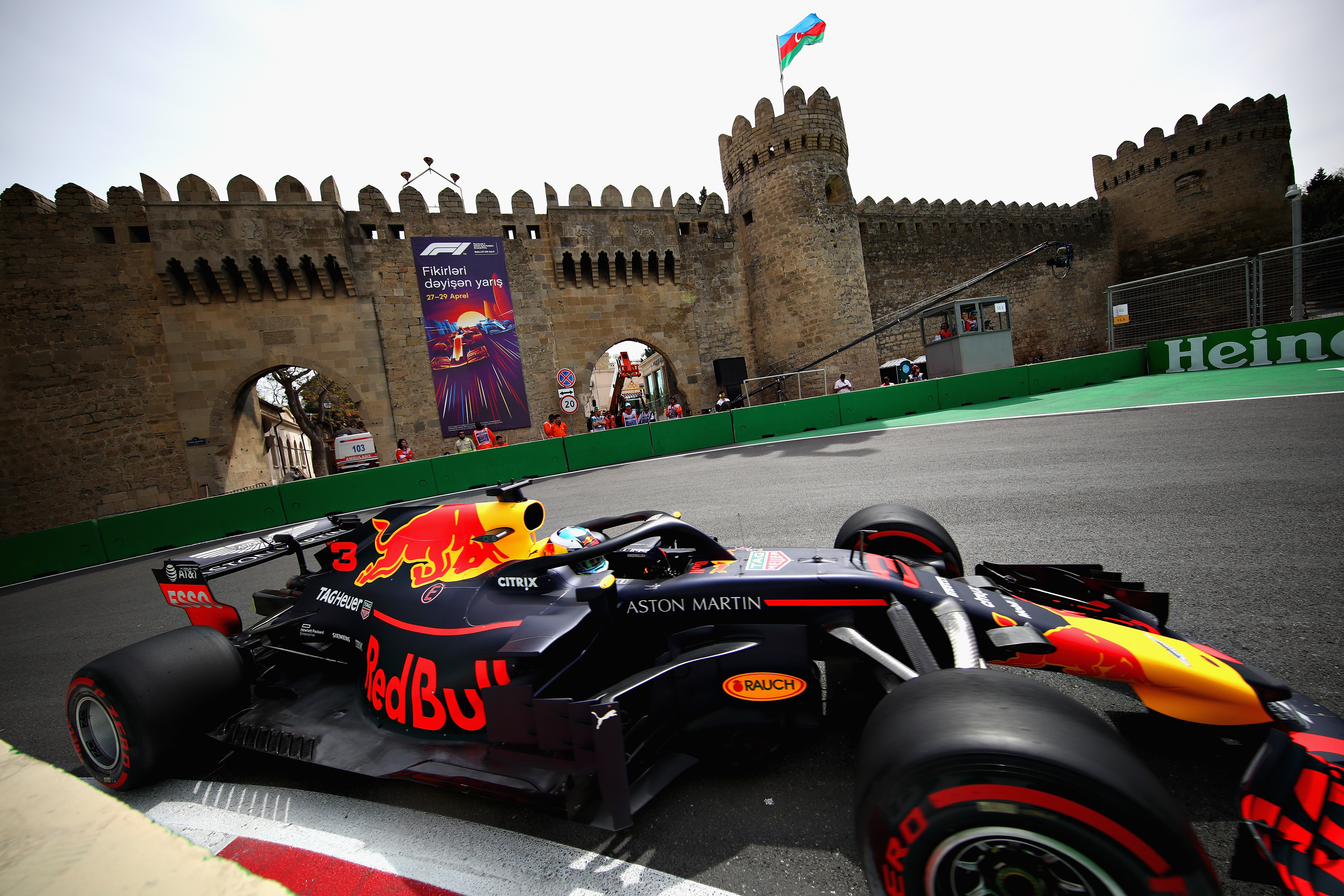
    Azerbaijan GP 2018: Friday Practice Round Up

    Friday Practice in Baku for the Azerbaijan Grand Prix showed the Red Bull are looking like the team to beat. After a strong showing in FP1, and FP2 Daniel Ricciardo looks like he’s in the groove this weekend, hot on the heels of his victory in China.

    The Australian was not far off the pace in FP1 finishing 2nd fastest. In FP2 he finished top of the time sheets with team mate Max Verstappen a little bit off the pace finishing off a strong Friday for Red Bull.

    Free Practice 1

    The session was off to a busy start with the Mercedes drivers heading out unusually early in the session. Nevertheless it was Valtteri Bottas that edged out Daniel Ricciardo by 0.035s to finish fastest of the session. Bottas best time of the session was a 1:44.242.

    In a really strong showing was the Force India of Sergio Perez finishing the session 3rd fastest ahead of Lewis Hamilton in 4th nearly one second off Bottas’ pace.

    Esteban Ocon finished 5th fastest ahead of the second Red Bull of Max Verstappen. Although Verstappen had set a time early in the session, he was out of the session just as quick. The Dutchman lost the rear of his Red Bull under braking into T5 and tagged the barrier side on. He kept the car running and tried to get going again but he stalled the car and could not get it going again. The VSC was deployed to retrieve the stricken Red Bull. Verstappen sat out the rest of the session trackside.

    The green and dusty track made conditions tricky and the notorious Turn 8 run off area came into play very quickly there were also a few other drivers that tested the limits of grip into various other corners around the track by aborting the corner and taking to the run off area.

    Fernando Alonso, meanwhile, got on with McLaren’s program and finished the session 7th fastest. Sergei Sirotkin ended 8th in a very good session for Williams.

    Sebastian Vettel rounded out the top 10 for Ferrari. Vettel complained about a lack of rear grip throughout the session and tried various tyres in a bit to try and find a viable setup. Kimi Raikkonen suffered a technical issue after 10-minutes and sat out the rest of the session.

    At the end of the session it looked like Mercedes and Red Bull had it dialled in very early on in the session but the long runs of FP2 were still to come…

    Free Practice 2

    Free Practice 2 all but confirmed Red Bull’s strong pace with Ricciardo topping the session with a session best time of 1:42.795 just edging out Ferrari’s Kimi Raikkonen who set a best time of 1:42.864. Raikkonen did catch a small break courtesy of a tow from Hamilton down the long run to the finish line.

    3rd Fastest was Max Verstappen who had a much cleaner FP2 but had an issue at the end of the session where he was told to come into the pits slowly. Red Bull, after the session revealed that a faulty sensor was the cause and that there is no real concern.

    Valtteri Bottas finished 4th fastest ahead of team-mate Hamilton in 5th. Continuing their good run of form from FP1 was Esteban Ocon in the Force India finishing 7th ahead of another solid session for Carlos Sainz in the Renault.

    Kevin Magnussen finished a good session for Haas in 9th with Nico Hulkenberg in the second Renault rounding out the top 10.

    Sebastian Vettel in the second Ferrari did not feature in the top 10 with another scrappy session with rear grip once again the issue.

    Like in FP1, the drivers continued to test the limits of grip under braking with a few drivers running into the run off areas around the circuit.

    Marcus Ericsson in the Sauber was confined to the garage for the session after a gearbox issue was detected early in the session.

    On the long runs Red Bull are coming out the fastest with Ferrari close behind. Mercedes are finding it hard to get heat into the tyres which means front and rear grip comes at a premium. On board shots of Hamilton’s car shows that the usually on rails Mercedes is quite a way off peak grip.

    Red Bull seem to have the edge on one lap pace as well in Baku. Mercedes’ qualifying engine mode might spoil the party for the Bulls come qualifying which will make strategy quite important once again. With the Ultra soft being the qualifying tyre and with little durability, it looks like the soft tyre will be the favoured race tyre. And we know how well the softs suit the Mercedes. Red Bull have something to say about that though…

  • 2017 Brazil GP Friday Practice Round Up: Mercedes Dominate the Day

    2017 Brazil GP Friday Practice Round Up: Mercedes Dominate the Day

    Mercedes dominated the Friday Practice sessions for the Brazil Grand Prix at the Autodromo Jose Carlos Pace. Fresh off winning the championship Lewis Hamilton finished fastest in both practice sessions showing no signs of easing off now that he’s won the championship.

    Free Practice 1

    Hamilton eventually set the fastest time of the session over team-mate Valtteri Bottas in the other Mercedes. Hamilton’s 1:09.202 came courtesy of the super soft compound tyres. Bottas was not that far off with a session best time of 1:09.329. The two Mercedes drivers duelled for most of the session for the fastest time but it was Hamilton who eventually prevailed.

    With just a touch over half a second off the pace was Ferrari’s Kimi Raikkonen in 3rd fastest for the Maranello based team. Raikkonen’s best time of 1.09.744 was 0.542s off the pace.

    Splitting the Ferrari’s were the two Red Bull’s of Max Verstappen and Danieel Ricciardo in 4th and 5th fastest respectively. Verstappen’s time was just a whisker off Raikkonen’s with the Dutchman crossing the line 0.006s slower than the Finn.

    Sebastian Vettel in the other Ferrari was 6th fastest more than 0.7s down on Hamilton’s benchmark.

    In his second final home race, Felipe Massa ended the session 7th fastest just a touch over one second off the pace.

    McLaren got both their cars in the top 10 with Vandoorne 8th fastest and Alonso 10th. The McLaren’s were split by Esteban Ocon’s Force India.

    It was not the best of sessions for Toro Rosso after Brendon Hartley suffered from an engine problem. This was an engine where they had just replaced his MGU-H. Pierre Gasly managed to only complete 7 laps for the session.

    Making his F1 debut was George Russel in the Force India. He did an impressive job to finish 12th fastest.


    Free Practice 2

    Hamilton picked up right where he left off and set the fastest time in FP2. His time of 1:09.515 was slower than the morning sessions time but was enough to get him the top spot.

    The session was much closer than FP1 with the top 5 covered by 0.5s.

    Mercedes looked incredibly strong out on track in the long runs and over one lap. Bottas and Hamilton traded fastest lap times but once again it was Hamilton that emerged fastest with Bottas 0.048s off.

    Daniel Ricciardo took the third fastest spot of the session after a relatively late run on the super softs.

    Splitting the Red Bull’s this time was Ferrari’s Sebastian Vettel in 4th with Max Verstappen in 5th ahead of 6th place man, Kimi Raikkonen.

    Esteban Ocon once again featured in the top 10 and places 7th fastest beating the Williams of Felipe Massa in 8th.

    Nico Hulkenberg got his Renault into to 9th place with McLaren’s Alonso rounding it out for the top 10.

    There were a few problems for Alonso earlier in the session after he reported deployment problems. The McLaren was back in the garage for a short while before he was back on track.

    Sauber’s Marcus Ericsson cut down his track time after a spin at Turn 11 shunted him into the barrier. He made it back to the pits after the impact and it seems there was no damage to the Sauber.

    Haas’ Romain Grosjean also spun at T4. He was able to carry on but complained of vibrations from the rear of his car. He was eventually called into the pits.


  • Video: Friday Drivers Press Conference | Spanish Grand Prix

    Video: Friday Drivers Press Conference | Spanish Grand Prix

    Not even the #RoomofAwkard could have been as awkward as the Friday Drivers Press Conference following two practice sessions ahead of the Spanish Grand Prix. Demoted Daniil Kvyat – now racing for the Toro Rosso team, Promoted Max Verstappen – now racing for Red Bull, and Carlos Sainz (current and former team mate respectively) – all on the front row of Friday Drivers Press Conference.

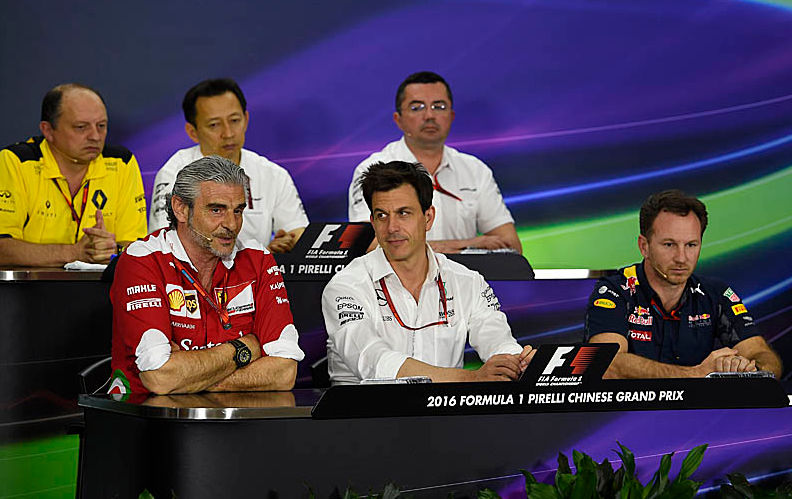
  • FIA Friday press conference – Chinese GP

    FIA Friday press conference – Chinese GP

    Here’s a look at who said what at the Friday Press Conference following practice ahead of the Chinese GP.

    TEAM REPRESENTATIVES – Frederic Vasseur (Renault), Yusuke Hasegawa (Honda), Eric Boullier (McLaren), Maurizio Arrivabene (Ferrari), Toto Wolff (Mercedes), Christian Horner (Red Bull Racing)

    PRESS CONFERENCE

    Maybe we could start with a general question for everyone. Obviously in the next couple of weeks there have got to be some decisions made on the future shape of Formula One, the regulations for 2017 and engines for 2018, so Christian, maybe we could start with you and how things are shaping up on the chassis side and where you think the discussion are, what shape we’re in and what we can look forward to?

    Christian Horner: Well, I believe that as far as the technical regulations are concerned, we’re pretty close to a conclusion on that. They were basically agreed at the last strategy meeting, so I think it’s just a formality to finalise those chassis regulations at the end of this month. I think most people are already tentatively looking towards next year based on those regulations anyway. As far as the engine regulations are concerned, again there have been some discussions recently, which again will go through the Strategy (Group) and subsequently onto the Formula One Commission but everything has to be fixed by the last day of this month for 2017, so I’m not expecting too many major surprises.

    And are you comfortable with where everything is at the moment, the shape of those regulations?

    CH: Well, they are the same for everybody at the end of the day. It represents a bigger change on the chassis side, so that inevitably is going to move things around a little. On the engine side there is obviously discussion still going on and that’s probably the bigger topic for the future, but as far as the chassis is concerned I think they are interesting rules, they add an element of variance compared to what we currently have, so you’ll see some different solutions no doubt from different teams, that you usually get from a regulations change such as that.

    Toto is that a situation that suits you, that there might be some variation in how the regulations suit the teams?

    Toto Wolff: Well, every variance challenges your organisation and I think we are well position to take up the challenge. Definitely making the cars look different, putting emphasis on new bits or innovation is interesting. Whether those rules can provide more interesting racing is another question. In hindsight, because we’ve voted on these regs already, we will see next if it works out. But yeah, I’m looking forward.

    Eric, what are your thoughts on this?

    Eric Boullier: Pretty similar to be honest to Toto and Christian. It’s exciting a little bit to have a new package. I guess the car will be faster and the drivers definitely will enjoy driving the car. So drivers happier, fans happier I guess. As far as we are concerned on the engine, we are seeking some stability, which would be the key to develop and have a better convergence in the future.

    Maurizio, Eric mentioned the fans there. These regulations are largely predicated on making Formula One more appealing, how important is it that Formula One gets these regulations right, now, for the next generation of Formula One fans?

    Maurizio Arrivabene: I think as my colleagues said, I think the regulations they are under discussion and nearly done, they are also especially to enhance the show in Formula One. Next year you are going to see a different car, tyres a bit larger and then if you want to make sure you do a good overtake you have to enlarge the track – no, I’m joking! I think it’s all following the direction to enhance the show and to make Formula One more interesting.

    Frederic, Renault has come back into the sport this year as a constructor, how difficult does it make it for you, or does it make it easier for you that everything changes next year?

    Frederic Vasseur: I don’t know if it will be easier or more difficult, but I think at least it’s new rules and it’s important for us also to start with this kind of game. But I think it’s not for sure much easier for us to start with a new regulation for next year, because we have to restructure the team and it’s not for us the best moment to change the regulations. But it doesn’t matter, it’s not the target, the FIA is not there to play the game for one team or another one but we have to try to push for Formula One and to find the most exciting way for the fan. And I think if the car is more impressive it will be much more fun for the fan and spectators.

    Hasegawa-san, welcome, your first time on this panel, and your second stint in Formula One. What’s Honda’s position on the engine regulations or the talks that are happening for 2018 in terms of power units for then? Are you satisfied with the progress that has been made there?

    Yusuke Hasegawa: As they mentioned still we need to have some further discussion but something like cost reduction and obligation. Yeah, from an engine manufacturer point of view, or as a member of Formula One society point of view, we have a kind of obligation to the fans and to this group, so Honda is happy to have that regulation, although we need to have some further discussion I understand.

    Just to the other people who engine manufacturers, what about the guaranteed supply that is being talked about for 2018. Is that something that you are comfortable with; is it deliverable? Toto?

    TW: It is a complex agreement. We have been given the task in coming up with solutions so that no team is left without an engine. I think all the engine manufacturers have acknowledged that, so we try to cover that. There is an aspect of price reduction, which is important to most of the teams, and we tried to cover that in the framework agreement. Obviously it’s very difficult to make everybody happy. Christian isn’t so happy. But I think we need to come up with a solution until the end of April. We need to ratify those regulations and at the moment everybody is working very hard to at least find the smallest common denominator.

    Christian, Toto mentioned that you may not be very happy. It’s obviously been an issue in the past. What’s your position on that supply going forward?

    CH: I think it’s a complex situation, but fundamentally there were four criteria that were requested by the governing body to be met to ensure stability moving forward. Those four criteria were: a significant reduction in cost to €12 million, the availability of supply or the guarantee of supply, power convergence to within a relatively small bandwidth and to address the noise. As we sit here now we are not anywhere near having met any of those criteria and I think unfortunately what will happen, as is often the case with these things, time will run out at the end of the month and nothing will be achieved and nothing will change. There is one more attempt in the Strategy meeting and the Commission meeting at the end of the month to discuss and table the concerns and where we’re at, but failing that regulations will inevitably stay as they are.

    Eric, Fernando back in the car today, maybe you could tell us what the process has been, how it worked with him today? And also maybe you could give us some insight into what Stoffel did at the last race and what he brought to the team.

    EB: Well, happily everything is back to normal. Fernando back in the car today was fine. The FIA wanted obviously to have another check and another go after practice one which was an easy one because he ran through practice one without any issues. He felt ready anyway before the Chinese GP weekend and I think this is a matter that is closed now. For Stoffel, obviously as far as we are concerned he did a very good job in Bahrain. Never easy to jump into an F1 car for a race weekend. I think he impressed everybody by how quiet he was and obviously by the good job he delivered. I think it’s a good driver for the future to have in our stable.

    Hasegawa-san, obviously the performance of McLaren has stepped up a little last year – what are your expectations for the rest of the season? Where do you see performance gains coming, when can you expect them to come?

    YH: It is too soon to say the exact number or position but obviously we’re not happy, we’re not satisfied with the current position. We can improve definitely with a decent level of step-ups so we are happy about that. Of course it is coming from the chassis as well but we can contribute with the power unit. It is important to show that we can improve in the step-ups. This is our target so far.

    Maurizio, one and two this afternoon, so a fairly good afternoon’s work. You’ve had two good results in Australia and Bahrain but a couple of technical issues as well. What’s been the response to those back at base and do you feel that that’s now been overcome?

    MA: What’s happened in Australia and Bahrain, we explained it very, very well and I think I don’t need to give further explanation because what we said, it was absolutely true, like it or not. Concerning here for the Chinese GP, it was a good Friday, not a bad one but unfortunately not gaining position on the grid or points in the championship. So, it’s a good short but the Chinese GP weekend is still long. Concerning the expectation of the season, I can say the Mercedes team of this year is the strongest one that I saw in the last ten years because it’s quite a lot of years that I’m around and, I mean, to be able to win against them, you have to work and be better than them. So, we are doing all our best to have good results.

    Toto, the best team in ten years! And Nico is performing very well at the moment. How have you seen him change over, not just the winter but if you look back to him in 2014-2015, do you think he came into the season with a different attitude? Is he a different driver?

    TW: Before answering the question I’d like to give the flowers back – they are pushing us very hard and you have seen today that it is raw performance and we have seen the performance in the last couple of races. Ferrari haven’t been able to pull it together because they made a big step from ’15 to ’16, similar to the step of ’14 to ’15 and in order to have the package rolled properly deliver and be reliable, that isn’t an easy task but in terms of sheer performance, they are really pushing us. And that is good; this is how the competition should be. In terms of Nico, he’s in a great place. I don’t see him oscillating a lot. People keep asking when Lewis had his winning streak last year, ‘is that going to knock Nico down?’ and then when he started winning after the championship was decided, ‘is it going to pull him up?’ Those guys perform on a very high level and it doesn’t particularly affect them whether they’ve had a good weekend or not. They’ve been in the job – or in motor racing – for 20 years or more, so the Nico I see today is developing as a personality, developing as a racing driver and learning – but also it’s not very much different to how I’ve known him the last couple of years.

    Frederic, you’re coming back to the grid as a constructor as we mentioned, you’ve had a couple of months now to assess where things are: what have you identified, or what did you identify as the things that needed immediate attention – and how is that progressing?

    FV: Nothing special and on every single matter because as we all know, we took over the company very late. The first challenge was to be on track for Barcelona and I think we did it but now, for sure, it’s a long term project and we have to improve on each area. There is no one, single matter to work on. We have to push on every single project and every single department of the company – but we know that it’s a long way and we are more than motivated and I hope that we will do it.

    Christian, these two gentlemen alongside you, they’re a little bit ahead but two fourth places in a row in Australia and Bahrain. Does that give you encouragement about the steps that have been made over the winter, not just on the chassis, on power unit as well. Where do you see it taking you this year?

    CH: Well we’re hoping to join their love-in. Sometimes two’s company, three’s a crowd… we’ve made good progress over the winter and I think at the last couple of races we’ve had arguably the third-fastest car. It’s a very tight pack fighting over that third place and the jump then to where these two teams are is quite a significant one. We’re hoping with further development on the power unit, that we expect around Montreal, to make good progress, certainly in the second half of the year and at certain circuits hopefully, try and get onto their shirt tails – but it’s quite a big gap that is inevitably going to take more than a season to close down.

    QUESTIONS FROM THE FLOOR

    Q: (Ben Edwards – Channel 4 TV) Frederic, about today, and about the tyre problem we saw on Kevin’s car and the decision not to run the car this afternoon; can you just explain that a little bit?

    FV: We investigated the problem at the end of FP1, that the problem came from the suspension and we had a lot of damage on the car and it was much better for us to stay in the garage for FP2 but we will be ready for tomorrow morning.

    Q: (Haoran Zhou – Top Driver) Question to everyone: during the last round of big regulation changes we heard that people like Ross Brawn were quoting downforce figures in the meeting to guide everyone how we should set these chassis rules. Presumably that sort of the discussion is present again in the strategy group; can you give us a rough range how much more downforce would next year’s car have on the chassis side? Is it one third or 20 points or something?

    TW: Interesting one! Around 80 percent! No, the numbers vary of course and they vary because of different interests so it goes from teams saying that it’s not a lot more than it is today until 30-35 percent.. So it could have quite a big effect on downforce which is in one sense good, because the cars will be more difficult to drive, will deploy much more G on the driver like in the past. But equally G isn’t visible for the spectator and the risk might be that overtaking could be more difficult and it will put an additional stress on the tyres. And all this is still in debate, but we have chosen the way forward and to come back to your question, that is the bit of the bandwidth I would say between zero and 30 percent.

    EB: It’s a little bit… yes, the debate was based as well on the tyres because we wanted to have more mechanical grip, let’s say, so there is a different tyre size, different compound and philosophy and all the discussion has been steered more about an improvement in lap time and on that point, I did agree with Toto. I think having a car with more downforce makes the drivers a little bit more confident to let’s say out-brake each other and obviously if you change the philosophy of the aero, less driven by the front wing, you improve the overtaking so I think it should be good.

    Q: (Joe van Burik – De Telegraaf) Mr Boullier, Stoffel Vandoorne received much praise for his performance in Bahrain; what more does he have to do to prove himself worthy of a fulltime racing seat or is that merely a matter of time?

    EB: Well, at this stage I don’t think he has to prove anything anymore, it’s just a question of having an opportunity.

    Q: (Haoran Zhou – Top Driver) Again, to presumably everyone: with the bigger tyre size for next year, presumably adding some weight, starting weight of the cars in race trim would be something like 820 kilograms and with Pirelli’s tyres being designed to degrade faster, that would significantly put a burden on how much the driver can push at the start of a race, which at the moment, at the start of the race, a Formula One car is not going that much faster than a GP2 car. Is there any way you can address that problem? And how much the drivers can push cannot really be solved by adding more aero to the cars in race trim.

    CH: First of all, I hope the cars aren’t 820 kilos. They’ve got a lot heavier with the new technology that’s been introduced over the last couple of years and compared to ten years ago, they’re more than a hundred kilos heavier than they were, almost approaching sports car weight, and that of course adds to the characteristic of making the car a little lazier than a lighter car but I disagree with you that by adding downforce and load back onto the car you’re going to give the driver a harder time. You’re going to give him much more of a workout. The drivers have been crying out for cars that are more challenging to drive. The cars that we have at the moment… it’s been discussed whether they are too easy to drive and I think that by making the cars edgier, by making them quicker you will get a bigger variance of drivers, the teams will get better value for money out of their drivers and they’ll have to start going to the gym again. So I think it’s a positive thing that we’ve got a regulation change but yes, the cars are a little bit on the heavy side. It would be nice to somehow get a hundred kilos out of them.

    FV: I think that Pirelli will adapt the tyres to the new regulations. It’s not a matter of downforce or degradation; it’s just the combination between the tyre regulations and degradation.