Tag: frederic vasseur

  • 2019 Formula 1 Brazil GP: Friday Press Conference

    2019 Formula 1 Brazil GP: Friday Press Conference

    TEAM REPRESENTATIVES – Toyoharu TANABE (Honda), Otmar SZAFNAUER (Racing Point), Christian HORNER (Red Bull Racing), Frédéric VASSEUR (Alfa Romeo), Mario ISOLA (Pirelli)


    PRESS CONFERENCE


    Q: Mario, if we could start with you please. Cast our minds back a couple of weeks please, to Austin, when the 2020 tyres were tested by the teams. The feedback was mixed, what did the teams tell you, and what’s the plan going forward with these tyres?

    Mario ISOLA: Yeah, as you said, the feedback was mixed. I believed that we had quite difficult conditions in Austin. It was very cold and the new tyres are designed with a different philosophy. So the plan now is to test them again in Abu Dhabi where we have a two-day test planned specifically for testing the new construction and new compounds, so we will have a comparison that is more reliable compared to Austin. We tested this new construction during the year with the teams and with their cars and we found an improvement in terms of overheating, in terms of compounds with a wider working range – but mainly the new construction was designed because every year the performance of the cars is increasing and obviously we have to follow this increase in performance. If we don’t change the construction, the only possibility is to raise the starting pressure – and raising the starting pressure is making the overheating worse and the behaviour of the tyre in general worse. So, the new construction has been designed with the target to keep the pressure as low as possible, according to the improvement in the performance of the cars. So, I hope that we can have a test in Abu Dhabi that is more representative. I fully understand during the race weekend all the teams are focussed on the race weekend itself, so they cannot adjust the set-up of the car – the aero-balance of the car – and the new tyres have a different profile. They are wider, especially on the rear, and this has an impact on the downforce of the car, as well as the balance of the car. So, we need a bit more time to test them properly on long runs, to understand if we achieve this target. After that, obviously we are very happy to accept any… not accept any decision but to discuss the result of the test and to see what is better for the sport.

    Q: Looking further ahead, the 18-inch tyres for 2021 were tested by McLaren at Paul Ricard recently. What feedback did you get from the drivers and the team?

    MI: It was positive feedback. They said that the 18-inch tyres were better than expected. They are more reactive, we confirmed some results that we had with Renault at Paul Ricard in September. So now we are finalising the 2020 test plan. Obviously we will have another 25 car-days of tests but I’m very positive. And in any case, what we have developed for the 2020 tyres, we have some concepts that we can transfer to the 18-inch tyres. So, it’s useful to keep this direction for the future.

    Q: Fred, coming on to you. We’ve asked you this question for a while now and you’ve finally got an answer for us: Alfa Romeo have re-signed Antonio Giovinazzi. Can you tell us your reasons for that?

    Frédéric VASSEUR: I think he did a very strong second part of the season, he improved a lot. He is now matching Kimi in quali and I think the issue is not on the driver side. We have to stay focussed on this and keep a consistent line-up, and it will be the best thing to do.

    Q: You say the issue isn’t with the drivers. Let’s turn our attention to the team. How well has this year gone for you and what are your plans for the team in 2020?

    FV: The plan is to do a better job next year for sure. We started pretty well this season, we were P4 after five or six races and then we started to have an issue. Different issues, not always the same, but we didn’t score a point in the second part of the season – or one or two points – but it’s not an issue always with the pace and, at the end of the day, we are doing too many mistakes collectively and this is the big issue.

    Q: Otmar, Checo told us in the press conference yesterday that 2019 has been a difficult and disappointing year for Racing Point. Would you agree with him?

    Otmar SZAFNAUER: Well, it’s not what we wanted. We definitely wanted to be a little bit further ahead. We’re just one point ahead of Toro Rosso and 18 behind Renault, so yeah, we were hoping to be fifth or fourth this year, so from that regard, it’s a bit disappointing. However, having looked back at what happened the year before this, when this year’s car was in development, we were in a bit of turmoil, especially financially, so it’s not surprising – although as a team we always want to do better.

    Q: As you say, you’re 18 points behind Renault, two races to go. How do you fancy your chances of catching them and even beating them?

    OS: Well, we’ll do our best. If we can mind the weighbridge and not start from the pitlane, that should help. Collectively, if we do a good job… but I think it’s not just up to us. I think we’ll need a bit of luck to be able to catch them – but we’ll do the best we can.

    Q: Tanabe-san, has this been a better first season with Red Bull than you expected?

    Toyoharu TANABE: So far, after 19 races in this season with Red Bull, we achieved positive results compared to previous years. And then two wins, one pole position and then, additionally, both teams on the podium in German Grand Prix. We made considerable good progress in the year. We want to do our best in the rest of two races in this season and then we want to carry over this positive progress and the momentum for next year.

    Q: As you say, lots of progress but has it been better than you expected, coming into the relationship?

    TT: In terms of the relationship, I think very good. And then, so far the results of the race depends on the performance compared to other competitors. It’s not easy to say good or bad. As a result, as I said, we got wins and a pole position. It’s good progress in the relationship.

    Q: Thank you. Christian, perhaps I could bring you in on this. How would you sum up progress with Honda during this first season together?

    Christian Horner: I think it’s been really positive. It’s been a great relationship. The two companies are working really well together. In our first year we have achieved seven podiums to date, two grand prix victories, two pole positions – albeit that we only started from pole once – but yes, the progress that has been made with the introduction of each engine has been great to see. Reliability has been strong. This year was always going to be a transitional year in this first year of this new partnership but it feels like momentum has built through the year and with stability of regulations in all areas for 2020, we’re really looking to take the positive momentum from RB15, the current car, into RB16, which will be our 2020 contender.

    Q: Better than expected?

    CH: I think in many respects, yes. I think if you look at… there were a lot of questions as to why we had made the move to Honda. I think very quickly, at the first grand prix, we achieved a podium. We’ve scored more points than we had at this time last year. All around, reliability has been strong, performance has been getting better and better. I think on the chassis side we were affected more than we thought going into the year by the front wing regulation change and Honda have certainly exceeded our expectations in all areas. So, it has been a really very positive start to this partnership.

    Q: Christian, just one more question for you. You’ve re-signed Alex Albon for 2020. Just your reasoning behind that?

    CH: Obviously Alex has done a very good job in his first year in Formula 1. He started the year at Toro Rosso and we then took the opportunity at the summer break to promote him into the senior team. The reason behind that was to have a look at him within our own environment. And since stepping into that seat he’s finished in the top six at every grand prix, sometimes having to start from the back of the grid or even the pit lane. So, he’s driven exceptionally well. He’s given great feedback; his pace is improving and improving, at many circuits at which he’s never been to before or countries he’s never been in, like here in Brazil this weekend. He’s earned the seat on merit. We’re excited about his potential for the future. It was a relatively straightforward decision to come to, to extend his relationship with the team as the partner for Max in 2020.


    QUESTIONS FROM THE FLOOR


    Q: (Scott Mitchell – Autosport) Christian, on Alex: he’s had a pretty rollercoaster 12 or 13 months from thinking he’s racing in Formula E to getting his F1 opportunity, driving an F1 car for the first time just before pre-season testing in the shake down and then obviously the Red Bull call–up. Now he’s going to be going into next year in a car you hope is going to be fighting for the title. Have you ever seen a turnaround like this in someone’s career and how well do you think has Alex handled that? 

    CH: What it demonstrates from Alex’s side is great tenacity. Originally he was part of the junior programme, he was released from that early on in his career and he really had to fight to retain a career in motorsport and rely on his talent, tenacity and never-give-up attitude. And the way he applied himself, you know, driving for Fred’s team in Formula 3, he pushed Leclerc hard that year. Formula 2 he graduated to and he had a strong career in Formula 2 and then, as you say, he was off to another discipline and then, ironically, trigged by the events created by Daniel’s decision to leave to Renault created this opportunity for him to join Toro Rosso and then very quickly you could see that he had a decent talent and great race craft and that’s continued and grown. And then the opportunity came for us to have a look at him within Red Bull Racing. It just shows that if you have the right commitment, the right attitude then things can turn around and talent does always rise to the top.

    Q: As a follow-up to that, can you compare and contrast Alex with Pierre Gasly?

    CH: I think that obviously for Pierre it was very tough for him coming into the start of the season off the back off two accidents in pre-season and that I think definitely affected his confidence and of course being the team-mate to Max Verstappen is a very tough job to have, having that reference point. For Pierre, it was a difficult first half of the season for him. Obviously we felt that with the pressure building on him, the public pressure, the media scrutiny, it was right to remove him from that and put him into the slightly less pressured environment of Toro Rosso. And since that switch I think he has driven again exceptionally well. You can see his confidence is growing. He’s driven some very strong races and his pace is getting better and better. He looks happier in that environment, which is good to see.

    Q: (Jesus Balseiro – Diario AS) Christian again, also about your drivers. Carlos Sainz used to be a Red Bull driver. What’s your opinion about his performance this year. And also, at any point did you regret losing him, just considering him as a good option for the second Red Bull this season?

    CH: Well, I think it’s been good to see Carlos get into a good car this year and he has done a very good job. He has done a very good job. He has driven well. He has very much been the best of the rest after the group of the top three teams and he’s driven some very strong races this year. We elected to go our different ways but we are still proud that we gave him the opportunity to come into Formula 1 and that he’s managed to use that opportunity to carve himself our a career, albeit now with another team.

    Q: (Marcel Teixeira – Reuters) I would like to know from the three team bosses how useful was this first session, because of the climate conditions, of course? It seems we’re going to have wet weather again this afternoon.

    OS: We didn’t do much running so… We did a little bit of running on the intermediate tyres so it was useful to do that. We gained a bit of understanding and a bit of data on what to do here on the intermediate tyre but we’ll see what the rest of the weekend holds. I believe tomorrow and Sunday will be dry.

    CH: Well, for us it was quite an expensive session. It started good. Alex, first time in Brazil, first time on the track, went fastest on the intermediates and then as the circuit looked like it was starting to get dry, I think there were ten cars that went out on slicks and Max went off at turn two – but on his own this time…

    OS: On his own last time too, by the way!

    CH: And Alex unfortunately, with cold brakes, he locked up into the last turn and did a bit of damage so it’s dented the mechanics’ lunch break to get the car ready for the next session.

    FV: For sure it’s not an easy session, it was much less expensive for me than for Christian, but he has much more money also. But no, at the end, the evolution of the track was so huge that it was difficult to do comparison. You had some cars on track with slicks, with wets, with inters [so] I’m not sure it was the best session of the season.

    Q: (Emerson Furkim – Car Magazine) I would like you to talk a little bit about the new regulations for the 2021 season, so I have two short questions. The first one: do you think that the budget cap will really close the gap between the teams? And the second question is will the fans really see more overtakes on track with the new cars?

    TT: For the PU manufacturers, we don’t have a budget cap. In the regulations, we have a testing time limitation, big reduction required and in terms of the teams, I need to hear from the other people. Also that area of chassis development required (for more overtaking) we will see. From a PU point of view, we try to make a strong PU and then make the race more fun.

    OS: Well, the budget cap… we’re going to be nowhere near it so it will not have a big impact on us but some of the bigger teams that will have to perhaps downsize I’m sure it will have an impact in the short term and then they’ll hit some type of equilibrium where they’ll continue to be strong but I think it will have an impact at the beginning. Will the new regulations help overtaking? I can’t predict that. We thought that the new front wing this year was going to do that and it didn’t so I’m unsure. Hopefully the work that’s been put in with creating a different wake of the leading car will have an impact on the following car but whether it allows more overtaking, I can’t predict that.

    CH: Well the budget cap question… what you have to remember about the budget cap is that it’s fixed for a five year period so for certainly the top three teams it’s a considerable challenge to get into a position to obviously get under that cap for 2021 onwards. And then obviously once we are there we have to stay there for five years, so whilst there may still be some divergence between the smaller teams and the larger teams over a period of time and hopefully as revenues continue to grow within the sport with the plans that Liberty… and the growth that they expect to see during the next five years I think things will naturally converge. I think the frustration about the regulations are it makes next year very expensive because we have effectively three things going on: we have the current car to develop, we have tyre testing on behalf of Pirelli with a sort of an interim car and then we have the development of a new car to a new set of regulations, so next year is a big challenge. And in terms of the outcome to the rules, do they achieve the target? Only time will tell. I think the intention is great in what they are wanting to achieve with this high wake concept. Whether that’s achievable only time will tell. The cars are going to look a lot different, it’s very much a clean sheet of paper, the regulations, so with that you tend to get divergence rather than convergence and obviously the cars are a little simpler, there’s not as many aerodynamic influencing elements all over the car so it’s certainly going to be interesting and hopefully the intention is to get it to be more driver influenced which I think is only a positive thing.

    FV: Yeah, the situation is a bit different compared to the teams but for sure the budget cap won’t affect at all the six or seven teams on the grid. It will affect the top teams but on the other hand they will have more resources to develop the new car next year as Christian said before, but the most important thing for me is the stability of the regulations of other period but if we change the regulations another time in ’23 or ’24 but it will be very difficult for the small teams to have an advantage on this. And then on the overtaking, I think the target is clear but the FIA and the FOM worked pretty hard to reduce the wake of the cars and to have a better understanding of this but now we will see only in Melbourne ’21 what is the situation.

    MI: To reply to the question, we are not subject to the budget cap. About the regulations, I want to be positive because if it is true that the cars that are following are losing a lot less downforce, obviously this is a big help for the tyres not to overheat and to keep the performance and this should help overtaking, then obviously we will know in Melbourne 2021 but I want to be positive. I think we are taking the right direction.

    Q: (Scott Mitchell – Autosport) Christian, you mentioned Alex’s off in FP1. Obviously the conditions were quite a significant factor in that, so can you just sort of brush this one aside or has he got a little bit of a nasty habit of this, because we’ve seen a few times in practice this year he’s had quite costly accidents?

    CH: I think today wasn’t… you can’t put on Alex’s account. I think maybe we were a little bit too optimistic getting out there, trying to get him laps in on a track that was still pretty damp in the middle sector. Max, as I say, he had a moment at turn one, turn two. There were other cars that were running wide so I don’t think today we can blame that on Alex but he has had a few little incidents this year. Thankfully they’ve all been on Fridays and Saturday mornings. When it’s come to it in qualifying and the race he’s absolutely delivered.
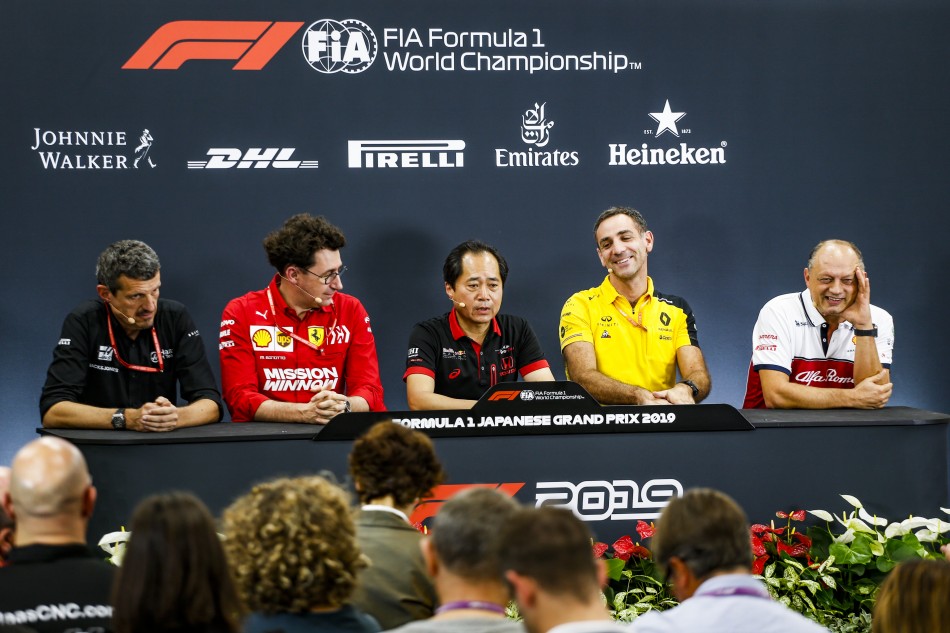
  • 2019 Formula 1 Japanese Grand Prix: Thursday Press Conference

    2019 Formula 1 Japanese Grand Prix: Thursday Press Conference

    TEAM REPRESENTATIVES – Guenther STEINER (Haas), Mattia BINOTTO (Ferrari), Toyoharu TANABE (Honda), Cyril ABITEBOUL (Renault), Frédéric VASSEUR (Alfa Romeo)

    Q: Tomorrow’s programme has been called due to the typhoon. Can we get your thoughts on that decision and could you explains how it has affected your programme today. Perhaps we can start with Fred?

    Frédéric VASSEUR: I think that it’s safety first and probably it makes no sense to ask the spectators to come on track and then to be in a big mess. In terms of schedule and programme for the team. We already thought about this yesterday evening honestly. OK, it will change the programme but I think we can afford the weekend with two free practices. Perhaps it will be a good exercise for the future.

    Q: Thank you. Cyril?

    Cyril ABITEBOUL: Well, nothing really to add. It has happened before and it will happen in the future. There is enough time on Sunday to conduct both qualifying and the race. I think maybe it will give us an impression of Formula E, maybe a little bit, so not a bad thing. That’s for my neighbor on the left, and on the right.

    Q: Tanabe-san?

    Toyoharu TANABE: First, I’m sorry to the fans willing to be here Saturday, but in terms of our programme we will just prepare for the qualifying and the race this afternoon and then maybe analyse the data and then ready for the qualifying on Sunday and the race.

    Q: Mattia?

    Mattia BINOTTO: I would join certainly his comment, as first I think it’s a shame for the fans but it’s a fully respectable decision, safety is first. In terms of programmes, certainly it’s a lot more intense now. We are certainly skipping one session, which is FP3. Qualifying may be occurring on Sunday morning. But it means that today it will be a lot more intense. We’ve got, eventually, more tyres to be used – the ones from FP3. We need to set up the car for the Quali on Sunday morning. There’s just a session less. Things are more complicated but certainly a great challenge but I’m pretty sure it should be a good show and spectacle on Sunday.

    Q: Guenther?

    Guenther STEINER: Nothing to add from a sporting side. I think it was the right decision from the organisers, safety is first, and the rest is set.

    Q: Thank you gentlemen. Tanabe-san, if I could come back to you, please? It’s always special to race here at Suzuka and Honda has a good chance of getting a good result this weekend. How exciting is it to be in that situation?

    TT: Yes, it is a very special race. The Japanese Grand Prix is our home race, and then the Suzuka circuit is owned by Honda. All Japanese fans are willing it to have a good result from Honda-powered cars. On the other hand, it’s kind of pressure for us, but fans give us more power. In terms of the weekend preparation, the setting is the same as the other races. So, we just set up the PU accordingly and do our best.

    Q: Can we get a word too on the performance of Naoki Yamamoto this morning in the Toro Rosso. He was only one tenth slower than Dany Kvyat. How would you assess his performance today?

    TT: Considering it’s his first run on a grand prix weekend I think he did a good job. Comparing the lap time against Dany is a bit difficult because they are doing different strategy in the practice. But he did a decent job for the team to set up the car in the first session of the weekend and then his run today will definitely encourage Japanese young drivers. So, thank you Toro Rosso and Red Bull and it’s good for the Japanese fans as well.

    Q: Thank you. Fred, coming back to you: there are five races left this year, so when you look back at this season, has it been a success?

    FV: It was a really up and down season. We had the first four or five races where we scored a lot of points and then we had a bad momentum around Monaco and Barcelona and then we went back. The last four races were very difficult. It’s up and down. But let’s see in the last five if it’s up and hopefully the last five will be OK.

    Q: What can you do to level out the performances?

    FV: It’s small things and small details honestly. If you compare with Sochi that we were, with Antonio, we were P13 in Quali but we were two tenths off compared to P7 in Q2 and it’s very, very tight and for small details sometimes you can be completely out of the classification but we have to take care when you are doing the analysis. But it’s true also that we made too many mistakes over the last three or four weekends – teams, drivers, everyone in the same basket – but at the end of the day we have to wake up a little bit and to come back to the pace and top score points in the last four events.

    Q: And how has the experience of Kimi Räikkönen helped the team?

    FV: He’s staying calm. He’s not a big nervous. I think it’s good also for us to stay focused on the real issue and not to start to try to go in every single direction. We know what did wrong on the last two or three events and I hope that we will be able to correct it for Suzuka and the next ones, and that’s it.

    Q: Guenther, if we could come to you now please. In Russia, Kevin Magnussen scored his first points since the German Grand Prix. What aero was he running on his car that weekend and is that the direction going forward?

    Guenther STEINER: I don’t know what aero he was running because we are mixing it up a little bit. There is no definitive spec what we could call it. It’s a hybrid, we call it and, going forward, in the moment we are on a very similar spec like we had in Russia. Going forward, we test a few things and I cannot tell you what we do in the next race because we just try to get better and get a better understanding so we are not in this position next year. But, I mean, it seemed to be working a little bit better in Russia. So, let’s hope we can find a few more points on our way to the end of the season.

    Q: Knowing what you know now, what would you have done differently with the development of this year’s car?

    GS: A lot. It’s like… I don’t want to go into the specifics of technical stuff but we should have listened a little bit more to the drivers when they gave their opinion about what the car is doing and whatnot. And sometimes listen more to drivers than look at numbers. That’s what we have to learn out of this. And now I think we need to get what drivers say correlated with what the numbers say and get an understanding so we can move forward. As I said, we would have done a lot different from Barcelona onwards.

    Q: Cyril, tell us about the progress with your car, particularly this weekend, and what feedback you’ve had from your drivers about the new front wing?

    Cyril ABITEBOUL: It’s as always when you bring this type of parts, in particular with these current regulations, it’s a very sensitive part. I think everyone here would say the same thing. So, it always takes a little bit of time to understand properly, to measure, we’ve done a number of back-to-back tests. The guys are currently looking at the data at the factory – and also listening to drivers, Guenther, we are also doing that – and no, there is nothing really bad but I think there is more to come in pace and in balance in particular. But this is a very complex area of development of the car. It’s highly loaded so it creates some instability. It’s complex.

    Q: Can you tell us any more about what the drivers were saying about the car this morning?

    CA: I don’t want to go into specifics but I think the balance was not exactly where it was supposed to be, so we need to review that in particular, make sure that the data do back up what they were experiencing on track. And if that does, we’ll be making some set-up change in FP2 to see if we can indeed get it to work a bit better.

    Q: OK, and looking a bit further ahead, it looks like you won’t be supplying any customer teams in 2021. How will that impact on your power unit development?

    CA: In particular for next year there is no impact because the engine for next year is done, it’s on the dyno already, you know that it’s a long lead-time development, so nothing is going to impact what we are doing for 2020. It’s going to impact what we could be doing for 2021 on the basis that, when you have multiple customers, in particular the way that Renault is doing it, we always try to satisfy everyone to take on board all the comments in terms of installation, and so on and so forth, so that will be one less distraction. We will be able to focus on ourselves and just on ourselves. And that’s it. From an economic perspective, there is absolutely no impact and nothing in it, because we sell, more or less, at a cost. Due to the price cap limitation. So, frankly, it’s nothing, that it’s good news, because, you know, it’s always satisfying to see your product being used by multiple teams but in terms of what we need to achieve and deliver for Renault it has absolutely no impact.

    Q: Mattia, we understood from Charles yesterday that you spoke to both drivers in Maranello last week. How confident are you that another situation like the one we saw in Russia won’t arise again?

    Mattia BINOTTO: First, it’s not the first time we are speaking in Maranello. It’s true that I met both of them this week, they were in Maranello for some activities: simulator etc., I think we had positive, constructive, honest, fair, transparent discussions with both of them, individuals. I think what happened in Sochi, nothing really bad but certainly something that needs to be improved and addressed and I think it’s only an opportunity of lesson learned and trying to do better in the future. But how much I’m confident it will not happen, I’m not at all. I think these are both very good drivers. They are all going for a single objective which is winning themselves but I think what again is more important is that at least we between us we’ve got clarity and fairness and I think that’s key.

    Q: You say they’re both very competitive drivers. What have you learnt about Sebastian and Charles over the last two grand prix weekends?

    MB: I think that they are both performing very well and, as I’ve often said this season, it’s somehow a luxury for a team principal having this situation. I’m very pleased for the racing performance of Sebastian, as I am for the one of Charles since, let’s say, the start of the season and his progresses. What I’ve learned, that we’ve got a very competitive line-up. But I don’t think I learned it. It’s not a surprise, it’s something on which we’re simply happy.

    Q: And what about this weekend. How’s your car performing and what do you make of the pace of the Mercedes this morning in FP1?

    MB: It’s only FP1, very difficult normally to judge. We cannot neglect that we set the four poles in the last four grands prix but we’ve seen as well that our competitors have brought some upgrades here. The Red Bull and the Honda will be very competitive this weekend as well. The weekend will be shortened because of tomorrow. Sunday morning the conditions can be very difficult for everybody after, let me say, the bad weather of tomorrow. So, I think it will be a difficult and challenging weekend for everybody. More important that we are focused on ourselves. We’ve got some homework after FP1 certainly to do. A few balance issues to be addressed. Again, I think the benchmark are still the cars which are ahead in the Championship and we are still the challengers but I’m pretty sure we can be competitive and this is our objective.


    QUESTIONS FROM THE FLOOR


    Q: (Eric Bielderman – L’Equipe) To all managers: would you regard this afternoon’s FP2 as a potential qualification session due to the fact that Sunday morning, with the wind, it might not be possible… there is a slight chance it might not be possible to run the qualification process?

    GS: I wouldn’t say a qualification but I think a lot of us will try to put in a fast time to prevent…  if qualifying is cancelled on Sunday morning, they are discussing it now, we need to look at the weather. But for sure, we have got more tyres available as well because we are not running tomorrow so it’s a judgement for everybody to do, to see if they can do a good lap but I think it will be quite interesting as Mattia said before, this afternoon, with not having FP3, there will be a lot of running out there this afternoon so hopefully we have got an interesting programme going.

    MB: Not much more to add. I think the answer was completely clear. I don’t think the main objective of this afternoon will be to set the best lap time. The main activity, certainly, will be to address any set-up issues that we got in the morning, making sure that we are ready for Sunday because still, I think, the most likely will be to have qualifying on Sunday morning and then the race in the afternoon. But no doubt, if we can, we will try to do at least a good lap, just in case.

    TT: In terms of a PU settings point of view, we just set up our PU for the qualifying and the race this afternoon and we will see. I hope the typhoon goes very quick after landing on the Japan island.

    CA: Yeah, it’s going to be a bit of a balancing exercise because we still need to prepare the race and particularly, in our case, because of the development parts, we still need to understand (them) a bit better and look at that but in parallel, we will keep that in the back of our minds. As far as we are concerned, we have elected to stay with our Friday engine, which is down on power because it’s an engine which we were using initially at the start of the season, so it’s costing a little bit but on balance we still believe that Sunday will be decent enough so that qualifying can be run so we prefer to stay with that plan.

    FV: Not much to add that I think at the end it will be a mix between FP2 and FP3 and in case of non-quali on Sunday, I hope that we won’t take the race number for Antonio!

    Q: (Dan Knutson – Auto Action, Speedsport) Fred, when will the team decide who Kimi’s team-mate will be next year?

    FV: We will take the decision quite soon but honestly, if you have a look at the last event I think that Antonio is doing a very strong job, that he was matching Kimi in the last six or seven qualifyings in a row. He was in front in Sochi. OK, the first lap was not a good one for us but he’s doing the job and he’s improving step-by-step but this morning we had an issue on the car and he was not able to show the pace but he’s doing the job, he’s improving and I’m very confident with Antonio.

    Q: (Kate Walker – Financial Times) I have a two-part question for Mattia: first off, I was wondering if you could talk us through the progress on the 2021 rules from the perspective of Ferrari and secondly, what is your current position on the use of the veto?

    MB: 2021, there will be a meeting with the FIA and F1 next week on the 16th which I think will be very important because that’s the last one, altogether, before the end of the month when there will be a new vote. I think there are still a lot of open points and discussions are still ongoing so how will be the conclusion of all these discussions, it is very difficult to say at the moment. There are various interests between teams, between the teams and the F1 and the teams and the FIA. But certainly, as Ferrari, we are intending to play our role, we believe as Ferrari because of what Ferrari represents for F1, we’ve got a voice, an important voice in the discussions but no doubt that there’s still a lot of points to be addressed. In terms of the veto – you mentioned the veto – as I said I think last time in Sochi that will really be a shame. I don’t think that should be the case at all. I think we’ve got a good and open discussion with the stakeholders at the moment and I’m as well somehow hopeful that we can find the right compromise at the end.

    Q: (Julien Billiotte – AutoHebdo) Gunther, you’ve been summoned to the FIA stewards for what you said over the radio in Sochi. Are you surprised, are you upset, do you believe you have a strong defence case?

    GS: I don’t know what they’ve got to say. I’m going to see them in five minutes, I will be leaving here early actually, because the two dates clashed. I don’t know what they’re going to tell me. You read the same as I read so I don’t know any more information than that. I can tell you something a little bit later but I hope I don’t get a penalty for leaving the press conference early!

    Q: (Martin Moravec – dpa) Mattia, when you look at this intense rivalry between Sebastian and Charles, do you fear that at some point you could lose control of your drivers?

    MB: No, no I don’t think there is the risk of losing control because there is a difference between not managing drivers and at least having the intent to manage them. There is always a solution which is not manage them, maybe someone may do so, I think our intention is to try to manage the situation to the benefit of the team and secondly to the benefit, overall, as well, of the drivers. We may do a few things that can be addressed or improved and I think that is what we are building and trying to do for the future.

  • 2019 Spanish Grand Prix: Friday Press Conference

    2019 Spanish Grand Prix: Friday Press Conference

    TEAM REPRESENTATIVES – Mattia BINOTTO (Ferrari), Frédéric VASSEUR (Alfa Romeo Racing), Guenther STEINER (Haas), Franz TOST (Toro Rosso), Mario ISOLA (Pirelli)


    Q: Guenther, a promising start for the Haas team here in FP1 but it’s been another difficult start to the season for Romain Grosjean. Are we seeing a repeat of last year or is it a different set of problems for him?

    Guenther STEINER: I hope that he hasn’t got the same problems here as he had last year. I think a lot of people would not enjoy that. I think we’ve struggled as everyone has seen. In Australia we were performance-wise not too bad but we had the pit stop issue. In the races afterwards… I shouldn’t say it because I’ve got Mario beside me, but we had some issues, we couldn’t get the tyres to work, which he will disagree with heavily, I forewarn you. But here it seems to be working. But it’s too early to say, it’s FP1, you know. We at least have to go through FP2 to get to some conclusions. This morning was a good session; it was enjoyable again. Let’s hope we can repeat it for the rest of the weekend and we don’t do any damage in the race.


    Q: But from Romain’s point of view are you seeing more consistency from him this year than at the same stage last year?

    GS: Absolutely. He’s very calm. He cannot do anything about it. He stays very calm, he stays focused, and I’ve all the confidence that he doesn’t repeat what happened last year.


    Q: Now, you’ve already touched on tyres. You were quite outspoken about them after the race in Baku two weeks ago. Just tell us what the issues were?

    GS: Mario knows better than me. He’s the expert on tyres, not me you know. We have got issues, we cannot get them to work, we cannot get the heat into them on certain kinds of tracks and that is our problem. I said in Baku that we would be struggling, beforehand. Here I was more confident, not completely, be should get them to work here and we get them to work here. But we have an issue that we cannot get the tyres to work at each track, so that is our issue.


    Q: Thank you and good luck this weekend. Mario, perhaps we could get your reaction to some of the comments Guenther came out with in Baku?

    Mario ISOLA: Yeah, I believe that Baku is quite a unique circuit, where you have an asphalt that is very smooth and so is not going to generate energy into the tyre, you have a long straight, cold weather conditions, the tyres are losing a lot of temperature and we know from the past the characteristics of the circuit. Last year, when we developed the current product, we were require to have a product without blistering – you remember last year we had some race with blistering – and to reduce overheating. That was a clear request from the drivers. So basically, our tyres have been developed with this in mind. Also, the working ranges are probably a bit higher than last year. But we didn’t experience any issue here in Barcelona in the pre-season test. We had good weather, but it was February, March, and the same in Melbourne. In Bahrain, OK, I had a chat with Guenther, I know their situation, and I hope they find a solution to that but I cannot say that it is a common problem to everybody. In Baku, because of the circuit characteristics it was a bit more difficult to keep the front and rear tyres in the right operating window. The operating windows cannot be narrower than last year because don’t forget that we have two compounds, that we call C3 and C4, that are the same compounds as we had last year, so at least with these two compounds we have the same operating window, and this is the analysis I can do now.


    Q: Apart from the two compounds that are the same as last year, have the new compounds become harder to work with for the teams?

    MI: I don’t think so, because the C1 and C2 are slightly softer than last year and with the C5, which is equivalent to what we called the hypersoft in 2018, the main issue was the graining and the new compound has a better mechanical stability with the same or wider operating window. Obviously we have to discover that in the next few races, where we are going to use this compound. They tested this compound in Abu Dhabi, they tested it in Barcelona, because it was a free choice of all the five compounds, and I believe that the new compounds are not more difficult to manage.


    Q: Looking a little bit further ahead, you announced yesterday that Formula 2 will use 18-inch tyres in 2020. What can you tell us about your testing programme ahead of Formula 1 making the same changes in 2021? Have you decided how that’s going to work yet?

    MI: Yeah, for Formula 2 we obviously have a very packed test programme because we have to develop the tyres in six or seven months. We already agreed a test schedule with the promoter and with the FIA. For Formula 1 the intention is to have three sessions – September, October and November – and three teams are going to supply the mule car, and they are Mercedes, McLaren and Renault. And we are going to offer the opportunity to provide a mule car for 2020 again to all the teams, it’s their choice if they want to do that or not. So it’s the same system and the same procedure that we have used in the last few years. We offer to everybody, teams can accept or not and then we make a plan according to the number of teams that accept it. We have 25 days of testing for next year, as it was in the last few years, so we have a short development plan for 2020 in the first half of the season and then we switch on 18-inch tyres from September onwards.


    Q: Thanks. Franz, perhaps we could move on to you. We heard from Guenther an overview of Haas’ start to the season, perhaps you could give us your thoughts after the opening four races from Toro Rosso’s point of view?

    Franz TOST: Toro Rosso has a competitive package. We have a car that works well, we have a powerful engine from Honda, and two drivers that are also competing quite good. We scored points in all the races apart from Baku but I think Daniil could have finished there in the ninth or tenth position but unfortunately he was involved in a collision with Ricciardo. I’m quite positive that we can also be here within the first ten. Generally speaking I think we are in the position to come with at least one car in qualifying three and to score points.


    Q: OK. A word about Alex Albon as well. He was something of an unknown quantity coming into this season. Has he surprised you with how quickly he has adapted to Formula 1?

    FT: Yes, it was a positive surprise, because as you know, if a young inexperienced driver is coming into Formula 1 there is always a questions mark, but I said already during the test sessions here in Barcelona in February that Alex could become the driver surprise of the year and so far he has done really a very good job, with good technical feedback on the mechanical side and the aero side, but also regarding the tyres he understands how to use the tyres in the best possible and we are really very happy to have him in the team.


    Q: Thank you, Franz. Fréd, coming to you, we saw some compliance issues with the front wing of Kimi Räikkönen’s car in Baku a couple of weeks ago. How have you resolved that for this race? Have you reverted to an older spec or have you updated the Baku wing?

    Frédéric VASSEUR: Just to clarify, that I think first we were out of the spec, we did a mistake, and perhaps you could consider that the decision was a bit harsh, but it’s like this, we have to clean in front of our door first and I think the mistake was on our side and for sure that we are not coming in Barcelona with the same wing.


    Q: It’s been a strong start for Alfa Romeo this year, particular on Kimi Räikkönen’s side of the garage. But we saw progress from, Antonio in Baku. How confident are you that he’s made a breakthrough and that he can progress and challenge Kimi for the rest of the season?

    FV: I think if you look at the first four races I think he was into the pace but I think we made on his side too many mistakes. He had some reliability issues. He got the penalty in China first, he didn’t do the quali and then in Baku… OK it’s far too much, we have to give him a clean sheet one week and to do a proper job, but I think he is improving. He was in front of Kimi in Baku, and he did a very strong quali also in Melbourne. No, I’m quite confident that he is very focused and motivate and the results will come and will help.


    Q: OK, thanks Fréd, good luck with that. Mattia, we’re back Barcelona, where two months ago Sebastian in particular was singing the praises of your car. The driveability then seemed to drop away when we went racing. After FP1 today can you tell us, are you back where you were in March?

    Mattia BINOTTO: I think we never dropped away. I think that certainly we had a strong winter testing, but I think that our main competitors were as strong as we were at the time, and on the last day of winter testing they scored the same lap time as us. As a matter of fact, I think we already mentioned that they would have been very strong as well. I think that since then we are both developing our car. The car developed, so coming here it’s certainly not any more the same car we had at the time, the weather conditions are completely different, the heat is certainly a different factor. So, are you exactly, let me say, on the same page? I don’t think you can compare. I think more important that it’s a relative competition so it’s more important that we are focusing on the weekend and trying to optimize the car and the package, and we are doing our best.


    Q: You’ve bought a host of upgrades to this race. A lot has been made of the power unit upgrade that is a couple of races early. Can you just tell us what’s been going on in Maranello to bring these updates forward? Are people working even harder than normal?

    MB: Obviously when you are planning such a change on your schedule you need to do it a few weeks ago. It’s not something we decided within that week. Having started the season in Melbourne we recognized that somehow we may have been late on our let me say performance compared with our competitors and we tried simply to push on all the main items where we were already planning developments. We were simply looking for opportunities in anticipating some of the programmes. We did it already with an aero package in Baku which was somehow introduced earlier compared to our initial programme. We did it here as well for the power unit. You simply achieve that by trying maybe sometime to shortcut or intensify the activity. I have to say that the people back at Maranello have worked very hard, we intensified our activities, and we are working still very hard, as it seems that’s what we need to do at the moment.


    QUESTIONS FROM THE FLOOR

    Q: (Frederic Ferret – L’Equipe) Question to all of you: has the success of the Netflix series helped you to have an agreement with them for the Season Two?


    Franz, have you signed something with them for the second season?

    FT: No, not that I’m aware of.

    Will you sign with them?

    FT: We will see.


    Do any of you just want to give us your thoughts on the success of the Netflix series, and what you think it’s done?


    GS: I didn’t see it – but everyone tells me. I don’t know how successful it is because there were no ratings, so I’m told and Netflix never gives them, but I think everybody was positive about it, so I guess it helps. It should help to bring people in who don’t normally watch the races, who see this. There are more people watching Netflix than F1, I would say. If the people watch it and then get interested in F1, that should help us. That should help us all, and it’s a good thing in my opinion.


    And Guenther, to follow up on Fred’s question, would you be willing to help Netflix with a Series Two.

    GS: Yes!


    Mattia, will we see Ferrari involved?

    MB: I think that, as Guenther said, it’s certainly an interesting programme. We were not participating last season as Ferrari. We are considering it at the moment. We have not taken our final decision, so it’s something we will do in the next few weeks.


    Q: (Sam Collins – Racecar Engineering) Looking to the future, in 2021 to 2024, we’re going to have single make brakes and wheels. I’m a little bit interested to know how that’s going to affect your teams and, in terms of Pirelli, how it’s going to affect your company, both commercially and technically. That’s to everybody.

    MI: On our side, having a standard rim is obviously… you know that at the moment each team is designing his own rim and that could make things a bit complicated for us. Sometimes it’s difficult to fit a tyre. And heat exchange with the rim is also an item we are able to consider so, for sure, it’s a standardisation that could help on our side. The brakes as well.

    GS: Standardisation. First of all, I think it hasn’t been decided how much we do standardisation so I think we’re getting ahead of ourselves here to say that it’s been decided for ’21. I don’t know if anyone signed an agreement that it will be standardised. A lot of parties looked into it because the tenders went out – but it could go both ways, y’know? Sometimes you get some parts which just work, and sometimes you get parts that everybody’s got the same and some people get them to work with their car. The worst bit for me, we need to make sure that Formula One keeps its DNA. And the DNA of F1 for me, it’s developing… it’s the only motorsport that is free for technology. Once you start standardisation, it can be a slippery slope in my opinion. We need to be careful not going down that slope and all of a sudden ending up with all the same cars. A lot of people are interested in our technology and that is why they’re watching F1. I don’t know. First of all, we need to see what is happening with standardisation before I make a final comment how I think about it.


    Mattia, what’s your view?

    MB: Very much aligned with Guenther. So, first it’s not decided yet, yes, true there are some tenders and discussions are on-going. As Ferrari, we always relay that we are against the standardisation principle – but we know as well that we need to control the costs and expenses – and obviously there is a budget cap so we need to find the right balance. Standardisation only makes sense if you may save money, which has to be proved first. And as well we need to take care of the DNA of F1, as Guenther said. For example, if we take the rims, all the cars with exactly the same rims – I think that, in terms of aesthetics, is not good for F1 from the outside, because you’re not differentiating any more the cars from one car to the other, maybe just the paint. But it’s not something we should look at. We are going through an entire process, together with the FIA tenders. I think first we should look at the result of the tenders and then to a proper evaluation and make it carefully.


    Fred?

    FV: F1 was able to do it on the ECU 15 years ago. I think that we can manage a situation on the brakes or the rims. The only issue, for me, would be the timeline. We need to be aware quite soon, and we need to have more details quite soon about the technical aspects. If we are in a rush then everything is more and more expensive.


    And Franz?

    FT: First of all we have to wait, what the regulation at the end will say. Standardisation of parts, there are two reasons: first to come down with the costs; the second also to bring the performance together of the different teams. I don’t agree to say the DNA of Formula One is just to develop, we have to find a way to come down with the costs and no-one takes care which brakes we have in the car, or which rims they have. The people want to see some interesting races, some overtaking manoeuvres. They don’t care about the form of the rims or about the brakes. They just want to see interesting races. And we have to come down with the costs. Therefore I am in agreement with as many standardised parts as possible.


    Q: (Scott Mitchell – Autosport) Mattia, you talked about the upgrades and the earlier upgrades and rejigging the schedule. I just wanted to check what the longer-term consequences of that will be this season – because obviously it’s a long season. Does this, by bringing it at race five, does that lock you into probably a fourth engine at the end of the year – and could you introduce an additional spec at the end of the season?

    MB: No, that’s not the plan. The early introduction doesn’t mean that we cannot still use PU1 in some races. Maybe that can be an option – but certainly we are not hoping to have four engines per season per driver plan.


    Q: (Dieter Rencken – Racing Lines / racefans.net) Mario, given all the talk about the tyres etc., obviously when you came into the season, you had some form of objective list, your target letter etcetera. Are you quite comfortable that you’ve achieved all of those in terms of compounds, of degradation etcetera – and at which stage do you phase-out of developing 13-inch tyres and concentrate purely on 18-inch?

    MI: I would say, as I’ve said before, one of the targets was to eliminate the blistering that we had last year. And the other one was to reduce the overheating to give the opportunity for drivers to push more. I believe we are in the right direction. Last year we started the development of the new produce with some other ideas – and we want to conclude this phase for 2020. That’s why we have decided to keep the development of 13-inch tyre in the first part of the season for next year, so the plan is also to find new compounds with a wider working range, that is what they are asking for. And to upgrade another step in the construction. Then obviously we will focus on 18-inches, that is a big challenge.


    Q: (Ian Parkes – New York Times) Question to all four team principals. Given your respective starts to the season, could you give us an idea as to whether it has been worse, or better than expected, and the reasons behind that. And what your expectations are for the rest of the season, now you have a decent idea as to where you are performance-wise.

    FT: From Toro Rosso’s side, I must say we had a reasonably good start into the season. As I mentioned beforehand, we scored points and we have a competitive package. From the different race tracks, I must say Australia was really a big success. Many people were there, it was also not so bad in Bahrain and Baku. From the race entertainment itself, I must say it was not so exciting because we have two cars in front which are winning race after race and that’s not, I think the best for Formula One because it starts to become boring as far as friends of mine say to me: don’t watch F1 any more because always the same are winning. This I think is not good.


    Alfa Romeo’s perspective?

    FV: For Alfa Romeo racing, probably a good start to the season that we score points on every single event and it’s so tight in the midfield that you can – as Franz said before – that from one session to another one, or one race to another one, you can move from P4 to P10 and it’s very difficult to make any prediction. But I think at least at this stage of the grid it’s exciting, and when you arrive in Barcelona, you never know if you will be P7 or P20. I think that the fun is there and everybody is pushing like hell to bring updates and to push and get results on the next one. I think I’m quite happy with the job done so far – and for Alfa Romeo Racing it was a good one.


    Mattia?

    MB: Difficult answer. Certainly we are not happy for the points we’ve scored so far. I think we have missed a great opportunity in Bahrain where we certainly could have done a fantastic result compared to the one we did. I think as well in Baku we could have done a better race and certainly a better quali – so if you make the sum at the end, we are missing points, we are missing points compared to where we believe is our potential. Our objective certainly is not to be where we are in terms of – again – points and classification, so we cannot be happy on the start of the season. But assessing that from the performance overall, it’s not a drama at all. I think we have got still a good car. The competition is very, very strong and that, I think, was known and it’s not a surprise but I think we are still in the battle and we could to every single racing with the willing to do well – and we can do it.


    GS: I think we clearly underperformed from Australia onwards, because of our issues which we cannot get a grip of, and we need to do a better job going forward on that one. I think, as Fred said, the competition in the midfield is very tight which makes it interesting for F1 but I think, if you ask, maybe we should have more points but we don’t. The good thing is, it’s very close together. Nobody in the midfield went away with 30 or 40 points so you can make up a lot in one race. As long as we don’t keep on doing what we did up until now, we should be OK – but I would say, I’m happy on one side – the car is very competitive – but we didn’t get the maximum out of it. We just need to do a better job as a team altogether.


    Q: (Alan Baldwin – Reuters) Mattia, you mentioned earlier about Netflix. Another area that Ferrari have not been involved and I’m sure it’s well down your list of priorities is e-sports. I just wondered if you’d made the decision whether you were going to be competing in it and what are the pros and cons for a team like Ferrari of getting involved?

    MB: I think e-sports and Netflix – both of them are certainly great programmes. E-sport is increasing in terms of interest and certainly as Ferrari we are looking seriously into it. We are not yet fully committed to the programme but it’s something where the discussions are ongoing and we will very soon make our own decision.


    Q: (Joe van Burik – Racing News 365) It seems very likely, a year from now, we will be racing in Zandvoort for the Dutch Grand Prix. What are your personal experiences with that track and what do you expect of that event?

    MI: I don’t have a lot of experience in Zandvoort. We go there with GT racing but to be honest, I don’t know the circuit very well.

    GS: I have been once in Zandvoort with DTM, a long time ago and I think it’s a great place to go racing. It’s a race track near cities, for sure there will be a lot of Dutch fans there and I think it’s always exciting to go to new places. I know Zandvoort is not new but it’s new again for Formula One. I think it’s exciting because we reach out to more people who are sometimes in areas where they cannot go to other races and it’s interesting, new things to learn, new things to see and I actually look forward to it.

    MB: It’s new for me as well, I have never been in Zandvoort so it will be the very first time. Quite interested and exciting to be there. I think it’s good to have another race in Europe and the Netherlands, as Guenther said, a lot of Dutch fans so I’m pretty sure it will be a good race so I’m looking forward (to it).

    FV: Yeah, I went a couple of times to Zandvoort for the F3 and DTM and it was always a great and exciting event with a lot of fans. I think it’s a good place.

    FT: We did a lot of races in Zandvoort in Formula Ford, Formula Three. It was very positive, I must say I like it there, it’s close to the sea, it’s close to Amsterdam. They have, I think a fantastic infrastructure, interesting track and I expect many many spectators will come there and it will become a very exciting race for Formula One, therefore I hope that we go there.


    Q: (Christian Menath – Motorsportmagazin.com) First part of the question for you, Mario: can you talk us through the process, how you chose the three teams for the 18 inch tyre tests this year and how many teams offered the possibility? And for the team principals: what are your feelings about that, you were probably not chosen or you didn’t offer your cars? Do you think this could be a disadvantage, especially for Mattia? Your main competitor, Mercedes, is delivering a car. Could this be a disadvantage for you?

    MI: OK, the process is the one I described before. We offered the opportunity to test to all the teams and three teams replied in a positive way and obviously everybody knows that the development is not just in these three sessions in 2019, so as I said, all the team can decide to participate in 2020. The three teams that replied positively have been chosen and we are planning three sessions so it’s quite easy to give one session each.

    MB: Yeah. Obviously we have been offered. It has been our own choice not to participate. Been short on time and the resources for the programme so as Ferrari we decided simply not to take part in this test in ’19 but we are preparing ourselves to do it obviously in 2020. I’m pretty sure that we will have the opportunity to do it. Will that be a disadvantage? Certainly you cannot do everything and you need to make your own priorities as some stage and that again has been our own choice but there is still a process put in place where Pirelli anyway are sharing the data with all the teams, of the output and the results of the new tyre testing so we are certainly counting on that one for actually the very first test.

    FT: Everybody could decide. We from Toro Rosso can not afford to do this test because we simply don’t have the manpower and also not the financial resources and therefore three teams decided to do it and that’s fair.

    FV: If Mattia is short of resources to do the test, you can imagine that for us it’s not easy.

    GS: We are working hard to figure out the ’19 tyres so we have no time for the ’21 tyres.


    Q: (Sergio Rodriguez – Formula Rapida) Yesterday we saw that PIrelli will use F2 as a way to develop the 18 inch tyres. Do you think that F2 can be used as a development platform for the new revolutions coming in 2021? Not only that but in the future as well? Do you think F2 can be used as a platform test?

    FT: Of course. First tests with F2 makes sense. Pirelli can get a lot of information, data about it and in parallel to this, anyway test with the three Formula One teams and I think the way they are doing it is the right one.

    FV: Yeah, they will get live experience with Formula Two. I think it’s also good for young drivers in F2 to be used to drive with the 18 inch tyres and then I think each team will try to build up a collaboration with GP2(F2) teams and to have a look.

    MB: The question has been asked of the four team principals but for me Pirelli is the best person to reply, whether that is useful or not as a platform. The cars are quite different, the level of performance is certainly quite different. The level of downforce and loads on the tyres are different but those are things that Pirelli is obviously aware of but at least it’s a good starting point. They can get some experience on a different platform, a different formula and whatever they can do there will be of help for Formula One, but I’m pretty sure that they are pretty aware that on the F1, the exercise will be much more difficult.

    GS: I think there are no negatives to test them in F2 but the technicalities… I will leave that one to Mario to explain because as Mattia said, the loads and the forces, I think they are different, unless Mario disagrees with me!

    MI: No, no. I never disagree with you. He’s right. The forces, especially after 2017 when Formula One decided to move on to the wider size and the cars are faster and faster, it’s a good opportunity to get some experience from our side but we cannot compare the F2 tyre with a Formula One tyre. We will develop the Formula One tyre with the new cars, with a representative performance and otherwise we make a mistake for sure. We have to develop a bespoke tyre for Formula One but the effect we are anticipating with Formula Two is helpful because we can have some experience with single-seaters on 18 inches but don’t forget we are supplying a lot of other championships with 18 inch tyres, like GT and touring cars and so on, but the stress and the energy that is going into the tyre on a Formula One car is not comparable.


    Q: (Dieter Rencken – Racing Lines, racefans.net) Mattia, the way that I understand it, the veto that Ferrari has is a contractual right, not a lifetime right. How important is it to Ferrari to retain this veto right after 2020, in other words from 2021 onwards? Is it a sticking point in your negotiations or are you happy to forfeit it?

    MB: No, certainly the veto right is something important for Ferrari but I believe it’s something important for F1 overall as well because somehow it’s not only protecting us but it’s protecting all the teams maybe against some decisions which could be against the spirit or the interest of the teams themselves, something that we are starting discussing with both the FIA and F1. I think we are doing well in that respect and hopefully we can keep the same rights.


    Q: (Scott Mitchell – Autosport) Fred, just wanted to clarify what you said at the beginning about the front wing hereafter what happened in Baku. So is it correct to say you haven’t had to change the specification, it’s just that you’ve had to replace it with one of the other front wings that you had?

    FV: No, we changed the hook and the fixation.

  • 2018 Japanese GP: Friday Press Conference

    2018 Japanese GP: Friday Press Conference

    TEAM REPRESENTATIVES – Christian HORNER (Red Bull), Franz TOST (Toro Rosso), Frédéric VASSEUR (Sauber), Masashi YAMAMOTO (Honda)

    PRESS CONFERENCE

    Q: Yamamoto-san, you introduced an engine upgrade in Russia. How much of a step forward is that? And in more general terms, how much progress have Honda made this season?

    Masashi YAMAMOTO: Regarding this season, we were not as quick in the development as we would have wanted to. However, recently, everything has been much better, especially regarding the combustion chamber. We have upgraded it, and it’s finally complete, and very successfully complete. Regarding Russia, and the problems we had with the other engine, it had regard to the calibrations but we have fixed it since Russia, and within this one week before the race in Suzuka, we have fixed that issue and so I suppose Mr Tost can look forward to great weekend.

    Q: How are preparations going for 2019 with Red Bull Racing? Do you feel a big pressure to deliver top results?

    MY: Yes, regarding 2019, we are very pleased to also work with another top team. We believe Red Bull is a top team in Formula One. We – me and Christian – we have had great communication throughout the year, and obviously there is pressure, however this pressure, we turn it into good energy, and this good energy will bring us fantastic and fabulous results. Of course, with Team Toro Rosso, Team Red Bull on both sides, pressure into great energy, great results for 2019.

    Q: Franz, you had a busy week leading up to Honda’s home grand prix. I believe Sakura on Tuesday, Wako Wednesday, Suzuka factory yesterday morning. Just tell us what you found in each place and about your experiences this week.

    Franz TOST: And Tochigi! You forgot another company. No, it was fantastic, the visit with the two drivers, all the different factories here, the research and development factories from Honda. The people were very enthusiastic and they liked to talk to us, to ask questions and I must say the Honda employees are really Formula One fans and I hope that we can provide them with good results, so they can see all the hard work which they have done in the last months come to a successful end.

    Q: It was announced recently that Daniil Kvyat is going to return to Toro Rosso next year. After a year with Ferrari, what kind of a driver are you expecting back in the Toro Rosso fold?

    FT: I was with Daniil Kvyat out in Sochi, we had a fantastic dinner together, he is relaxed, I have the feeling he is much more measured that the year before. I expect a competitive Daniil Kvyat. We all know he is very fast, that he has a very high level of natural speed and he just has to sit in the car, push the right-hand pedal and you will see he will show good results because he can do it. We all know this.

    Q: Christian, we’ve just heard from Yamamoto-san about Honda’s preparations, their hope for good results next season, can we just get your take on how things are going with Honda. How are advanced you are.

    Christian HORNER: We’ve been very impressed with the progress that Honda have been making during the course of this year. Obviously, we’re now working closely regarding… incorporating the engine into RB15 for next year. I have to say the communication has been excellent between both companies. We’re hugely impressed by the effort, commitment, desire, determination to succeed that there is in Honda. Certainly, when Yamamoto-san talks of energy, we’re not lacking any energy within Red Bull Racing, regarding the 2019 season.

    Q: Bringing it back to this year, you’re now 101 points ahead of Renault in the Constructors’ Championship, so you’re pretty much nailed-on for third place. How has that affected your preparations for next year? Have you started work on the new car earlier than would be normal?

    CH: Well, we have a regulation change coming for next year, the front wing changes the characteristics of the car quite significantly, so we’re effectively in no-man’s land in the Constructors’ Championship, so obviously, a large amount of resource is already being placed into next year’s programme – but of course any updates we can introduce and learn from, we’re bringing trackside.

    Q: When did you start work on next year’s car?

    CH: It becomes a transient process. So, obviously as soon as the regulations are released, you start to look at kind of impact that there is and then that ramps up through the summer months. So, pretty much all the design team now are obviously focussed on 2019.

    Q: Fred, excitement is building about Charles Leclerc and his move to Ferrari in 2019. We saw another great race from him in Sochi last weekend. Just wanted to ask you how much Charles has changed as a driver, and as a person? The driver who turned up in Melbourne, compared to the driver that’s now racing in Japan.

    Frederic VASSEUR: Compared to Melbourne, for sure he’s got a lot of experience. He struggled a little bit on the first event of the season with management, mainly due to the fact we had a very short winter session in Barcelona due to the weather. The first week. The first races were a bit difficult for him but then step-by-step, after second or third race he was able to put everything together and he improved consistently. I think he’s still improving.

    Q: Let’s throw it ahead now to 2019. Kimi Räikkönen was at your Hinwil factory a couple of weeks ago. What sort of work was he getting on with there?

    FV: He’s not designing the next car! We tried to sit him into the car. The next year car. It went well!

    Q: What about Giovinazzi? How excited are you about him joining the team?

    FV: For the whole team it’s a huge push that we have still a couple of guys who were there when Kimi drove for the team, and the reputation of Kimi at Sauber is still huge. When we did the announcement, that it was a great push for everybody and I think it will be helpful for the team.

    QUESTIONS FROM THE FLOOR

    Q: (Scott Mitchell – Autosport) Question for Franz, Christian and Yamamoto-san. Regarding Honda’s upgrade and the progress we’ve seen so far. Franz, what are you expecting the difference that will make in the midfield battle? Christian, do you agree with some of the comments from last weekend, that it puts Honda at least level, maybe ahead of Renault, and Yamamoto-san, how do you feel about the comments, the positivity the upgrade has had from Red Bull and Toro Rosso?

    MY: Regarding Spec-3, which we have brought in Russia, well, actually, obviously as you know, it hasn’t raced yet, so it will be the first opportunity to race with the new spec. According to the results that we’ll have after the race, it will be more comparable. We can start comparing data with the other ones that we have used before. So, not only the engine but of course the entire performance with the car.

    CH: Well, it’s obvious that progress – and good progress – is being made and that’s really encouraging for us. Our focus is not on where our current position is. It’s where the lead position is. That’s the same goal that Honda share. In-roads are being made to reduce that gap to the benchmark in Formula One. You need all elements to be performing to win in this sport, and of course the engine is a key element. We’re looking very much forward to 2019 and starting this relationship with Honda.

    FT: With the spec-3 engine we must be in Q3 and we must stay ahead of Sauber because they put a lot of pressure on us in the Constructors’ Championship. That’s the target.

    Q: (Dieter Rencken – Racing Lines, Racefans.net) A question to Christian and Franz. In the past the Red Bull group has had very close relations with the VW group across various categories – rally, DTM, etc. I believe that: a) you are reducing your DTM involvement and secondly, the relationship you now have with Honda covers two Formula 1 teams and MotoGP. Does this supersede your previous VW relationship or replace it or what are your plans going forward?

    CH: Obviously there was a historical relationship with VW across different elements of motorsport. The withdrawal from DTM coincides with other movements going on within DTM. Obviously it’s a growing partnership with Honda. And of course Red Bull, who operate in many categories of motorsport, work with many different manufacturers but of course this relationship in Formula 1 is extremely important. There has been a long and successful partnership within MotoGP and we hope some of that success will be mirrored in our Formula 1 activities.

    Franz, anything to add?

    FT: There’s not much to add. Toro Rosso was together with Volkswagen at the beginning and we had a real good co-operation also with them, especially on the sponsorship side, but then we changed the engines to Renault and now to Honda there was not any more the possibility to work together with Volkswagen and we are now with Honda for the next years and we are very happy about this.

    Q: (Luke Smith – Crash.net) A question for Yamamoto-san. Could I get a progress update on the Honda young drivers, Makino and Fukuzumi, in Formula 2 for 2019 and your plans to keep them there? And how important is it for Honda to get a Japanese driver on the F1 grid in the coming years?

    MY: Yes, obviously to have a Japanese driver on the Formula 1 grid is very important for Japan and for ourselves for the future of this motorsport in Japan. Regarding Making and Fukuzumi. As you know he has won in Monza. Regarding the series that they run in, as you know, the teams have been working with the new regulations, a lot of changes, trying rolling starts etc so it hasn’t been a very stable series this series itself. But they are both very good drivers and we are educating them for a bright future.

    Q: (Edd Straw – Autosport) A question for all four, please. There is a lot of talk about the longer-term future of Formula 1, 2021 and beyond, and there are a lot of competing objectives: cost reduction, making sure the on-track competition is close, the look of the cars, road relevance, driving technology. How do these competing objectives get balanced up, particularly with the fact that technology and road relevance often tend to drive up costs and sometimes have made the racing worse?

    CH: Formula 1 ultimately is a show, it’s an entertainment, and to be entertaining the racing has to be good, the drivers have to be the heroes and I think we need to improve the spectacle of what we currently have. I know a lot of work is going into trying to create cars that are easier to follow or promote better racing. Of course technology has a role to play in that but it shouldn’t be the predominant factor, it should be a complimenting factor, and I think if you get the ground rules and the shape of what the product should be and then the other elements will fit in with that and so we’re relying very heavily on Ross Brawn and his group and the experience that he has, together with the FIA, to come up with a set of regulations, both technical and sporting, that deliver the product, that deliver the spectacle and obviously the commercial terms that are allied with that will follow.

    Yamamoto-san, your thoughts?

    MY: As Christian has mentioned, Formula 1 is the top motorsports platform for the future and it is very important for us as a car manufacturer also to develop, an important platform to develop the latest technology. Also not only the technology itself but thinking about the world environment, so the future in all these different perspectives is very important and this is the perfect platform for us, so as Honda and Formula 1, branding, the fans, the entertainment point of view is very important, as well as the development of the technology of the future that will be released to the world.

    Franz?

    FT: Formula 1 is entertainment and currently, fortunately thanks to Hamilton and Vettel, we have two drivers who keep this entertainment on a higher level. But generally speaking there are three teams and the rest are far behind. That means that the FIA and FOM must come up with a regulation from a) the sporting side and b) the technical side, and they must also look that the costs come down. The cost cap is I think an idea that can be realised, that a minimum of five or six drivers are able to fight for the championship, because this is what the spectators want to see. In addition to this, there is always enough space and room for the manufacturers to develop, for example, the power unit or whatever, and that Formula 1 stays at the pinnacle of motorsports. Once more FIA and FOM has to come up now with solutions, because time is running away. We are talking about 2021 and we still don’t have a 100% fixed regulation a) for the chassis, and b) for the power unit and this needs to be clarified as soon as possible.

    And Fred?

    FV: Yeah, for sure it’s quite obvious that we need to improve to improve the show. That Sochi was a race with less than five overtaking, if I don’t consider the two red Bulls, but you won’t start from the back very single weekend and now for the target for the second part of the grid is to avoid to be lapped, more or less. Even when you are the first of the second pack, success is when you are not lapped. I think that we would have to find a solution to allow talented drivers in a small team to be not too far away from the podium in exceptional circumstances, and today we are far away from this. We saw last weekend that even though Ricciardo and Verstappen started from the back, after 25 laps they were five and six or something like this. We are not racing in the same competition.

    Q: (Scott Mitchell – Autosport) A question for Fréd, Franz and Christian. You all respectively have experience of working with drivers who are either F1 rookies or new to the team and in a high-pressure situation. What do you need from your driver to get the most out of them in that scenario, how important is their attitude and approach and how important is the team environment to helping them succeed?

    FT: First of all, the driver must be skilled. Second he must be passionate – that means 365 days Formula 1. Then he must be disciplined and he must be, I call it innovative. That means he must think about how best he can improve himself and then he has to be integrated into the team and of course with a young inexperienced driver the team has to take much more attention to him, take much more care of him and preparation, nutrition, physical preparation, then simulator work, then all the technical stuff. A young driver is many times during the winter months in our factory, sitting together with our engineers, discussing all the different topics regarding setting up the car, regarding power unit management from the steering wheel. It’s a lot of stuff. It’s a lot of work and therefore you need a 100% committed driver to bring him to the front.

    FV: For sure, the pace is the first skill. If you do not have the pace then you can forget about it. On the top of this we have a lot of guys with good pace who are not able to achieve in F1. Mainly for the same reasons. There is a huge step between the junior series and F1; you have much more things to manage. You have not so much test days. We spoke about it before but with the four days you have in Barcelona, it’s quote short and when two of them are under snow it’s a nightmare. Then they have a huge pressure from the press, from you mainly, at the first events, when it’s not working well. I would like to remember to everybody that after two races I had in the press conference questions about Leclerc, if it was not too early, it was a mistake to take him in F1. We have to be patient, because it’s a huge step and we have to take it step by step and to let them work. But they have to be fully committed and I think that when we are speaking about the young kids that we have I am convinced that that they are more than committed.

    CH: For us it’s very simple. We send our youngsters to Franz. If they can survive his 365-day training programme and graduate with that then they might make it into Red Bull Racing, so we’re very grateful for the education that Franz gives these young drivers and it’s obviously proved successful over the years.

    You’ve got Pierre Gasly coming into the team next year and Max Verstappen is still young. What do you have within the team to help these young guys?

    CH: Well, what annoys me about those two drivers is that their combined age, for the first time, is younger than my age. I think, again, it’s about creating the right environment, about creating an environment in which the drivers feel confidence, they feel heard, but they also know what their side of the deal is, what they have to deliver, because the expectation in Formula 1 is extremely high, especially in a front-running team, where you’re not just driving for yourself, you’re driving for the aspirations of 800 people within a team, all the partners and the shareholders that they represent as well. So the pressure is significantly higher. I think it’s finding that balance, that they still can enjoy what they do, but they still recognise the responsibility that they have.

    Q: (Dieter Rencken – Racing Lines, Racefans.net) To the three team principals: it’s just a little over two years since Liberty acquired Formula One’s commercial rights and just under two years since they formalised it. Obviously there were great expectations, great hopes. Have they actually managed the rights up to your expectations so far after two years?

    CH: I think Liberty have obviously gone through a learning process. They’ve had to understand what they’ve bought, what is Formula One and I think that there are many aspects that are easier than previously. They’ve invested heavily in marketing the sport, they’ve put on promotions, roadshows. They’ve opened up digital platforms, social networks etc to bring new eyeballs into the sport. They’ve introduced e-sports, so they’re exploring new territories with Formula One and I think the key element for them going forward is not so much the promotion, which they are proving to be well-equipped with, it’s what the product is and I think that’s what the key part now to the success moving forwards is, what are those regulations for 2021 going to be? What does Formula One look like over the next ten years? And obviously there’s a responsibility on Liberty and the FIA to get that right.

    FT: OK, up until now, they took over something that was very well organised from Bernie. There are contracts until 2020 and that means their influence was not so dramatic but nevertheless they’ve done a good job in promoting Formula One with all these new ideas, especially on the media side with social media and so on. But their decisive job is, as already said, to create the new regulations and to bring Formula One into this new period and then we will see how good they are working from 2022, 2023 onwards when the new regulations are really on top. They are quite well organised, they are very experienced people within FOM and together with the FIA they should be in a position to sort out all the smaller problems which Formula One, especially on the starting field that everything is more on an equal level and also on the money distribution and of course, also that the revenues stay on the level which was the case in Bernie’s time. These are the main topics they have to face and I’m quite convinced that they will do a good job.

    FV: Yeah, for sure they very open, they are investigating new projects, launching new ideas, opening new doors and so on but I think at one stage we will need to get results, that everybody will need to get results and we will see what will be the next step.

    Q: (Oleg Karpov – Motorsport.com) To all four gentlemen: Cyril Abiteboul and Toto Wolff recently said that Formula One should maybe think about reducing the number of races to 15 or 16, so the product is more exclusive. First of all, do you agree with that and secondly, if you do how could we achieve that? Should we reduce the number of races just like that or should we rotate races like Hockenheim and Nurburgring, something like that?

    MY:  Well, as you know, we are not constructors so we will accept what FIA and FOM decide.

    CH: Well, we are a constructor. 21 races, I think, is about saturation point. I think that there’s only so many chapters you can have in a book and I think at some point you go beyond what’s relevant. I think to go as low as 15 or 16 I think is too low – maybe Cyril was looking at grid penalties or something – but I think that 21 is the upper end. It’s tough. It’s tough for the guys in the garage, for the travelling staff, it’s tough for everybody involved and I think for the spectator and fans as well, beyond 24 races it reaches saturation, so I think it’s finding that balance. I think the really encouraging thing is that there are some great venues that want to host Formula One races and events and I think that that should provide natural competition for the venues that are already on the calendar.

    Q: Christian, what’s the ideal number?

    CH: I think we are it, I think 21 is max.

    FT: I think it’s not the number of races or the size, it’s the show which we offer and the level of the entertainment. If you have 15 boring races people will not watch any more. No, I think we should have around 20, 22 races and I think this is a good number and the exclusivity once more depends how good we are and we also should not forget that we are a global player and therefore we need a certain number of races to stay a global player. And I would absolutely refuse to go below 20 races. The year has 52 weeks, therefore we have a lot of time.

    FV: For sure we will never go more than 21 because that is, from my point of view, far too much and we have to keep…

    CH: If we could keep Christmas it would be good.

    FT: We should prefer a race at Christmas and New Year, far away, in New Zealand or…

    FV: I think at one stage also we are losing the exceptional of the event; the more races you are doing, everybody is used to and at one stage we have to keep the exceptional side of the races and for me it’s a bit too much but I will follow the calendar for sure. I won’t stop after 18 next year.

    Q: Fred, what’s the magic number for you? How many races?

    FV: Magic number? I think that below 20 would be fine but between 18 and 20 would be fine for me.

    Q: (Kazuki Kasahara – Car Watch) Question for Yamamoto-san: this Grand Prix is a Honda supported brand name (title sponsor)? Could you tell me why and also give your motivation for another 30 years?

    MY: Yes, well, as you well know, Honda started joining Formula One in 1964 and it has developed along the years, along with Formula One, so Honda has developed, F1 has grown and so it’s been a mutual development throughout the 30 years. In honour of this relationship that we have had for 30 years, we’ve decided to sponsor the title of the event in Japan here this year, just to thank everyone, including the fans, I know, for this great support and collaboration.

  • 2017 Formula 1 Malaysia Grand Prix: Friday Press Conference – Part 1

    2017 Formula 1 Malaysia Grand Prix: Friday Press Conference – Part 1

    PART ONE: TEAM REPRESENTATIVES – Frédéric VASSEUR (Sauber), Christian HORNER (Red Bull Racing), Otmar SZAFNAUER (Force India).

    PRESS CONFERENCE

    Christian, let’s begin with you and the announcement of the Aston Martin deal. Tell us the scope of that, the ambition and whether there is an engine dimension to it going forward?

    Christian HORNER: Well, it’s great news for our team. We have been working with Aston over the last 18 months now on a project, starting with the Valkyrie road car, and out of the upturn there has been within the Aston business over the last couple of years, they have decided that Formula 1 is the right platform to invest in and have taken up the title sponsorship of our team for the next three years. That collaboration will not only see an on-track, with the team being named Aston Martin Red Bull Racing, it also sees behind the scenes a collaboration on future products that Aston are working on and then producing some of those cars in Milton Keynes, producing more jobs in Milton Keynes – over 100 new positions are going to be created in the future – to hopefully produce some great looking cars.

    And the engine dimension?

    CH: There is no engine dimension at this point in time but what we await with interest is what will the regulations be, what are Liberty’s plans regarding engines and chassis from 2021 onwards. So in an ideal world it would allow an independent manufacturer such as an Ilmor or a Cosworth to be able to compete with the big guns. But until we can see what the scope of those regulations are, it’s difficult to make any assumptions.

    And on the subject of engines, your sister team Toro Rosso has the Honda engines next season and you collaborate technically with that team, so how closely will you be monitoring the progress of Honda?

    CH: I think it’s a really exciting development for Toro Rosso. It’s an opportunity for them to move forward. It keeps Honda in Formula One, which I think is also a positive and we’ll certainly be keeping an interested eye on how things are developing in Italy.

    Otmar, you’ve kept the same two drivers for next season – a very exciting pairing – how are things working out between them since you had a talking to them in Spa and do you feel you have got on top of their issues without blunting their competitiveness?

    Otmar SZAFNAUER: Yeah, they’ve always gotten on. They have their on-track incidents, like you mentioned in Spa. That event kind of focused both their minds and now they have a good understanding that if they come together you never know who the winner or loser is, but for certain the team loses. We all work for a team, we all pull together, we’re all team members. They understand that and they’ll be working for the team going forward.

    You’re a clear fourth in the Constructors’ Championship now, and likely to stay there. Obviously next year with Renault likely to move forward, with McLaren pairing up with Renault and all the other moves going on, will it be an achievement to just stand still in fourth next year, or are you pushing the team to get third?

    OS: Well, it will be difficult next year. Like you say, Renault have shown great steps forward this year from where they started to where they are now. I think it’s no secret that McLaren have a lot of resources and are also capable. It will be difficult for us to remain fourth, but we always set our sights on achievable goals and we will push hard next year to at least stay fourth and someone makes a mistake ahead of us, you never know what can happen.

    Frédéric, you ran Charles Leclerc in FP1. How did he do? And how do you rate him, given that you’ve had so many great young drivers pass through your hands – the Hamiltons, the Hulkenbergs, the Rosbergs – how do you rate Charles against them?

    Frédéric VASSEUR: I won’t rate Charles, only on the FP1 this morning, and it was a tricky session. He did very well this morning. He had not so many laps to do but he was at a good pace from the start and he did a very good session, even on the technical feedback everything went well. If you look on the global picture, he did very well in the junior series, he is doing very well in Formula 2. So far I think he had to be focused on the last part of the championship, to win the title and then you will see for next year.

    It looks like Sauber could be more closely linked to Ferrari next season. You’re obviously an expert in bringing young drivers on, as we’ve just discussed. Is that the best direction, you believe, for Sauber to take?

    FV: For sure there is a huge gap today between Sauber and the top teams and we need to find a way of collaborating with a top team fi we want to improve and if we want to improve quickly. Because the most important thing is to bring the team back into the field and then to be able to compete. OK, with the Ferrari deal we will improve and we will improve a lot and then we have to build up our own project to be able to fight with the guy in front of us.

    QUESTIONS FROM THE FLOOR

    Q: (Dieter Rencken – Racing Lines) To all three of you: there has been a resignation this week from a senior member of the FIA’s technical team. He has three months’ ‘gardening leave’, which would then allow him to go to another team in a technical capacity. Does it concern you that he could be taking some secrets from teams with him?

    CH: Well, we take major issue with that if he does end up with another team. Obviously in these individuals you place an enormous amount of trust. In the role that Marcin has been responsible for he has been in an extremely privileged position and extremely recently he has been in people’s wind tunnels and looking at intimate details of knowledge of next year’s cars and I think three months’ notice period for him to then turn up in a competitor team in Formula One is entirely inappropriate. I certainly hope that isn’t the case and I’m sure it will get discussed quite seriously at the next strategy group meeting. It’s an important and vital role and it’s vital that the teams have trust and faith in the governing body that they can discuss their technical know-how, their technical secrets in many respects, which cost millions and millions of pounds, in confidence that that information doesn’t have the ability to end up in a rival team.

    FV: First, we need to know where Marcin will go but I agree with Christian, it is a big issue, because the FIA is fully aware of all the teams’ project and at the end of the day if we can’t be open with the FIA it’s a tricky situation. But first we need to know where Marcin will go.

    OS: I do agree and it would have been nice to know the notice period. Three months I don’t think is long enough and had we known it was three months earlier, perhaps we would have hired him. But I think three months is nowhere near long enough.

    What is?

    OS: I think a year. I mean, it has to be long enough such that the technology that he is aware of becomes, if not obsolete, then not leading edge. There are some sporting regulations as well that prohibit us from selling current-year cars for exactly the same reason. The cars have to be at least one year before we can dispose of them and it’s for that reason and I think notice periods should follow along the same lines.

    Q: (Dan Knutson – Auto Action and Speed Sport) For the other two gentlemen: what do you think would be an appropriate time, one year or more?

    FV: For sure, one year would fit with the spirit of the regulations but three months is really too short.

    CH: I think industry standard for the type of role that Marcin has been performing would be anywhere between 12 and 18 months. We would look to place senior personnel within our team on at least 12 months.

    Q: (Jake Michaels – ESPN) To all three of you: How can concerning was what we saw at the end of the session, with Romain Grosjean going off?

    FV: For sure it was a huge crash. I am not an expert on the drain cover but I think we have to find a solution for tomorrow because it will be very, very risky, but I think that the FIA is focused on this point and I hope that we will be able to find a solution for tomorrow morning.

    Christian you have experienced this before.

    CH: Yeah, we had an incident quite a while back similar to that. The good thing is that nobody was hurt. Obviously the session was stopped and I’m sure all the covers here will be inspected rigorously before tomorrow’s running. I’m pretty confident and hopefully we won’t see a repeat issue.

    Otmar?

    OS: I think it just teaches that in future we should do it before it happens, have good inspection before something like this happens.

    Q: (Ysef Harding – Xiro Xone News) This question’s for Christian, since your announcement with Aston Martin for 2018, social media has been very creative coming up with some liveries for next year – would you be considering taking some of those ideas from social media, maybe getting the fans involved – because Red Bull’s very good at fan engagement.

    CH: We enjoy the work we do on social media, we have great interaction with the fans and followers of the teams. The livery is pretty much decided for next year but it’s great to see people’s interpretations and ideas and they should keep putting them out there.

    Have you seen anything that’s on the right track?

    CH: No!

    Q: (Dieter Rencken – Racing Lines) Christian, your team has recently published its financial results – or rather submitted them, filed them with Companies House. When I look at them, first of all, there’s about a £40million contribution from the parent company, but apart from that your budget’s about two and a half times the size of Otmar’s. Do you actually get 250 per cent the value compared to theirs or is this not really proof that there should be some form of budget cap in place?

    CH: Well, I think what you have to look at is what are the cost-drivers in Formula One, and they are absolutely the sporting and technical regulations. We see costs spiralling out of control. We’re not by any means the biggest spender in Formula One as you’re well aware. And I think what’s going to be fascinating to see, hopefully over the next month or so, is what are Liberty’s and FIA’s plans regarding the future – because a budget cap becomes far less emotive if it goes hand-in-hand with sporting and technical regulations that absolutely deal with the costs, because they are the cost drivers. So I think, if the sporting and technical side are dealt with, some form of cap will be easier to bring in but if you put all of the pressure on the cap, then it becomes an accounting world championship and I think that some of the issues we have today with disparity of performance, with the amount of spend that’s going on, with the situation that’s regarding… Red Bull Racing is the only British registered team to be registering a profit, albeit a moderate one, and that shouldn’t be right in this level of sport.

    Otmar?

    OS: We welcome a budget cap or some cost controls within the sport. I mean, even with a cap I don’t think we’ll have the resources to spend up to it but I think it will help reduce some of the disparity in performance and that can only be good for the fans.

    Fred?

    FV: Yeah, we spoke about this in Monza, as I told you, I think the cap won’t be an issue for me.

    CH: Just coming back on Dieter’s point, I think one of the key things within Red Bull’s cost is how much goes into promotion, and promotion of the sport as well, that are contained within that budget. I think Red Bull does more than any other team on the grid with its running show car activities around the world, with the way that we try to promote not just the team and the brand but obviously the sport in general as well.

  • 2017 Italian Grand Prix: Friday Press Conference – Part 1

    2017 Italian Grand Prix: Friday Press Conference – Part 1

    PART ONE: TEAM REPRESENTATIVES – Toto WOLFF (Mercedes), Maurizio ARRIVABENE (Ferrari), Frédéric VASSEUR (Sauber)

    Maurizio, obviously notable that you have had some very strong updates either side of the summer break, in Hungary and in Spa, which have made the car good on all circuits. Tell us how that’s been achieved and is there more like that coming in the pipeline later in the season?

    Maurizio ARRIVABENE: I mean it’s not really a big achievement. You’ve got a big achievement when you are winning the race and we are not winning the race. Having said so, Belgium and also even Monza they are not races that are good for the technical point of view for our car, we know that. Knowing that even before we were working a lot but for the type of project related to our car, we are still… these guys, they are stronger than us.

    You’ve committed to next year with Kimi and Sebastian, providing stability. Can you tell us why they work so well as a pair? And also some thoughts on your plans for your young drivers Leclerc and Giovinazzi.

    MA: The reason why I think is quite clear. They went through the last three years with great co-operating within them. They feel very good together, being part of the team and translating this spirit to the overall team, I think we don’t find any reason why not confirming them together. Talking about the young drivers, they are growing, our objective is to of course to grow up young drivers and maybe to see them in the future with us. This is the final goal. But, before that they need to demonstrate in Formula One that they deserve it.

    Thank you. Toto, following up on the first question to Maurizio, after dominating as you did at Silverstone, were you shocked or surprised the Ferrari was on a similar type of circuit, in Spa, and have you had to scale up your response?

    Toto WOLFF: Ferrari’s response in Spa was very strong indeed. I don’t think that you should be shocked by anything in Formula but we knew that the DNA of the car and the performance of the car is very good on twisty circuits and they came to Spa and they were competitive. It’s the same thing we in Monza today also. Second free practice gave a good indication that Ferrari is to be expected to be fast tomorrow and on Sunday. I think this is the narrative of the season. It’s a tough fight between the two teams. It’s rare that you can say on Sunday who has had the faster car. You have to just put it all together, and hopefully the drivers put it all together, and then you can win the race. I think this is going to go to the very end.

    Only one of the top four seats not confirmed for next year. Can you give us an update on Valtteri’s situation? And with him being 41 points off the championship lead, does he need a win here in Monza for Mercedes to maintain a two-driver challenge for the championship?

    TW: It is a no-brainer for the team to continue with Valtteri for the very same reason that Maurizio mentioned – within the team the dynamic between the drivers is important in order to extract the best possible result. We’re very happy with Valtteri. It’s his first year with the team. He had very good moments, like in Sochi, and he had more difficult races, like in Spa. But we are not manic depressive and therefore stability is important and we want to keep him in the team and it’s just down to the contractual situation – the nailing it and signing it and hopefully we can do this.

    And the second part of the question?

    TW: Which was what?

    Does he need a win here for Mercedes to feel you are maintaining a two-driver challenge for the championship?

    TW: Again, Ferrari has a situation where Sebastian has been scoring lots of points and Kimi, for whatever reasons, not so much. Therefore, for them it’s probably a little bit easier. Our boys were pretty close together, until probably Spa. The situation is a little bit different now, but we would like to keep all options open and evaluate the situation in every race and see how it develops.

    Thank you for that. Fred, your Ferrari engine deal all signed, can you tell us the benefits of that relationship? Also, Ferrari chairman Sergio Marchionne has said he would like a Ferrari junior team. Do you see it that way, with a chance to take either Leclerc or Giovinazzi, or both?

    Frédéric VASSEUR: First of all, the deal is based on the powertrain, which means it’s the engine and the gearbox and then we will discuss together the fact that we could extend the deal on another parameter for some other parts. On the driver point of view, I think that if it’s regarding Charles for example, I think he has to be focused on the Formula 2 Championship, still a couple of races to go and it’s a bit too early to discuss about this. I hope we will have the discussion at some stage! But I think, to be honest, even for Charles it’s a bit too early to put it on the table.

    You’ve had some time now – not much! – but you have had some time to assess the strengths and weaknesses of Sauber. What are you telling the owners that the team needs to move forwards?

    FV: The problem is that we are in a tough situation because we started the project very, very late last year. We are also running of the previous year, but I think our biggest weakness is on the development of the chassis, because we started very late. We decided to switch on the ’18 car quite early also. But we knew perfectly the situation before the season for the team, and before I joined. For me it’s clear that we won’t be able to change the situation before the end of the season. We just have to keep the pressure, to race and to keep the team on their motivation. That’s very important in terms of preparation for next year also. But we know that the end of the season will be difficult, it’s not a surprise.


    QUESTIONS FROM THE FLOOR

    Q: (Ysef Harding – Xiro Xone News) A question or Maurizio. Coming here to Monza, if you have never been here and you are walking around this track, this place. I wanted to ask you what does Monza mean to you and to Ferrari?

    MA: Monza is the Grand Prix of Italy and we are an Italian team, so of course for us, it’s like… it’s unbelievable – the atmosphere, the tradition, the history. Even Enzo Ferrari was talking always about the Italian Grand Prix as the grand prix. This is the emotional part. The public is fantastic; we can feel the vibe. I think even yesterday, it was only Thursday but we were feeling, all the team, the drivers etc, they were feeling the vibe of the tifosi and they were pushing us. The expectation is very, very high. Despite that we need to be humble because we know the natural [characteristics] of this year’s car and we know that Monza is not really the best track for us. Having said so, our attitude will be humble, but not surrendering. This is what I can promise to our tifosi and I hope they are going to support us big time tomorrow and also on Sunday.

    Q: (Peter Farkas – Auto Motor) A question for Toto and Maurizio. Toto, regarding this engine oil-burning situation, there have been some conflicting reports in the press. Some said that you brought forward the engine so that you could adhere to the old 1.2-litre limit and others said you voluntarily adhered to the 1.9. What’s the truth and how do you see it going forward. Maurizio, what’s Ferrari’s stance on the whole situation?

    MA: First of all, we have no conflict. I don’t want to comment on this kind of thing. Mercedes introduced early one engine that have also disadvantages during the course of the season, because you have no more development and this is the end of my comment.

    TW: I think it was completely blown out of proportion. Exactly what Maurizio said, the reasons we have introduced it early was in order to bring some performance to the track, with the risk of having to do many races until the end of the season – more races than our direct competitors, number one. Number two, you lack for further development. The longer you wait for the last introduction of engine, the more you can probably add the upgrade. So these are the reasons we brought it and not in order to extract a performance advantage out of the capability of burning more oil. So, if you ask the FIA you will be quite interested to see what the results are, and they are pretty much all the same. I don’t know where that rumour came and it was nothing that was ever a problem or discussion among us.

    Q: (Heikki Kulta – Turun Sanomat) Maurizio, Kimi said that his target is a race win in the second part of the season. Do you think he is a capable of getting it?

    MA: He demonstrated that he could be capable to do it in Monaco. Also in Hungary he was nearly there. I would be happy if Kimi is going to win a race during the course of this season. For me, it could be a dream, because he was working so hard during the last three years and I think if he is going to win I can be happy.

    Q: (Peter Hartig – BMF1) A question for Frédéric. I would ask you the main difference between being a team principal at Sauber, compared to Renault. It could be internally, it could be a little close that answer, and also according to the drivers?

    FV: There is not big difference to be honest. The two teams are passionate and it’s a real racing team, in both cases. Now I am taking the team in approximately the same direction, because when I joined Renault last year, we were in a restructuring situation and it’s exactly the same with Sauber. I hope that I will have some other challenge in the future because it’s a bit tough. But, on the other hand, it’s a good challenge, it’s exciting, because we know where we are today and we know that we have a lot of work in front of us. On the driver situation, it’s also quite similar: they are young, they are doing a good job, they win a couple of races, a couple of championships in the junior series but we have to still improve – the same for the team, the same for everybody and we have to keep everybody under pressure, including drivers to try to improve and to get the best from them also.

    Q: (Dieter Rencken – Racing Lines) The commercial rights holder, Liberty, seems intent on introducing a cost cap of about $150 million from 2021 onwards, with a glide path through until the end of 2020. This of course has massive impact on your head count levels etc, because you would probably have to cut your head counts by 50 per cent in the case of Mercedes and Ferrari. Could you still see yourself still participating in Formula One after that has happened, to Toto and Maurizio?

    TW: It’s the first time I hear the number. It’s good that you tell us, so we are warned!

    MA: Thank you!

    TW: And the glide path until 2020. I think we are all living in the same financial reality and we have seen teams growing dramatically over the years and we are all very sensible that we want to somehow contain it. It needs to be done in a way that it is good for the sport, that it respects the structures that have been created, so it needs a glide path, and it needs to be fair. That is very important. We have all different set-ups, the way we are organised in different ways. Ferrari is a fully integrated team within the larger road car company. We are a separate entity in the UK. You look at all the teams; it’s very different. You need a governance that functions and you need a strict set of rules and then it just needs to cover everybody. The discussions that have been happening, at a very early stage, I think there is no big disagreement.

    MA: I agree with Toto. Having said so, we need to take into consideration that this year, thanks to the battle between Mercedes and us, you can see, all the tracks they are full of people and I mean, maybe Liberty have to think about that.

    Fred, any comment from you? Obviously head count won’t be an issue for you but…

    FV: I won’t have to cut my head counts first – at least that’s a good news. NO but for sure at one stage we will have to work on it but it’s also difficult. We have to find a fair way. If we want to do something like this we need to find the best way to do it and it’s not so easy to police after the decision and to be sure everybody is sticking to the decision. For sure it will be in the common interest of the championship also to have close competition and to close a little bit the gap on the grid.

    Q: (Luigi Perna – Gazzetta dello Sport) A question for Maurizio. It’s a fact that introducing your fourth power unit in the last part of the season, you will be forced to respect a lower oil consumption limit because of the rules. Are you confident you can compensate for this disadvantage with respect to Mercedes with your new upgrades?

    MA: First of all, we are not introducing out power unit number four for that reason. It has nothing to do with that. We have a plan since the beginning of the year and we would like to introduce power unit number at the right time and with the right power. This is the answer, but nothing to do with the oil consumption.

    Q: (Agris Lauzinieks – Kapitals) Question to all three team principals. According to President of International Monetary Fund Christine Lagarde in the world there is unprecedented economic situation where countries are doing really well economically – does this mean that there is also a boom time in the sponsors market that teams are having lots of demand and monies flowing into teams easily and will you have next year some new names printed on cars? Thank you.

    TW: The market is a challenging market. I think in my experience I have seen years that were more difficult but due to the intense fight between Ferrari and Mercedes at the moment and growing audiences in many territories we have a quite a good pipeline and solid interest from potential sponsors and I’m optimistic that we can close some of these discussions.

    MA: First of all, we are perfectly fine with our sponsors. Having said so, you notice on the car that some of them, they leave their spaces on the car and on driver overalls to celebrate the 70th anniversary of Ferrari and this is also a very good sign. Having said so, I can confirm what Toto said about Mercedes. We have contact every day with sponsors. They are calling us and the interest due to the battle between us and Mercedes is growing every day. Today the problem is to select the sponsor and find the space on the car – but not the other way around.

    Fred?

    FV: For sure on our side it is a little bit different. The situation is difficult for sure but I think it’s also coming from the fact that we have much more sport on the TV and proposals than we had in the past. On the other hand, I think we have much more contact for Sauber than we had in the past and I think we can be optimistic for the future.

    Q: (Dieter Rencken – Racing Lines) Getting back to this glide path and the budget cap. I’ve calculated that collectively the four or five teams that employ in excess of the sort-of 500 figure would have to retrench or redeploy something like 1500 engineers or staff members. How does one go about this and is that actually a responsible alternative?

    TW: Again, I think that where we are at the moment, everybody at Liberty, the FIA are pretty conscious about the structures that have been created and it needs to be a consensus about how these numbers can be reduced to a sensible level, find out what a sensible level is and discuss the glide path and, in any case, avoid any hardship for anybody involved. So, it’s early days. It’s 2017 and once we agree on a way forward, we will have three, four, five years to adapt our structures to whatever the end result will be.

    Maurizio?

    MA: I agree with Toto, every structure has a number of employees that is related to the business request, the objective and the performance and so on. I mean I’m not questioning the number of people that is working for Liberty or for FIA but of course to find an agreement we need to sit everybody around a table and we need to have a good confrontation about what is the reality of our companies today and to work on that. I’m not telling you that our intention is to do nothing but at least if they are sharing with us their thoughts we can discuss about that. Having said so, as I said before, linking my answer related to the sponsors, saying no to some of them, we are already applying a budget cut somehow.

    Fred?

    FV: Yeah, at Sauber I can’t be against this regulation for sure but on the other hand I think the most important thing for everybody is that if we want to introduce new rules we have to be sure that we will be able to monitor the point. For me this is the most important. We will introduce into the system new discussion and it won’t be good point. When you want to make a rule you have to be sure you will be able to monitor it.

    Q: (Peter Farkas – Auto Motor) Toto and Maurizio. It just occurred to me that, in the past, we have seen some really fierce rivalries between teams fighting for the World Championship. The rivalry has often gone off-track, literally, there was some animosity between the teams but to me, from the outside at least, it seems that now Ferrari and Mercedes are in a surprisingly harmonious relationship and it didn’t go off track even though there were some issues where it could have. Could you explain why your relationship is so friendly – at least it seems so.

    TW: You want Maurizio and I coming out here?

    MA: I’m always surprised when I’m hearing this kind of comments. If you want we can organise a boxing match, if you want, just to create some spectacular relation but we don’t need to. We need to get used to a kind of civil relationship between the teams out of the competition. Out of the track there is nothing wrong if you are taking a coffee together and at the track we are punching each other. Because there is the competition, it’s not out of there. I can respect Toto as a person, not as a competitor, he knows that. I’m not going to take a coffee with everybody. With certain people I get on very well, with other people not at all. This is my personal choice. Having said so, I think that a civil and a gentle education is the minimum that is requested in all sports. Otherwise instead of being team principals we can be defined as hooligans – and we’re not.

    TW: Many topics covered. First of all, I’m not going to let the sport ruin a respect that I have for a personality off-track. As Maurizio said, you get on with somebody or you don’t. Number two, I like the analogy to rugby: that you can be fierce and tough competitors and trying to punch each other during the match and win with all the necessary emotions – but you’re still able to have a beer afterwards. This is the attitude that we’ve had over the years: that we can be fierce competitors and we wouldn’t want to have a coffee during the race with each other. But it’s necessary for my third point of view, we are all stakeholders in this giant platform. And if this giant platform is successful, it makes the teams successful and it makes the sport successful and we are all benefitting from this. I think in the past – not only in the past, still today – there are individuals that are very narrow-mindedly focussed on Formula One as is there was nothing else besides it. And the truth is that there are many interests that we share besides the fierce competition on track. And Formula One is at a crucial point with new shareholders, with new management. We all want the sport to do well and it is necessary that we are capable to sit around a table and discuss the sport and be able to take our Ferrari or Mercedes or Sauber head off and say what in this particular situation is important for us to understand in terms of doing good for the sport. And this is the discussion we are having regularly and this is influencing our relationship.

    MA: We’re not only discussing sport. With certain people you can… life is not only about Formula One, we can discuss about everything: about music, art, many, many other topics like all the other human beings.

    Q: (Dieter Rencken – Racing Lines) Again Toto and Maurizio, back to the same topic, if they do actually reduce the cost of competing to around about $200million all in, would you be prepared, as the recipients of by far and away the largest slice of Formula One’s revenues to receive less – possibly half of what you’re getting at the moment, because the costs will be cut in half?

    TW: You changed the number!

    No – I said $200million including. The $150million is the basic cap excluding marketing, executive pay, drivers and engines. Adding up to about $200million.

    TW: Again, I didn’t hear the number before.

    Well whatever. If it comes in.

    TW: I think it depends on the situation. I have… you wouldn’t want to reduce your salary of what you have now. And then just smile and walk off and say “that’s great.” We are all… within our responsibility is the sporting aspect of the team’s performance and there is the business aspect of the team’s performance and we are all going to try to maximise our revenue and keep the team healthy. It’s clear what the answer to your question is.

    Maurizio?

    MA: I agree with Toto. In addition I would like to say that we… it’s the beginning of the story we were hearing many, many times. Everybody is focussed on making sure the sport is growing and so on. So, let us see the economics first: the earnings, the loss etcetera, etcetera and then we can discuss with pleasure. But we are at the early stage. We don’t have to rush that much before seeing the result and the number related.

  • 2017 Hungarian GP: Friday Press Conference Part 1

    2017 Hungarian GP: Friday Press Conference Part 1

    PART ONE: TEAM REPRESENTATIVES – Frédéric VASSEUR (Sauber), Mattia BINOTTO (Ferrari), Mario ISOLA (Pirelli)

    PRESS CONFERENCE

    Q: Mattia, it’s very tight at the top of the timesheets this afternoon. How did today go for you, Ferrari, and how do you assess the pace of nearest rivals?

    Mattia BINOTTO: Obviously we just finished the session so we are looking at the data. I think it has been a difficult session because of a lot of traffic, red flags, so difficult somehow to complete the programme. We had to do some compromises on the programme but trying to collect as much data as possible. As you said, the field is very close but nevertheless we are concentrating on ourselves. Trying to optimise the balance of the car will be very important for qualifying and the race. It will be quite hotter Sunday compared to what we got today, so preparing and working on the balance will be very important and key.

    Q: And knowing what you know now, are you confident you can be more competitive here than you were at Silverstone two weeks ago? 

    MB: I think it’s always difficult to judge but certainly today was less negative, let’s say, compared to what we have seen in Silverstone. But Silverstone is in the past. I think somehow we need to forget it, being focused on what is this weekend. I don’t think the comparison is really necessary. More important just being focused on Hungary.

    Q: In the past week it has been announced that the Halo head protection is going to be introduced in 2018. Can I ask you about the practicalities of including the Halo on next year’s car, just from a cooling point of view, an aerodynamic point of view, how far down the road are you with those developments?

    MB: Obviously the decision has been made at the last Strategy Group meeting in the last week. It’s quite a late decision compared to the project but nevertheless, because of the safety it’s important everybody tries to work very hard on it. The implications are from the chassis structure point of view. So we need to make sure that we are fitting well the Halo on the chassis and the chassis is resisting to the loads that are required by regulations. As well from the aero point of view it may affect certainly the back of the car and that has to be taken into account when designing the new car.

    Q: Mario, just a word on today’s running. What have we learned about tyre performance, tyre wear, degradation? How many pit stops can you foresee on Sunday?

    Mario ISOLA: Difficult question, because, as Mattia said, during FP2, which is the most representative for us to collect some data, we had two red flags. In terms of delta lap time between soft and supersoft we saw something like 0.8s, 0.9s per lap. It is a bit more than we expected. Our estimation was 0.6, but more or less in this range. We know that the medium is not going to be used during this weekend. The temperature is very high, so degradation will be a key factor on the supersoft, especially on the supersoft, but we don’t have a number now. The number of pit stops will be dictated by the degradation of the supersoft. The tarmac is new. Last year the circuit was resurfaced. Very smooth, but very black. So the temperature is going up easily and we expect more than 50 degrees tarmac on Sunday, so it could be quite a challenge.

    Q: You’ve done a lot of analysis since Ferrari had their tyres problems at Silverstone two weeks ago. Can you just tell us about the conclusions you have drawn and whether or not they were freak incidents? 

    MI: We made a lot of analysis to be sure that we were not underestimating any potential issue on the tyres. So we didn’t want to say anything about Vettel’s tyre, because we saw together with Ferrari the loss of pressure starting from Turn One since Sunday afternoon. We wanted to take some time to analyse deeply both the tyres. We saw two different failures. One was a puncture. The conclusion was, on Vettel’s tyre, that it was a puncture with a loss of air starting in Turn One and obviously at a certain point the construction is not able to support the load and in Turn 6 it failed. For Kimi, it was more difficult, because it was not clear at the beginning. The carcass was still in one piece. We had a part of the tread missing and we had two points in which the belt was damaged, on the inside shoulder. So we had to analyse not only Kimi’s tyre but most of the tyres used during the race to exclude that there was any other potential issue. We can away with the conclusion when we were 100 per cent sure that we didn’t have any other issues. I cannot say it was debris or an impact or something like that because I don’t have the evidence but the evidence is that we have the belt that is damaged in two specific points and the rest of the tyre is still OK, but Kimi had to stop to replace the tyre, so this is the result of the investigation.

    Q: Fred, welcome back. Hefty accident for Pascal this afternoon. Just a word on his condition and also the state of the car? 

    Frédéric VASSEUR: It’s a bit too early to have a clear conclusion on the reason of the accident, but we will do the investigation. The monocoque looks OK, but we have to investigate a little bit more. I left the garage straight after the end of the session.

    Q: You’ve been in the new job, team principal, for just a week or so, but it’s been a busy week. I just wondered if you could talk us through the reasons behind the switch from Honda power in 2018 to Ferrari power? 

    FV: Yeah, Sauber and Honda signed a memorandum of understanding a couple of weeks ago but things move forward quite fast in our world and I think that the situation was a bit unclear also regarding the collaboration between McLaren and Honda and on our side the engine supplier had to find a solution for the gearbox. We had a deal with McLaren and the situation was a bit more complicated. On the other end, the collaboration with Ferrari is based on a long-term relationship and we had the opportunity to discuss with Ferrari to get the new-spec engine and I think it was a good choice and we found a mutual agreement with Honda to stop the collaboration.

    Q: Just to confirm, it will be a current-spec Ferrari engine that the team has…

    FV: Not the current one, the next one!

    Q: Exactly! Just to finish, I know you have only been there a week but I’d love to get your thoughts on Sauber as a team, both in the short term and in the long term?

    FV: The short term, that will be difficult to achieve something – it’s a long-term project for sure. But I think the basics are there. The facility is impressive compared to the other teams. I think we are in a good move. The wind tunnel is a good one and the team, I think that Sauber is still in F1 an iconic name and there is a real team spirit, quite comparable to the team spirit I had last year at Enstone. Everybody is really dedicated, pushy, and now that the financial structure is stabilised I think we can have some hope for the future.

    QUESTIONS FROM THE FLOOR

    Q: (Roksana Cwik – SwiatWyscigow) A question for Mr Vasseur. When you brought Robert Kubica to Spa and he drove the RS01, did you think he would be here?

    FV: No, at this stage he did some test sessions in the simulator before. I tried to help him for different reasons. We had the opportunity to do a race in the RS01 in Spa. He did it and he did a good job, but it’s not my project anymore!

    Q: (Dieter Rencken – Racing Lines) Question to Fred, I wonder if you could clarify exactly what your position is please? Are you responsible for the total Formula One programme, including marketing, sponsorship, whatever, or only the sporting side. And if not, who else reports to Mr Picci?

    FV: My position is quite clear, that I’m the CEO of the company and team principal. It means that at the end of the day I am in charge of all the departments.

    Q: (Peter Farkas – Auto Motor) Mattia, this track might be a completely different story but in the last few races we’ve seen Mercedes maybe gaining a bit on Ferrari. Do you think it was because there has been some decisions like the restrictions regarding the floor or engine oil burning, or just because you’re at different phases of development during the year and it will ebb and flow between you?

    MB: I think that each race is different to the others. There have been races at the start of the season where we have been competitive and others where Mercedes has been competitive. If you look, for example, Bahrain very early in the season, they have been very competitive in qualifying, we have been in the race. I don’t think that there is a clear tendency and a clear trend on the competitiveness of the two teams. Certainly the development is very important. That has to be done race by race. There are still many races to go, we are just half of the season and I don’t see any reasons why this should be one trend or another one. I think that oil burning, as you mention, is something that is not directly related to Ferrari and the floor, honestly I don’t think there is any impact on our performance.

    Q: (Peter Farkas – Auto Motor) This is again to Mattia. We have seen that both of your drivers are now on their fourth turbochargers. Is it just normal as you are playing around with the element or is it cause for concern and now basically you are sure you will have to take a penalty later this year?

    MB: Certainly it is somehow a concern in the fact that we had failure on the turbo at the start of the season and we have to replace them at the very start and you introduce very early in the season turbo number three and turbo number four. Having said that, we introduce as well in the following turbos some modifications for reliability. They are running well at the moment, so we’ve got all the pool at the moment that have been introduced but we’ve got all the mileage available on each turbo, so we are rotating them and, obviously it’s our objective to conclude the season with the current pool of turbos.

    Q: (Dieter Rencken – Racing Lines) Mattia, a lot of your motorsport and road car competitors are embracing Formula E with a vengeance. Could you see Ferrari ever doing that?

    MB: That’s something that sometimes we have discussed internally but no decision have been taken and honestly it’s a decision that is not down to my responsibility. So, I have no clue and no answer for you.

  • 2016 Formula 1 Brazilian Grand Prix: Friday Press Conference

    2016 Formula 1 Brazilian Grand Prix: Friday Press Conference

    TEAM REPRESENTATIVES – Christian HORNER (Red Bull Racing), Maurizio ARRIVABENE (Ferrari), Paul HEMBERY (Pirelli), Monisha KALTENBORN (Sauber), Guenther STEINER (Haas), Frédéric VASSEUR (Renault)

    PRESS CONFERENCE

    Christian, can we start with you: just looking at the track action that’s been going on today, the long run pace obviously looks quite close to Mercedes, but is it really that offers you the chance to fight for victory, or can you be a little more optimistic after today?

    Christian HORNER: Well, I think under normal circumstances the usual business will happen. Mercedes have been the dominant force all year and there’s no reason to expect any different this weekend. But, race pace over the last few race, on a Sunday we’ve managed to get close to them particularly their tail car. Perhaps with a little bit of weather… there are some unpredictable forecasts over the next few days and opportunities can hopefully present themselves to put a challenge on.

    Either way, there is a pretty good chance that you are going to wrap up second place in the Constructors’ Championship this weekend. Given where you’ve been, in transition from 2015 to 2016, does that constitute a success?

    CH: It would represent an enormous achievement for the whole team. We came into the year thinking, ‘you know what, to get into the top five will be difficult’. But the guys have produced a great car. The people at Renault have done a good job with the engine over the winter. Our season has just grown stronger and stronger. To be sitting here having achieved 14 or so podiums, two grand prix victories, Max’s first victory in Barcelona, Daniel with a one-two finish in Malaysia and to be sitting here ahead of Ferrari on points and the nearest competitor to Mercedes represents and extremely impressive season for the whole team.

    Maurizio, what about your side of that story: the battle with Red Bull. It’s not the team you set our to be battling against this year in the world championship but how and why did they get ahead of you?

    Maurizio ARRIVABENE: I think first of all we need to take into consideration… it’s not an excuse but it is circumstances that happened where we lose position on the grid and you know when you start a bit in front the story is going to change. Having said so, they have a strong reaction, as Christian said, and we are below of our expectation. By the way, as I said many, many times, we are not giving up here and not either in Abu Dhabi. I know it’s tough, but the championship is still not finished.

    Now you told Sebastian yourself, personally over the radio in Mexico, to “calm down”, quote-unquote, and he admitted sitting here yesterday that he did lose his cool in Mexico but he said it was not down to frustration, so how happy have you been in general with his performance?

    MA: I have zero problem with Sebastian. I mean, as I said many, many times, Sebastian is quite emotional. Sometimes he looks a bit more Latino than German. I think Christian knows the matter like I do. He’s very emotional, he’s very passionate, especially when he’s driving and it’s in a racing battle. It’s not a question of frustration. Sometimes he can be unhappy as we are unhappy because our expectations are different. But he’s not a guy who is giving up; he’s a guy that is pushing like hell. Sometimes when the adrenalin is going up to the sky, maybe he’s choosing a word more than what is expected, but then my role, like in Mexico, is also to call him and to invite him to be focused on what he’s doing.

    Paul, you brought soft and medium again this year to Interlagos, but also the hard tyre. It’s quite an unusual move, only the second time this season you’ve brought a harder tyre than the one that came last season. How’s that looking?

    Paul HEMBERY: Well, you wouldn’t want the supersoft here that’s for sure, so it sort of chose itself from that point of view. The soft tyre is suffering. It’s hot, an aggressive track, high wear, so it’s pretty much as we expected, but that was the majority choice as well of the teams.

    Important test coming up for you in Abu Dhabi. Can you give us a preview of what to expect and a general overview on progress, where you are with next year’s tyres?

    PH: Well, we’re clearly homing in on final solutions now. There are still going to be a lot of combinations tested next week in Abu Dhabi. Still some compounding work, we’re still working on some internal aspects of the tyre but we’re progressing as planned.

    Fred, coming to you, you’ve retained Jolyon Palmer for 2017 to drive along Nico Hulkenberg. What were the reasons for that and what do you expect from him in his second year?

    Frédéric VASSEUR: First we had to secure the first one. It was done with Nico around Suzuka, something like this. Then we were able to postpone a little bit the decision. If you have a look at the last event, I think that Jo did a very good job; he is improving. If you have a look also to what he did in the past in the junior series he was always able to improve step by step, year after year and we took the decision to move forward with Jo and I would expect that he will have the same improving curve that he did in the junior series and it will be good.

    Now, a lot hinges for next season, for you team and for Christian’s team, on the Renault engine taking a decent step. So will it?

    FV: I hope so! It’s in the pipe… I think Christian also thinks so… no, no we are working on the project of the new engine and I think everything is going well so far and we will see in Barcelona.

    Guenther, coming to you and continuing on the theme of the drivers, Esteban Gutierrez has said on social media this weekend that he is leaving your team and there are strong suggestions that Magnussen will be leaving Fred’s team to come and join you. What’s most important for you over the next couple of years? Is it to have consistent drivers that you can work with to develop the team and the cars or would you look to bring in an American or a rookie? What’s the most important thing?

    Guenther STEINER: I think the most important… just if somebody hasn’t seen the press release, it just came out maybe 10 minutes ago, we confirmed that Romain and Kevin will join us next year, that just came out 10 minutes ago. We want to grow the team and therefore we wanted some experience of drivers that have been on the podium and that have scored points and Kevin was fitting the bill, therefore we moved forward with him. I would like to take this moment to thanks Esteban for what he did for us over this year. I think he has got a good future; he did a good job and whatever people say he is a good driver. He helped us develop the team from nothing to be where we are so thanks a lot to him.

    Q: The Ferrari partnership has obviously got you started in 2016; you’ve scored plenty of points but as you now move forward, are you now looking to build your own capability in the future to be able to take control of your own destiny.

    GS: No, we have a long-standing contract in place with Ferrari that we can continue the business model we are doing. We are going forward like this for the next few years and then we see, we rethink. But at the moment we are very happy with Ferrari, what they did for us over the year to get again to the point where we are now. Hopefully we finish eighth if Fred’s team doesn’t pull out something very special, and we hope we move up next year. But in the moment, for sure you always develop your team and you keep on getting better and more people in and that will happen – but in general it stays like we are now.

    Q: Coming to you Monisha, staying again on the theme of the drivers, the other teams clearly as we’re hearing have been tying down their drivers and making their announcements, just a few moments ago in the case of Haas. You did yours here a couple of years ago I think. How far off being able to do the same thing are you and should we expect any changes?

    Monisha KALTENBORN: Well we are still in the process of analysing our options but it’s not going to take that long any more. We still have the target that we do want to announce in the season, so there’s not that much time left. So that’s all I can tell you now.

    Q: Jörg Zander has returned to the team. How had he benefitted from his years with Audi in particular and what will that bring to your team?

    MK: Well, we know Jörg Zander for quite a while. He was the chief designer in our team earlier and now, as we decided to actually take up a technical director again it was quite an obvious person to look at. He’s been working at Audi for very long, he has a lot of motorsport experience now, inside Formula One, outside Formula One, so we do think he fits in very well with that because we also have third party business outside Formula One. I’m sure he’ll bring many new ideas and the team can only benefit from that because we are now in a new era, you know it’s a new chapter in the team history and this kind of influence and these ideas will only be beneficial to move into the right direction.

    QUESTIONS FROM THE FLOOR

    Q: (Alessandro Giannini – Agência O Globo) For you Monisha, I would like to ask you a direct question about Felipe. How are the talks with him and if he has one chance to stay at the Sauber team?

    MK: Well, Felipe is certainly one of our options, that’s clear, we know him well, we know his skills. We’ve had a lot of experiences together with him: good ones, bad ones, so we can assess him very well. So talks are taking place, that’s what I can tell you.

    Q: (Andrea Cremonesi, La Gazzetta dello Sport) Question for Maurizio, yesterday you present an appeal now for the podium win in Mexico. I would like to know some more details, when you find out the new elements. If you can give us some more details about which are these elements.

    MA: Yes, if we present according with the International Sporting Code Article 14.1, we presented new elements, of course, as we said, what we think are new elements and we have the right to present it. If you want me to present all the elements here, is not something that I’m going to do because in 40 minutes we have a conference call and we have to discuss the matter. I think it’s not correct to share this kind of information here.

    Q: (Dieter Rencken – Racing Lines) As the previous question proves, there’s been a lot of controversy about the regulations etc and Christian, you and Maurizio have been particularly outspoken about them. You’re both members of the Strategy Group: would you like to take them up in the Strategy Group. Would you like to take them up in the Strategy Group? What would you like to see changed? And if anybody else would like to comment, feel free, please.

    MA: Back, if you refer to Mexico and many other races, I think, I understand the difficulties of the stewards because sometimes they have to take a decision immediately and to take this decision they need to collect in quick time all the available data and material – and it’s not an easy job, I think. That is further complicated by what we said many, many times at the strategy group level about sometimes the complication of the regulation. We ask many, many times to try to find a way to simplify the rules, so I think this is something that we need to think further for the future, making sure that we don’t have a Rule A that is covered by the Rule B that is covered by the Rule C and D and E and F and so on. If there is a rule it is A dot. And then we go to the B. I’m expressing my thought with all the respect for the people that is making the rule. But I think this sport, it is already complicated in terms of technology, in term of what we have to do to build-up the car and to make competitive the car. I think simplifying the rules could be a good help for everybody.

    Christian, your view.

    CH: Yeah, I think that we’re over-regulated in many respects, that the drivers need to take a rulebook with them really on a Sunday now in the car and consult it before they either defend or make an overtaking manoeuvre these days and there’s too much subjectivity and interpretation of different events. So Lewis Hamilton going straight on at the first turn last weekend, comes out half a kilometre up the road, is that an advantage or a disadvantage compared to Max going off and coming back in the same position he went off with, with dirty tyres later in the race. It’s very difficult for the teams, for the drivers and one can only think for the viewers as to what’s permitted and what isn’t. I think, like all things in life, keep it simple. Keep it straightforward. I’d say less rules in terms of… but more clarity in terms of what the rules of engagement are. Nobody wants to see dangerous driving but let the drivers race, let them go wheel to wheel. I mean everybody’s talking about the last five or six laps in Mexico because, let’s face it, the rest of the race was pretty boring. The last ten laps were fantastic and of course there’s been a whole bunch of discussion about it since then and that’s what Formula One needs to be and I think let’s avoid the situation that drivers can cut corners and gain an advantage. Put a gravel trap there. Put something to slow the cars down, and then it takes that subjectivity away from stewards having to interpret ‘well, is that result different to this one. Is that incident different to that?’ We can see so many examples of that that I think for the teams, for the drivers and most importantly for the fans, let’s come up with something straight forward and simple that’s easy to understand and interpret.

    Monisha, do you agree?

    MK: Well I agree with that but I think there’s another element to it which is how you actually apply the rules, and you would need to try to bring some consistency in there. At the end of the day it’s always up to an interpretation, it’s up to the discretion of the people who are doing it, so apart from making things simpler it’s also that you try to have consistency on the people. That you have somebody who is always there, or a group of people because this is how you will bring in certain consistency on how rules are applied. So I think you have to look at both sides: look at the rules themselves but also how they are implemented.

    Fred?

    FV: It’s not an easy point and to know if we are to take the decision during the race or not, the first one is that you will always have someone to complain: that if you take the decision during the race you will say that OK, the steward has to take time before to take a decision and, if they take the decision after the race, OK you will affect the results of the race, after the podium and so on. But for sure we’ll have always issue with the chicane and probably the only solution would be to do all the races in Monaco but even Monaco will be tricky. The solution to slow down the car when they cut the chicane would be the best one to be sure. We have to find a solution that the guy will be directly penalised, that will avoid discussion and the stewards and so and so and so because it will be always the same mess after the race.

    Final thought on this Guenther

    GS: I think everything was said. I think I’m good, y’know, they all spoke and I agree with all of which was said. It’s just to try to simply what we are doing.

    Q: (Silvia Arias – Parabrisas) Maurizio Arrivabene, just two days ago Bernie Ecclestone said that in his opinion maybe the problem with Ferrari not winning races is because it is 100 percent an Italian team. I would love to know if you agree with that and in which way the passion which we know the team has and which we know is fantastic is a handicap for your work?

    MA: First of all, we all know Bernie. The day after he said the opposite and he also came to me to explain himself without being requested to do so. If I’m not wrong, it’s said that I need somebody nearby me to help. I don’t need it. I’m part of the Ferrari racing department and I have hundreds of people who are nearby me. We have a new technical group led by Mattia Binotto. They are enthusiasts, they are working very very well. So we have a team. In terms of the passion, I was always passionate about Ferrari, all my life, I have to say, even before doing this job and Ferrari is about passion, it’s about emotion. When I’m at the factory and I cross the street to go in the GT department and I’m looking at new GT cars that are coming out from the factory, for me it’s a big emotion. And this is something that is not a handicap, it’s a dream.

    Q: (Andra Cremonesi – La Gazzetta dello Sport) Maurizio, it’s about the arguments of the last Grand Prix. Have you talked to Sebastian, have you tried to make a different approach for this Grand Prix, even because the FIA said they will not forgive another situation like this in the future?

    MA: Listen, first of all I think… I don’t know if you know but Sebastian asked… he excused himself in writing with Charlie and the FIA and the FIA responded to Sebastian in a way that we really appreciated. I spoke every day with Sebastian, and not only after the Mexican race. Somebody maybe thinks we have tension or things like this. No, we are honest  with each other. The word honesty must sometimes be put in the script or in the article, because we have an honest, open, straightforward relationship and if you are asking me, we are always in agreement, like all human beings, sometimes yes, sometimes no. We have a fantastic relationship and it’s based on an honest, day after day feedback. I respect him as a driver, he was four times World Champion. He’s putting all of himself into the job that he’s doing. A couple of months ago, I said sometimes even too much but it was not a criticism. I want to make it clear, once and forever. It’s because he’s putting all of himself – he tries to put all of himself into everything he’s doing and sometimes you just have to say, like in Mexico, ‘hey Seb, calm down, head down, look in front of you and push.’ And there’s nothing wrong with that so you ask me, you can ask him and you have the same version.

    Q: (Dieter Rencken – Racing Lines) I’m not Italian but the question’s for you, Maurizio, and I’d like to refer to yesterday’s teleconference call by your president to investors after your Q3 results. One of the things that Mr Marchionne didn’t do is rule out Ferrari possibly going into Formula E. And the second thing is that he said that Ferrari can’t continue throwing money at Formula One, which would indicate that the investors are starting to seek more value for money. How do you feel about these two comments? Could we see a red Formula E car and how do you see this for Ferrari’s future, that just maybe investor pressure could turn Ferrari away?

    MA: The strategy in terms of investment at Ferrari is not under my responsibility. Formula E, I think Mr Marchionne was very very clear, at the moment it’s not in the programme of Ferrari. If we’re talking about hybrid, we have Formula One, we are building up our experience in Formula One on that side. We could be but it’s not up to me to decide or to indicate the right strategy but Formula E, I don’t think so.

    Again, it’s not my responsibility to talk to the investors. I can talk about the word pressure. Everybody is talking about pressure when they are referring to our job and everything we are doing but there’s nothing strange in that. If you are working  in a team like this, the day that you sign a contract you know what you are doing, you know that the sport is pointing at you because we are Ferrari. Sometimes I am hearing ‘are you guys under a lot of pressure?’  It makes me laugh. So what, it’s expected when your name is Ferrari

  • 2016 Formula 1 Belgian Grand Prix: Friday Press Conference

    2016 Formula 1 Belgian Grand Prix: Friday Press Conference

    EAM REPRESENTATIVES – Christian HORNER (Red Bull Racing), Claire WILLIAMS (Williams), Monisha KALTENBORN (Sauber), Eric BOULLIER (McLaren), Frédéric VASSEUR (Renault), Robert FERNLEY (Force India)

    PRESS CONFERENCE

    Eric, if we could start with you please. Let’s start by talking about the updated power unit you’re running in both cars this weekend. Where is it better than the old one and do you have any further reliability worries after what happened to Alonso this morning?

    Eric BOULLIER: As whole it’s very easy to understand. The first is engine power from the ICE and obviously the power recovery you can get from the turbo and the MGU-H. So on that [Honda] did a brilliant job to improve both compounds, let’s say, on both systems. In terms of reliability, no, we don’t have any concerns. It was a small issue, which cost us a full power unit this morning and the session but you could see in practice two both cars ran faultlessly, so I think it’s far?

    Can you put a number on the lap time gain you’ve found with this power unit?

    EB: Yes I can, but I will not share it with you!

    We’ve seen former motorsport director of Volkswagen Jost Capito with McLaren this weekend. When does he start with the team and can you explain to us where he’ll fit into the current management structure?

    EB: Yeah, it’s very easy. He’s going to start very soon; it’s a question of days. He is here this weekend as an observer, that’s why he’s not wearing any team uniform. He’s going to be CEO of McLaren Racing, so chief executive officer.

    Thank you, Eric. Claire if we could move onto you. I’d like to start by talking about drivers. Your technical boss Pat Symonds was quoted recently as saying that Williams is ready to sign a top driver. Now, one of the interpretations of that is that you don’t currently have a top driver, do you agree with him?

    Claire WILLIAMS: I think actually Pat’s comments in that article that came out over shutdown were comments that were made in January, so it’s quite odd that they are now brought out. But Pat, when he was making those comments, was making a reference to one particular driver. It was not in reference to our current two. I think as we have said very clearly we are very happy with the job Felipe and Valtteri have done for us. I know everybody is waiting for our announcement now that lots of other teams have made theirs, but we are not ready to announce our line-up for ‘17 yet but we are working through all our options but I hope we will be able to make that announcement shortly.

    When do you think we will get an announcement from you?

    CW: By the end of the year.

    OK. Moving on to Spa: this is a track where you have traditionally been very strong, although you seemed to have a few issues this afternoon, just 16th and 17th fastest. How confident are you of a good result this weekend?

    CW: I think after our performance in the past few races where we expected the circuits to suit our car, it wasn’t the case for a number of reasons. We’ve obviously been working hard to try to analyse where we are going wrong and it is really frustrating fro the team and we do have a really tough battle with Force India at the moment – we don’t want them to take our fourth in the championship. It’s going to be another tough weekend, as much as this circuit does suit our care, but there are also elements of it that don’t. So I don’t know. After today’s performance, where we’re finishing 16th and 17th, we obviously had some issues, I’m not entirely sure where we are going to finish on Sunday but I certainly hope it’s in the points.

    OK thank you Claire. Bob, Force India is another team that has a very good record here and things clearly going very well for you so far – third and fifth quickest this afternoon. You’re quick here today, do you have Williams in your sights, do you think you can beat them this weekend and what about the Constructors’ Championship?

    Robert FERNLEY: Well, I think we’d like to beat them, but I think you have to look at it that probably Spa and Monza are going to be quite critical races, because as you rightly said earlier, they do tend to favour Williams. So, at the end of Monza we need to look at where the situation is and whether we’ve got ‘game on’ for a hard fight until the end of the season. I think these two races are quite critical because historically and on normal expectations you’d expect Williams to be stronger.

    Let’s talk about drivers as well. Vijay Mallya said at the British Grand Prix that both Nico and Checo are under contract for 2017 but Checo has said that he’d make a decision after the summer break. Has he done that?

    RF: Well first of all both Checo and Nico are both under contract and that’s the normal way you would work as obviously we need continuity in the drivers, we’d very much like to keep the two together, but with Checo come highly sophisticated and complex commercial negotiations and those obviously have got to play their part as well. But that can only come after we’ve secured the two drivers in the first place. That’s the process we’re under now and I would be very surprised if we’re not staying with the two drivers in 2017.

    Fred, coming to you, your driver situation is equally fluid, so when do you expect to make a decision for next year?

    Frédéric VASSEUR: Quite similar to Claire, before the end of the year. We are not under pressure to take a decision. We will take a decision in the next few weeks or months.

    Are drivers for 2017 a priority for you or is it more important to get the technical structure of the team sorted?

    FV: Drivers is the priority for everybody, you can’t race without being concerned by the drivers. [Remainder of answer inaudible]

    What is the likelihood of Esteban Ocon coming back to you for next year as a race driver, because he’s done some FP1 sessions for you this year, he’s now gone to Manor. Is he a possible for next season for you?

    FV: It is possible. Don’t worry we will take a decision soon.

    Q: Monisha, like Renault, Sauber are rebuilding. Now that you’ve had new investment, what is the plan for the rebuilding? Is there a timeline?

    Monisha KALTENBORN: Well, you want to do things as quickly as you can because we still have to achieve a few things this year and there are not than many races left. At the same time, we have such a big change coming up for next year where you also really don’t want to lose time, and get on straight away to that year. We are already in that process but now, with the new ownership we have, the trust we’ve been given, we are of course on a very different basis. Simultaneously and very quickly we have to look at the technical structures, people, drivers, the financial status. All of that has to be done actually in parallel, and is already happening.

    Q: You said you still have things you want to achieve this year. Is one of those scoring points? You’re the only team on the grid that hasn’t done that this year, so we’ve got upgrades on the car this weekend, are we going to see more as you keep pushing to get that point?

    MK: We’ll see a few bits and pieces still coming but nothing really extremely big because we are already on to the new car – but staying where we are is certainly no option. Now, we’ve had a season before where we didn’t score points. It had many reasons but it’s not enough to say that we’ll just manage it somehow again. We have to score at least a point, if not more and make sure that we’re getting back into the usual routine, the way we’re used to working.

    Q: Christian, the team moved ahead of Ferrari at Hockenheim, last time out, on the evidence of today, you’ve stayed ahead. What are the prospects for the coming races. Do you see yourselves as staying ahead of Ferrari? Can you challenge Mercedes?

    CH: They’re two very different things. One, staying ahead of Ferrari, obviously that’s our target and goal. I think the next two races represent our biggest challenges of the nine races remaining. Very power-dominated circuits, here at Spa and Monza in a week’s time. I think Mercedes, we know there’s a significant gap to. We’ve been closer at some races than others. Hopefully there will be opportunities in some of the race venues coming up – circuits spring to mind like Singapore – that we can give them a harder time. And, of course, they’ve got some issues to deal with this weekend with one of their cars. So that represents other opportunities.

    Q: How important is second place in the Constructors’ Championship to you – or is it all about 2017. Is that the only thing that matters?

    CH: It’s worth a few million pounds, obviously, like all these positions do, so it has a significant value to us. So there is a big push to carry the momentum that we’ve built over the last few races, right to the last race in Abu Dhabi. And then, of course, behind the scenes, as with all the teams, there’s a big development programme under way on the 2017 car with a big regulation change coming. So it’s a busy time, certainly in the factory at the moment.

    QUESTIONS FROM THE FLOOR

    Q: (Marc Surer – Sky Germany) A question for Fred Vasseur. Today, I think it was a premier that a car started on the track. Can you explain, first of all how it stopped and secondly how you got it restarted?

    FV: During the session we had a sensor failure and we stopped the car, we decided to stop the car. Then we restarted the car with the MGU-K and the battery. It’s not the first time we did it. I think all the other teams did it in the past.

    Q: (Oana Popoiou – F1 Zone) Question for Mr Fernley. Force India has a good chance this year to finish fourth. Is there a compromise to be made by focussing on the battle this year and developing the next year’s car?

    RF: No. They’re two completely separate programmes. The battle obviously is for us to take to Williams. Williams are in the lead, they’re an extremely competitive and competent team and we’ve just got to battle hard to try to overtake them. As far as the ’17 car is concerned, that’s a factory issue and we’re flat-out in the factory, as I’m sure all the other teams are as well. So they’re two separate programmes entirely.

    Q: (Thomas Lund Hansen – Morgenavissen Jyllands Posten) I have two questions for Mr Vasseur. You’ve said that Renault needs a leader. What characterises a leader and does Kevin Magnussen have these qualifications?

    FV: We have to build up the project on a driver because I think it’s also a catalyst for the project, for the team. He needs to motivate the team. If you have a look at the success stories of the past, Sebastian with Red Bull or Michael Schumacher with Ferrari, all the good story and long success stories was built up also on the drivers. We have to do the same for the next six or seven years. Kevin is doing the job. I won’t come back on the fact that I have to take a decision on the drivers. I will do it quite soon, be sure, he is doing the job. We know that we have to improve too on the structure and it’s not a question just on the drivers be sure. I’m happy with my guys.

    Q: (Dieter Rencken – Racing Lines) The current engine regulations took over five years to agree and they currently have about four and a bit years left to run before they expire at the end of 2020. We have an interesting spread here in that we have four customer teams, an exclusive partner team and a manufacturer. When do you believe that we should start looking at the new regulations for 2021 onwards and also what would you like to see included and enshrined in those regulations?

    CH: Well, it’s very simple really: cheap, loud, fast engines. I think what we have now… obviously to abandon that fully would be irresponsible, an awful lot of development and R&D has gone into these engines but I think cost is a significant element, particularly for the teams that are paying for the engines. I think that  we’re addressing the chassis side of things already for next year, making the car more aggressive, faster and so on, I think one of the elements that is missing from Formula One at the moment is the sound and I think that’s a key aspect that needs to be addressed in engine regulations moving forward. But probably not moving too far away from the architecture that we currently have. I think to rip it up in its entirety this far into the game would probably be the wrong thing to do.

    EB: I think that if you want to address the cost and obviously the convergence of performance we believe that the regulations should be extended after 2020 with the current ones. As Christian said, part of the show is maybe we miss better sound or better quality sound for the engines so that’s something that needs to be addressed technically but clearly if you have stability in the regulations and some longer term projects, obviously the convergence of performance will happen quicker and the cost will go down.

    CW: I would echo what Christian and Eric have said. Obviously from an independent team’s perspective whereby we are a customer, having those regulations outlined beyond 2020 and stabilised inevitably will help us if we are to go out and look for our own engine partner past 2020 when our Mercedes relationship will come to an end will be really important. I obviously believe that the hybrid element of the current power unit is part of the architecture that we should maintain. I think it’s a very important message that Formula One can send out but yeah, I would echo everything that Christian and Eric have said.

    FV: It’s quite similar to everybody else in that  if you want to have more exciting racing then to close the gap between everybody, we need to get the convergence on the engine also and by the way, we would be able to reduce the cost for the future, but if you drastically change the regulations you will increase the costs because you will have to do research and development and at the other end you will increase the potential gap between everybody. But I think we have to stick to the current ones and for sure we have to adapt some points because it makes sense but not to change the regulations drastically.

    MK: As an independent team that pays for its engines, for us of course the costs are extremely important and one thing is with stability to bring the cost down but equally important is the changes.  Ancillary costs can get very high and this is something which independent teams equally suffer from because in addition to the costs with the engine itself brought in which were much higher than the previous engine, the costs you had around building that engine in the chassis side were extremely high for us so stability is very important. Of course as Christian said, you have to keep in mind that the show has to be a good one and we have seen this time a lot went wrong in introducing the engine. At the same time, you also have to make sure that the interests of the manufacturers are looke at because they have vital interests in introducing certain technologies. So I think looking at all these very different positions, it’s very important to start talks now, because we’ve seen in the past that engines were cancelled overnight, whilst different concepts were introduced, we really need a long time to be able to agree something sensible and not again be in a situation where in six months time you have to decide something.

    BF: I think I would endorse what Christian said. We need to have something that’s very competitively priced, addresses the issues in terms of noise but I think we’re fooling ourselves if we think that as independent teams we have any say in these things. At the end of the day the manufacturers will decide what they’re going to do and we will be given a take-it or leave-it  situation.

    Q: (Silvia Arias – Parabrisas) For M. Bouillier, yesterday Fernando Alonso said he is not enjoying this Formula One. I would love to know what are your feelings about that, what it means to have a driver who is not enjoying driving?

    EB: Well, I think we have been working on changing the regulations for next year and as McLaren was concerned we were pushing a little bit harder. It’s true that the regulations today… drivers enjoy qualifying today because we are now breaking records so I think it’s fast enough. Drivers enjoying driving a physical car to drive and clearly Fernando is one of the most experienced drivers on the grid so he remembers the cars in 2005 and 2006 where they were much more lateral Gs than cornering speed and this is what the drivers like. I think next year’s regulations will fix part of or most of the issues actually. They may have today by not enjoying the cars, the tyres get fatter, the cars… now you have to save fuel, save tyres to be competitive during the race and I think by changing the regulations they will enjoy it more. So we have discussed this matter many times, it’s understandable and  I think F1 anyway should have this wow aspect. When a young driver comes in and realises that F1 is the pinnacle of motorsport and even including driving the car is the most difficult car to drive.

    Q: (Louis Dekker – NOS.NL) Christian, it’s been a long time since Red Bull had a one-two in a race. Imagine there’s a possibility on Sunday in the closing stages, Ricciardo leading the race, Verstappen very quick, wants to win his home race. How do you prevent Mercedes-like problems in the closing stages?

    CH: Well, we talk about these things beforehand, you discuss tactics, you try and come up with set rules in certain situations and then the race starts and everything gets forgotten. The guys are racers at the end of the day and if we were in a fortunate enough position to be racing for a victory and you’ve got a driver racing in front of – well, I think half of Holland is coming here this weekend by the looks of things – I can’t imagine that he wouldn’t go for it. I think it would be wrong for us to interfere with a race like that. All we ask of the drivers is give each other enough space to work with. If you’re going to race each other, race fairly and remember you’re carrying the aspirations of the 750-odd people that you represent when you’re driving those cars. It’s not just about the drivers.

  • 2016 Formula 1 European Grans Prix: Friday Press Conference

    2016 Formula 1 European Grans Prix: Friday Press Conference

    TEAM REPRESENTATIVES:

    Frédéric VASSEUR (Renault)

    Roberto BOCCAFOGLI (Pirelli)

    Eric BOULLIER (McLaren)

    Gene HAAS (Haas)

    Toto WOLFF (Mercedes)

    Claire WILLIAMS (Williams)


    PRESS CONFERENCE

    If I could start with you Eric: you had both cars in the points in Monaco a couple of races ago but it was a tougher race for you in Montreal. How do you reflect on the team’s performance in Canada?
    Eric BOULLIER: We know obviously that some track layouts are suiting are package, chassis, power unit, and some others are not. Clearly you have a long straight line in Montreal and downforce level obviously different from the other track layouts, so you have to specifically design your downforce levels there. Conditions were better for us on one lap on Friday and Saturday but the race was a bit difficult and we had also a slow stop due to a technical issue. But I think we are still on the move and proving every weekend that we are improving by bringing more updates and I think this is a positive.

    Well, where do you go from here? IN terms of development, the drivers want you to keep pushing for 2016, but is the prudent thing to focus on 2017 now?
    EB: I think you still have to mix both of them. We don’t want to stop developing this year’s car. Even if there is a strong change for next year into the technical regulations I think we can still carry over some of the development we are having now.
    Thank you. Gene, if I could come to you: Esteban Gutierrez appears to be growing in confidence while Romain Grosjean has struggled a little bit more in recent races. How do you explain the shift in performance between your two drivers?
    Gene HAAS: I think a lot of it is just the learning curve of trying to get the tyres to work. We’ve struggled with tyre temperatures. We’ve had issues when the Safety Car comes out that once the tyres come out of their optimum temperature we just lose pace rather quickly. So that’s probably the biggest problem – trying to maintain the tyre temperatures, especially when you’re in back of the pack where you’re always going to be a few seconds off the leaders and that differential makes a huge impact on how hard the tyres are worked and also their temperature.

    You had an emphatic start to the season, but your last points finish was in Russia and after a strong start to the campaign do you feel that you are now starting to lose out in the development race?
    GH: No, not really. Actually, I think the team is coalescing together quite well. There’s no more scrambling to figure out why this didn’t work or that didn’t work. We had a lot of problems with the simple things like radio communications and electrical boxes and at the last few races we don’t have those issues anymore. So they’re starting to sort out how the cars work, what it takes to put them together. So I think I feel very, very comfortable with the progress the team is making.

    Thank you. Frédéric, you’ve said on many occasions that this is a transitional year for Renault, but only the one points finish so far, so how do you assess the team’s performance?
    Frédéric VASSEUR: To be honest, even if I told you it is a transition year, we have to stay focused and don’t give up the season. It’s very important to keep everybody under pressure. For sure the last two races were a bit difficult and we had too many issues. But we are on a good improving curve and I’m sure we will be quite soon.

    Those issues that you refer to in the last couple of races: both drivers had accidents, unfortunate, but how do you sum up the job that Kevin Magnussen and Jolyon Palmer are doing for you?
    FV: You don’t have to forget that Jo is a rookie and Kev didn’t run last year and I think so far they did a good job. For sure we had some crashes over the last weekend but so far they did a good job. I think they are improving in terms of collaboration with the team and we are on a good direction.

    Roberto, today the FIA has rubber-stamped Pirelli’s new three-year deal with Formula One. What does that mean for both Pirelli and the sport?
    Roberto BOCCAFOGLI: For Pirelli it means a big satisfaction of course. As we can imagine it is the final step of a very long path. We know already for quite a long time that we are remaining in Formula One for the next three years, but when it gets ‘officialised’ by the FIA it gets really true. Now it is. We found a very good agreement, a very good collaboration. Everybody knows that next season many new things will be happening in Formula One from the technical point of view and also many modifications are very strongly related to the new tyres for next year. We are ready to start our job, which is a very important job for next season.

    Well, you gave us a glimpse of those tyres at the Monaco Grand Prix a few weeks back. What can you tell us about the testing programme that you are going to do with the 2017 tyres for the remainder of this season?
    RB: With the 2017 tyres things are still to start. They are expected to start for possibly, for us, hopefully, in August, very shortly after the grand prix in Hockenheim. We have 25 days’ testing with these wider tyres. As everybody knows we will start with three teams. Many details still need to be fixed but we know the three teams are Ferrari, Mercedes and Red Bull. We should be starting very early in August and then we should be testing again immediately in September before going away from the long hauls to the east and to America and possibly a last testing session by the end of the championship. It is a very big job to be done.

    Thank you. Claire if I could come on to you please. It was a frustrating start to the season in many ways fro Williams, so how much of a shot in the arm was Valtteri’s podium last weekend in Canada?
    Claire WILLIAMS: Yeah, it was great for everybody in the team to have that. It’s been a long time coming. I wasn’t there, so I was gutted. I did tell Valtteri not to dare get a podium in Canada if I wasn’t there, but he did and it was great for the team to have that and I think we have come here really much more motivated. This hopefully will be a good race for us as well. We’ve got a string of races coming up where the circuits will all suit our car, so hopefully we’ll have a positive few races in the next ones to come.
    Q: Let’s talk about third place in the Constructors’ Championship. You currently lie fourth, 49 points behind Red Bull Racing. Do you feel you have to strike now, at these tracks that you’ve just mentioned if you’re going to stand a chance of regaining that third place?

    CW: Yeah, I think we absolutely have to capitalise on these races: this one here and then obviously the ones coming up in Austria, Silverstone, etcetera. They will suit our car and we have to make the most of it. But then that’s not to say we haven’t got to ensure we have a chassis that can compete competitively at all the circuits so that we can take the fight to Red Bull. Obviously all the work’s still going on in the factory to make sure the car remains competitive – or as competitive as it can be for the remaining rounds. Because we do want to take the fight to Red Bull. We aren’t happy lying in fourth. Unfortunately that gap’s opened up a little bit but we have to work hard and make sure we can keep closing that gap and taking the fight to them.

    Q: Toto, both of your cars were passed by Sebastian Vettel at the start of the Canadian Grand Prix. Can you just talk up through what went wrong and why with both of your cars?
    Toto WOLFF: The purpose of the change in regulation last year was to make the starts more unpredictable and more variable – and this is exactly what’s happening. You cannot see a pattern throughout the field that some teams always get it right or some teams always get it wrong. We have had some amazing starts before Montréal and in Montréal both of the cars didn’t really have a good getaway. This is now the nature of the sport. Having said that, you still need to optimise – and there is room for optimisation in the clutches and its operation and the execution with the drivers, all needing to remember it’s a tricky operation. But we’re working on it.

    Q: We’ve seen in the last few races a momentum swing from Nico Rosberg’s side of the garage towards Lewis Hamilton. After Nico’s strong start to the season, how do you feel he’s coping with his current difficulties?
    TW: We always have the discussion that if one wins and the other one doesn’t, is there the change of momentum or has the balance swung? It didn’t. As a matter of fact, both of them are very close: Nico had a brilliant run, winning seven races in a row and it was clear that would eventually stop, and it did. And the balance has swung more towards the direction of Lewis and some of the other drivers and that’s normal: it doesn’t mean that he’s going to fall into depression because it doesn’t continue. These guys are very professional and they don’t swing a lot emotionally or mentally – so I have no doubt it is not a big issue for him.

    Q: Is there any evidence the current contract negotiations are weighing on Nico’s mind?
    TW: No, first of all he had a brilliant adviser who is pretty experienced in negotiating good contacts, and that was very clever because he took himself out of it and I don’t think it affects him at all.

    QUESTIONS FROM THE FLOOR

    Q: (Chris Lines – AP) Question for Roberto. There were reports from some of the teams that the damage on the tyres today from the kerbs, getting cuts and that kind of damage on the tyre. Could you tell me, did you notice anything here in this circuit damage-wise that was different to what you would get in a normal practice session.
    RB: We saw during the season some cuts which were, I just want to underline, cuts with no air loss. We told it to FIA as a normal procedure because we normally say, we normally tell FIA when we see something on our tyre which could mean something strange on the track. We simply told FIA. FIA made their checks, you know what was going on afterwards and… nothing strange.

    Q: (Ben Edwards – Channel Four) Question for Toto and for Eric. Can we have a summary of today’s running? It’s the first time we’ve been to this Baku street track, so what kind of feedback are you getting from the drivers? Is it as we expected? How’s it going to be in terms of setting the cars up for tomorrow and are we likely to see positions change quite a lot for tomorrow when we get into qualifying, do we think?
    TW: For us it went pretty well. Immediately you realise when you put the car down and you just hit the sweet-spot or not. Today that was the case. The track has everything: it has that high-speed straight line, we’ve seen more than 350km/h, that’s pretty exceptional, and then the very narrow part through the old city. It’s still a matter of getting the tyre in the right window mechanically and aerodynamically – and that has functioned pretty well for us. I personally find the track very exciting: it’s something new and certainly very challenging for the race, in terms of virtual safety cars and safety cars. Probably strategy’s going to play quite a crucial role on Sunday.

    Eric?
    EB: Well first, the drivers didn’t complain, so that means it must be good. And I agree with Toto: it looks a fantastic place. The general feedback from the paddock is very positive. I think you know with the tools we have at home now, the simulation tools, we can see the car was more or less set up for this track. We see there is huge track evolution: this is the first time we are running on this track, the tarmac is very slippery. Couple of glitches this morning obviously but this is normal when we hit a new venue. But I think globally it was a positive day. It is a track where over the weekend there will be huge track evolution, long straight lines so favouring the higher power PUs, so I think the show on Sunday will be good, will be great. You could see a lot of cars went off in the runoff, so that means it is going to be a challenge as well for the race as well on Sunday.

    Q: (Christian Nimmervoll – Motorsport Total.com) There is the long straight at the end of the circuit; is slipstreaming between teammates going to be an issue or Saturday, or something that you might consider?
    FV: I think that will be difficult to manage, because you will disadvantage one of your two drivers so I don’t think anybody will play this kind of game.
    CW: Nothing to add.
    GH: Well, I talked to the drivers a little bit. They really like the track, they like the high speed straightaways. I don’t know so much about slipstreaming as much as it is getting your brakes to work, very very high speeds going into a left hand, right hand turn, you have to get that right and I think that’s really where they’re going to pull a lot of their times, getting the brakes to work.
    TW: Since I have been in motor racing in the early nineties, I have never seen slipstreaming between two teammates work for both of them in any category so I don’t see that really.

    Q: (Silvia Arias – Parabrisas) Question to Claire; Claire I would love to know… you have been given a big honour just a few days ago, coming from the Queen. I would love to know how important that is for you and what it really means for you and if you ever expected anything like that?
    CW: No, I’m still a bit speechless about it to be honest. I never expected it and it is a real honour to receive an award in the Queen’s birthday honours. But from my perspective, it’s a team effort, we always say that at Williams. I wouldn’t have been able to have done what I’ve done without the support of all seven hundred people at Williams, so the honour is for everybody at Williams, not just for me.. I’m just the figurehead that gets to run it after their name but is an enormous privilege and I’m delighted that we have it.

    Q: (Chris Lines – AP) Toto, do you have any diagnosis yet on what happened with Nico, why he had to pull over? He called it an engine and drive issue.
    TW: We don’t know yet. We have to look at it, what exactly it is so I can’t really give you a comment on that at the moment but it’s a Friday engine so whatever the outcome is, it’s not dramatic.

    Q: (Christof Becker – Frankfurter Allegemeiner Zeitung) Question to follow up on some of the discussions on the situation of human rights here in Azerbaijan which was going on yesterday. You will have heard what Bernie Ecclestone has said. About the situation today that there were reports that an Azeri news agency did not get accredited although the situation here is being said or handled differently than before at other races of Formula One, there have not been any calls for boycotts. What are your thoughts on the situation here?

    TW: Look, I think we are responsible for sport, for the sports and sporting side and sport should unite and not divide and I think if we can add our bit in bringing people together and putting on a good spectacle then this is all we can do. The federation and the commercial rights holder are fundamentally responsible for hosting the race. It’s not that we are closing our eyes, on the contrary, but we need to know what we need to do and this is sports.

    CW: As Toto said, we are not politicians, we run sports teams and we’ve come here to race. Bernie and Jean believe that it’s right to race here and we go where the calendar asks us to go. And from our perspective, I think the organisers have done a fantastic job of putting on some great facilities for us to do that, but as Toto says again, sport is supposed to unite people and we just want to put on a good race on Sunday.

    GH: … it’s a very controversial topic. I know in the US human rights are extremely important and the American people have a tendency to throw their weight around to make sure that people do get treated equally in the world. But I think, as Toto said, I think racing is a sport that brings people together to see that differences between people can be overcome. Sometimes when I go to races – like I was in Russia  and I think the US has had a long history of rub-ins with Russian people but they are so friendly and it was so great to be there. So I really think that our sport can help smooth over some of those problems and hopefully when the politicians get to it, they can come to an agreeable solution.