Tag: Formula 1

  • F1 2015: Car Launches, Testing Dates and Driver Line Ups

    F1 2015: Car Launches, Testing Dates and Driver Line Ups

    The 2015 Formula 1 Season is upon us and with all the teams releasing teaser pics and with the car launches and testing about to take place within the week we thought we’d give you a quick run down on the testing schedule and the driver line up for each team.


    Testing Dates:

    01 – 04 February – Jerez, Spain

    19 – 22 February – Barcelona, Spain

    26 February – 01 March – Barcelona, Span


    Car Launches:

    29 January – McLaren(Online)

    30 January – Ferrari(Online)

    30 January – Sauber(Online)

    31 January – Toro Rosso

    01 February – Mercedes


    Driver Line up:

    MERCEDES: Lewis Hamilton and Nico Rosberg.

    RED BULL: Daniel Ricciardo and Daniil Kvyat

    WILLIAMS: Felipe Massa and Valtteri Bottas

    FERRARI: Sebastian Vettel and Kimi Raikkonen

    MCLAREN: Fernando Alonso and Jenson Button

    FORCE INDIA: Nico Hulkenberg and Sergio Perez

    TORO ROSSO: Max Verstappen and Carlos Sainz Jr.

    LOTUS: Romain Grosjean and Pastor Maldonado

    SAUBER: Marcus Ericsson and Felipe Nasr

    The entries for the Marussia and Caterham teams were on the provisional FIA list subject to confirmation before the season begins.

    The complete 2015 Formula 1 World Championship Calendar can be found here

  • F1 2015: New rules, new looks, new faces

    F1 2015: New rules, new looks, new faces

    In less than two months Melbourne will become the epicentre for start of the 2015 Formula 1 season. As with its predecessors there is much to be excited about for the new season.

    If you found the 2014 aesthetics unpleasing and plain awkward you weren’t alone. Mercifully a tweak to the aero rules for the nose section means that the hideous duckbills and anteaters have been consigned to the scrap heap. Visually the majority of the field will have a relatively uniform look for the nose section of the car and it does constrict some of the eccentric individuality seen last year. Nevertheless, there is little doubt that most will be happy to have far better looking cars to ogle.

    For the sites that Formula 1 will visit the FIA has announced a twenty race calendar with a highly anticipated visit to Mexico City in late October. As predicted the Korean grand prix loses its spot on the calendar while the German grand prix will again be hosted at the Hockenheimring for 2015. Even though the deal struck with Bernie Ecclestone back in 2006 specifies an annual rotation between Hockenheim and the Nurburgring the latter’s change of ownership has left it in financial difficulty and without a deal in place for the coming season.

    scWhile safety is paramount in F1 the Safety Car periods have, on occasion, been far too long. It has been mainly lapped cars which has been the culprit in these long-winded intermissions. The FIA has shown some common sense by announcing that the Safety Car will no longer wait for lapped cars to catch the rear of the field before resuming the race.

    Along with a far more visually pleasing sport there will also be three rookies on the grid. Sauber has confirmed that Brazilian Felipe Nasr will be partnering with Marcus Ericsson for 2015. Nasr gained valuable seat time in F1 last year as the official test driver for the Williams team and he graduates to Formula 1 with a pretty solid CV. Nasr has won both the Formula BMW and British Formula Three championships before finishing third overall in last year’s GP2 campaign. It’s no secret that he comes with substantial financial backing from Banco do Brasil which is much needed by a struggling Sauber team. Neverthless, Nasr is a real talent and it’s more than worth it to keep an eye on his progress.

    At one stage it appeared as if Carlos Sainz Jnr’s introduction to Formula 1 would have to wait a few more years. The son of former double rally world champion Carlos Sainz was on course to be fast-tracked to F1 but he lost out to Russian driver Daniil Kvyat. It proved to be a momentary delay as Sebastian Vettel’s departure to Ferrari meant a promotion to the Red Bull team for Kvyat. This in turn opens the door for Sainz Jnr to slot into the vacant Toro Rosso seat.

    Max_VertappenHowever, it will be his Toro Rosso teammate who will undoubtedly carry the biggest weight of expectation of all the rookies in the field. Max Verstappen is the son of the not-so-successful former F1 driver Jos Verstappen. But that isn’t what makes his debut so spectacular. Instead, it’s the fact that when Max Verstappen takes to the starting grid in Australia he will be seventeen years old. He will be the youngest driver ever to compete in the sport and probably the first, should he score a podium, who cannot legally have a sip of the celebratory champagne. Verstappen’s racing biography is rather limited given his age but he nevertheless boasts some impressive wins including third place in last year’s European Formula Three championship.

    There are many who believe that if you’re fast enough you are old enough. To a degree this plays true but handling the pressure of Formula 1 is a big ask for someone so young. It is clear that Red Bull’s motorsport director Helmut Marko has no qualms about piling on the pressure and has already compared the youngster to the great Ayrton Senna. As grand and fiery as the Verstappen PR has been he is a bit of an anomaly. Either Max Verstappen is going to be the greatest thing since Lewis Hamilton, read sliced bread, or he’s going to be something else which time will inevitably tell.

  • F1 2015: Engine Rule Game Changer?

    F1 2015: Engine Rule Game Changer?

    It has always been recognised and celebrated that Formula 1 has some of the most complex and advanced engine technology in the world. It’s a sport of innovation after all and the introduction of hybrid engines for 2014 well and truly proved that. Last year, Formula 1 went racing on a third less fuel than in 2013 with a 1.6 litre turbo engine and still it produced quicker cars.

    It didn’t quite go to plan as far as it being an all-out nail biter between the teams. Instead the rest of the field watched forlornly and from a considerable distance as Mercedes thrashed the lot of them and strolled to both championship titles. Mercedes’ enormous 2014 advantage emanated mostly from an exceedingly superior power unit which left rival manufacturers shamefaced.

    Throughout the year Ferrari and Renault fought hard for permission to introduce upgrades during the 2015 season.  As a change of rules can only be achieved through a unanimous decision by the teams Mercedes’ refusal to yield seemingly put an end to Ferrari and Renault’s hopes. Yet, for as much as F1 is known by its advanced technologies, the rules that ‘govern’ the sport seemingly has an infinite amount of grey area. You would think that for as long as these experts have been sitting around shiny boardroom tables they’d by now have an idea of how to create a rule that leaves no wiggle room for the infinitely brighter teams. Instead the engine homologation rule is saturated with enough grey area to make you cringe.

    Pascal Wehrlien Abu Dhabi Test 2014At a meeting with the FIA in Abu Dhabi Ferrari technical director James Allison pointed out that the lack of an exact date by which the final 2015 engine must be lodged. Subsequently, and to appear less dense, the FIA have told teams that the “most logical and robust” way to proceed would be to assume that there is no homologation date for the 2015.

    Honda has been purposefully left out of the equation because according to the rule a new manufacturer must homologate its engine by 28 February 2015. The Japanese manufacturer in partnership with McLaren feels it is “unfair” to allow its opposition to make progress while its own power unit will remain unchanged throughout the season.

    You would think that this means Renault and Ferrari powered cars will have a good and proper shot at the Mercedes. Few things have ever been that uncomplicated in Formula 1 and this is no exception. This is a win for Ferrari and Renault but it’s a relatively small one. Bear in mind how the development of the engine is divided and that in-season development and upgrades are not a free for all. On its introduction in 2014 only 92 % of the hybrid engine was open for development. From here, manufacturers selected 48% to develop. This 48 % is split into 32 tokens which are assigned to various parts of the engine. The various sections each carry a value of one to three tokens depending on its influence on performance.

    fiaNow there is the regulation surrounding the homologation which itself has led to several wordless moments of some pretty hefty squinting and head-tilting. Rule 28.5 states that “only power units which have been homologated by the FIA…may be used at an Event during the 2014-2020 Championship seasons.” This rule makes no explicit mention of how many engines can be homologated per year. It is clear however that for an engine to be used during a race weekend it must be homologated. Should this rule be applied as it’s read it would mean that teams have several opportunities throughout the year to bring upgrades to their engines, to homologate as they go. Keep in mind that each driver will only be allocated four engines for the entire season which brings into play the certainty of a grid penalty with each engine change after the allotment.

    On the other hand, if the rule is to be interpreted differently it means that once an engine has been homologated for 2015 no changes can be made to it at any stage. By this understanding the advantage of the loophole is only a few extra weeks of development before the start of the season in Australia. Furthermore, up until an engine has been lodged with the FIA, for homologation, the 2014 engine will be the only option to run with. New rules are created to bring clarification, they said.

  • Virtual Safety Car Rules Finalized for 2015

    Virtual Safety Car Rules Finalized for 2015

    The FIA have finalized the procedures for the new Virtual Safety Car (VSC) system that will be used to neutralize races in 2015.

    The VSC was brought about after Jules Bianchi’s accident at the Japanese Grand Prix last year where he crashed out of the race with serious head injuries under yellow flag conditions.

    The new VSC rules have been integrated into the 2015 sporting regulations and will be used to neutralize a race or “normally be used when double waved yellow flags are needed on any section of track and competitors or officials may be in danger, but the circumstances are not such as to warrant the use of the safety car itself”.

    Under the VSC rules, drivers are not allowed to enter the pits except to change tyres, this means that stop-and-go penalties may not be served during the VSC period. Drivers will have to stick to a minimum delta time set by the FIA in each sector. To ensure drivers do not drive too slow, the rule makes provision for drivers that drive erratically and “unnecessarily slowly. If a driver is found to breach these rules, a penalty will be imposed. A penalty will also be imposed for drivers who do not stick to the delta time.

    Once the race director is satisfied and it is safe to resume racing, teams and drivers will be notified via the official lighting system. Once the notification is given, a green flag signal will be given on the FIA light panels. Drivers can continue to race from that point on.

  • FIA Concedes 2015 Engine Regulation Loophole

    FIA Concedes 2015 Engine Regulation Loophole

    A loophole in the 2015 technical regulations means that teams will be allowed to update their engines during the season.

    The loophole only exists because the regulations do not mention when the final engine for 2015 must be homologated as it stated in the 2014 regulations. An FIA spokesperson has said that the FIA was always under the impression that the teams will have homologated their engines before the first race of the season. The FIA have however conceded that the regulations do not stipulate a due date and that teams will be allowed to bring updates to their engines during the season.

    Going forward for the 2015 season teams will be allowed 32 development tokens which means that teams will be allowed to bring 32 updates to the engine, but will be limited to 4 engines per car for the season instead of 5. These updates, according to Charlie Whiting in a note sent to the teams, can be carried out at any point during the season.

    This is good news for Ferrari, Renault and to some extent Mercedes, who fought hard to prevent the engine updates during the season. Honda on the other hand do not have the benefit of developing their engine during the 2015 season as they are a new manufacturer.

    The current regulations do not specifically state when Honda must submit their homologated power unit. The FIA, however, are standing firm by its view that the Japanese manufacturer must submit their homologated power unit by 28 February 2015 as the existing manufacturers were obliged to submit their power units by the same time last year.

    McLaren and Honda are not taking this lightly and will meet with the FIA to discuss the situation. Honda feel that the changes that will be brought by teams during the season wont make much of a difference. But we all know that in F1 any small change can make the world of difference.

  • F1 2014: Fernando Alonso: McLaren Now & Then

    F1 2014: Fernando Alonso: McLaren Now & Then

    To the casual, minimally interested race fan Fernando Alonso’s one year spent at McLaren was relatively successful. The Spaniard had, after all, only missed a third world title by a solitary point.

    However, behind the scenes a sinister plot was unravelling and would soon bear explosive consequences. Fernando Alonso, fresh off his two world titles with Renault signed for McLaren sometime towards the end of the 2005 season. He arrived with the expectation of being treated as the team’s unequivocal first driver. He didn’t account for a young British up-start named Lewis Hamilton.

    In Australia he finished ahead of Hamilton but the rookie stole the spotlight by finishing on the podium. It’s no surprise that Alonso is a poker player; after all, he is pretty good at spinning it in the media. For all intent and purpose as far as Fernando was concerned things could not have been going better at the McLaren team and with his new teammate. On balance he likely expected to be getting a considerable upper hand on the young Hamilton as they got into the meat of the season.

    jbbxbhJRZcTUvOThe next race in Malaysia was won by Alonso but Hamilton would strike back at the heart of the Spaniard by beating him to second place in his beloved Spanish grand prix. The first sign of tension in the team appeared in Monaco. The chequered flag was taken by Alonso while a particularly quick Hamilton appeared disappointed after the race for having to adhere to team orders.

    But the cracks were there and they would be put on display for all to see in the North American stops on the calendar. Hamilton claims his first, impressive, grand prix victory in Canada and makes it two in a row in the United States. At a point in the Indianapolis Gp Alonso veers widely towards the pitwall in a clear message to the team to let him past his race-leading teammate. He later denied that the move had anything to do with the changing of position.

    Unknown to most at this stage there was a story brewing that could turn the championship on its head. The next two race victories went to Kimi Raikkonen with Ron Dennis claiming that McLaren team had merely “flattered” Ferrari in France. At the Nurburgring Alonso came out on top of a wheel-banging fight with Felipe Massa for his third victory of the season. At the Hungarian grand prix qualifying session Alonso and his illustrious physio concocted a plan to “punish” Lewis Hamilton. He would spend just enough time in the pitbox to stop Hamilton from getting another crack at a flying lap. It worked and the Spaniard secured a short-lived pole position. It left team Principal Ron Dennis incensed as he marched up to the physio and yanked the comms from head.

    It later emerged that during the lead up to the Hungarian GP Fernando Alonso had offered Ron Dennis the “opportunity” to re-establish him as the number one driver and to throw all of the team’s resources behind him. If not, he had information that he would share with the FIA president. The information would reveal that McLaren had been in possession of confidential Ferrari documents and had used it to their advantage. Not to be bullied Dennis contacted the FIA himself and after a lengthy investigation the McLaren team were fined $100 million and excluded from the Constructor’s championship. On appeal the fine would later be reduced to $50 million.

    In China, there were rumours that an exceedingly angry Fernando Alonso was slamming doors off their hinges and having heated words with Ron Dennis. At this point in time most would have, and did, suspect that it established an irreparable amount of damage to the Alonso/Dennis relationship. By the end of the 2007 Brazilian grand prix neither McLaren had won the world championship and Fernando Alonso sped off to rejoin the Renault team apparently never again to darken the McLaren doorstep in his racing career.

    He spent a relatively unsuccessful couple of season at Renault which was blighted by the crashgate saga of Nelson Piquet Jr. and the Singapore grand prix. Off he went to Ferrari with the belief that he would add to his world champion trophy cabinet. It wasn’t to be but the Spaniard’s racing reputation didn’t suffer any harm either. No joy at Ferrari and a few parting jibes later he once again finds himself as a McLaren driver with Ron Dennis in charge.  Oh, how time changes Formula 1.

    DENIS3


    As many drivers and F1 personnel have attested to in the past Ron Dennis’ incessant need for control meant that he dictated every single aspect of the team. One example of it is that he requires all drivers’ hair to be neatly coiffed and to be clean-shaven.

    With the official announcement of Fernando Alonso as a 2015 McLaren driver brings with it the speculation as to how much, if at all, the relationship between these two has been repaired; and how much of the decision was actually Dennis’ to make in capitalistic world of Formula 1. Because, as far as we know, Ron still doesn’t like beards.

  • Video: Alonso: “Unfinished Business at McLaren”

    Video: Alonso: “Unfinished Business at McLaren”

    Newly signed McLaren driver Fernando Alonso says that he has unfinished business at McLaren

  • More than 60 Trophies Stolen in Red Bull Factory Burglary

    More than 60 Trophies Stolen in Red Bull Factory Burglary

    More than 60 trophies were stolen from the Red Bull Racing in a burglary last night.

    According to a statement by Team Principal Christian Horner, a vehicle was driven through the front entrance of the factory where the teams trophies are displayed. The burglars made off with more than 60 trophies.

    “We are obviously devastated by this serious factory break-in,” said Horner.

    “The break-in caused significant damage and was very upsetting for our night officers who were on duty at the time”

    Red Bull facotry damage“The offenders took items that not only did not belong to them, but which represented the efforts of a group of dedicated, hard-working individuals.”

    “Beyond the aggressive nature of this break-in, we are perplexed why anyone would take these trophies. The value to the team is of course extraordinarily high due to the sheer hard work and effort that went into winning each and every one. But their intrinsic value is low; they would be of little benefit to those outside of the team and, in addition to that, many of the trophies on display were replicas.

    Horner said that because of the break-in, they will need to tighten security at its Milton Keynes base.

    “The actions of these men mean it’s likely that we will have to make our site less accessible in the future, which will be unfair on the hundreds of fans that travel to visit our factory each year to see our trophies and our Formula One car.


    Photo credit: Infinity Red Bull Racing Formula 1 

  • Jules Bianchi FIA Crash Report

    Jules Bianchi FIA Crash Report

    A few weeks after Marussia’s Jules Bianchi crashed at the Japanese Grand Prix, the FIA appointed a panel to investigate the crash. Today, at the World Motor Sport Council meeting in Doha, the report was presented to the FIA with the findings and recommendations for improvements which are relevant to all motor sport.

    The panel was chaired by FIA Safety Commission President Peter Wright. Former Ferrari Team Principal Stefano Domenicali and former Team Principal of Mercedes, Ross Brawn were also part of the panel among others. The 396 page report was accepted by the FIA who also gave a mandate to implement the recommendations of the report.

    The complete list of findings and recommendations are listed below:

    The review of the events leading up to Bianchi’s accident indicate that a number of key issues occurred, which may have contributed to the accident, though none alone caused it:

    1. The semi-dry racing line at T 7 was abruptly narrowed by water draining onto the track and flowing downhill along it. Both Sutil, and Bianchi one lap later, lost control at this point in T 7.

    2. Sutil’s car was in the process of being recovered by mobile crane when Bianchi approached Sectors 7 and 8, which include the part of T 7 where the recovery was taking place. Sectors 7 and 8 were subject to double yellow flags.

    3. Bianchi did not slow sufficiently to avoid losing control at the same point on the track as Sutil.

    4. If drivers adhere to the requirements of double yellow flags, as set out in Appendix H, Art. 2.4.5.1.b, then neither competitors nor officials should be put in immediate or physical danger.

    5. The actions taken following Sutil’s accident were consistent with the regulations, and their interpretation following 384 incidents in the preceding 8 years. Without the benefit of hindsight, there is no apparent reason why the Safety Car should have been deployed either before or after Sutil’s accident.

    6. Bianchi over-controlled the oversteering car, such that he left the track earlier than Sutil, and headed towards a point “up-stream” along the barrier. Unfortunately, the mobile crane was in front of this part of the barrier, and he struck and under-ran the rear of it at high speed.

    7. During the 2 seconds Bianchi’s car was leaving the track and traversing the run-off area, he applied both throttle and brake together, using both feet. The FailSafe algorithm is designed to over-ride the throttle and cut the engine, but was inhibited by the Torque Coordinator, which controls the rear Brake-by-Wire system. Bianchi’s Marussia has a unique design of BBW, which proved to be incompatible with the FailSafe settings.

    8. The fact that the FailSafe did not disqualify the engine torque requested by the driver may have affected the impact velocity; it has not been possible to reliably quantify this. However, it may be that Bianchi was distracted by what was happening and the fact that his front wheels had locked, and been unable to steer the car such that it missed the crane.

    9. Bianchi’s helmet struck the sloping underside of the crane. The magnitude of the blow and the glancing nature of it caused massive head deceleration and angular acceleration, leading to his severe injuries.

    10. All rescue and medical procedures were followed, and their expediency are considered to have contributed significantly to the saving of Bianchi’s life.

    11. It is not feasible to mitigate the injuries Bianchi suffered by either enclosing the driver’s cockpit, or fitting skirts to the crane. Neither approach is practical due to the very large forces involved in the accident between a 700kg car striking a 6500kg crane at a speed of 126kph. There is simply insufficient impact structure on a F1 car to absorb the energy of such an impact without either destroying the driver’s survival cell, or generating non-survivable decelerations.

    It is considered fundamentally wrong to try and make an impact between a racing car and a large and heavy vehicle survivable. It is imperative to prevent a car ever hitting the crane and/or the marshals working near it.
    Recommendations:

    A number of recommendations for improvements have been proposed, relevant in many cases to all of motorsport. They include the following:

    1. A new regulation for double yellow flags:

    Proposed new Appendix H Article (possibly under 2.4.5.1 b):

    The Clerk of the Course will impose a speed limit in any section of track where double yellow flags are being displayed.

    It is proposed that a Working Group, made up of FIA Race Directors and Stewards should meet and draw up detailed regulations and guidelines for the application of this new regulation, in time to apply it in 2015 across international circuit racing.

    2. Safety critical software:

    A review of safety critical software and measures to check its integrity will take place.

    3. Track drainage:

    Guidelines on circuit drainage will be reviewed, to include drainage off access roads.

    4. 4-hour Rule:

    Article 5.3 of the F1 Sporting Regulations states that:

    However, should the race be suspended (see Article 41) the length of the suspension will be added to this period up to a maximum total race time of four hours.

    It is proposed that a regulation or guideline be established such that the Start time of an event shall not be less than 4 hours before either sunset or dusk, except in the case of night races.

    It is also recommended that the F1 Calendar is reviewed in order to avoid, where possible, races taking place during local rainy seasons.

    5. Super Licence

    It is proposed that drivers acquiring a Super Licence for the first time should undertake a course to familiarise themselves with the procedures used by F1 in running and ensuring the safety of an event.

    It is also proposed that new licence holders pass a test to ensure that they are familiar with all the relevant regulations.

    6. F1 risk review

    Consideration will be given to a review of F1 risk, in order to ascertain whether there are any significant holes in the safety defences, such that an unforeseen combination of circumstances could result in a serious accident.

    7. Tyres

    It is part of the challenge of a racing driver to drive his car as fast as possible given the track conditions combined with the characteristics of his tyres. Although the characteristics of the wet weather tyres provided by Pirelli did not influence Bianchi’s accident or its outcome in any significant way, it is recommended that provision is made for the tyre supplier to develop and adequately test wet weather tyres between each F1 season, such that it is able to supply the latest developments to the first event.
  • A New 21-Race Calendar Released By The FIA and a Few Rule Tweaks

    A New 21-Race Calendar Released By The FIA and a Few Rule Tweaks

    The World Motor Sport Council of the FIA met on Wednesday 3 December in Doha to discuss numerous issues and points of interest about the sport.

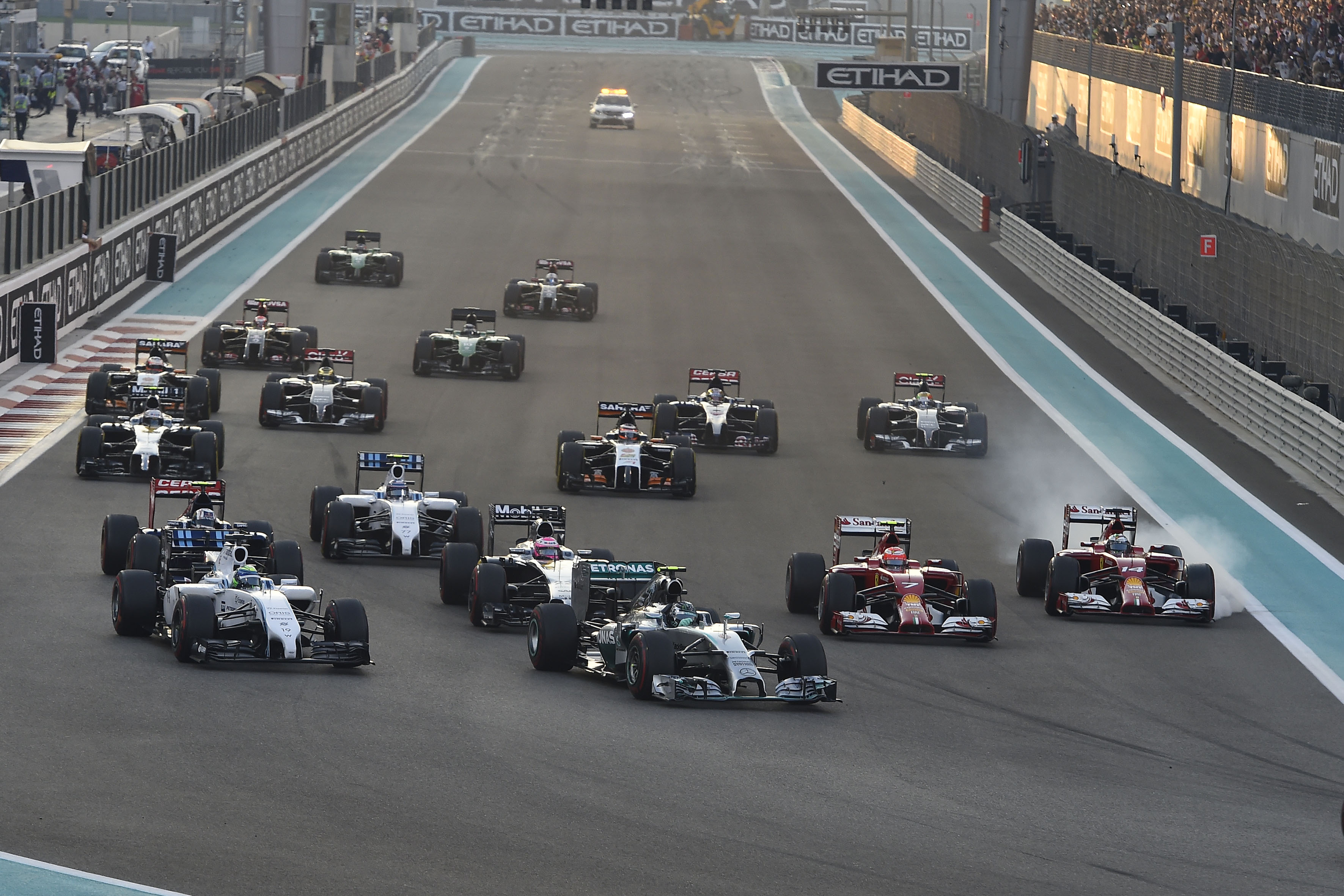
    When it came to Formula 1, a 21-race calendar was revealed with the Korean Grand Prix returning to the F1 calendar on 3 May 2015. The event is still to be confirmed though. The F1 season will kick off in Australia on 15 March 2015 and will end on 29 November in Abu Dhabi.

    A few changes were also made to the sporting regulations.

    The double points scheme for the final race of the season that was in place for the 2014, will be scrapped for 2015. Standing re-starts after a safety car period have also been scrapped.

    The virtual safety car that was being tested in the final three races of the season will be implemented in 2015. This is designed to neutralise the race when double-yellow flags are waved, or when officials or other drivers may be in danger anywhere on an active track.

    Other sporting regulation changes

    • Suspending a race: Upon suspension of a race, the pit exit will be closed and all cars must line up into the pit lane and not on the starting grid. 
    • Power unit penalties: A complete power unit replacement will not carry a penalty. Instead, penalties will be applied cumulatively for individual components of the power unit.
    • Grid Penalties; If a grid place penalty is imposed, and the driver’s grid position is such that the full penalty cannot be applied, the remainder of the penalty will be applied in the form of a time penalty during the race (not at the next race as was previously the case).
    • Time penalties: In addition to the 5-second stop-and-go penalty an additional 10-second stop-and-go penalty has been introduced.

    Below is the 2015 Formula 1 Calendar:

    15 March – Grand Prix of Australia

    29 March – Grand Prix of Malaysia

    12 April – Grand Prix of China

    19 April – Grand Prix of Bahrain

    3 May – Grand Prix of Korea (TBC)

    10 May – Grand Prix of Spain

    24 May – Grand Prix of Monaco

    7 June – Grand Prix of Canada

    21 June – Grand Prix of Austria

    5 July – Grand Prix of Great Britain

    19 July – Grand Prix of Germany

    26 July – Grand Prix of Hungary

    23 August  – Grand Prix of Belgium

    6 September – Grand Prix of Italy

    20 September – Grand Prix of Singapore

    27 September – Grand Prix of Japan

    11 October – Grand Prix of Russia (Sochi)

    25 October – Grand Prix of USA (Austin)

    1 November – Grand Prix of Mexico

    15 November – Grand Prix of Brazil

    29 November – Grand Prix of Abu Dhabi