The short version
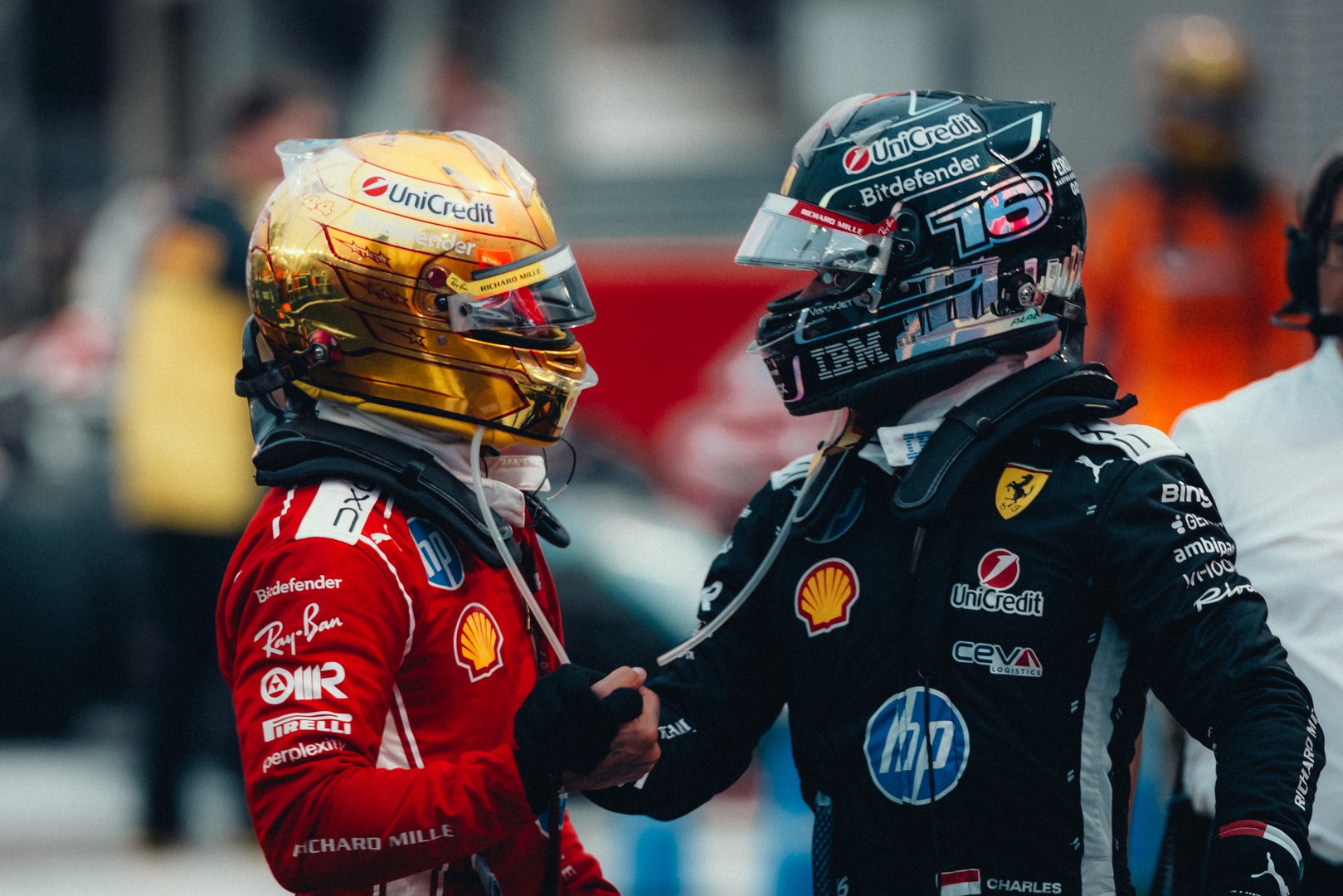
- Verstappen won the Singapore Grand Prix by 7.0 seconds from Charles Leclerc. Lewis Hamilton went from third on track to sixth after staying out under the Virtual Safety Car.
- Ferrari say they told both drivers to pit. Hamilton says he missed the pit entry, then chose to stay out, and has taken the blame. Both can be true, and the radio that would settle it hasn’t been published.
- Ferrari already have more points than in the whole of 2025 (444 against 398). That is real progress. At Ferrari, progress is not a result.
Ferrari strategy has always been a spectator sport, and Singapore added another episode. A split plan, a Virtual Safety Car, a missed pit entry and an apology on the cool-down lap. What it doesn’t settle is the bigger question: when the pit wall and the driver disagree, who is supposed to win the argument?
How the race went
Verstappen took pole, Leclerc was second and Hamilton third. Verstappen and Leclerc started on softs. Hamilton started on mediums, Ferrari’s way of covering both bets on a tyre nobody could read. Leclerc had a run at Turn 1, Verstappen closed the door, and Leclerc stayed within a second for the first 15 laps. Then Verstappen pulled away.
| Lap | What happened |
|---|---|
| Start | Verstappen pole. Leclerc P2 on softs, Hamilton P3 on mediums |
| 19 | Hamilton pits from the fading mediums to softs |
| 25 | Leclerc pits for mediums, about 9s behind Verstappen |
| 33 | Verstappen pits and keeps the lead |
| 39 | VSC for Lance Stroll’s stopped car. Leclerc pits for softs, about 17s behind. Hamilton stays out |
| Finish | Verstappen, Leclerc (+7.0s), Antonelli, Norris, Piastri, Hamilton |
Hamilton’s old softs faded. Leclerc passed him, then Antonelli, Norris and Piastri all followed him past. A likely podium became sixth place.
The strategy: clever or chaotic?
Splitting the strategies at the start was defensible. Ferrari were unsure whether the medium or the soft would last, and the sprint, affected by wet running, gave them poor tyre data. The medium turned out to be the worse race tyre, so Hamilton stopped early. That is a plan working as designed, not a plan going wrong.
The trouble came after. One analysis of the race argues Leclerc’s lap-25 stop dropped him in front of Hamilton, who was quicker at that point, and cost Hamilton roughly two seconds. Reports say Hamilton asked to be let through, and offered to swap back, and heard nothing. Vasseur defended the call. Whichever side you take, the optics are the same: two cars, one team, and a driver asking a question the pit wall didn’t answer.
The VSC call
This is the part everyone is arguing about. Vasseur says Ferrari called both cars in for a double stack and Hamilton chose to stay out. Hamilton says the team called him in, he missed the pit entry, and he then decided to hold track position. After the flag he said: “Sorry boys. I let you down today with that strategy.”
There is also a theory, popular online, that the pit call never reached him. The evidence for that is a gap in the published radio, which proves nothing either way. What is reported, though not confirmed by Ferrari, is that Hamilton had asked for the pace of soft-tyre runners at the end of their stints and was given current lap times. If true, that is thin information to base a gamble on.
The cost was real. Vasseur said P2 and P3 were on offer. One analysis has Hamilton losing about 2.5 seconds per lap to Leclerc over the closing stint. Hamilton has taken full responsibility, which deserves to be said plainly. Whether the information he had justified the decision is a separate question, and that’s the one Ferrari need to answer.
Does Hamilton trust the pit wall?
Three recent races tell the story, and none of them paints Hamilton as a rebel.
| Race | The situation | Hamilton’s response | Result |
|---|---|---|---|
| Zandvoort | Ferrari didn’t swap him past a slower Leclerc on older tyres | Sarcastic radio, then compared Ferrari unfavourably with Mercedes | P4 |
| Sepang | Pit wall floated an intermediate gamble on lap 5 | Declined and stayed on slicks | P3, 4.9s behind Verstappen |
| Singapore | Called in under the VSC | Stayed out | P6 |
Sepang was a week earlier, and it taught Hamilton that overruling the pit wall can work. Singapore taught him it can also cost a podium. Neither race proves he distrusts the team. They show a driver who backs his own read when the information is thin, and a team that has handed him thin information more than once. Zandvoort suggests the communication is the pattern, not the exception.
Could Leclerc have won?
Probably not. Verstappen led by about 9 seconds when Leclerc stopped on lap 25 and about 17 when he stopped under the VSC. Leclerc finished 7.0 seconds behind, so on fresh softs he took about 10 seconds back in 23 laps. That sounds promising until you remember Verstappen was managing his race.
Leclerc himself said Red Bull had too much pace in the opening stint. He also thinks he misjudged Verstappen’s early power deployment problems and didn’t spend battery to force a pass. He doesn’t think that changes the result. Had he got ahead at Turn 1, he would have led with the faster car sitting behind him on a track where passing is hard. That’s a long way from a win. The honest answer is that second was the realistic ceiling, and Ferrari got it.
The Ferrari tax
Context matters. In 2025 Ferrari finished fourth with 398 points, with no wins, and Hamilton had no podiums. This year they are second with 444 points, two wins and a seven-time champion who is third in the drivers’ standings. Mercedes have 11 wins, so Ferrari are clearly the second-best team on the grid and clearly not the best.
That is the Ferrari problem. Anything short of a win is failure, a seven-time champion in red adds extra scrutiny, and every sketchy call arrives with an audience. Sepang’s slick gamble and Singapore’s split-and-pray plan did the team no favours.
And then there is Vasseur
Strong rumours have been circulating since late September that Ferrari’s senior leadership has a succession plan to ease Vasseur out after this season. Nothing has been confirmed, and nobody has ruled it out either. Ferrari moved quickly, saying within days that they have full confidence in him. Both drivers backed him publicly: Hamilton called him a fantastic leader and Leclerc said he trusts him. Vasseur says his relationship with CEO Benedetto Vigna and chairman John Elkann is a very good one. Christian Horner, a man with time on his hands, called Ferrari a dream job.
None of that is confirmed, and Ferrari have publicly backed him. But the story hasn’t gone away for weeks and reappears after every race. Smoke isn’t fire. Still, a team that issues a vote of confidence and then has to repeat it a week later is telling you something. No change has been announced at the time of writing. Austin is next.
📸 courtesy Ferrari Media