Tag: f1 tech

  • FRIC Suspension Deemed Illegal by FIA

    FRIC Suspension Deemed Illegal by FIA

    The FRIC (Front and Rear Interconnected) suspension systems used by some F1 teams was deemed illegal by the FIA and could be banned as soon as the German Grand Prix in less than two weeks time.

    The FRIC suspension systems work with a series of valves, pipes and cylinders that controls the pitch of the car during acceleration and braking and also through cornering. Mercedes are believed to be running a very complicated version of the FRIC suspension at the moment and could be impacted the most if the ban were to be enforced before the German Grand Prix.

    According to the FIA the suspension systems are in breach of article 3.15 of the technical regulations which outlaws any moveable aerodynamic device.

    Article 3.15 is quoted below for reference:

    Any specific part of the car influencing its aerodynamic performance :
    a) Must comply with the rules relating to bodywork.
    b) Must be rigidly secured to the entirely sprung part of the car (rigidly secured means not having any degree of freedom).
    c) Must remain immobile in relation to the sprung part of the car.

    The FIA, is however, considering to impose the ban from the start of the 2015 season due to the fact that the 2014 cars were all built around these suspension systems and there is not enough time for testing between now and the German Grand Prix. This can only happen if the teams unanimously agree to it. It is a tough ask for teams to all agree on the 2015 ban, especially if some teams are not using the same suspension system or feel that their system is not working as well as the next teams.

    If the majority of the teams do not agree to postponing the ban, the FIA’s Charlie Whiting has made it clear that teams will be reported to the stewards for not complying with the regulations.


    An explanation about FRIC suspension is available here
  • 2013 Spanish Grand Prix – F1 Technical Round Up – Part 2

    2013 Spanish Grand Prix – F1 Technical Round Up – Part 2

    The second part of this f1 technical round up will focus on Sauber, Toro Rosso, Red Bull and Caterham.

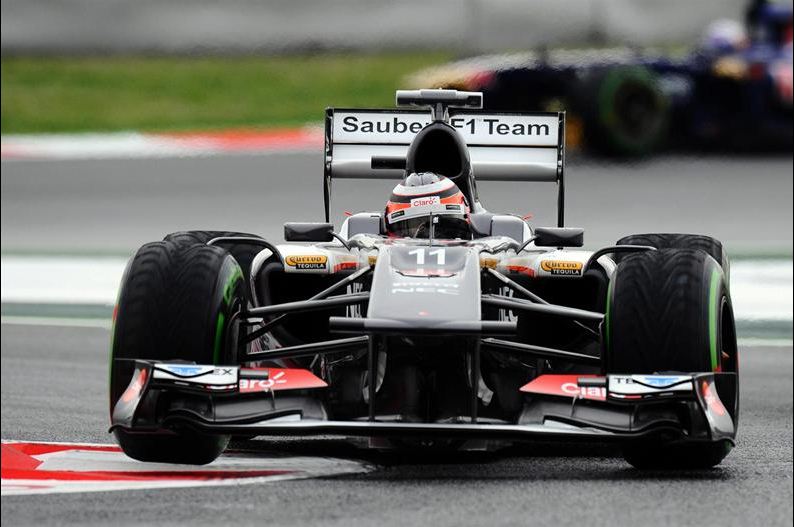
    Sauber: Sauber’s biggest change was the new rear wing. For the first few races the team ran a wing with a dipped central section. This little dip in the middle of the main plane allows for more down force but does not add to drag. They’ve tested a more conventional version in the races preceding Barcelona and have reverted to the conventional design in Barcelona.

    Toro Rosso: Toro Rosso made a number of changes to the bodywork of their car. The biggest change is to the rear of the car where they’ve took a leaf from their big brother team, Red Bull, and they’ve added the cross under tunnel solution which Red Bull has had on their car since 2012. The way it works is that the air from the side of the side pod, moves around the outside of the side pod and down towards the floor, the air then  moves underneath the coanda exhaust towards the central part of the rear diffuser. They exhaust exits are also very similar to the Red Bull solution. The only difference for Toro Rosso would be the Ferrari engines. The engine would make a difference in tuning the coanda exhaust to work with this solution. Another big update was the detached front side pod. This helps attach the airflow over the top of the side pod along the bodywork which better aids the coanda exhaust.


    Caterham_NewBodywork_spainCaterham: Caterham brought an almost “B-Spec” car to the CT-03. They brought along a new side pod air flow conditioner. It is now a twin element airflow conditioner with the rear section curving around the top of the side pod and attaching to the top edge of the side pod. They’ve also added a vanity panel to the front which gets rid of the stepped nose. Another addition was the horizontal vane under the wing mirrors. This little vane creates a vortex that will attaches the airflow to the top of the side pods.


    Red Bull: There weren’t that many updates that were reported on the Red Bull car. One of the updates was to their rear wing. They’ve gone from curved rear wing end plate louvres to more horizontal louvres. This brings them in line with the other teams on the grid. They’ve also made some changes to the rear of the car. More specifically around the rear wheels/exhaust area. They’ve added and additional vane on the floor ahead of the rear wheels. These vanes “catch” the air flow off the tyres due to the tyres’ rotation (tyre squirt) and channel the air towards the rear of the car. This does help to minimise tyre squirt, but it’s not a cure.

    This coming week see’s the Formula 1 circus head to Monaco. We can expect to see lots of additional wings and vanes on the front wings of the cars all to get that extra bit of down force. We can also expect to see heavily raked rear wings, anything for extra down force. Mercedes will be quite strong here as they are quite strong with the slow speed corners and we cant discount Red Bull.


  • 2013 Spanish Grand Prix – F1 Technical Round Up – Part 1

    Formula 1’s return to Europe this past weekend signaled the first round of major updates for most teams. Since most teams are based in Europe it makes bringing more substantial updates to the cars much more easier. Not that teams don’t update their cars at the fly-away races, but returning to Europe just makes things a little more easier. Here is a Part 1 of our F1 technical round up of the Spanish Grand Prix.

     Some of the updates were major changes as in the case with McLaren and Toro Rosso. McLaren were somewhat relying on their Barcelona updates to bring them up to pace with Red Bull and Ferrari. Did it work for them? Not so much. Button struggled to make it into Q3 while Perez did slightly better and qualified P9. Their race performance, however, was much better and they finished P9 and P10.

    Lets take a look at some of the teams.

    Ferrari: They had little tweaks here and there with their body work. They brought a new engine cover which features a longer fin at the back and thats slightly lower than theFerrari_AirflowConditioner_Spains one they’re currently using. The rain in FP1 put a spanner in the works for them to test it. They will bring the same engine cover to Montreal. Together with the new engine cover they tested a new longer exhaust outlet with a more shallower angled exhaust. They also tried new sidepod airflow conditioners, similar to Red Bull’s “D” wing airflow conditioner, except the top section extends over the sidepod and attaches to the cockpit. They’ve somewhat kept the original design of the split airflow conditioner, only with this variation, the front section curves over the top of the sidepod and the rear section remains vertical. The purpose of the curved section is to bring the airflow around the outside of the sidepod, over the exhaust and eventually out the diffuser at the back. Both Ferrari drivers ran an additional horizontal cockpit fin ahead of the wing mirrors in addition to the two horizontal airflow conditioners behind the wing mirrors.


    Lotus: Lotus came to Catalunya with a new front and rear wing. There were two changes on the front wing. They had a curved vane on the outer part of the end plate. The main deflector vane in the front wing is not slotted. The rear wing features tiny separated vanes on the endplate.

    McLaren SidePods_Spain

    McLaren:McLaren brought along a new front wing. This new wing had one vertical slot on the endplate and a new upper flap.

    They still stuck to the old three element front wing, whereas other teams are using 5-6 element wings. The sidepods have been given a make over. The vertical air flow conditioners are now attached to the edge of the sidepod making it similar to the “D” wing of Red Bull. They have ditched the horizontal airflow conditioner above the sidepods and went with twin vortex generators, similar to what they ran in 2012


    MercCockPitWings

    Mercedes: Mercedes have dropped their three horizontal vortex generators on the side of the cockpit and have replaced it with one larger

    wing. The rest of the car remained largely unchanged with most of the changes unseen.


    Part 2 to follow soon.