Tag: ers

  • F1 2016: European GP Review – Rosberg Rules In Baku

    F1 2016: European GP Review – Rosberg Rules In Baku

    If you’d asked most people to point out Azerbaijan on a map they would probably struggle. If you then told them that its capital city Baku is going to host its first F1 race in 2016 it would possibly have been met with reluctant enthusiasm.

    Nevertheless, on the edge of the Caspian Sea the Azeri organisers plotted a street circuit unlike any other. The combination of the stunningly high-speed section and incredibly tight section around the city’s beautiful medieval architecture merged perfectly to highlight the strengths of Nico Rosberg’s Mercedes. The German driver cleaned house in Baku by taking pole position, fastest lap and the race win in dominant fashion.

    Rosberg led cleanly off the line and was never challenged as he completed the 51-lap race on a one-stop strategy. It yielded his fifth win of the season and a sizeable increase in his lead atop the driver’s table. As faultless as Rosberg’s weekend preceded so the opposite was true for teammate Lewis Hamilton. Seemingly out of sorts, Hamilton stuck his Merc in the wall on Saturday and confined himself to a tenth place starting position. An ERS (energy recovery system) issue disrupted his charge through the field. Thanks to the FIA regulation, which bans certain radio communications, Hamilton was left to figure out the setting himself. The Brit was able to eventually resolve the issue and set two blisteringly quick laptimes before cooking his tyres.

    GP EUROPA F1/2016Behind race leader Rosberg Sebastian Vettel overtook Daniel Ricciardo for second. To cover the Red Bull stop Ferrari called Vettel into the pits. However, the driver overruled the pitwall and stayed out. It paid off ultimately as Vettel finished second without any realistic shot at victory.

    Force India’s Sergio Perez secured third to score his second podium in three races. Ferrari’s Kimi Raikkonen ran third for nearly the entire race. The Finn stopped early on lap 8 and ran a 43-lap stint on the soft tyre. But a five-second penalty for crossing the pit-entry line and a late ERS issue meant he was unable to keep Perez at bay. Eventually Raikkonen, suffering with a bout of food poisoning, finished fourth. Lewis Hamilton finished a lonely and disappointed fifth ahead of Williams’ Valtteri Bottas in sixth.

    Both Red Bull drivers were forced onto two-stop strategies with overheating rear tyres and faded badly throughout the race. Daniel Ricciardo finished seventh ahead of teammate Max Verstappen in eighth. Nico Hulkenberg brought his Force India home in ninth while Williams’ Felipe Massa scored the final point in tenth.

    GP EUROPA F1/2016All expectations were that the safety car would appear several times throughout the race given the tight confines and close proximity of the walls. But all twenty-two drivers were exceptionally well behaved and there were no major incidents. In fact, only four drivers did not make it to the chequered flag. Toro Rosso has some investigating to do as both their drivers, Daniil Kvyat and Carlos Sainz, were forced to retire with suspension issues. Manor Racing’s Pascal Wehrlein retired with brake failure as Fernando Alonso’s McLaren was pulled into the garage with a gearbox failure.

    Remarkably Rosberg had the same ERS issue as Hamilton but was able to rectify it by changing the right settings. This resounding victory increases Rosberg’s championship lead to 24 points over Hamilton. But given that thirteen races remain on the calendar the race for the 2016 driver’s crown is just warming up.

    (All images courtesy of Pirelli Motorsport)

  • 2014 Bahrain GP Preview – Mercedes set to sparkle under desert floodlights

    2014 Bahrain GP Preview – Mercedes set to sparkle under desert floodlights

    Less than a week after the Malaysian Grand Prix, where Mercedes thundered to its first one-two finish since the 1955 Italian Grand Prix, Formula One sets up shop in Bahrain for round three of the 2014 F1 World Championship.

    Mercedes will remain in good spirits for this weekend’s Bahrain GP. The car is perfectly suited to the layout of the Saakhir International Circuit.

    The Sakhir circuit offers more stop-and-go corners and more throttle time than the twisty Malaysia circuit. No need to compromise super speed on the straights for downforce through the turns. Most of the corners in Bahrain are around 160kph or less.

    The circuit is also very demanding on fuel. This could be a game-changer for teams like Red Bull, who’ve had fuel flow sensor issues in both races so far this season.

    This is the tenth outing for F1 to the Saakhir International Circuit and with this anniversary, the Bahrain Grand Prix presents a new challenge to teams and drivers – the first race under floodlights in the desert as Bahrain joins Abu Dhabi as the second twilight race on the F1 calendar.

    Bahrain GP night race pitsThe cooler evening temperatures lead to changes in balance and grip levels so teams have their work cut out for them. They do already have data on these conditions which they would have gathered at the two pre-season tests held at this circuit.

    The lower temperatures will favour the cooling capabilities of the new power units which has been an issue for some teams leading up to the start of the 2014 season. Red Bull in particular had a very difficult time with overheating power units.

    Mercedes will be the team to beat as the sun sets over Bahrain on Sunday. One thing is certain – we are in for a visual spectacular!


  • F1 2014: Australian GP Preview: Mystery In Melbourne

    F1 2014: Australian GP Preview: Mystery In Melbourne

    Eleven teams will start the 2014 Australian grand prix. Beyond this obvious fact not much else can be forecasted. Unpredictability in Formula 1 is back with a vengeance and brings with it a bevy unanswered questions.

    How many drivers will finish the Australian grand prix? The saying that to finish first, first you must finish has never been so appropriate; and the prediction of half the field finishing the race is seen as generous by some. Reliability has dominated the winter testing season as teams struggled to integrate the new power units and electronic systems. Renault powered cars were stricken on the side of the track most often with issues ranging from cooling to complete failure. Meanwhile the consistent crooning of the Mercedes power stamped its authority at the top of time sheets.

    The pecking order after twelve days of testing suggests that Mercedes, Williams and McLaren are the front running teams, at least on paper. These teams, all Mercedes powered, delivered the most consistent performances over long runs and in qualifying trim. The newly renamed Williams Martini team looks to have taken a significant step forward and Felipe Massa believes that he will start the Australian GP with a good chance of mixing it at the front.  It would be especially sweet for the former Ferrari driver should his Williams feature in the top three.

    Messages of support for SchumacherTo be the favourite on paper doesn’t carry much weight, if any at all. The reality is that Red Bull Racing may yet show up Down Under and perform quite well. The car rolled into the back of the truck on the final day of testing will hardly resemble the one that takes to the Albert Park circuit this weekend. Several teams will bring a raft of updates for their cars as they aim to learn as much as possible before the start of Sunday’s race.

    The Ferrari team has remained under the radar with neither of its mega quick drivers revealing too much about the team’s prospects. The Italian squad’s winter hasn’t been awesomely positive nor has it been disastrous.  Fernando Alonso was particularly underwhelmed about driving in 2014. “We were saving the tyres from lap one of the stints last year, and we are saving the tyres from lap one this year. That’s no different. I don’t think things will change that much, but obviously the cars are slower,” said the double champion. It is worth noting that the Alonso is one the greatest politicians in the F1 game. A bit of psychological by-play is never too far from his repertoire.

    In a normal year of F1, the first race of the season requires for a variety of factors to come together just right to ensure success – and 2014 is no TEST PRE-CAMPIONATO F1/2014 BAHRAIN 19-22/02/14normal year. Teams are limited to 100 kilos of fuel per car for the grand prix which will call for vigilant fuel management throughout the race. As before, tyres have to be looked after, so too the power units which are limited to five per season. However, in F1 2014 the driver can be the difference.  “It really is a driver’s car – more than the old ones,” said McLaren rookie Kevin Magnussen. “It’s a bit more difficult with more torque. It’s difficult to take care of the tyres and I think it’s going to be tricky. You need more skill and more sensitivity in your throttle.”

    Few things are the same in Formula 1 2014. The cars do not look the same, they do not sound the same and they are a tad slower. However, the skill of the greatest drivers in the world and absolute unpredictability of it all ensure that it remains the greatest spectacle. This is Formula 1 2014.

  • What is wrong with F1 at the Moment?

    What is wrong with F1 at the Moment?

    The short answer is not much. Apart from the hideous looking noses on the 2014 cars. I can’t really see much wrong with the sport at the moment.

    Some would say the changes to the sporting regulations, are a welcome change. Others think it’s the spawn of the devil himself. Personally, I feel that these changes can only benefit the sport in the long run. The change to smaller, lighter engines for example, is a natural progression from preceding years. Especially considering the fact that car manufacturers are becoming every more environmentally aware and are on this whole ‘reduce carbon emissions because it’s bad for the climate’ thing. A lot of pressure was being placed on Formula One to make the sport more environmentally friendly. But it was inevitable.

    Mercedes V6 EngineIf you ask any of my friends or colleagues here at F1 Madness, they’l tell you that I hated the idea of 1.6l V6 engines. No one liked the idea. There was nothing wrong with the previous roaring V8 engines (which were already limited to 18 000rpm). But that is old technology. Yet KERS was there from 2010? Yes it was, and it was a small a technological jump, a platform for the engines we have for this season.

    This season we have a lot more electrically assisted power in F1. It’s called ERS. The engine is smaller, but it has a turbo. But wait, that means that F1 is turning into a hybrid racing formula. In fact, that is exactly what it is now. Formula Hybrid. But is that such a bad thing?

    Again. No. If you look at some of the top hyper cars that we’re getting from Ferrari, McLaren and Porsche, you’ll see that their flagship hyper cars are all hybrids. The LaFerrari from Ferrari, the McLaren P1 and the Porsche 918, all hybrids. All those cars have similar DNA to the F1 cars we are seeing now. Battery power to supplement the power from the engine, brake energy recovery etc. All from Formule One. And that is what F1 is meant to do. It’s meant to bring the technology used on the track to the cars that we drive.

    Upon hearing the cars in testing I was admittedly a bit surprised. I was expecting the sound to be much louder. But I quite liked the sound. It was very raw and hoarse and there was the turbo whistle on gearing down. I knew this would be different in the race when the full field of 22 cars are going around at full chat.

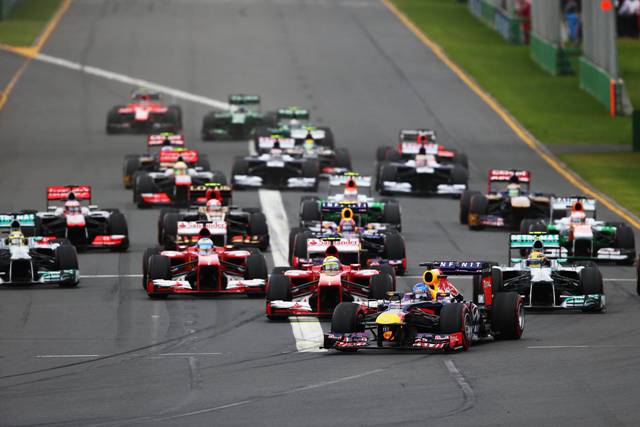
    2013 Australian GP startOn race day, I’ll admit  I was slightly disappointed at the sound of all the cars on the starting grid. For the first time we could hear tyre lock ups. I don’t think that has happened before.

    Good old uncle Bernie himself doesn’t like the sound of the new cars and the Australian Grand Prix organisers reportedly threatened to sue due to the fact that it was less of a spectacle than previous years. I don’t blame them. One of the big marketing draw cards of F1 is the sound of the cars.

    The thing is though that everything is still very new. It will take a while to get used to the sound of the new cars as well as the new regulations. Remember how weird it was back in 2009 when the cars suddenly had very narrow rear wings? We got used to it. The same with the new noses. It will just take time. It’s only been the first race of the season. I don’t think we need to make snap judgements and decisions. There are going to be some purists out there that love the sound of the old V12’s or even the V10’s. I’ll be the first to admit that if they went back to the V10’s I’ll be the happiest guy in the world.

    But let’s give this new era a chance, before we all jump on the band wagon and slam it. The first race of the season was after all, spectacular, to say the very least!