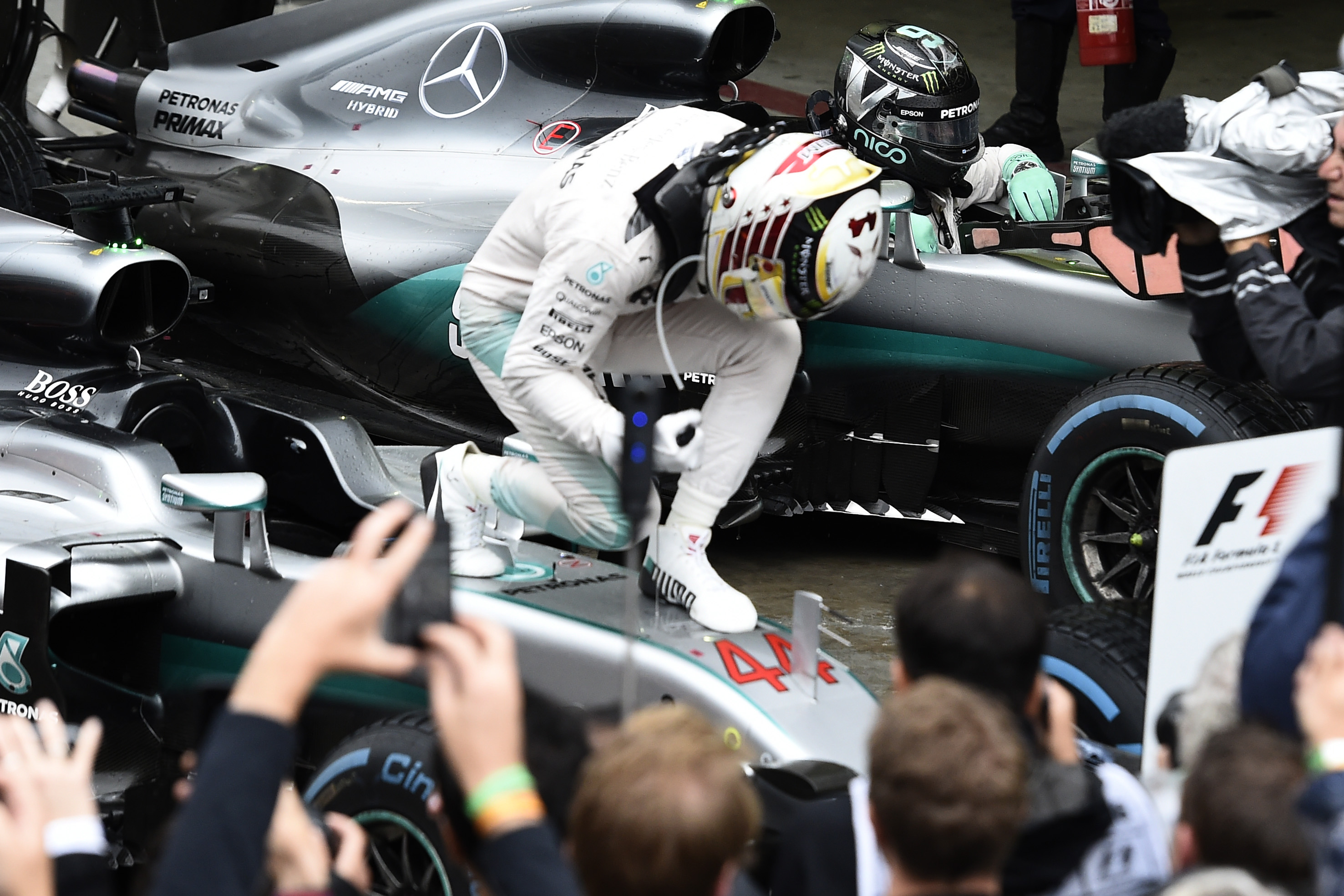
DRIVERS – Felipe MASSA (Williams), Sebastian VETTEL (Ferrari), Daniel RICCIARDO (Red Bull Racing), Max VERSTAPPEN (Red Bull Racing), Lewis HAMILTON (Mercedes), Nico ROSBERG (Mercedes).
Charlie WHITING (FIA)
PRESS CONFERENCE
Q: Let’s start with Felipe, your last Brazilian Grand Prix as a Formula One driver, what does this weekend, this occasion, mean to you?
Felipe MASSA: Well, I think it will be a very special weekend for me, for my last home race, the place where I grew up, the place that I remember I was in the grandstand watching and supporting Ayrton Senna, Nelson Piquet, always dreaming to be here. And then I managed to get here and managed to win two races here in Interlagos, getting quite a lot of times on the podium, so it’s definitely a fantastic place for me. I will miss, definitely, this race. When I see these guys racing next year, I will definitely miss to be here. But I am so happy and proud for everything I passed through these 15 years in Formula One, every people that I met – friends, drivers, the competition I had with these guys for quite a long time. So yeah, I will miss, definitely, this place, some nice races around the world but also some friends. It will be a very special moment for me.
Q: As you say, so many great memories from your own career here, especially the pole positions, the podiums and those two very special wins with Ferrari. What stands out, though, for you, and what were these guys like to race against?
FM: Difficult. We are talking about the best drivers in the world. Everybody who got here is here because of talent. They are here because of talent. The competition is really high, but I think I definitely learned a lot. I think it was an amazing life experience that I had. It’s definitely not easy to be a Formula One driver I would say, but I had a fantastic time and so happy to achieve what I managed to achieve and to get here after very long and yeah, I will always remember them as tough drivers on track and I would say maybe the relationship maybe in the last years gets a little bit better outside the track and it will get even better when all of us stop I would say. Just expect the best for them and support them for the future.
Q: OK, thank you. Lewis, of course that 2008 memory is still very strong. You won the world championship, your first of three world championships, that day but Felipe showed great dignity on the podium, having won the race. What was he like as an adversary?
Lewis HAMILTON: It’s been great driving alongside Felipe and against him. We’ve had some great times. Even before I got to Formula One, when I was in GP2, we had already become friends back then and had some good experience. But yeah, to have those great, strong battles we had, even beyond 2008, for me was a privilege and something that I will always cherish. At some stage we’ll be a bunch of oldies, replacing the older drivers that are hanging around today and we’ll be coming along, looking at the other youngsters, but yeah I think Formula One is going to miss him for sure.
Q: OK, and the other drivers, your thoughts on Felipe’s final race here as part of his Formula One career. What kind of atmosphere do we expect at this Brazilian Grand Prix this weekend?
Nico ROSBERG: It will great. I’m sure the Brazilians will go crazy to support Felipe in his last race here. He’s given a lot to F1 so it’s going to be a loss for the sport, for us, for sure.
Q: Max?
Max VERSTAPPEN: Of course, I mean the career he has had many want to achieve. That many years in Formula One as well, and being able to fight for four world championships. So I think it will definitely be a very special moment for him and I think, in general, the Brazilian Grand Prix is always very special and a great track and a great atmosphere to be at.
Q: Seb, you’ve won here a few times, you’ve had a few good battles against Felipe, your thoughts?
Sebastian VETTEL: Yeah, I think… well, we don’t need to talk about his talent. I think there’s no doubt that he’s one of the most talented drivers on the grid. But apart from that, he’s a great person. He’s the kind of person you look at and smile, because he’s just smiling from the inside, so I think that will be missed a lot. So I hope he still comes around a couple of times and has a look and a laugh and in that regard I wish him the best. But for this weekend, I think it would be great to see hopefully a lot of Brazilian flags, support for him, because as everyone said, he has had a great career. So, yeah, it’s hid weekend.
Q: Daniel, final thought?
FM: Be careful what you say!
Daniel RICCIARDO: Yeah, I’m looking forward to the drivers’ parade on Sunday. It’s always very interesting. For as long as I’ve been doing it at least anyone who is Felipe’s team-mate gets an absolute pounding on the drivers’ parade. He’s going to get some extra love this weekend and we’ll probably get yelled some funny Brazilian names, but it’s all in good humour. The atmosphere is awesome, so I think we are going to have a pretty amazing crowd this weekend.
Q: Thanks for that. Back to Lewis and Nico then. Two races to go and Nico a win for you on Sunday and you’re world champion. Lewis, a great motivation for you to win a Brazilian Grand Prix you haven’t won before. How are you both feeling going into this? Is the tension rising? Nico, first…
NR: Yeah, feeling great, of course, because it’s awesome to be fighting for the world championship with two races to go and so, yeah, excited about the weekend, looking forward to it and of course going to try to go for the win.
Q: Lewis?
LH: yeah, I’ve had lots of great, or mixed experiences here, so it’s a real challenge to come here and try to win for the first time, something that Nico and Felipe have experienced in the past. That’s my goal and nothing really to lose.
Q: For the drivers on the back row, with the nature of this track and also the weather forecast we have at the moment for this weekend, what’s the scope for racing against these two guys at the front this? Daniel…
DR: Yeah, it looks like it’s going to be potentially wet on the weekend, which is going to make it interesting. There’s obviously a little bit less pressure on everyone else but I’m envious of their positions. I’d like to have that little bit of pressure. Anyway, if there’s an opportunity we still go for it. We race, and that’s how it’s going to be. If it’s wet it’s going to make it interesting. It’s going to be fun. We’ll see how it pans out on Sunday but hopefully we get a good race on Sunday.
Q: Seb?
SV: I think this place for some reason has always delivered special races. I don’t know what it is: I think the circuit is good fun, nice to drive, but I think it’s the atmosphere, the weather, all that coming together that has created crazy races in the past. You mentioned the one in 2008, the last race in 2012 was pretty amazing as well. I’m sure we’ll have a great race on Sunday. Obviously for all of us not fighting for the championship, we are fighting for the victory here, but yeah, we’ll see. Weather conditions and so on, as I said, there’s always room to do something.
Q: Max, a potentially winnable race for you?
MV: You always try, but I haven’t really experience a lot of mixed conditions here in Brazil. Of course I’ve seen a lot on the TV. But it will be interesting like always. I really enjoyed it last year and hopefully with some rain coming in it would be even more interesting, so I’m looking forward to the weekend.
QUESTIONS FROM THE FLOOR
Q: (Pedro Lopes – GloboEsporte.com) Ricciardo, how was you meat feast yesterday?
DR: Our meat feat yesterday was… very good. Fortunately it’s no longer with me, otherwise I would still be sweating. But yes, how do you say… muito bon?
Q: (Kevin Eason – The Times) Seb, can you tell me, do you believe… You’ve had a pretty fruitless year with Ferrari and you started with bit of a dream. Do you believe you’ll ever win a world championship with Ferrari.
SV: Yes.
Q: (Kevin Eason – The Times) Why?
SV: Because, generally I think I’m positive, looking forward. Obviously it was a big step when I decided to change, at the time when I did. It was clear that it would take some time. Obviously we had a great season last year, we got closer and closer to Mercedes, so the hopes and expectations for this year were high. I think it’s normal when you finish second in the Constructors’ you aim to finish first. We haven’t achieved what we set out to achieve but nevertheless our main target is to win the championship, fight for the championship, and I think there is a lot of change that I see, a lot of change that is going on inside the team that will make us stronger, I’m pretty confident about that. I guess it’s a question of time.
Q: (Livio Oricchio – GloboEsporte.com) To Nico and then to Lewis. You won the last two races here starting from the pole position and Lewis also I recognise that you were very strong both weekends. Can you explain if you find something special, some special way to win here. And Lewis, why you’ve said he’s so fast and you could not reach him in the last two Brazilian Grands Prix?
NR: I love the track. It’s a great track, feels good and I’ve always gone well here, so I’m looking forward to the weekend also. Great memories also from those two wins, those were very special. But at the same time, this year we all start from zero. Those past wins are not going to help me get the win this weekend. We all start from the same place and I just need to do a good job this weekend and that’s it.
LH: I don’t really know why I’ve not won here, so I don’t really have an answer for you. I try every year and I’ll try harder this year.
Q: (Dan Knutson – Auto Action and Speedsport) Felipe, there are going to be a lot emotions leading up to the red lights going out. How difficult will it be to switch off when the red lights go out?
FM: I think it’s always the same. I think when you are in the car you don’t think about other things, you just think about what you want to do in the best way that you can. I would say that maybe the whole race I will be concentrating on my job, trying to get the best race possible, the best result I can, for me, for my team, especially in this moment that it’s quite important this fight with Force India for Williams Martini. But I think that maybe when I finish the race, after the chequered flag, I think it will be very special. It will be an amazing feeling to do the last lap in Interlagos of my career in Formula One, here, you know. I think during the race you just so much concentrate on everything you need to do but after it may be quite different.
PRESS CONFERENCE PART 2: QUESTIONS ARISING FROM THE MEXICAN GRAND PRIX
[Note: Charlie Whiting refers to video clips of the Mexican Grand Prix that were shown in the press conference room to illustrate his answers]
Q: Charlie, obviously there are several key areas of interest. Firstly, can we talk about the incident with Lewis missing Turn Two at the start and the one later with Max at the same spot and the differences between them?
Charlie WHITING: Yeah, sure. I think the principal difference between the two was simply that, in Lewis’ case it was felt that he didn’t gain any lasting advantage and it Max’s case, he did. We can show you a couple of videos here just to refresh everyone’s memory: perhaps that will be a help. The first… I think you’re all pretty familiar with it. You can see that Lewis makes a small mistake at the beginning, cuts across, gains significant track advantage but then sets about giving that back immediately. You can see on the straight – or we can see – on the straight between Turns Three and Four he backs off to 80 per cent throttle to give that advantage back. Because obviously he’s got a significant advantage there. Then, about a minute later, the Safety Car’s deployed and that advantage is gone completely. So, the stewards felt no lasting advantage. On the other hand, the case with Max and Sebastian, if Max had done the same thing on the straight between Turns Three and Four, he would certainly have lost the place. I think that’s why the stewards felt that this deserved a penalty because the driver had gained a lasting advantage. That’s the fundamental difference between the two incidents in the eyes of the Stewards.
Let’s bring the drivers in on this. Max, you had a comment there. What’re your thoughts on what you’ve seen here and what Charlie just said?
MV: Yeah, well of course I don’t agree with the decision but it doesn’t really make a lot of difference, does it? I’ve got a penalty. I think if you give penalties, give it to both or you don’t give any penalties. But I think what we maybe need to change for the future is that once you go off it should be a penalty on its own instead of the stewards interfering with that to decide a penalty. I think we need to come up with a solution that, once you go off, that should be the penalty on its own.
Lewis, your thoughts on what we’ve just seen and what Charlie just said?
LH: I relatively agree with Charlie’s explanation. I don’t really have a particular opinion about it. I think ultimately the stewards have a very, very difficult job because every single scenario is different, as he was mentioning. For example, the Safety Car came out immediately after my incident, for example. Every scenario is a little bit different; it’s not that easy to apply the same rule to every single thing. I also agree with Max that we should work with Charlie – as we have been, I think, through the year – to try and make it easier for them to make decisions and for it to be more clear.
OK, moving on to another topic of great interest. The moving under braking obviously has been widely discussed throughout the season. You issued a clarificiation at the Austin weekend. Can you tell us about Sebastian’s defence from Daniel at the last race in light of that?
CW: I think it might be helpful to just go back a little bit to Hungary where there were two incidents involving Kimi and Max. This got thoroughly discussed during the drivers’ meeting in Germany and the consensus of opinion was that moving under braking was something that should not be done. We agreed with this and then we had the incident with Max and Lewis in Japan where the first think that Lewis said on the radio was “He moved. He moved when we were braking.”We looked at it after the race. The stewards, as you know, felt that there wasn’t a case to answer there, which gave rise, of course, to a lengthy discussion in the drivers’ meeting in Austin. I then issued what was a clarification of existing regulations to say exactly what we felt should be reported to the stewards. With that as the backdrop, so to speak, Mexico was really the first race where that rule was applied.
There are three fundamental points there within the rules. Firstly, if a driver has to take evasive action; if a driver makes an abnormal change of direction in the braking zone; and if it could be potentially dangerous to another driver. If those three conditions are satisfied then the stewards felt that was a dangerous manoeuvre and should be penalised. That’s how the stewards looked at it and they felt Sebastian had moved under braking; that was very clear from the data, and also pretty clear from the video, of course; it was potentially dangerous and it was an abnormal change of direction which could have led to an accident. So I think it we look carefully at some footage here, you’ll probably… there’s one view I doubt anyone has actually seen. This is from the track camera. I think you can see very clearly that both cars are on the left of the track; Sebastian moves to the right and then, in the braking zone, moves to his left and then you can see quite clearly that Daniel had to take evasive action. And then the onboard [footage]. I think you can see very clearly that, had Daniel’s right front hit Sebastian’s left rear it would have been a significantly different scenario. That’s, I think, what the stewards really looked at was that it was a potentially dangerous situation. It’s close, and I think that’s what the stewards looked at. As I say, those three conditions were satisfied as far as the stewards were concerned and that’s what they felt they should act upon.
OK, let’s bring the drivers in on this, Daniel first.
DR: yeah, I think it’s obviously been explained and we were in the stewards’ after the race and, from an outside point of view, for fans – and for drivers – you don’t want to wait so long after a race to then have an outcome but that was that. I felt like the move was as Charlie explained. It’s just when you’re in that braking zone, once you’re committed, and especially when you’re overtaking. You know, we’ve discussed this, drivers, that you’re putting the car on the limit because you’re trying to out-brake someone, so you’re already on the edge, so any sort of move then, you’re not really in control, I guess. Hence why I lock up the brake and it all turns into a bit of a mess. It’s the only real part where we’re not in… it’s not that we’re not in control but we can’t really get out of it much, once we’re on the brakes. When you’re down the straight, if someone defends, if they move one way you can obviously move the other, or whatever, but then once you’ve committed to the braking then it’s hard to pull out of the move. Yeah, so obviously I felt that was the right decision. As I said, from an outside point of view, from I guess fans and that it’s probably a bit hard to understand and digest it all after the race but yeah, obviously we’ll try to keep it… I won’t say clean: I like the hard racing, but we’ll just try to avoid these moving-under-braking things in the future and then these things won’t need to be addressed.
And Seb, your thoughts?
SV: Well, obviously I don’t agree with the decision that was made. I think I moved over once to defend my position, after that yeah, I think I gave Daniel enough room on the inside; I kept the car straight for more than the majority of the braking, so I think the reason why, from my point of view, why Daniel locked up so bad is because there was no grip on the inside and it’s something that… yeah… I think we all knew. There were people locking up on other corners when they were offline, so I think it actually looks a bit worse than it was. I don’t think it was actually dangerous for Daniel at that point but OK, I have to deal with the decision.
QUESTIONS FROM THE FLOOR
Q: (Livio Oricchio – GloboEsporte.com) Charlie, we understood perfectly but the main question we see if that you have different stewards in each race and we are not sure all of them have the same criteria to interpret it. Even why it’s also an interpretation question what we have been seen. Don’t you think it’s a problem? If in one race they follow one criteria and then in another race another criteria. And also, the drivers I believe had complained about that.
CW: Well, needless to say, I disagree. As Lewis pointed out, every incident is different. Some can look at first sight to be very similar to another incident from a previous race but when you examine then more carefully… You must remember also that the stewards have an enormous amount of images available to them, data, all manner of things available to them which you don’t see. I think it’s easy to say decisions are made inconsistently but more often than not, in my opinion, when you look into it in detail, you find that, in fact, Incident A wasn’t the same as Incident B. They have small differences and that’s where I think further explanation is sometimes needed.
Q: (Alan Baldwin – Reuters) Charlie, one of the things you haven’t addressed so far is the issue of language being used over the radio and specifically what Seb said about you. Could you give us your take on that and your views on driver language and what was said about you?
CW: I’ll give you my views on what was said about me. I think bad language… it’s not the first time that bad language has been used, of course, and the fact that it was directed at me was unfortunate and I think there are a number of mitigating circumstances that led up to Sebastian’s obvious frustration but the fact that he sought me out very shortly after the race to apologise, for me that was enough and I’m prepared to just forget it and move on. I think that’s really what we should do. Things happen in the heat of the moment. I think you’ve seen what the FIA’s position on this is; and I personally feel that’s enough.
Sebastian, you have the right to reply if you wish.
SV: Well, I think it’s all been said but I have no problem saying it again. I’m sorry for what I said. Obviously when we are racing, when we are fighting… I think you can understand why I wasn’t so happy at that point but yeah, for sure I regret what I said and certainly didn’t mean it but yeah, it was very clear for me to look for Charlie right after. I wrote a letter as well. I’m happy that Charlie accepted the apology and happy to, as he said, move on.
Q: (Alan Baldwin – Reuters) A follow-up. One of the things the FIA said was the impact swearing might have on the younger generation. So perhaps Max could also comment on that.
MV: Thank you! Thank you very much. I think when you’re in the heat of the moment and you have a radio available you can say bad things. But it’s the same if, let’s say you give a microphone to a football player. Imagine how many words are coming out there during a game. Or another sport, it doesn’t need to be football… rugby, whatever. So I think it’s just, yeah, with the radio around you it’s pretty dangerous. So, I think maybe you shouldn’t broadcast it. That’s another solution. Because you know, we are driving on the limit, in some good fights and then, you know the adrenaline is going really high. So maybe in the future, if it’s bad for the younger generation, just don’t broadcast it.
Lewis, you’re nodding. Do you agree with Max’s point?
LH: Someone’s nodding to me in the crowd.
Q: (Ralf Bach – AutoBild Motorsport) Charlie, what do you think… how often would a guy like Donald Trump, because of the language, after a race, to the stewards? I asked because he’s now the president of the United States. Do you think it’s the right way to show the youth, OK, maybe it’s not the language you have to say it but it’s the language of everybody in the world, in the universities and everywhere?
CW: To be honest, I’m not sure what Donald Trump’s got to do with this. I think I’ve already answered what I feel about the language that was used there and I think the question of whether or not it should be broadcast is something that needs to be discussed really. I really don’t understand exactly what you’re asking, if I’m honest, but I think my answer to the previous question said what I feel about the actual incident that occurred in Mexico.
Q: (Andrea Cremonesi – La Gazzetta dello Sport) Sebastian, don’t you think that in the last two Grands Prix you needed to revise your image a little bit, your reputation, because of the accident that happened during the race was followed by other accidents… I mean bad languages by other drivers. And the second question is if, when you lose your temper during a race, do you also lose your commitment to attack Verstappen? In that case, do you penalise yourself, losing control of yourself during the race?
SV: I’m not sure I understood this. First, what happened in Austin then, because you said the last two races, accidents? Well. Can you repeat the question, I’m not sure I….
Q: The basic gist of the question is about losing your cool.
Q: (Andrea Cremonesi – La Gazzetta Dello Sport) Your reputation in the last two races, if you want to rebuild your reputation…
SV: I think we actually had two very strong races. I think we started seventh in Mexico and we were fighting for the podium at the end which I think is a great achievement. We had a great race so there’s a lot of positives. Obviously, I think… similar to all other drivers, when you’re fighting, for sure the adrenaline goes up, you’re excited and I was not happy with sitting in fourth which is still a good result coming from seventh. I wanted to attack for the podium because the opportunity was there. I think I tried everything I could. Obviously circumstances weren’t helping but from my point I think I did everything I could at that time. I think we’ve seen many times that overtaking is not so easy. I think I put Max under pressure and then I think we all know what happened but in the end I think it was actually two good races. If there’s anything to criticise, I think it was the performance on Saturday which wasn’t much in the performance that we could show on the Sunday.
Q: (Andrew Benson – BBC Sport) Charlie – initially – a lot of the problems that arise from drivers going off track come from the fact that there’s no penalty for going off track. You can rejoin and keep your position. Are you looking at changing tracks to make that not the case and would drivers like to see that happen?
CW: Yes, I think we’ve done this in fact in a number of circuits where you have a situation similar to the one that occurred in Mexico: second chicane in Monza; last chicane in Montreal; Sochi, first corner or turn two in fact. So we’ve developed systems, if you like, that drivers have to take a certain route back onto the track and thereby are automatically slower. This wasn’t a problem last year in Mexico because I think simply because the grass was all new and it was wetter and it was more difficult to drive across. This year, quite clearly, it was quite easy to drive across and hence we had a problem, but it’s very easy, I think, to rectify that and do a similar sort of arrangement to come back onto the track, which will mean that drivers will come back on slower and hence there will be no discussion whether or not they gained an advantage. I think that’s what Max was saying earlier.
NR: For sure, I think it would be good if somehow we can automatically get some kind of slowing down system on all run-off areas so that would solve the issue, definitely
Q: (Luis Fernando Ramos – Racing Magazine) Charlie, the incidents in turn one; was the safety car decisive for not giving Lewis a penalty, because you said ‘not gaining a lasting advantage’ and from what we see from the video, he had a one car length advantage under braking and at the braking at turn four, even though he lifted, a four or five car length advantage. If the safety car hadn’t happened, would it have been alright for his race to continue? And the other drivers who didn’t comment, what do they think about this?
CW: We were going to ask Lewis to back right off to ensure that he maintained the same distance he had when he went in to the corner but we could see from the data that he had already backed off significantly and then the VSC was deployed followed by the safety car so there was no need to take any further action but had that not happened, yes we would have done that, yes.
Q: (Erick Gabriel – motorsport.com) To Lewis and Nico, of course Max Verstappen has been a great topic – I think we’re discussing a lot of things because of his driving style. I want to know what do you think about his driving style and if you have any fear that he could interfere with the outcome of the championship?
NR: Fear? No, definitely not. And driving style? I think it’s just important that we keep on discussing because I think there’s still room for progress in terms of getting continuity in the decisions and that’s it. So it’s something we need to keep going on with, keep discussing to see if we can make improvements there and that’s it. It’s not depending on one specific driver or not, so that would be good to do that.
LH: Well, firstly I think you should move your phone from down there because it’s kind of dangerous. It’s not healthy to have it there – just so that you know. Radiation, yeah. I’m helping you, seriously. I can only really comment on Max’s driving as I have through the year. He’s obviously a very talented kid and he’s come in and… I’m calling him a kid because he’s a kid to me, he’s still below 20 and he’s still got a lot to learn but he’s obviously done a great job up until now and he’s going to continue to grow and be a force to be reckoned with in Formula One.
MV: I’m still negotiating with them, who’s going to pay me the most. Yeah, so we’ll see, we’ll see on Sunday.
Q: (Frederic Ferret – L’Equipe) To all of you apart from Lewis and Nico, will you be more careful during the last two races, when you attack Nico or Lewis because they’re contesting the World Championship?
DR: Honestly no, because I think that every race is like it’s the start of the season: in Melbourne, you race hard and now it’s the end of the season so I think the championship will work out how it should work out. I don’t think we should… if you like, assist in the outcome if that makes sense. Just because they are fighting doesn’t mean we shouldn’t still try and make an overtake if there’s a door open. I’ll always race, I think, with respect but sure I’ll race hard and if there’s an opportunity… normally if we are fighting with them it means we’ve got a chance to probably win a race. If there’s an opportunity to win, for sure I’ll go for it. I just feel that the championship will end as it probably should. The winner will be the winner and we shouldn’t affect it by staying out of the fight, if you know what I mean.
SV: First of all, it’s clear that the fact is that you race to see the chequered flag, so you never try to do something that doesn’t allow you to see the chequered flag. Equally it applies when racing against people who are racing for the championship, but for sure, I think it’s something you have to have in mind because credit to them, they did the best job of the season for whatever reason, to put them in that position and I think it’s for the others to respect the fact.
MV: For sure. Imagine you tell your team like ‘now I’m going to stay out of the fight, I’m just going to cruise round behind them.’ They wouldn’t be happy as well. You always treat it with respect, you never try to hit each other but that’s already the whole season when you try to pull a move on them or when you are in that position. There is the same approach.
FM: Well, I would love to be fighting with them, to be honest, in the race. If I can be fighting with them, then I think they need to be careful with me because I will try everything I can.
Q: Nico and Lewis, what you’ve heard from the other drivers is presumably what you expect on Sunday and again in Abu Dhabi.
NR: Of course, they’re not going to take it easy just because one guy’s fighting for the championship. He’s a competitor like everybody else and that’s completely normal for all us drivers to approach it in that way.
Q: (Bruno Vicaria – Bandeirantes Radio) Charlie, what’s your opinion about this new Interlagos? Are you satisfied with the structure here?
CW: Absolutely. It’s given the teams more space, I think it’s a lot better for all. I think the working conditions are greatly improved and I think it’s improved the whole place massively.
Q: (Livio Oricchio – GloboEsporte.com) Charlie, you started in the seventies as a mechanic and then track engineer and we are discussing here, until now, drivers’ behaviour. Do you think all these rules, concerning drivers’ behaviour, are a step forward in motor sport or not? And what do the drivers think about this subject?
CW: Unfortunately I think the whole sport has become more complex and there are continual requests to make things clearer and the clearer things need to become, the longer the rules and the more detailed the rules become. For example, all the rules on driving could be summed up in one sentence: drivers must drive safely or something that simple. But when you have a simple rule like that, you are continually asked exactly what does that mean? Can we do this? Can we do that? And then the rule becomes longer and longer and longer, there’s always the request for more detail and more precision and it’s not just in driving, it’s throughout the whole rules, sporting and technical. They naturally become more complex because everyone’s trying that much harder to get everything out of every situation. So I personally don’t see any likelihood of the rules becoming simpler, because we do have a complex sport, that’s really how it is and that’s how it’s developed over the last twenty or so years, I would say.
DR: Obviously I was in a position last weekend where I was in a way protesting a move but on the flipside of that, I think that was a specific move as we discussed, under braking, but apart from that, I think that we should be allowed to… and I think they’ve eased the rules over the last couple of years or so. We did make a conscious effort to give us a bit more freedom to race and I think it’s been more fun and better since then. So there’s always going to be incidents where you feel this or that but I definitely feel that we should be allowed to still put it all on the line. I think that’s what makes the sport exciting, it lets out emotions as we’ve heard and it gives us our own personality, I guess, as well. Fans can attract to a driver on the way he races or the way he responds. Yeah, we should definitely… I mean all of us love racing. I’ve said it: you come here to win but if you can’t win you don’t want to drive around on Sunday afternoon by yourself. You want to have a fight and have a battle. We can always make improvements here or there but you don’t want the rules to become that tight that we’re afraid to do anything, but I think we’re OK as we are.
LH: I agree with what Daniel said. We’re here to race hard but of course we all have different opinions about different rules that are set and how we go about them, obviously, because we have two different opinions for every one scenario and that’s why we need people like Charlie in the middle who really helps, with no bias, to make sure the right decision is made. I think also they allow us to race but of course we can’t be led down the wrong path, the incorrect way.
MV: It’s normal that you don’t crash or make the other driver lose a lot of positions. I think you can race pretty hard.
Q: (Ralf Woodall – L’Equipe) Charlie, could you explain or clarify regarding the penalties: why Seb had a ten second penalty and Max a five second penalty?
CW: I think that in every set of circumstances where a penalty is applied, the stewards have a range of penalties they can choose from: a five second, ten second, drive-through or a ten second stop-and-go. It’s just simply a matter that the stewards felt that it was more serious hence ten seconds was necessary

 A virtual safety car was deployed for the recovery of Lance Stroll’s Williams, which had been dumped off the circuit by Sergio Perez. It is at this point that Ferrari decided to call Sebastian Vettel into the pits for a change of boots. Unfortunately, a full safety car would be deployed shortly after to clear the heavily damaged Sauber of Antonio Giovinazzi. This afforded race leader Hamilton a free pitstop while Vettel was stuck behind a Verstappen/Ricciardo/Raikkonen train.
 Meanwhile, Max Verstappen brilliantly recovered his race and went from sixteenth to finish third ahead of teammate Daniel Ricciardo in fourth. The sister Ferrari of Kimi Raikkonen finished in a frustrated fifth. While the Finn struggled through the race with an intermittent power issue, the Ferrari pit wall compounded his frustration by calling an absurd strategy. Their inexplicable decision left Raikkonen out while all the front-running drivers made their stops while the driver was adamant that the tyres would not make it to the end of the race. From the radio messages, it was clear that Raikkonen had to force the issue and he eventually pitted, what was ten laps too late.
 While conditions flattered Red Bull on the day Valtteri Bottas did not cover himself in glory as he spun out of contention early on. The Finn eventually finished sixth. Sainz, who had started the race on supersofts, drove brilliantly to recover from an early spin and finish a spectacular seventh. Kevin Magnussen delivered Haas’ first points of the season in eighth ahead of the two Force India’s of Sergio Perez and Esteban Ocon in ninth and tenth.