Category: Technical

  • 2013 Canadian Grand Prix Technical Round Up

    2013 Canadian Grand Prix Technical Round Up

    There’s a lot going on behind the scenes on an F1 weekend that we don’t always get to hear enough discussion about. How the cars are set up to specifically suit the track and drivers, what updates are brought to each circuit etc. Here’s a technical roundup of the action packed F1 Canadian Grand Prix.

    The Gilles Villeneuve circuit in Canada is one of the fastest Circuits on the Formula 1 calendar. Most teams are known to run medium to low down force settings on their cars. This means very shallow rake angles on the rear wings to maximise the speeds on the straights.

    Due to the stop start nature of the track, it is more biased towards mechanical grip rather than aerodynamic grip. Williams and Toro Rosso both ran very different specification low down force rear wings. Williams had the main plane curving upwards which was the same as the wing that they used in the 2012 F1 Canadian Grand Prix, and Toro Rosso had the main plane at a downward curve.

    Interestingly enough, Sauber, who started the season with a similar design to to Toro Rosso have now reverted to a more conventional straighter design.

    Ferrari have had a few updates to the front wing. The main change was that the pillars that extend down from the nose of the car were straighter in Canada than the previous races. The other change on the front wing was the second flap above the main plane.

    FerrariCanadaFrontWing2

    The previous wing had the flap extending out of the end plate, the Canada specification has the second flap extending out of the main plane with a gap between the end plate and the main plane. They also ran the new side pod airflow conditioners they tested in Barcelona on both cars in the race.

    Ferrari front wing at the Canadian Grand Prix
    Red Bull ran a rather interesting modification with small vertical vanes on the main plane of their front wing and under the second wing element.

    Red Bull Racing front wing for the Canadian Grand PrixIt is a very similar principal to the vortex generators above the side pods that some cars run. They help guide the air along the top of the surface of the side pods by disturbing the boundary layer of air above them.

    These vertical vanes under the second wing element have a similar function, except they guide the air along the underside of the second element.

    This allows the air underneath the wing to move away quicker and helps in the creation of vortex generation. The same airflow will flow around the tyres and onward to the the side pods and eventually out the rear of the formula one car.

    What are your thoughts on the updates and the set up of the cars for the Canadian Grand Prix? Let us know what you think in the comments below.
     

  • Revised F1 Tyres To be Used in Canada Free Practice – Pirelli

    Revised F1 Tyres To be Used in Canada Free Practice – Pirelli

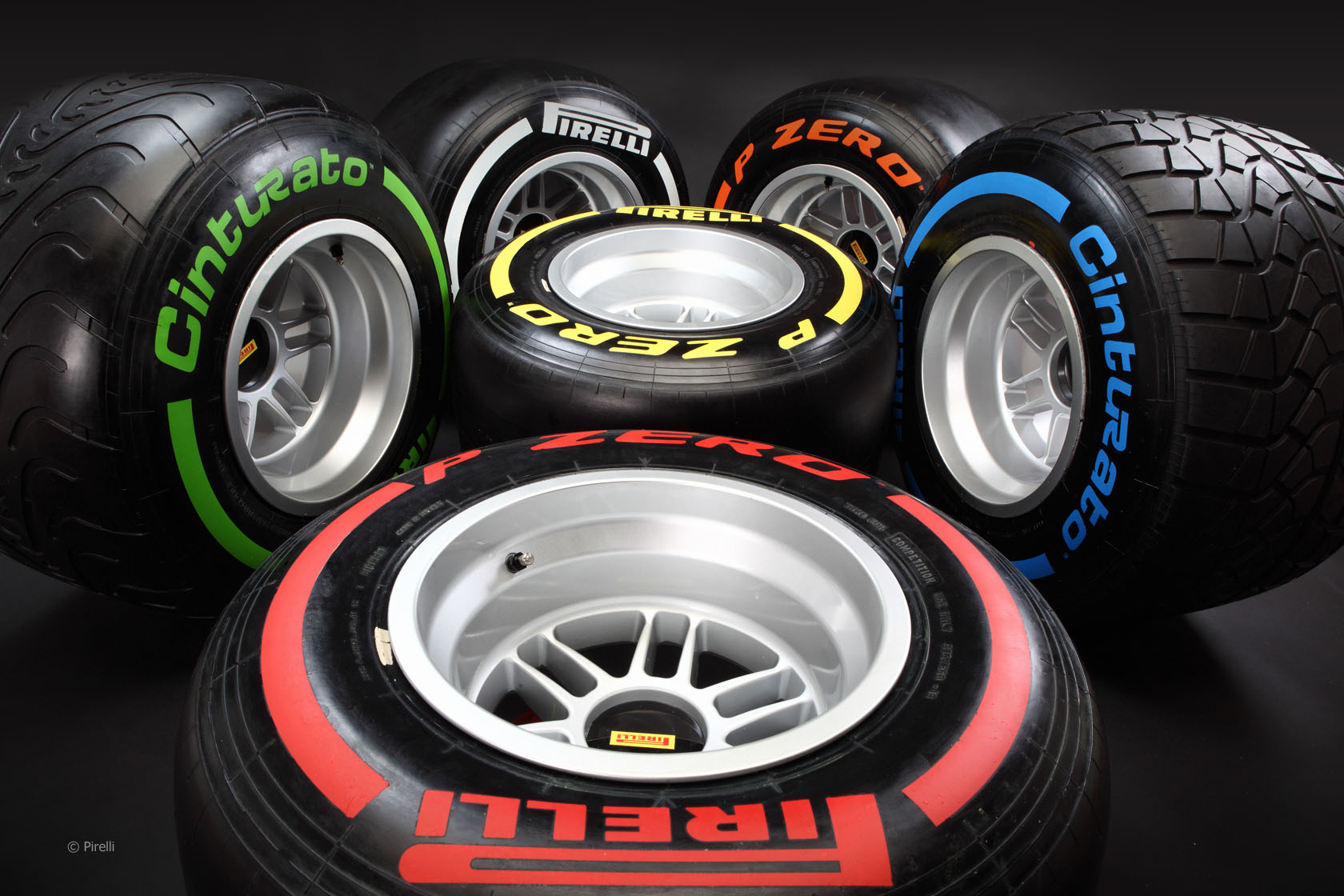
    Pirelli have announced that they will be supplying a revised specification F1 tyre for Friday’s Free Practice at the Canadian Grand Prix.

    The new revised P Zero White medium compound will only be available in Friday’s Practice Sessions to all the teams and not for the entire race weekend. The new specification tyres, according to Autosport, will feature a 2012-style kevlar belt rather than the steel belt used in the current race tyres. The new specification F1 tyres will make their race debut at the British Grand Prix.

    The priority for the modifications were to reduce tyre wear on the 2013 F1 tyres. The modifications will now focus more on the tyre construction in order to prevent the tread of the tyre coming off the structure. There will also be a slight modification to wear characteristics but they will not be as significant as originally intended.

    Each team will receive two sets to test the new rubber in Friday Practice.

    “Following feedback from the teams and drivers, the new specification of F1 tyre is then set to be introduced from the British Grand Prix at the end of June, and will remain in place until the end of the year,” said Pirelli.

  • 2013 Spanish Grand Prix – F1 Technical Round Up – Part 2

    2013 Spanish Grand Prix – F1 Technical Round Up – Part 2

    The second part of this f1 technical round up will focus on Sauber, Toro Rosso, Red Bull and Caterham.

    Sauber: Sauber’s biggest change was the new rear wing. For the first few races the team ran a wing with a dipped central section. This little dip in the middle of the main plane allows for more down force but does not add to drag. They’ve tested a more conventional version in the races preceding Barcelona and have reverted to the conventional design in Barcelona.

    Toro Rosso: Toro Rosso made a number of changes to the bodywork of their car. The biggest change is to the rear of the car where they’ve took a leaf from their big brother team, Red Bull, and they’ve added the cross under tunnel solution which Red Bull has had on their car since 2012. The way it works is that the air from the side of the side pod, moves around the outside of the side pod and down towards the floor, the air then  moves underneath the coanda exhaust towards the central part of the rear diffuser. They exhaust exits are also very similar to the Red Bull solution. The only difference for Toro Rosso would be the Ferrari engines. The engine would make a difference in tuning the coanda exhaust to work with this solution. Another big update was the detached front side pod. This helps attach the airflow over the top of the side pod along the bodywork which better aids the coanda exhaust.


    Caterham_NewBodywork_spainCaterham: Caterham brought an almost “B-Spec” car to the CT-03. They brought along a new side pod air flow conditioner. It is now a twin element airflow conditioner with the rear section curving around the top of the side pod and attaching to the top edge of the side pod. They’ve also added a vanity panel to the front which gets rid of the stepped nose. Another addition was the horizontal vane under the wing mirrors. This little vane creates a vortex that will attaches the airflow to the top of the side pods.


    Red Bull: There weren’t that many updates that were reported on the Red Bull car. One of the updates was to their rear wing. They’ve gone from curved rear wing end plate louvres to more horizontal louvres. This brings them in line with the other teams on the grid. They’ve also made some changes to the rear of the car. More specifically around the rear wheels/exhaust area. They’ve added and additional vane on the floor ahead of the rear wheels. These vanes “catch” the air flow off the tyres due to the tyres’ rotation (tyre squirt) and channel the air towards the rear of the car. This does help to minimise tyre squirt, but it’s not a cure.

    This coming week see’s the Formula 1 circus head to Monaco. We can expect to see lots of additional wings and vanes on the front wings of the cars all to get that extra bit of down force. We can also expect to see heavily raked rear wings, anything for extra down force. Mercedes will be quite strong here as they are quite strong with the slow speed corners and we cant discount Red Bull.


  • 2013 Spanish Grand Prix – F1 Technical Round Up – Part 1

    Formula 1’s return to Europe this past weekend signaled the first round of major updates for most teams. Since most teams are based in Europe it makes bringing more substantial updates to the cars much more easier. Not that teams don’t update their cars at the fly-away races, but returning to Europe just makes things a little more easier. Here is a Part 1 of our F1 technical round up of the Spanish Grand Prix.

     Some of the updates were major changes as in the case with McLaren and Toro Rosso. McLaren were somewhat relying on their Barcelona updates to bring them up to pace with Red Bull and Ferrari. Did it work for them? Not so much. Button struggled to make it into Q3 while Perez did slightly better and qualified P9. Their race performance, however, was much better and they finished P9 and P10.

    Lets take a look at some of the teams.

    Ferrari: They had little tweaks here and there with their body work. They brought a new engine cover which features a longer fin at the back and thats slightly lower than theFerrari_AirflowConditioner_Spains one they’re currently using. The rain in FP1 put a spanner in the works for them to test it. They will bring the same engine cover to Montreal. Together with the new engine cover they tested a new longer exhaust outlet with a more shallower angled exhaust. They also tried new sidepod airflow conditioners, similar to Red Bull’s “D” wing airflow conditioner, except the top section extends over the sidepod and attaches to the cockpit. They’ve somewhat kept the original design of the split airflow conditioner, only with this variation, the front section curves over the top of the sidepod and the rear section remains vertical. The purpose of the curved section is to bring the airflow around the outside of the sidepod, over the exhaust and eventually out the diffuser at the back. Both Ferrari drivers ran an additional horizontal cockpit fin ahead of the wing mirrors in addition to the two horizontal airflow conditioners behind the wing mirrors.


    Lotus: Lotus came to Catalunya with a new front and rear wing. There were two changes on the front wing. They had a curved vane on the outer part of the end plate. The main deflector vane in the front wing is not slotted. The rear wing features tiny separated vanes on the endplate.

    McLaren SidePods_Spain

    McLaren:McLaren brought along a new front wing. This new wing had one vertical slot on the endplate and a new upper flap.

    They still stuck to the old three element front wing, whereas other teams are using 5-6 element wings. The sidepods have been given a make over. The vertical air flow conditioners are now attached to the edge of the sidepod making it similar to the “D” wing of Red Bull. They have ditched the horizontal airflow conditioner above the sidepods and went with twin vortex generators, similar to what they ran in 2012


    MercCockPitWings

    Mercedes: Mercedes have dropped their three horizontal vortex generators on the side of the cockpit and have replaced it with one larger

    wing. The rest of the car remained largely unchanged with most of the changes unseen.


    Part 2 to follow soon.

  • Formula One Fuel Systems

    Renault F1 explains the intricacies of the formula one car's fuel systemThe 2013 Formula One season is the last season in which we’ll see the use of the V8 engine formula.

    Renault – the engine makers behind the Red Bull, Lotus, Williams and Caterham F1 teams discuss their RS27 engine’s intricate fuel system with in this very interesting article.

    It is a very interesting, in-depth look at how a Formula One car’s fuel system works, and is most definitely worth a read.

    Click here to read the article.


  • Formula One FRIC Suspension

    In 2009 Brawn GP had the double diffuser, in 2010 McLaren had the F-Duct, 2011 saw Red Bull pioneer and perfect exhaust blown diffusers. In 2012 we had Mercedes bring out the Double DRS. Every year in Formula One there is a new development that one team brings out and is touted as a game changer, which naturally teams complain about the legality of such a device, but eventually end up copying.

    The Lotus F1 team uses the FRIC suspension
    The Lotus F1 team uses the FRIC suspension.
    Photo: Lotus F1 team

    It is no different in 2013. The new development this season is the FRIC suspension. FRIC stands for Front and Rear Interlinked suspension, which is being used by Mercedes and Lotus as far as we can tell. The basic principle behind FRIC suspension is to essentially keep the car at a constant ride height under braking, acceleration and during cornering.

    This is not a new technology, it’s merely a redevelopment of the early active suspension that Williams ran on their FW14 and FW14B in the early 1990’s, which was subsequently banned for the 1994 season.

    The only difference between today’s FRIC system and Williams’ is that the FRIC system is totally passive and it is not controlled by any electronics. Which makes it perfectly legal and falls within the FIA technical regulations.

    The FRIC suspension controls the pitch and roll of the car. Pitch is when a car’s nose dives under braking, the weight and balance of the car gets transferred forward. During acceleration the weight and balance of the car shifts towards the rear, the nose of the car lifts up. Roll is when a car corners the weight and balance of the car gets transferred to the opposite direction of the turn. I.e. if you’re turning right, the weight and balance of the car gets transferred to the left and vice versa.

    The FRIC system passively controls the pitch and roll of the car by moving hydraulic fluid through a series of pipes, valves and cylinders to keep the car at a constant ride height.


  • Bahrain Grand Prix – Alonso’s DRS Dilemma

    Fernando Alonso suffered a very unusual DRS failure in Sunday’s Bahrain Grand Prix. The DRS flap got stuck in the open position andCapture way above the 50mm limit. The cause seemed to have been the stopper that sits in the middle part of the rear wing. This little device stops the wing from opening above the 50mm limit. In Ferrari’s case the stopper seemed to have failed, not once but twice. This resulted in Alonso coming into the pits twice in as many laps to have the flap reset. The question is, why didn’t the team tell him he should not use it? It was clearly broken and the chances that the team could just whack it back into position and for it to be working again were very slim.

    This was the second time this season where Ferrari have made strategic blunders. The first being the incident he had with Vettel in the Malaysian Grand Prix where he had his front wing damaged. Instead of bringing him in and changing the wing, Ferrari chose to keep him out. This ultimately caused his exit from the race.

    In Bahrain he was still able to drive with the rear wing open. This, in itself, is something to behold. It’s a small wonder he wasn’t sent spinning off the track. He did complain of a lack of grip but he had thought the tyres were going off.

    Nevertheless he managed to fight his way back up the field and finished in 8th place. Had he not come into the pits for the second time he could have finished much higher up the field. With hindsight it’s easy to say that, but such is the sport of Formula 1. The only thing predictable about Formula 1, is that it is unpredictable.


  • Vortex Generators in Formula One

    A vortex generator is a small aerodynamic surface which consists of a small vane that creates a vortex. They’re mostly used on aircraft to delay or disturb the separation of the flow of air from the boundary layer of a surface.

    In Formula One they’re used just above the sidepods of the f1 car to “re-attach” the airflow above the sidepods so that the air flows along the coke-bottle shape of the car. This better aids the use of the coanda exhaust system that Formula One teams are using to create more downforce at the rear of the car by utilising the exhaust gasses. This extra airflow, together with the coada exhaust, are what teams have used to create extra downforce at the rear of their cars since the exhaust blown diffusers were banned.

    F1 Teams have used different methods to re-attach this airflow over the sidepods. Ferrari are using a series of horizontal vanes that are alongside the driver on either side of the car just behind the wing mirrors.

    Mercedes F1 are running a combination of the horizontal vanes along the cockpit and a series of vortex generators above the sidepod.

    Horizontal vanes and vortex generators on the Mercedes F1 car. Photo: F1.com
    Horizontal vanes and vortex generators on the Mercedes F1 car. Photo: F1.com

    Mclaren and Lotus seem to be running a slightly different configuration. They have a horizontal flap that extends across the top of the sidepod.

    McLaren F1 horizontal flap across the top of the sidepod. Photo: F1.com
    McLaren F1 horizontal flap across the top of the sidepod. Photo: F1.com

    The rest of the teams, Red Bull, Torro Roso, Caterham and Force India are running vertical  vane vortex generators above the sidepods. The number of vanes varies between the teams, but we’re mostly seeing two to three vanes.

    Vertical vanes seen on the Caterham and Red Bull. Photo: F1.com
    Vertical vanes seen on the Caterham and Red Bull. Photo: F1.com

    Williams, Sauber and Marussia are yet to employ the use of vortex generators on their F1 cars. We’re only at the beginning of the season so it’s safe to say that somewhere along the line we will see them with it on their cars.

    The height of a vortex generator usually indicates the height of the boundary layer they want to disturb. Which is why some teams have tall vortex generators and others have short ones.


  • Formula One Pull Rod vs Push Rod Suspension

    Most formula one fans have heard these two terms thrown about but are not really clear on what the difference is between pull rod suspension and push rod suspension on a Formula One car. F1 Madness’ technical writer takes a closer look.

    At the beginning of the 2012 season we saw Ferrari run a front and back pull rod suspension. This was was in response to Red Bull Racing running a rear pull rod suspension and a front push rod suspension configuration for the 2012 season.

    For the 2013 season, Ferrari have opted to keep with the front push rod suspension and McLaren have also moved to a front pull rod setup.

    Pull rod suspension runs the pull rod from the outer end of the top wishbone down the bottom corner of the chassis.  For the rear suspension, the inner end of the pull rod set up is on the gearbox casing.  This mounts the inboard elements of the system low down on the gearbox, either inside entirely contained within the casing (which is more aerodynamic), or splits the elements inside and outside of the gearcase.

    newpullvspush
    Push-rod setup on the left and pull-rod setup on the right. Image: f1fanatic.co.uk

    The main benefit of the pull rod suspension is to place the almost horizontal pull rod in an ideal aerodynamic path to direct the airflow over the formula one car. This will offer a very small coefficient of drag benefit. With a pull rod setup, the top wishbone is under more stress, which will require a much stronger construction.

    Ferrari have stuck with the front pull rod design and carried it over to its 2013 car. They obviously see some benefit to it. Reverting to the conventional push rod setup would’ve been a major admission of failure from them. It looks as though it’s worked for them since they’ve stuck with it and were looking good in testing.